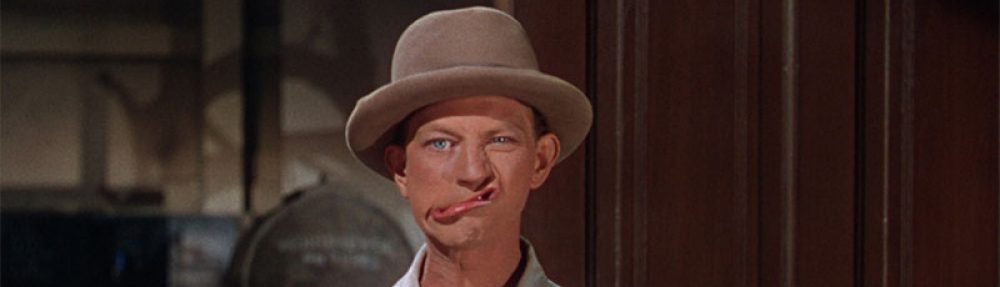
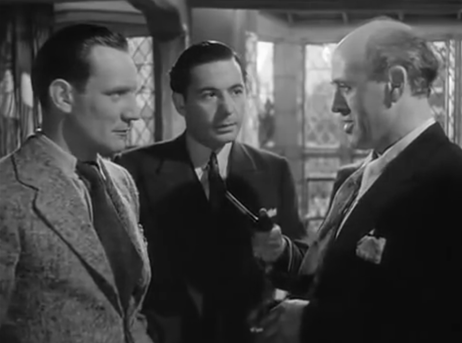
 Green for Danger gives murder mysteries a good name because it is drawn up excellently but also with a degree of charm and that should not be taken too lightly or maybe it should. But either way, there’s no doubt that director Sidney Gilliat’s tale based off of a novel by Christianna Brand is quality entertainment.
Early on the fitting backdrop of wartime Britain circa 1944 is developed from a historical moment that is uniquely dynamic in its own right. The German V1 “doodlebug” rockets are raining down overhead leaving the Isles in rubble. In such an environment nurses and doctors must work continually to care for numerous patients in need of medical assistance. The most pivotal patient for the sake of this story is the seemingly unextraordinary postman Mr. Huggins. Complications on the operating table do not bode well for him and he doesn’t make it. Though it hardly seems the pretense for murder.
Still, some are not so sure. Namely, the suspicious Sister Bates and yet another murder, this time more blatant, gathers the attention of Scotland Yard and so they send one of their men over — our trusty narrator — the one and only Inspector Cockerill (Alastair Sim).
He dictates the entire story with a rather amused detachment, conducting his job with a certain degree of care but he doesn’t mind a laugh or two. It’s truly a delightful performance from Sim, playing the jocular inspector like we’ve never seen before. His is a dryly wicked wit and he’s even prone to little bits of physical antics. One moment he watches with the giddy satisfaction of a schoolboy as the doctors duke it out, making no effort to stop the violence. But he also makes full use of a pair of voluminous eyes that can shift between sly glances and glaring accusations whenever the change is called for.
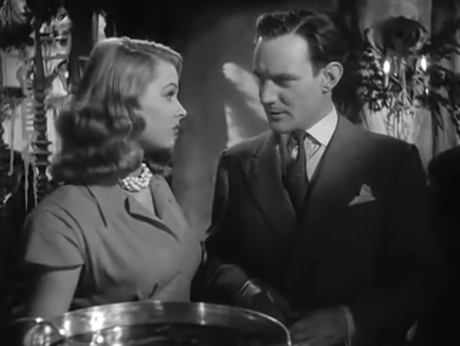 He comes in and steals the film but he does have some enjoyable castmates to work off of. Dr. Barnes (Trevor Howard) the anesthesiologist and the suave surgeon Mr. Eden (Leo Genn) are both in love with the same girl and understandably so. The attractive Nurse Freddi (Sally Gray) is a real prize but only one among a taut nursing staff including the fragile Nurse Sanson and the always lively Nurse Woods (Megs Jenkins). Before the Inspector arrives on the scene they are the true backbone of the storyline and it’s confirmed early on that the murderer comes from within their ranks. The age-old puzzle is left, to decipher who the culprit is and for what nefarious purpose.
It’s hardly a spoiler to say that the revelation of the murderer and the reason for the murders is hardly the highlight of the film. Because although we are dragged along by our curiosity as we have been trained to do with such mysteries, engaging films such as Green for Danger have more depth than the simple patterns of intrigue with a big reveal at the end. Because once you’ve seen one, you’ve seen them all, or at least you won’t be surprised the next time around. But this rendition has enough life in its characters, specifically Sim, to work beyond a basic murder mystery plot.
It strikes me that British backdrops often serve as the best environments for Whodunits and the quintessential nature of this reality has to do with certain sensibilities that the British people generally embody. They are civilized, proper, and not prone to the same fits of drama as other people. There’s also a reason that film-noir is an American genre and not really English. That darkness seeps out more readily and uninhibited.
But the Whodunit can still function because, despite their outward exteriors, that does not mean the characters within this film cannot still stoop to jealous action and even murder. Green for Danger is a thoroughly enjoyable exercise in such themes.
4/5 Stars
 Are you a mod or a rocker? ~ reporter
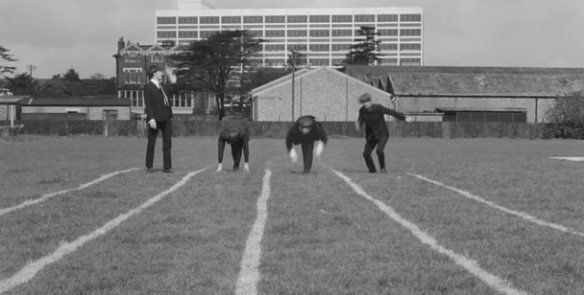
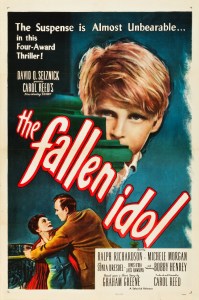 Fallen Idol is a fascinating film for how it develops inner turmoil. It’s earnestly interested in the point of view of a child and as such, it functions on multiple levels –that of both kids and adults. Philippe’s (Bobby Henrey) home is the embassy as his father is a French ambassador who is always away on the job. So Phil’s a little boy who is perpetually in the care of servants. Namely the authoritarian Mrs. Baines (Sonia Dresdel) and her good-natured husband (Ralph Richardson).
 “He will be your true Christian: ready to turn the other cheek, ready to be crucified rather than crucify” ~ Minister of The Interior
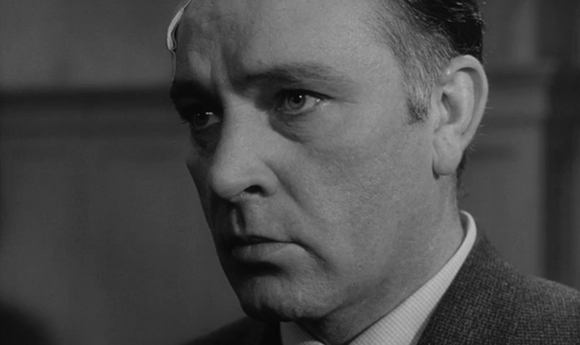 Adapted from the John le Carré novel, this is a black & white spy thriller that personifies cold war paranoia in ways that Bond never could. Richard Burton is an operative working in Berlin before being demoted to a librarian job. It looks like our narrative is heading in a direction hardly fit for a spy film. Its intentions are not so obvious at first, and it keeps its audience working for the rest of the film.
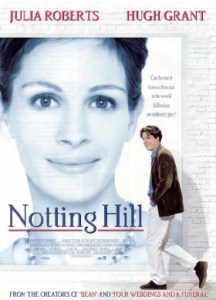 There is a scene in the film where a group of friends is sitting around the dinner table in the Notting Hill district of London, and they are having a friendly after dinner competition to decide whose life is the most hopeless. The winner gets the last delectable piece of fudge. One person sitting at the table is seemingly out of place. Actress Anna Scott (Julia Roberts). Her face is plastered on double-decker buses all down the squares. She made $ 15 million on her last film, circa 1999. You would think she’s got it made. But this woman takes her turn and shares about her own brokenness. She’s had surgeries to maintain her beauty. The tabloids rake her life over the coals, and when she gets old, she will only be remembered as the shell of someone who used to be famous.

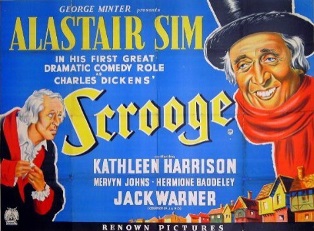 Oftentimes during the holidays, we are quick to label someone a “Scrooge,” almost jokingly because it’s a moniker that’s somehow lost a great deal of its magnitude with overuse and the passage of time. However, if we look at this film, so wonderfully anchored by Alastair Sim, and even Charles Dickens original work from which it is derivative, we would adopt a much wider definition of the word “Scrooge.”
 4 Star Films