Chariots of Fire (1981)

Chariots_of_Fire_beach“Now there are just two of us – young Aubrey Montague and myself – who can close our eyes and remember those few young men with hope in our hearts and wings on our heels.” ~ Lord Lindsay

I am hardly a world traveler but one of the places I fell in love with early on was the British Isles. London is a wonderful city with so many memorable landmarks from Big Ben to Buckingham Palace. Harry Potter to Sherlock Holmes. There are the Salisbury plains hosting the monolithic Stonehenge, and the Lake District which is undoubtedly some of the most beautiful country I have ever seen. No wonder Wordsworth and Blake were so enamored by it. However, St. Andrews Scotland has to be one of the most starkly beautiful places I have ever had the pleasure of visiting. It’s steeped in golf history due to the Old Course and despite being the home of a university, it is surrounded by a charmingly quaint town.

And of course, most pertinent to this discussion, its beaches became the perfect setting for the opening moments of the now iconic Chariots of Fire. Really it is so much more than its stellar theme by Vangelis because these sequences bookend a truly remarkable story. We enter the narrative in 1978 where two old men eulogize about the old days and their good friend Harold Abrahams who has recently passed.

Cross_and_HaversBack in the 1920s, a brash young Abrahams (Ben Cross) is about to enter university at Cambridge intent on becoming the greatest runner in the world, and taking on all the naysayers and discrimination head-on. He’s a Jew and faces the antisemitism thrown his way with defiance and a bit of arrogance. He’s a proud young man who loves to run, but more than that he loves to win. His best friend becomes Aubrey, a good-natured chap, who willingly lends a listening ear to all of Harold’s discontent. Soon enough Abraham’s makes a name for himself by breaking a longstanding record of 700 years, at the same time gaining a friend in the sprightly Lord Lindsay. Together the trio hopes to realize their dreams of running for their country in the Paris games of 1924. They are the generation after the Great War and with them rise the hopes and dreams of all those who came before them.

Charleson_as_LiddellSimultaneously we are introduced to Eric Liddell (Ian Charleston) a man from a very different walk of life. He’s a Scot through and through, although he grew up in China, the son of devout Christian missionaries. Everything in his life is for the glory of God, and he is a gifted runner, but in his eyes, it’s simply a gift from God (I believe God made me for a purpose, but he also made me fast. And when I run I feel His pleasure). His sister is worried about his preoccupation with this seemingly frivolous pastime, but Eric sees a chance at the Olympics as a bigger platform – a platform to use his God-given talent to glorify his maker while living out his faith. Abrahams is a disciplined competitor and he goes so far as to bring on respected coach Sam Mussabini (Ian Holm) to help his chances. Liddell is a pure thoroughbred with life pulsing through his veins, and of course, they must face off. It’s inevitable.

But this is only the beginning as all these men we have built a connection with travel across the sea for the Olympic Games grappling with their own anxieties and consciences. For Abrahams, it’s the prospect of failure and success. Failure will burn because his whole existence has always been about running — about winning. He has only a few seconds to justify his very existence. However, the fear of winning is almost greater, because at 24 years of age, where else is he supposed to go after winning a gold medal? It scares the life out of him. Liddell’s tribulation is of a different nature as he must stand true to his beliefs even if it seems to be sabotaging his own success. And of course, Aubrey and Lord Lindsay have their own successes and failures that run the spectrum. Perhaps most importantly these men prove their worth not only to their American opponents but the entire world. They can return home with their heads held high — champions of a feel-good tale to be sure.

Yes, this is a story about two strikingly different individuals, but Chariots of Fire becomes so engrossing due to all its characters. Aubrey resonates with me due to his general contentedness. Lindsay has an air of playful charm that is refreshing. Harold embodies my own hopes, fears, and anxieties. Eric reflects every person’s struggles with spirituality and personal conviction. In essence, the narrative goes back to the glory days to bring light to the universal and continual rise and fall of man. We’re far from perfect, but in spite of all our failures, there is still space for redemption.

The refrains of the theme music paired with William Blake’s majestic “Jerusalem” get me every time. I love being steeped in this atmospheric periodness and my heart yearns to be back in England so I can run on those very same beaches with wreckless abandon. But even if I don’t get there soon, I will be content in running life’s race to the best of my abilities wherever I am. That’s all that any of us can do.

“I have no formula for winning the race. Everyone runs in her own way, or his own way. And where does the power come from, to see the race to its end? From within. Jesus said, “Behold, the Kingdom of God is within you. If with all your hearts, you truly seek me, you shall ever surely find me.” If you commit yourself to the love of Christ, then that is how you run a straight race.” – Eric Liddell

4.5/5 Stars

Starter for 10 (2006)

215px-Starter_for_tenOftentimes I get my greatest excitement not simply from the masterpieces I get to discover, but also hidden gems that get unearthed along the way. This one just happens to have some of Britain’s best talent. Starter for 10 is a coming-of-age film which immediately sets off a number of ideas in one’s head, and it has most of what you expect in that department. However, it also has an astounding plethora of young British talent. The list of names is as follows: James McAvoy, Alice Eve, Rebecca Hall, Benedict Cumberbatch, Dominic Cooper, and even James Corden.

The heart of this film is Brian Jackson a college-aged kid, who grows up wanting to be clever and he has a passion for trivia because he always wants to learn more and he spent some formative moments in front of the telly with his now deceased dad. Now in 1985, he gets ready to leave his mother (Catherine Tate) and head off for new experiences at Bristol University. But she’s not the only one he leaves behind. His friends Tone and Spencer are not as ambitious as him, but he promises not to forget them.

Still, when he gets to college, he’s excited for the new challenges ahead and although his first acquaintances are rather odd, he does meet the winsome girl Rebecca Epstein (Rebecca Hall), who has an affinity for political protests. Soon he’s quick to join the University Challenge quiz team anchored by a very stuffy post-grad (Benedict Cumberbatch) but that’s not all. He also gets his first encounter with the posh girl with a gorgeous figure (Alice Eve). He’s immediately smitten with this new quiz kid and for good reason.

But what follows is all the drama that one would expect. The pitter-patter of his beating fragile heart as he dreams of days with the beautiful Alice. It even manifests itself in a dinner date and a rather awkward New Years with her parents. But then there’s Rebecca too. She’s brilliant as well and he has to figure out what he’s doing. Mixing up names on New Year’s Eve is not the best plan, but of course, that’s what happens.

His best friend Spencer (Dominic Cooper) comes to visit and that fosters more turmoil than Bri would like with the old world intersecting with the new. He’s confused and apathetic about the University Challenge by now. Everything goes wrong before the big day of the final competition and to top it all off Brian messes things up in a big way that leaves him dejected. He cannot even face his team now. Early on Brian latched onto the idea that knowledge is the key to being happy, not a job that you might hate. Although that can be true, it seems he slowly realizes that there’s even more to happiness than knowledge. If that’s all you have, you’re probably not going to be all that content. You see, he’s certainly clever, but that doesn’t mean he doesn’t do some stupid things and make some big mistakes. Don’t we all, and otherwise, this could not be a coming-of-age story full of discovery, confusion, and love.

It’s a bad metaphor, I know, but do you want the Marilyn Monroe blond bombshell or the sweet Audrey Hepburn brunette? Everyone has their proclivity, but Brian seems to make the right choice because he doesn’t go with the outward appearance, he goes with the one with a depth of character and the ability to forgive. That’s big.

There’s a formula being followed certainly, but it’s easy to look past that and enjoy Starters for 10 for its heartfelt performances and simply the good fun it brings to the table. The names attached to the picture were slowly on the rise and it’s impressive to see how far their careers have taken them.

3.5/5 Stars

Review: Goldfinger (1964)

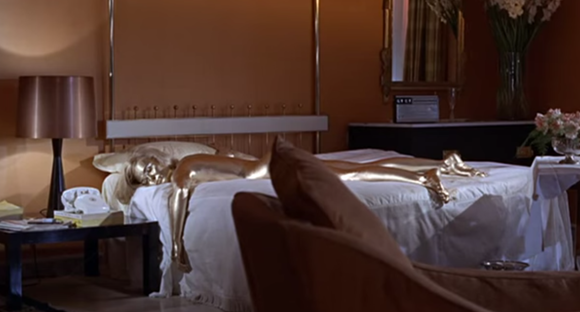
goldfingerThe film opens with a wonderfully unnecessary opening gambit, which allows us to reenter the world of dashing MI6 super spy James Bond (Sean Connery). His electrifying escapade culminates in the memorable quip, “Shocking, positively shocking” and just like that we jump headlong into his next adventure, Goldfinger!

Shirley Bassey’s striking rendition of the title tune reverberates over the metallic credits setting the tone for one of the great Bond films. It starts with the music and never wavers as we pick up with MI6 on a nice holiday in Miami Beach. He has his first run-in with international gold dealer and suspected smuggler Auric Goldfinger (Gert Frode). Bond has a little fun with the cheater at the expense of a young woman while also having his first encounter with the mysterious Odd Job.

Goldfinger leads Bond all over the place from Switzerland then back to the United States. MI6 discovers how Goldfinger does it while also crossing paths with Jill Masterson’s sister Tillie, who has a personal vendetta to make Goldfinger pay. It doesn’t go so well.

Bond is imprisoned but not before proving himself to be a nuisance. He is nearly mowed down by an industrial laser, but Goldfinger thinks better of it and ships him off to his base on a Kentucky farm. Bond gets his first tete-a-tete with pilot extraordinaire Pussy Galore, and needless to say, he is intrigued. Meanwhile, his American ally Felix Leiter attempts to track his whereabouts and keep tabs on his progress.

Imprisoned yet again, he, of course, escapes just long enough to witness the plans of Goldfinger to use a deadly Delta 9 nerve gas to incapacitate the defenses at For Knox so he can swipe all the gold from the stronghold.

He first gets rid of some lowly American mobsters and captures Bond again. Operation Grand Slam begins as Pussy leads her group of pilots over Fort Knox deploying the gas over the premises. It takes effect instantly and soon Goldfinger rolls in with his forces and Bond in toe. It’s like taking candy from a baby and Bond can do very little as he is handcuffed to the bomb which is to set off in the vault. A rather sticky situation indeed.

But alas it was all a ploy. The gas did not actually work and all the troops suddenly get up and convene on Fort Knox with Goldfinger and his forces still inside. The game seems to be up, but not before another shocking moment between Bond and his old nemesis Odd Job.

The rascally Goldfinger gets away but Bond at least ends up with Ms. Galore. He used all his power of persuasion to acquire her help. What happened to Goldfinger, you ask? He comes back to enact his revenge, of course, and it nearly works. Instead Bond and Pussy get in some passionate necking while the search parties are out looking for them.

It is hard to top this early Bond installment for a plethora of reasons. It has the best theme song. It has arguably the best villain (or villains if you include Odd Job). Perhaps the best Bond in Sean Connery. The best decked-out car in the Ashton Martin DB5. And a couple memorable Bond girls. When it is all said and done, it adds up to an enjoyable spy thriller stuffed with intrigue, wit, and a crumbling of early 1960s sensibility. Above all it’s a “positively shocking”  piece of entertainment sure to give you a volt.

4.5/5 Stars

Review: From Russia With Love (1963)

fromrussia1To Love it, To Love it Not… Sean Connery is back as Bond and so there is plenty to enjoy with From Russia with Love (1963). Out of personal preference, my top three favorite films in the franchise would have to include Goldfinger (1964), Casino Royale (2006) and this beauty, all packed with quintessential Bond.

Sean Connery is arguably the best Bond. Some of that resulting from being the original and also simply because he was made for the role with dashing good looks, an impressive physique, and one smashing accent. Next, comes arguably one of the best so-called “Bond” girls in Tatiana Romanova (Daniela Bianchi) who plays the beautiful Russian opposite the handsome Brit. They’re a match made in heaven beginning with steamy encounters, followed by violent escapades, and topped off with playful romance. There’s not more you would want, except action and villains and gadgets, which we also get along with some ubiquitous Cold War sentiment.

In this installment, the Soviets are pitted against the CIA and MI6 with the nefarious SPECTRE manipulating both sides. They have received the aid of one of the Soviet’s highest officials in Rosa Klebb, who puts their plan into action. She, first and foremost, recruits deadly assassin “Red” Grant (Robert Shaw), followed by the pawn Tatiana Romanova, who works at the Soviet consulate in Istanbul. She is to be the siren to lure Bond into a trap with the tantalizing promise of a Lektor device (which MI6 desperately wants).

Thus, as any good spy would, Bond goes after this presumed admirer and first meets with station head Ali Kerim Bey. One man is dead and the Soviets suspect the Westerners. Bey’s office is bombed and the Soviets are the obvious culprit. However, the whole time it’s Grant working incognito.

Bond is taken by Bey to a gypsy camp for refugee and after an evening capped by ambush, he has his first meeting with none other than the beautiful Romanova. The new accomplices ultimately steal the Lektor without a hitch and board the train as “newlyweds” with Bey. However, the ever lurking Grant is waiting for Bond and his companions. Without getting into all the gory details, it sets the stage for a great fighting sequence.

007 gets away with a recently drugged Romanova and puts a helicopter as well as a fleet of motor boats out of commission single-handedly. Number 1 of SPECTRE is very displeased, and Klebb has one last time to make things right. She has a wicked pair of kicks. That’s over soon enough.

What’s left is a romantic gondola ride with our two lovebirds and the notes of Matt Monro playing over the kisses. Talk about a first date, this one was a great one, even for all us third-wheelers.

Goldfinger maybe the apex of Bond viewing, but From Russia with Love is a close contender for that title. Its action does not look half bad even after 50 years, and Sean Connery is quite the hero. What more is there to say about Daniela Bianchi except God was very good to her. Very good indeed. It’s a great adventure with everything you would want and expect in a spy thriller. It’s from Russia with love.

4.5/5 Stars

Alfie (1966)

alfie“I’ve been doing things my whole life I’m not suppose to” ~ Alfie

Alfie is a real character, with his cockney accent and personal insight about the world he resides in and the people he crosses paths with. Before Ferris Bueller, there was originally Alfie constantly breaking the fourth wall. Although that’s where any comparison ends because Ferris may be a schemer but he is good at heart. Safe to say Alfie is no Ferris Bueller. Not by a long shot. He is a self-indulgent, hedonistic, womanizer, constantly playing the field without looking for anything real.

True he has a kid, a few affairs and casual trysts, but he never sees “Birds” as anything more than objects. Every girl is an “It” not a “Her.” They fulfill his desires and their main purpose is to be used for his pleasure and his needs. He is a man who lives for himself and no one else. He is a real cynic and a deplorable sort of person at that.

Initially I had nothing complimentary to say about the character because the reality is there really was nothing good to say about him. But in a single moment Alfie proved that he might be selfish but not heartless. He finally attempts to “settle down” only for it to backfire on him. That’s the way it works and so Alfie is about right back where he started. I would like to think his heart is a little softer though.

Michael Caine is likable enough to make me not completely hate Alfie and that is to his credit because it was difficult not to. His various conquests and companions were played by, among others, Julia Foster, Jane Asher and Shelley Winters. The film’s jazzy score may not be rock and roll but it seems to personify Swinging London as much as Double-Deckers and Tower Bridge.

3.5/5 Stars

To Sir, With Love (1967)

To-sir-with-loveStarring Sidney Poitier and set in London, the plot follows a former architect from British Guiana who becomes a teacher at a high school in a tough area. Early on Mark Thackeray faces a rebellious group of teenagers who dislike education and challenge authority whenever possible. He resolves to keep his temper and yet one day their actions are too vulgar for him and he loses it.

After that he develops a new strategy to treat them as adults and he teaches them practical skills they will need in the real world. He changes how they act and takes them on field trips so that even the most combative one Denham is won over. However, after an incident during gym class which he must diffuse, Thackeray loses the respect of much of the class. His mood changes slightly after receiving another job offer.

Later on in the gym class he is supervising he boxes with Denham. In the ensuing moments he wins Denham and then everyone else over once more. With the year finally over, Thackeray is invited to the year end dance where he is given a gift and serenaded with song (To Sir, With Love by Lulu)! Too choked up to speak he retreats to his office. After a chance encounter he resolves to continue teaching and rips up the other offer.

Besides a good theme in “To Sir, With Love,” Sidney Potier gives a great performance that makes this film both powerful and touching. If you want a small look into Swinging London this is one to watch. Although I am tempted to find fault in this film I find myself focusing on the positives and I will leave it at that.

4/5 Stars

Blow-Up (1966)

40940-blowup_posterDepicting the time and place of Swinging London in the 1960s, this film is directed by Michelangelo Antonioni and it stars Peter Hemmings as the protagonist. He is a fashion photographer in a hopping city. He spends his day working with models with countless photo shoot after photo shoot. He is skilled at his job and as such he is temperamental and at times irritated by his fashionable but arduous occupation.

After one such string of photo shoots he goes off on an excursion to an antique shop and a park where two lovers have met. He sticks around and snaps pictures of them before he is chased off by the woman. The next day the attractive woman comes to him asking for the negatives and at first he refuses. After she has left he develops the negatives and blows them up only to find something very intriguing. He goes back to the park at night and finds something very perilous indeed. He returns to his flat and then he spots the woman at a club only to lose her during a concert.

Following the lively evening he returns once more to the park, this time to find something even more unusual. Despite all his efforts everything is still a complete mystery that he cannot hope to solve or understand. There seemed to be some superfluous scenes in this film but it was interesting to watch it unfold. The photographer has an intriguing lifestyle but he is not a very likable character. Following the blow up of the image everything begins to change and we begin to sympathize with him. When the film ends and the mystery is still unresolved, it forces him as well as the audience to simply accept it and move forward. This is an anti-mystery if there ever was one.

4.5/5 Stars

Monty Python and the Holy Grail (1975)

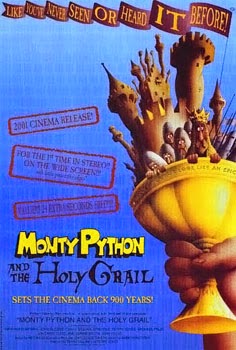
830e6-monty_python_and_the_holy_grail_2001_release_movie_posterThe beauty of The Holy Grail is that it is absurd in every sense, and it is keenly self-aware the entire time. The comic troupe Monty Python found fame from its British T.V. show Monty Python and the Flying Circus. Now Graham Chapman, Eric Idle, Terry Gilliam, John Cleese, Terry Jones, and Michael Palin transferred their brand of humor to the big screen. What better canvas for their brand of humor than Medieval Europe? It’s got Castles, Trojan Rabbits, French Soldiers, Swords, Knights who say Ni,  Headbanging monks, a killer rabbit and so on.

They offer us the weirdest, oddest, and downright hilarious revisionist parody of King Arthur’s legend.  I use the term plot loosely because The Holy Grail follows no strict set of parameters or plot points. The quest for the Grail by Arthur and his right-hand man Patsy is purely an excuse for gag upon gag upon gag. Even while he recruits his Round Table, the fun is not in the completion of the quest, but the detours the plot takes for the sake of a laugh. And it goes all over the place. Tangents abound and the story jumps back and forth, oftentimes for no good reason. The film has the oddest of openings (involving llamas) and it ends just us weirdly as it began with the arrival of the police. Don’t question it. Just enjoy.

When is the optimal time to watch The Holy Grail you ask? The real answer is anytime, but it reaches its maximum potential when you watch with others late at night in a giddy delirium. Let the comic absurdity of it all carry you off into the Monty Python world. The first time watching it you might be a little befuddled, but the beauty is that it gets better nearly every time. Anachronisms become your friend, quotability skyrockets, and there is a kind of joy that surfaces from each vignette of comedic madness.

It works so well because the ensemble is so wacky and fun with no one individual completely outshining the others. They are never relegated to a certain role but instead are given free reign to show off their skills in many zany incarnations. Thus, the actor playing a certain character becomes less important and  the comedy that is found in this or that role takes precedence.

I never have been too keen about living in the Middle Ages, and after watching The Holy Grail I… definitely would not want to live in the Middle Ages. It’s certainly good for a few laughs, though. Ni! Ni! Ni!

4.5/5 Stars


A Man For All Seasons (1966)

a4d49-a_man_for_all_seasonsSir Thomas More had the misfortune of getting in the way of perhaps one of the most notorious kings in history, and it proved costly. It is the early 1500s in England, and the Reformation has shaken the world but Henry VIII (Robert Shaw) has his own plans for the church in his country. He is bent on getting his marriage annulled by the pop,e because young Anne Boleyn will be much more likely to give a healthy heir to the throne.

A Man For All Seasons focuses on the position of More who at the time was Lord Chancellor of England. First, in talking with Cardinal Wolsey, More resolves not to sign the letter to the pope on the king’s behalf, because it goes against his conscience. Later, in his dealings with Thomas Cromwell, More resigns rather than to sign an oath making Henry VIII the supreme leader of the church in England.

Except there is more to it than that. More certainly was not a dissident or a rebellious political figure. Far from it. At least in the film, he is portrayed by Paul Scofield as a constantly even-keeled and gracious man in all circumstances. When a young man named Rich (John Hurt) sold More out for a high title, in a Christ-like response More has only pity for the fellow. Selling his soul for the world is worse enough, but Rich did it for Wales.

Not even the pleading of his newly-wedded daughter (Susannah York), or his strong-willed wife (Wendy Hiller) can change More’s conviction as he wastes away in the Tower of London. Sir Thomas went calmly to his death confident that his faith in his Lord would give him eternal peace. He died there for a seemingly trivial reason at the hands of men who used to be his friends. But he died with his conscience intact.

As I acknowledged, Paul Scofield is such a serene force during the storm of this film. The portly Orson Welles and Leo McKern seem to fit their roles well, and Robert Shaw has enough bluster to pull off Henry VIII. A young John Hurt turns in a fine performance as the Judas of the film and Nigel Davenport is commendable as More’s exasperated friend the Duke.

Adapted from a stage play, here is another highly acclaimed film from director Fred Zinnemann. Perhaps it is the period drama, but this film strikes me as very English and it did very well for itself. I suppose because it’s a tale that is universal and audiences love to identify with men such as Sir Thomas More. Zinnemann was always superb at capturing the inner struggles that humanity is often forced to confront, and he did it once again here.

4/5 Stars

Repulsion (1965)

f483d-repulsion
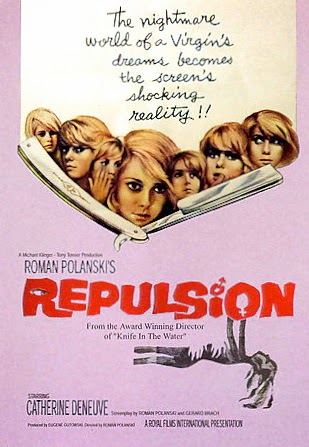
Directed by Roman Polanski and starring Catherine Deneuve, this British Psychological thriller is in the same vain as Psycho. Carol is a manicurist who is often absent-minded at work and she returns home to an apartment that she shares with her older sister. She passively resists the advances of an infatuated young man and at home she must live through her sister and a boyfriend in the next room. 

*May Contain Spoilers
Then, they leave and an attached Carol cannot bear her sister to leave her alone. The next days and weeks she sinks into a unstable state and slowly loses her sanity while losing track of reality at the same time. She is sent home from work, becomes even more preoccupied, and then begins hallucinating back in her home. When Colin comes to speak with her she is still unresponsive and she unexpectedly bludgeons him to death. Then, later on the annoyed landlord comes by for his money, and then makes advances on her, only to be killed by a frightened Carol. Helen and her boyfriend return to find the apartment in disarray and Carol out of sorts and concerned neighbors come to spectate. The camera closes in on a family photo and a young Carol’s perturbing face. 

This low budget documentary grade black and white film still packs a powerful punch and the best word to describe it is probably disconcerting. Unfortunately, I had never heard of the cinematographer Gilbert Taylor, but he had several wonderful films in his catalog including Dr. Strangelove, A Hard Day’s Night, Star Wars, and of course Repulsion.
 
4/5 Stars