
Mystery Train (1989)

I hold an immediate affinity for the images at the core of Mystery Train: A Japanese couple (Youki Kudo and Masatoshi Nagase) riding a train. This is the ’80s so they’ve got a walkman with an audiocassette tape, and it’s blaring Elvis! It becomes apparent they are making a pilgrimage to Graceland so famously immortalized by Paul Simon. The song “Mystery Train” becomes an apropos and uncanny way to enter the story while paying homage to the King.

Jim Jarmusch always strikes me as such an open-minded and curious filmmaker. Modern society speaks in terms of diversity and inclusion, but the beauty of watching a Jarmusch picture, it’s the fact he’s not looking for these things in order to meet some quota. He seems generally interested by the stories and perspectives a whole host of characters can provide him, and his films benefit greatly from this enduring proclivity.

Regardless of where the funding came from, who else would consider making a film about two Japanese youth in search of Elvis Presley in the 1980s? They spend the first several minutes speaking a language that the primary audience probably does not understand. They likewise are bewildered by a upbeat yet motormouthed docent at Sun Records. Still, somehow shared passions for Carl Perkins, Jerry Lee Lewis, Roy Orbison et al., draw them together in inextricable ways.

There’s something perfectly fated about the whole thing with Screaming Jay Hawkins as a rather flamboyant hotel clerk aided by a youthful bellhop (Cinque Lee). I don’t know how to describe it but Hawkins has a command or a sway over the picture rather like Wolfman Jack in American Graffiti. His presence is felt and becomes so indelible in accentuating an aura. He comes to represent a certain era and a place in human form.

Jarmusch’s characters of choice often feel like sojourners, strangers in a strange land and Memphis is such a place. It is a film that features degradation — cracked pavements, garish neon lights, and portions of the world that are not perfectly manicured. What a concept. It’s almost like Jarmusch is giving us the real world albeit composed through his own cinematic lens. It’s no coincidence it has this kind of baked-in glow of Paris, Texas another film of geographical Americana captured so exquisitely by Robby Muller

It’s only a personal observation but my level enjoyment slightly decreased with each descending story. As someone who journeyed in Japan and went to one of the greatest concerts of my life in Yokohama, I feel this kind of kinship with these Japanese youths in their pilgrimage to Elvis and Carl Perkins. Also, on another level, this is a point of view we just don’t often see in movies of the 1980s or even today. Jarmusch is not using them as some kind of stereotypical punchline. He’s genuinely interested in their story and allowing it to play out in front of us.

Then, there’s Nicoletta Braschi in part two. She’s told a ghost story by a dubious stranger and gives him a tip to be left alone. She too seeks asylum for the night at the same hotel and gains a chatty roommate (Elizabeth Bracco) who is linked to our final vignette.

This last interlude with Steve Buscemi feels like it exists in the time capsule moment of a certain era where Tarrantino, the Coens, and others were making these stylized, often grotesque comedies. Elvis (Joe Strummer) gained his nickname inexplicably, but he’s also started to become unhinged because his girlfriend went up and left him. The cocktail of booze and firearms make his buddies Charlie (Buscemi) and Will Robinson (Rick Aviles) uneasy. Although it feels more like an absurd episode of The Twilight Zone than Lost in Space.

Regardless of my own preferences, Jarmusch still gives his world a sense of purposefulness. Again, it’s this serendipitous quality reminiscent of Jacques Demy’s fated films where lives cross paths and intersect in deeply poignant ways.

There’s something somehow elegant about the structure. It’s certainly premeditated and Jarmusch purportedly was inspired by classical literary styles in constructing his triptych, but it’s also a genuine pleasure to watch it unfurl.

The movie revolves on the axis of a few shared moments and places: A hotel, a radio DJ (Tom Waits) playing “Blue Moon,” and a gunshot. But it’s not like they’re all building to some kind of collective crescendo; it’s more so just a passing indication of how lives, whether they mean to be or not, are often interrelated.

Characters orbit each other and interact in these preordained ways that reflect the mind of the maker, in this case, Jarmusch. There’s something oddly compelling and comic about it, but there’s simultaneously a sense of comfort. We have order and a kind of narrative symmetry leading back out from whence we came.

Jarmusch is calling on the poetry of the ages and so in a movie that seems to have a free and laissez-faire attitude, there’s still a very clear order behind it, three distinct threads end-to-end and yet still interwoven into a tapestry that we can appreciate. Mystery Train represents the best in cinematic storytelling — with purposeful composition and aesthetics — but also a sense of aura and inscrutability.

It’s funny and yet when it’s over there’s also satisfaction and a hint of wistfulness. I wish there were more of its ilk today. The movie that’s come the closest is Paterson — another modern jewel from Jim Jarmusch. I see that film in a new light as a much older, wiser, and more forthcoming Masatoshi Nagase sits down on a bench with Adam Driver.

Again, it is a story about the human journey, how we are all travelers in some sense, and what a beautiful thing it is to relish the road because it can lead us to so many beguiling places if we take the time.

4/5 Stars

Beijing Watermelon (1989)

Nobuhiko Obayashi is known to a pocket of western moviegoers for his crazy, unhinged haunted house flick Hausu (1977), but as I’ve gotten more familiar with at least some of his filmography, I’ve come to appreciate his more grounded works.

Using this phrase has the danger of giving the wrong impression about him. This doesn’t imply boring or anything of the sort. Still, some of his later works are told with such humanity through relationships, humor, and often a wistful nostalgia that comes on the tails of youthful optimism.

Beijing Watermelon hardly makes a blip on the radar. I consider myself fairly well-versed in film (albeit with many noticeable blind spots), but I had never heard of it.

Still, this film spoke to me through its simple rhythms. It’s easy enough to introduce the premise and still fail to totally articulate what makes this movie such a meaningful experience for the right person. Because it a mundane slice of life tale following a grocery store owner who comes to form a bond with a contingent of Chinese students studying and living in Japan.

It begins inauspiciously enough when a poor Chinese student tries to barter with him. He’s a bit offended by it — his prices are already reasonable — but events cause him to take an interest in the young man’s life and his well-being. He meets Li and a host of local students who are many miles away from home. It feels inexplicable at first, but as time progresses, they form an unalienable connection. I’m not sure if other’s find this cross-cultural relationship to be unbelievable or at the very least somewhat whimsical.

As someone who has lived abroad in Japan of all places and relied on other people’s good graces, there was something so resonant about this scenario. It spoke to me on a profound level, and it was not in spite of the mundane nature but rather because of it.

The comedian “Bengal” who stars as the greengrocer Haruzo Horikoshi, somehow reminds me of the Tora-san character. It’s almost like he’s an extension of the Japanese comic prototype. He’s at times a buffoon and outlandish, and yet he’s imbued with so much heart and by extension pathos. If we stretch the Tora-San metaphor, he feels a bit like the Japanese everyman who brings back nostalgic reminisces of a different era. There’s something hilarious and tragic and warm about him all at the same time.

I must admit that there’s a point where it feels like the Chinese students are taking advantage of Mr. Haruzo. Perhaps it’s just a cultural difference and a way of showing good-humor and affection, but as an outside observer and someone who has a modest appreciation for Japanese courtesy I felt bad for the man.

At the same time, he continues to grow more and more accustomed to providing them discount goods, maintaining letter correspondence with Li when he returns home, and then picking up a new arrival at the airport named Zhang.

As a side note, there are two airport sequences that feel so authentic. The callow student looks downs and realizes his bags are missing! Of course, they are nearby where a thoughtful lady has set them aside out of the way. Also, a local Japanese man brags about his English prowess. Except the moment an English-speaking tourist asks for directions, he has no help to offer and sheepishly walks away.

By this point, we must ask the question: why does Mr. Haruzo feel compelled to do all this? There’s something in his constitution that makes him different, causing him to go against the tide of Japanese convention. Because what he does transcends polite niceties and keeping up appearances. Dare I say, it’s true sacrifice.

Could it be he’s slowly falling in love with the earnest Pingping? A lesser film would have played this up for the sake of drama. But while the affection is evident, it never goes further than that.

Meanwhile, his local neighbors joke that he’s caught the “Chinese disease.” If that’s so I’d probably wish I had it too. Of course, eventually it seems to derail his life. His business isn’t profitable anymore, he’s less present with his family. His long-suffering wife (Masako Motai) is trying to pick up the slack because he feels mostly absent. His kids feel ashamed by how he’s acting. Even his shaggy-haired employee vows to go to a rival supermarket where he won’t be a laughingstock.

It feels like Mr. Haruzo’s ruined — entirely thrown away his life — and soon the tax board comes to impound his belongings while he’s also detained for a hilarious public disturbance while requesting a loan. The heightened blood pressure leads to an extended stay at the hospital. Surely this cannot be the fruit of his troubles? He’s in such a dejected space with his family unsure what to make of him.

It’s a bit on the nose, but I think of that immortal line that “no man is a failure who has friends” and of course, the friends Mr. Haruzo has in his life come to his aid when he needs it most. It’s a beautiful sentiment and something I’m sure many of us recognize if we’ve ever been enmeshed in a close-knit community.

The watermelon becomes one of the substantive cultural metaphors of the film, and as someone who lived in Japan as a westerner and has spent many years working in international spaces, this film speaks to me on a deep level.

Surely you don’t need this in order to appreciate the film, but as I watch this Japanese man build cultural bridges and become a kind of local institution with a spread in the paper and then getting treated like a king by all his grateful beneficiaries, I was fundamentally moved.

I think of the people in my life overseas who watched over me at my most vulnerable or lifelong friends my parents and siblings have made when they were abroad. If we let it, film can be one of the great universal unifiers, a language unto itself that connects us and transcends cultural origins or international borders. That’s what it’s often been for me and Beijing Watermelon is such a winsome portrait of what I aspire to in my life.

I’m not sure if anyone else has made this comparison, but Haruzo Horiko feels a bit like a Japanese Mr. Chips because with his name comes a lasting legacy and impact. It turns out to be an extraordinary life.

There is one last aspect of Beijing Watermelon that deserves some comment. I acknowledged already that this is one of Obayashi’s more formally traditional films, and yet he still breaks out of narrative convention — not for want of ostentatious showmanship — but because it serves the story he wishes to tell.

I could not track down any definitive details, but Beijing Watermelon is supposed to be based off real events that happened. However, Obayashi takes this biography and gives it a Brechtian ending, somehow working with the negative space of the film and what it does not show.

Bengal speaks to us and tells us we are back on a Japanese set in a studio. He and his movie wife journey to China and yet it’s made explicit that they are in the cabin of a plane set and not an actual plane for a reunion with all their Chinese friends.

If you’re like me, you question why have this break with the cinematic reality? The movie was humming along beautifully without the distraction. But then it slowly becomes more apparent the longer you sit with it, especially considering the cultural moment and what was happening in China — the Tiananmen Square massacre of June 4, 1989 being a particular inflection point…

Because even if you are not aware of any of this, there’s something imperceptible and still intuitive about the melancholy that comes over the viewer. It’s all there in the movie both the warm feelings welling up inside of us, but also this inherent sense of sadness carried with those Chinese students as they play and sing their bittersweet song on the beach with the credits rolling against them. The postscript of the movie is what does it for me as a final rallying cry and call for greater cultural understanding:

“We dedicate this film to all our young Chinese friends.”

What an extraordinary film. I hope more people can search it out and enjoy it as much as I did.

4.5/5 Stars

Pump Up The Volume (1990): A Gen X Jeremiad

Pump Up The Volume is a movie that tackles the existential malaise of the generation beyond After Hours and Something Wild. I’ve never been particularly good at charting the shifts in generational demographics, but the film is definitely an adolescent jeremiad for Gen Xers.

In truth, I only learned about the movie from a work colleague who is a generation older than me. The sense of upfront and personal alienation spoke to him as a high schooler and probably a whole generation of the discontented.

Although Allan Moyle’s movie doesn’t make the rounds too often, you can immediately sense its cult appeal and also a certain level of prescience in speaking to the teenager’s dilemma. I’m not sure if it’s merely a post-war phenomenon, but it’s certainly something Millennials, Gen Zers, and whoever else follows can certainly resonate with.

Harry Hardon (Christian Slater) is a local DJ who hits the airwaves at 10 pm sharp every evening cued by his theme song, Leonard Cohen’s “Everybody Knows,” and backed by a steady flow of alternative music, personal commentary, and raunchy gags. He’s garnered quite a devoted following.

Within the confines of the film, he builds a cult of personality as a nighttime provocateur, and it’s so easy for him to represent the profane bombastic nature of youth. His viewership cuts across high school cliques to encompass nerds, punkers, beautiful overachievers, and everyone in between. Because everyone of a certain age can identify.

As he puts it, parents, teachers, TV, Movies, and magazines tell you what to do, but you know what you have to do — your purpose is to get accepted, get a cute girlfriend, and think of something great to do the rest of your life.

For those crying out for an alternative, less conventional existence, it can feel like a suffocating road to the American Dream. It’s easy to feel lied to or at the very least feel like school and the world haven’t fully prepared you for the brunt of angst weighing on your mind.

Christian Slater is required to do a lot of the heavy lifting throughout the film, and it relies on his charisma because in many of his scenes, he’s just speaking to an audience out in the dark somewhere (both over the radio and in the movie theater). Somehow it works though DJing is only a small aspect of his life.

By day, he’s Mark Hunter a disenchanted teen. His father is on the school board, they’re in a great district, but he’s also the new kid on the block and doesn’t have any friends. He exists on the outskirts mostly unseen as a diffident disciple of Lenny Bruce stuck in his own thoughts and unable to socialize. By night, well…he comes alive.

Samantha Mathis almost feels like a bad girl version of Molly Ringwald, dark-haired, pretty, and spunky as Nora De Niro. She, like all the rest of her peers, is captivated by Harry because of what he represents to all of them. It becomes her mission to figure out who he is as she scrounges around school and sends letters to his P.O. Box as bait. Eventually, she learns the identity of their mild-mannered Clark Kent.

It does feel like Pump Up The Volume is on the cusp of a new decade while still channeling the remnants of ‘80s film culture. There’s a War Games-like wunderkind ingenuity where a single teenager seems capable of taking on all manner of adults, government organizations, and what have you even as he muddles his way through the usual adolescent romance and alienation.

It escalates following a classmate’s suicide and a broader probe within the highly-touted school as the principal looks to bring down an iron fist on any troublemakers and keep her pristine reputation. The only problem is that the masses are getting more and more unruly and brazen as they rebel against the school’s primary enforcer, Mr. Murdock.

Then, the FCC is on Mark’s trail prepared to shut down his clandestine operation. It’s not a game anymore. We’ve gone large-scale. If you’re like me, you’re always under the assumption he’s going to be caught; they’re going to nab him, and still, he always finds a way to outsmart them.

I couldn’t help likening Harry to a prophet of the airwaves, a Howard Beale for the angsty teenage population as he exhorts them to “Do something crazy!” But what I appreciate about the movie is how he eventually kicks his version of a nihilistic spiral.  Early on he opined that “Being young is sometimes less fun than being dead.” Then, he changes his mind. Hang in there he says. It can only get better.

He and Nora take his radio show on the road for one last evening of insurrection before signing off for good as the local teenage population’s cult hero. He becomes a legend in his own time and even if his frequency dies, there’s a nation of others to rise up and take his place.

I’m not sure what the contemporary implications of Pump Up The Volume were; it could have been negligible at best, but even though this movie is not always talked about, there’s a sense it spoke into the zeitgeist of the times.

It’s not a large production, it didn’t make a ton of box office, and it hardly has the enduring reputation of John Hughes’s most prominent works. Part of this might owe to its coarser even darker subject matter, though it’s rarely bandied about with the same frequency as Heathers. But this very same punk mentality wrapped up in the anxieties of the suffocating structures of high school, middle-class meritocracy offers a foreboding portrait of the future.

It still manages to be a movie of common ground, reassurance that we are not alone, and that the days ahead can get better. It’s not a movie about stewing in death and insecurities but acknowledging them and putting them to rest. In their place, we can have romance, friendship, and camaraderie.

I’m not for glorifying delinquency per se, but it is a movie, after all, and Slater makes it quite an intoxicating thrill. Especially when we don’t have to witness the aftermath or live with any consequences. Somehow, he can ride off as the hero we always wanted, knowing deep down inside maybe we have something inside ourselves that can still be expressed — it’s waiting to be expressed. Whatever your opinion, it’s fairly optimistic, and this is in its favor all these years later.

3.5/5 Stars

Never Give a Sucker an Even Break (1941): W.C. Fields and Gloria Jean

Screenshot 2020-07-07 at 9.13.35 PM

“Do you think he drinks?”

“He didn’t get that nose from playing ping pong.”

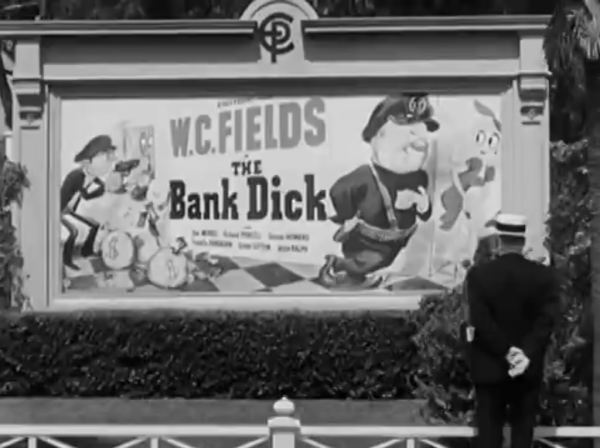
Self-reflexive metanarratives have the capacity of dissecting celebrity and playing with personas. Such a context is ripe with possibility and so when we find ourselves on a studio lot with W.C. Fields eyeing the a big billboard for The Bank Dick, we know we just might be in for something. It came out the year prior, a critical darling and a commercial flop. He’s looking to pitch the follow-up to his producer.

He is under employment at Esoteric Pictures. His niece in the picture, real-life songstress Gloria Jean, plays a young ingenue out of the cut of Garland or Durbin. They are the film’s affable nucleus.

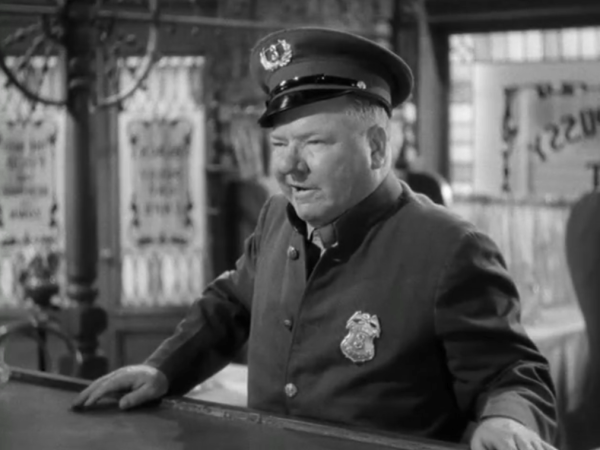
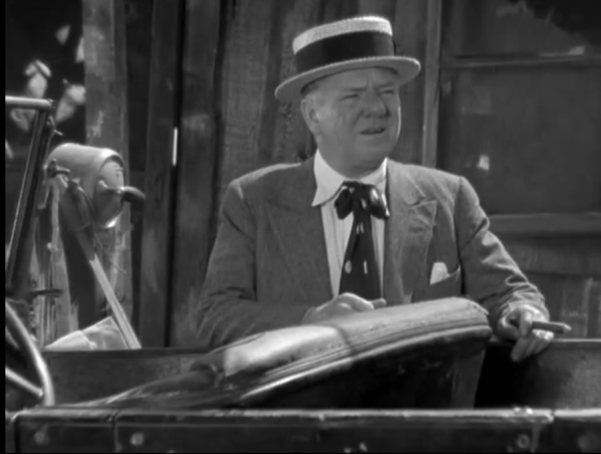
W.C. Fields is a picture of his usual self with his protruding proboscis and that straw hat of his as battered as ever. There’s the way he casually mumbles away at dialogue. It falls offhand and unrehearsed. You can almost lose it. Some of the garbled gook he gets out only makes it to your ears after he’s said it, and your mind has time enough to catch up.

Meanwhile, a typically huffy Franklin Pangborn with his stringy hair tries to command the unremittent chaos of the studio sets to get Gloria Jean to perfect her latest song, one of those high-pitched operatic numbers out of yesteryear. He’s already in a unstable mood when Fields pays him a call.

The script Fields is pitching becomes the premise for the movie itself as he darts in and out of scenes that might as well have no relation to one another aside from featuring Fields and Gloria Jean.

They start on an airplane together to some unknown destination. They might as well be waiting for Godot. He goes free-falling through space in pursuit of a bottle of spirits only to end up trampolining into the stratosphere of a pretty maiden from an oblivious world. Margaret Dumont is her imperious mother Mrs. Hemoglobin leading a great dane by the leash like some bleak Amazonian woman.

Fields, who penned the script under one of his many aliases, pushes the boundaries farther than he’s ever gone before, and it’s spectacular and surreal if this is what creative control looks like. It’s not as out and out funny as some other Fields movies, but it’s giving itself over in its totality to this absurd rhythm which is quite extraordinary to watch. He throws himself over a cliff in a basket only for Pangborn to loudly protest. The story lacks continuity! It’s an insult to human intelligence!

Is it too obvious to read it as a commentary on a career of movies and studios and such? I think not. Because W.C. Fields films were never the most tensely plotted, tightly constructed gems. He built his career out of ad-libs and performance, not so much the written word. Not that he didn’t come alive with verbal wit of his own accord and this was his gift.

never give a sucker an even break bank dick billboard

But he was never made for the strictures of the industry, and so it’s fascinating to watch him when the restraints come flying off, and he’s got his run of the candy store so to speak. In fact, he rebels against conventional plot to the point of totally pulling it apart in front of us and tossing it away as collateral damage.

There is absolutely no pretense here. It’s even less about fast and free gags and bits being assembled together. It’s given itself over fully to surrealist feats of cinematic fancy. It might leave some befuddled now as it did then, but one can gather some sense of the performer. It suggest so much about him implicitly that still needs to be parsed through.

With the real-life context, it shows the decline of W.C. Fields who was quietly ditched for other more agreeable talent, especially because Never Give a Sucker… was hardly going to woo the audiences. Not in 1941. It was of that rarefied breed we often far too easily label “Ahead of its Time.” Here it seems pertinent.

The final set piece is an eye-popping death defying car chase to the maternity hospital. It feels like a flashback to the heyday of Keaton or Lloyd. It’s the most purely comedic slapdash moment in the picture, and does it fit with the rest of the movie? Not by a long shot, but somehow it remains a capstone for something that is totally of its own form and function. It’s almost obligatory. Here the career of W.C. Fields quietly came to an end. This was his final opus to hang his reputation on for future generations.

Doing a bit of perfunctory research, Fields was game to make another such picture with Gloria Jean and some of his favorite stock players. The studio wasn’t about to have it, and his own health was at the detriment of his drinking habit, lampooned as it might have been. W.C. Fields is one of the more irascible classic comedians to be able to pin down. But his comedy at its core does seem to get at a central human longing. It was always him against the world. He took it as well as dishing it out.

gloria jean

Maybe it’s only a small reward and too little too late, but I think even Fields understood the significance of Gloria Jean being in his corner unreservedly. Yes, it’s mawkish in the kind of Hollywood tripe sort of way, but secretly it also feels like a healing balm to the Fields character.

At last he can have some kind of peace. At last there is someone who will accept him unconditionally for who he is. My hope is that Fields experienced some of that in life as he did in his final major screen role. That’s not for me to know. All I know is that we all crave love; we all crave relief.

Fields wanted the film to be titled “The Great Man.” We can read it as jest or a bit of self-congratulatory pomp. But I think this is inside all of us veiled by insecurities. For people to see past our flaws. We want kids to look up to us and see us as what we aspire to be and not as the damaged goods we actually are. Gloria Jean extends her uncle such an honor as she smiles into the camera one last time. He is known and loved. To her he is a great man.

3.5/5 Stars

The Bank Dick (1940): Egbert Sousé and Lompoc, California

Screenshot 2020-07-08 at 4.50.58 PM

When W.C. Fields goes and names his protagonist Egbert Sousé it doesn’t take a brain surgeon to get the joke, although he does spend much of the movie explaining the correct pronunciation. The other half he spends drinking at his favorite bar: The Black Pussy Cat Cafe.

His hometown is none other than Lompoc, California. Aside from being a memorable name in its own right, the town had the illustrious title of being a dry zone with a long history of temperance. What better way for W.C. Fields to thumb his nose at them, than by setting up shop right in their fair city, albeit in his own made-up cinematic universe?

If it’s not becoming obvious already, I think the reason The Bank Dick is often touted as the finest example of his style is because it totally digs into his stereotypical persona whole hog. He’s an irreparable drunkard, a lier, and a braggart prone to any number of human vices. There’s no attempt to varnish them either. He’s a bona fide reprobate.

Nor is he particularly fond of his wife, daughter, mother-in-law, or the little kid who shows up in the bank. His daughter is bent on throwing rocks at him, and he about strangles a little boy who’s armed with a toy pistol. Does it even need to be said? He’s never a likable figure.

However, beyond mere character flaws, it is Field’s delivery that sets him apart from the crowd — the way he mumbles or draws out a line of dialogue. Again, it’s like an afterthought. He’s saying all the unfiltered comments he would say if he thought no one else is listening. Either he’s too dumb to know he’s being overheard or he plainly doesn’t care. At least that’s part of the shtick.

If he has anything close to a friend, it would probably be his bartender (Shemp Howard). He would follow the man to the end of the earth and back again, mostly because the man spells booze. It’s not all bad though since he makes another acquaintance over drinks.

After reminiscing about the good ol’ days giving a passing mention to Mack Sennett, Chaplin, Keaton, and Fatty Arbuckle — all the lads — he finds himself being pulled onto a 36-hour movie set in desperate need of a stabilizing force.

Souse’s tall tales nab him the job, and he certainly acts the part: Dishing out stage directions and convening with the script girl, between trips of being carried around like ancient royalty on a litter. His family’s far from impressed by his hamming.

What’s more, we drop this scenario almost as soon as it begins. It’s like Fields was bored with the narrative strands and decided to table it until his next go around. He has other priorities. His film, after all, is called The Bank Dick and so there has to be some scenario for this to come into being.

So, a bank robbery happens. He’s going to the saloon (where else would he go?). Alas, it’s closed, but sitting on a bench, with his nose in his paper, he ends up in the right place at the right time and gladly takes the mantle of a hero as a criminal is apprehended — no thanks to him.

As recompense, he’s bestowed a low-grade job as a bank dick that’s somehow tied to his home, which they might foreclose on if he doesn’t keep the position. It’s a dubious scenario, but also the kind of underhanded deal Fields probably more than deserves if we can say it. Tit for tat as they say. After all, it’s only a movie and this obliviousness underscores his very identity.

Next, he’s talking his future son-in-law into buying some useless mining stock, and pretty soon they’re embezzling from the bank for a dead-end deal. So of course the bank examiner, a snooty Franklin Pangborn, has to show up right on cue to throw a perilous wrench into their plans.

All Fields’ attempts at cordiality and voluntary sabotage fail, but the entertainment comes with each and every one of his ploys. I won’t try and spoil them here, but Pangborn was born to be his hapless target and Fields obliges with all sorts of shenanigans. Again, to no avail.

the bank dick

Of course, none of this matters. Not the embezzlement. Not the bank robbery. Not any of it. Because their mine is actually a bountiful lode, and they strike it rich as only W.C. Fields can. It’s an instantaneous, convenient reversal of fortune, but then again, Fields’ pictures always defy conventional logic. It’s in their very nature to shirk the normal rhythm for whatever behooves them at any given moment.

In this way, The Bank Dick synthesizes many of his prevailing themes — some of those mentioned already — capped off by an outrageously decadent happy ending. It also joins the ranks of Never Give a Sucker… in his line of raucous car chases, and it’s not a coincidence he’s working with Cline who partnered with Keaton on Sherlock Jr. Similar stunts abound here. It’s a bit of comic nostalgia even in 1940.

W.C. Fields isn’t for everyone. The Bank Dick is not always entertaining. But you come to appreciate his personal penchant for comedy as each performer of the era cultivated a very particular image. He’s little different and seeing as he wrote this number as well as starred in it, he’s giving himself over to the comedy and doing it the way he sees fit. If nothing else, it probably most closely aligns with his proclivities as an entertainer.

His films were never meant to be cohesive. They were never even really meant to be films at all. As with many comedians, it feels like the best dashes of serendipity occur in those suspended spaces in between. Where there’s a throwaway gag, an off-handed zinger, or just something resolutely out of left field.

Every person is different as are their audiences. They don’t always carry our interest every waking second. Sometimes all they have to do is bless us with little bits and pieces of time. It’s often enough for us to remember them so that they remain in the cultural consciousness. This is how I feel about Fields. He is an indelible figure for the persona he built, straw hat, big nose, flaws and all.

3.5/5 Stars

It’s a Gift (1934): “California, Here I Come!”

Screenshot 2020-07-07 at 8.04.46 PM

It’s a Gift is built out of the framework of the domestic lifestyle. This is where it gets its comedy. Take for exhibit A an early sequence. Harold Bissonette (pronounced bis-on-ay) tries to shave with a straight edge despite the interference of his daughter. It leads him to resort to using the reflection of a can and then a mirror suspended from the ceiling dangling around the room.

He follows it around taking intermittent swipes at his gullet covered with shaving cream quite unsuccessfully. It’s a wordless sequence that’s a wonderful escalation of utter absurdity. Because it bubbles with human invention and though Fields takes it further than seems necessary, that’s part of the fun — watching him keep it going.

For any of this comedy to function, there must be a suffocating bulwark around Fields in the form of his family. He has a perfectly henpecked, windbag of a wife (Kathleen Howard) berating him incessantly. His cackling kid’s either gliding around on his roller skates or leaving them lying around so they can be tripped over. His daughter is simply boy-crazy.

Put them together and it’s a perfect combustion engine for his comedic shtick. He has dreams of leaving his corner drugstore for an orange grove in California. If his uncle keels over like he’s supposed to maybe he’ll be left some inheritance.

For the time being, he has the daily grind, which isn’t much better than his home life. A huffy man demanding kumquats. There’s a blind and deaf fellow with an ear horn who’s a walking booby trap. The stock of light bulbs never had a chance. Even his oafish shop hand is hopeless; riding his bicycle indoors, falling asleep, failing to keep a wayward baby from spreading molasses all over the shop floor. You name it. It happens to him.

W.C. Fields becomes a vehicle of antagonism and all the ires of the world seem to be directed at him. This is the source of giddy delight in the comedy strung out over the progression of loosely connected scenes. Could it be he can never catch a break or maybe he’s just enough of a doddering fool to never warrant one?

Normally the image of the comedian is sculpted as a hater of mutts and tykes. It’s true this ornery image makes him all the more human. Here in this movie, it feels strikingly different because he’s effectively accosted on all sides even as he’s just lying around minding his own business. He’s allowed no peace.

One of the ripest gags is set out on the back porch one morning. Fields is trying rather unsuccessfully to get some shuteye, thwarted by an uncooperative couch, a milkman rattling his morning stock of “sleigh bells,” and about anything else you might possibly imagine. Don’t forget a rolling coconut exuding 10 times its decibel level — it’s practically a bowling ball as it thunks down the steps. Likewise, babies are infernal creatures out to get him and wage war against his comforts, no fault of his own.

It’s also one of the most visibly cinematic scenes in which we get this stratified sense of comedy as if it’s from the old two-reeler days of the silent era.  Though, here, the sound is such a vital element. That’s what sets it apart.

Then, the needle drops on “California Here I Come” to send the move in motion again. He’s gone and put his money into his dream. He done and bought an orange grove on a whim, loading up the jalopy and taking the wife and kids out west.

With it comes camping and sprawling West coast estates with rolling greens and statues. In fact, a witty passing gag has Fields crashing into the lawn ornament while his wife exclaims, “It’s the Venus de Milo” now in mint condition having been decapitated a la real life.

They make themselves at home on the private land. Their ensuing picnic is replete with sandwiches and meats wrapped in paper, feather pillows, feisty dogs, and sprinkler systems. By the time they leave the premises, it looks a bit like a ravaged water park gone awry. It’s an example of incremental chaos all conjoining into this culminating mayhem.

In the end, Bissonette is duped with what looks to be a precursor to Green Acres‘ Haney Place. In the immortal words of Bette Davis, “What a dump.” It’s a shack falling apart at the seams. His wife is indignant, ready to walk out on him, and he’s left to sit on the front stoop. What a dismal place to be in if this is truly the end. We only have minutes left after all.

But the cinematic world of W.C. Fields is an absurd space where only moments later all his miseries are turned on their head. Soon he’s sitting on the veranda pulling Oranges straight off the tree to squeeze into his own juice. It’s an outrageous joke scenario and a lampooning of idealized California culture, but in the face of The Grapes of Wrath and other such images, it’s a welcomed relief. If only every Tom, DIck, and Harry who took his family plunking out to the west coast struck it rich like this. It really is a comedy…That is until he sees the property taxes he owes.

3.5/5 Stars

Million Dollar Legs (1932): Klopstokia and The 1932 Olympics

Screenshot 2020-07-06 at 8.25.11 PM

“All the women here are named Angela. And all the men are named George.”
“Why?
“Why not?” – Jack Okey and Susan Fleming

This kind of laissez-faire, anything-goes mentality is one of the obvious strengths of Million Dollar Legs‘ comic tableau. There need not be a given rationale behind what it does and with this brand of laxity, there is an empowerment to do anything it so desires.

Thus, the narrative opens in a far-off Eastern European land called Klopstokia. Their chief exports, imports, and inhabitants are goats and nuts! If it’s not evident already the movie looks like it might be an equally oddball companion piece to Duck Soup.

It’s hard not to see its shared space and that’s mostly on a perfunctory level (and because of the fact Susan Fleming married Harpo Marx). One must also note it came first to precede the L.A. Olympics, though it’s not too hard to believe the Mankiewicz brothers did conceive the movie as a vehicle for the crown princes of anarchy.

Since this is not the case, Million Dollar Legs is ripe for rediscovery propping up some other stars who are sometimes less remembered. They didn’t get them, but Herman and Joseph working with director Edward F. Cline wrangled together an absurdist universe for the likes of Jack Okey. He might be most famous to modern audiences for parodying Mussolini in Chaplin’s The Great Dictator.

Here he’s front and center, an itinerant brush salesman, who happens upon the nation on business only to fall head over heels for the country and its people — one person in particular — her name is, of course, Angela (Susan Marx). They brush each other off rather seductively as her kid brother (Dickie Moore), a begrudging and silent cupid, does his best to keep them apart.

But she also has a connection to the country’s fearless leader. Her father is the President (and also W.C. Fields) with his hat and a dictaphone perfect for bad-mouthing his subordinates on his daily carriage ride to the office. He’s the broadest, most formidable name in the movie.

He makes a daily show of his brawn arm-wrestling his sneezing cabinet including such hoodwinked bumblers as Hugh Herbert and Billy Gilbert. The President is oblivious to their conspiratorial endeavors because frankly, even with their secret cache of spies, they hardly seem likely to hurt a fly. One of their spies out in the field, no less, is a pantomiming, cross-eyed man in black portrayed by Ben Turpin.

However, despite their impotence, they agree to call upon the woman who men can’t resist — the ultimate vamp and a caricature of the Dietrich archetype — Mata Macree (Lyda Roberti). What are her plans? To seduce the entire Klopstokia Olympic team in their bid for the 1932 Olympics! It has no import aside from meeting narrative expectations.

So everyone piles onto the ocean liner, including the President, Migg, and his best girl Angela. The movie’s apex might come when W.C. Fields on one side and his cabinet on the other start yanking the wall back and forth as Okey tries to woo his girl with the gibberish national anthem. It’s delightfully absurd both in the immediate visuals and the auditory accompaniment.

The Olympics aren’t much different with the Klopstokian contingent in a shambles before Angela rallies them jumping from the high dive to have it out with the duplicitous mata hari once and for all. Then, her father shows off his feats of strength in the weightlifting competition against his rival cabinet member. All pretense of logic is gone. Just go with it. Take it for what it is.

The final baton is taken up by the speedy Major-Domo who zips past the competition as a last-second entry coming from behind on the urging of Angela on a motorbike.  Truthfully, I’m still trying to figure out who owned the pair of million-dollar legs. For my money, it’s the galloping Major-Domo

What’s not up for contention is Million Dollar Legs as an intriguing vessel of comedy functioning as a kind of cultural time capsule. Not only does it help chart the famed Mankiewicz brothers before the heights of their future successes, it’s also a contemporary commemoration of the L.A. Olympics. Marx Brothers or not, it might just be worth a look as a historical curio.

3.5/ Stars

Bill Forsyth’s Films: Gregory’s Girl, Local Hero, Etc.

Bill Forsyth is a director who has flown under my radar, and yet only after a week’s time and a handful of films, he’s quietly become a new favorite. Now I heartily understand why he’s one of Scotland’s most beloved directors. Part of his appeal is because he wrote and directed his own projects, but it also comes down to how he imbues his films with a certain sensibility that’s thoroughly disarming.

That Sinking Feeling (1979)

That Sinking Feeling was his debut, a microbudget caper about a pack of eccentric Glasgow youth who alight on a plan to make a buck stealing sinks. It follows the beats of a heist while straining them through a very specific experience.

What Forsyth brings out of his youthful troupe of actors are the lovely idiosyncrasies his films are all utterly replete with. It’s the kind of humor that feels honest in its truth and the good nature behind it. Many of the faces that show up throughout would crop up in some of his later works as well.

Comfort and Joy (1984)

For some, Comfort and Joy might be a new Christmas tradition. It’s a low-key movie finding its footing by focusing on a disc jockey (Bill Patterson) who’s a kind of local celebrity thanks to his good humor, jingles, and the fact he’s in people’s homes just about every day.

There’s a curious streak to the movie as Dicky becomes a kind of mediator between two rival families in the local ice cream racket. I’m not sure where these premonitions come from, but the way Dicky gets caught up in the late-night escapades in the feud between ice cream vendors, I couldn’t help but think of the milieu of After Hours. It’s probably because the situation escalates into this quirky absurdity with a touch of doom.

It has a few fanciful dreams and feels like it could be a sick nightmare. Still, Forsyth never allows any of this to totality derail the prevailing good nature of his characters.

Housekeeping (1987)

In 1987, he alighted on another journey, writing and directing an adaptation of Marilynn Robinson’s Housekeeping. Although it was his first American production, it also brought him together again with his fellow countryman, producer David Putnam.

It’s a film rather reminiscent of Jonathan Demme’s Swing Shift and it’s not simply due to the inclusion of Christina Lathi. It’s the way Forsyth hones in on a story of keenly observed moments and distinct characters rather than a fierce adherence to form and structure. Yet again, there’s a clear-eyed authenticity to it that feels far from being fabricated. It maintains this ethos, and time and time again succumbs to these quietly profound moments that are all too easy to disregard.

I’d like to take the rest of my time to highlight Forsyth’s two most noteworthy films because they all but embody my newfound appreciation for the director.

Gregory’s Girl (1980)

The opening tag immediately feels like the opening moment in any number of cringe coming-of-age films. A group of prepubescent peeping toms gape at a beautiful woman hidden behind glass. Gregory’s Girl looks destined to join the trashy, smutty cadre of ’80s locker room movies. And yet around every turn as I kept expecting the worst, here is a film that constantly surprised and left the dorkiest, most curious, and strangely poignant impressions.

Gregory (John Gordon Sinclair) is one of those iconic coming-of-age protagonists, meaning he’s a spindly dork with the most atrocious head of hair imaginable, and we’re already talking about the ’80s. Still, in a word that could easily be harsh and unfeeling, he makes it genial and a tad innocent.

He doesn’t have a killer instinct out on the football pitch. He loses his coveted striker spot only to bump his best friend, another loser named Andy, out of goal. They hardly seem to mind. Because they’ve made way for the school’s latest talent: the athletic blonde Dorothy (Dee Hepburn).

Again, this brings with it all sorts of potential problems. The male population is quick to rally around her — cheering her on ardently — though it could be a lot worse. It suggests girls can excel in many facets. However, it does run the danger of turning her into a regressive object where the girl is a trophy to be won.

On more than one occasion, it bends away from the expected gauntlet of crude jokes giving us something lighter, more agreeable. It comes with how it conceives of a very particular version of adolescence: small-town Scotland outside the urban decay of the big city. It feels quieter and more hopeful, even if the world itself and the time in life is incredibly transient.

Gregory’s Girl is nothing like what I expected. It was far better. Yes, it’s a slight film, but this plays to its strengths because it gives us these characters and these moments — observations we can appreciate — and then we get to leave them with a wealth of affection. It’s easy to see my estimation of this one rising after future viewings. Even as I ruminate on the title Gregory’s Girl, it has new meaning, and it makes me smile. It’s a pleasure to have expectations subverted and then exceeded.

4/5 Stars

Local Hero (1983)

Local Hero is bolstered by a simple premise being subverted. A colossal American oil company looks to gobble up land in and around an idyllic Scottish village. However, there’s no malevolent corruption and their eccentric benefactor, Mr. Happer (Burt Lancaster), would much rather chart the stars than deal with any amount of oil refineries.

Likewise, it’s never a story of the little guys trying to hold out against progress. The locals are delirious about the money coming their way. Instead, we come to appreciate what this kind of life has to offer as does our stand-in Mac (Peter Riegert).

It hearkens back to an era — the days that made my parents fall in love with the U.K. –where there were still pockets of the world seemingly untouched by modernity and true western influence. The Texas businessman and his Scottish sidekick (Peter Capaldi), pay a visit to the small town and set up shop in the B&B. The local pub is where the whole town pools their funds to make change for an intercontinental phone call.

At first they look rather out of place: two suits walking across the beaches with their briefcases. But then we get a passing sense of who they are as people. They are romantics even friends of passing rabbits. We come to like them. The same might be said of the town and why not? Wow, is the countryside breathtaking. I miss it so.

This is never a movie about board rooms or business, but the bits of business happening in a community. There are all sorts of people, and the quaint elements prove utterly charming.

What a lovely connection between Star Wars and Local Hero to have Wedge Antilles be the town’s main accountant and hotelkeeper prepared to cut a deal with the man from America. Though any amount of haggling or conflict never materializes and they quickly become best buds.

If there was any conflict, it all but evaporates and what is left is warm humor and the forming of lasting relationships. There are the cultural differences, the manifold eccentricities, but there’s also the congeniality. It’s part of what makes this unassuming movie such a pleasure.  Local Hero is gentle cinema, and it’s exactly what we need.

4/5 Stars

Vincente Minnelli Films (1958-62)

Gigi (1958)

Lerner & Loewe’s adaptation of Colette’s Gigi is a picture accentuating the France of Hollywood’s most opulent dreams and confections frequented by the consummate French people of the movies: Maurice Chevalier, Leslie Caron, and Louis Jordan.

Whether it’s Ernst Lubitsch or Billy Wilder or Vicente Minnelli, Chevalier doesn’t change much. He’s convivial with the audience existing just on the other side of the camera. He gives off his usual cheeky, harmless charm that doesn’t always play the best seeing as his first tune is about the litters of girls who will grow up to be married and unmarried young women in the future.

Gigi (Caron) is one of their ilk, a carefree gamine who lives under the auspices of her Grandmama’s house, a startling domicile touched by Minnelli’s charmed palette of deep red.

In some manner, Gigi seems to represent the worst of Minnelli. Yes, it was wildly popular in its day, but all of its manicured embellishment and immaculate set dressings feel mostly fatuous and merely for their own sake. While one can easily appreciate the pure spectacle of the thing, the director’s best pictures show a deep affection for characters.

Here all manner of songs and tête-à-têtes are cheery and bright, while never amounting to something more substantive. It’s easy to suggest the movie revels in its own frivolity. Gaston (Jordan) is a ridiculously wealthy young man and Eva Gabor is his companion, though the gossips get ahold of them. They’re not in love.

Another primary reservation with the picture is how Leslie Caron is summarily stripped of most of her powers. At times, dubbing feels like an accepted evil of these studio-era musicals or a stylistic choice of European maestros. However, in Caron’s case, not only is she not allowed to sing, she can’t talk for herself either (dubbed by the cutesy Betty Wand). I might be missing something, but this seems like a grave misfortune.

You can add to this fact the further grievance she never really has a traditional dance routine, and there’s nothing that can be appreciated about the picture in comparison to the crowning achievements of An American in Paris. All that’s left is to admire is her posture and how she traipses across the canvasses Minnelli has devised for the picture. This alone is hers to control, and she just about makes it enough.

My favorite scene was relatively simple. Gigi and Gaston are at the table playing cards, and they exude a free-and-easy camaraderie. If it’s love, then it’s more like brother and sister or fast friends who like to tease one another. It isn’t yet treacly with romance. Instead, they break out into a rousing rendition of “The Night They Invented Champagne,” which distills its point through an exuberant melody.

The lingering power of the film is how it does its work and grows on me over time. It considers this not totally original idea of trying to become who you are not in order to please others. Gigi must learn the breeding and the etiquette, acquire the clothes, and in short, turn herself inside out in order to fit into rarefied society.

Gaston doesn’t want her to be like that, attempting to replace all the elements of her character that make her who she is. This is what he likes about her. If it never turns to eros, then at the very least, it’s shared affection. Caron and Jordan make their auspicious entrance at Maxim’s and, it feels like a precursor to Audrey Hepburn’s introduction in My Fair Lady. It’s not a bad comparison since most of the film is filtered through speak-singing.

Does it have a happy ending? In a word, yes, but Chevalier singing about little girls doesn’t make me any less squeamish the second go around. Thankfully, Minnelli is no less of a technical master with Gigi. Still, film was not meant to live on formalistic techniques alone.

3/5 Stars

Bells Are Ringing (1960)

The title credits are so gay and cheery with so many admirable names flashing by on the screen, it almost negates the sorry realization that this is the last go-around for the famed Arthur Freed Unit at MGM. Pick out any of the names and there’s a history.

Say Adolph Green or Betty Comden for instance; they were the architects of some of the era’s finest. Anyone for Singin’ in the Rain or The Band Wagon? The movie spells the end of the era, though there would be a few later holdouts.

Like It’s Always Fair Weather, Will Success Spoil Rock Hunter?, or Pillow Talk, Bells Are Ringing is well aware of its cultural moment, and so it reminds us about the necessity of telephone answering services. Actually, one in particular called Susanswerphone.

It’s easy to love Judy Holliday from the outset as she’s playing crazy gymnastics on the telephone lines because automation hasn’t been created yet. Originally, she was a comedienne best remembered for a squeaky voice and a ditsy brain. Bells Are Ringing, which she originated on the stage, allows us to see a different contour of her movie personality, one that might as well hewn closer to the real person.

She does her work ably only to suffer through a dinner date from hell (with her real-life boyfriend Gerry Mulligan). However, we couldn’t have a movie without a dramatic situation.

The staff are forewarned never to cross the line to “service” their clients. But she breaks the cardinal rule, overstepping the bounds of a passive telephone operator and becoming invested in the lives of those people she communicates with over the wires. Not least among them, one Jeffrey Moss (Dean Martin).

She’s just about lovesick over his voice. It’s no mistake that she puts on her lipstick before ringing him up to remind him about a pressing engagement, as if he can take in her appearance intravenously. Alexander Graham Bell never quite figured out the science behind that.

It’s not much of a mystery to us what Moss looks like. Because if you read the marquee, you know it’s Dino. But she doesn’t know that and scampers up to his room to save him. Surely there’s a Greek tragedy trapped in here somewhere. If it’s not about falling in love with a reflection or her own work of art, then it’s about the sound of a man’s voice. She wants to help him gain confidence in his own abilities as a writer.

But first please allow me one self-indulgent aside. Dean Martin had a point in unhitching himself from Jerry Lewis. Sure, Lewis had a groundbreaking career as an actor-director, but Dino was so much more than The Rat Pack and his TV program.

The string of movies he took on throughout the 50s and 60s never ceases to intrigue me. He could go from The Young Lions, Some Came Running, and Rio Bravo to pictures like Bells Are Ringing and Kiss Me Stupid. For someone with such a distinct professional image, he managed a steady array of parts.

The number “Just in Time” in the park is made by Holliday in striking red and Dino crooning through the night air. There’s a goofy brand of showmanship between them that we were lucky to see in many of the old MGM pictures. It’s their own rendition to complement Astaire and Charisse from Band Wagon showcasing Minnelli at his best and brightest as we are brought into a moment of fluid inspiration where all facets of the production look to be working on high cylinders.

At the nearby party, Holliday becomes overwhelmed by the Hollywood glamour scene, as all the folks jump out of the woodwork and start smooching as Martin descends down a spiral staircase. This only happens in the movies, and yet it’s a summation of her blatant otherness. She doesn’t fit in this crowd where everyone is on first name basis with the biggest names in the business (“Drop That Name”). It seems like their worlds are slowly drifting apart as her secret life is about to totally unravel.

However, Martin joins forces with a musical dentist and Mr. impressionist himself, Frank Gorshin, who puts on his best Brando impression as they bring the movie to a striking conclusion. The same woman has changed all their lives for the better. Now they want tot return the favor. Moral of the story, get yourself an answering service, especially one with someone who cares like Judy Holliday.

3.5/5 Stars

Two Weeks in Another Town (1962)

It might play as unwanted hyperbole, but when I look at Two Weeks in Another Town, it almost feels like a generational predecessor to Heaven’s Gate. Although Vincente Minnelli’s picture is well aware of the old hat and the emerging trends of cinema, it’s raging against the dying of the light, as it were. He subsequently bombed at the box office, and we witnessed the cinematic death knell of an era.

The director makes the transition from b&w to color well enough as you would expect nothing less from him. Kirk Douglas has what feels like a standard-issue role seething with rage thanks to a career hitting the skids. He’s bailed out of his sanitarium by a collaborator from the old days and shipped on-location to Rome.

There we get our first taste of a demonstrative Edward G. Robinson playing the tyrannical old cuss Maurice Kruger. He’s right off the set of the latest Cinecitta Studios big screen epic with George Hamilton, an Italian screen goddess, and Vito Scotti working the action.

But Two Weeks in Another Country is just as much about what is going on behind the scenes of the production. Robinson and Claire Trevor together again have a far from congenial reunion after Key Largo generations before. They’re part of Hollywood’s fading classes, though they’re far from relics.

Minnelli takes the personal nature of the material a step further. In a screening room watching The Bad and The Beautiful, the self-reflexivity has come full tilt as Douglas wrestles with his image onscreen from a decade before.

Meanwhile, Cyd Charisse makes her entrance on a jam-packed road flaunting herself in the traffic. She’s charged with playing Carlotta — Jack’s former wife — she’s bad and if her turn in Singin’ in the Rain is any indication, she’s fairly accomplished in this department. It’s almost a novelty role because she’s rarely the focus of the drama, only a sordid accent.

The pieces are there for a truly enrapturing experience as only the olden days of Hollywood can offer. I’m thinking of the days of Roman Holiday, sword and sandal epics, and La Dolce Vita. The movie is a reaction to all of them in the flourishing TV age with its glossy romance in beautiful cars, glorious rotundas, and luscious beaches.

It’s not bad per se, and yet it seems to reflect the very generational chasm it’s readily trying to comment on. George Hamilton utters the movie’s title and it’s all right there — utterly temporal and disposable in nature.

These moments and themes feel mostly empty and, again, while this might be precisely the point, it goes against our human desires. Either that or the movie is begging the audience to connect the dots. We want the critique wedded with entertainment. Because most of us are not trained to watch movies from a objective distance. Our mental wiring does not work like that especially when it comes to epics.

Jack is taken by a young starlet (Dalia Lavi) he meets by chance, thanks to her proximity to the troubled production. His and Veronica’s relationship becomes one of the focal points and one of the few deeply human connections in the picture.

Later, Jack’s bellicose benefactor, Maurice, falls ill. The added melodrama is to be expected along with raucous slap fights and the scramble to get the picture in under budget before the foreign backers try and pull out. The old has-been comes alive again — momentarily he has a purpose and companionship — until he’s besieged by new pressures.

Although it was purportedly edited down, it’s not too difficult to observe Minnelli doing his own version of Fellini’s earlier movie from 1960 with the dazed-out remnants of an orgy and a young Leslie Uggams singing her torch songs.

The apogee of the entire picture has to be Douglas and Charisse tearing through Rome in a mad fury. It’s the craziest, most chaotic car ride that can only be conceived in Hollywood; it’s so undisciplined and wrenched free of any of the constraints of realism. The back projections up to this point are totally expressionistic.

And as the car lurches and jerks around we realize we are seeing the film crossover: What we see behind the scenes and on the screen are one and the same, merely facades, and little more. It’s the kind of unbridled moment that could easily earn derisive laughter or genuine disbelief. There’s no way to eclipse the moment.

Instead, what follows is a cheery denouement out of a goofball comedy. Jack resolves to put his life back on track opting to leave behind his young leading man on the tarmac with a girl until they meet again. Hollywood, as is, was not totally dead — there was still some light in the tunnel — but if the box office receipts are any indication, tastes were changing.

3/5 Stars

The Reluctant Debutante (1958): Rex Harrison and Kay Kendall Together

If Royal Wedding started off the decade with the auspicious coronation of Queen Elizabeth II, then The Reluctant Debutante depicts another cultural milestone in its own right: the last “Season” before the newly-instated Queen decided to officially disband the social tradition.

There’s hardly anything pointed about either of these pictures and so historical events serve as only a twee and oh-so-mild evocation of a totally bygone era. It’s a bit refreshing to have them back again even for an hour or so.

Front and center, we must acknowledge Rex Harrison. Harrison comes off as a generally innocuous figure from my childhood with his monologue songs in Doctor Doolittle and My Fair Lady (in that order). He’s mostly amicable if a bit dry and witty.

Personally, his biography is a bit more complicated. When he was a younger man, he was famously attached to blonde bombshell Carole Landis whose career was ended tragically by an untimely death. Harrison’s part in her final days remains mostly obscured. I won’t pretend to know the details.

Then, after their comedic foray in The Constant Husband, Harrison and Kay Kendall got married and made The Reluctant Debutante together portraying husband and wife onscreen. It would be their only film together while they were married and Kendall’s last film, period. She would die at age 32 of Leukemia.

It’s another shocking tragedy and so only some solace can be gained from the frothy goofiness making up Vincente Minnelli’s picture. Because it feels totally antithetical to this entire biography laid out thus far. This is cinema at its most dorky and feel-good.

We must also take a moment to acknowledge Sandra Dee: she was America’s quintessential ingenue for a generation thanks to pictures like this and Gidget. Her persona falls quite easily into a story like this as we are dropped in London, circa 1958 during “The Season.”

There’s a delightfully playful jauntiness to The Reluctant Debutante from the outset, and it comes down to the character types bouncing off one another to great effect. All that’s left to do is watch where they lead us.

Husband and wife rush off to the airport to pick up their daughter. It’s easy enough to explain away the relationship between Jim Broadbent (Harrison) and Jane (Dee) rather quickly with a mention of her American mother back in the States. Kendall is the well-meaning, if a bit ditzy, stepmother, Sheila, and we’re off.

Soon they’re crammed into a taxi with chattering Mabel (Angela Lansbury). She and Kendall form the film’s most antagonistic relationship as dueling mothers trying to set their young daughters up with the finest prospects in well-to-do society.

Because a debutante’s “coming out” is of grave social importance — at least to mothers — it’s not just like breaking a bottle over a ship; this will launch them into the social elite! Sheila’s intent on creating an extravagant charade out of Jane’s coming out ball because she must keep up appearances and outdo Mabel at all costs. This is war and wars require stratagems, if not slings and arrows to do battle with.

Father and daughter couldn’t care less. Sheila’s not interested in any of the prospects, and Mr. Broadbent seems far more interested in the buffet. In fact, it’s the mothers going gaga over the same distinguished young man, David Henner (Peter Meyers). He’s a royal guardsman with quite the handle on diction and London geography.

Kendall whisks Harrison away from the bar and his sardines and potato salad to win an introduction with the fellow. He’s a dutiful husband, but it’s little more. In comparison, he has the most delightful time sharing a moment with the drummer playing with the band; it used to be an aspiration of his as a young man.

This turns out to be a bit of an unexpected but serendipitous rapport because the young Italian-American, David Parkson (John Saxon), will soon be catching his daughter’s eye. For the time, their instrumental rendition of “Rock Around the Clock” has a buoyant joy all but epitomizing the picture at its best. We’re in for some good fun.

The story starts to sing as we get comfortable with the movie’s rhythms with all the pieces in place. Harrison the walking ulcer in evening dress. Lansbury diabolically switches wires with them — giving her “friend” the number of the wrong David on “accident.” Wink, wink.

Harrison and Kendall form the perfectly in-sync comedy duo; they play wonderfully off one another. They’re flying around the ballroom, heads on a swivel going every which way in their evening duds, keeping tabs on Jane’s perfectly innocent activities. It matters to them very deeply which David she fraternizes with. But only one David matters to her.

If it’s not obvious already, Kay Kendall should be lauded as an unsung comedienne because there are unimaginable pleasures in watching her tug everyone around like a dizzying hurricane all out of a place of good-natured maternity. Harrison gets on by pleasing his wife and feigning convention and doing his best to love his daughter in spite of it all.

Heaven forbid Jane go out to the nightclub with the wrong David because she looks all but destined to. It has Sheila in a tizzy. When they finally arrive home, husband and wife hang around trying to spy on them and figure out what they’re doing, but the adults are not very adept at faking a search for lost earrings or fiddling with hot water bottles right within earshot. One can only imagine the obligatory kissing scene. It’s as awkward as one might expect, but also sweet.

It’s in these ways we can see the similarities between Father of the Bride, The Courtship of Eddie’s Father, and The Reluctant Debutante. There’s no denying the full-blown comedic elements, and yet Minnelli never lets these totally envelope the interpersonal relationships at the core of his movies. This is to their benefit. We genuinely care about Spencer Tracy & Liz Taylor, Glenn Ford & Ronny Howard, etc.

I might easily attribute it to a quirky mood or a generous spirit, but The Reluctant Debutante caught me on the right day. Minnelli’s forays in comedy usually have a dash of goodwill, but this one struck a chord immediately. Harrison still had some of his most prominent performances ahead as did Sandra Dee. You might come for one of them, but stay for Kay Kendall. We lost her impeccable talents far too soon.

4/5 Stars