The Edge of Seventeen (2016)

The_Edge_of_Seventeen_2016_film_poster.jpgThere’s a moment in Kelly Fremon Craig’s The Edge of Seventeen where Nadine (Hailee Steinfeld) suffers the ultimate humiliation third wheeling with her older brother Darian (Blake Jenner) and her (former) best friend Krista (Haley Lu Richardson). Needless to say, the evening is less than stellar but it gets worse after Nadine feels like she’s been totally betrayed. She’s been hating her brother recently and her best friend is dead to her now. The fact that she sets up an ultimatum doesn’t make things any better.

It only gets worse when a fellow partygoer notes Nadine’s sibling relationship reminds her a little bit of the movie Twins — if Nadine was Danny Devito and Darian was Arnold Schwarzenegger. It’s a perfect illustration of how she feels.

Growing up is never easy for anyone and it’s little different for Nadine. Mean girls at school. No friends. Until the fateful day when she got one but by the time high school hits everyone’s doomed. Hailee Steinfeld manages the tall order of portraying this maladjusted, histrionic, neurotic teen with a pitch-perfect pout.

She’s simultaneously our Lloyd Dobler and our Molly Ringwald in any of the John Hughes vehicles and yet none of those things because she’s come out of a different millennium. She must put voice to every thought and emotion that comes ricocheting through her head as much as she constantly yearns for the not so pretty boy on campus to notice her existence.

Her family life is little better. The death of her father still lingers with hurt. Her brother is the devil’s incarnate (at least to her) and her mom (Kyra Sedgwick) is a little ridiculous–not to be taken seriously in the least. Did we mention that her best friend is hooking up with her brother?

What the film grasps so impeccably is that the teenage years are often defined by one word: Awkwardness. This film is the creme de la creme of awkward and for a coming-of-age film that’s very much a compliment.

There so many awkward conversations to be had. Steinfeld and Woody Harrelson share some of the best because she comes like a hurricane of emotion and he gives her nothing — only the driest retorts as her smart-aleck history teacher. Equally enjoyable is the budding friendship between Nadine and fellow classmate Erwin Kim (Hayden Szeto) who makes no attempt to hide his crush on her.

It’s easy to quickly assume Erwin is in the tradition of Long Duk Dong from Sixteen Candles but a particular Ferris Wheel conversation throws all those conventions out the window for good with a few self-aware lines of dialogue. It’s a pleasant surprise that this relationship is rife with laughs but not at the expense of the characters. Only in the sense that we have the age-old conundrum of the friend zone, still fretted about by teens to this day.

She thinks he’s nice but isn’t attracted. He thinks she’s the greatest girl in the world and dreams of making it into something. He takes all her signals to heart. She doesn’t. The Edge of Seventeen feels very genuine in these respects and the beauty of these themes are their universal quality. This isn’t just about a girl and a guy–one Caucasian the other Asian–they are two people just like us. It’s the universal unifier. We’re all human.

That’s one of the relationships modeled by Nadine in the film. But there’s another one that is far more unpleasant. The one involving her own crush on Nick a seemingly unextraordinary teen male that Nadine for some inexplicable reasons seems batty over. So much so she wants to get with him and sends him the longest, most explicit, and regrettable text message of her life. Still, it gets her some results–a ride in his car with some extra-curricular activities. Whether it’s exactly what she wanted is another thing entirely.

It’s sad really. Our culture is so saturated by sexual images teenagers think there is a need to play into those expectations, to use those same methods to get others to like them and be with them. When, in reality, that’s not right at all and the funny thing is that isn’t even what we want. It’s fairly clear Nadine finds this out firsthand. She doesn’t want just the sex in the first five minutes. She wants more. Conversation. Relationship. Intimacy. To be known. Anything would be nice. And that’s what we all want to some degree but we have an inherent ability to chase after the imposters and the imitations. They seem so nice and yet leave us with nothing.

We’ve been taught we need to lead with what’s on the outside — it’s our body that matters — as our hearts slowly die on the insides because we feel like no one understands us. Our family is made up of psychos and we have no friends. That’s part of what makes this film so revealing. But also the very fact Nadine, despite all her teenage drama, certainly has her moments.

Speaking into her mom’s life with certain candor at least on one occasion and actually opening up to Darian in a way she’s never been willing to do before. It’s the fact that she and Mr. Bruner can joust and yet by the film’s end you know full well they genuinely enjoy each other. It’s true that the acrimonious relationships with teachers somehow are the ones we remember and ultimately invest in most deeply. It’s those interactions that redeem Nadine and help her figure her life out, even if it’s only a little bit.

My only reservation is that although we greatly enjoy their characters, because of their economical amounts of screen time, it feels a little bit like Nadine’s dad and her best friend were used solely for the sake of the plot.

Still, the film’s ending makes no attempt to suddenly discover the meaning of life in some lightning rod of an epiphany. Instead, it contents itself in concluding its story not so much with endings but with the hint of new beginnings and that is oftentimes so much more rewarding. Can I simply end by saying Erwin’s quite the filmmaker?

4/5 Stars

The Big Sick (2017)

The_Big_Sick.jpgIn his opening introduction, Kumail (comedian Kumail Nanjiani playing a cinematic version of himself) explains what it was like to grow up in Pakistan with cricket and praying and arranged marriages. All those fun Pakistani traditions. There’s a bit of a matter-of-fact flippancy to how he recounts it all. Truthfully, it’s in stark contrast to much of what we’re used to. As he so rightfully points out, it also meant they got episodes of Knight Rider a lot later than everyone else. That’s before his parents made the decision to move to the States with their two sons.

America has always been a melting pot since the day of Alexis De Tocqueville and that’s part of what this film celebrates while never completely denigrating Kumail’s Pakistani roots. It so refreshingly provides a story told from a different point of view — one that we have not seen all that often — which is all illustrated so exquisitely in the opening moments.

But The Big Sick is also resonant in part because of the conflict of cultures that dwells at its core. A differing perspective usually causes chafing and it’s no different in this case. Still, at first, it must start out as a love story and it is or at least it evolves into one. This particular romance feels invariably relevant to the current world we find ourselves in. It’s a picture informed by a 21st-century worldview.

Kumail is making a go of it as a stand-up comedian in the Windy City and he makes ends meet with a bit of Uber driving. He meets a girl named Emily (Zoey Kazan) at his comedy club, a local grad student with aspirations to be a therapist. They go on a date and wouldn’t you know it, they sleep together. That is the culture after all as much as Uber, ethnic diversity, profanity, and irreligiousness.

Perhaps it’s more precisely put by Kumail who so candidly admits he hasn’t prayed for years because he does not know what he believes. That is the world that this movie occurs in, our world right here and now. They have their rounds of playful patter and time spent together watching Kumail’s favorite horror movies (he proudly has a poster of Shaun of the Dead up on his wall like any unabashed nerd). Still, they are equally noncommittal in how they never want to get too serious about relationships.

It makes sense that romances are about relationship but often those very things are also so closely tied to family. Both sets of parents play a significant role in the picture and certainly, none of them are perfect — exhibiting a wide range of idiosyncrasies — and yet the key seems to be that they are more than a pair of punch lines. It’s those very relationships too that seem to add even a greater depth and heighten the stakes. Because parental commitment more often than not is for the long haul even when their kids’ relationships don’t seem to be.

In case the title didn’t tip you off already, I’ll save you the trouble and let you know that Emily winds up sick in the hospitable. The people by her side are her mom (Holly Hunter), her dad (Ray Romano), and Kumail who feels bad even as their relationship was all but finished.

As we get to know them as people though, it really feels as if we are getting a better understanding of Emily and the same goes for Kumail. In the same way that Kumail feared telling his family that he was dating a white girl, we see another culture clash in her parent’s who fell in love years ago despite coming from two very different backgrounds, one a stiff New Yorker the other a southern belle in a football-loving family.

Kumail begins to gain a certain modicum of courage to stand up to his own parents, in particular, a mother who is always trying to set him up with a nice Pakistani girl like she did with his older brother. He’s weathered a long list of resumes and “drop-bys” by the most eligible Pakistani ladies. We sense the need for personal integrity. He needs to learn how to exercise it not only in dealing with Emily but his parents as well.

You can still be an American and embrace other cultures and that’s one of the keys to this story because navigating that can be utterly trying. Our differences far from encumbering us should bless us with life more abundant and humanity still proves that love can be a universal language that crosses many divides, cultural or otherwise.

Furthermore, could it be that this film too succumbs to that character trope formerly in vogue as the manic pixie dream girl? It’s a stretch since this is based on real events but it falls apart further still as we watch the film progress to its full conclusion. Because if you remember this fantasy character is meant to bring something out of the male character and cause a change in them. That does happen to Kumail to an extent.

The crucial development for the sake of Zoe Kazan’s character is the fact that she is allowed more growth than simply being the cause of Kumail’s growth. Thankfully she is more than a mere plot device. She is given the dignity of an actual human being meaning that she’s able to acknowledge that maybe she hasn’t changed as much as him — she’s not ready to just go back to the way things were before — and that’s okay because that feels authentic.

That’s not to say there can’t be a happy ending but as many of the greatest modern romantic comedies have managed this one leans into ambiguity and makes that a strength far more than a weakness. Kumail has gone onto to pursue his stand-up career. Emily no doubt continues her aspirations to become a therapist. Still, there’s such a thing as a fairy tale and this might be a good time to point out again that this is semi-autobiographical. Real life fairytale romances are possible. They just usually happen to be a lot messier than we’ve read about in books. A lot like this story.

3.5/5 Stars

Update: On September 16th, 2017 a man named Nabeel Qureshi passed away. And I bring up his extraordinary life because it was difficult for me not to see the parallels to this film.

Like Kumail, Nabeel was Pakistani-American. Like Kumail, Nabeel also faced the challenges of going against the wishes of his parents when it came to core aspects of his life. Like Kumail, Nabeel and his wife faced the malevolent onslaught of sickness. But in Nabeel’s case, the sickness struck him and he did not recover.

It sounds like a very sad tragedy and it is bittersweet but I reference it because Nabeel was a man who had tremendous joy and hope and he left such a lasting impact on his fellow man. It is a life worth sharing about. I enjoyed the Big Sick but even in the last few months and weeks, I have been inspired by Nabeel Qureshi’s life even more.

An Autumn Afternoon (1962)

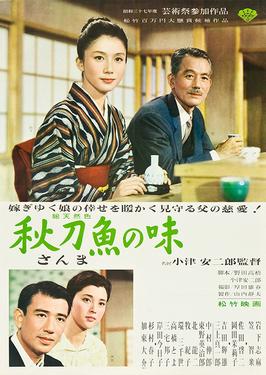
an_autumn_afternoon_filmposterThere’s something overwhelmingly soothing about Ozu, simultaneously slowing my pulse and calming my nerves. Yes, An Autumn Afternoon stands as his final film. Yes, he would sadly pass away the following year. But there’s a comfort to watching his films unfold — even his last one. The drama is everyday and somehow disarming and pleasant. We often take for granted that Ozu was not planning to end here. This was not supposed to be his last film. It just happened that way.

However, that is the way that the world turns and with such of an outcome we get one final candid view of the director at work — his confident and streamlined aesthetic that at this point is instantly recognizable. It’s not simply about content, though his film examines many of his usual preoccupations of years gone by. It’s really about the form.

His palette is by this point assured and at the same time vibrant and free. Everything is in its precise place, the colors bright and cheerful — a certain amount of authenticity married with simple visuals that take impeccable staging, facades, and a static camera to tell his narrative in a very particular way.

And he’s willing to break the rules of perspective that have forever been textbook Hollywood law and yet the way he does it is hardly off-putting. In fact, it’s rather reassuring. His figures always looking at us directly, carrying on conversations, sharing in pleasantries or even chortling together over some small trifle. And we get to be fully a part of that both the trivialities and the drama.

Still, I am constantly being drawn to different things around the edges of the screen. Distracted in a good way by various bottles placed throughout the frame, bowls placed in front of our figures, or Suntory logos that hang overhead. Important, certainly not, but still they mesmerize me for some unexplainable reason.

And I have long gotten over any amount of impatience in the pacing of Ozu. Shots of empty rooms. Seemingly pointless conversations. Eating and drinking. It’s all palatable. It’s more about savoring every little moment for what it is. Because that’s what Ozu was truly a master at capturing. So many people behind a camera can capture high drama with enough action, intrigue, and scandal. But it takes a fairly fearless individual to put a microscope (or a movie camera for that matter) up to the banality of life. Yet it’s the true irony, that it’s precisely in those places we kind find so much truth pertinent to our own existences.  Yes, it’s true.

Meals with friends. Family conversations. Husbands. Wives. Fathers. Daughters. Brothers. And so on. It’s no surprise that these are all things that Ozu looked at before and if he had continued making films he would have undoubtedly continued. The same social mores and familial relationships that while uniquely Japanese, still share enough with the rest of humanity to be oddly universal.

In this case, his favorite protagonist (Chishu Ryu) is a widower who lives with his grown daughter and son. It’s his buddies who chide him to let his daughter go so she can get married before she’s an old maid. And while in previous iterations Ozu looked deeply at the heartbreak, the emotional effects are slight. The daughter is relatively happy. The father is wistful but still resolved to live his life. The ever-changing aspects of life are felt but hardly earth-shattering. Instead, mankind is forced to continually wax and wane with the times. There is a time for a laughter, a time for tears, a time for work, a time for play, and so on.

Although the father-daughter relationship is the nucleus the film boasts a surprising depth of character. There are coworkers, old war acquaintances, former teachers, and the brother and sister-in-law. In fact, the venerable Mariko Okada is always one of my favorites in Ozu’s films and she picks up where she left off in Late Autumn with a certain spunkiness and vivacity.

If this must be our exit point from Ozu’s work, it’s a relatively easy place to leave. It’s a beautiful, warm portrait of modernity. Two old war buddies can assert that maybe it was for the best that the Allies won the war. A husband can really want a pair of golf clubs, though he doesn’t have the money to buy them. Old men can gather around a table for a party and joke about their old teachers. It’s a delectable slice of life.

4.5/5 Stars

The Devil and Miss Jones (1941)

the-devil-and-ms-jones-1Its title suggests that this film might be something like Lubitsch’s Heaven can Wait but The Devil and Miss Jones could easily hold the title as the original version of  Undercover Boss. Although its main function is on the romantic and comic planes, it also has a bit of a social message behind it that signals for change.
Setting the stage, the wonderfully memorable Charles Coburn is none other than the 6th richest man in the world and he is also a hopelessly cranky curmudgeon. A comic Mr. Potter if you will. He’s also a finicky eater only indulging in graham crackers and constantly calling upon his longsuffering servant (S.Z. Sakall). He’s always got something to gripe about.

At the moment, the workers at the department store franchise he holds ownership of are decrying his policies and the benefits he gives workers. They’re pretty bad but he really doesn’t care. All he cares about is that his name is being slandered and he’s looking to hire a detective to find the conspirators. However, not finding a suitable candidate, he resolves to join the floor staff in the shoe department himself so he can act as a mole and undermine any plans they have against him. He’ll beat them out his own game. He’s “a real Benedict Arnold in Sheep’s Clothing” as they say.

Soon he is befriended by the kindly Ms. Ellis who swears by her tuna fish popovers and it takes a moment but he is disarmed by her generosity. The plucky Ms. Mary Jones (Jean Arthur) also takes him under her wing in a way, looking out for him amidst the cruel world of customer service. He isn’t much good at it anyway — selling slippers that is. Edmund Gwenn in a rather subdued role as the snooty store manager tells him as much.

And it’s Mary who unwittingly introduces him to the inner workings of all things store-related. Including the fact that her beau is the infamous Joe O’Brien (Robert Cummings) a recently fired store employee who is working his hardest to rage against the accepted order by organizing a labor union to protect his fellow working class friends.

But it’s not all serious, hardly. Among other things, the foursome takes a lively day trip. One can only imagine Coney Island or some such hot spot with crowded beaches that look more like sardine tins and bustling avenues with kids running hither and thither. In these moments it becomes obvious that there’s a bit of a comical culture war being waged, perfectly summated by the moment some of his new colleagues dilute his fine wine with soda pop to kill the peculiar taste. And despite, their simple ways, they grow on Mr. Merrick, while at the same time his naivete about real life, gains their sympathy. He seems fairly helpless without them. A rambunctious trip to the police station ensues because he gets lost like a little kid.

Of course, there’s the expected turn of events. It must happen. Mr. Merrick is slowly becoming redeemed, falling for Ms. Ellis and gaining the trust of both Mary and Joe. But Mary happens across something that puts everything in jeopardy. And it could be melodramatic but Arthur knows how to adeptly play the comedy even in these moments. Most notably, when she’s summing up the courage to clock her deceptive colleague over the head with a hay maker courtesy of the season’s latest model of footwear.

The final crusade for unionization leads to utter bedlam with the higher ups and it has a trickle-down effect on everyone else. Mary and Joe lead the charge emphatically but with this inside look at the corrupt inner workings of his leadership, Mr. Merrick is aghast and willfully joins the rebellion. It’s comic absurdity and all the main players do the film justice making their happy ending all the more deserved. Sam Wood might not be noted as a director of raging comedies (true, he worked with the Marx Brothers) but he does well enough with The Devil and Ms. Jones to make it a delightful trifle even now. Thanks be that Jean Arthur and Charles Coburn were paired once more in More the Merrier. They’re gold together.

4/5 Stars

Spider-Man: Homecoming (2017)

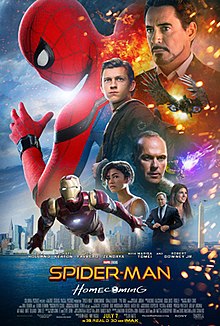
220px-Spider-Man_Homecoming_posterThis was yet another pleasant surprise. Just when I think I’ve finally washed by hands of superhero movies the cineplexes are blessed by two pictures like Wonder Woman and then Spiderman: Homecoming. And they couldn’t be more different. Still, as much as Wonder Woman was invested in its heroine, you get the sense that the crew behind this film care some about Peter Parker too.

Peter (Tom Holland) is living the dream. He got to do battle with the Avengers and Tony Stark has taken him under his wing and he has video proof of it all. He’s expecting great things. He’s expecting to leave the drudgery of high school classes, band, and academic decathlon behind.

Except for most of the film, he is relegated to thwarting small-time crime and he never gets to fight extra-terrestrials or other unearthly beings from outer space. It’s precisely this point that suggests there’s something profound about this character without any of that added white noise.

It’s the very fact that Peter is struggling with his own identity, how to be Spiderman and keep it a secret while simultaneously trying to realize the full extent of his abilities. He’s walking a tightrope because he wants to tell his Aunt May (Marisa Tomei) and he wants Mr. Stark’s right-hand man Happy (Jon Favreau) to call him up for his next assignment so he can prove himself. And yet nothing happens like he wants. No one takes him quite as seriously as he wants. After all, he is a teenager. As some famous philosopher once noted, “with great power, comes greater responsibility.”

But Tom Holland imbues Peter with a genuine likability that lights up his performance from end to end. This guy isn’t a jerk or a moody loser. He falls somewhere in the middle, making idiotic decisions but always because he believes them to be right in that wayward teenage brain of his; he only gets distraught because in his world Spiderman is all he has. Without it he is nothing. That’s his own insecurity speaking.

In one scene that’s undoubtedly meant to be impactful and which subsequently gets referenced later, Tony Stark takes away Peter’s suit after a debacle with an ocean liner and in so many words he says that if Peter needs his suit to be someone then he doesn’t deserve it. Maybe this and the related scenes are needlessly overt in reflecting our hero’s fall and redemption but if nothing else they cast our protagonist in a positive light. He is one of us.

Another thing that constantly reminds us of this fact, has to do with the world and characters he is surrounded by. First of all, the writers do something fairly refreshing and they give him the honor of fighting a villain who is grounded on earth — a man (Michael Keaton) just trying to provide for his family. He is vengeful when the government (Tyne Daly) cancels his contract in favor of the affluent private corporation of Stark Industries. It’s a very real issue wrapped in a superhero film similar to Civil War’s antagonistic dilemma, part of what made that previous film and this one compelling.

But whereas that was a battle among friends, this picture is understandably a high school story. In fact, I couldn’t help noticing the John Francis Daley/Jonathan Goldenstein writing credit not to mention the inclusion of a certain decathlon advisor (Martin Starr) making it hard not to draw up a minor Freaks & Geeks connection.

Honestly, it’s hard to put Spiderman on that level but it does begin to tease out the high school experience as Peter is forced to live a double life while chasing after Adrian Toomes and his clandestine arms operation all across town. Because just as important are his friendship with his Star Wars-loving best bud Ned (Jacob Batalon), teenage crushes, parties, National Decathlon Championships, and, of course, Homecoming.

That’s the beauty of this story. It never tries to take on some epic agenda but far from settling it finds the importance in both the hero’s journey and the growth of someone in the throes of their adolescence. Peter knows that his nighttime activities are hurting his relationship with his aunt and hindering anything that could be between him and his amiable dream girl Liz (Laura Harrier).

The film’s greatest twist (which I’ll consequently omit)  is a beautiful bit of storytelling because it links together Peter’s two worlds so openly. Before they were two entities crisscrossed and tied together like chords of his spider webbing. But there comes a point where they are so closely connected he can no longer keep them separate. He must face it all even if it can’t be resolved as he would like.

So as the Marvel Universe rolls ever onward this picture turns out to be a rewarding entry because in some respects it chooses to tell a smaller story. Still, that story has some lovely touches and a rich cast that more than carry our attention.

The fact that the school outcast (Zendaya) wears a Sylvia Plath t-shirt cracked me up as did a bit of shameless Star Wars product placement, not to mention Captain America fitness videos. But there’s also some sentimental nods as well, namely to Ferris Bueller and the war memorabilia in the Principal’s office honoring his relative who fought alongside Cap during WWII (played by Kenneth Choi in both films).

Michael Keaton turns in a surprisingly sympathetic performance as a “villain” and everybody from Marisa Tomei to Donald Glover are enjoyable in their admittedly small parts. Of course, we have the laundry list of cameos from Robert Downey Jr., Jon Favreau, Gweneth Paltrow, and Stan Lee too as expected.

I won’t harp on this topic too much but it’s obvious that Spiderman is making a concerted effort to be ethnically diverse with its cast which is awesome and refreshing on so many levels. Whether they’re trying too hard with this perfect spectrum of ethnicity is not something to criticize at this point in time. Still, it does suggest that surrounding your typical characters with a lot of diverse individuals in cameos and supporting roles is good enough. Rather than forcing these smaller roles to meet public outcry, there’s a necessity for a better solution.

If the recent Hawaii Five-O pay equality news is any indication, the current state of affairs often has more to do with how the parts were initially created whether in Spiderman or Hawaii Five-O and not how they are interpreted. What might be more radical still is creating these same types of stories and standalone parts for actors who have normally been relegated. I would love to see a Donald Glover movie (on top of Community of course), a Kenneth Choi movie, or even a Jacob Batalon movie. But while we wait, go enjoy Jon Watt’s film for all it’s worth without an ounce of reluctance.

4/5 Stars

Baby Driver (2017)

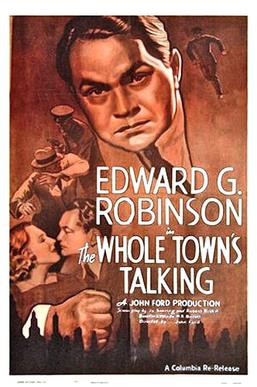
Baby_Driver_poster.jpgEdgar Wright has a reverence for movies, he knows his movies, and when he makes his own movies there’s always an inherent understanding of the cinematic landscape–taking what’s already been done and proceeding to add his own affectionate spin on it.
There are aspects of his filmography from Shaun of the Dead (2004), to Hot Fuzz (2007), and Scott Pilgrim (2010) that are familiar but you can never accuse him of being derivative because he seems fairly incapable of that mode of filmmaking. Coming from such a tradition of off-kilter modern classics, it’s no surprise that Baby Driver is far from your typical heist film though it boasts both cars and crime in equal measures.

Part of what sets it apart is a soundtrack, something that has been put back in vogue recently by films such as Guardians of the Galaxy. It reflects how popular music can replace a score by tying itself so closely to the plot and the most important elements of its characters so much so that it becomes vital even to the narrative arc.

In this case, it involves Baby (Ansel Elgort) a young getaway driver plagued by the memory of a life-shattering car crash, one of the many traumas being tinnitus, a ringing in the ears that he helps to alleviate by constantly blocking it out with music. Thus, he can be found with a ubiquitous pair of earbuds tucked into his auditory canals ready with an iPod Classic full of tunes for every occasion (He even has a pink one with sparkles).

Of course, his driving songs prove to be the most important and he uses music to keep himself in the zone when he’s making the getaway. What helps him concentrate proves to be an equally thrilling experience for the audience, immersing us in the action in the most utterly electrifying and crowd-pleasing way possible. Cars swerving this way and that down the busy urban jungle of Atlanta with retro tunes blasting in surround sound. If that doesn’t epitomize a summer blockbuster than little does.

Criminal types including a psycho killer named Bats (Jamie Foxx) and an armed and dangerous couple Buddy & Darling (Jon Hamm and Eliza Gonzalez respectively) are only a few of the colorful figures Baby falls into company with. Doc (Kevin Spacey) is their contact who runs all their operations with a plethora of inside contacts and a dry no-nonsense precision. He trusts Baby because he’s never steered him wrong. But it does beg the question how did this young man get himself into this life?

Because when he’s off “work” he spends time caring for his deaf foster father (CJ Jones), mixes audio cassette tapes out of his bedroom and frequents the local cafe that his mother used to work at. There’s also a waitress (Lily James) in said diner who intrigues him and brings him out of his shell with genial vivacity.  They share music as much as they share aspirations and mundane conversations.

But the danger is that the soundtrack becomes a gimmick and it’s true that Wright does a couple of no-nos including having his characters meet and subsequently fall in love over music, namely Carla Thomas’s 1966 hit “BABY” and Beck’s “Debora.” That’s an unforgivable cliche and yet we still want it and in his very best sequences he builds around the cadence and rhythms of the complementary songs that fit immaculately with the editing too. Whether a jaunt to grab coffee, the mundane creation of a peanut butter sandwich or a car chase, each becomes like a musical dance that’s surprisingly fresh.

If the genres of musicals and chase films ever had a point of intersection it would be Baby Driver. These opening moments have the energy of a Gene Kelly musical or even this past year’s La La Land pulsing through them. But it’s equally indebted to the heritage of The Driver (1978), Drive (2011), and of course the king of the heap, Bullitt (1968). The bottom line is that there is a care to deliver the goods as expected and have fun while doing it. There’s something refreshing about practical stunts that don’t utilize CGI and nevertheless manage to feel all the more exhilarating and real. There’s no question that this is an action film. But an action film set to the beat of the music.

Unfortunately, after setting such a fascinating groundwork for a film and delivering on a concept that seems admittedly absurd at times, it does feel that Baby Driver descends into utter chaos–action film hell if we want to coin a term–full of profane violence. No longer does it fully utilize the concept that it was built around or the engaging methods it initially used to draw the audience into yet another colorful creation of genre fiend Edgar Wright.

It’s as if the final act of the film doesn’t quite know where to go. The characters start to deviate from the axes that they have been moving on thus far. Not unsurprisingly Buddy is bent on getting revenge on Baby but Baby also shows a darker side without much provocation and Doc suddenly becomes a romantic sticking his neck out for the young lovebirds. There’s a certain amount of confusion on what direction to go next.

However, you could easily make the case that these developments are simply mirroring reality for a getaway driver, especially one as young as Baby. This is partially a tale of maturation. Losing innocence and trying to find it again without completely blocking out the world around you. In the end, the film settles down just enough into a conclusion that fits the parameters set up in the beginning. It’s lifted from the bloody wreckage and actually slows down long enough to ground itself in its characters once more as stylish and satisfying as ever.

4/5 Stars

Terms of Endearment (1983)

terms_of_endearment_1983_film

I owe a comedic debt to James L. Brooks and that’s for the basic fact that he’s made me laugh countless times, namely because of his work with sitcoms. The Mary Tyler Moore Show and Taxi are two prime examples. The casts he brought together and the writing, the writing is just absolutely superb, orchestrating that tricky balancing act between humor and heart.

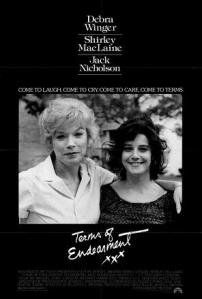
When I look at Terms of Endearment from a purely objective perspective it looks like a wonderful picture. James L. Brooks, the mastermind of so many great projects is writer, director, and producer. It’s his first time behind the camera for a film and his cast is what most others would only dream about. Looking down the cast list is like a hit parade.

Shirley MacLaine as the widowed Aurora, the quirky mother who is strangely difficult, looking for love and still somehow detached — with both her daughter and a plethora of male companions. The always spirited Debra Winger as her daughter Emma. Her husband, the fresh-faced lawyer, Flap is played by Jeff Daniels. The always devilishly grinning Jack Nicholson plays the washed-up astronaut next door who makes the strangest and somehow most viable of suitors for Aurora. And the other nooks and crannies are filled in by the likes of Danny DeVito and John Lithgow. So with such a rank and file, there’s no question that this film should be remarkable.

But for some reason, it just doesn’t come off. It’s not that it doesn’t have its moments or that it’s not intermittently funny, romantic, and moving. There are tinges of those qualities that this film is undoubtedly looking to elicit. But for some reason, one that is somehow difficult to articulate, Terms of Endearment never brought me in like the truly great films have a habit of doing.

Was the plotting too slow? Were there too many characters? Was it due to the fact that I have never been a huge admirer of Shirley MacLaine’s work? To each of these, I would have to give a fairly decisive “No.” In fact, for me, this is one of MacLaine’s finest roles (along with The Apartment) to date. She’s somewhat perturbing, inscrutable you might say, but that also makes her the most interesting character. Watching her cold maternal figure evolve is one of the interesting aspects of this story.

Because she is trying to learn what it is to love and in a sense what it is to show that affection which comes second nature to most. Over time I’ve become increasingly impressed with Debra Winger because there’s always something so dynamic about her — a certain vitality that allows her to do comedy and tragedy equally well.  Both are on display here but for that same unknowable reason, Terms of Endearment did not move me as much as I expected. That’s no criticism just the simple, honest truth as clearly as I can lay it down.

But I respect this film because any film about people, their relationships, and how they navigate the tragedies of life is worth at least a little bit of trouble. Parsing through those very relationships is what this story cares about like Brooks’ earlier works. Maybe it did not affect me as much as I might have expected but that does not take away from the fact that mother-daughter bonds are worth exploring as are marital turbulence and personal tragedy. Because each of these is a very real circumstance and there’s something incredibly honest in trying to examine such things. For that, I commend Brooks as well as his film.  I will not be singing its praises necessarily but we all can respect Terms of Endearment for the very fact that it’s sincerely trying to dissect our world with wit and grace. Whether it succeeds is very subjective indeed. But then again, that’s part of the magic of the movies. At their very core, they are subjective.

3.5/5 Stars

Review: A Hard Day’s Night (1964)

A Hard Day's Night 2.pngAre you a mod or a rocker? ~ reporter

Um, no, I’m a mocker ~ Ringo

As a 4 or 5-year-old, I didn’t know who the Marx Brothers were and no one had told me yet about Cinema Verite and what that meant. But I loved the Beatles. Also, I didn’t find out until years later that Richard Lester was an American director who caught the eyes of the Fab Four and predicted the MTV age with its frenetic editing style. But if you actually watch A Hard Days Night with the eyes of an unabashed fan — like I was as a boy — none of that matters. So let’s leave that on the drawing room floor and look at what makes this film pop with vitality all these years later.

Any conversation must begin with the music. The film bursts onto the screen with the iconic riff of A Hard Day’s Night as the Beatles scramble down a street corner fleeing frantically from a screaming mob of fans. It perfectly encapsulates this rash of Beatlemania that was exploding onto the world stage and making its way across the pond.

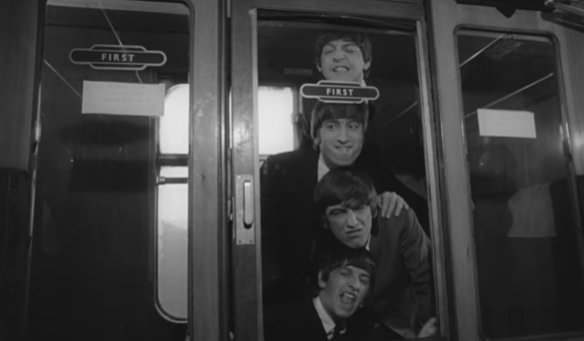
And what the film does so well is create this fun aura around the four lads from Liverpool. There silly, fun, a bit cheeky too but there’s something so endearing about them still. It struck me this time around that these are four men are hardly over 20 years of age and yet they had fame and stardom thrust upon them. And they are superstars but they don’t act quite like superstars.

A Hard Day's Night.png

The filming style and handheld camera work lend themselves not only to Lester’s frantic style but there’s also an indication that this is a day in the life type of musical comedy (no pun intended). It’s the perfect combination of quotable one-liners and zingers paired with a certain British humor (I now declare this bridge open!) and some of the early classics from the Beatles canon (Can’t Buy Me Love, She Loves You, etc).

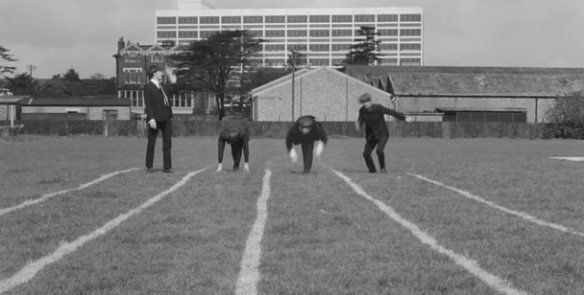
Paul’s Grandfather (Wilfrid Brambell) is very clean but that’s only a veneer for a searing personality that looks to manipulate others and stir up trouble. On Paul’s own account he’s a real mixer.  Norm is their road manager and general killjoy while Shake is his gangly hapless sidekick good for a few laughs of his own.  If you want a “plot” in the conventional sense you probably won’t get it but it’s enough to watch the boys run out on their obligations by sneaking off to dance parties or abandoned fields to do their own renditions of Monty Pythons silly Olympics.

A Hard Day's Night 3.png

We watch them in their idle moments as John messes around in the tub and George exhibits his shaving prowess on Shake’s mirror image.In another moment George takes a wrong turn and finds himself in some new age advertising agency where he unwittingly tears their campaign to shreds by calling their merchandise “grotty.” Meanwhile, the boys are herded from press junkets to tapings, from makeup to answering fan mail (a train and a room and a car and a room and a room and a room). That’s about their life at this stage.

It’s odd to think that the name The Beatles is never spoken in the film. It just is. It’s part of the world consciousness. It brings to mind a chance encounter John has with a woman who while she doesn’t utter his name notes his striking resemblance to one of the boys. In the end, she’s mistaken and he walks away muttering that she looks more like “him” than I do. So A Hard Days Night is a film that while boasting great music and wonderful comic mayhem still is a slight commentary on the Beatles stardom.

They have become beholden to their rigid tour schedule. Prisoners in a sense. But they still find time for personal expression and a bit of playful rebellion despite those very restraints. Of course, the backbone of this comic-laden rock musical is the pinnacle of their artistic expression — their music. By now all these songs are like old friends to me that it hardly seems necessary to list them off one by one. You just have to hear them.

In the final moments before their climactic show, Grandad stirs up Ringo to go out and live a little and so the boys must track him down before time runs out. What follows is an inane ruckus involving the majority of the local bobby population. But all four make it back and put on a lively showing for their adolescent admirers screaming their heads off the entire set.

As quick as they arrived they get whisked off by a helicopter to their next destination ready to rock another day. I’m not sure if this is based on the film or my own wishful dreaming, but I like to think that they’re heading across the ocean blue as the flagship of the British Invasion. When you watch this film it all comes into clearer focus what all the hoopla was about. They had a genuine charisma, a certain presence, and their music speaks for itself after all these years. Still sincere, catchy, and enduring even in its pure simplicity. Billions of screaming girls can’t all be wrong.

5/5 Stars

Slap Shot (1977)

slap-shot-2

The question is, what to do with Slap Shot? It’s grungy, dirty, and foul-mouthed. Bloody and violent. Did I mention profane and boisterous? Loud and obnoxious? Yet somehow there’s still something idiosyncratically lovable about this board busting hockey film. Is it wrong to call it an adult version of The Bad News Bears? After all, the men that the film follows are actually real professional hockey players. Not some kid looking to play at their local gymnasium. Except hockey’s still not the biggest sport (not even today) and the Charleston Chiefs are a minor league club if I’ve ever seen one.

But it’s precisely that quality that keeps us around. Because we all gravitate towards the rejects and the bottom dwellers. The people we can easily feel sorry for and who simultaneously make us feel a little bit better about ourselves.

In bringing George Roy Hill back with Paul Newman and surrounding him with quite the cast of lug heads, epitomized by the gloriously violent Hanson Brothers, Slap Shot somehow became a cult classic.

Player-manager Reggie Dunlop is in the twilight of his career. It’s hardly a secret that the Chiefs aren’t doing so hot and it looks like this might be their last season. It’s a fairly abysmal existence for all involved then Dunlop has the bright idea to let go of any inhibitions. Soon he has his boys brawling with everyone imaginable. Opposing players, fans, referees, anyone who is living and breathing. The funny thing is that this new style of play actually elicits winning results and the public loves them for their brutality.

One perfect illustration of this chaotic pandemonium occurs when the opposing goalkeeper goes diving over the boards to continue his showdown with Paul Newman. They shared a few choice words beforehand. That’s putting it lightly.

But these are also the same group of guys who leave every battle bloodied and bruised. The same group of guys who wind up playing cards on the bus or get mesmerized by the latest corny soap opera on television at the local watering hole. They’re a sorry lot who also happen to be ridiculously funny at times.

It’s the rowdiest of films with at least a couple screws loose. If we were to be pretentious I guess who would chock it up to Slap Shot having “Character.” But I’m not sure if it would be too far from the truth to blame this film for leading the charge in legions of awful R-Rated comedies with no merit whatsoever.

Even with Slap Shot, there are some rather interesting tonal shifts. It’s as if Nancy Dowd’s script looks to get sincere once or twice. Or there were thoughts of getting dramatic. But then the gloves came off and the sticks were thrown aside and there was a collective “Nawww!” from all involved. Not surprisingly this was one of Paul Newman’s favorite roles because he’s not just a ne’er do well or an old crotchety wise guy, he’s a legitimate scuzzball.

Also, it doesn’t hurt that Slap Shot’s soundtrack is now synonymous with the bouncy infectious notes of Maxine Nightingale’s 1975 classic “Right Back Where We Started From.”  The added addition of Fleetwood Mac doesn’t hurt it either. So, yes, I would hardly call this one a revered classic, and I’m still digging around for some redeeming qualities. I’ll let you know. But Slap Shot never claimed to be anything of those things.

It’s unashamedly crude. Gratuitously violent but so over the top as to be comic and there’s not even the slightest attempt to cover any of this up. It could be that Slap Shot is one of the more honest portrayals of human nature. Humanity loves sports. We’re often losers and outcasts with few redeeming qualities when you really get to know us. That’s by no means a promotion of Slap Shot but more of a qualification.

3/5 Stars

Guardians of the Galaxy Vol. 2 (2017)

GotG_Vol2_poster.jpgI find that my own life was greatly influenced by my father during my most formative years, in particular in the realm of music. I grew up on the classics of the ‘60s. But there’s that juncture in time perhaps during middle school where you begin to branch out and you latch onto other sounds for some inexplicable reason. And it doesn’t have to be modern artists but even those who your parents never imparted to you. That is to say that “Brandy” by Looking Glass is such a song for me. I loved it the first time I heard it and not on any provocation of my parents. I consider it one of my own personal favorites.

Thus, when Guardians of the Galaxy opens in Michigan in 1980 “Brandy” blaring on the radio of a sleek convertible I resonate with the moment. The man and the woman are unknown to us but that familiar Dairy Queen Middle America matched with that paradoxically joyfully melancholy love song pulled me into Guardians of the Galaxy Vol. 2 in an instant.

In this way, the film still plays to its strengths namely a retro vibe that’s in perfect cadence with the tongue in cheek tone and explosive sci-fi storyline. Writer-Director James Gunn is back in the driver’s seat delivering his expected riff off the Marvel blockbuster that at this point is both irreverent and violent with persistent zingers and mild touches of heart. It’s the kind of entertainment that will easily find a broad audience because once more he delivers the goods while simultaneously making light of them. We generally like him for not taking his subject matter too seriously, even if sometimes it, ironically, feels like the story dips too quickly into melodrama.

Still, at its core is a misfit hero that we love to cheer for in Peter Quill (Chris Pratt). This film examines in greater depth his own identity as a part human part spaceman. He’s still reeling in the shadow of his mother’s death many years ago and then he meets the man purported to be his father (Kurt Russell) the charismatic Ego.

Meanwhile, there are his other relationships to be parsed through and in many ways, they get pushed to the fringes. Baby Groot (Voiced by Vin Diesel) definitely ups the cute factor and Rocket (Voiced by Bradley Cooper), as well as Yondu (Michael Rooker), are there to play their crusty curmudgeon roles that nevertheless are given a bit of definition. We like them better by the film’s end as might be expected just as we are made to consider the dynamic between Gamora and her vengeful sister Nebula.

So Guardians is not only grounded by Walkman and classic tunes and a very human sense of humor but these relational moments. True, they’re not played out to the best degree as Quill tries to figure out his “Sam and Diane” thing with Gamora (Zoe Saldana) or reconcile his feelings for his father but that’s okay. 

My only qualms are the fact that sometimes Gunn seems to play too much into the jokes and tries to delve into the conflict too quickly so it comes off a little shoddy. The laughs are funny initially and the drama compels us at first but at times Guardians seems to stretch itself too far tonally. It was not meant to do that much.

But the characters are still an endearing ragtag band of misfits, the music is spot on (ie. Sam Cooke, Glenn Campbell, Electric Light Orchestra, Fleetwood Mac, etc.), and there are some purposeful references to Cheers, Mary Poppins, and Knight Rider that come off wonderfully as nods to a bygone era and an earth that we know and love. Brandy’s place at the center of the film’s narrative helps in in the nostalgia department as well. Whereas, in a film like The Martian you get the sense that disco was considered a cool addition, in Guardians music is often so closely tied to the storyline and the tones created in each scene visually. It uses its soundtrack incredibly well. 

An interesting caveat is the fact that in the rather unexpected arena of a superhero film, spiritual issues are briefly touched on. Namely ideas of a god complex, this idea of paneverythingism as coined by Francis Schaeffer, and even the idea of duality of persons compared to a trinity. It’s all perfectly introduced to us as we enter Ego’s creation with the sounds of George Harrison’s “My Sweet Lord” wafting over the landscape.

Even if it only scratches the surface we are in some small ways asked to consider the true purpose of man, a being that while fallen is certainly meant to live in fellowship with others. What that’s supposed to look like is another issue altogether. If that’s a little too heady then there’s enough anarchy and joyous eye candy to fall back on. Enough said.

3.5/5 Stars