
 It’s the bane of my literary existence, but I must admit that I have never read Joseph Heller’s seminal novel Catch-22. Please refrain from berating me right now, perhaps deservedly so, because at least I have acknowledged my ignorance. True, I can only take Mike Nichol’s adaptation at face value, but given this film, that still seems worthwhile. I’m not condoning my own failures, but this satirical anti-war film does have two feet to stand on.
It reads like a cast of millions: Alan Arkin, Martin Balsam, Richard Benjamin, Art Garfunkel, Jack Gilford, Buck Henry, Bob Newhart, Anthony Perkins, Paula Prentiss, Martin Sheen, Jon Voight, Bob Balaban, Peter Bonerz, Felice Orlandi, Jack Riley, Marcel Dalio, and even Orson Welles. And in truth, no one character disappoints, because no one character has to carry the brunt of this narrative.
Certainly, Yossarian (Alan Arkin), the disillusioned WWII bombardier, is our protagonist, but he needs people to react to and bounce off of. It’s the likes of Colonel Cathcart (Balsam) and Lt. Colonel Korn (screenwriter Buck Henry) his neurotic superiors and the pragmatic wheeler-dealer Milo Minderbender (Jon Voight) who make him that way.
Their world of bombing missions, valor, medals, and “The Syndicate” are utterly absurd just as they are, but they don’t seem to recognize it. That’s where the satire stems from, the critique of war, and all the wit. It seems like no coincidence that Mike Nichols released this film during the Vietnam Era. Like its compatriot, Robert Altman’s M*A*S*H, it finds a wickedly dark sense of humor in war. Because what is there to do with death and violence, but laugh and try to find some way to grapple with it?
 The Chaplain (Anthony Perkins) doesn’t feel like a man of the cloth at all, but a nervously subservient trying to carry out his duties. An agitated laundry officer (Bob Newhart) gets arbitrarily promoted to Squadron Commander, and he ducks out whenever duty calls. Finally, the Chief Surgeon (Jack Gilford) has no power to get Yossarian sent home because as he explains, Yossarian “would be crazy to fly more missions and sane if he didn’t, but if he was sane he’d have to fly them. If he flew them he was crazy and didn’t have to; but if he didn’t, he was sane and had to.” This is the mind-bending logic at the core of Catch-22, and it continues to manifest itself over and over again until it is simply too much. It’s a vicious cycle you can never beat.
In fact, each man involved must cope with their duties one way or another oftentimes through prostitution, jokes, or an obsessive almost numb commitment to duty. Yossarian tries all of the above rendezvousing with an Italian beauty and receiving a medal without any clothes on.
 But the tonal shift of Catch-22 is important to note because while it can remain absurdly funny for some time, there is a point of no return. Yossarian constantly relives the moments he watched his young comrade die, and Nately (Art Garfunkel) ends up being killed by his own side. It’s a haunting turn and by the second half, the film is almost hollow. But we are left with one giant aerial shot that quickly pulls away from a flailing Yossarian as he tries to feebly escape this insanity in a flimsy lifeboat headed for Sweden. It’s the final exclamation point in this farcical tale.
M*A*S*H certainly deserves a reevaluation, but Catch-22 just might be the best, or at least one of the best, anti-war films of the 1970s. Mike Nichols delivers once more with a wickedly funny indictment of global conflict using a classic of American literature for inspiration.
4/5 Stars

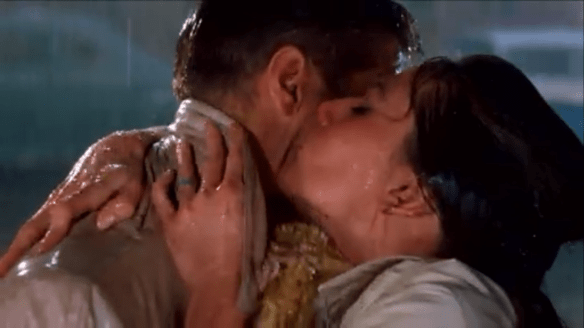
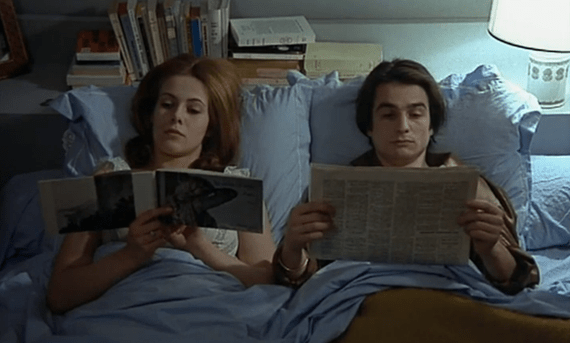 Arguably the greatest French comic was Jacques Tati and like Chaplin or Keaton he seemed to have an impeccable handle on physical comedy, combining the human body with the visual landscape to develop truly wonderful bits of humor. Bed and Board is a hardly a comparable film, but it pays some homage to the likes of Mon Oncle and Playtime. There’s a Hulot doppelganger at the train station, while Antoine also ends up getting hired by an American Hydraulics company led by a loud-mouthed American (Billy Kearns) who closely resembles one of Hulot’s pals from Playtime. Furthermore, there are supporting cast members with a plethora of comic quirks. The man who won’t leave his second story apartment until Petain is dead and buried at Verdun. No one seems to have told him that the old warhorse has been dead nearly 20 years. The couple next door that is constantly running late, the husband pacing in the hallway as his wife rushes to make it to his opera in time. There’s the local strangler who is kept at arm’s length until the locals learn something about him. The rest is a smattering of characters who pop up here and there at no particular moment. Their purpose is anyone’s guess, and yet they certainly do entertain.
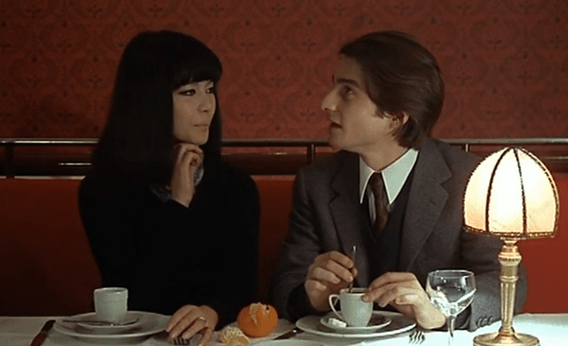 But as Truffaut usually does, he digs into his character’s flaws that suspiciously look like they might be his own. Antoine easily gets swayed by the demure attractiveness of a Japanese beauty (Hiroko Berghauer), and he begins spending more time with her. Thus the marital turbulence sets in thanks in part to Antoine’s needless infidelity –revealed to Christine through a troubling bouquet of flowers. It’s hard to keep up pretenses when the parent’s come over again and Doinel even ends up calling on a prostitute one more. It’s as if he always reverts back to the same self-destructive habits. He never quite learns.
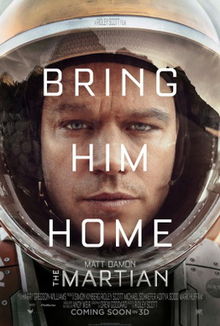 The Martian is not the film you first expect. It’s a space thriller. It has tense moments assuredly, but it also has an astute sense of humor that pulses through the film as its lifeblood. It makes Ridley Scott’s latest endeavor, based on the novel by Andy Weir, all the more palatable because it lends a fresh face to space exploration.
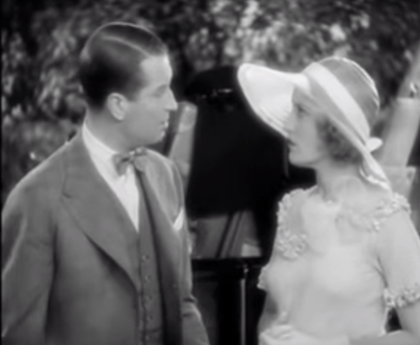 This is unequivocally the age of sound! That’s what this film proclaims from the rooftops with its symphony of syncopation as the world of Paris awakens from its slumber. Its opening rhythms are pure ingenuity and the glorious unfoldings never cease for the rest of the cheery production.
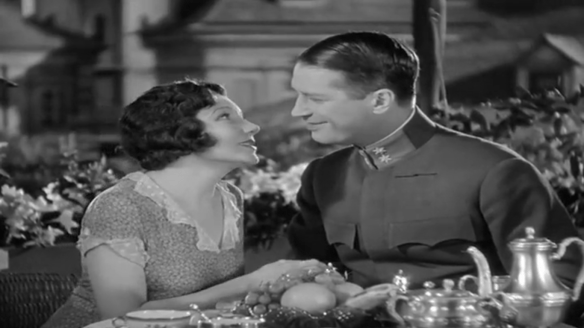 One would never think that one well-placed wink would change the course of an entire life or be the basis for an entire film, but on both accounts it is true. Ernst Lubitsch’s The Smiling Lieutenant represents all that is good and right about one of his films. It’s light and airy with a dash of charm and a tune in its heart. It’s light on its feet with humor and somehow maintains its self-respect, much like the man at the center of this one (Maurice Chevalier).
 But Lubitsch’s final twist is completely out of left field and a completely comic inversion of what’s supposed to happen — capping off his oeuvre of song, suavity, and sensuality in high fashion.
 “I always did like a man in a uniform. That one fits you grand. Why don’t you come up sometime and see me? I’m home every evening.” ~ Mae West
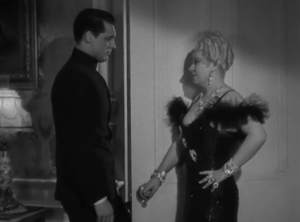 This is her film — her personal vehicle. She rules it that twinkle in her eye and a rapier wit coming from her mouth. Sometimes it’s not even what she says but how she says it (Why don’t you come up sometime and see me?). No one quite has a delivery like her. Whatever she says seems to carry implications and double meanings. In a modern culture that’s overwrought with sexual innuendo and bad taste, West led the trend when it was still in vogue. Back then, it was certainly controversial, but the box office doesn’t usually lie, and West did pretty well for herself, especially during the Depression era. There’s a reason that soldiers named their life vests after her. She was the queen of double entendres in the post-Shakespearian age, and she was ripe in the public consciousness. There was no one quite like her.
 I still remember driving through the hills and dales of the English countryside listening to Hard Day’s Night in the family rental car. Back then I had a haircut that could best be described as a mop top. And then during my one visit to Liverpool, I was beyond ecstatic. I’m a fairly reserved person and yet standing in Paul McCartney’s kitchen at 20 Forthlin Road (his childhood residence) what else could I do but bend down and kiss the floor?

 4 Star Films