Venus (2006)

Venus_ver2“God, he was gorgeous.”

When the waitress looks at the image in the obituary, she’s talking about Maurice Russell, but for all intent and purposes, she might as well be talking about Peter O’Toole. In some ways, they’re one in the same. He certainly was a ruggedly handsome young man with piercing blue eyes. Certainly capable and epic enough to play the inscrutable title character in Lawrence of Arabia. But his life had as much turmoil as it did success. O’Toole in his present incarnation looks wrinkled, perpetually tired, and dare I say, somewhat decrepit. It’s not just the fact that he is so many years older, but his life was a hard one involving heavy drinking and many related health issues.  In many ways, it was a miracle he was still alive, but the fact is he persevered and gave us Venus.

I must admit the idea of Venus intrigued me perhaps more than the actual film. Here we have O’Toole, arguably one of the greatest actors ever to come out of the British Isles, playing a version of himself well into his 70s. The opportunities abound for reminiscing and deep soul searching as he looks back at the life he has led. Pair him with another British star like Leslie Phillips and the chance for fun little moments between two old pros seems all the more likely. And Venus is a bit like this; certainly boasting moments of immense depth of character, sadness, and emotional sequences.

However, I had some trouble parsing through the other side of aging star Maurice Russell (O’Toole). In many ways, he just looks like a dirty old man. The assumptions begin when he begins to make small talk with Ian’s (Phillips) grandniece Jessie (Jodie Whittaker), who isn’t too keen on living with her great uncle. But a sort of dysfunctional friendship forms thereafter. Maurice gets immense vigor out of spending time around Jessie, who he encourages to model, buys clothes for, and takes out for drinks. But as he deals with his illnesses and ailments, he also seems to have a deep desire to be close to her, bequeathing her the name Venus, the goddess of love, after taking her to his favorite piece in the National Gallery.

However, this symbiotic relationship that they build at times feels excruciatingly uncomfortable and it turns destructive more than once as they have one falling out after another. If you put aside a few scenes of awkwardness — Venus really does have goodness to offer — you just have to be patient. In fact, perhaps Maurice is not dirty-minded but is greatly enraptured by beauty. He notes the most beautiful thing a mortal man can ever see is a woman’s body. But when asked about the woman’s perspective, he candidly replies that their first child is the most beautiful thing they could ever imagine.

I am quickly reminded of the moment where the two old-timers begin to wander the halls of the church acknowledging plaques inscribed with the names of Boris Karloff, Robert Shaw, Laurence Harvey, and Richard Beckinsdale among others. They must come to terms with the fact that someday they too will be up there, but for right now they resign themselves to dancing joyously together. There’s another moment when Maurice drops in on his ex-wife played by a genial Vanessa Redgrave, who has long forgiven him for the hell he put her through. Now as the years have gone by, they have become friends once more, and there is an earnestness in Maurice because he knows he might not be around much longer. Finally, the film comes full circle returning to the tranquil shores in Kent, where it all began, and Maurice is reconciled with Jessie as he feels the water between his toes one last time. His work here is done. R.I.P. Peter O’Toole. You were a true romantic of Shakespearian stature.

3.5/5 Stars

Blue Velvet (1986)

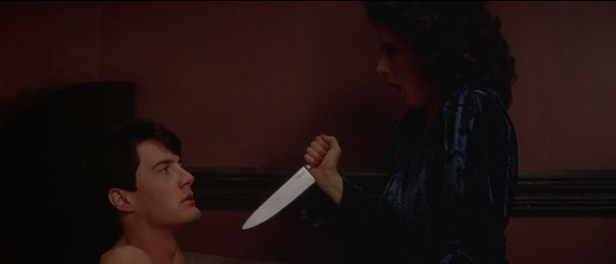
bluevelvet1It’s certainly not a news flash that I often have immense troubles dealing with black, satirical comedy. I think the difficulty for me lies in the dividing line between comedy and tragedy. Oftentimes, although I’m not always fond of violence or profanity, I can make a concession if there’s something deeper behind it. With Schindler’s List, this means watching the scenes of the Holocaust, because there are vital realities to be gleaned from that. In a Scorsese film, aside from being well made, I often see them utilizing profanity in such a way that shows the corruption and baseness that lies within mankind. Take Goodfellas for instance.

All this to say, Blue Velvet was hard to pronounce a verdict for. Without a doubt, David Lynch is a worthy director with his own surrealist vision, that is nevertheless polarizing to the viewing public. There is no doubt that his films are fascinating and in moments mesmerizing; there’s no arguing on that account.

However, Blue Velvet is a dark and brooding film, as are many others, but the big difference here is that all of that is buried under a thinly layered caricature of suburbia. These scenes are so superficial; almost stupid, because the dialogue seems torn off some billboard or magazine cover. There are flowers, white picket fences, and robins denoting the changing seasons. It reminded me of some precursor to American Beauty, except the ending was brighter and the depths seemed darker.

Under the surface lies something sinister and it all comes to a boil when Jefferey Beaumont (Kyle MacLachlan) returns to his hometown of Lumberton to visit his injured father in the hospital. The college boy comes across a severed ear, and it leads to stakeouts, and eventually brazen attempts to break into a mysterious woman’s apartment.

And as you would expect Jefferey gets in too deep, getting sucked into a twisted, subversive spiral that includes singer Dorothy Vallens (Isabella Rosellini), a sociopathic maniac named Frank (Dennis Hopper), and a whole lot of ambiguity. All things return to the status quo in this suburbia and we can go back to singing “Blue Velvet” and “In Dreams” in peace. But there’s this nagging sensation that Lynch’s treatment of this topic is utterly cruel. Isabella Rosellini gives a stellar performance that is a constant emotional roller coaster, while Dennis Hopper is the definition of a screwed up, drugged up, lunatic. These individuals have so much darkness and twisted caverns in their characters that it’s hard to leave them like this.

After all, this isn’t a big joke, and it shouldn’t be, but it’s hard to get away from that idea since the dichotomy between the two is separated here by a hair’s length. However, for others who find it easier to parse through the tonal problems I have with Blue Velvet, there’s undoubtedly a lot to take note of. This is one of those enigmatic films we leave with more question than answers; more confusion than clarity. It’s not always the easiest, but it can certainly be rewarding.

3.5/5 Stars

Day for Night (1973)

dayfornightposter10 years prior Jean-Luc Godard made his own film about movie-making entitled Contempt (1963). It too delved into what it looked like to make films, as well as the individuals behind the camera because their relationships undoubtedly affect what is revealed in front of it. His colleague Francois Truffaut came out with his own meta-film about film, but Godard was open with his criticism. In fact, their long friendship suffered because Godard accused his longtime collaborator of selling out and telling a lie.

However, if we look at Day for Night today, that feels a little harsh, because while Truffaut’s film is engrossing and different than his earlier New Wave work, he is, in general, a more accessible director on the whole than Godard. That should certainly not take away from what he gifted to his audience. What he does is color the lines between film and real life. Because, while one mirrors reality, it can never quite replicate it and things get messy when the two begin to get in the way of each other.

Immediately we are thrown into a street scene only to learn minutes later that it’s only a set; these commonplace people only extras filling up a cinematic space. It’s the perfect entry point into the meta nature of the film. Ferrand (Truffaut himself) is the director flooded with all your typical problems, setbacks, and deadlines. He must work around his stars, navigating the drama that comes about with so many personalities all gathered together. Severine is a has-been starlet with troubles remembering her lines. Alexandre is her love interest, a fading star in his own right who is aging gracefully. Alphonse (Jean-Pierre Leaud) is the young heartthrob, who secured a script girl position for his girlfriend, but their playful romance is not without bumps. All the while everyone waits with baited breath for the arrival of transcontinental star Julie Baker (Jacqueline Bisset), who has recently recovered from a nervous breakdown followed by a marriage to a distinguished doctor.

We are privy to series of takes, rushes, and all the decisions that are going on behind the scenes. It is in many ways far fuller and more in-depth than the picture Godard gives, but Truffaut maintains the same respect for his heroes. He goes so far as name dropping: Hitchcock, Hawks, Bresson, Godard himself, Bergman, Rossellini, Lubitsch, Bunuel, Jean Vigo, Jean Cocteau, not to mention an initial dedication to the Gish sisters. Even Citizen Kane and The Godfather, two of cinema’s landmark achievements, are both alluded to in passing.

But adding an exclamation point to everything is the drama of death, romantic affairs, and even a pregnancy, suggesting that life is a lot messier than a moving picture. All the strips of celluloid get tied together in a nice bow. They can be explained away by a plot point. They can be completely discarded on the cutting room floor. Or a double can be hired as an easy fix for any discrepancy. In this, there is a falseness that fails to perfectly align with reality. There is no perfect way to convey the truth, because everything, even a documentary, can never be complete subjective reality. A mirror image is only a reflection of what is real. That is part of what Truffaut is getting at and that is part of the irony of his row with Godard.

You only have to look at its title, because Day for Night points to the inherent artificiality of cinema, but Hollywood films especially.  So, far from telling a lie, Truffaut seems to riddle the film industry with all sort of holes, pointing out the difficulties that come with such a business. Life and film may meet and overlap, but they can never truly reconcile their differences because there is bound to be contention along the way that cannot be perfectly remedied by even the greatest director.

But far from condemning the art form, it’s important to realize Truffaut is pronouncing his undying affection for the medium. He was the one who famously asserted, “I have always preferred the reflection of life to life itself.” This man unquestionably loved movies and it shows.

4.5/5 Stars

Girl Shy (1924)

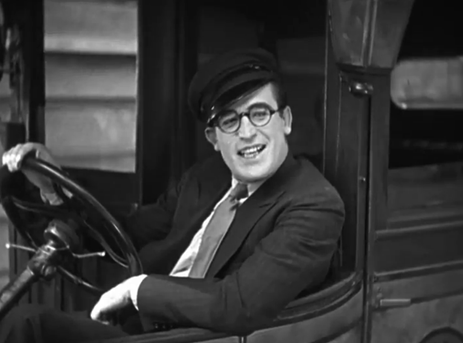
girlshy1Harold Lloyd’s feature Girl Shy is not so much a comic gag reel as a character-driven story. The first type I would equate more with Keaton, the second feels more like the sentiment of Chaplin. Lloyd does both very well and in this case, he plays Harold, a tailor’s apprentice with a stuttering problem — which actually is very pronounced — despite the lack of sound. Of course, his nervous bouts only come along when he has the harrowing experience of interacting with the opposite sex.

Instead of attending a town-wide dance in Little Bend, Harold resolves instead to stay in his basement and type away at the novel he’s writing. It’s called “The Secret of Making Love” and it’s his manifesto for all the boys who don’t quite know how to act around girls. Really, he’s penning it for himself and within its pages, he details how to win over anyone from a vampire to the flapper. To him, it’s going to be the next great thing and we cannot help but admire his ambition — misguided as it may seem.

Aboard the local train he helps a pretty young woman (Jobyna Ralston) stowaway her dog from the conductor, and then he excitedly regales her with his book, when he’s not shaking. The lovely time is broken up when they reach their final destination, but as parting gifts, they trade a box of dog biscuits for a pack of cracker jacks. Perhaps not the most romantic of gestures, but neither one cares. In fact, Mary detours through Little Bend several more times until she finally runs into Mr. Meadows again. They sit by a pond where Harold mistakes a tortoise for a rock and gets in a bit of a sticky situation. However, the gags do not overshadow the human aspect, which is still at the forefront of our tale.

When Harold finally has his date with the publisher everyone laughs at his joke-of-a-book. It dashes all his dreams and he knows he cannot get Mary now. So he puts up a false front, not wanting to string her along, and so, of course, the heartbroken girl goes to the only other person she can. The token rich middle-aged suitor, who is stuffy and boring.

But on the advice of a proofreader, the publishers decide to spin Harold’s book as a humorous read and unbeknownst to him a check comes in the mail. He’s dejected at first because these aren’t the terms he wanted, but then he remembers Mary, and upon seeing news of her marriage, he rushes to stop the impending wedding.

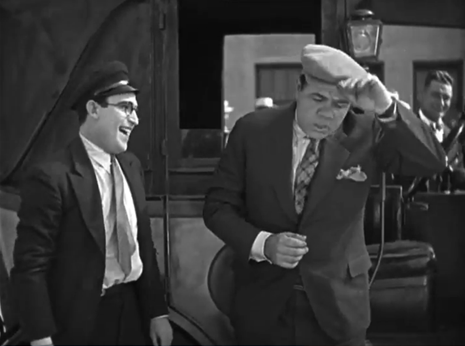
girlshy2At this point Girl Shy loses its heartfelt narrative thread in favor of Lloydian acrobatics, a la Speedy, but don’t get me wrong, it’s still thoroughly enjoyable watching Lloyd frantically try to hitch a ride to the wedding by any means possible. I was half surprised he didn’t try to pull a little girl’s bike away from her because he tried about everything else imaginable. In case you hadn’t guessed, he gets the girl in the end.

Going back to Chaplin, I think he tugs at the part of our hearts that feels sympathy for the poor and unfortunate masses. Lloyd on the other hand channels a different vein, relatable to all those who have ever been rejected or made fun of for being awkward and uncool. He suggests that there is still hope for those people. I relate to the quiet stoicism of Keaton certainly, but the nerdish charm of Lloyd hits home too. I think a lot of us can relate to Girl Shy.

4/5 Star

In a World (2013)

220px-In_a_World_posterWhat makes In a World… work for me is a new perspective on material that could potentially be so cliche. Even when it enters long-trod territory we as an audience are able to extend grace to a film that is willing to step out there.  The film’s writer and star Lake Bell crafts a story set in the world of movie trailers, where her character, Carol Solomon, looks to make the leap from a vocal coach obsessed with dialects, to a full-fledged trailer narrator. It has the potential for a light, unassuming payoff, for a topic that feels so slight, but In a World… is indubitably rewarding.

It starts with Lake Bell’s Carol, a character who is easy to get behind. Her dad is a highly-acclaimed voice-over artist, who also happens to be a Grade-A jerk. Her sister’s stressed by a hotel concierge job and to have family plopped long-term on her couch is only another annoyance. Moe (Rob Corddry) is probably the most chill of all her relations, and he’s a brother-in-law with an easy-going vibe and a genuine love for his wife. To his credit, Corddry proves he can play roles that an audience can sympathize with.

Besides Carol, the most pivotal character is Louis (Demetri Martin), that slightly awkward, slightly awesome, male love interest, who happens to work in the recording studio with her as a sound engineer. They must go through the cringe-worthy conversations and interactions that are almost a rite of passage for the genre, before finally getting together as they are supposed to. That includes uncomfortable telephone conversations and a very eventful party at the home of trailer champ Gustav Warner. As Carol must navigate her own romantic entanglements, Dani’s marriage to Moe takes a hit when she starts entertaining the advances of another man. It’s in such moments that In a World… sheds its simple layer of humor and gets to something a little more substantial. These are genuine moments involving characters like Dani and Moe who we truly feel for, not to mention Carol and Louis, who both exhibit a refreshing level of earnestness.

As Carol tries to get her big break by beating all her male competition, she continues to get lack of support from her father, until things get real personal. He too decides to audition for the coveted voice-over for the upcoming epic quadrilogy “The Amazon Games.” It pits father against daughter, man versus woman, and the results are more than memorable. For me, Demetri Martin is a standout with his dorky turn, and we get another appearance from perennial indie supporting cast member Nick Offerman, not to mention a cameo from Geena Davis (and Eva Longoria)!

3.5/5 Stars

Kid Brother (1927)

kid brother 1Kid Brother is a departure for Lloyd from the general hubbub of urban life as he finds himself on a ranch, living with his two older brothers and his father, who is the local sheriff. His surname this time around is Hickory an aptly brawny moniker for a frontiersman, except he’s hardly the physical specimen of his father and brothers. They spend their days chopping down timber and hoisting logs on their broad shoulders. Harold does his daily work collecting the laundry and ultimately chasing after it when it blows away.

He unwittingly gets himself into a jam when he puts on his father’s sheriff garb and is approached by a traveling medicine show looking for a permit to perform in the local town. Not wanting to lose face he plays the role and lets them have their show. When father catches wind he’s not very happy and sends young Harold to end the show, but he’s not much at laying down the law. Instead, they make a mockery of him, and he is truly a pitiful figure hanging helplessly by his arms at the road show.

kidbrother2But there is one person who likes him a lot. Mary, who is part of the traveling show. And Harold does a seemingly unheard of thing of inviting her to spend the night at his family residence. She does something even more unthinkable and accepts. It’s probably the happiest Harold has been in a long time, and it spells a turning point for him. Mary winds up staying somewhere else as not to cause a scandal, but nevertheless, Harold’s ego is boosted.

After his father is accused of stealing a large sum of money, the town is in an uproar. All three sons go out to try and clear his name by bringing back the culprits. Of course, it is brother # 3 who is on the right path and finds the shady members of the traveling show hiding out on a boat. This ending set piece in some ways hearkens back to Keaton’s The Navigator and Lloyd rather ingeniously subdues his foe, although he seems woefully outmatched.

He regains the family honor and earns the commendation of his family. Most importantly Harold Hickory walks off into the sunset, love in arm, rather like Chaplin, but there’s no doubt Lloyd is his own man. He wears glasses, and he’s most certainly his own creation.

In fact, it brought to mind Woody Allen’s Love and Death. Harold Lloyd makes as good a pioneer as Woody Allen makes a Russian, but then there is a great deal of comedy from appearances alone. Their personas are at odds with the worlds that they place themselves in. However, while Woody Allen is always weighed down by cynicism and fatalistic thoughts, Lloyd’s glasses character has not been besmirched by the ways of the world. He maintains his sense of innocence and hope throughout his journey. That’s what allows him to get the girl and conquer all obstacles, winning his audience over in the process. His outlook is summed up by the intertitle, “no matter what anybody else thinks, have confidence in yourself and you can’t lose.” Perhaps it’s idealistic stuff of the past, but then again 90 years ago is in the past. Maybe even today there’s at least a bit of truth we can glean from it.

4/5 Stars

Please Give (2010)

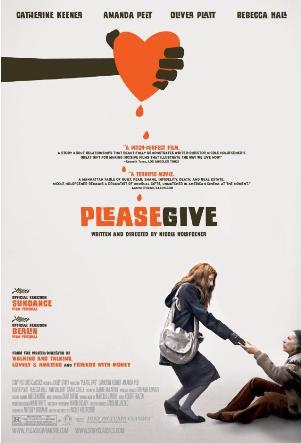
Please_Give_FilmWhat is Please Give about? The most succinct answer I can muster up is that it is about the simple rhythms of life. It’s about people rubbing up against each other, the neighbors you try and be nice too, but speak about behind closed doors. In writer-director Nicole Holofcener’s fifth collaboration with Catherine Keener, the latter is Kate, a woman who lives a life of uncomfortable dichotomy with her husband and teenage daughter.

Next door is the cranky grandma Andra, who is quite along in age, and she gets assistance from her granddaughters, who are both young professionals. Rebecca (Rebecca Hall) works as a radiology technician often spending her days giving mammograms, while her fashionable sister Mary (Amanda Peet) works as a cosmetologist. Their grandmother is not exactly the most agreeable person, and her acerbic nature earns the disdain of Mary and the quiet industriousness of Rebecca. They both have different ways of dealing with other people just as they have different ways of approaching love. Rebecca is quiet and looks for love in a nice young man. Mary constantly checks out the woman who stole her old boyfriend and embroils herself in an affair.

Meanwhile, Kate feels uncomfortable for buying Andra’s flat and waiting for her passing to start renovations. Likewise, in her joint venture with husband Alex, they buy people’s old possessions at estate sales and make major profits on their furniture. These issues along with a rebellious streak in her daughter, make Kate noticeably agitated, and she tries to overcompensate. She gives money to every homeless person she ever sees and tries to volunteer at numerous spots across town without much success.

The film suggests that we can tread a thin line on the margin of what is honest and what is termed “the ways of the world.” After all, if we balance it out with enough good deeds it ends up okay in the end, right? On her part, Kate has an odd way of dealing with her own sense of morality when it comes to her family business and the homeless on the street corner. Her husband is a generally agreeable man, who has no trouble with what they do, but he at least admits it, just like admitting when he flirts with other women.

Above all, I think Please Give boasts interesting female characters, in fact, they are the focal point of Holocener’s story, and it makes for a worthy character study in an industry that is often male-centric. Within these women is hypocrisy, pettiness, and a lot of insecurity, but it manages to be invariably funny as well as perturbing at times.

3.5/5 Stars

Speedy (1928)

speedy1It’s hard not to appreciate Harold Lloyd. His life was less tumultuous than Buster Keaton and during the 1920s he was more prolific than Charlie Chaplin. So if you look back at his career you can easily argue that he was not playing third fiddle to the other silent titans. He was their equal in many respects, and it’s only over the years that he’s fallen behind the others. But he deserves acknowledgment at the very least and his comedies such as Speedy make his case with rousing gimmicks and gags aplenty.

The film opens with Pop Dillon, the last of the horse-drawn streetcar drivers. He’s a kindly old man who lives with his radiant granddaughter Jane, who is faithfully by his side. But a corrupt railroad magnate is trying to buy him out, and he’s ready to go to great lengths to get what he wants. It’s about what we expect to happen, so the real entertainment factor comes with how we get there.

Enter Speedy (Harold Lloyd) a baseball-loving soda-jerk turned crazy cab driver and the sweetheart of Jane. It’s true that he starts out working the coffee counter with great dexterity while keeping up to date with the latest box scores of Murder’s Row. However, after a major blunder, he knows he won’t have a job when he gets back. Rather than stew in his misfortune, Speedy heads out on a Sunday afternoon in Coney Island with Jane. This proves to be a wonderful aside rather like in Sunrise: A Song of Two Humans, and there are a lot of great little gags being pulled by Lloyd, and others occur unwittingly. He tricks a myriad of folks with a dollar bill on a string and a crab in the pocket causes a lot of chaos. He even picks up a new unwanted friend in a hungry dog. But perhaps most of all the sequence is a fun nostalgia trip to the fair, showing off all the attractions circa 1928. It’s an eye-opening experience, and it still looks like quite a lot of fun.

speedy3The other section of the story begins with Speedy garnering a job as a cab driver, but he has an unfortunate aptness for picking up tickets. He does, however, pick up some precious cargo in Babe Ruth (playing himself) and it leads to a wonderfully raucous ride to Yankee Stadium courtesy of Speedy’s crazy maneuvering through the streets of New York. Even Lou Gehrig sneaks in on the fun with a wry grin.

As the last order of business Speedy must save Pop’s cart from utter extinction and what follows is a rip-roaring brawl in the streets between the young thugs and the old-timers. Instead of being suspended from a clock, Lloyd must race against it to get Pop’s stolen livelihood back to its track in time. Once more he puts his madcap driving to good use.

Speedy lives up to its name and certainly justifies the popularity of Harold Lloyd. Its strengths include a plethora of sight gags that play off the audience’s sense of dramatic irony. Put them in the hands of such a nerdish icon and it spells true comedic gold. It’s Lou Gehrig approved no less.

4/5 Stars

The Sessions (2012)

220px-The_Sessions_posterI was a bit skeptical of this film at first, but I can say unreservedly that it boasts true heart and sensitivity. In many respects, it reminds me of another film about a man with a so-called disability, The Diving Bell and the Butterfly. In both, a highly creative individual is able to defy their physical barriers and truly impact the world around them.

In the case of Mark O’Brien (John Hawkes), he graduated from Berkeley destined to become a journalist and poet, the only difference with him is that for most of his life he has been confined to an iron lung that keeps him alive. It seems like an obvious roadblock to success in life, and yet not so for Mark because he faces each day with a sense of humor and even a spirituality that is impressive. He relies on his caretakers for so much and yet they enjoy helping him because he is a generally kind spirit. First, it’s the beautiful Amanda (Annika Marks), who he sincerely professes his love to and then there’s Vera (Moon Bloodgood), who while frank, is still deeply concerned with his well-being. Furthermore, the local priest (William H. Macy) is equally willing to listen to Mark’s confessions, not simply about sins, but more importantly his life on a whole.

Mark’s a very transparent individual, who attacks life with a positivity and tenacity that goes beyond the physical. Wit becomes his precious ally in facing every day, and he also takes great care in the relationships around him. He wants to live his life to the fullest, and he won’t let an iron lung impede him. Thus, he decides that he would like to try and have sex since he is still a virgin and feels that he might not have long left to live. And so, after consulting with his priest and acknowledging the sensitive nature of the decision, he tentatively decides to go for it. Cheryl Cohen-Greene (Helen Hunt) becomes his sex surrogate, and yet she is more of a therapist than anything else. She helps Mark become more and more comfortable in his own body and there is a beautiful vulnerability and openness to their time together.

The Sessions proves that there can be depictions of sex that can be as tender and sensitive as the characters involved. It’s not some vulgar act or a simple gratification of desire. It has more significance than that, just as these characters carry more significance. Father Brendan is not a perfect character just as Mark is not perfect, but we appreciate them for their geniality and light touches of humor. As for Cheryl, she does a great favor for Mark, and yet in the process she herself is deeply moved by this man in front of her. He’s seemingly so weak, so unassuming, and yet there is so much vibrancy to him.

The day Mark dies is sad for all of us and gathered at his funeral are all the people we expect to be there. The Father gives a heartfelt eulogy as all the women he touched sit in the pews looking on. The beauty of this story is that Mark finally did find love quite by accident, and he touched so many lives in the process. Though not a perfect film, The Sessions is heartfelt and that covers a multitude of faults.

4/5 Stars

In Bruges (2007)

In_Bruges_PosterNear the end of the film, one of our main characters questions whether or not being stuck in Bruges is the equivalent to being in Hell. However, far from badmouthing the Flemish city, director Martin McDonagh actually makes it a fascinating backdrop for a film. It’s a city full of history, romanticism, mystery, and even peril. It just depends on how you look at it, with eyes of reverence or general disdain.

In Bruges, the film, only happens because two men have to make a quick getaway after knocking off a target in London. That is the life of a hit man. Quick work and then long periods of waiting. That is the majority of what we witness, following the existences of Ray (Colin Farrell) and Ken (Brendan Gleeson). Ray is a bit of a jerk sometimes and to him, Bruges is a living nightmare. Completely and utterly dull. But then he happens upon a fantastical film set starring a dwarf. There a beautiful woman Chloe (Clemence Poesy) catches his eye and then Bruges doesn’t seem so bad after all. At least for now.

Then there’s Ken. He’s not looking for casual companionship or booze. He has respect for the arts, the places of worship and the culture around him. Both men share foul Irish mouths and a general jadedness about their profession. After all, being a hitman is a living, but as Ray finds out it’s not without its stress. Shooting a little boy on accident takes its toll, and Ray must contemplate the entire framework of his morality. Meanwhile, Ken sticks by the phone and gets a call from their fiery boss Harry (Ralph Fiennes). He gets an order, and it catches him off guard. He already has his next assignment, but now he must attempt to reconcile orders with personal conviction. These are hitmen with a conscience.

Scum of the earth, yes, rough around the edges, maybe, yet somehow they still reveal their humanity. The miracle is that through the violence, we still find common ground to relate with them. We become thoroughly involved in this tale that, while darkly funny, is most certainly moving. When all the shots are fired, what we’re left with feels like a Shakespearian tragedy sprinkled with the absurdity of Bosch. Place all of this in front of the quaint Flemish setting and you have a rewarding adventure. I also recently saw Hot Fuzz and it seems that these films could almost be watched in tandem. Aside from both being British productions, they both have action, violence, and dark humor, but perhaps, more importantly, they exhibit genuine heart. That’s something not to be taken too lightly these days.

3.5/5 Stars