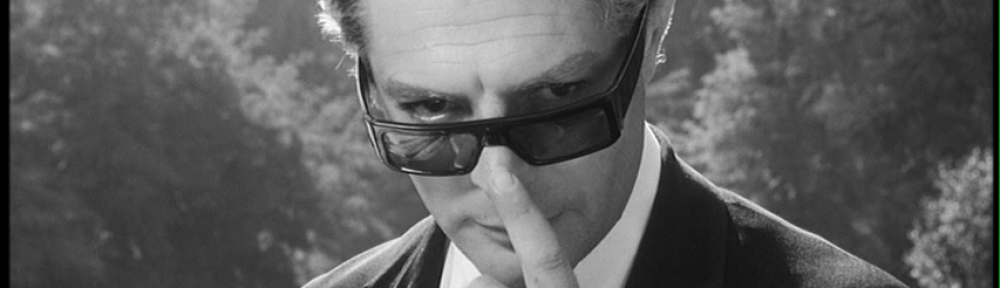
 I was a bit skeptical of this film at first, but I can say unreservedly that it boasts true heart and sensitivity. In many respects, it reminds me of another film about a man with a so-called disability, The Diving Bell and the Butterfly. In both, a highly creative individual is able to defy their physical barriers and truly impact the world around them.
In the case of Mark O’Brien (John Hawkes), he graduated from Berkeley destined to become a journalist and poet, the only difference with him is that for most of his life he has been confined to an iron lung that keeps him alive. It seems like an obvious roadblock to success in life, and yet not so for Mark because he faces each day with a sense of humor and even a spirituality that is impressive. He relies on his caretakers for so much and yet they enjoy helping him because he is a generally kind spirit. First, it’s the beautiful Amanda (Annika Marks), who he sincerely professes his love to and then there’s Vera (Moon Bloodgood), who while frank, is still deeply concerned with his well-being. Furthermore, the local priest (William H. Macy) is equally willing to listen to Mark’s confessions, not simply about sins, but more importantly his life on a whole.
Mark’s a very transparent individual, who attacks life with a positivity and tenacity that goes beyond the physical. Wit becomes his precious ally in facing every day, and he also takes great care in the relationships around him. He wants to live his life to the fullest, and he won’t let an iron lung impede him. Thus, he decides that he would like to try and have sex since he is still a virgin and feels that he might not have long left to live. And so, after consulting with his priest and acknowledging the sensitive nature of the decision, he tentatively decides to go for it. Cheryl Cohen-Greene (Helen Hunt) becomes his sex surrogate, and yet she is more of a therapist than anything else. She helps Mark become more and more comfortable in his own body and there is a beautiful vulnerability and openness to their time together.
The Sessions proves that there can be depictions of sex that can be as tender and sensitive as the characters involved. It’s not some vulgar act or a simple gratification of desire. It has more significance than that, just as these characters carry more significance. Father Brendan is not a perfect character just as Mark is not perfect, but we appreciate them for their geniality and light touches of humor. As for Cheryl, she does a great favor for Mark, and yet in the process she herself is deeply moved by this man in front of her. He’s seemingly so weak, so unassuming, and yet there is so much vibrancy to him.
The day Mark dies is sad for all of us and gathered at his funeral are all the people we expect to be there. The Father gives a heartfelt eulogy as all the women he touched sit in the pews looking on. The beauty of this story is that Mark finally did find love quite by accident, and he touched so many lives in the process. Though not a perfect film, The Sessions is heartfelt and that covers a multitude of faults.
4/5 Stars

 “On Sunday, August 13th, 1961, the eyes of America were on the nation’s capital, where Roger Maris was hitting home runs #44 and 45 against the Senators. On that same day, without any warning, the East German Communists sealed off the border between East and West Berlin. I only mention this to show the kind of people we’re dealing with—Real Shifty.” ~ James Cagney as C.R. MacNamara
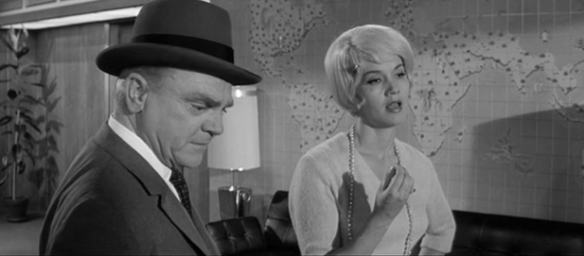 When he’s not getting English lessons or doing dictation with his shapely secretary (Liselotte Pulver), Mac is trying to swing a deal to start selling his billion-dollar beverage in the Soviet sector. He’s met by three bumbling boobs led by the portly Peripetchikoff (Leon Askin), who feel like heirs apparent to Ninotchka’s Russian trio.
 The monetized mayhem is complete with car chases, Soviet torture involving “Its Bitsy Teenie Weenie Polka Dot Bikini,” and a scramble to turn the belligerent Otto Piffl into a respectable capitalist. It’s a brilliant escapade blending social commentary and narrative hiccups as only Wilder could.


 Sabrina, Sabrina where have you been all my life? ~ William Holden as David Larabee
 There is a scene in the film where a group of friends is sitting around the dinner table in the Notting Hill district of London, and they are having a friendly after dinner competition to decide whose life is the most hopeless. The winner gets the last delectable piece of fudge. One person sitting at the table is seemingly out of place. Actress Anna Scott (Julia Roberts). Her face is plastered on double-decker buses all down the squares. She made $ 15 million on her last film, circa 1999. You would think she’s got it made. But this woman takes her turn and shares about her own brokenness. She’s had surgeries to maintain her beauty. The tabloids rake her life over the coals, and when she gets old, she will only be remembered as the shell of someone who used to be famous.
 Disney has scored again. On almost all accounts Zootopia is grade-A family entertainment. To address the elephant in the room, the film is rather formulaic in its hero’s journey and at times it feels like we are attempting to systematically check off all the necessary moments in the rise, fall, and redemption of our spunky heroine. However, there are moments of wit and grace that begin to slowly grab hold of us an audience. It, in turn, becomes ceaselessly inventive with this metropolis of anthropomorphic animals, whether it is the rhythms of daily life or the social issues present that look strangely familiar.
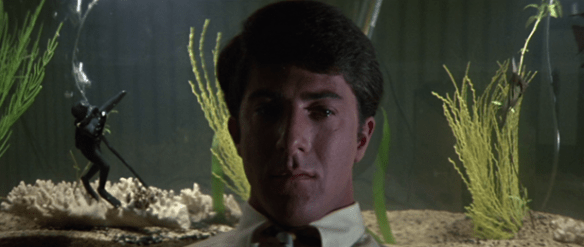 “You’re living at home. Is that right?
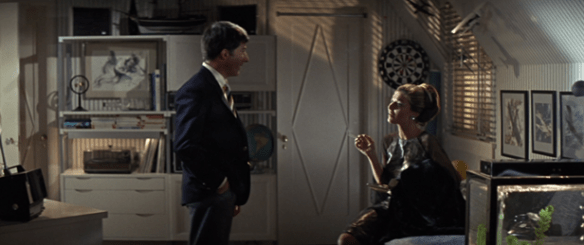 Then Mrs. Robinson coolly enters his life. It’s perhaps best signified when she tosses him the keys. They end up in the fish tank almost as if on purpose and after that she has him reeling for good. Soon he’s walking into the lion’s den (or lioness’s) as she expertly manipulates and elicits the precise response from him. In these moments the film is elevated by the awkward, huffing and puffing, and nervous chattering of Hoffman. We often forget the second part of his famed line, “Mrs. Robinson you’re trying to seduce me. Aren’t you?” His general naivete and hesitancy say it all.
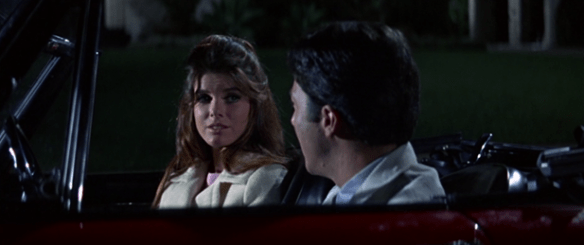 But when he meets Elaine Robinson and finally begins to connect with her on a peer-to-peer level, it’s something so profound to him. Having someone his own age that he can relate to, who feels the same unnamed apprehension and angst that strains on him. It’s what makes Ben become so mixed up. He has true feelings for her, while his affair with Mrs. Robinson only serves to poison all that could be good. And his illogical, unhealthy pursuit of Elaine continues to Berkeley where she is attending school. Still, Mrs. Robinson and her now estranged husband look to send their precious daughter far away from Benjamin Braddock.
 That’s what makes his final Herculean effort all the more climactic. He bursts in on her marriage to another man and whisks her off to another life altogether. A life that seems exciting at first, because, oh how great it is to be young and in love. But once they climb aboard that bus in their tattered garments, have a chance to sit down and really think about what they are embarking on, you see something else in their eyes. The laughter slowly dissipates and as they look around nervously, they begin to somber up. True, Ben is no longer alone in an airport terminal, he has a fellow traveler, but that does not make the future any less unpredictable or scary for that matter.
 4 Star Films