 A comedy romance in pantomime. That’s just exactly what City Lights is, because, despite the fact that talkies had been around for approximately 4 years, Chaplin was hesitant to transition his Tramp over to sound. In many ways, I can understand why since the universality of his character would be gone and Chaplin’s own voice would give a very different feel to the little man. With his great popularity and artistic control, Chaplin made this film and Modern Times without dialogue. All he used were synchronized sounds and musical scores. As audiences can attest to, it worked out just fine for him.
This film opens with the Tramp in all his glory sleeping on a statue during its public unveiling. He is rudely awakened and shooed off on his way. He drifts down the boulevards finally meeting a lowly flower girl, showing her kindness before moving on. Although I am partial to Paulette Goddard, Virginia Cherrill plays the blind girl believably and she is a wonderful love interest for Chaplin’s character.
His next acquaintance is a drunken millionaire (Harry Myers) bent on committing suicide. His attempt is unsuccessful partially in thanks to the Tramp. He even gives the man a few positive words as is his custom (Tomorrow the birds will sing, be brave, face life!).
And there you have it. Chaplin introduced his audience to the two people who would be closest to the little man. The two new chums head to a high society hang out where they nearly get in a fight over everything from a bottle of seltzer to a chair, and even the floor show.
The Tramp goes back to the girl, and as another act of kindness he purchases her whole basket of flowers for $10 and continues to masquerade as a high society swinger. As the next title card reads, the sober dawn awakens a different man. Thus, The Tramp is initially rejected by his friend from before, but the drunken millionaire gets reincarnated once again and they begin a wild rager. The next morning the cycle begins again with the Tramp being thrown out.
The Little Man has taken it upon himself to be somewhat of a guardian angel for the blind girl who has become his love. Money is needed if she wants to have a home, and despite getting fired from his job, he resolves to get the funds the next best way. In a boxing match. This is where my favorite sequence, which plays out in the ring, comes to fruition.
The Tramp is seemingly outgunned, but that does not stop him from duking it out. He uses the referee, hugs, and anything else at his disposal to try and not get clobbered. The scene had to be choreographed extensively because at moments it looks just like a dance perfectly synchronized between the three characters. The so-called dance becomes even more uproarious when he begins to tackle his opponent and then unknowingly takes out the ref next. The fight seems even with each man falling down repetitiously as the ref tries to say the count. Unfortunately, the little man cannot hold out and he loses the pot.
One final time he runs into his millionaire friend just back from Europe, and he gets the much-needed money for his girl. Matters are complicated by burglars and a misunderstanding with the police. All works out in the end and the flower girl has her home and enough over to get a surgery to allow her to regain her sight.
Chaplin’s character pays the cost though, winding up in jail because of the “stolen” funds. When he gets on the outside he is more destitute than ever, but the girl’s business is now flourishing.
He runs into her and eyes her happily. Little does she know who this man is. This is not the debonair gentlemen she was expecting. She laughingly proclaims, “I’ve made a conquest.”
Only when she touches his hand by chance, reverting back to her old self, does she comprehend who this really is. This is her savior, the one person who radically changed her entire life. He is dressed in tatters and barely has a penny to his name. But he did have kindness and compassion for her.
A lot has been said about the final moments of the film where she has her “aha” moment, and he responds accordingly. What strikes me is how Chaplin so effectively reveals the nervous charm of his character. His fingers are constantly near his mouth, flower in hand. He states the obvious (You can see now). Then, the film closes with his face lit up with another nervous smile, fingers still in mouth.
It is hard to say where the story goes from this point. That’s not the important part here, though. The important part is that in both of The Tramp’s relationships his two friends cannot see who he truly is. The girl is physically blind and the millionaire is blinded by his stupor. They easily accept him in certain circumstances and yet they truly do not know him.
He, on the other hand, seems to accept them no matter the person they are at that moment. He is faithful and compassionate to them in all circumstances. It seems that perhaps the Tramp truly knows them because he is not blinded like they are. Again, I marvel about how so much can be pondered thanks to the actions of an unassuming vagabond. He is a remarkable little man with a very big heart.
5/5 Stars
The Band Wagon (1953)
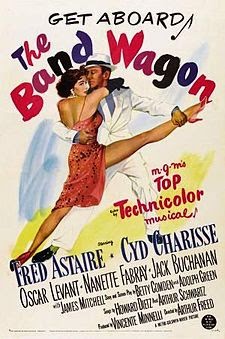 Going into this film I must admit that despite hearing good things, I had zero expectations. I must say I was pleasantly surprised by this Minnelli musical because it was a deft and often beautiful production. Channeling the same vein as Singin’ in the Rain and The Red Shoes, this film is a spectacle in its own right. You have headliners Fred Astaire and Cyd Charisse matched nicely. Oscar Levant and Nanette Fabray act as wonderful comic relief as the wedded playwrights, who also do some song and dance. Finally, there is Jack Buchanan, as the stereotypical theater maestro Jeffrey Cordova.
It all begins with Tony Hunter (Astaire) a washed up has-been who is headed to New York for some relaxation. There is little fanfare during his arrival except coming from his friends the Martons, who have a new production for him to star in. They get the famed Cordova on board and next comes an up and coming choreographer and his girlfriend, who is none other than the young starlet Gabrielle Gerard (Charisse)
Following an initial misunderstanding, the leads finally clear up their differences and push forward to make The Band Wagon the smash hit it is destined to be. However, Cordova has turned it into a modern-day Faust and when opening night comes the after party is more like a wake.
All the players seem strangely nonchalant and then the idea hits! Make The Band Wagon over again and take it on the road. Everyone in the cast from the bottom up is excited for the second chance with Hunter at the helm. All that is except choreographer Paul Byrd.
Despite Paul’s departure, Gaby is still enthusiastic and they turn the Band Wagon into the production that the Martons had envisioned from the beginning. Tony is a success once again, and he receives a round of rousing cheers from his new family. Gaby speaks for all of them (and herself) when she says they love him and believe that the show will go forever.
I immensely enjoyed many of the numbers including: “Shine Your Shoes,” with the camera following Astaire as he frolics around at an arcade with a shoeshine man. The extras, the exquisite set, and Astaire himself all culminate in an often comical and always upbeat number that is great fun to watch. Then, of course, there is the ever memorable “That’s Entertainment,” which even spawned a series of musical documentaries, and for good reason. The words and melody are quite a catchy ode to the stage. Perhaps the most beautiful sequence in the film involves Astaire and Charisse in “Dancing in the Dark” where they positively glide through Central Park together in perfect cadence. They move not as individuals but as a poetic unit in motion. It is fitting that it was their first dance together in the film.
For never seeing Cyd Charisse in another film (except briefly in Singin’ in the Rain), I must say that I really did enjoy her performance opposite the always likable Fred Astaire. Furthermore, I am in complete agreement with her character, “I don’t think a dancer should smoke,” it’s bad for the lungs.
The cameo of Ava Garner was an odd surprise (especially due to her resemblance to Charisse). Furthermore, I never thought it could exist, but this film proved me wrong. There is such a thing as a film-noir musical! That’s The Band Wagon for you folks! That’s Entertainment!
4.5/5 Stars
Walk, Don’t Run (1966)
 This was the last screen performance of legendary actor Cary Grant and for once he is not the one getting the girl. This time he is the matchmaker in this adaption of the earlier classic The More the Merrier. Grant’s character finds himself in Tokyo during the 1964 Olympics and the only room he can get is from a young English girl. This causes some difficulty but they make it work. It gets even more complicated after Grant meets a young American architect who is competing in a mysterious event in the Games. Sir William Rutland secretly puts the two young people together. It seems doomed from the beginning but through a wacky conclusion somehow it all works out in the end. Not a great film, but a decent swan song for Grant and it is certainly fun to have the film set in Tokyo.
3.5/5 Stars
Indiscreet (1958)
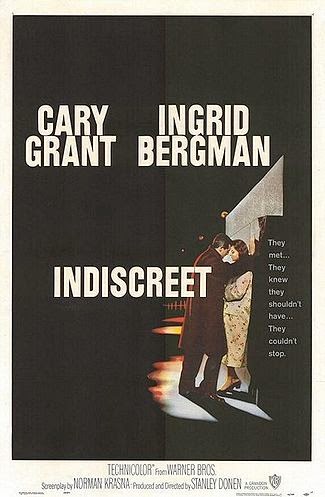 This is a solid romantic comedy which pairs the legendary Cary Grant and Ingrid Bergman one last time. Bergman is a well-known actress who has success, but has never experienced true love. Then she meets Philip Adams, a man who literally walks up to her door since he is a friend of her brother-in-law. They become acquainted and they turn into fast friends. Bergman finally feels she has found the one and their love grows. However, the only problem is that he is married and estranged from his wife. Little does she know what is really going on and yet when she does it throws their whole relationship into jeopardy. She has one final plan to get back at Grant and it really backfires, but in the end the two lovers get back together.
In this film it was nice to see two more middle aged stars paired. I enjoy Cary Grant with Audrey Hepburn or Grace Kelly, but I think Ingrid Bergman is more his contemporary. Some of the best sequences had to be during the ball. Here Grant shows he still has the physical comedy ability because at this time he had fell almost completely into the debonair gentleman persona. This is not a great romantic comedy but still a respectable piece from Stanley Donen.
3.5/5 Stars
Review: Modern Times (1936)
 Modern Times: A story of industry, individual enterprise, humanity crusading in the pursuit of happiness
With those words, Charlie Chaplin’s Modern Times opens with the final installment of The Little Tramp. Clocking in at a little under 90 minutes, Chaplin is still able to do so much, because he does not waste a single segment of film. This is one of the most wonderful pieces of social commentary that Chaplin was able to dream up to reflect the life and times of his audience — to reflect these modern times.
As was his style with The Great Dictator as well, he pokes fun and critiques his targets all under the guise of comedy. He sets the stage at the industrial factory that the Tramp works in. In a precursor to the famed I Love Lucy conveyor belt episode, it is the Tramp who must fight against the constant stream of nuts and bolts. Breaks and lunch become a thing of the past, and the little man suffers a nervous breakdown that leads to mayhem involving a wild ride through the cogs of the machinery as well as some oily madness.
Right off the bat, Chaplin poked fun at this mechanized system that is overseen by a Big Brother-type figure who spends his idle moments at his desk working on puzzles and reading Tarzan serials.
After the Tramp is forced to leave his job following the series of mishaps, he is confronted by numerous issues that Chaplin gleefully exploits. These include communism, the police force, prison, and even drugs (smuggled nose-powder).
Through the Tramp character, Chaplin comments that with the state of the nation during the Depression it was better to be in jail than out in the world. At least you got a bed and food. It was better than unemployment or starving to death with the police constantly on your backs ready to quell any riots.
These sorts of issues are explored through the character of the Gamin (Paulette Goddard). She becomes the Tramp’s love interest for the rest of the film, but the circumstances of their meeting are important. She was attempting to steal a loaf a bread from a bakery truck. It was not out of malice but desperation to feed her family.
The antics are often funny throughout these sequences, but the reality is, she and her sisters lose their father, and they are already motherless. The future is bleak and there is no help to be found with the Depression at its peak.
Here is where possibly my favorite part of the film begins. The two vagrants imagine themselves living in a middle-class household with fruit they can pick from outside their window and a cow that comes up to their door to be milked. They have a fully furnished home with furniture, ottomans, drapes and a fully stocked kitchen. This is their American Dream and that is where their hope lies. One could say that this was the consumerism culture of the post-war 1950s in a nutshell.
Next, the Tramp becomes a night watchman in a department store and for the evening he and the Gamin have the place all to themselves: To roller skate, eat, and use the beds and furs as they please. It is a moment of relaxing diversion from their normally grungy, monotonous lives.
Finally, they find a home as well. It is a real fixer-upper, but it’s home and that’s all that matters. They have each other, and they seem happy enough making do. The Tramp goes back to his 9 to 5 at the factory only to get kicked out once more. The pair of them land work at a local restaurant only to have juvenile officers come after the fugitive Gamin after an uproarious floor show from the Tramp.
Thus, they are once more on the road again. But that never stopped them before, and with his inexhaustible spirit the little man cheers on his love, “Buck up, never say die. We’ll get along!”
They walk off down the highway with new resolve but more importantly they have each other. If they ever do find that elusive lifestyle I am not sure it would be all that it is cracked up to be. The life of a Depression Era vagabond was no picnic, but I think the gift of the Tramp is he is able to make the best of all circumstances. He may look to a better lifestyle in the future with hope, but he does not need it to bring him happiness. Because the reality is, it never could completely satiate. I tip my hat to you for once little man, because for someone so humble you teach us a great deal about ourselves.
Chaplin did it again bringing us a near silent picture in the age of talkies. Although I admit it might seem awkward at times, this film uses sound and the score wonderfully to accentuate the images onscreen. Chaplin did not need the needless babble of dialogue unless it was for comic effect. After all, he and Paulette Goddard had enough chemistry beforehand, they didn’t need words.
5/5 Stars
Review: Harvey (1950)
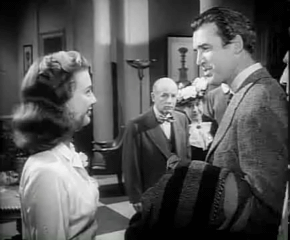 Why am I so infatuated by Harvey you ask? Let me clarify that. I’m not talking about the title rabbit. Why am I so enamored by this fantastical film from 1950? It all stems from Jimmy Stewart as Elwood P. Dowd, which was undoubtedly one of the most unique and remarkable performances in his storied film career.
Elwood is often quotable (Here, let me give you one of my cards, What did you have in mind, etc.). However, I think his innocence and perpetually pleasant demeanor is what makes him so wonderful to moviegoers, like myself, and to many of the characters in this story. He has his oddities, to be sure, but a little common courtesy and thoughtfulness is something that is often lacking in this world. Elwood is the complete epitome of that kind of individual. He always has an open invitation, he constantly insists that others enter before him, he has a penchant for giving flowers, he is the king of compliments, and he can put a positive spin on most anything (I Plan to leave. You want me to stay. Well, an element of conflict in any discussion’s a very good thing. It means everybody is taking part and nobody is left out).
.
Sure, his friend is a giant invisible rabbit named Harvey. So what? By the end of this film, I might be a little bit of a lunatic too, but after all, that’s being human for you. What makes us who we are, are those quirks that populate our persons. For Elwood it’s his pal Harvey, for others, it might be something more mundane than a giant invisible pal.
However, I will undoubtedly keep returning to Harvey, because it is a thoroughly enjoyable film that gives us a little lesson in life, and it certainly does not hurt that it is quite funny, in a whimsical sort of way.
As I noted already Stewart is wonderful, playing Mr. Dowd straight, but he is surrounded by an eclectic group including Josephine Hull, Cecil Kellaway, and Jesse White. They are necessary foils for his character to bump up against. Although Charles Drake and Peggy Dow are somewhat flat at times, both of them fit the sentimentality of the film just right. It’s a pity Dow was not in more films because she seems like such a lovely person on the screen. But why focus on the negative, because after all Elwood P. Dowd never would.
4/5 Stars
It Happened One Night (1934) – Updated

Hopefully no one holds this against me, but I have never been a big fan of Claudette Colbert. However, I will say that I am a Capra aficionado and Clark Gable is certainly a classic Hollywood star who is dynamic in this film. Thus, despite my hangups with Colbert, I can still thoroughly enjoy this romantic comedy, the so-called original screwball. It helps to have such comedic fellows as Roscoe Karns, Alan Hale Sr. (father of The Skipper) and Walter Connolly.
Peter Warne is the down on his luck newspaper man and Ellen Andrews is a socialite who feels trapped between her suffocating father and an upcoming marriage. Does this formula sound familiar? It undoubtedly is, but this was the original, all those following were impostors.
The unlikely pair begin a cross country trek towards the destination of New York. It includes uncomfortable bus rides, awkward overnight stays, a bit of hitchhiking, and eating carrots to survive.
Only in the movies could such a scenario play out and yet that is the fun because anything can happen one night or another. In this case all the caterwauling and antics lead to a happy ending. To think many people thought this film would not be very good! That was obviously proved wrong by numerous accolades. Just think this film came out 80 years ago and we are still watching it today! That is amazing. That is the power of the movies.
Peter Warne: A normal human being couldn’t live under the same roof with her without going nutty! She’s my idea of nothing!
Alexander Andrews: I asked you a simple question! Do you love her?
Peter Warne: Yes! But don’t hold that against me, I’m a little screwy myself!
5/5 Stars
It Happened One Night (1934)
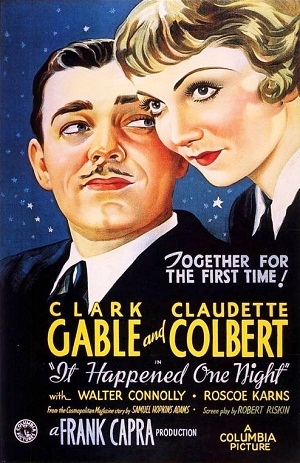 Starring Clark Gable and Claudette Colbert with director Frank Capra, this light romance pits a sunk newspaper man with a dissatisfied socialite. Colbert feels stuck in her life with a domineering father who does not approve of her marriage, and so she runs off to get away. While on a bus she meets the recently fired Peter (Gable) and there is immediate friction between them. However, realizing she is inexperienced, Peter watches out for her and they travel together. Finding out who she is, he is even more driven to get a story and stay with her. Along the way Colbert begins to fall in love but he does not immediately react. When he finally realizes his true feelings, the situation becomes complicated when Colbert returns to her father and fiancee. In the midst of the wedding she hears of Peter’s true love and runs off to him. By that evening they are married and the “walls of Jericho” come tumbling down. Gable and Colbert both do well in this film and Capra gives us another light classic.
5/5 Stars
Review: Singin’ in the Rain (1952)
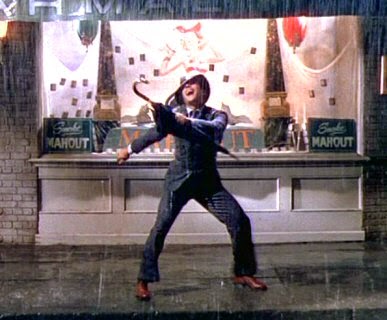 I always seem to get goosebumps during Gene Kelly’s “Singin’ in the Rain” number, because each time I see and hear it, there is still a new magic to it every time. You see when I was young, before I knew all the classics, first and foremost, I knew this gem of a film. It is such a wonderful buildup to that moment with such personal favorites as “Make em’ Laugh” and “Moses Supposes.” Then you have the always popular “Good Morning” with not only Kelly but Donald O’Connor and Debbie Reynolds performing. Great stuff! There’s tireless choreography that goes into many of those sequences but it comes off so effortlessly and it brings us into the moment. There those wonderful, brief instances when you lose yourself in the music, the magic, and so on.
As the story goes, the three friends save the failing “Dueling Cavalier” by losing the simple “talkie” gimmick and making it a musical by dubbing the squeaky-voiced Lena Lamont (Jean Hagen). Cathy (Reynolds) no longer is a bit player, and she gains the acknowledgment that she deserves. Then Don Lockwood (Kelly) gets the girl who burst out of a cake. Cosmo Brown (O’Connor) is along for the ride staying with Don through thick and through thin, even calling him a cab when necessary. He’s a true friend in a million.
Although Kelly had a career with other high points (arguably never as high as this one), I am always slightly saddened that O’Connor and Reynolds never reached another apex like this in their subsequent careers. But they were both so great here, we must simply cherish this film for what it is.
Even to this day, the film holds up, and that is a tribute to the writing of Betty Comden and Adolph Green highlighting the infant Hollywood and the advent of talkies. In the same breath, it’s both a satire of the movie star culture and still a love letter to that same cottage industry. The only film with a similar dissection of Hollywood’s Golden Age is another 50s classic in Sunset Boulevard. The big difference is that Wilder’s film is chock full of drama and darkness. Singin’ in the Rain will always and forever be a light, fun musical with a lot of laughs. It is constantly quotable whether it is “dignity, always dignity” or “I CAN’T stand it!”
Jean Hagen is always the butt of everyone’s jokes, but she is indeed very funny with the most annoying voice in the history of cinema (She can’t act, she can’t sing, she can’t dance. Triple threat). You also have other fine performers like Millard Mitchell as studio head R.F., and then appearances by Cyd Charisse and Rita Moreno who made a name for themselves as dancers in the ensuing years. And is it just me or does Donald O’Connor remind others of Danny Kaye? He not only cracks the jokes, but he is a wonderful all-around performer. Although O’Connor was undoubtedly a better dancer.
All in all, this is a timeless classic and it will undoubtedly keep that title for as long as people watch movies. Now I hope it starts pouring buckets of rain so I can go outside and stomp around in the puddles. I will let you know if I come down with pneumonia. But until that happens I’ll enjoy every minute of it. I entreat you to do the same.
5/5 Stars
The Shop Around the Corner (1940)
 Starring James Stewart and Margaret Sullavan with direction by Ernst Lubitsch, the film follows the events in a little shop in Budapest Hungary. Alfred Kralik (Stewart) is the most respected employee in the shop and when Ms. Novak (Sullivan) comes in he advises her no jobs are open. However, she does land one and thus begins their rocky relationship. They are constantly at each others throats arguing. Both of them want to end the conflict on a good note as they go their separate ways to marry people that they were corresponding with by letter. When Stewart is to finally meet his unknown lover, he is shocked to look in and see Ms. Novak. Through a series of events she finally figures out he was the writer of all her letters and the two former enemies fall in love. This unorthodox romance has good characters and comedic moments that make it enjoyable to watch.
4.5/5 Stars
 4 Star Films