Swing Time (1936)

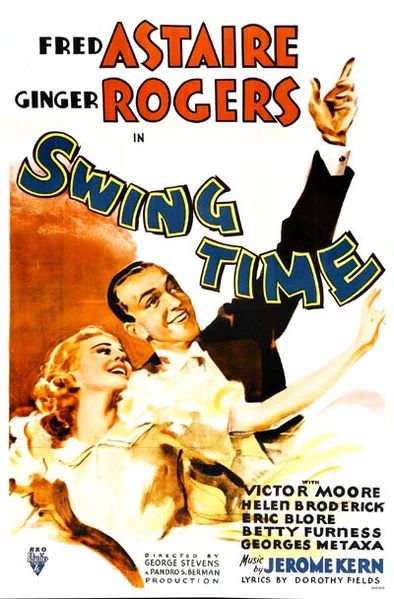
0c747-394px-swing-time-1935Starring Fred Astaire and Ginger Rogers with director George Stevens, this light film is like a screwball romance with a lot of added dancing. Astaire is a man who has missed his wedding and he agrees to go off to the city with a friend so he can make money to bring back. There he meets a fiery dance teacher accidentally and then they begin to perform together. As “Lucky” (Astaire) and his friend try to survive by gambling with the little money they have, he begins to fall for Penny (Rogers). However, she does not find out until later that he already has a fiancee. When she realizes the situation she goes to marry another. In the end everything is all a big mistake full of laughter and of course everything is made right again. There is no denying that Astaire and Rogers are not only good dancers but good performers. Many of the numbers they dance and sing are memorable like “The Way You Look Tonight,” Pick Yourself Up,” and of course “Waltz in Swing Time.”

4.5/5 Stars

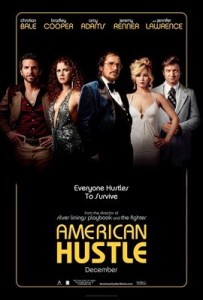
American Hustle (2013)

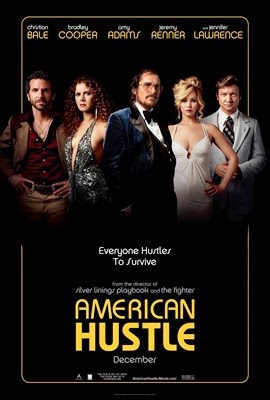
f88cd-american_hustle_2013_posterFrom the get-go, this film sets the tone when we are cheekily told that “some of this actually happened.” Not that it’s based on a true story or based on actual events, but some of this might be true and other parts might be livened up a bit. Then we are thrown into a story we do not quite understand as of yet. All we know is that it’s the 1970s, the hair is crazy, the clothes are tacky by today’s standards, and America’s “Horse With No Name” still sounds good even after all these years.

For me, if this film was all about the story it would be okay, but the reason to watch it is really for the characters. Each one is a caricature who we can hardly take seriously, and yet in many respects, they are going through some very serious stuff. Christian Bale is a con man with an epic comb-over, a pot belly to match, and a Bronx accident, wearing his ever-present shades. He is one of the smartest con men around, but he also has a family life since he married a widowed woman and adopted her young son.

Amy Adams is the stylishly smart dame he meets at a party, and the two of them start a lucrative partnership upping the profitability of his conning enterprise.  Adams character hustles everyone with her fake English accent and identity, that over time it seems like she even seems to believe it herself until it is too late.

They are flying high and the two of them are drawn to the confidence and smarts they see in each other. However, in one instance they are not quite careful enough, and they have the Feds giving them heat. Namely, Bradley Cooper’s character who is out to make a name for himself. He is a man will a lot of attitude and a primped hairstyle, yet he seemingly knows very little. He forces Bale and Adams to work under him in order to trap others and of course they do.

But his plan becomes so big that the con becomes extremely volatile. It involves an Atlantic City mayor played by Jeremy Renner, the Mob, some congressmen, and even a senator, who have all unwittingly gotten themselves into something illegal.

Bale and Adams are trapped living lies that they must stop at some point because he has formed a bond with Renner and she is still masquerading as Lady Edith Greensley.

The final act ends with one final con, and I must admit that I was satisfied with the ending because as a member of the audience I expected a twist to come and, sure enough, it came. But I would have never have guessed it. It ultimately lived up to its name American Hustle.

I think what makes the performances good in this film are not the fact that they are lifelike or even realistic, but they are, in fact, larger than life. Sure, people like Irving, Richie Dimaso, Sydney Prosser, and Rosalyn probably did walk this earth, but the film highlights all their quirks and idiosyncrasies. Whether it is how they talk, dress, or even how they do their hair. Furthermore, they have even messier and crazier personal lives than their hair, and that’s saying a lot. These are not the kind of folks that you would want for friends, and yet could it be possible that there is a little bit of these characters in each one of us? Do we still live in a world where the Carmines are the victims and the real perpetrators get away scot-free? It’s something to ask ourselves.

I’m not sure why people compare this film to Scorsese, perhaps because it is a crime film, it takes place in the 1970s, it features the Mob, or it shows off one of Scorsese’s acting icons in Robert de Niro. No matter the reason, American Hustle is a separate entity that seems completely different from Scorsese. That does not make it bad, just unique. And that it is. You have to give David O. Russell credit for teaming his two previous casts (The Fighter and Silver Linings Playbook) in this one for an acting extravaganza. It will be difficult to top this one as far as acting power goes. I must admit I was a sucker for the music too.

4.5/5 Stars

Charade (1963)

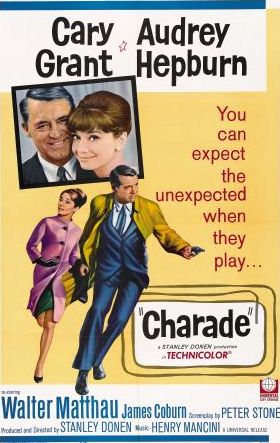
Starring the romantic pair of Cary Grant and Audrey Hepburn, with Walter Matthau, James Coburn, and George Kennedy, this film is considered the best “Hitchcock film” which the director did not make. While on vacation, Grant and Hepburn first meet briefly and then she returns to her home Paris. Hepburn goes there only to find out her husband, who she wanted to divorce, has been murdered. When meeting with a CIA man (Matthau), she learns that her husband and three buddies stole some money during a war but the three chums never got their shares. Upon meeting Grant again, he agrees to help Regina (Hepburn) and also says he is looking for the money. Through a series of events the three other men are all killed and everything seems to point to Grant. Hepburn runs for her life with Grant close behind and winds up meeting the CIA man. However, everything is not as it seems and after a shoot out Hepburn finally realizes the truth. Along with the thrills this movie has a nice score and a touch of playful comedy (including Grant’s many aliases including Peter Joshua, Alexander Dyle, Adam Canfield, etc.). Cary Grant was hesitant of playing opposite Hepburn since he was quite a bit older, but that is used nicely in the film as a source of even more comedy. Furthermore, Mancini’s score gives the film a 1960s spy vibe or I guess I should say agent… Hope you enjoy Stanley Donen‘s Charade.

4/5 Stars

Roman Holiday (1953)

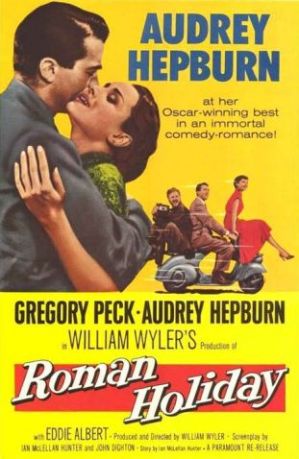
3fd3e-roman_holidayStarring Gregory Peck and Audrey Hepburn with direction by William Wyler, this movie has one of the greatest romances ever depicted on screen. Hepburn is a young princess named Ann on a trip to a foreign country. However, she is constantly bored from the rigidness of her life. On a whim she escapes in the night and finds herself sleepily wandering the streets of Rome. An American journalist (Peck) happens upon the disorientated princess and eventually decides to take her in since she seems lost. Soon enough he figures out just who she is and decides to take her through Rome with a friend (Eddie Albert) so they can get a scoop. Together they take her through the city to explore and secretly take candid photos.

However, Peck soon finds himself falling in love and he cannot bring himself to submit the article. With the thanks of the princess, they are left with the simple satisfaction that they were able to spend the day together. Peck and Hepburn are both wonderful in this one and the story is heartwarming and funny.

I tried to figure out why it is always so enjoyable coming back to this film. Was it the romantic chemistry of Peck and Hepburn, the timeless setting of Rome? Or perhaps is it the direction by William Wyler, the screenplay by blacklisted Dalton Trumbo, or the support work of Eddie Albert as Irving? Undoubtedly all of these wonderful occurrences play some part in making this film a classic.

Most of all it struck me that much like Jacques Tati’s Mr. Hulot’s Holiday, this is not just a film. It is quite like a vacation for the audience and we get to enjoy it along with all the main players. We get the privilege of taking part in all the adventure and the laughs. By the end we don’t want it to end but like any holiday we must say goodbye and wait until our next vacation comes around. Thus, it seems that Roman Holiday never gets old because the audience is constantly looking forward to the time away in 1950s Rome with our romantic stars.

5/5 Stars

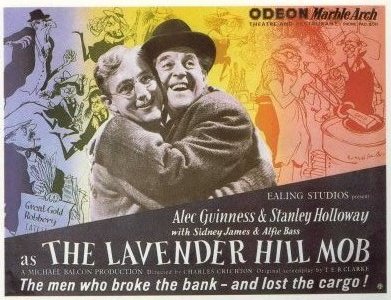
The Lavender Hill Mob (1951)

1dadb-the_lavender_hill_mobStarring Alec Guinness and David Holloway this Ealing Studios comedy-heist film begins with an older man recounting how he got away with a large amount of gold bullion. His job had been to ride with gold shipments while they were transported. However, soon he met a quirky fellow partial to art and together they devised a plan to get the gold. They enlisted the help of two small-time criminals. The day of the caper was far from smooth and they must improvise. With luck they get away and the two instigators take their prize to Paris. There they have disastrous results and arrive back in England eventually to even more craziness. This film had endearing characters and its share of comical moments. If you pay attention you can see a young Audrey Hepburn for a blink of an eye near the beginning too!

4.5/5 Stars

It’s a Wonderful Life (1946)

This is not only a Christmas classic but a classic in any sense of the word. It is the best of Stewart and Capra adding up to one of the most heartwarming stories of all time.  This may exhibit Stewart is his everyman role once again, but it breaks away from Mr. Smith in many ways making it another uniquely great film. A film like this that makes you know and feel for characters so profoundly is certainly worth watching.

Starring Jimmy Stewart and Donna Reed with a fantastic supporting cast,  the film tells the life story of George Bailey. We watch with the angel Clarence as he sees George’s life unfold. George saves his brother Harry as a boy and as a result, loses hearing in his ear. He works in the Bedford Falls drugstore and keeps the proprietor Mr. Gower from making a deadly mistake. Later on, he plans to travel the world and go to college so he can escape his hometown and do bigger and better things. But once more he sacrifices. One fateful day, he doesn’t know it yet, but he meets the love of his life Mary, and the same day his kindly father has a stroke. Soon after,  Harry goes off to college and George is left holding down the fort at their father’s old building and loan. He builds up all those around him with selfless kindness, while simultaneously standing up to the grumpy millionaire Mr. Potter. Eventually, he marries Mary and has children. First, during the Depression George gives up his honeymoon to keep the building and loan open. Then, during WWII while his brother and others become heroes, George stays in Bedford Falls because of his poor hearing. In this post-war period, the story picks up in the present.

Although, by unfortunate circumstances George Bailey finds himself contemplating suicide after the absent-minded Uncle Billy misplaces $8,000. That’s when Clarence comes into his life to show George just how important he really is. George sees a world where Harry is dead, Mr. Gower is a disgrace, Martini does not own the bar, his mother has no sons, Uncle Billy is insane, Violet is disgraced, Bert and Ernie do not know him, Mary is an old maid, and Mr. Potter has monopolized Bedford Falls.

Once he gets his life back George finds immediate joy and gains so much because of his friends and family. He runs through the streets of Bedford Falls yelling out “Merry Christmas,” because he is simply grateful to live again. Miraculously, the whole town rallies around him, and George reaps the reward for all he has sowed over the years. Clarence is finally awarded his wings and George Bailey is the richest man in town. There is nothing much to do after this film but simply be happy and sing “Auld Lang Syne.” It is a Wonderful film in many ways, with a wonderful cast, and a wonderful message. It has some of the greatest character development of any film ever because you do not simply become attached to one man but an entire community. That’s what makes the scene where Uncle Billy loses the money one of the most difficult for me to watch. Each and every time I’m so attached to these people. Even if I already know the resolution, I cannot bear for anything bad to happen to them. In fact, it is interesting to focus on just one of the supporting characters and see how they are affected by the life of George Bailey. It makes me ask myself if I were to die tomorrow would anyone care? We know in the case of George they certainly would.

I am further reminded of the phrase that is written on the wall of the building and loan, “You can only take with you, that which you give away.” This is what George Bailey did, and I believe it is something that each and every one of us should be mindful of. He is a great character not only because James Stewart played him genuinely and with such magnetism and heart, but because he was such a sacrificial figure. True, this is a sentimental film given the title and the director, but it is paramount to realize the progression this film follows. George must sink into the depths of his despair and disillusionment before he can truly realize that It’s a Wonderful Life. I would challenge you the next time you watch this film, to not simply acknowledge it as perennial Christmas fare, but look a bit deeper because there is so much more here. As always, Attaboy Clarence! You did it again.

5/5 Stars

A Hard Day’s Night (1964)

5b3a7-a_hard_days_night_movieposterA Hard Day’s Night directed by Richard Lester and starring the Beatles, showcases the eponymous album and plays out rather like a documentary more than a full-fledged movie. 

The opening sequence has the Fab Four running frantically away from a mob of fans as they try to get to their train without being carried off. On the train we get a bit more acquainted in a day in the life of the Liverpool Lads. Paul’s clean but crafty grandfather has come along for a change of pace and the boys try to pick up girls, while their manager attempts to keep them in line. They get to their destination, but would rather dance, talk with girls, and frolic in an open field rather than answer fan mail and attend a press conference. They find themselves in trouble a number of times in between rehearsals for their show. It might be Paul’s grandfather getting in trouble at a casino, George taking a wrong turn, or John being cheeky and childish. Then, thanks to Paul’s grandfather they lose Ringo when he decides to get out and live a little! Time is running out and so they try to run him down with the police hot on their trail. They make it to their performance in time and Beatlemania takes over as they perform complete with swooning girls and deafening noise. The Beatles are a success and then they quickly head off in a helicopter, stopping one of Grandad’s schemes in the process. 

We can only assume they were heading to American and as we all know the rest was history. I read an interview with Bob Dylan once and he said the true 1960s did not really start until about 1965. With Marx Brother antics and their challenging of authority you could say that the Beatles led this change. They may have looked like four clean cut boys, but their music, hairstyle, and nonconformist demeanor, at times, reflected a new generation. If you like the Beatles’ music this film is for you, and it also gives an interesting representation of 1960s London.
 
4.5/5 Stars

Midnight in Paris (2011)

8d293-midnight_in_paris_posterDirected and written by Woody Allen and starring Owen Wilson, this film is a nostalgic piece of romantic fantasy. 

Gil is a successful screenwriter, who is attempting to finish his first novel, and he is in Paris with his wife (Rachel McAdams). She dismisses his work on a nostalgia shop because she feels it is not as worthwhile as his screenwriting career. Gil is infatuated with everything about Paris, while his wife is content with fine dining and shopping with her parents and wine tasting with stuffy friends. 

Then one evening Gil wanders the streets of Paris, and at Midnight a 1920s style car pulls up and he is invited in. Over the course of the evening, he meets the likes of F. Scott Fitzgerald, Zelda Fitzgerald, and even Ernest Hemingway, who agrees to read his manuscript. The following night he brings his wife but she leaves and he is picked up once again at midnight. This time he talks with Hemingway, meets Gertrude Stein, Pablo Picasso, and the beautiful Adriana (Mario Cotillard). Gil continues to return at night much to his wife’s annoyance and his father-in-law’s disapproval. He meets legendary surrealists such as Salvador Dali, Man Ray, and Luis Bunuel, who he inspires with his conversation. 

He finds Adriana’s diary in the present and meets a fellow aficionado (Lea Seydoux) of the olden days. Gil returns to the 1920s and Adriana convinces him to go back to the 1890s where they meet Toulouse-Lautrec, Gauguin, and Degas. This is where Adriana is happy and despite their love, Gil realizes that even though nostalgia is good it is best to live in the present. Gil gets some final feedback on his manuscript and then breaks up with Inez, realizing it was not meant to be. However, Gil finally does find someone who shares his love of Paris in the rain. 

Allen made this film really enjoyable for me because he brought to life many people such as Hemingway, Dali, Bunuel, and others. This type of history fascinates me much like Gil, and it was fun to see these figures represented in the flesh by the likes of Tom Hiddleston, Kathy Bates, and Adrien Brody. That being said, this film carries a good lesson about living your life in the present. I would have initially said that Owen Wilson seemed wrong for this film, but I think he did a wonderful portraying Gil as a man mesmerized by the golden days of Paris.

4/5 Stars


Amelie (2001)

Amelie is one of those films that you will either love it or you won’t because the fact is, it marches to the beat of a different drum. It is a unique, whimsical Parisian world full of a quirky cast of characters headed by Audrey Tatou. 

The ever present narrator opens the film by relating Amelie’s childhood as a young girl who was forced to occupy her time with fantasy and her imagination. Soon we are introduced to this quirky little girl and all the other figures who take up space in her life. She was isolated and her mother died when she was very young leaving her to live with her father. When she is older, Amelie moves on and begins to work in a café. Then in 1997 the death of Princess Di and a bit of fate cause her to devote her life to bringing happiness to other people. She plays matchmaker, reunites an old man with boyhood treasures, guides a blind man through the city, spurs her father to travel through use of his beloved gnome, gives renewed hope to a widowed landlady, and puts an abusive grocer back in his place. Amid her many good deeds Amelie makes friends with as solitary and brittle painter as well as Lucien, the kindly assistant at the corner grocery. Most importantly Amelie begins to realize she is falling for an unknown man after she accidentally retrieves a scrapbook of his. She tries to deliver it back to him anonymously and it becomes a wild goose chase all across Paris, full of arrows, flyers, notes, and rendezvous. However, her shyness makes it difficult for her to approach him, but with a little prodding she finally goes after Nino Quincampoix and he finally meets his mysterious girl. 

This film had me in stitches at times,  attempting to catch up at times, and completely mesmerized in other moments. This film has wonderful characters and such an idiosyncratic, and often abrupt way of telling their story. It was a change of pace that I enjoyed and I believe that Amelie is an enjoyable albeit eccentric romantic comedy.

4.5/5 Stars


Arsenic and Old Lace (1944)

Directed by Frank Capra and starring Cary Grant with a zany and strange supporting cast, this film adapted from a play is a farcical  black comedy. Grant is a drama critic who is just recently married and he is about to go on his honeymoon. However, he is horrified to learn that his two unassuming aunts have killed hopeless, old men with arsenic-laced tea. He must also deal with one brother who believes he is Teddy Roosevelt and a recently returned brother who is wanted for murder. Add these crazy characters, a peculiar German doctor, some policemen, and you are in for a wild ride of wacky antics and mock terror. All the while Grant tries to balance his many problems which nearly go awry. Everything gets figured out in the end and Grant carries his bride away. To say the least this film is very odd and perhaps not Capra’s best. It does culminate nicely in the end however, closing the story on a high note. The cast includes Priscilla Lane, Raymond Massey, Josephine Hull, Peter Lorre, Jean Adair, Jack Carson, and John Alexander

3.5/5 Stars