The Accused (1949)

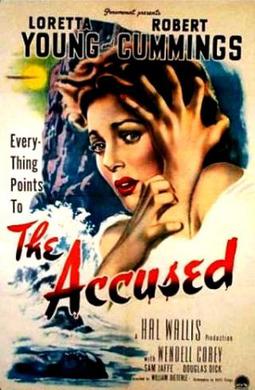
Loretta Young must own a pair of the most luminous eyes in the history of Hollywood, and in black and white, she’s incandescent. More important than that, she’s one of the great sympathetic heroines of Classic Hollywood. In The Accused, she plays both a woman in danger and a working professional. They don’t have to be mutually exclusive, and it makes for a far more nuanced character, especially for the post-war 40s.

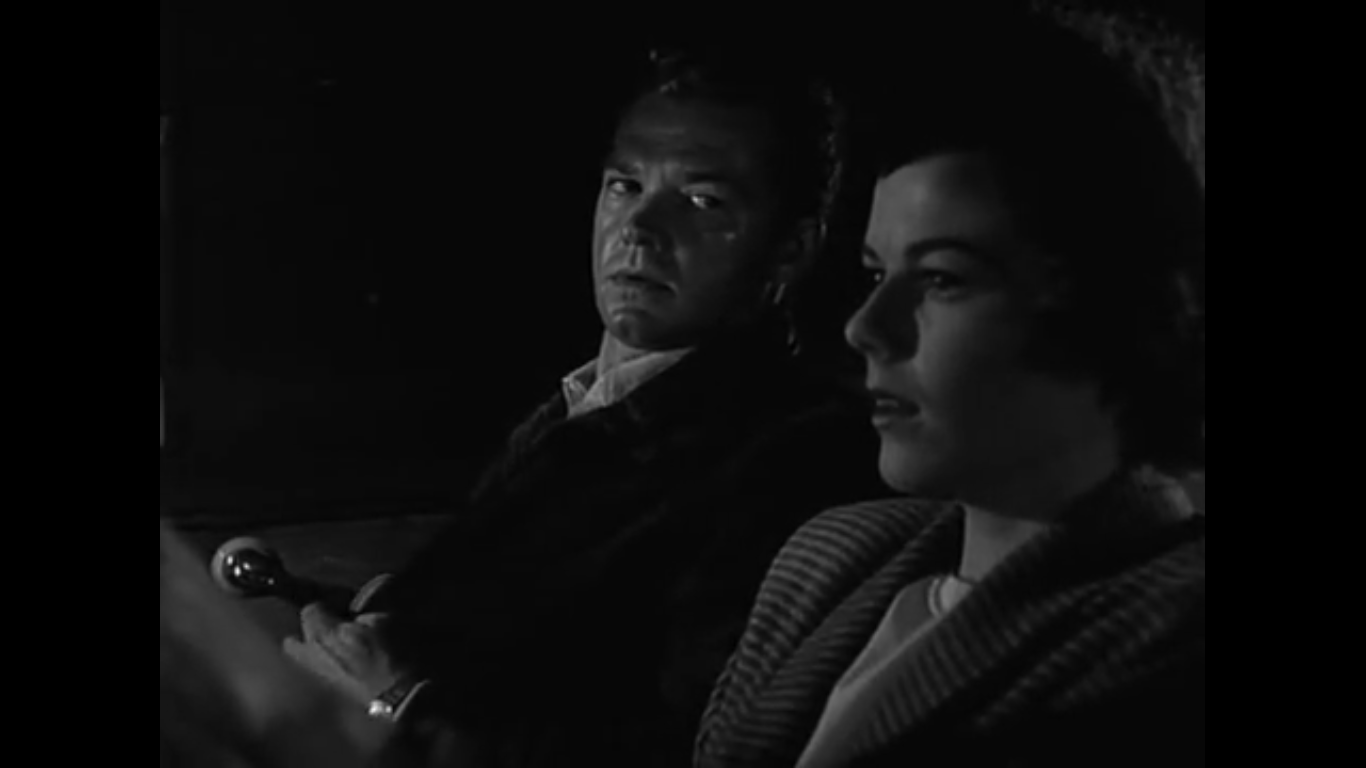
Like poor Ida Lupino in Woman in Hiding, we meet her in the dead of night on the road. It’s evident she’s frantic and on the run from something. She gets picked up by a truck driver, though she’s not much for conversation, and he lets her off without much consequence.

A flashback introduces her pre-existing life as Dr. Wilma Tuttle, a professor of psychology at an unnamed university in L.A. It’s finals week as students take their exams and classes wind down.

We get an inkling of drama as we watch the wordless interaction between the fidgety teacher with a leering male student, mirroring her every move and, no doubt, turning in a Bluebook analyzing her own personal psychoses from biting on pencils to tugging on her hair. It’s a queasy relationship because, although she’s in a position of authority, she also seems helpless to do anything.

Douglas Dick does well as the slimy, if charismatic, co-ed who looks ready to entrap his teacher; he’s a kind of skeevy-eyed homme fatale playing teacher’s pet and coaxing his favorite instructor along — first offering her a ride home and then stopping by the seaside in Malibu.

Without using too much equivocation, it becomes a movie about assault and trauma, with the feminine victim becoming the accused, much like Anne Baxter in Blue Gardenia. There needn’t be a movie, but in the 1940s, she operates out of a position of fear in a predominantly male world.

Wilma’s internal monologue gets a bit oppressive, becoming a monotonous crutch, but the cavalcade of performers who come alongside Young are a worthwhile reason to stay the course. Robert Cummings and Wendell Corey aren’t showstoppers necessarily, and still, they have the prerequisite appeal to see them through the career of a reliable actor in Hollywood.

We meet lawyer Warren Ford (Cummings) and Lt. Ted Dorgan (Corey) together at Malibu police headquarters. The former was the boy’s guardian, and the policeman is investigating the case. After the boy’s body washed up on the beach, it was deemed an accident and no foul play.

No fingerprints were found in the car. Immediately, as an audience, we’re doing our mental calculations. Could this be, or is it merely a glaring plot hole? I’ll save you the trouble. Young was wearing gloves as a true lady does in the 1940s. Or else she wiped them…

The film’s asset comes with how it ties all of its primary relationships into twisted knots, all in the name of interpersonal tension. Warren has some personal connection with the deceased, but he quickly becomes enamored with the lady professor, and why wouldn’t he be? They effectively mix work and play, with Cummings being the smooth silk to Corey’s abrasive sandpaper approach.

In its latter half, The Accused becomes a Columbo episode from the inside out. We have our Hollywood star. There’s an opening prologue before the police get involved, and she falls in love. She also begins to feel trapped by what otherwise would be everyday occurrences as she tries to protect herself and cover her tracks.

One of her pupils is a primary suspect. She’s also requested to drop off the dead boy’s Bluebook, which might incriminate her. The truck driver who picked her up in the dead of night is called in as an eyewitness. Then, there’s the business of a missing note that she left for the dead boy and then misplaced. She must find and incinerate it.

Corey’s character is difficult to read. There’s something horrid about him, far worse than his incarnation in Rear Window, and yet he tries to play it off as an act or all part of the game he’s embroiled in on the daily as he does his job. It’s a bit of a curious surprise to see both Henry Travers and Sam Jaffe taking up positions in the police lab. There’s a rational inevitability about the work they do.

Wilma feels the heat, and a date at a boxing match brings out all her latent traumas to the surface again as she transposes the boxer in the ring with the boy she killed. In one sense, there needn’t be a movie because she is a victim, though she digs a bigger hole for herself.

Ultimately, the movie’s denouement is open-ended. The courtroom proceedings are just beginning, and her fate is far from settled, but as we stare into the dazzling eyes of Loretta Young, it’s easy enough to know she will beat the rap with a hedge of innocence around her.

If you dwell a little too much on the implications, the optics that Dorgan also observes might be a flaw in the justice system — if sympathetic appearances are taken as everything. However, in a movie about a woman who is assaulted and then plays the culprit out of fear, it’s at least par for the course.

There’s also a couple of oddities: Corey flirts with her in the courtroom, and Cummings is effectively defending her for killing his “nephew,” though they weren’t close. And still, Corey’s impish sense of humor and Cummings’s passionate orations for his beloved don’t change the bottom line.

This is Loretta Young’s movie, and even as she plays an intelligent woman often hassled and infantilized by the world around her, there’s something so winsome and generous about her performance. The noir elements burn off to make it a story of reclamation and vindication of a life. If you go digging, it does feel like a movie moderately ahead of its time, courtesy of screenwriter Ketti Fring and Young, respectively.

3.5/5 Stars

The Unsuspected (1947)

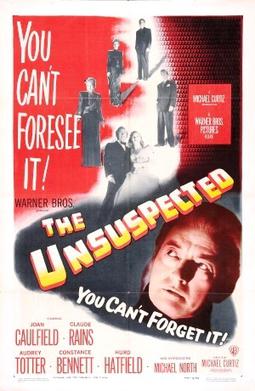
The Unsuspected has a delicious opening dripping with a foreboding chiaroscuro atmosphere. It’s the dead of night. There’s a woman on the telephone tucked away in a back room. The familiar face of Audrey Totter picks up on the other end of the line. She’s out enjoying herself at a club with some male company.

Someone emerges and descends on the flustered secretary. Moments later, she winds up hung from the ceiling — a grisly murder framed as suicide. For ’40s Hollywood, it doesn’t pull punches.

Since Totter is a consummate femme fatale, it’s easy to question what angle she could possibly have in this whole affair. We don’t have the answers, and so we must follow the rest of the film to find out; it’s a genuine pleasure to be afforded the opportunity.

If it’s not apparent already, we are in the hands of professionals with Warner Bros. stalwart Michael Curtiz directing a screenplay by Ranald MacDougall and the director’s wife, Bess Meredyth.

The film is dressed up nicely for a bit of noirish drama with the added benefit of the shadowy, gothic interiors when the story moves to the abode of one Victor Grandison (Claude Rain), a revered radio mystery performer who is reeling after the death of his secretary and the loss of his beloved niece who perished recently at sea.

Rains is an actor with such poise and regality, but building off his turn in Notorious, he plays another complicated figure. It’s a role worthy of his talents, and he anchors a packed menagerie of the usual suspects.

Totter as the sultry Althea always seems to take vindictive pleasure in playing the venomous harlot, and she’s just about one of the best from the era. With her arched eyebrows and intense eyes, she reflects the perfect epitome of an opportunistic, venomous vamp. Though it’s possible she only looks the part. Other people are willing to stoop to murder.

Her inebriated wet noodle of a husband (Hurd Hatfield) feels like a non-entity in comparison, and that’s precisely the point. Fred Clark always has a shifty authority about him, and he’s a close associate of Grandison. Over time, we realize he’s actually the local police detective, a handy man to have as a friend…

The ubiquitous Classic Hollywood heavy Jack Lambert is introduced in one lingering shot, looking out the window of some dive hotel window. What could he have to do with all of this? It’s difficult to implicate him immediately, but we know he’s waiting there for something.

Constance Bennett might just be the finest addition to the cast. She was the wit and experience like Eve Arden a la Mildred Pierce, both beautiful and able to trade banter and wisecracks with just about anyone. She lends a sense of levity to a movie that might otherwise feel oppressively dour. In some ways, she lives above the fray of everyone else, providing a kind of narrative escape valve for the audience.

If you think you already have a line on The Unsuspected, it’s a joy to mention it’s a movie full of perplexing wrinkles. A mysterious stranger (Michael North) shows up on their doorstep unannounced like a specter, and he asks to see Grandison. His next claim is even more outlandish: This young man, Steven Howard, was secretly married to Grandison’s niece Matilda.

Then, a dead person is resurrected like an apparition. Joan Caulfield’s character suffers from a cruel lapse in memory. What happened to her? I should have noted it sooner, but she has the aura like Gene Tierney in Laura, down to the portrait.

Like that picture, it’s a movie spent deciphering people’s motives; it feels like everyone is keeping secrets and no one wants to tell. Is it a case of elaborate gaslighting? It’s not unthinkable in the noir worlds of the 1940s, and Caufield is a ready victim, so sweet and innocent.

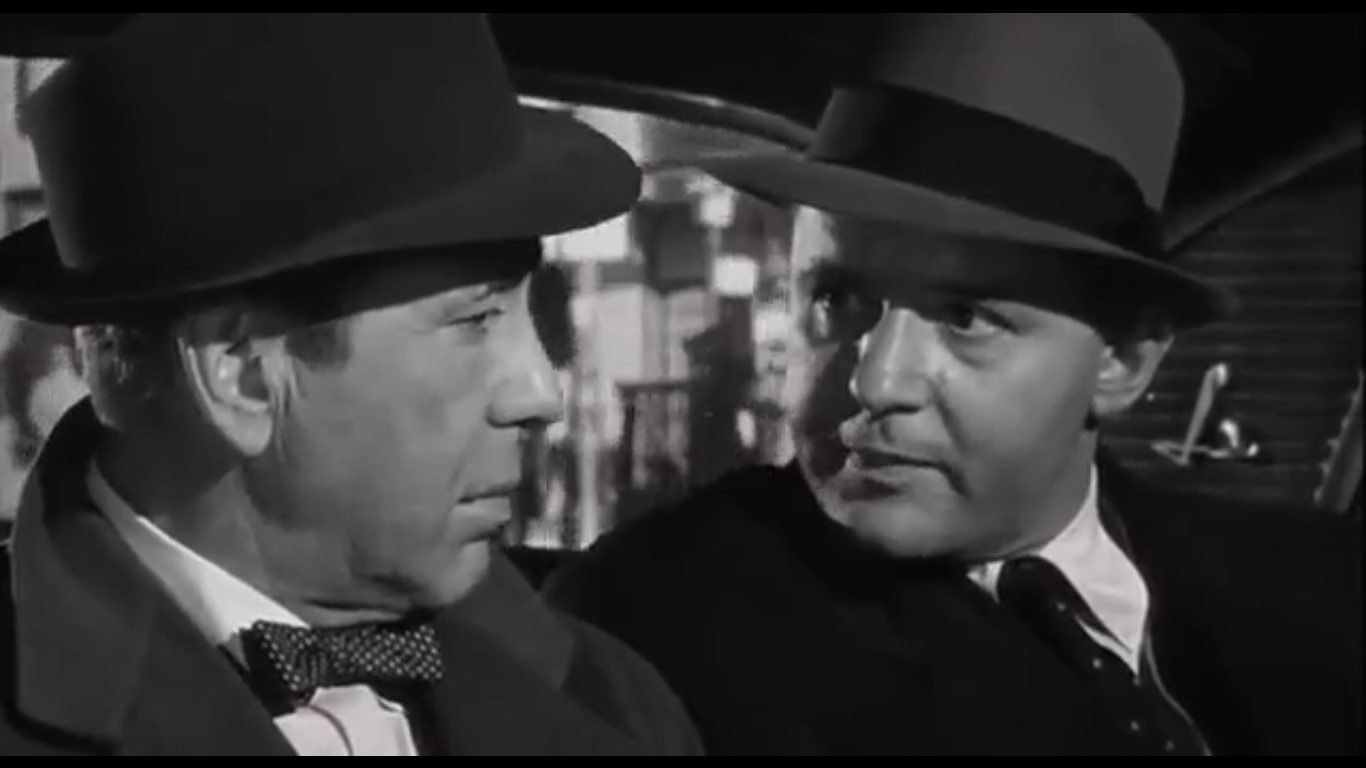
What are we to think? Who can we trust? In taxicabs, we find conspirators of a different kind — those trying to ascertain the truth behind a suicide. Because they know there is more than meets the eye.

Matilda returns to her home, lighting it up with the glow of her virginal white countenance in the dark recesses of the family mansion. It feels like oil and water. She does not belong there, but the story is still unresolved. There are several skin-crawling moments as Matilda is subjected to danger with a touch of Hitchcock’s Suspicion (1941). Something’s not quite right, but perhaps her mind is playing tricks…We know she’s not crazy.

It might be low-hanging fruit, but the crucial nature of the antagonist makes the film feel like an early precursor to the Columbo series. Although we don’t know everything right away, eventually the audience is given the keys to the murder, and we must sit back in earnest to watch how they play out, from botched murders to car chases with the police toward the city dump.

I’m also intrigued by the trappings offered by murder mystery radio programs, and though they are used in other films like Abbott and Costello’s Who Done It?, to my knowledge, they aren’t as prevalent in Classical Hollywood as one might imagine.

There’s a delightful meta-quality with Grandison narrating plotlines that played out in the story around him, adding another perturbing layer for the filmmakers to play with. It feels especially fitting here, thanks to Rains’s mellifluous voice and the continued prevalence of mystery and true crime stories to this day. It seems like we still can’t get enough of them over 75 years later. The Unsuspected represents the best of Warner Bros. and the mystery genre, wrapped up in a movie that rarely gets talked about.

4/5 Stars

Mystery Train (1989)

I hold an immediate affinity for the images at the core of Mystery Train: A Japanese couple (Youki Kudo and Masatoshi Nagase) riding a train. This is the ’80s so they’ve got a walkman with an audiocassette tape, and it’s blaring Elvis! It becomes apparent they are making a pilgrimage to Graceland so famously immortalized by Paul Simon. The song “Mystery Train” becomes an apropos and uncanny way to enter the story while paying homage to the King.

Jim Jarmusch always strikes me as such an open-minded and curious filmmaker. Modern society speaks in terms of diversity and inclusion, but the beauty of watching a Jarmusch picture, it’s the fact he’s not looking for these things in order to meet some quota. He seems generally interested by the stories and perspectives a whole host of characters can provide him, and his films benefit greatly from this enduring proclivity.

Regardless of where the funding came from, who else would consider making a film about two Japanese youth in search of Elvis Presley in the 1980s? They spend the first several minutes speaking a language that the primary audience probably does not understand. They likewise are bewildered by a upbeat yet motormouthed docent at Sun Records. Still, somehow shared passions for Carl Perkins, Jerry Lee Lewis, Roy Orbison et al., draw them together in inextricable ways.

There’s something perfectly fated about the whole thing with Screaming Jay Hawkins as a rather flamboyant hotel clerk aided by a youthful bellhop (Cinque Lee). I don’t know how to describe it but Hawkins has a command or a sway over the picture rather like Wolfman Jack in American Graffiti. His presence is felt and becomes so indelible in accentuating an aura. He comes to represent a certain era and a place in human form.

Jarmusch’s characters of choice often feel like sojourners, strangers in a strange land and Memphis is such a place. It is a film that features degradation — cracked pavements, garish neon lights, and portions of the world that are not perfectly manicured. What a concept. It’s almost like Jarmusch is giving us the real world albeit composed through his own cinematic lens. It’s no coincidence it has this kind of baked-in glow of Paris, Texas another film of geographical Americana captured so exquisitely by Robby Muller

It’s only a personal observation but my level enjoyment slightly decreased with each descending story. As someone who journeyed in Japan and went to one of the greatest concerts of my life in Yokohama, I feel this kind of kinship with these Japanese youths in their pilgrimage to Elvis and Carl Perkins. Also, on another level, this is a point of view we just don’t often see in movies of the 1980s or even today. Jarmusch is not using them as some kind of stereotypical punchline. He’s genuinely interested in their story and allowing it to play out in front of us.

Then, there’s Nicoletta Braschi in part two. She’s told a ghost story by a dubious stranger and gives him a tip to be left alone. She too seeks asylum for the night at the same hotel and gains a chatty roommate (Elizabeth Bracco) who is linked to our final vignette.

This last interlude with Steve Buscemi feels like it exists in the time capsule moment of a certain era where Tarrantino, the Coens, and others were making these stylized, often grotesque comedies. Elvis (Joe Strummer) gained his nickname inexplicably, but he’s also started to become unhinged because his girlfriend went up and left him. The cocktail of booze and firearms make his buddies Charlie (Buscemi) and Will Robinson (Rick Aviles) uneasy. Although it feels more like an absurd episode of The Twilight Zone than Lost in Space.

Regardless of my own preferences, Jarmusch still gives his world a sense of purposefulness. Again, it’s this serendipitous quality reminiscent of Jacques Demy’s fated films where lives cross paths and intersect in deeply poignant ways.

There’s something somehow elegant about the structure. It’s certainly premeditated and Jarmusch purportedly was inspired by classical literary styles in constructing his triptych, but it’s also a genuine pleasure to watch it unfurl.

The movie revolves on the axis of a few shared moments and places: A hotel, a radio DJ (Tom Waits) playing “Blue Moon,” and a gunshot. But it’s not like they’re all building to some kind of collective crescendo; it’s more so just a passing indication of how lives, whether they mean to be or not, are often interrelated.

Characters orbit each other and interact in these preordained ways that reflect the mind of the maker, in this case, Jarmusch. There’s something oddly compelling and comic about it, but there’s simultaneously a sense of comfort. We have order and a kind of narrative symmetry leading back out from whence we came.

Jarmusch is calling on the poetry of the ages and so in a movie that seems to have a free and laissez-faire attitude, there’s still a very clear order behind it, three distinct threads end-to-end and yet still interwoven into a tapestry that we can appreciate. Mystery Train represents the best in cinematic storytelling — with purposeful composition and aesthetics — but also a sense of aura and inscrutability.

It’s funny and yet when it’s over there’s also satisfaction and a hint of wistfulness. I wish there were more of its ilk today. The movie that’s come the closest is Paterson — another modern jewel from Jim Jarmusch. I see that film in a new light as a much older, wiser, and more forthcoming Masatoshi Nagase sits down on a bench with Adam Driver.

Again, it is a story about the human journey, how we are all travelers in some sense, and what a beautiful thing it is to relish the road because it can lead us to so many beguiling places if we take the time.

4/5 Stars

The Intruder (1962)

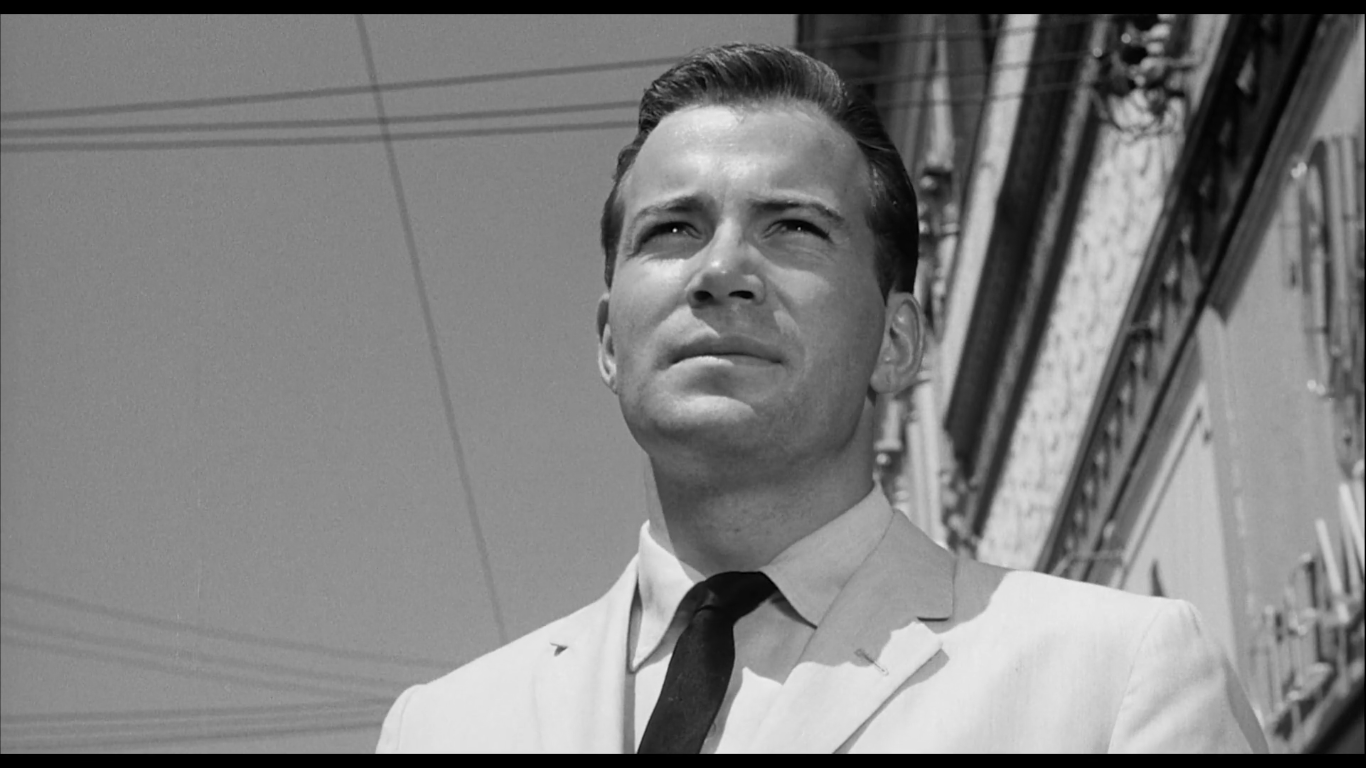
Before he became a caricature of his former self, even before the days of Captain Kirk and pop culture canonization, The Intruder is a reminder of something else in William Shatner. He still feels ripe and almost dangerous with a charisma that has yet to be calcified or even corroded by time.

The same could be said of Roger Corman at least if you only have a perfunctory understanding of his career like me. He is the master of fast and cheap entertainment turned out for profit at a rapid rate. Surely, The Intruder doesn’t fit into the patchwork of his career.

Before we blandly christen him the “King of Schlock,” a more nuanced observation seems to be in order, considering both his talents and his ambitions. Others must speak to this more knowledgeably. All I can say is that this specific film totally obliterates any preconceived notions of what we are getting.

Shatner stars as Adam Cramer, a self-described social reformer with a skeevy look in his eye to go with a cool disposition. He’s headed out on the latest bus to help the locals fight the government implementation of integration in the town’s high school. Under the guise of the freedom-loving Patrick Henry Society, he’s ready to stir up some action. Give me Liberty or Give me Death (though mostly death). In other words, a real creep.

He sets up shop at the local hotel — it bleeds with crusty southern hospitality — feeling like a stronghold for a racist status quo. He’s put up by a sweet ol’ lady while his next-door neighbors, a gregarious salesman (Leo Penn), and his flirtatious wife (Jeanne Cooper) don’t leave much to the imagination. We know what they’re doing and they don’t much care who knows it. It’s a good thing because the walls are especially thin in a place such as this.

Although the film is primarily white-centric, for a white audience, there are some black characters playing crucial roles on the periphery. One is the local minister, a man of faith who takes his calling seriously. He exhorts the youngest members of his congregation in meekness and prays over these 10 lambs from his flock. He’s well aware they are about to enter the valley of the shadow, a space no young person should have to be subjected to. Still, the letter of the law in some ways falls on their side in the face of threat and injury.

One evening on a grand old southern estate Cramer holds a rally to rile up the townspeople, spewing all sorts of epithets, and appealing to their spirit of discontentment.  The NAACP is a communist front, headed by a Jew. It’s all a sham. The government can’t be trusted and The Patrick Henry Society is tasked with preaching the truth — at least his version of it.

As we watch the masses be swayed and he skillfully plays them like a marionette with public opinion in his palm, the deviousness comes into full color. He’s a Lonesome Rhodes-type figure who uses his own magnetism to get what he wants.

When the whites, armed with their newfound ammunition, take to the streets ready to victimize a black family driving home the movie becomes too real. It’s almost like the film was overly cognizant of its time with an incisiveness toward the hot-button issues of the age. Even today it feels gutting to watch whether fiction or not. The images strike too close.

Shatner riding in a hooded caravan with a gang toting a cross through the black community is horrifying. There’s a faceless dynamiting of a church with the faithful minister left for dead. The only other time I recall something comparable in mainstream Hollywood was the mobbish vitriol in Phenix City Story a few years earlier. To Kill a Mockingbird is wistfully nostalgic in comparison. Right or wrong, The Intruder has no such illusions.

Cramer is a man who happily takes a prison sentence telling a wealthy backer (Robert Emhardt) to never underestimate a jail sentence — remember Socrates, Lenin, Hitler… How you can conflate all these men says so much about you. And of course, there’s no mention of Dr. King. This is not the kind of man to dignify a fellow reformer on the other team with an acknowledgment.

The most curious figure (aside from Cramer) is Tom McDaniel (Frank Maxwell). He’s a southern man. He’s been inculcated with the prevailing sentiments of the South, but he also seems to have a higher standard. It’s partially because he’s the herald of the local news — he has journalistic standards — but there’s something else we have to spend time with him to figure out. His wife disagrees. Grandpa wants to disown him. His daughter (Beverly Lunsford) is probably still trying to make sense of it all. Regardless, he believes the law must be carried out.

I don’t know if we ever get a clear indication of why. Although he’s not the only one we can say this about. I’m not sure if we ever get a precise reason for Cramer’s actions either. He’s not a Southerner and there’s never a clear indication he’s truly aligned with the white community, at least not when it gets right down to it. He’s not a Southerner. But he knows he can manipulate them for his purposes.

My fear is that the film is still too much the pipe dream of well-meaning moviemakers where southern guilt all of sudden turns a few solitary individuals into men and women of conscience. Maybe this is historically true. I don’t know, but for all the stories that ended like this with a life saved and a wolf in sheep’s clothing defrocked, we know that history was not always so forgiving. It is strewn with the names of men and women who were degraded, intimidated, and often killed.

That’s why part of me rumbles with a deep sentiment that must be acknowledged. It wants to cry out and warn folks not to see this movie. The inclination begins when they threaten to flip a black family’s car and reverberates again when a young white woman gets coerced into crying rape against a fellow black student named Joey (Charles Barnes).

There’s almost something indecent and profane about it as it echoes things that really came to pass. It’s this fine line I don’t know quite how to reconcile. Because I’ve rarely seen a movie this fierce and unflinching for the era, and yet in the same breath is this what is required then or now? It’s an open-ended rhetorical question. I don’t know the answer.

If the box office receipts are testament enough, the movie didn’t make much of a dent but for entirely different reasons. Roger Corman seems to have made his own implicit response. He never made another such picture again instead relegating his talents to Vincent Price Poe dramas and other such fare blessing the film world in another way. Yes, it was cheap entertainment, but also a breeding ground for some of the up-and-coming stars of the New Hollywood generation.

He did in fact make his own diagnosis of the film’s lack of success, which might be telling if not altogether definitive:

“I think it failed for two reasons. One: the audience at that time, the early sixties, simply didn’t want to see a picture about racial integration. Two: it was more of a lecture. From that moment on I thought my films should be entertainment on the surface and I should deliver any theme or idea or concept beneath the surface.”

Still, with a man’s face buried in the grass, a man fallen from grace head first, The Intruder totally reframes my perceptions of the now chubby anachronism of Shatner’s persona. I won’t say it redeems it so much as it augments it with a kind of duplicitous venom. It’s a new astounding contour to his career.

I’m still not sure if that’s a hearty recommendation or not. This is a very triggering film and a deeply onerous watch. The discerning viewer should make their own judgments. Because for some this kind of burden might be necessary. For others, it might be too heavy to bear.

4/5 Stars


Note: This review was written before Roger Corman’s passing on May 9, 2024

The Harder They Fall (1956): Bogey’s Last Film

As the saying goes, the bigger they are, the harder they fall and Toro is a big man. He’s a sculptable Argentinian bumpkin who will quickly be fashioned into a killer in the boxing ring. Rod Steiger plays Nick Benko, a shifty promoter looking to groom his latest talent and set him up for success. It has nothing to do with actual training.

First, he calls in a veteran sportswriter to stir up some good publicity. Things have changed. No one wants to fight anymore when they could go to college. It’s more like playacting than an actual sport. You’ve got to give the audience a show and that means publicity (and staging the results). Eddie Willis (Humphrey Bogart) has long been concerned with holding onto his self-respect in the journalistic profession. Now he’s finally caved to Benko’s racket because he wants to get ahead for once in his life. His coffers aren’t as full as they could be.

It becomes increasingly apparent, in spite of all of Nick’s high words and cajoling, he’s obviously no good. Eddie knows what it all means as he watches a dirty fight and the ensuing repercussions of each subsequent business agreement. Nick’s operation is taken care of by an army of hoodlums. All these faces pop up here and there, making appearances and showing up ringside or in hotel rooms. Bogart joins the king of the creeps by pocketing 10% for himself if he can keep them out of jams.

While Bogart carries the picture, I couldn’t help thinking about some of the intriguing sparring partners he has — not the big names but the likes of Harold Stone and Edward Andrews. Because the movie feels like an analysis of the entire ecosystem and why people do the things they do. An added tinge of realism is given by real-life fighters like Jersey Joe Walcott and Max Baer.

Jan Sterling appears in a role reversal playing the principled wife watching her husband slowly slip away from her as he’s swallowed up by his all-consuming job. At first, I was intrigued until she slowly evaporates in a part that does not avail her the opportunity to do anything substantial.

It’s necessary to take a brief moment to mention screenwriter Budd Schulberg too. Like A Face in the Crowd, it’s a story documenting the perils of television and media in general. Toro is no Lonesome Rhodes; he’s a bit of a stooge, but the men behind him are able to orchestrate everything to easily manipulate a response out of their target audience, and it’s all for monetary gain.

I’ve always heard mention of the collaboration between Schulberg and Spike Lee focusing on the bouts between Joe Louis and Max Schmelling. Although the younger director vowed to get the production made after his friend’s passing, it’s still reassuring to know Schulberg already had a portrait of the boxing world put to the screen. Not surprisingly, The Harder They Fall is unsentimental, and yet it still manages to humanize many of the fighters as victims of a system.

What strikes me about the film is what it decides to spotlight and what it leaves to our imaginations. We know the reason for all these back parlor deals — it’s to prop up the gambling — but the movie rarely pays this much heed. It’s simply understood. And also the movie focuses on the families and the business outside the ring. It’s as if everything between the ropes is already a foregone conclusion, and it is, so we hardly need to focus there.

Instead, it’s the drama beforehand: Chief (Abel Fernandez) won’t take a dive because his family is in the audience. Then, there’s Dundee (Pat Comiskey) an old journeyman dealing with head trauma from his last fight. He’s barely ready to face off against the new challenger, and it doesn’t bode well. Still, each fight paves the way for Toro’s chance at the champion (Max Baer) and some real promising money. This is what Nick has been striving for from the beginning.

There’s an abrasive whininess to Steiger’s whole performance that keeps everyone on edge. I can understand any complaints of the actor being too intense, but he’s also one of the primary attractions because his unscrupulous fixer personifies everything crooked about the racket. It’s always gangsters or businessmen in suits with all the power, but Steiger effectively makes these skeevy mugs into slimy parasites. He feels like a new, different brand of antagonist, and frankly, he makes Bogey and the audience sick. The movie wouldn’t work without him.

It comes off as one of the most bloodthirsty and unsentimental boxing pictures of the era because they let this boy get absolutely butchered in the ring — building him up — only for him to get annihilated. And it’s all for money.

By the end, it’s almost ludicrous. Like A Face in the Crowd or even Network. Toro gets his brains beat out; he’s fully commoditized and then sold like chattel, and he comes out on the other side with nothing and no one to look after his interests. He’s been cast to the pavement as disposable goods.

Eddie holds the only grain of decency left and with his moral character eroding, he must make the decision to finally stand up for something greater. It’s a nervy performance from Bogart because it never resorts to bravado or any grand showing. He’s an older, wearier man now, and it shows.

Cancer would take his life far too soon, but by relinquishing the gangster roles, he offers up a different side of himself that we could not have expected without an earlier movie like In a Lonely Place. He really is a great one. I realized part of the reason I was reluctant to see the picture was that I didn’t want to acknowledge his career actually came to an end. Even if it was well over 70 years ago, I still miss Humphrey Bogart to this day.

4/5 Stars

Orson Welles: Mr. Arkadin (1955) and Compulsion (1959)

Mr. Arkadin (also known as Confidential Report) has the abundance of canted angles and striking visual flourishes one usually attributes to the films of Orson Welles. It also boasts his ever more disorienting sense of space and shot-reverse-shot even as the international cast, financing, and locales outside the prying eyes of Hollywood map his labyrinthian journey to continue making movies.

His entry into this particular story is a small-time smuggler, Guy Van Stratten. There’s something abrasive and unplaceable about Robert Arden. It’s rather like when non-English-speaking filmmakers will cast an American, and it sounds tone-deaf in a picture that otherwise feels normal. Regardless, he receives a tip-off from a dying man, and it sends him in search of something…

Arkadin, an aristocratic Russian, as played by Welles, is really another version of Harry Lime from The Third Man with everyone talking about him and wanting to meet him as he remains just out of reach and hidden behind a mask at a masquerade party.

Stratten has ambitions to get in with the daughter of the enigmatic Arkadin. Welles casts his wife Paola Mori to play his carefree young daughter (albeit dubbed). In the end, the gruff answer-seeker winds up globetrotting after Arkadin, hired by the man himself to see if he can dig up any dirt on him. It feels like the ultimate act of paranoia if in fact a double-cross isn’t in order.

While his accomplice Mily (Patricia Medina) is out on her own, he crosses paths with the likes of Michael Redgrave, an eccentric pawnbroker providing some leads, and then Akim Tamiroff who is also somehow implicated in a web of conspiracy.

Plot notwithstanding, Mr. Arkadin feels increasingly emblematic of what Welles’s cinema became after his earlier successes. He was scrounging around for funding, cobbling together films all across Europe with a cadre of international talent, and increasingly drastic creative choices.

It’s evident in a picture like The Other Side of the Wind generations later, which historically took years to be completed long after Welles’s death. It does feel like every subsequent picture after Kane continued to be a monumental struggle, and it’s some small marvel that each one got made for any number of reasons. Add Mr. Arkadin to the list.

It’s not explicitly Shakespearian, but it has a certain gravitas blended with the cheap smuttiness of noir street corners and pulp novels. We are treated to a Wellesian Christmas party. The focal point is a rather perturbing visual carousel full of jocund gaiety and lurking menace capped off by a band playing “Silent Night.”

Ask me to say exactly what we’ve watched with all the various plot details, and I don’t dare try. But it bears the markers of Welles, full of flourishes and at one time both mystifying and inexorable. It’s easy to criticize the flaws, but Orson Welles hardly makes mediocre pictures. There’s always a gloriously messy vision behind them. It’s the same with Mr. Arkadin.

3.5/5 Stars

Compulsion (1959)

I never thought about it much until his passing but there’s something about Dean Stockwell in his young adult years and even his later roles that’s reminiscent of James Dean. He’s not emotive in the same way as the method actors; he’s a button-upped clean-cut version with his own neuroses.

They have some facial similarities, true, but it comes down to something more difficult to pin down when it comes to actors, whether eccentricities or the bits of business that draw in your gaze so you can’t help but watch them at work. With Stockwell, it’s something he was able to draw upon later in his career when he had a reemergence and a renaissance; acting seemed fun again.

In 1959, James Dean was gone for a few years already and Stockwell was still closer to the beginning of his career than the end. He plays one two young men who have read too much about Nietzsche’s superman believing themselves to be above the law.

Bradford Gilman is his counterpart a disingenuous sociopath who knows how to throw his charisma and influence around. Both Arthur and Judd are different than normal college students, but Arthur knows how to play the game. Then, when they’re alone in each other’s company he’s able to dominate the other boy as they play out their sick fantasies.

In one moment, stirred by his accomplice Judd takes a girl to observe some birds — it happens to be near where a boy was killed — the bird calls in the distance play against the increasingly uncomfortable conversation. He plans to force himself on her, and though he tries he cannot bring himself to go through with it. There’s a sliver of decency still left inside of him.

Soon enough he and Artie are brought in for questioning by E.G. Marshall, a calm and collected beacon of authority. I’ve never seen The Defenders, but I could see him carrying it off with a level of pragmatic stability. Artie’s the one who walks in the room and tries to flip all the power dynamics. He pointedly stays standing as Marshall questions him sitting down. He’s confident enough not to be thrown off his game though he implicates them soon enough. They must vie for their lives in the courtroom.

Jonathan Wilk shows up sooner or later. Orson Welles hardly needs a great deal of time to put his mark on the picture. His haggard magnetism holds its own against anyone as he takes in this most harrowing case defending two privileged boys who were unquestionably implicated in murder.

The ensuing case comes with a myriad of perplexing caveats. Judd was coerced into trying to attack the girl, Ruth Evans. She later takes the stand in his defense. Martin Milner is an up-and-coming newshound who at one time was classmates with the boys and soon desires to watch them hang. His feelings toward Ruth are very protective.

Wilk is a bit of a moral cypher: He’s atheist who has the KKK showing up on his lawn blazing a cross as an act of intimidation. He also flips the case on its head with a rather unorthodox and risky decision.

He looks to appeal to the so-called Christian community of the court reminding them that cruelty breeds cruelty, and charity and love are what they have devoted their lives to. When he admits to a lifetime of doubt and questioning, it doesn’t necessarily mean he’s reached any final conclusions. It makes me appreciate him more for his moral transparency

Given the fact Welles was probably playing his version of Williams Jennings Bryant, a man who was also featured in Inherit The Wind portrayed by Spencer Tracy, it’s hard not to connect the two pictures. Their subject matter is very different and yet they both dwell on these ideas of religious beliefs and how narrow-minded societies can use them to stubbornly maintain their agendas. However, they can also be exploited.

For this reason, Compulsion is a fairly perplexing courtroom drama for the 1950s; between the performances of Stockwell and others it offers up something persistently interesting.

3.5/5 Stars

The Clay Pigeon (1949) and The Japanese-American Experience

The Clay Pigeon is a film that I have spent several years trying to track down, and I’ve finally been able to see it. From the outside, it feels like fairly run-of-the-mill post-war noir fare. It’s directed by an up-and-coming workhorse in Richard Fleischer and stars real-life couple Barbara Hale and Bill Williams.

It’s one of those amnesia plots steeped in the residual post-traumatic stress of WWII reminiscent of Somewhere in The Night, Act of Violence or even a later entry like Time Limit. It’s this kind of narrative device that injects instant ambiguity into our story since G.I. Jim Fletcher (Williams) doesn’t know why he is currently in a hospital, and he seems to be implicated in some far more dubious crimes. Richard Quine also turns up, and he still has a couple years to go before his prolific career behind the camera.

Williams feels like a bit of an innocuous leading man without the gravelly charisma of a Van Heflin though he works in a pinch. Barbara Hale is a fond friend from Perry Mason so it’s easy enough to take her even if she transforms fairly quickly from victimized hostage to loyal female companion.

Because during the war her deceased husband was compatriots with Williams and Quine in a notorious Japanese prisoner of war camp. This clouded mystery of how their buddy was snitched on drives the movie with dubious implications in their own backyard.

Screenwriter Carl Foreman (known for High Noon) spins a swift tale that incorporates some real-life history that’s too farfetched to be fiction. It came out of an incident where a former POW walked into a department store only to see the unmistakable face of his former tormentor, a notorious prison guard nicknamed “The Meatball.” What a nightmare scenario.

Tomoya Kawaita was an American-born Japanese, going to Japan for university, but he got stuck overseas as the war heated up and ultimately became a notorious prison guard who would speak to his captors in English. After the war, he returned to States to attend USC. He was ultimately tried for treason and eventually got deported, spending the remainder of his days in Japan living in obscurity.

We usually think of the idyllic serenity of returning home from war albeit with growing pains. Warzones and  home are mutually exclusive spaces. But here these scenes collide. The movie ties all of these details into a widespread conspiracy with broader implications and still it pales in comparison to the facts.

Richard Loo becomes “The Weasel” and the fateful encounter happens at a Chinese restaurant called “The White Lotus.” It’s possible that the movie conflates the Japanese and Chinese cultures, but regardless, it’s rather striking to even have this space acknowledged at all.

Loo purportedly relished the opportunity to put the Japanese in such a bad light, and he was often called upon to play such demented roles for WWII propaganda. The Clay Pigeon was no different in how it called on his wartime persona. It’s a bit of a holdover of the earlier sentiments.

However, there is one obvious difference. The movie does actually provide some nuance or at least an alternate depiction of the Japanese. This is the other reason I’ve searched so earnestly for this otherwise unassuming movie.

During a chase where Fletcher’s trying to flee his pursuers and clear his name with the Naval authorities, he rushes into an open door seeking asylum. The woman (Marya Marco) calmly doing her laundry looks him over and allows him to hide as she answers the door.

Once the danger passes, they share another moment. It’s an interaction that the tiny film, barely over an hour long, didn’t require, but whether it was screenwriter Carl Foreman or someone else, he takes time to honor this lady and her people. You see she has a young son, but also her husband was a Nisei who died during the war. His commendation and photo are displayed proudly for all to see.

When Fletcher sees it, it changes his whole demeanor because the 442nd carries a certain cachet. They paid for it with their lives and through their bravery. That’s something that anyone fighting in the armed forces can accept. It’s a badge of honor.

The movie rumbles to its inevitable conclusion, and it’s a nice bit of meta narrative to watch Hale and Williams embrace right outside the doors with all the loose ends wrapped up neat and tidy and our hero vindicated.

But for me, I already got what I came for with this one solitary interaction as an emblematic remembrance memorialized for all time. In the face of so much discrimination and wartime paranoia, the Japanese-Americans proved themselves to be fearless, fiercely loyal, and just as profoundly American as anyone else.

3/5 Stars

Peter Lorre: Stranger on The Third Floor, Mask of Dimitrios, The Verdict

Stranger on The Third Floor (1940)

Although it’s not a highly touted picture, Stranger on The Third Floor feels like an important enough footnote to aficionados of film noir because it embodies a few of the earliest definable features of the movement. It’s not an entirely new concept per se, but it feels like it’s reaching a new market taking the influences of European Émigré cinema to the American public.

The influence of German Expressionism on ensuing generations cannot be underappreciated, and there’s this very practical suffusing of these techniques into Hollywood because many of these writers and technicians were physically transplanted to the west coast thanks to the scourge of Hitler. He unwittingly injected American cinema with some of its foremost talents.

Although he was an immigrant from Italy, Nicholas Musuraca would soon prove himself to be one of the foremost figures in noir cinematography thanks to his run at RKO Studios, which hardly had the budget and personnel to pull off the lavish A-list productions of MGM and other bigger studios. This necessitated a different niche and an ongoing visual ingenuity.

It becomes evident early on in the film thanks to severe shadows and a patchwork of light and dark. The story itself is incredibly contrived but the movie is saturated in voiceover and fatalistic dread thanks to a man (John McGuire) being sent up for murder.

The tenets of what would become noir are plainly evident. Still, there’s something organic about it. This is not premeditated; it simply happened with the confluence of talents and a bit of happenstance.

It’s fitting that while The Maltese Falcon feels like the most high profile distillation of noir as an American breed, Stranger on The Third Floor uses two of its primary culprits. By this I’m referring first to Peter Lorre.  He’s called upon to do an import of his psychotic killer in M complete with his gaunt hand crawling up an apartment door frame. He’s hardly as slimy and therefore as conflicted and interesting as Joel Cairo; it’s his slinking foreignness that conjures up menace in the eye of the viewer.

However, there’s also Elisha Cook Jr. who plays one of his more reticent types a bit different than his blustering henchman Wilmer. However, they would both become integral figures to the movement even if it were only for their association with that individual film.

Although the movie’s a quickie, it still finds time for mini flashbacks as the inevitable noose of noir gets tied ever tighter around our hapless hero’s neck. The finest moments are when he’s overtaken by the nightmare of his conscience with men in bowlers chomping cigars start to cross examine him, and he falls apart inside his own head. As such, it’s probably more intriguing for its place in film history than as an undisputed piece of art.

3/5 Stars

The Mask of Dimitrios (1944)

The Mask of Dimitrios feels like an old world adventure story centered around a phantom figure who becomes the picture’s version of a MacGuffin. Zachary Scott turns up mostly in people’s recollections as a precursor to Harry Lime, the man everyone wants to find.

Although the movies could hardly be made today, there’s something about Warner Bros. and it’s aesthetic and stable of actors that was made for transporting western audiences all over map. The movie literally globetrots around the world.

It’s a pleasure to have Peter Lorre offered a bigger piece of the film’s pie at this point in his Hollywood career.  He’s allowed to be a far more genial and charismatic figure, a writer of detective fiction and a seeker of this great mystery because he has time for such whims and frivolities if only they pique his interest.

Then, Sidney Greenstreet turns up ominously both a friend and a foe. They form a tenuous alliance after the fat man all but ransacks the other man’s room. Greenstreet and Lorre feel like unlikely cinematic bedfellows as it were, and yet they feel inextricably linked for all posterity. They feel a bit like the Laurel & Hardy duo of Warner Bros. crime pictures based on physical characteristics and also their palpable rapport.

Here there’s no Bogart in the limelight and Scott, while a headliner, is mostly the enigmatic engine behind the picture so they are allowed to anchor the story. Thus, what makes the movie are the same cloak and dagger elements that make a romp out of The Maltese Falcon where characters have motives and unseemly sides, but it feels more like unadulterated fun rather than totally depressing drama. This is a testament mostly to our two worthy protagonists.

The Verdict (1946)

The Verdict feels totally indicative of the evolution of Don Siegel’s career, a road paved with many well-remembered films, and it all began right here. We’re met with a foggy London frequented by Sidney Greenstreet with every constable and upstanding gentlemen bidding him good evening. It’s a long way from Dirty Harry although the picture is equally indebted to the criminal justice system.

This comes in part because Greenstreet made a lapse in judgment by sending an innocent man to the gallows. Instead of feeling altogether remorseful, he’s seems more intent in proving the incompetence of his supercilious successor.

It feels like a chatty picture once Peter Lorre and the rest get involved, drinking and quibbling about politics and social reform. There’s a rather vindictive pretense as the two men despise one another.

Lorre, now with a bigger billing, is allowed a broader portrayal of gravitas and jocularity. He’s the picture’s most welcomed source of inspiration. He’s found casually wondering in on murder scenes and eavesdropping in closets as it seems he has nothing better to do. What’s more, he makes it look like a grand old time as everyone else is hustled and harried going through the paces of the drama.

Because there is a murder, a murder queued off by the raging score before we’re even aware that anything has happened. The newly enlisted police chief at Scotland Yard is called to solve the mystery right quick. He proceeds to question his suspects, distrusting everyone, and keeping them all under surveillance, including a nosy housekeeper and a spirited night hall singer.

The whip pans over the faces when the verdict is made feels like a dose of Don Siegel, and the kind of visual octane he would give his movies for generations to come. Although there’s a danger with all the Victorian exteriors, the picture might easily feel stuffy. However, there’s enough noir and a surprising amount of wit sprinkled throughout to give the film a shelf life.

It somehow manages to play on both Greenstreet and Lorre’s reputation as shifty villains by first casting them as our protagonists and then making us second guess their motives again and again. It’s a perplexing picture with a dose of mystery and some twists. The fact that it’s ludicrous seems beside the point because it’s the wild ride of the experience offering the most impact.

3.5/5 Stars

Crashout (1955): William Bendix and Arthur Kennedy in a Jailbreak Noir

If you wanted to string together a noir cast with the quintessential mélange of rogues who never quite made it to bona fide A-lister status, Crashout more than fits the bill. It’s a different kind of mission movie for a different kind of mission and a different brand of protagonist. They’re all prison convicts.

William Bendix and Arthur Kennedy both have fine pedigree. It’s a bit unfair to Kennedy because the Academy loved him — offering him 5 Oscar nominations — just never enough to ever bequeath him any hardware. Somehow, this snub alone makes him right at home in this company.

For their parts, William Talman, Marshall Thompson, Gene Evans, and Luther Adler are the kind of actors who eat these kinds of crime pictures for breakfast, and it starts with their faces. None of them are classic Hollywood handsome — even Thompson is a bit severe — but they’re invariably interesting to look at.

Cinematographer Russell Metty is more than well equipped to help instill the film’s grungy, sweat-caked aesthetic. We feel like we’re knee deep in all of their stink and squalor.  The crooked preacher among them, sent up for murder (Talman), baptizes a wounded man (Bendix) in the swampy hideaway they’ve staked out while waiting through the hysteria of the prison’s search parties.

It’s hard to know where the picture can go if they’re forced to bide their time for 3 days. Fortunately, the cast carry the picture as they rub up against each other only unified in their pursuit of self-preservation. Ultimately, they form a pact to retrieve Bendix’s dough, an alliance that’s easy enough to doubt the legitimacy of. Still, they don’t have much choice. They need money to live.

Much of the movie going forward is made by these standalone interactions with the general populous because they provide an added layer of humanity and tension to overlay the ongoing search for the fugitives.

Take for instance, when they call in a roadside visit from a rural doctor who gets pressganged into their little posse to service their injured member before being unceremoniously disposed of. Later, they roll into a dinner lodge like Bogart in Petrified Forest ready to terrorize some folks for clothes and sustenance.

There’s an exquisitely executed overhead shot encapsulating the dramatic tension of the scene when a pair of cops unwittingly pay a visit. They don’t know how close they are to their prey…

Between forcing themselves on a man’s wife and steamrolling a man in a car, there’s a level of ruthlessness that might be unanticipated for the era and yet for the initiated it’s not too surprising between genre markers like Dial 1119, The Hitch-Hiker, and Riot in Cell Block 11. Although Bendix had the earliest association with the genre with Alan Ladd in the 40s, his castmates were more than familiar themselves.

However, there are other more sensitive moments too. Thompson is befriended by a young woman on the train (Gloria Talbott). She’s just recently left her music conservatory, and she’s forthcoming and kind. They share her sandwiches and cups of water to go with the conversation. There is a sense we need this scene to diffuse the film momentarily.  Although even this brief hint of relief must be quickly stamped out. It cannot survive in such a picture.

There’s also the addition of Beverly Michaels. She’s featured in a far more angelic role especially if you’ve been conditioned by her eponymous turn in Wicked Woman. She’s not pleased to have her home desecrated by wanted criminals. However, Kennedy is the one man who reasons with her. Because he didn’t murder anyone and he has personality, they build a kind of rapport. Kennedy has his own moments where he feels warm and affectionate, hardly a hardened criminal. It’s like a prelude to his own destruction.

Two of the convicts almost maul each other to death in the living room, but this isn’t what does it. In fact, Gene Evans meets his demise in a manner in which took my breath away. Yet again we’re reminded it’s not a squeamish picture.

Crashout’s snow-powered finale isn’t quite the par de excellence of On Dangerous Ground or Nightfall (1957), but the persistent frankness of the material is something I still can’t quite shake. We often conflate the 1950s with a kind of Leave it to Beaver mentality (whatever that means), and yet watching something like Crashout is to come to terms with something about as unsentimental as they come. The 1950s aren’t always as innocuous as we’re often led to believe. Sometimes the decade seems more than capable of bludgeoning us over the head with a crowbar. Consider this a recommendation.

4/5 Stars

Russell Rouse: Wicked Woman (1953) and New York Confidential (1954)

Wicked Woman (1953)

There’s some instant shorthand at play as the titular woman takes a bus into town to set down some roots for awhile. It’s apropos given the salacious title and the opening ballad looking to capitalize on the first impression.

Beverly Michaels steps into view and does the rest, more than holding up her end of the bargain as the eye-catching platinum blonde, Billie Nash, a name made for this kind of trashy downbeat drama.

In truth, she comes out of the heyday of platinum blondes: the Monroes, Mansfields, Van Dorens and all their ilk. Still, there’s little chance of confusing Michaels with the others. For one thing, she only has a sliver of their fame, but also she’s such an individual beauty. Svelte with eyes that are dark at times almost sad and sleepy. They serve her performance well.

She checks into a local dump and with her payroll she’s can’t be too picky about her accommodations so she shovels out the dough to keep a roof over her head. It’s the kind of place where someone as pretty as her turns the heads of all the men. Across the hall is the small-time pipsqueak Charlie (Percy Helton) anxious to make her acquaintance. If she even deigned to address him, it would make his miserable day.

If you’re like me, you remember Helton for a cameo in White Christmas, maybe a stray episode of Get Smart, and of course, that wonderfully iconic hoarse voice of his. It’s almost like taking Mickey Rooney and putting him in Drive the Crooked Road, except this guy was always a bit player. Here he gets one of his biggest showings as a tiny, dismal runt of a man, and even he has pride and desires in life.

If there was any initial reluctance, Wicked Woman more than fits the bill offering up hot jazz and a wily woman who knows how to play the opposite sex like an instrument. It earns her a free meal and a laundry list of other favors. She doesn’t mind because this is the way the world operates. A girl’s got to get ahead any way she knows how.

It happens again when she signs on as a hostess at a local joint. She’s always sashaying and slinking around burning up the local establishments and street corners like red-hot coals. The first moment she sets sights on Matt Bannister (Richard Egan), she gives him the eyes. He runs the place with his hag of a wife. Already we know their marriage is instantly in jeopardy when Billie lands the job.

Later, during business hours, Egan lights a cigarette, takes a puff, and sets it down in her general vicinity. She gets the idea and takes a drag. In Hollywood terms, if this were a geometric proof, it’s basically the transitive property in action. It’s easy enough to put two and two together.

Like Brad Dexter, Egan has a bit of the physique and the piercing eyes perfect for an sleazy drama like this. It borrows liberally from the convention blending shades of Postman Always Rings Twice and Scarlet Street mashed together and made tantalizing thanks to Beverly Michaels.

The man and woman are soon caught up in a plot together and their mark is easy — her faculties all but deluded by alcohol — and she’s getting worse.  All they have to do is cash out on the business without her knowledge, and they can run off below the border, just the two of them.

But these kinds of sordid affairs always ratchet up the tension. That’s part of the expectation — part of the fun — and I wouldn’t dare spoil that. It strikes me that while most of the scenes have a clandestine intimacy, one of the film’s biggest moments turns confrontation into a public affair because everyone is in everyone else’s business. It goes with the communal showers and the nosy landlady.

These are pretty much the expectations of the world. It can only end the way it began with this sultry siren taking the same bus out of town with a one-way ticket to wherever. And the cycle begins again.

On a different note, the film’s star, Michaels, and writer-director, Russell Rouse, would get married soon thereafter and remained so until Rouse’s death. Fortunately, life didn’t imitate art in this regard.

3.5/5 Stars

New York Confidential (1954)

New York Confidential provides a bird’s eye view of the world of “the syndicate.” It’s a Naked City-type perspective with an impartial Voice of God providing us the context of the crime world calling the shots in the urban jungle. It’s not exactly a fresh premise since the decade engendered many such pictures.

What makes it mildly interesting derives wholly from the performances and there are some actors worthy of note. Although the movie itself always feels like it’s playing at a gangster movie — a narrative we’ve seen umpteen times before it was tackled so definitively by The Godfather.

Here we have Broderick Crawford and Mike Mazurki, even J. Carrol Naish, all playing their respective types in this world we’re probably already familiar with. It’s the milieu of the syndicate where organized crime and legitimate business have coalesced with the culture of the old country. Meanwhile, hits are carried out with merciless precision. It’s just another less sentimental side of the business.

When Richard Conte shows up there’s some real promise. The way he so smoothly mows down some thugs at the bar. It’s casual and self-assured for the era. It’s like no one can touch him.

Even as gang wars run rampant in the city, he’s too cool and calculated to get dirtied in the fray. He goes about his business, does his job well, and gains the trust of his superiors because he’s smart and charismatic. He also rebuffs the come-ons of his boss’s moll (a mostly underused Marilyn Maxwell). It’s yet another act of self-preservation.

Then, Anne Bancroft shows up. She’s still an ingenue with breeding but also the spirit capable of clashing against her father’s own notoriety. He can never quite become respectable, and she must reconcile her affections for him while still loathing his brand of business.

Piety, decency, and legitimacy. These are the terms the movie must deal in because this is the world at stake. Father and daughter quibbling over blood money and splitting at the seams. Meanwhile, we sit by watching the story escalate. The paces feel mostly rote and all but inevitable. Again, the onus of the film falls on Conte, Crawford, and Bancroft as their dynamics give a human face and motive to a movie that otherwise feels mostly clinical in nature.

3.5/5 Stars