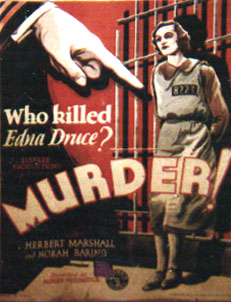
Murder! (1930)

Murder_hitch.jpgAlfred Hitchcock captures the pure bedlam that overtakes a neighborhood when their peaceful dreams are rudely disrupted by an awful din. As is customary everyone is in a foul mood, peers out their windows, bickers with everyone else, and moves into action.

Then in a split second, everything’s beastly still. The reason: The dead body lying on the floor discovered by the policeman making his rounds. The blunt instrument is at the feet of a disoriented young actress who looks to be the obvious culprit. But there has to be more to this story than what meets the eye. This cannot be as simple as we are led to believe. It’s a stellar environment to introduce a murder. Acting as one of Hitch’s few whodunits, Murder! involves itself with the rest of a stage acting troupe full of players.

Still, in the ensuing court hearing, the aspiring starlet, Diana finds her life on the line in the hands of a jury. Their deliberations feel a bit like 12 Angry Men (1957) as Sir John (Herbert Marshall) is hustled and hurried into coming to a guilty verdict by groupthink as the one remaining holdout.

In these sequences, there’s a sense that Hitchcock has a bit of frustration with the state of affairs with the legal system or if nothing else a great interest in its functions much like Fritz Lang did in pictures like M (1931), Fury (1936), and You Only Live Once (1937). But it’s truly a Hitchcock touch to have the pronouncement of death given as the camera continues to focus on a worker cleaning up the juror’s room. But it’s key that the story does not end here, rather like The Phantom Lady (over a decade later) there’s more to the story and only one man is interested in figuring it out. Because of his sheer fortitude, it’s understandable that he becomes our hero.

Sir John finds himself in a bit of a moral dilemma (as denoted with an early example of character voiceover) because he feels partially responsible for the problems assailing young Diana and he resolves to do something about it. Unfortunately, the film’s latter half slogs on a bit as Sir John calls upon the services of Ted Markum and his wife — two witnesses in the opening scene — to help close in on the real killer. The individual they suspect to be the culprit. However, the real trouble is not simply pinning the murder on this perpetrator but also figuring out how they did it.

A woman’s life hangs in the balance as the gallows sit menacingly in her future. Still, Hitchcock uses some cruel poetic justice to tie his story’s loose ends up. A trapeze act gets a lot more morbid than ever before and again Hitchcock returns to human tumult which livens up his picture moderately and makes Murder! truly worthy of its name. In such instances, there are obvious signs of the master at work. Otherwise, this is hardly Hitchcock’s most diverting offering in the genre.

3/5 Stars

Blackmail (1929)

Blackmail_1929_Poster.jpgIn one sense Blackmail proves to be a landmark in simple film history terms but it’s also a surprisingly frank picture that Hitchcock injects with his flourishing technical skills. It’s of the utmost importance to cinema itself because it literally stands at the crossroads of silent and talking pictures and holds the distinction of being one of Britain’s first talkies.

So close did it ride the lines, in fact, that two versions were released. It was initially supposed to be a full-fledged silent until it was requested that Hitchcock update the production to follow the tides of the times.

Far from being hampered by the transition, Hitch takes everything in stride and delivers a story that is pure cinema. It means simply that the film functions as a visual narrative. Still partially silent, yet using dialogue, and utilizing all the tools at his disposal to develop the greatest impact to reach his audience.

The story is simple really, about a young woman named Alice (Anny Ondra, future wife of German boxing icon Max Schmeling) who’s having a bit of a rough time with her boyfriend who’s on the police force. Still, she’s trying to make it work but another man has taken her fancy. He’s an artist and he uses the excuse of showing her his work as a pretense to get her up in his room. We all have an inclination of what might happen next. She’s taken advantage of and Alice has no recourse but to defend herself.

A conniving low-level conman is looking for an easy bit of blackmail and the policeman goes to great lengths to protect his girl but she herself is struggling with her guilt with what happened. Her nerves cannot take the constant strain because she was never meant for such circumstances. She’s hardly a bad person. In fact, she has no reason to feel remorse because, in the film’s candid portrayal of the artist’s less than honorable intentions, it’s easy to sympathize with Alice.

What makes the picture extraordinarily refreshing is that Hitch never relies too heavily on dialogue although it was the newest technology. He seems to already have an intuitive sense of how it can be used in cadence with the moving image. He can still make a film that for sequences is much like a silent picture and far from detracting from the story he is developing it further. It only serves to bring out more of the story whether it be the atmosphere or certain amounts of character development.

The local gossip chattering on and on about the murder and how she would never use a knife no matter the provocation but we are also privy to the young woman’s reaction shots as the word “knife” reverberates through her consciousness. Even in that moment, the dialogue underlines her inherent guilt and the further moral dilemma she has been put in.

Hitchcock’s already resorting to using memorable locales, in this case, The British Museum to make his chase sequences pop with character. You might say this is even an obvious precursor to Vertigo (1958) with a chase sequence that takes off across the rooftops of the museum.

But the ending comes with a bit of fateful luck that’s simultaneously darkly comic in quintessential Hitchcock fashion. It’s the perfect punctuation on a film that spun on an unfortunate split second altercation and it just as easily fell back on track with another such moment of good fortune. It’s the director’s way of teasing his audience in a sense and he’s very good at it — mingling murder with wit.

3.5/5 Stars

The Lodger: A Tale of the London Fog (1927)

The_Lodger_1927_Poster.jpgWhat’s striking about Alfred Hitchcock is the sheer breadth of his work and how his career managed to take him in so many directions as he continued to evolve and experiment with his craft from silent pictures, to talkies, then Hollywood, and all the way into the modern blockbuster age. And yet the very expansiveness of his oeuvre begs the question, where to begin with it all? Certainly, his lineup of masterpieces in the 1950s are a must.

But of his early silent pictures, The Lodger is the film that Hitchcock himself noted was really the beginning of his filmography as we know it and within its frames, there are some telling signs of an artist coming to grips with his craft.

His subject matter here is a bit of a Jack the Ripper-type tale set in London. A rash of murders has overtaken the town as coincidentally a new tenant with suspicious tendencies moves into the room of a local family. Their daughter does her best to make him feel welcome but her macho boyfriend, a member of the local police force, is skeptical of the competition. Especially since circumstance seems to point to the lodger’s guilt. So in this central conflict, we have a bit of the innocent man motif that Hitch would scrutinize and continue to tweak again and again.

Hitchcock already shows an immense aptitude for visual experimentation, utilizing his mise en scene in fascinating ways.  He makes great use of staircases whether he only shows a man’s hand as it slides along the banister or he sets up crucial moments along the expanses of the stairwell, characters slowly descending toward us being representative of innumerable tension.

We also unwittingly have one of Hitch’s first documented cameos and his assistant director on the picture is none other than his soon-to-be wife and lifelong collaborator, Alma Reville. That connection alone makes this production crucial to Hitchcock’s future career.

It’s easy to make the assertion that Hitchcock remained in the most basic sense a silent filmmaker his entire career and if we can count F.W. Murnau as one of his major influences from his time in Germany, you have that same sense of visuals over dialogue or even title cards. Some of his greatest scenes are in fact nearly silent. The crop dusting chase in North by Northwest (1959) or Norman Bates discarding the evidence in Psycho (1960) both spring to mind.

Though the parameters set up by the studio and expectations of his audience meant his leading man could not be found to be guilty, Hitch still manages to make the scenario as interesting as he possibly could — even if the degree of moral ambiguity wasn’t quite to his liking.

Consequently, in many ways, The Lodger also manages to be one of Hitchcock’s most tenderly romantic films. Because while his pictures have romance and passion they are more often than not subverted by the macabre, sensuality, or that notable dry wit. But here, the love story seems generally sincere.

Because there are tinges of true heartbreak here and the circumstances that bring the two lovers together are imbued with emotional consequence. Even the intricacies of a flashback and genuine interactions between two people who exude a certain chemistry make up for any overly theatrical moments courtesy of the tenderhearted heartthrob Ivor Novello.

But as he generally had a knack for doing Hitchcock also knows how to squeeze the most out of his ending sequences with the most satisfying spectacle. In this case, although the police have exonerated their suspect, the mob is after him and he flees them only to get caught on the iron works of a fence, his handcuffs leaving him dangling, vulnerable to the onslaught of humanity. He hangs there pitifully, at their mercy, a near Christ-like figure.

Perhaps the outcome was not quite what he wanted but the burgeoning master still manages a true Hitchcockian ending worthy of remembrance alongside some of his more championed pictures.

3.5/5 Stars


Blast of Silence (1961)

Blastofsilence.jpgIt looks like we’re staring into a black hole. Disorienting. Dark. Swirling around us. Our eyes adjust as our narrator begins his voiceover that will cover the majority of the film’s canvas. In this moment he talks about that initial spark, that moment of birth when humans leave the womb behind and see the light of day for the first time. In that same instance, we burst into the open air and realize that what we were looking at all along was the long dark tunnel from a moving train.

It’s from that train that our main protagonist hops off to get to work. He settles in a hotel room. Gets his assignment laid out with all the applicable details. He spends some time getting to know his target from the comfort of his car and picks up the gun he’ll use to commit the dirty deed. His supplier is a pudgy beatnik with a penchant for rats — a real salt of the earth kind of guy — but Frankie (Allen Baron) was never looking for a new friend.

However, he does bump into an old one. Because New York City used to be his home when he was a boy. He tried to get away from it. His memories of the orphanage and the Nuns who once cared for him. But now he’s back and one of the boys he grew up with is staring right back at him with his good tidings and Christmas cheer.

Frankie gets distracted. This complication throws him off his agenda because for one brief moment he becomes an actual human being and his very human desires begin to overtake the mechanisms of a stone cold killer. These are the same callous instincts that dictated his actions thus far. Things begin to come into their own and evolve into something truly inspired. It’s when Blast of Silence stops being a mere atmosphere or an aesthetic and becomes something real.

Because initially, this crime film is a grungy unsentimental picture that wears its low budget on its sleeve, delivering the kind of crime scenes that Jean-Luc Godard would have been proud of. However, this is not a French New Wave auteur but instead the director and star Allen Baron. At first, it seems like an exhibition not so much in style but a look and a mood and a feel. Drudging up images of the gritty pavements of Brooklyn, shipyards, and train tracks. Meanwhile, the score meanders between jazzy interludes and melodrama given the mood.

There’s a sense that it relies too heavily on its voice-over — the inner monologue of its lead — and still, that’s hardly a criticism because the film does so much that is engaging. In the end, Blast of Silence begins to suggest the immense isolation of a man in such a position. We’ve seen it before but few portrayals are so unflinching and pointed. Even as he pushes towards his objective, he’s simultaneously a picture of loneliness. We begin to question what leads someone to this career path. Some hints are left for us to make our own inferences. He’s an orphan. He’s searching for love. He wants something more. He wants a life with other people. Love, community, family perhaps.

Yet as it goes, God works in mysterious ways and you’re alone again back in the cold black silence like how things began. The film takes on a thoroughly pessimistic ending that nevertheless feels like a fitting conclusion amid the whirling rage of real-life Hurricane Donna. A truly unsentimental journey in the existence of a hitman.

3.5/5 Stars

The Kennel Murder Case (1933)

The-kennel-murder-case-1933It’s happened in some well-documented cases that the same actor has played two characters that feel nominally similar and based on this cursory level of comparison the general public has been forever befuddled. You could cite some notable examples being Bogart playing Sam Spade and Phillip Marlowe the archetypal pulp private eye heroes of Dashiell Hammett and Raymond Chandler.

Even the fact that Fess Parker played Davy Crockett for Disney and then Daniel Boone on the small screen undoubtedly still has the less historically inclined folks to question if there is any difference between the two men.

A still earlier example would be William Powell who was famed as Nick Charles in The Thin Man Series pairing him with Myrna Loy but about that time he also did pretty well for himself as the eponymous Philo Vance in a handful of mystery serials. In truth, this installment would be his last time performing the role but he slid rather seamlessly into The Thin Man series that arguably allowed him more freedom for comedy.

Other actors took on the mantle as well including Basil Rathbone, Warren William, Paul Lukas, and even Alan Curtis. But it was The Kennel Murder Case directed by one of Warner Bros. top craftsman Michael Curtiz that remains the hallmark of this Pre-Code franchise.

Although Raymond Chandler called Philo Vance, “the most asinine character in detective fiction,” much of that quality was toned down in the feature adaptations and after all, with a charmer such as William Powell, how could he not be at least a bit compelling?

In this particular storyline, there’s initially no case at all only Vance missing out on the big prize at a prestigious dog show. But on his way to Italy riding an ocean liner for a much-needed vacation, he catches wind of the death of one of his kennel acquaintances Mr. Archer Coe. Although the authorities including the straight-laced District Attorney Markham (Robert McWade) and the lovable police detective Heath (Eugene Palette) assume it is suicide, Vance comes in on the proceedings with a hunch of his own.

It has murder written all over it but the circumstances are most peculiar and the extensive array of suspects makes it no small matter to pinpoint the culprit. But that’s the fun of the chase as our perceptive detective looks to derive the correct conclusion and the audience along with him (without much success I might add, at least in my case).

It’s very easily to surmise that nowadays we are so culturally well-versed in crime, mysteries, and whodunits that this film’s script feels clunky at times because the characters say all the things and hit all the marks that we might expect. It’s a rite of passage to have the police constantly dismiss our hero’s deductions as it is to hear the shots ring out in the house or the various suspects nervously fib and cover up for this reason and that person.

However, to its credit, the resolution gets so lost among the various characters with numerous motives and the like that when the killer is revealed it still provides a certain amount of satisfaction. So in some sense, you could say that The Kennel Murder is a successful mystery because it does hit all the marks.

Yes, a no-nonsense Powell isn’t quite as fun as a snarky slightly tipsy Powell, although he still makes for an enjoyable lead. But supporting spots for the always jovial Eugene Palette and noir icon Mary Astor add a dash of character across the rank and file of the cast. Meanwhile, James Lee plays a rather fascinating character for the time, a Chinese cook who nevertheless attended Columbia and is highly educated in Chinese porcelain.

And there is undoubtedly an efficiency to The Kennel Murder Case such that a great deal is able to unfold and be resolved without feeling tedious or overlong aided by Curtiz’s direction and plenty of screen wipes. It proves to be just about the right length to make the payoff worthwhile and the story’s mystery generally engaging. More character development is always a plus but with a whodunit that’s usually not your main concern.

3.5/5 Stars

The Thin Man (1934)

The_Thin_Man_Publicity_Photo

“What were you doing on the night of October fifth, nineteen-hundred-and-two?” ~ William Powell as Nick Charles

“I was just a gleam in my father’s eye.” ~ Myrna Loy as Nora Charles

With The Thin Man, Dashiell Hammet successfully crafted several archetypes that go beyond the basic pulpy film noir standards that he also helped to define. Nick and Nora Charles were a cinematic power couple even before the word was in vogue and as their real life counterparts, William Powell and Myrna Loy were quite the pair in their own right being matched in a mind-boggling 14 films together.

The Thin Man became one of the most beloved pairings, helmed by W.S. Van Dyke and spawning a wildly popular series of sequels that continued throughout the 30s and 40s. At the very least it suggested that it was not so much the story lines but more so the characters that resonated with the general public.

It’s true that casting William Powell as Nick Charles was one of the hand in glove situations. He had a certain dashing even debonair quality with his pencil mustache perfectly thrown askew by the scenarios he gets himself into. Above all, he has a witticism or lithe quip handy for any given situation. He’s a real riot at dinner parties. One of those men who has a perpetual smirk on his face.

But Myrna Loy is just as impeccably cast as his fun-loving wife who is as game as he is to have a rip-roaring good time. She’s constantly keeping up with his droll wit while continually chiding him good-naturedly to get back into the amateur detective game.

For the time, with no children to speak of, their beloved wire terrier Asta (the famed Skippy who was also featured in other such classics as The Awful Truth and Bringing up Baby) rounds out their happy clan.

It really is a strategic depiction of marriage and family circa 1934. The Great Depression still had a fresh imprint on the nation and yet in Nick and Nora you see no indication of any such malaise.  Their days are spent drinking martinis and gallivanting around town while their nights are filled with fancy dinner parties and the occasional crime caper.

These forms have been so often parodied to this day but at the time it seems obvious that The Thin Man whether subconsciously or not was an escapist fantasy that indulged the desires of those less fortunate. Because if nothing else, they could at least spend some fun taking a load off and joining the Charles for an enjoyable evening. Everyone laughs. Cops and citizens have close knit connections. Excessive drinking is only a delightful diversion. The only ones who were in need were the slothful and the greedy.

Although The Thin Man employs admittedly incomprehensible plotting at times it’s hardly a knock. So many characters get thrown in and chatted about it becomes difficult to keep them all straight much less figure out what their bearing on the plot is. And it is the oddest cross section of individuals to be sure.

Much like The Third Man, this precursor, The Thin Man acts as a nifty MacGuffin in a pinch, driving the plot forward with his spectral presence. The fact he’s hardly on screen does not detract from his overall importance in this film. Meanwhile, his invested daughter (Maureen O’Sullivan), wife, mistress, and various other involved parties all get tossed around as culprits and accomplices including Porter Hall and Cesar Romero.

While not noir in the typical sense James Wong Howe’s photography does give the film certain dark sensibilities at times to contrast with the plethora of more comic moments in drawing rooms and the like. It also shares in the tradition of Agatha Christie and other such detective fiction narratives with bits of amateur sleuthing and all the subjects rounded up for a dinner party so the culprit might be revealed.

But what The Thin Man truly explored was the capabilities of crime when paired with comedy. In some sense here is a film where you have certain screwball aspects but I hesitate to call this film a true screwball just as I hesitate to call this a gangster picture though there are cops and thugs.

It’s that immaculate blending of comedy and crime that makes The Thin Man go down like a perfectly mixed martini. It was the charisma of Powell and Loy that allowed the series to exist well beyond the parameters of a one hit wonder.

4.5/5 Stars

The Lineup (1958)

Thelineupmovieposter6nfIn style if not entirely in execution The Lineup exhibits some similarities to Murder by Contract from the same year. Both films choose to take hit men as their main characters and it becomes a surprisingly intriguing way to look at a crime. Because the killers are a certain brand of sociopath who make film criminals all the more compelling based on not only on the way they carry themselves or the actions they take but the very words that leave their lips.

For the modern viewer, it’s very possible to miss the fact that The Lineup was a Dragnet-like detective show of the 1950s and this film installment carried over some of the same hallmarks from the program.

The police lieutenant is played by a no-nonsense Warner Anderson who utters every word as if he has marbles crammed in his throat. The other man (Emille Meyer) is what you expect from a second fiddle, a bit more flabby, a rounder face, and a funny intonation to his voice. Still, together these two men represent the arm of the law in San Fransisco, only two hardworking men in a vast force of crimefighters.

Don Siegel does well in all facets of the film from the opening mayhem on the streets of San Francisco that set the groundwork for all the rest, guiding the plot through the rhythms of procedures, hits, crime scenes, and casings. The climatic scenes on the Embarcadero pack the type of gratifying wallop you would hope for.

Meanwhile, Stirling Silliphant’s script has an odd cadence to it that’s particularly entrancing. It’s not hardboiled patter and that’s perhaps signified best by the fact that we meet our two main villains mid conversation on an airplane. One lauds the use of proper grammar and diction while the other, an out of town killer only known as Dancer (Eli Wallach) reads a grammar book to improve himself. After all, who’s ever heard a killer who knows their subjunctives?

From one end we follow the police as they look into a few big payloads of heroin that are being shipped in from Asia using unsuspecting tourists. There are no solid leads but they have enough competency to know something is up. They do all the things that they’re supposed to in order to nab the wanted parties. But it’s not that simple.

Because we also see a bit of what’s going on with the other side of the law. Dancer and Julian (Robert Keith) are called in to retrieve the payloads for a shadowy Mr. Big orchestrating everything from the background. And these are two of the most peculiar criminals you’ve ever known.  Dancer’s a bit of a tough guy and he’s almost never caught without his trusty briefcase that carries his silent killer. He’s not about to take any flack from their chatty wheelman (Richard Jaeckel) either.

Except Dancer listens to Julian, an older fellow (obsessed with last words) who seems to serve little purpose except to be Dancer’s constant voice of reason and his coach giving him pep talks and guidance from every location. First, a Seamen’s club near the Bay, then a local residence, and finally an aquarium where they track down their last unsuspecting carrier, a young mother (Mary LaRoache) traveling with her little daughter.

But all great crime pictures must have some kind of twist, a wrench in the plans or an about face and The Lineup likewise begins to tear at the seams. Except it actually begins to mean something because in some ways we’ve built more of a connection with the criminals than the good guys.

With its surprisingly authentic images of San Francisco preserved from the 1950s, you can definitely trace a line between this film and Dirty Harry another Siegel picture that made extensive use of SF’s iconic terrain as well. Silliphant also graduated to several big crime films most notably In the Heat of the Night. But there should always be a place for smaller gems like this because they must differentiate themselves from the pack in the ways they draw up their characters and how they choose to rehash themes that have existed all throughout the tradition of gangster flicks and film-noir. That is the only chance they have to be remembered. The Lineup certainly stands out amid the fray.

3.5/5 Stars

The Third Man (1949): Out of the Rubble

the third man 1Like the fella says, in Italy for 30 years under the Borgias they had warfare, terror, murder, and bloodshed, but they produced Michelangelo, Leonardo da Vinci, and the Renaissance. In Switzerland they had brotherly love – they had 500 years of democracy and peace, and what did that produce? The cuckoo clock. 
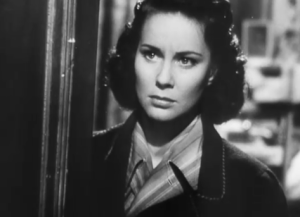
Great films ring anew each time you see them. Or in this case, they twang with the oddly disconcerting strains of zither strings. The Third Man is such a film that continually asserts itself as one of the golden classics of the 1940s. But we must set the scene.

There’s an image of a great city–a formerly great city–blown up, diced up, and quartered. The first syllable of dialogue glibly carrying a twinge of irony lays the groundwork for the entire plot really. This is Post-war Vienna. It’s where the blown out buildings strewn with rubble can exist with the elegant remnants of royal dynasties. A land of black marketeering and shifty-eyed collaboration between wartime allies. It’s deception and ambiguity to the nth degree not only evident in the people but the very social structure they find themselves in. Everyone’s got an angle, a secret to hide, and a reason to hide it. There’s a consistently fine line between right and wrong and the storyline is ripe with incongruities and dissonance that, if nothing else, are disconcerting.

It struck me that this is the original Chinatown except it doesn’t simply act as a mere metaphor. We actually get enveloped in the atmospheric Vienesse world that feels invariably gaunt and hollow. It’s a world that’s flipped upside down and with the hapless American western pulp novelist Holly Martins (Joseph Cotten) as our guide, we become just as mixed up as he does.

He’s come to the town for the prospects of a job offered by an old school chum Harry Lime. But Harry’s not there to meet him. In fact, Harry’s not anywhere. He’s dead. But everything is clouded with that same ambiguity. The military police led by Inspector Calloway (Trevor Howard) and his right hand man (Bernard Lee) are still investigating Lime’s prior dealings on the black market in tainted penicillin. Meanwhile, Martins obviously goes blundering around trying to learn anything he can because these men are obviously incompetent. He scouts around for eyewitnesses and several of Lime’s acquaintances. Most of all he’s taken with Harry’s gal Anna (Valli) who is also torn apart by the death of her Harry. They bond over that although Holly soon becomes infatuated with her as she remains in love with a man who is gone forever.

This is the disorienting world that we are thrown into by Graham Green and director Carol Reed. Where heaven is down and hell is up. Ferris Wheels ever turning, rotating through their cycles. Dutch angles giving every figure a contorted view. We never see anyone for their face value and we can never assume anything. Because there’s always something lurking in the shadows.

the third man 2Joseph Cotten is surprisingly compelling as the poor, unfortunate stiff and it’s hard not to feel sorry for him in his ignorance because we can relate with him. Alida Valli is striking as the aloof beauty who nevertheless has an unswerving affection for her former love that remains the only joyous thing in her current existence. Then, of course, there’s Orson Welles as the charismatic myth of a man–arguably the most intriguing supporting character there ever was even if it’s mostly thanks to the legend created by those who knew him.
Meanwhile, Carol Reed’s film is stylish and simultaneously dingy around the edges another gritty entry in the annals of film noir with some of the most beautifully pronounced shadows in the history of film. The final setpiece through the dank cavernous underworld of the Viennese sewers is a fitting place for the Third Man’s climatic moments to play out. It epitomizes all that has been going on above ground so far.

Then in a strikingly Deja Vu moment, the story ends much as it began in the exact same place with the exact same people but now there is so much more tension underlying each character. Feelings now buried in the dirt.

And in his final shot, Reed is fearless. He plays a game with the audience, giving them their final shot but instead of bringing it to a rapid conclusion he lets the gravity of the situation sink in before it’s gone in a fit of wistful melancholy. It ends as all films noir should with one man dead, another man smoking a cigarette, and the girl walking off with neither of them. It’s about as bleak as you can get but then again we’ve already spent the entire film getting accustomed to this lifestyle. This is only a day in the life of a city like Vienna. This is what life is in a post-war zone.

5/5 Stars

Note: I will say that I rewatched the film on Netflix and I would vehemently dissuade others from doing the same (at least if they’ve never seen The Third Man before). Because one major change they made that you would hardly even think about is adding subtitles in some crucial moments. When I saw the film multiple times before the lack of subtitles only added to my general sense of confusion in the face of ambiguities, much like Holly Martins faces himself. Subtitles take some of that away from us as an audience. In this case, the subtitles are tantamount to colorizing black & white movies or resorting to pan and scan. They can easily ruin the experience.

The Whole Town’s Talking (1935)

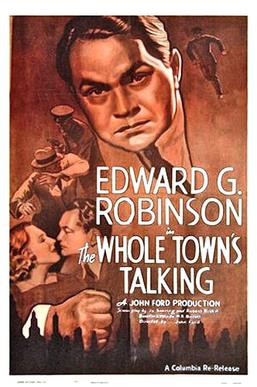
the_whole_towns_talking_1935_posterComic mayhem was always supercharged in the films of the 1930s because the buzz is palpable, the actors are always endowed with certain oddities, and the corkscrew plotlines run rampant with absurdities of their own.  Penned by a pair of titans in Jo Swerling and Robert Riskin, The Whole Town’s Talking opens with an inciting incident that’s a true comedic conundrum.
Bald and beady-eyed Mr. Seaver is called upon to fire the next employee who comes in late to work. A tough proposition to begin with but it gets worse.  Arthur Ferguson Jones has not been late to work in 8 years and of course, today’s the day his alarm clock doesn’t work. Although he gets a reprieve. Still, the next person walking in isn’t so lucky. The hardy, wisecracking Miss Clark (Jean Arthur). And that’s our introduction to our main players.

But the real wrench comes from an age-old device that’s easy to scoff at initially. There’s a doppelganger. Yes, the same upstanding, timid Arthur Ferguson Jones is cut in the spitting image of Public Enemy No. 1, Killer Mannion. But before you check out, consider what this does for this ruckus of a story. It ties it up in knots.

Jones is the talk of the town. Exploding flashbulbs. Cover stories. Tumult. Back in the glory days when the press ran in a pack like hyenas.  His boss invites him to dinner, wants an autograph for his boy. He’s being ribbed by his coworkers and Miss Jones takes an interest in his literary endeavors. This leads to a gig ghostwriting the gangster’s life story in the local paper.

Meanwhile, the police argue about what to do about him. They finally decide to give him a special passport. It says he’s not Killer Mannion. And hapless little Mr. Seaver still badgers his employee to finish up his waiting caseload. What no one expects is that Mannion will sneak into Jones’ home and sets up camp.

And from that point on, everything gets confused. Robinson gets a chance at a great deal of range sometimes having his two diverging roles playing off each other in the same frame. All you need to know is the gangster is looking to leave his new benefactor holding the bag for his numerous crimes. Whether it works out or not is quite another story.

This a particularly odd film for the talent assembled. It doesn’t especially feel like a John Ford film and not simply because it’s not a Western. But at this point in his career, his stock company isn’t even assembled.

Edward G. Robinson will always be identified with gangster pics and it’s true he was tired of that association. Here he’s playing comedy. He has one foot in his usual wheelhouse but the other seems utterly alien to his usual persona. As such it’s great fun.  And his timid common man isn’t even a tragic figure like Chris Cross (Scarlet Street). The comedy is far more apparent and that in part stems from Arthur.

She shows up late to work, gets fired, and still has quips coming out of her ears. She plays all the journalists trying to pump her for facts and at the same time falls for this dope who has her picture framed by his bedside. Perhaps better than anyone she perfected how to be cheeky but still wholesome and caring. Arthur feels most at home in this film more than anyone else, given her comedic pedigree but she and Robinson bounce off each other well.

In a few years she would play a Miss Jones but for right now she’s content calling her colleague by the pet name “Jonesie” and (tiny spoiler) she does become Mrs. Jones. So an oddball romantic pair they might be, but that doesn’t make the partnering of Robinson and Arthur any less amusing. They’re both on their A-game in The Whole Town’s Talking and thankfully there would be many more arresting performances to come.

4/5 Stars

Shoot the Piano Player (1960)

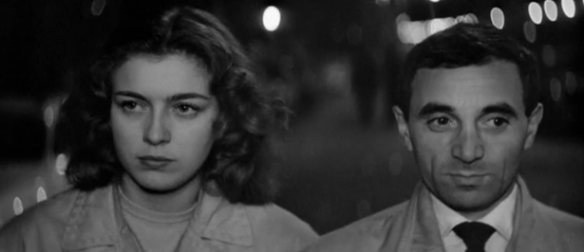
shoot-the-piano-player-1

Shoot The Piano Player begins thrillingly with a car chase. The man being pursued flees down a street corner, his assailants disappear into the night, and he subsequently bounces off a streetlight like an idiot. The man who brings him back up on his feet proceeds to regale him with stories about how he met his wife before walking off, never to be seen again.

In fact, none of these characters are our main protagonists but it perfectly encapsulates the glories of Francois Truffaut’s stroke of genius in this early emblematic film of the New Wave.  It’s a petty crime story with a comical streak. The two tough guys aren’t tough guys at all but with their hats and pipes they look like a pair of Monsieur Hulot doppelgangers or something. That is until they pull out a gun. But even then, they’re hardly thugs.

Listed out as simple plot summary, it has certain flourishes fit for a Hitchcock thriller. A man on the run. Lurking criminals, kidnapping, murder, romance, humor, but there’s no doubt, even with this being only his second feature, that this is very much Truffaut.

It’s all a wonderful front for Truffaut’s own explorations. And the bottom line is not simply homage to film-noir and the Master of Suspense but more broadly all his fascinations of men, women, love, and everything that intrigues him about putting a mirror up to humanity–cinema itself. However, as the director long suggested, he preferred film to reality because he could orchestrate it, make it to his liking, with touches of humor and tragedy.

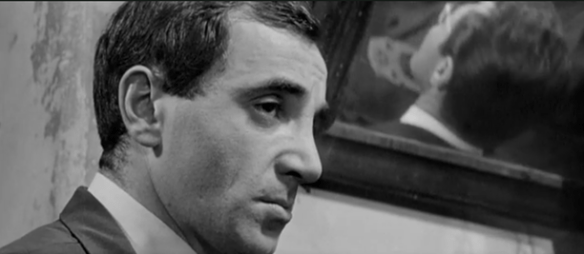
This pseudo-storyline starts with Charlie who placidly knocks out honky tonk for the public’s enjoyment. It’s hard to know if he’s content or simply biding his time. The latter seems more likely. Except when his big brother Chico busts into the joint with a couple of hoods on his tail, in some small way it brings everything rushing back on Charlie.

shoot-the-piano-player-2

It’s not much but the ensuing events have him wrapped up in his own bit of intrigue as he navigates his romantic inclinations and every other thing that is thrown his way.  A Hollywood reference point would certainly be Out of the Past and similarly sinks back into a flashback. But here it is used in a way that’s completely jarring, hardly convenient for those seeking comprehension. And Truffaut’s character utilizes voiceover as well but this is not the laconic, cynical speak of film-noir, instead the nervous inner monologue of a timid piano player.

His sometime bedmate and the housekeeper for his kid brother is Clarisse. Meanwhile, the waitress at his work Lena has his heart going pitter patter, not quite a Hitchcock blonde but a woman who is willing to get involved with his drama. But there was also another important woman in Charlie’s life: His wife.

It’s from these three women in their relationships with Charlie and all the other male characters that some very blatant realities become evident. There’s a conscious separation of the woman into parts whether it is her heart or her body. In one sense, the aforementioned women are strong characters. Meanwhile, the men are all fairly passive, their main outlets include objectifying, ogling, even ridiculing their female counterparts.

At least Charlie’s candid about it but he’s still part of the problem. In many ways, in looking at the women as the tragic figures often used by men as a cinematic object, Truffaut could very easily be wrestling with his own issues of love and romance. What does that actually mean? What causes people to marry? What causes them to love and fall out of love, break up and come back together or even commit themselves to death?

All that can be found within this film although it is obviously veiled by scenes masquerading as crime and comedy. The crowning joke of them all is really a kind of tragedy. Amid the strangest turn of events, Charlie or Edouard (as we now know he is called) is resigned to play behind his piano once more.

The final moments at the snowcapped cabin are madcap and still almost surreal with some stunning sequences captured vividly by iconic New Wave cinematographer Raoul Coutard. In breaking so cleanly with his initial effort of The 400 Blows, Truffaut simultaneously positioned himself as a very special filmmaker. He’s beholden to drama, comedy, crime, and romance, but most of all, he’s beholden to the magic of the silver screen.

4.5/5 Stars