 There is no solitude greater than that of the samurai unless it be that of a tiger in the jungle… perhaps…
It would be easy for some to call Le Samourai flat and pedestrian due to its visual style and even the workings of its plot. All very straightforward with cool tones and characters who barely crack a smile. Emotions are even less common. But that’s disregarding how exquisitely confident it is in its execution. Jean-Pierre Melville is a director who evolved into one of the great forgers of crime films for the very reasons mentioned above.
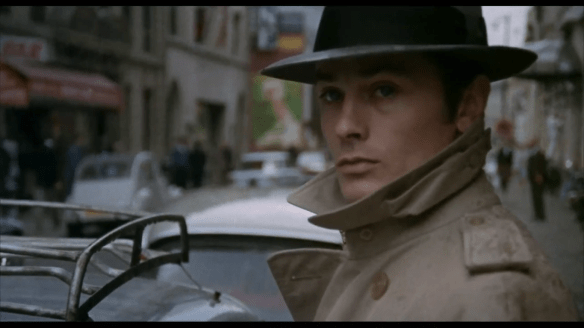
His hero played so iconically by Alain Delon is one of those great film characters who does not need to fill every moment of silence with a witty comeback. In fact, Jef Costello is not one to spitfire witty repartee at all. Instead, he’s calculating, steely-eyed and ridiculously phlegmatic. He fits the corridors of this film like a glove, perfectly suited for the cold exteriors and drab interiors.
We meet him not in some moment of dramatic action, but while he reclines silently on his bed, veiled in shadow, cigarette smoke clouding over him and the chirps of his caged canary piercing through the traffic sounds murmuring outside his window. Although we linger there for a time as the credits roll, it takes a moment to acclimate. If you’re not paying attention, the contours of his body are almost lost to us — an extraordinarily ordinary man. But that’s precisely what he wants you to think.
Meanwhile, he highjacks cars, puts an airtight alibi in place, takes on a hit at a local nightclub with ease and disposes of all evidence without even a hiccup. Veins of ice and nerves of steel give him the perfect physique for a hitman. Top it off with his uniform — a trenchcoat, fedora, and cigarette, bolstered by Delon’s imperious stare and it’s difficult not to be mesmerized by his every movement.
It’s the kind of self-assuredness that allows another character to ask him, What kind of man are you? and no answer is needed — at least not with words — because with every action, every look, he tells us precisely what he is. An aloof assassin of the highest order. Yes, if you want to make the comparison, a samurai.
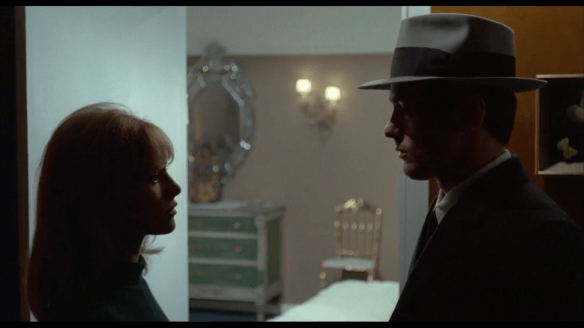 And though he does call on his lovely girlfriend (Nathalie Delon), who is absolutely devoted to him, as well as making eyes at the nightclub pianist who is the main eyewitness to his hit, Jef for all intent and purposes, is alone. It’s a kind of forced solitude, a self-made exile created by his trade. After he goes through with the hit, he must shut himself off more and more. That is his job.
So he goes to the police station to be questioned. Goes through the lineup. Stairs down the witnesses and goes home. Not to his girl but the dismal flat with his mournful canary. His contractors are out to get him, the cops are looking to catch him in his fabricated alibi and still, Costello maintains his composure as is his habit. He’s unphased by bugs or tails and when he has a gun to his face he never blubbers, only proceeds with beating up his assailant when the opportunity arises.
And although there is never much of overt romance in Le Samourai — Jef never shows any kind of passion — there are still glimpses that he cares about people. Perhaps he holds onto chivalry as part of his moral code. Even after staying away from his girlfriend for many days he comes back to her not expectant of anything but asking her if she’s alright. Pragmatic but concerned. Distant but still invested.
The same can be said for the film’s tremendous finale. Le Samourai is not a film of gratuitous killing but pointed moments of violence that are careful acts of deliberation. Costello kills two people and the film ends with his third and final hit. But it is in these tense moments that we gain yet another insight into the moral makeup of a world-class hitman.
Melville was obviously an admirer of American gangster films but what makes his vision of the genre so fantastic is the demeanor of his characters. Again, some might say boring, but that is probably a predilection of those raised on Hollywood action. There is no aura left. No shred of intrigue or tension left to be examined. Le Samourai is a crime thriller that performs differently, its pacing is entrancing and far from being tepid, it elevates the hitman to enduringly riveting heights to the last bullet fired. It doesn’t hurt that Jef Costello just might be the coolest action hero of all time.
5/5 Stars
 Saying that Phil Karlson has a penchant for gritty crime dramas is a gross understatement. And yet here again is one of those real tough-guy numbers he was known for, where all you have to do is follow the trail of cigarette smoke and every punch is palpable–coming right off the screen and practically walloping you across the face.
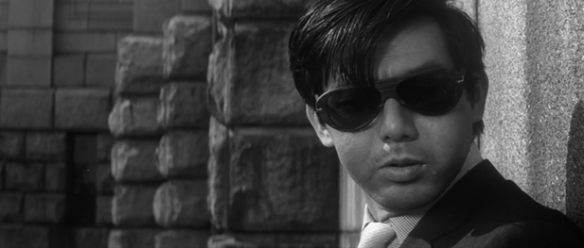 Branded to Kill is the stuff of legend inasmuch as director Seijun Suzuki offered up this wonderfully wacky, perverse, dynamic film and was subsequently dumped by his studio. At Nikkatsu they accused Suzuki of crafting an oeuvre that made “no sense and no money.” And if we watch it with the eyes of a rational, money-grubbing business mind, there’s a point to be made. Because this film is ridiculous on so many accounts, absurd in plot and action, starring an unlikely cult hero — a silky smooth hit man with prominent cheekbones and a hyper-sexualized penchant for steamed rice.
 Phase two follows Goro as he flaunts his tireless inventiveness as a hit man. Hiding inside a cigarette lighter advertisement and shooting his target through an adjoining water pipe for good measure. Then the femme fatale Misako slinks into his life and after a botched job, his life is in jeopardy, an unlikely adversary being his wife. She rightly characterizes them as beasts and their home life is pure chaos.
 By now we have the total dissolution of the character we have known as he begins to sink into an all-out state of sniveling paranoia. He finally meets the mysterious number 1 and far from being a tense showdown, it turns into a rather pitiful scenario. They go arm and arm to the toilet, not allowing each other out of sight as number 1 decides how to finish off his hapless foe.The final showdown comes and it’s all we could ask for. Brutal, perplexing and above all undeniably unique – accented with the brushstrokes of an utterly creative mind.
 We are brought into the world of Lew Harper with a cold open full of character. There he is.
  Peter Lorre has a face that will forever live in cinematic infamy, and it started with M. In truth, Fritz Lang’s drama involving a serial killer feels fresh and engaging even after all these years, maybe because humanity hasn’t changed all that much. We still murder, we still kill, we still seek justice, we still give into our base desires, and there’s not a perfect person among of us. Each one of us has our faults — our own personal downfalls.
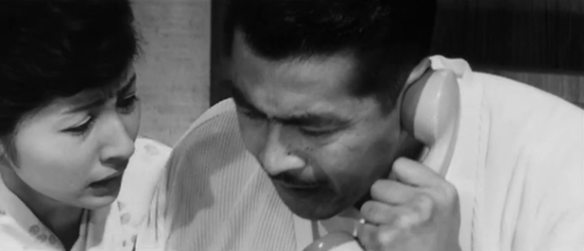 High and Low (or Heaven and Hell in the original Japanese) is a yin and yang film about the polarity of man in many ways. Gondo (Toshiro Mifune) is an affluent executive in the National Shoe Company. He worked his way up the corporate ladder from the age 16, because of his determination and commitment to a quality product. Now his colleagues want his help in forcing the company’s czar out. They come to his modernistic hilltop abode to get his support. Instead, they receive his ire, splitting in a huff. What follows is a risky plan of action from Gondo that is both fearless and shrewd. He takes all his capital to buy stock in the company so he can take over, but his whole financial stability hangs in the balance. He knows exactly what it means, but he wasn’t suspecting certain unforeseen developments.
 At this point, the police are called and they arrive incognito, ready to stake out the joint and do the best they can to get the boy back safe and sound. This section of the film almost in its entirety takes place within the confines of Gondo’s house and namely the front room overlooking the city. It’s the perfect set up for Akira Kurosawa to situate his actors. He uses full use of the widescreen and his fluid camera movements keep them perfectly arranged within the frame.
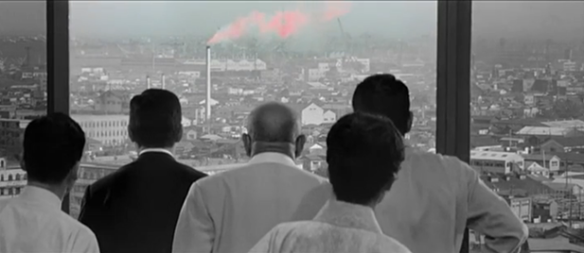 Finally, with the help of Shinichi, they make a startling discovery that ties back to the kidnapper. And the boy’s drawings along with a colorful stream of smoke help them move in ever closer. What follows is an elaborate web of trails through the streets as they work to catch the culprit in his crime, to put him away for good. And it works.
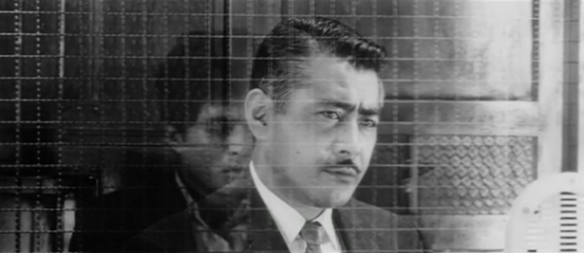 But High and Low cannot end there without a consideration of the consequences. Gondo has been brought low. He’s losing his mansion and must start a new job on the bottom of the food chain once more. His enemy requests a final meeting as he prepares for his imminent fate, and this is perhaps the most grippingly painful scene. Gondo’s face-to-face with the man who made him suffer so much. Toshiro Mifune’s violent acting style serves him well as he wrestles so intensely with his own conscience. And yet at this junction, he is past that. What is he to do but listen? In this way, it’s difficult to know who to feel sorrier for — the man who is resigned to a certain fate passively or the one who goes out proud and arrogantly against death. Both have entered some dark territory and it’s no longer about high or low or even heaven and hell. They’re stuck in some middle ground. An equally frightening purgatory.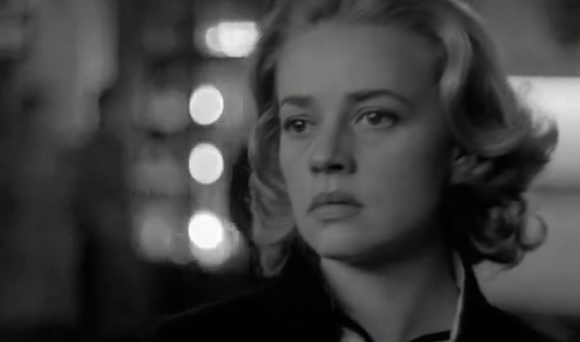
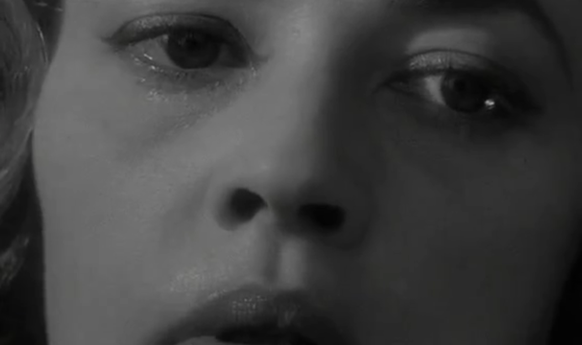
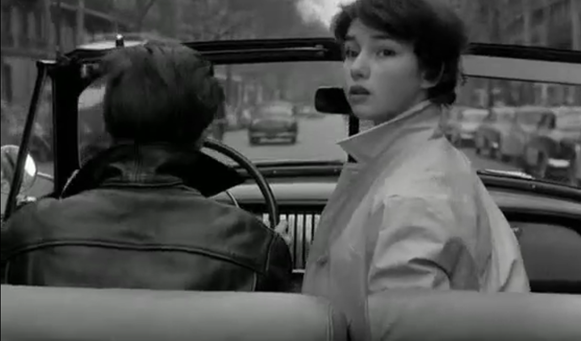
 an anxious Mrs. Carala begins to listlessly comb the streets trying to gather what happened to her lover. Where did he go? Julien
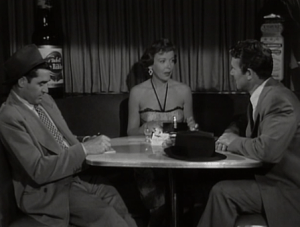 There’s not a whole lot to it. Aside from a wonderfully pulpy title, Private Hell 36 feels like a pretty straightforward endeavor from director Don Siegel. The low budget procedural nevertheless boasts a surprisingly good cast. The tale is framed by a nice bit of narration from the sitting police chief played by the always enjoyable Dean Jagger, in a particularly compassionate role.
 The temperature begins to rise when the two colleagues get caught up in a car chase with their counterfeiting adversary. All the days casing the local race track with Ms. Marlowe finally leads to some action. In the aftermath, one car goes careening off the road, and the boys have a decision to make. They frantically begin snatching up dollar bills and they decide to go dirty and make a run with the money.


 4 Star Films