Review: Breathless (1960)

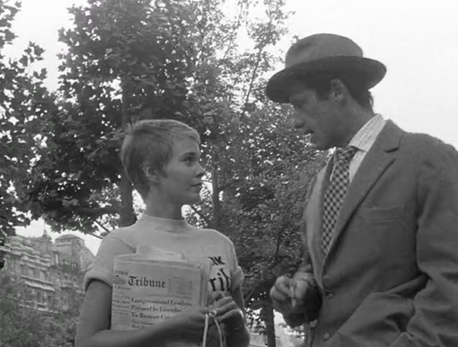
breathless2Breathless is such a fresh, smooth piece of cinema that feels as cool now as it was back then. The transcontinental French vibe paired with the revolutionary production is strangely still appealing. It does so many things with such style that is always unique but never quite off-putting. Not to mention the score which is playful in an elegant sort of way. The film has an array of quick cuts, it’s discontinuous, abrupt, and it literally jumps between images. Actions, like shooting a cop or sitting in a room with a girl, become more interesting than we could ever give them credit for.

Godard is known for saying that all you need for a film is a girl and a gun and that’s basically all Breathless is. Michel (Jean-Pierre Belmondo) is a low down, no good hood who also happens to be quite funny at times. He shoots a cop for no good reason and after that, the police are after him on the streets of Paris.breathless5He’s also broke and all his buddies are either unavailable or in some trouble of their own. He swipes money from one girl and rendezvous with his latest fling, the aspiring American journalist Patricia (Jean Seberg). They do very little except drive around the city or lounge around her room. In one memorable shot, jump cuts piece together scenes of the back of Patricia’s head as she sits in the passenger seat observing the world around her pass by.
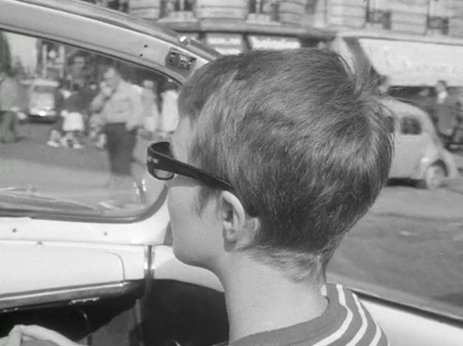
Michel, on his part, seems only to want sex and yet he says he’s never loved a girl before. He’s continually drawn to Patricia, and he never can quite pull himself away.

She, meanwhile, has another man with an eye on her, and she hopes to propel her fledgling journalism career. Her one assignment happens to be interviewing the highly philosophical and somewhat pompous Mr. Parvulesco (Jean-Pierre Melville).breathless10The billboards around town even foreshadow the impending doom of Michel. Patricia later learns from the police that her lover is wanted for murder, and she must decide what to do about it. In a memorable scene, Patricia is shown pacing around the room in a wide circle. In the end, she does turn in the hood to prove to herself that she doesn’t truly love him.
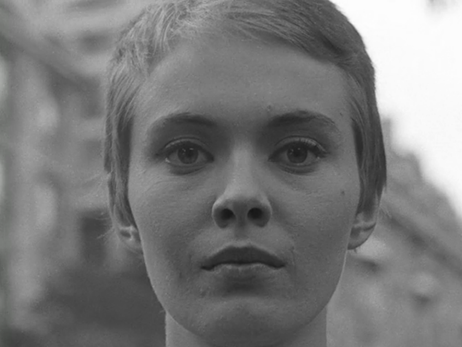
Michel looks utterly pitiful, like a wounded deer after he gets winged by the police and collapses in the middle of a quiet avenue. Patricia stares straight at the camera giving the queerest of looks as Michel breathes his last. If you wanted narrative clarity you’re definitely looking in the wrong place.

breathless9In some ways, Jean Seberg’s iconic look reminds me a young Audrey Hepburn another gamine glamour girl. The photography of Seberg is iconic from the reflection in her sunglasses to her donning Michel’s hat. Breathless proves film is not just entertainment, but it can also be lastingly stylish. There’s nothing wrong with that, and it still seems to work after over 50 years. Honestly, when I was starting out, Breathless helped open up all of European cinema to me and for that, I am indebted to Godard and The French New Wave.

4.5/5 Stars

Purple Noon (1960)

purplenoon4Right off the bat, there are two things that stick out about Purple Noon. First, you cannot help to notice the colors because the blues and reds pop like some vibrant 1960s painting. Then there’s Alain Delon who at the age of 23 made his rise to stardom, thanks to this film and Rocco and his Brothers (1960). As Tom Ripley, he finds a role that is fascinating in more ways than one.

During the first interludes of Rene Clement’s thriller, based on the Patricia Highsmith novel, I didn’t really know what I was watching or what to think. Tom was sent to Italy to bring the wealthy Phillipe Greenleaf back to San Francisco at the wishes of the man’s father who is paying Ripley. Their story begins as an entertaining jaunt through the city. They lounge at cafes, take carriage rides, and generally have fun living it up at night.

Tom is nothing like Greenleaf. He’s far poorer coming from a humbler background, but he is also much more resourceful and clever. When he takes a trip with the wealthy young man aboard his yacht, he finally hatches a plan to get what he wants. He abruptly stabs Greenleaf during a game of cards and the whole trajectory of the film changes in an instant. It began playfully absurd and quickly switches gears as a thriller involving murder, stolen identity, and deception.

purplenoon5

He plays up the tiff between Greenleaf and his girlfriend Marge, telling her that he is still angry and so he went off somewhere else without her. Thus, begins Ripley’s transformation into Greenleaf, forging a passport and signatures until he can pass off as the man himself. He starts dressing differently, spending more money, and continually acting as if he actually is Greenleaf. But things get difficult when he nearly runs into folks he knows, and Marge is desperate to know where her love is. These all prove problematic and yet Ripley skirts most of these entanglements with relative ease. It’s when a friend of Greenleaf’s named Freddie Miles figures out his charade that things begin to escalate because Tom’s only option seems to be murder. He commits the act coolly and plans his next move with calculated ease.

The police are after a murder, but it looks as if Tom has tied up all the loose ends and we find him relaxing reclined on the beach. He doesn’t know that the game is up, because of what the police found at sea.

The visuals of this film definitely do justice to the young Delon who is strikingly handsome with piercing eyes, but his turn is interesting in its own right because he was always so adept at playing the coolest of characters. He’s no different here and Purple Noon proved to be the initial boost to his storied career.

4/5 Stars

Kiss me Deadly (1955)

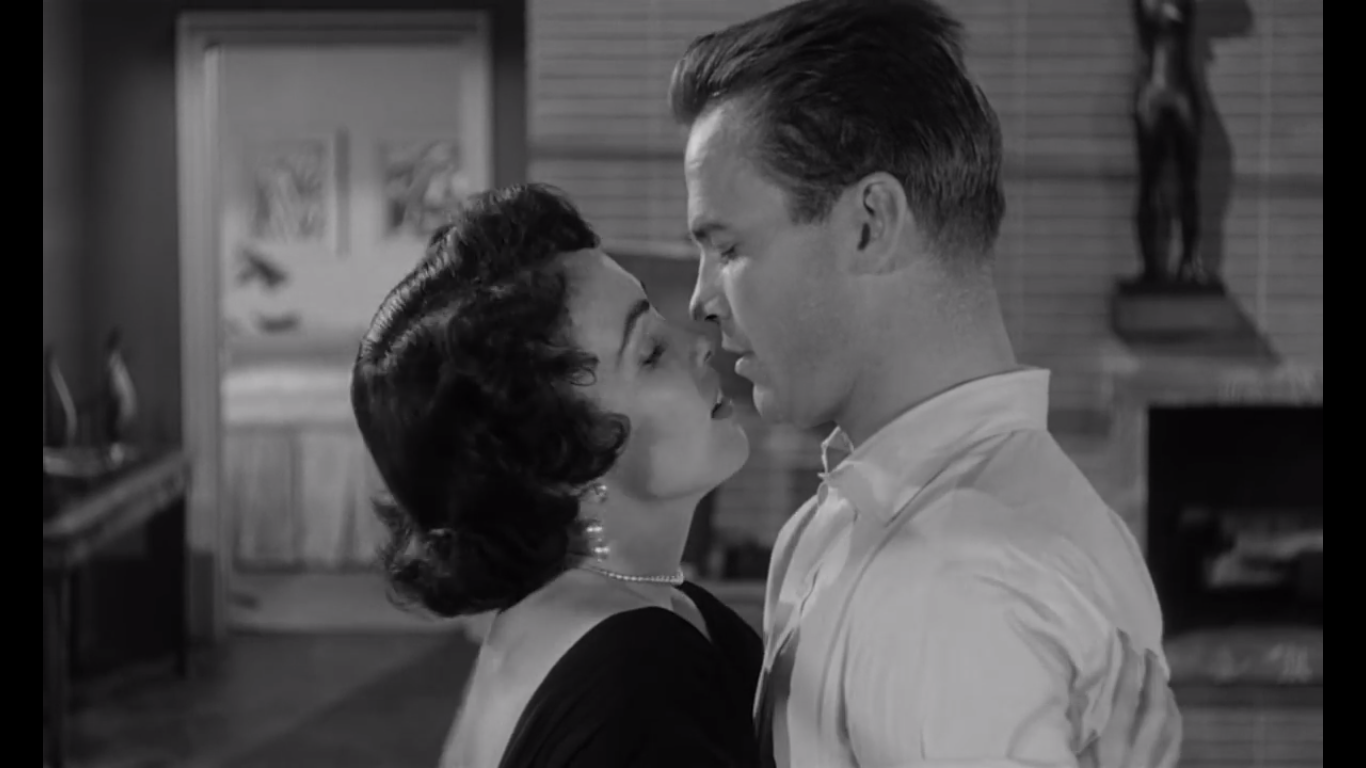
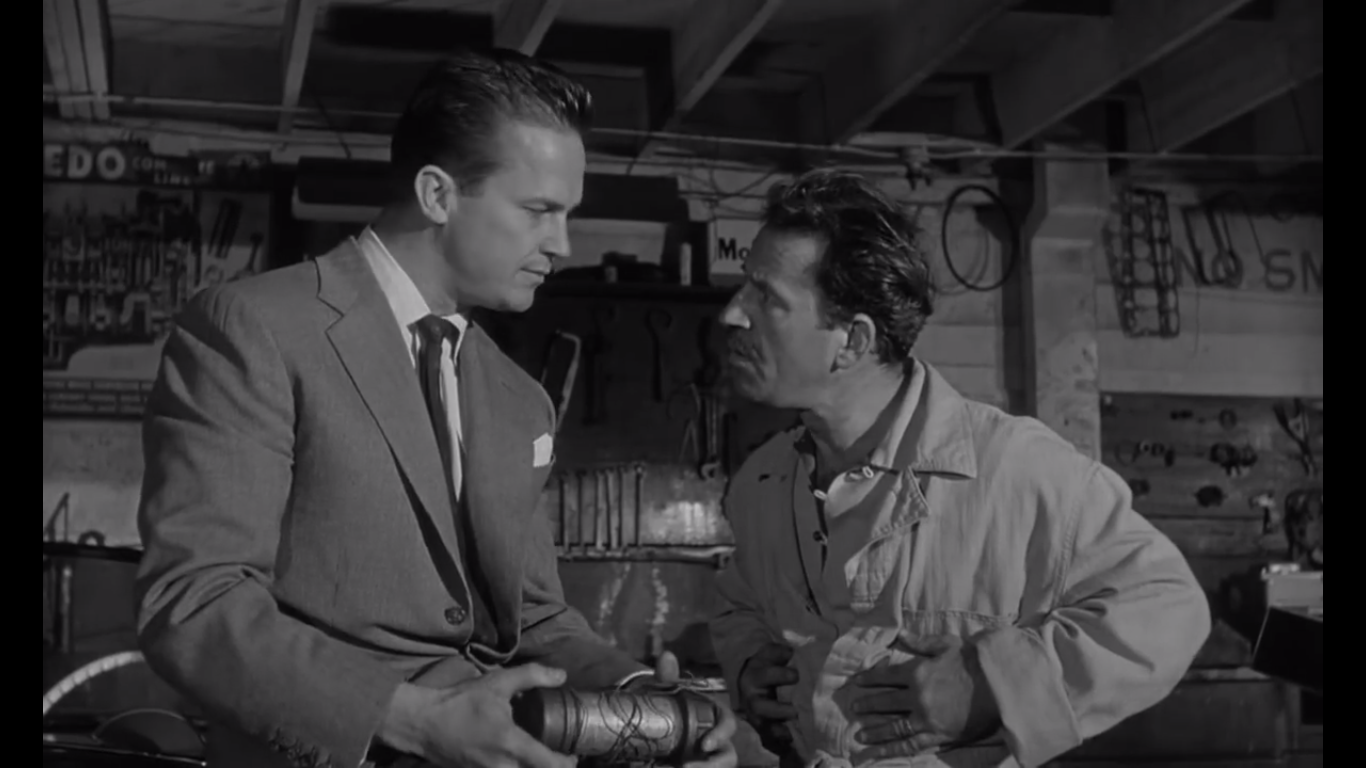
kissmedeadly1Set in L.A., the film stars Ralph Meeker as the callous and often corrupt P.I. Mike Hammer, adapted from the Mickey Spillane novels. One night while driving, Hammer picks up a frightened woman who begs him to remember her. They are forced off the road by thugs and the girl is eventually killed. Hammer wakes up in the hospital to his secretary girlfriend Velda (Maxime Cooper). He makes it his priority to find out what the mysterious woman was talking about. He meets up with opposition and a femme fatale, but Hammer keeps on going using strong-armed tactics. He finally tracks down a mysterious whats-it but then discovers that Velda was kidnapped. In the final confrontation, he finally learns who he was looking for and he finds out the consequences of the Pandora’s box in the hands of a deadly female.

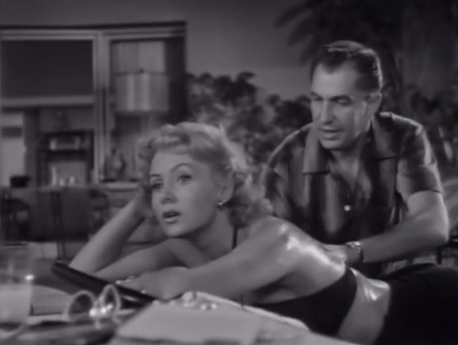
Out of most of the prominent works in the canon, Kiss Me Deadly is probably the pulpiest of L.A. Noir. The images are rather like a historical time capsule of 1950’s Los Angeles with locations on Wilshire Blvd., Sunset Blvd, and even near Angels Flight. It has crisp black and white cinematography with many noticeably low angles underlying the sleekness, but also the paranoia wrapped up in this story. It arguably has the queerest cold open and ending of any noir, which I cannot help but remember.kissmedeadly2Ralph Meeker plays’s Mickey Spillane’s P.I. Mike Hammer to a tee. His husky voice perfectly fits the bravado of Hammer, a misogynistic brute prone to coercive action. Out of all the private gumshoes we’ve met, Hammer is probably the lowest — he’s a real scuzzball.

 Hammer throws women around like playthings and even his girl Velda has a double purpose. Yes, she is a lover, but she also makes a keen asset for business. As a P.I. specializing in divorce cases and marital problems, he’s not below giving business a little help. Velda willingly works on the husbands for him and he’s not above playing around with their wives. It’s a cozy little set-up.

kissmedeadly8That’s Hammer’s level and so when he gets caught up in the story of the mysterious girl Christina (Cloris Leachman), he has no idea what he gotten himself into. It’s a lot bigger than him and when the authorities throw around words like the Manhattan Project, Los Alamos, and Trinity he finally understands what its all about, but not really. In essence, Kiss Me Deadly is the quintessential film of paranoia in the Cold War nuclear age. We have a MacGuffin in the form of the mysterious Whats-it, but aside from that, we get few answers. Only a few deaths and some mighty destruction.

kissmedeadly4

Kiss Me Deadly has some great characters aside from Hammer and Velma. The thugs are played by the perpetually cross-eyed Jack Elam and the glowering Jack Lambert which turns out to be great casting. Also, the lively Greek-American Nick (Nick Dennis) is a great deal of fun with his enthusiasm and a lot of “Vavavoom!”

It’s an interesting dilemma because I have never loved Kiss Me Deadly, but director Robert Aldrich developed a film that is so persistently interesting. It was a film that was supposed to ruin young viewers for its moral depravity, sensuality and who knows what else. This film literally screams “Remember Me” and honestly I will not be forgetting about it anytime soon.

3.5/5 Stars

Christina: You have only one real lasting love.

Hammer: Now who could that be?

Christina: You. You’re one of those self-indulgent males who thinks about nothing but his clothes, his car, himself. Bet you do push-ups every morning just to keep your belly hard. 

You Only Live Once (1937)

youonlylive1There are two types of lover-on-the-run narratives. There’s the Bonnie and Clyde/Gun Crazy extravaganza full of shoot-outs and bloodshed. Then you have the more sensitive approach of a film like They Drive By Night. You Only Live Once fits this second category thanks to two bolstering performances by Henry Fonda and Sylvia Sydney. Fonda is forever known for his plain, naturalistic delivery full of humanity. He has that quality as 3-time loser Eddie Taylor certainly, but he also injects the role with a somewhat uncharacteristic rage. In many ways, he has a right to be angry at a world that so easily writes him off and is so quick to pronounce guilt. There is very little attempt to rehabilitate the reprobate and Taylor is an indictment of that.

youonlylive2Secretary Jo Graham (Sylvia Sydney) is positively beaming the day they are releasing her boyfriend Taylor because he is finally getting the second chance he deserves. A glorious marriage follows soon after until reality breaks into the lovers’ paradise. Few people aside from Father Dolan and a few forward thinkers are willing to give Taylor grace. He is prematurely fired from his job and has no way to make the payments on the house that his wife has been sprucing up for him. Adding insult to injury, a brazen bank robbery is committed which he is wrongly accused of. It’s back to the clink and then the electric chair.

Jo is beside herself and Taylor is angered at the way the law deals with him. This justice is the most unjust imaginable, and he is about to pay the price. But Jo desperately gets him help and he tries to make a break for it.

youonlylive4That’s what makes a wire proclaiming his innocence all the more ironic because he will have none of it. He takes a man’s life and now his acquittal goes down the drain as quickly as he got it since he has a murder to his name. Eddie and Jo go off on the road together, looting banks and surviving the best they can with their newborn son. This is not two joyriding youngsters trying to get rich without an honest day’s work. Fritz Lang develops a more complex story with people who tried to live by the rules and found they were dealt an unfair hand.

As one of Lang’s earliest works in America, you can see some remnants of German Expressionism exported here with foggy clouds of mist engulfing the screen at times. His tale also has an interesting ambiguity suggesting that crime is not always black and white. Perhaps it has less to say about the moral degenerates or corrupt individuals in our society and more about the faulty structures that our justice system often get built around. It’s mind-boggling to think that this film came soon after the Depression meaning the bitter taste of those years was still fresh in peoples’ mouths. Nevertheless, this film is an interesting crime-filled character study.

4/5 Stars

While the City Sleeps (1956)

whilethecity1While the City Sleeps has a brilliant cold open followed by a pounding title sequence, courtesy of Fritz Lang, that brings to mind a bit of Diabolique and Psycho. The rest of the film turns into a case to find the wanted lipstick murderer (based on a real killer), but that only holds part of our attention.

When newspaper magnate Mr. Kyne dies suddenly, his begrudging son Walter (Vincent Price) takes over intent on shaking up the status quo and putting his mark on the company. He soon turns three men against each other as they desperately fight for the new position of executive director. The first is veteran newspaper editor John Day Griffith (played by the always memorable character actor Thomas Mitchell). The second candidate is chief of the wire service Mark Loving (George Sanders) who is Griffith’s main competitor. Finally, in the third spot is Harry Kritzer who happens to have a secret ace in the hole. Each of them is tasked with finding out the real scoop about the serial killer, and it turns into a real tooth and claw ordeal. Within the glass cubicles, everything can be seen, but not everything is heard and that’s where the secrets get disclosed.

On the outside looking in, so to speak, is star TV reporter Edward Mobley (Dana Andrew), who agrees to help his friend Griffith by doing a little digging around about the murderer. He gets some tips from a cop friend Lt. Kaufmann (Howard Duff), and Mobley tries to smoke the killer out on air. However, it leads to the potential endangerment of his fiancée Nancy, who also happens to be Loving’s secretary. Loving has his love directed towards a female reporter named Mildred Donner (Ida Lupino), who attempts to needle Mobley for info. At the same time, the killer is on the move once more, with Nancy being an obvious target. Mr. Kritzer’s own romantic entanglements get him in trouble because he is seeing Kyne’s beautiful but detached wife Dorothy (Rhonda Fleming). Mildred finds out about them and they have some talking to do. Mobley also has some making up to do with Nancy after she finds out Mildred came to see him. It’s a big mess.

whilethecity3Mobley juggles everything from his love life to the big scoop and they apprehend the killer, but things at Kyne’s don’t wind up exactly the way they expected. Mobley looks to move on from the paper with Nancy, but even he cannot get away that easily.

While the City Sleeps is an underrated tale from Lang that is positively stacked with big names. Its pacing can be deliberate at times, but it is just as much an indictment of journalism as it is a thriller. The office is a web of deception with so many interconnections between these work factions. Those you would normally expect to be scrupulous seem to give up their honor in the face of this new promotion. In a sense, Mobley seems to be outside of this fray and yet he cannot help but get involved in it. It doesn’t help that nothing turns out the way it’s supposed to. Everybody seems to gain something, but nobody really wins the game.

I must say it was great to see Dana Andrews in one of these leading roles again and although their roles were smaller, Ida Lupino and George Sanders still were a deliciously stuffy and corrupt pair. I was never really a fan of Vincent Price due to the roles he normally plays, but I was inclined to like Howard Duff (Lupino’s real-life husband) in his turn as the policemen. It goes without saying that Rhonda Fleming is positively beautiful, but she also cannot be trusted. I guess that applies to about every character in this film. It’s certainly a cynical world out there that Lang paints, where the killer might be caught, but corruption is never fully quelled.

4/5 Stars

Review: The Big Heat (1953)

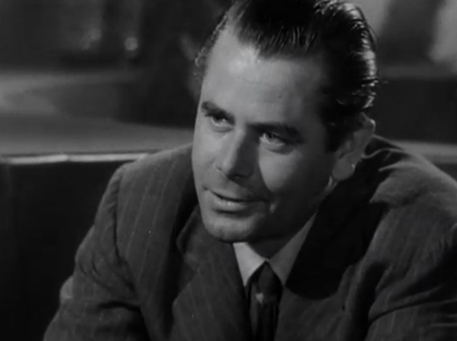
bigheat2The Big Heat is not a noir where the darkness comes from the shadowy visuals, but from within its characters themselves. In fact, some of these individuals are so subtle in their corruption that it easily gets overshadowed. Homicide cop Dave Bannion is, rather ironically, the straight-arrow trying to do what is right, and he becomes the most vengeful character in Fritz Lang’s film. It’s a subversion of the typical noir arc because his greatest help ultimately comes from the former femme fatale. That’s not how it’s supposed to happen, but then again a lot of things happen a little differently in The Big Heat.

The film opens and within a second a man has shot himself and left a confession on his desk. The cues tell us that he’s a cop and he’s just committed suicide. His wife comes downstairs strangely composed and shuffles through the pages he has written. She goes to the phone, not to call the police, but she talks to a third party. We quickly forget what’s she’s done, but the fact is Mrs. Duncan represents the corruption that reigns supreme in this film. She’s used a juicy piece of blackmail to receive large payoffs from someone and she’s not the only sellout.

Bannion (Glenn Ford) is a cop by day and a family man at night with a loving wife and a beautiful little girl. By convention, he is supposed to be the moral compass of this film — the emblem of good conquering evil. He takes on the straightforward case of Officer Duncan’s death, but it gets convoluted when a B-girl named Lucy Chapman calls him up to say she knew the deceased, and he would never kill himself. Initially, Bannion takes little heed of this girl, because she is hardly as respectable as Mrs. Duncan, or so society says.

He gets pressure from his superior Wilks to lay off, but Bannion is discontent with loose ends, especially when he receives news that the Chapman girl has been brutally murdered. This can’t all be all coincidence, and he begins sniffing out the truth like a bloodhound. Bannion leads us into the home of this empire of crime literally. He confronts local businessman/crime boss Mike Laganna, who he accuses of involvement in the corruption. Things are beginning to heat up, and they start to infiltrate the sanctity of his home life. The dark recesses of the noir world can never be subdued, and Bannion dives deeper into the labyrinth that is created by his own obsessive vendetta. He has no tolerance for his colleagues who don’t take a stand, in favor of their pensions. He can’t stand tight-lipped locals who give him no help and most of all he hates Laganna’s guts.

bigheat3At the local shady nightclub “The Retreat,” Bannion has his first run-in with the hired thug Vince Stone (Lee Marvin). Afterward Vince’s girl Debby is genuinely impressed by Bannion’s methods, but he will not give her the time of day. He expects her to be the same superficially ditsy dame that we have all seen before. Hardly a femme fatale, but still there is the potential to be deadly. The one character who seems to conform to the stereotype is Stone, and yet he is even more brutal than most, burning girls with cigarette butts and splashing scalding coffee on Debby’s face.

Bannion gets to one of the other hired guns named Larry and both Stone and Laganna decide that something must be done to stop Bannion in his tracks. The obvious target is his little girl, but this time the family life prevails over the noir world. His family and colleagues rally around him and yet Bannion is not done with his obsession.

In fact, it is Debby who actually finishes off Bannion’s work by paying a visit to Mrs. Chapman and then Vince. Bannion arrives soon after to reprimand Vince, but Debby has already done the dirty work. The nightmare is over and everything that is good and right comes to the forefront. Debby proves her allegiance, the criminals are put away, and Bannion gets a new position with the homicide department. But underlying this seemingly happy ending is still a sense of tension. The film ends as Bannion heads out on a new homicide case with the cycle continuing and it seems like he will never be free of it.

The world will continue ripping away the ones he loves. Before he knows it, he will be left with only his personal vengeance to drive his future. Bannion very easily could cross the line between righteousness and corruption. He already almost strangled two characters and was not opposed to slugging it out with others. It’s only a matter of time before he totally blows his cool and collected exterior. It’s a dark assumption, but then again that is a lot of what film-noir is. Fritz Lang seems to get this and that’s what makes his characters here so powerful because he knows that the root of all evil can be in everyone.

4.5/5 Stars

Review: Gun Crazy (1950)

guncrazy2

Bart has an intense obsession with guns. It’s what his life revolves around. It’s the only thing he wants to do as a boy and the only things he seems to think about. It becomes a problem when he breaks a store window, but during the following hearing, his sister and friends vouch for his character. He would never take a human life or kill. That’s not in his nature.

No matter, it is decided Bart should be sent off to a special preparatory school, and he only returns years later as a grown man recently off a stint in the army.  He’s back in his hometown not quite sure what his future plans will be, but his buddies are glad to see him. They shoot some, drink a few beers, and decide to take a jaunt to the carnival for a night of fun.

Their Bart meets the girls of his dreams. There’s a quality to John Dall that makes Bart into a pure victim of his circumstances. He’s quickly infatuated with the gun slinging and sensuous Peggy, who seems to share his one love. A goofy smile is plastered on his face as he faces off against her in an act of skill. He makes her uneasy and ultimately beats her. 

He gets a job with the carnival and spends as much time as he can with her when he’s not shooting guns. They are fed up with their boss and leave the migrant life behind. Marriage is on their radar, and they live it up with the money they have. But Peggy wants more and she wants to keep living the high life. 

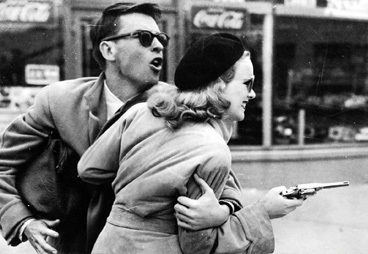
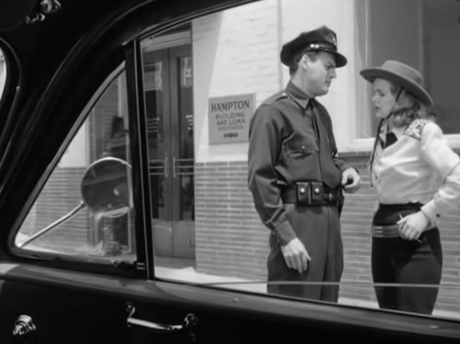
She wants to rob a gas station. It’s one little idea that soon blows way out of proportion. They are holding up banks, gas stations, and any place with money that they can lay their hands on. The pair is fugitives with exploits plastered all over the front pages and roadblocks waiting to stop them up. All the while Bart makes Peggy promise not to shoot anything because he still is totally opposed to killing people. 

It seems like things might end peaceably, except once again the gun-toting lovers are nearly flat broke so Peggy coaxes Bart into one last job to end all jobs. For the first time, despite their planning, just enough goes wrong to nearly botch their mission. Bart drives off and Peggy shoots a guard. He’s not the only one. 

 guncrazy1When Bart finds out, after the fact, he realizes they have just stepped up a level with murder stuck on them. The game is winding down and the only place Bart can turn is his hometown where his sister is. For good reason, she cannot stand Bart or Peggy who she sees as poisoning her brother. And it’s true. Bart seems different now, so paralyzed by fear that he even pulls a gun on his old friends.

The last ditch effort of Bart and Peggy is to literally head for the hills. The dragnet is sent out and the hounds are let loose. They hardly have a chance before dropping from exhaustion in a swamp. They’re trapped and a crazed Peggy looks to shoot it out to the death. But for once Bart breaks with her remembering his friends. It doesn’t help him much.

Gun Crazy is a B-film and yet it is easy to forget because the way Joseph H. Lewis constructed this film is so impressive in its economy. One scene that reflects this so beautifully is the long take from the back seat of the car. The camera does not change positioning and so we see a bank job from the outside, and it only helps to build up greater tension.

 We also have enough time to care about certain characters. We have enough time to see Peggy is really no good. Yet with her keen marksmanship, she is a different shade of femme-fatale who is still as deadly as any of her contemporaries. Along with They Live by Night (1948), this is one of the archetypal Bonnie and Clyde-esque films. Thank goodness this film’s title was changed from Deadly is the Female to the more apt Gun Crazy. That it is. 

4/5 Stars

Point Blank (1967)

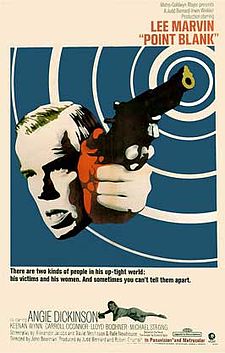
225px-PointBlankPosterJohn Boorman and Lee Marvin came together as equal parts in this venture called Point Blank and it’s quite something. You can call it neo-noir, you can call it a revenge story, a crime film, but nothing quite sums up what you end up with.

It’s a brutal, stark, psychedelic trip at times that never falters to any level of convention that we are used to. You have the clip clop of shoes on the concrete. Solemn, self-assured, repeating and ultimately deadly. There’s a man named Walker (Lee Marvin) on a seething rampage. He personally totals a car with the victim inside scared out of his wits. He’s shooting up victims all across kingdom come. Watching, waiting, then acting.

Point Blank is full of repetitive, reverberating sounds and images. Time too is repeating and evolving; fractured shards of the past followed by the present. It does not always line up or add up. Walker’s past is being fed to us through his own memories.

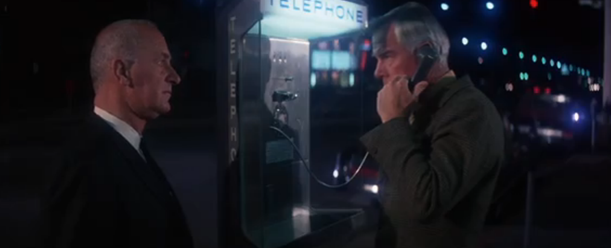
We get to pick up the pieces as he pushes forward on his vendetta. His wife is dead and he is after a man named Mal Reese, who double-crossed him, stole some of his money, and his girl. But the hunt doesn’t end with Reese. That would make too much sense and it would be too easy. Walker keeps going. Keeps hunting until it leads him to the next man and then the next. He gets together with the older sister (Angie Dickinson) of his wife Lynne (Sharon Acker). She is the repetition of Lynne who is now dead, just as each one of these targets is the new Reese.pointblank2There’s a point where we must beg the question? What does Walker even want now if all he gets is $93,000? What is going on in this world? Why does it tick in such a way, because to be honest, it doesn’t always add up? Is the Alcatraz we see and then the L.A. landscape true reality or is this a dream that Walker has created so he can act out his revenge? After all, he was shot, right? It might be a long shot, but the plan of Walker in itself is a long shot. He just continues pushing on and the hunt leads him back where he was in a perfect circle.

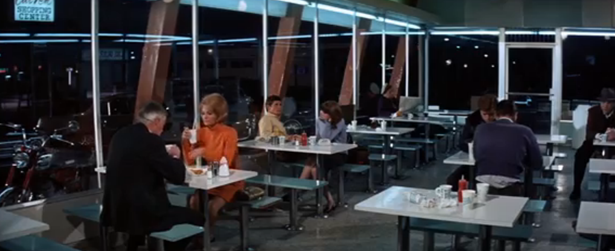
Now what? Reese is gone. Lynne is gone. Every single middleman is gone. He has a load of money laying out at Alcatraz for him and perhaps Chris is stilling waiting for him. We don’t know. That’s where Point Blank finds its conclusion and it’s just as vague as where we jumped in.pointblank3It’s understandable that it has gained a cult status over the years since Lee Marvin is an uber-cool gunman and his journey is hard to figure. His world is a bleak cityscape of 1960s L.A. and S.F. We can never hope to fully understand him or this world either and that’s the beauty of Point Blank. There is a degree of ambiguity that is fascinating. Heck, we don’t even know this man’s first name and yet we invest time in his story. I want to see Point Blink again because it’s not just your typical shoot ’em up action film. It makes you think and it has such a cool aurora and style. It deserves another viewing at some point soon.

4/5 Stars

Review: The Killers (1946)

Thekillers2It’s been said that Robert Siodmak’s The Killers was Ernest Hemingway’s favorite adaptation of one of his works which was, in this case, a short story. As a film-noir, it works on numerous levels from the cinematography, to the score, to the young stars, to the ingenious narrative. Some credit, of course, can go to Hemingway for the concept, but a lot of the creative success must be given to the likes of Siodmak, John Huston and a host of others.

The film opens in an instant with two lurking gunmen entering a diner in a small New Jersey town called Brentwood. Their target is a washed up boxer called “The Swede” and we do not know why, but after terrorizing a few locals, they riddle him with bullet holes and that’s the end of it. It’s an intense sequence because the thugs (William Conrad and Charles McGraw)  are antagonistic and Miklos Rozsa’s score is nearly relentlessness.

The story could have ended there if it wasn’t for an insurance investigator named Reardon (Edmond O’Brien), who takes an interest in the dead man so he can find his beneficiary. In the present, he begins to piece together little fragments of the boxer’s past slowly but surely.

It starts out with Nick Adams who witnessed the thugs and worked with The Swede when a mysterious man came by the filing station. Soon after Ole Andreson stopped coming in to work and a while later he was dead. That’s all Nick knows, and it does not give Reardon much to go on.

Next, he tracks down The Swede’s beneficiary who turns out to be a kindly hotel maid. The connection seems slim, but it turns out that she kept him from committing suicide after a tough evening where he tore his flat apart. It’s still not much to go on, but Reardon thanks her and moves on with his investigation, still intrigued.

Then he goes to Philadelphia and gets his biggest puzzle piece from a policeman named Lubinsky, who used to run with the Swede as kids and probably knew him the best of anyone. He and his wife explain to Reardon how Pete Llund, as he was known, lost his final bout and was forced to move on with his life. About that time he met Kitty Collins for the first time and was infatuated for good.

Charleston is next the old stooge who spent a good many years locked up in a cell with the Swede. Reardon comes upon him at the funeral and from the old convict, he learns about a bank job that the washed up boxer got involved in. The other partners were Blinky, Dum Dum, and Big Jim. They are Reardon’s next points of interest.

Blinky is near death and recounts the robbery. Dum Dum crosses path with Reardon and shares about the aftermath of the job which went sour. Next, comes Big Jim whose tight-lipped about the past. Last but not least is Kitty, who is fearful that Reardon knows something and can actually blackmail her. That’s when everything begins to line up and heat up. After being absent for so long, the Killers are back in the picture and Rozsa’s score picks up again threatening the status quo of the film. They put us on edge again and for good reason. But the real focal point of the ending is Kitty.

Obviously, Citizen Kane has so many layers of interest, but it shares a similar narrative arc to The Killers where the main character is killed and his story gets pieced together thanks to flashbacks that are furnished from the present. Except, in many ways, the story of The Swede intrigues me more as a character. Charles Foster Kane is a magnate with an impressive if not tragic life.

Swede’s life is probably just as tragic except it was more humble and chock full of more crime. He was small time and he even failed in love when his friend Lubinsky got the girl of his dreams. It’s an interesting life too that ended unnaturally with gunshots rather than Kane who died as an old man. The Swede was cut short in a tragic sort of way and I think that’s part of what intrigues Reardon. It’s more than a job, but a mysterious story of a man’s life that the audience also gets taken along for. As far as storytelling goes, it’s great and it really works to flesh out these characters.

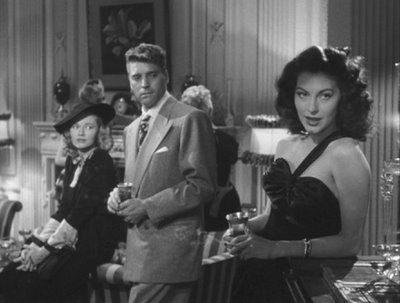
Ultimately, Reardon feels like the main character of sorts, but such an aura is built around The Swede and Kitty that it is understandable that this film made stars out of Lancaster and Gardner. They are certainly memorable partially because we hardly ever seen them in the present (except for Kitty at the end). Their whole persona is built off of what others say and there’s something interesting about that. There’s the fatalistic and sullen Swede which turned out be a perfect debut for Burt Lancaster. Ava Gardner has the soft seductive whisper of lethal poison all wrapped up in a beautiful body and it leaves a major impression.

Above all else, The Killers is a prime example of film noir blending German Expressionism from Siodmak’s native Germany with more documentary style sequences that take inspiration from post-war neo-realism. The opening sequence especially drips with noir sensibilities that, at its most dramatic, looms with shadows from the exterior of the diner to the low-key lighting of the Swede’s bedroom. For a while, it’s even difficult to know that’s Burt Lancaster reclined on the bed because his whole body is fully encased as he speaks. It’s only when he gets up into the light that we finally are introduced before he gets gunned down a few minutes later. It’s great staging and the atmosphere remains for a great deal of the film from the prison cell to Big Jim’s mansion. Each place is contrasted with the present or other locales like Reardon’s office which are more natural in lighting. It doesn’t get much better than that.

4.5/5 Stars

Review: The Big Sleep (1946)

b4c25-bigsleep1

Philip Marlowe is undoubtedly Raymond Chandler’s character, but Howard Hawks and Humphrey Bogart brought him right out of a pulp novel and stuck him on the silver screen to ever be solidified in our minds. Needless to say, this is a quintessential film-noir coming right at the tail end of WWII, known as much for its incomprehensible plot line as it is the romantic pairing of Bogey and Bacall.The title credits role and the contours of our two leads can be seen in the background, cigarette in toe with Max Steiner’s furious score pulsing in rhythm. We find ourselves on the doorstep of a man named Sternwood. A hand is ringing the doorbell and a servant answers. The hand, of course, belongs to Humphrey Bogart or closer yet Philip Marlowe. Right off the bat, he gets the come on from the flirtatious younger daughter of Sternwood and he takes it in stride.

When he meets the sickly man of the house, he’s stricken to a wheelchair parked inside a greenhouse. He and Marlowe get chummy, and he calls upon the P.I. to find a man named Geiger, while bemoaning the trouble his daughters get into. For good measure, Marlowe also gets his first taste of Sternwood’s older daughter Vivian Rutledge who is more mature, but suspicious all the same. From then on the case is a series of storefronts, L.A. street corners, and car interiors. It’s hard to believe, but it also seems so dark and dreary with buckets of rain to boot. It must be L.A. in winter (or in an alternative universe). Bogey has a little fun masquerading as an antique book aficionado and every lady he interacts with feels like another Carmen Sternwood. Always ready to flirt and he usually gives them the time of day.
He stakes out a home and he investigates a piercing scream only to find a disoriented Carmen in a big mess. Next, a dead man is pulled out of a Packard near Lido Pier. The names keep piling up too. There’s A. G. Geiger, Sean Regan, Owen Taylor, Joe Brody, Eddie Mars, Harry Jones (Elisha Cook Jr.), and a number of others. Most are seen at one time or another but a few are not.
08bfb-bigsleepBy this point, The Big Sleep is less about all the facts and more about how we get there in the end. Obviously, the source material is from Raymond Chandler, but the witty script full of great patter is courtesy of William Faulkner and Leigh Brackett of all people. Bogey and Bacall have some fun on the telephone (You like to play games don’t you) which coincidentally has no bearing on the plot. Later on, they have some more spirited back and forth about horse racing. It’s at these times that you cannot help but chuckle at the rapier wit of the script. Philip Marlowe is a great character with a lot of great things to say indeed.
Soon we suspect there is something romantic going on between Eddie Mars and Rutledge. A few more stooges get it and Marlowe gets himself beat up in a dark back alley (Of course). Next thing we know is our new favorite gumshoe is tied up in a house with two ladies. Rutledge is there and the wife of Eddie Mars. What? He gets out of harm’s way thanks to Vivian, and the showdown that we have been waiting for comes to pass. Marlowe outsmarts everyone and puts the damper on the case. Everything seemingly comes to a smooth resolution, the audience just has little idea how we got there. But that’s not the greatest of concerns.
It would be great enough to watch The Big Sleep for the sass and repartee which it is positively dripping with. Thanks to the reworking of the film in 1946, the Bogey and Bacall dynamic became more prominent and fun. Although it is slightly disappointing that a lot of Martha Vickers’s performance ended up on the cutting floor, it is made slightly better by a memorable appearance by a young Dorothy Malone. All in all, there is very little to complain about if you just sit back and enjoy this very engaging film-noir for what it is. Howard Hawks brought us yet another unassuming post-war classic that is unequivocally American.

4.5/5 Stars