A Face in the Crowd (1957): Lonesome Rhodes is No Andy Taylor

a face in the crowd 1.png

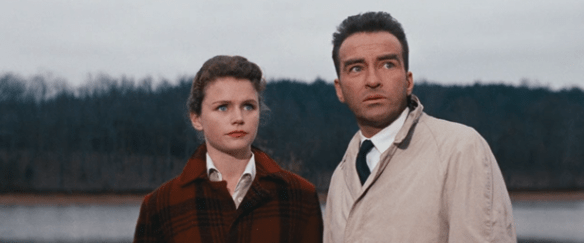
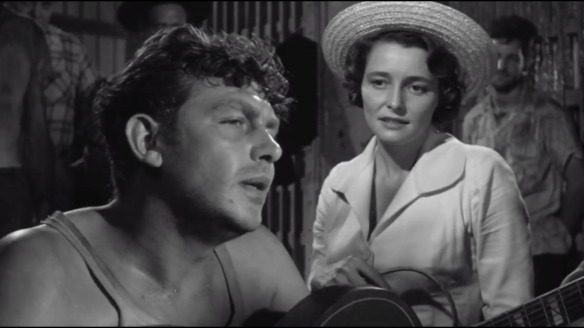
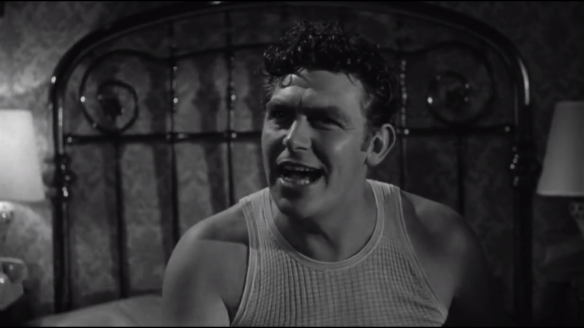
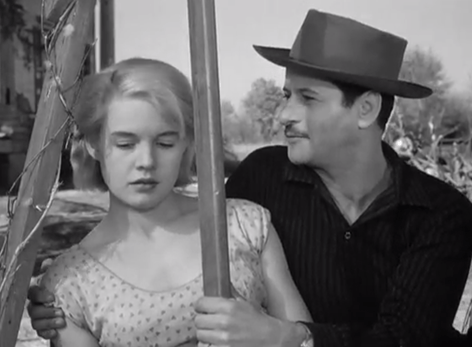
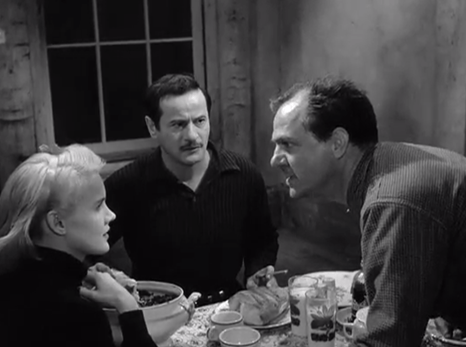
It begins unobtrusively enough. In a backwater Arkansas jail, a drunkard plays his guitar on a radio segment of “A Face in the Crowd” being broadcast from his cell. They don’t know it quite yet but soon the host who found him, Marcia Jeffries (Patricia Neal), and Larry “Lonesome” Rhodes (Andy Griffith) capture the public’s imagination. Far from just plucking Rhodes out of obscurity, Jefferies also rebrands him with an off the cuff remark and uses her daddy’s radio reach to broadcast him all around.

With such a platform, Rhodes does the rest with his wild whoops of down-home charm and strangely beguiling magnetism. He’s a natural performer and showman who knows how to form a connection with the folks at home. Soon they have created a following or as is popular in the lexicon these days a “tribe” giving him real media presence in the cultural conversation.

Someone asks him the question, “How does it feel to be able to say anything that comes into your head and be able to sway people?” But it’s true. He’s at the forefront of a grassroots democracy turning into a television phenomenon.

Meanwhile, Jefferies watches it all unfolding with bright-eyed awe and deep enthusiasm. It’s absolutely rich seeing it sweep over the country. One of the cogs in the machine is a jaded writer named Mel (an early Walter Matthau) who watches the unfoldings with grim amusement. Meanwhile, Lonesome’s ever-ambitious and cutthroat promoter (an even younger Anthony Franciosa) positions his man to continue broadening his success. Everyone’s trying to get a piece of this new pie. Because what’s more American than pie?

Rhodes keeps up his side of the bargain by purveying his own brand of “authenticity.” On one show he brings on a destitute African-American woman and gives a call-to-action and the money comes pouring in, in response. Another week he crosses a mattress sponsor and subsequently raises the man’s sales all across the country simply by belittling his product.

Soon he’s brought on to promote the product of the stuffy Vitajex company and he takes their pride and joy, disregarding their focus groups and tradition, selling the pill straight to the public. By the time he’s done with them, the public’s buying them up by the barrelful.

He also captures the imaginations and the fancy of all the young girls all across the nation — soon has them all swooning over him — but one lucky girl wins out (Lee Remick) with her baton twirling during the Ms. Arkansas Majorrette competition of 1957. Of course, Lonesome Rhodes is made the judge and after getting mobbed by the girls, he takes a shine to Betty Lou.

Marcia gets pushed further and further into the periphery of his life as Rhodes weds the frisky twirler and sets his sights on the next domain to be conquered. Politics have entered a new stage — the television age — and no man is more beloved than Lonesome Rhodes. “You gotta be a saint for the power the box can give you,” as Mel notes, and in the wrong hands, this immense power is dangerous.

a face in the crowd 2.png

Rhodes throws his support behind a stodgy old lawmaker giving him advice in the process. The film was already predicting the famed televised debate between Nixon and Kennedy. Where campaigning is about punchlines and glamor; it becomes a popularity contest and an advertising endeavor as much as a smear campaign. He uses his Cracker Barrel Show to promote the senator in a more relaxed atmosphere and has the position of Secretary of National Morale waved in front of him.

He even notes his candidate should get a dog, observing that it didn’t do Roosevelt any harm or Dick Nixon neither (referring to the well-received “Checkers” speech in 1952). Because these events begin to hint out how corruption, even double talk, begin to make the general public question “authenticity.”

In one off-handed remark, Lonesome crows, “This whole country is just like my flock of sheep.” However, like Arthur Godfrey, his downfall (though more rapid) occurs after an onscreen incident that removes his mask and undermines his image before the people. They can never see him the same way. The saboteur, as it were, is Marcia for she cannot bear to see the people taken in.

So the final trajectory is obvious — the ascension and the dethronement — but that can hardly neutralize what we have already witnessed. A Face in the Crowd lingers with fair warning, relevant to any analogous situation in the modern landscape, only magnified to the nth degree.

Earl Hagen’s down-home waterhole tunes fit The Andy Griffith Show just as this arrangement from Tom Glazer gels with A Face in the Crowd. Speaking of, I must insert a thought on what I know more about, as I grew up watching countless hours of The Andy Griffith Show.

The character of Andy Taylor obscures the fact of what a fine actor Andy Griffith was. To some extent, the same can be said of No Time for Sergeants because like the early seasons of his show, he’s just playing a bubble-headed hick. Later on, he became more of a straight man and after Barney Fife left, he settled into a more irascible role so there was an evolution.

Regardless, Lonesome Rhodes turns the overarching stereotypes of the man on their head. You can still see him as the benevolent Sheriff of Mayberry but this certainly lingers in the back of your mind. Take away the moral integrity and others-centric mentality of Andy and you wind up with Lonesome.

Given its themes about media and television, which seem like a cutting-edge indictment in their contemporary age, it seems logical to lump A Face in The Crowd with Network. Similarly, though technology and advertising continue to become more advanced and invasive, the themes explored feel, not less relevant, but more so.

We simply have to magnify them. Instead of television, we have Twitter and smartphones. Instead of people who willfully hide their intent, we have people in power who seem to blatantly disregard moral uprightness.

I want Lonesome Rhodes to be outdated and immaterial but to make such a claim would be an immense act of folly. It would cater to the same sense of ignorance and sway in all sectors of society, which led to the rise of such a person in the first place. Then and now…

4.5/5 Stars

Note: An earlier version of this review erroneously said Rip Torn instead of Anthony Franciosa (He was featured in an uncredited role).

Baby Doll (1956): Elia Kazan Does Southern Comedy

baby doll 1.png

Elia Kazan had a fairly lucrative partnership with Tennessee Williams and the same could be said of his ongoing working relationship with Karl Malden. It’s fitting that all three are back for Baby Doll and yet it still manages to feel like a bit of an outlier in Kazan’s oeuvre thus far.

As per usual, Kazan invests great commitment in his actors and the emotional richness of their performances, which enter near hyper-realized heights. Because there would be no Baby Doll without Malden, Eli Wallach and of course, Carroll Baker. They must carry its weight and for what it’s worth, they manage the task quite well.

Malden is the bug-eyed hick, Archie Lee, who made a pact with the dying pappy of his virginal bride that he would take care of her. Whether he’s held sway on his side of the bargain is up for debate, as Baby Doll and he live in a home literally crumbling around them by the hour

He’s a narrow-minded cotton gin operator who has recently been hitting the skids due to competition. If you are looking for the bare minimums of the story, there you have them. The situations themselves venture on the absurd in this hardly fully-realized plot.

With their house a decrepit eyesore, the furniture soon gets taken away. Archie Lee’s just about at the end of his tether and so he sneaks out one night and commits an act of arson on a whole silo full of cotton. It’s a desperate attempt to give himself an advantage and direct some business his way.

It’s true many might be unaccustomed to comedy in a Kazan film because though it’s masked by typical antics, melodrama, and the risque veneer that precedes it, the humor is unquestionable. If it sounds like melodrama you only have to look at the performances to crack a grin because they do feel like over-the-top exaggerations.

The galvanizing moment, of course, is our first view of Baby Doll lounging in a crib-like bed, sucking on her thumb. Her husband peeps on her through a hole in the plaster giggling like a lecherous schoolboy when she wakes up. We have a Lolita archetype and no doubt the source of its censorship woes, which elicited a “Condemned” rating from the Catholic League of Decency.

What always stings more is hearing the N-word bandied around so inconsequentially as the African-American characters play an unheralded supporting role in the far-off periphery. There you see the hypocrisy. No one in the Catholic or Southern Christian communities probably saw it fit to condemn this element, no doubt considering it acceptable, even commonplace. It’s at least something worth acknowledging soberly.

baby doll 2.png

If Archie Lee is our entry point into this asinine world, then Baby Doll and Vacarro (Wallach) have the presence to keep us watching. In a momentary lapse in judgment watching Long Hot Summer, I mistook Lee Remick for Carrol Baker because they look vaguely similar at first glance. However, Baker does more than a southern belle here full of sing-song dialogue. There’s a tremor, an impediment to her speech which, comes off as strangely childlike. She boasts a cutesy name and enticing sensuality akin to Darling Jill from God’s Little Acre and really there’s the film we can draw the most parallels between.

Because Eli Wallach plays the other man who pays Archie Lee a visit the following day after the conflagration at his place. He’s derisively referred to as a “Whop” and so it’s easy for him to become the outsider with a chip on his shoulder. He’s willing to do what he needs to do in order to get back on top of the heap. Ironically, he lets Archie Lee in on his philosophy.  He’s a proponent of “biblical justice,” an eye for an eye and a tooth for a tooth, though he obviously didn’t read the scriptures too closely.

Instead, he implements their “Good Neighbor Policy” and while the other man is out fixing his machines to take on a new cotton crop, Silva starts playing with his wife even sneaking into the house to toy with Baby Doll. But remember this is not A Streetcar Named Desire. Wallach has his own inner demons but he’s no Stanley Kowalski and Baby Doll’s no Blanche.

Their trajectories take them into different places as a drunken Archie Lee gets jealous of his wife’s suitor, going after his adversary with his shotgun. However, in the end, the stakes are slighter than its predecessors and yet there’s something novel and slightly refreshing in this. While Baby Doll is nowhere near the best of Kazan’s work its “otherness” makes it a risible endeavor out of left field.

3.5/5 Stars

A Tree Grows in Brookyln (1945): The Precursor to I Remember Mama

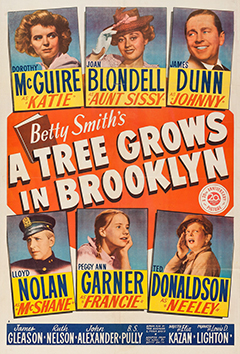
ATreeGrowsInBrooklyn1945Poster.jpgThe reveries of a Saturday afternoon in childhood are where A Tree Grows in Brooklyn chooses to begin and it proves a fine entry point, giving us an instant feel for the world the Irish neighborhood of Williamsburg in Brooklyn. Its contours are impoverished, even harsh, but also richly American.

There is a mother (Dorothy McGuire) who is practical and ever-resourceful, scrimping and saving to eke by an existence for her family. She faithfully pays her family’s due to the door-to-door insurance man Mr. Barker, who is always ready to sow some juicy gossip around the community.

It occurs to me that Katie Nolan (McGuire) is a precursor to Irene Dunne’s role in I Remember Mama. But there is also a near-callousness that is lacking in the latter part, which is mostly sunshine. In this regard, it gleams with a certain individual truth. Struggling  to make ends meet, Nolan asserts, “My kids are going to be something if I have to turn into granite rock to make them.” She dishes out tough love and makes difficult decisions in what she deems is their best interest — an extension of her undying love for them.

There’s an extraordinary shot showing bickering wives, stories up in their apartments, with clotheslines strung up every which way and a man trying to fix the source of their problems.

Nearby sits the little girl enthralled with her book and you understand first hand the power of the library. Because with the internet, television, and movies we’ve deluded them but, at a certain time, books were a way of escape, of learning, and open avenues to distant places.

Francie (Peggy Ann Garner) is, without question, the emotional center and if we are to extend the earlier juxtaposition further, she is an analogous version of Barbara Bel Geddes’s character in I Remember Mama. We view the memories of the past through their impressionable eyes.

She too is captured by her imagination — the rapturous escapes that stories and music can provide a fanciful mind like hers in the station of life she finds herself in. Francie’s deepest wishes are granted when she is able to attend a fine school where her benign teacher gently cultivates her passions.

The advice passed down to her is empowering as Francie is inspired to be a writer. She must write about the things she knows imbuing them with truth, which can then be dressed up with the whims of her imagination.

It’s true Francie maintains an underlying sweetness and innocence even in the midst of heartache. For instance, there is the annual Christmas ritual retrieving discarded trees and boy do the kiddies bring home a whopper. Its presence alone puts some yuletide cheer and the smell of evergreen into their holidays.

It only takes such a minor yet meaningful Christmas scene to humble us in our modern tendencies so that we realize how off-base our modern celebrations are. These folks have nothing and yet to look into their eyes you see such contentment in the singing of a song and quality time spent together.

However, the most debilitating ideology in the film is the concept of neverending cycles — believing the lie that change is impossible and things will never be different. Because already you have a self-fulfilling prophecy. We see it most obviously in the marriage of Francie’s parents.

Johnny Nolan is an ebullient father bred on dreams and singing. There’s always a song in his heart whether “Swanee River” or “Sweet Molly Malone” and unfortunately, for the sake of his family, a bottle in his hand. His daughter memorializes him aptly, “He had nothing to give but himself but this he gave generously like a king.”

The words stand tall and true. To my mind, I have not seen such a compelling father finger as Johnny Nolan in some time and the reasons are as obvious as his flaws. He’s an alcoholic. He makes promises he can never keep. He’s practically useless when it comes to providing for his family. And yet through all his shortcomings shines a light of generosity and geniality that positively warms the cockles of our heart. We cannot condemn him without loving him just as deeply. There you have the testament of a truly impactful character.

Aunt Sissy (Joan Blondell) proves another bright spot in the film and her vivacity, much like her brother-in-law’s, injects the film with a buoyancy making us grow fond of them even as their flaws are laid fully bare. Sissy has her own struggles holding onto a marriage with a couple of husbands already coming and going. Her escapades leave her baby sister shaking her head and hoping to shield her kids. And yet even Aunt Sissy has her admirable qualities.

The local police officer Mr. McShane (Lloyd Nolan) walks his beat with a quiet integrity, disregarding any stereotypes of policemen and fashions them into compassionate people the world could probably use more of. Meanwhile, kind old Mr. McGarrity (James Gleason) heaps neighborly generosity on the Nolan’s in an effort to help the overextended Mrs. Nolan make ends meet.  It’s the benevolent spirits in the film who are quietly memorable.

Too blinded by the resonating sentiments, I failed to see the obvious denouement of A Tree Grows in Brooklyn, which nevertheless proves deeply satisfying. As its title suggests, out of death and decay can grow new hope. It comes from hardy stock and dutiful cultivation, which all seem integral to the American way of life.

For me, it’s almost unthinkable to think the man who played a small part as Googie in City for Conquest only 5 years letter would alight on a directorial career that shook Hollywood over and I don’t think that’s hyperbole. He brought us Brando and Dean, conquered stage and screen and left an indelible mark on film acting forever. Of course, we’re talking about Elia Kazan and here he has his first prominent muse Dorothy McGuire (a founding member of the La Jolla Playhouse) who is often an unsung star fitting as she’s playing an unsung heroine

It seems a fitting entry point into Kazan’s career as it is an immigrant story and he came from such a family. It makes no difference that he wasn’t Irish because we can surmise the essence is much the same. He believes in the American dream no doubt and the love and integrity that can see people through the turbulence of life.

However, perhaps the most striking acknowledgment has to do with the fact this story does not thrive on intensity — one might see that as being a marker of Kazan’s most noted works — it’s tenderness mostly. But then if you stop a moment and think of Brando slipping on the glove belonging to Evie (Eva Marie Saint) or James Dean crying to his father (Raymond Massey), you realize he never lost those sentiments. What made his films was the real emotions that reach out to us. He never allowed for those sensations to waver. There you have an integral element of his success.

4/5 Stars

Ad Astra (2019): To The Stars and “The Seeing Eye”

Ad_Astra_-_film_posterSince the dawn of man, the vast reaches of the cosmos up above have enamored us to the nth degree. You need only watch something like 2001 to be reminded of that fact. (There’s no doubt James Gray is well-versed in its frames.)
Herein lies a core theme throughout our very existence. We have this inherent overlap between science and spirituality — the celestial spheres and the extra-terrestrial — forming a framework for how we comprehend this world.

Aspects of this film even have a near-liturgy or the solemnity of an open-air cathedral. Dean Martin’s “Heaven Can Wait” is a hymn and a hint. Prayers are cast up to St. Christopher for the pilgrimage ahead. The dead are venerated like saintly martyrs for the cause. Because somewhere at the end of it all is the thought of some universal meaning, some ultimate truth, be it God or sentient being.

One is reminded of the proclamation the Soviet Union made when they sent their cosmonaut up into the stratosphere and came back down not having seen God. In essence, the conclusion was that this tangible world was all there is. Tools and technology are the instruments in which to make sense of the world. God, in whatever form, is only a pipe dream or a form of wish fulfillment for the weak. We must look somewhere else. Inside ourselves perhaps.

C.S. Lewis in his essay “The Seeing Eye” wrote the following response when pressed on the Soviet’s pronouncement:

“Space-travel really has nothing to do with the matter. To some, God is discoverable everywhere; to others, nowhere. Those who do not find Him on earth are unlikely to find Him in space. (Hang it all, we’re in space already; every year we go a huge circular tour in space.) But send a saint up in a spaceship and he’ll find God in space as he found God on earth. Much depends on the seeing eye.”

Watching Ad Astra (Latin for “To The Stars”) with this context uncovers profound meaning for me. It is a journeyman’s film pure and simple. Brad Pitt’s Roy McBride is on a mission to the outer reaches of the galaxy. He procures helping agents along the way, namely, Donald Sutherland in an enigmatic role and Ruth Negga, an operations director and Mars-native who dreams of Earth as the distant reality she once visited as a child. It brings to mind her parents, now deceased. Yet another cryptic puzzle piece.

One is led to think they do a fine job being exactly that, mysterious and understated, but it doesn’t give us much to relish as an audience. Tommy Lee Jones is a vanished American hero clouded with secrets of his own. Could it be the rumblings are true and he’s the manifestation of Kurtz in the heart of darkness on the surface of Neptune?

The question becomes not what is at the end of the universe but even more sobering, what if there’s nothing there, just the vastness and austere beauty (as Kubrick depicted, without his images of rebirth)? What are we to do then? Ad Astra‘s conclusions aren’t all that different than the Soviets all those years ago, but they are admittedly far less cynical.

While it lacks true emotional heft in crucial scenes, Gray’s endeavor is concerned with human relationship and this distinction is ever so important. Because this niche of movies can fall into two categories. 2001 spearheads those that are not altogether interested in humanity as such. It’s vast and clinical with the vision and scope Kubrick could capture immaculately. Whereas Tarkovsky’s Solaris or even more recent films like Gravity and Interstellar are far more intimate, regardless of any flaws they might engender.

James Gray is certainly skilled at developing the world planted in a so-called “near-future.” Still, as expansive as the galaxy becomes with every panorama and lens flair by Hoyte van Hoytema, so much more of the movie is borne by the features of Brad Pitt. His perspective and his thoughts. We come to understand him in physical proximity even as we are never allowed close emotional proximity.

Because Ads Astra is a pensive, solitary film. It maintains some intrigue by divulging little and stretching out its assets. It plays with some generic terrors. For instance, “The Surge” that has sent a shockwave across earth leaving many dead and without power. We have moon raiders, Gravity-like survival moments, which Pitt handles with steely aplomb, and touches of governmental conspiracy verging on the sinister.

Primates in space give another brief glimpse of 2001, Planet of The Apes, or even Alien. However, we also get the fleet-footed Nicholas Brothers, who are one of the best-kept secrets of Classic Hollywood’s musical circuit. All these are cultural references to earth, mind you, and not the outer reaches of the galaxy. This is an important observation.

Because there is an uncanny feeling that humanity has managed to shape outer space into our own image with the proliferation of Subway or DHL shipping even made available on the surface of the moon.  It makes the Restaurant on The End of The Universe less of a joke and more and more of a reality.

Still, these are never the elements completely defining Ad Astra for me. They are of secondary or even tertiary importance in deference to the central character study. I am willing to give Pitt the benefit of the doubt and believe his performance to be authentic and genuine. Where his masculinity is made really and truly vulnerable. We don’t build a deep connection with him precisely because he doesn’t have a rapport with anyone. Not his wife (Liv Tyler in a minuscule role), not his father, not anyone.

We begin to assemble a blueprint of someone who has always dwelled in their father’s footsteps, resentful of being abandoned, and simultaneously driven to be the best he can be in pursuit of the same auspicious goals. There are fractures cutting through his life even as he is a figurehead of national pride and American know-how, his life continually compartmentalized into professional and personal.

In fact, Ad Astra is simultaneously an exploration of how we forge heroes and erect idols in our culture. It doesn’t actually tackle this idea to an altogether satisfying conclusion, although it’s pardonable as the film literally takes an about-face. This is how it manages to set itself apart from the pack with a final decision different than the Soviets or Lewis, Kubrick or Nolan, even Tarkovsky.

For the final key, I turn to a very mundane place. One of my favorite bands sings about “Stars” from a Descartes perspective — humanity at the center of the universe — only to turn it on its head.

Instead of us looking up into the heavens, it becomes the stars looking down at us. To recall Lewis, those who cannot find “God” on earth will hardly find them in space. And those who look for meaning, or the beauty or the love they are lacking, in the skies above will probably be disappointed.

After all, maybe our objective is not the stars at all, and it never was. They are only markers and a compass with which to reorientate ourselves amid the entropy of this lifetime, that is, existence on earth. Once oriented, we can start looking around and seeing the people orbiting around us and begin a new objective — to love and cherish one another. It’s striking Roy’s final words almost sound like wedding vows. As if he went to the stars only to realize what he had to come back to. He finally had eyes to see.

4/5 Stars

To Each His Own (1946): Olivia de Havilland Does Melodrama Well

To Each His Own 1.png

Ginger Rogers purportedly passed over the script for To Each His Own because, at first glance, it’s hardly a glamorous role; but for the right person, it could be something unquestionably special. That actor was Olivia de Havilland.

Certainly, the production is bolstered by Mitchell Leisen, a mostly forgotten director who made a string of highly memorable comedies and romantic pictures during the 30s and 40s. It’s no different here. And then you have Charles Brackett, formerly half of the lucrative writing partnership with Billy Wilder before alighting on his own as a producer. None of that can be discounted nor a handily-played dual debut by John Lund. But we must return to Olivia de Havilland.

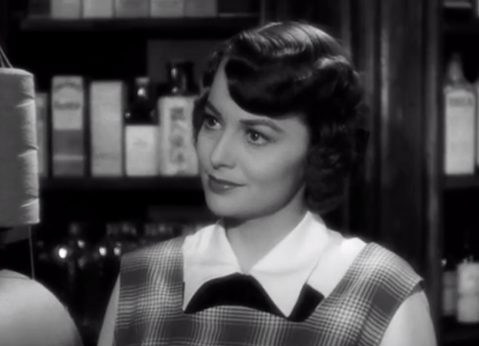
In the opening interludes, she comes off as acerbic and curt, a forlorn type of person. No relationships or community or people to worry about or to worry about her. She’s joined by another middle-aged man named Desham (Roland Culver) and they make quite the pairing, taking on the night watch duty over the holidays so others might celebrate.

He coolly makes the observation that people like themselves are alone for one of two reasons — not caring enough for other people or caring far too much. Though Ms. Norris divulges little, we instantly gather she fits into the latter category. This is what starts us on the journey through her past, which led her to a man named Bart Cosgrove (John Lund).

But before their fateful meeting, the flashback sets up the world of Pierson Falls, familiar to anyone who has glimpsed It’s a Wonderful Life with its parochial atmosphere and local drugstore. Match that with the jingoism out of Hail the Conquering Hero and you have a slice of life in this little town during WWI.

John Lund is sour and far harsher than I recall in say The Mating Season and it serves him quite well. He and his co-pilot (the always reliable Frank Faylen) are the two jaded flyers who get the hardiest of welcomes from the townsfolk. However, this is their umpteenth stop on an endless bond tour. They’ve become overly familiar with people like Bernadock Clinton (Arthur Loft) the asinine town cryer making a continual bother of himself ushering the flyers around like prized sideshow attractions. And it would be more of the same if not for the meeting of the flyer with the town’s most eligible gal.

To Each His Own 2.png

The heightened emotion of wartime uncertainty swirls around them and they share a rapturous, if whirlwind, romance that Captain Cosgrove was never expecting. All too soon, he’s off again leaving his newfound love behind and to use euphemistic vernacular, they’ve created a ticking time bomb.

Here To Each His Own enters its scandalous phase where Jody must confess to her father that she’s had a child out of wedlock. The old man (Griff Barnett), with the steady voice, sounds uncannily like Will Geer and spouts unassuming wisdom, “We don’t judge each other. We love each other.” But small towns are not usually as forgiving and so lest people talk, Jody decides to leave her child on a doorstep. Hoping to pick her child up later and “adopt him.”

Instead, a couple who’ve been tragically hit with a miscarriage are thankful for this second chance at cultivating life and they take the child. Of course, the couple is one of Jody’s old beaus and another peer. They got married because Jody rejected him. The dramatic situation is clear enough.

When the mechanizations of the plot become clear, it also becomes clear just how awful the circumstances are — just horrible. They’re apt to tear your guts out. After the passing of her father, Jody, who needs a job, proposes coming on as a nursemaid, but there is no compassion there. She gets pushed out of the scenario thanks to a jealous wife and a husband who still holds a boyhood crush.

She has no choice to move on and, being a go-getter, she takes charge of a bootlegging business and turns its front, Lady Windemere’s, into a legitimate international operation proving highly successful. Whenever she has a free moment, Jody does her best to manufacture chance encounters just so she can glimpse a few minutes with her son who is growing in knowledge and stature. But she knows deep down, with each passing year, little Gregory is less and less her son.

Melodramas or so-called “women’s pictures” can be hit or miss depending on how thick they lay it on and how much the music swells at the exact moments of deepest impact. But in full consideration, To Each His Own might be one of the finest such pictures to come out of the 1940s, and it’s no small coincidence that it shares that distinction with the thematically similar Stella Dallas.

When it’s all said in done, it’s about heartwrenching relationships between mothers and their children and when the mothers are portrayed by such stalwart titans as Barabra Stanwyck and, in this case, Olivia de Havilland; the drama enters territory that can easily pierce the heart to the core.

To Each His Own is also somehow akin to Random Harvest with dramatic irony being integral to the plot — one character knowing something that deeply affects how they live their life — except the person they care about knows nothing about it. This is by no means a criticism either but simply an acknowledgment that these stories can tug at the heartstrings with great fervor.

Again, it comes down to the players as much as the scenario. They must be people that we are capable of feeling great pathos for. Certainly Stanwyck, Greer Garson, and Ronald Colman and even Olivia de Havilland. Maybe she’s known for being difficult or a perfectionist or what have you, but that has nothing or maybe everything to do with her as an actress.

She makes us care about her as she moves from every stage of her life. And I say life because it feels less and less like a performance and more like real life. She, like Stanwyck before her, is able to carry the weight of youthful exuberance and maternal toil equally well.

Far from being unglamorous for winding up being mother to a grown son, I think a film like To Each His Own makes you appreciate the beauty of de Havilland even more. Because there’s a realness and a depth there that you would have never gotten in a career of roles opposite Errol Flynn. You just wouldn’t.

That’s part of what makes it special. And like the other previously mentioned titles, it goes out with a few tears but also espousing dreams. We can question the final moment — the rationality; the catering to the audience — or we can just enjoy it like a wedding feast with the ones we love.

4/5 Stars

Dodge City (1939): An Errol Flynn Western

Dodge_City_1939_Poster.jpgThe year is 1866. The Civil War is over and anyone with vision is moving west. One such outpost is Kansas where the railway is replacing the stagecoach. It’s a world of iron men and iron horses. Because a place like the notorious Dodge City is a “town that knew no ethics but cash and killing.”

It’s not a decent place for children and womenfolk for the time being. But some affluent magnates with vision see the profits it affords. That’s their business. It will take others to smooth out the rawness and make it into a land worth cultivating and settling down in.

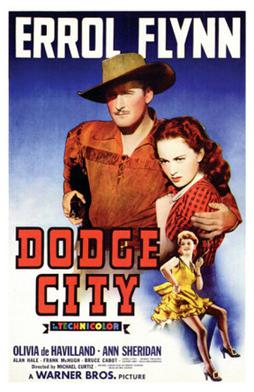
Though lawlessness runs rampant in the streets led by town bad boy Jeff Surret (Bruce Cabot), a wagon train led by a caravan of seasoned cowhands looks to be yet another signifier of change. Because one of the men riding with the rest is self-assured Wade Hatton (Errol Flynn) supported by his pals. You can bet even with an accent Mr. Flynn makes an able-bodied western hero but he’s not alone.

Alan Hale was forever Flynn’s right-hand man from Robin Hood to The Sea Hawk (even playing his father in Gentleman Jim). They also get the boisterous and yet generally good-natured Tex (Guinn Big Boy Williams) to round out their trio. Hatton has his eyes on a pretty passenger who is easy on the eyes. Unfortunately, her younger brother is a drunken hellraising nuisance. He instigates a stampede that turns deadly and from thenceforward Wade and Ms. Abbie Irving (Olivia de Havilland) have a contentious relationship at best.

Seeing Dodge growing so much leaves everyone all agog. Never has a western outpost been crammed with such activity. It feels authentic in one sense. You understand how disease and waste could begin to run rampant in such a bustling atmosphere and crowded conditions. Hatton gets his first taste of Surret when one of his business associates named Orth is shot. But the story is not all drama.

In an ongoing scenario, the boisterous Algernon Hart (Hale) forgoes the tempting calls of the local Gay Lady Saloon for the Pure Prairie League, residing right next door, attended by all the town’s most proper womenfolk.

What follows just might be one of the finest brawls ever, spilling over into the lady’s social, overwhelming the scene with all sorts of gory sights and gut-busting crashes, bams, and bangs. It feels wild, alive, and somehow thoroughly enjoyable. Maybe because we get to sit on the outside looking in at the merry madness accompanied by whoops and raucous accordion music.

What’s more, it forces a response. A drunken Hart is singled out by Surret and his thugs who get ready to string him up in the plaza right then and there. While Hatton quells the injustice without a standoff, there’s a sense that things will only continue to escalate. No sheriff will stick out their neck in such a country. No man seems strong enough.

Finally, a child (Bob Watson) is lost; it’s the final straw and Hatton vows to clean up the streets and bring civility, law and order to the territory. Rounding up the rowdy troublemakers and ending the citywide shootouts forcibly. He clamps down like no one has ever done and it begins to make things peaceable again.

It’s the old story of civilization moving in on the wheels of law and order, which slowly begin to push out the graft and corruption. Someone must have the guts to lead the crusade with ideals and guns, if necessary. But it takes a community behind him to make it stick.

In this case, he is backed by the paper and its audacious editor Joe Clemons (Frank McHugh) an ardent purveyor of free speech. Change happens incrementally. Scare tactics come and go. De Havilland joins the paper too in order to represent the interests of the local ladies and then becomes an integral member of Hatton’s crusade for good. He takes Surret’s right-hand man Yancy (Victor Jory) into his custody knowing full well that fierce retribution is coming.

Because it’s common knowledge that when two immovable objects come barreling toward each other, there’s bound to be drama. In Dodge City it comes to pass in a flaming railcar finale, one moment dire and in another thrilling, with faceoffs, ambushes, gunfights, prisoners, hostages, and some stellar sharpshooting. But a man like Wade is not meant to remain stagnant. Husband and wife ride off toward their next adventure on the range.

It truly is double trouble with Ann Sheridan and Olivia de Havilland. But Sheridan’s role had the potential to be far more compelling than it is, unfortunately. Aside from a few musical numbers and screaming for a brawl to stop, she doesn’t get much screentime before disappearing for good.

De Havilland is the obvious ingenue love interest and though she abhorred the unimaginative parts she was being handed, she nevertheless has ample talents to imprint herself on the picture. She and Flynn go through the expected beats of mutual distaste toward ultimate affection, and we delight in their chemistry even if it’s easily plotted from start to finish.

However, to survey Dodge City is to look at various pieces that feel almost incongruous. Here is Erroll Flynn playing a cowboy. The palette is Technicolor but the action is focused on towns and interiors opposed to magnificent plains. It’s not Ford. It’s not Wayne or Fonda, and yet it manages to be a fine actioner to add to the western canon due to compelling characterizations, deep-seated conflict, and of course, enough gunplay and romance to make it a true horse opera.

4/5 Stars

The Naked Dawn (1955): An Edgar G. Ulmer Western

220px-The_Naked_Dawn_film_poster.jpgThe western is founded on certain unifying archetypes, from drifters to revenge stories, showdowns and the westward progress of civilization butting up against the lawless wilderness. It always proved a fitting genre for morality plays and deeply thematic ideas. The tradition of the bank robbery goes back to Edwin S. Porter and The Great Train Robbery, and it plays an important role in The Naked Dawn.

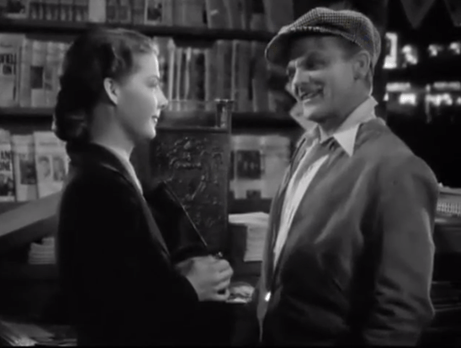
The action opens with Mexican banditos robbing a train and looking to flee the scene. Though they manage to get away, it’s not without consequences. One hombre named Santiago watches as his campanero Vincente dies in his arms. He comforts him with visions of heavenly cattle grounds even though the man’s life was full of indiscretions, to put it nicely.

The story does occupy itself with religious rhetoric, which feels very much a part of the cultural landscape, as do the Spanish language and such ubiquitous elements as taco stands, cantinas, and a mariachi soundtrack. The film rightly steeps itself in this perceived world below the border. Whether it is authentic or not feels slightly immaterial, because something fairly immersive is erected. In one sense, this is the most impressive success of The Naked Dawn.

There is “brownface” needing acknowledgment and a certain stereotypical gaze, but director Edgar G. Ulmer develops a surprising amount of atmosphere for such a meager western. Secondly, Arthur Kennedy somehow manages to give a thoroughly flamboyant performance showing his competency in anchoring a leading role — even in an admittedly small scale oater like this.

Because in typical drifter fashion, he goes from leaving his dead buddy behind to finding a day’s shelter at a farmhouse along the trail. There he is met by an energetic young farmer and his dutiful wife. The presence of such a figure as Santiago unearths all their flaws even as he overwhelms them with his vagabond existence, full of a certain high-living and nostalgia for the old days.

Although initially hesitant to get involved, the husband finds himself brought along for a raid on a crooked shipment manager who they overpower and string up while raiding the contents of his safe. In the midst of all the money, Manuel (Eugene Iglesias) suddenly becomes brave and also greed springs to life in his heart.

For thence onward, Manuel holds this stranger in high regard, in awe of this man who has seen so much and takes him for the time of his life in the local watering hole, partaking of all the worldly pleasures afforded from strong drink, saucy women, lively music, and a bar brawl to wind out the entertainment.

But if this is the grand exciting world away from the ranch, then back with his doting wife (Betta St. John), we find a certain amount of unrest. She does not love her husband but his prospects were so much better than what she had before. Still, this new man makes her heart glad; she is ready to elope with him without fear of consequences.

The utter irony is the very fact that while Santiago is the outlaw, at least he is obvious and upfront about his waywardness. In his new company, Manuel fancies himself an honest man and his wife comes across as an angel. However, whether it’s unwitting or not, they both have more conflicted characters than they let on. Santiago is the one who allows them to salvage their lives.

It should be noted Francois Truffaut purportedly gleaned inspiration from this film’s love triangle for Jules et Jim. At first, any sort of comparison seems superficial at best. However, I finally settled on the fact both films contrive this three-way relationship that plays peculiarly for the very fact it lacks a great deal of interpersonal drama.

There is a passivity to how it unwinds and this feels counterintuitive to how these stories are supposed to function. Although we have tragedy on both accounts, the fact it is so detached leaves a different taste, rather than a blistering, jealousy-fueled gunshot finale. For that, we have to look at alternatives like Laura (1944) or Truffaut’s own Soft Skin (1964).

There is not a lot of time and space but the resources are used in all number of facets to at least touch on issues of religion, law and order, romance, greed, and unquestionably, so much more. Fittingly, as the picture zips to its rapid conclusion, we have come full circle with our larger-than-life Bandido dreaming of the pearly gates much like his campanero before him.

Ulmer blesses the audience with another extraordinarily lucid 10-day effort. Let that sink in for a second. The Naked Dawn is yet another marvel in economic ingenuity. Better yet, any drop off in quality or production values only seems to add to the film’s inherent flavor.

3.5/5 Stars

The Desperate Hours (1955) Bogart Vs. March

desperate hours 1.png

As the credits roll, the camera zooms its way down a residential street but doesn’t feel natural. It’s like a peering gaze casing the scene as music hammers away in the background. What makes the imagery more disconcerting is that this tranquil picture-perfect suburbia could be plucked right out of Leave it to Beaver. In fact, coincidentally, the house is the very same!

In this film, it belongs to your typical everyday family circa 1955. The man of the house, Fredric March, sits around the breakfast table, preparing for his job at local bank, bemoaning the fact his kids are growing up.

Little Junior is already showing signs. Not wanting to kiss his pops goodbye. His daughter is lovestruck and intent on marrying her beau, which he can’t stand to think about. His wife is perfect. Pretty, maternal, and a fabulous homemaker. Its all a bit insipid on the whole but that’s very purposeful. Currently, we might call his daily struggles “first world problems.”

It is a bit of the lifestyle that can be easily plucked out of any of the old family sitcoms from Fathers Knows Best to The Donna Reed Show. And yet what those portraits of the nuclear family never did have was the threat of three convicts at-large…

Their hardened leader is Glenn Griffin (Humphrey Bogart) joined by the boisterous slob Kobish (Robert Middleton), and Griffin’s kid brother Hal (Dewey Martin).  Come to think of it, there was an episode of The Andy Griffith Show with striking parallels, albeit with more comical resolutions. As is, William Wyler’s piece falls more in line with The Detective Story (1951) from a few years prior pushing the stage elements out a bit but still centering its action on the family domicile.

Arthur Kennedy at the Police Precinct is brought on the case but he really feels like a wasted opportunity and a dead-end at best. The real meat of the story is within that house between the two men vying for control.

Bogart, who got his break in Petrified Forest (1936) as a crazed heavy, is essentially book-ending his career with tough guy roles. Even if he’s over the hill for such roles, he still makes a good snarling approximation of his former self. One could argue that time has only made him more disgruntled and worn. His convict is a much more sorry figure with 20 years sagging under his dour eyes.

He plans to lay low in the residential neighborhood until the money they’re expecting gets sent their way. So we expect the plot to be a waiting game. Except the subsequent tension comes with criminals existing in such close proximity to this family, a theme running through other contemporary dramas like He Ran All The Way (1951) and Suddenly (1954).

To be ousted by the authorities means that everyone gets it. And yet the Hilliards are commanded to stick to their daily rhythms as closely as possible, even as the fugitives take over the home and turn it into a shambles. The conflict that goes through Mr. Hilliard’s head is between doing as the convicts say to protect his family and trying to get in contact with the police. He’s faced with the most nervewracking proposition of his life as the hours tick excruciatingly by.

desperate hours 2.png

When March finally gets to his office, frazzled by the turn of events, it feels like a Wyler touch of perfectionism to have three portraits prominently sitting in his office. The way they’re arranged perfectly toward the camera feels blatantly artificial. No one would have them set up that way and yet they’re implicitly reminding him (and us) that the lives of the people he holds most dear are still in constant jeopardy. The worst part: he’s all but powerless to do anything about it.

Meanwhile, the police are shacked up in Al’s Dining Room kitchen as their command center itches for a decent lead. Cindy tries to head off her beau (a far too old Gig Young) so he doesn’t find out about the fugitives and get the family in more trouble. A garbage man gets it for seeing too much. Mr. Hilliard sweats it out waiting for a letter loaded with cash destined for his office.

One can easily surmise Wyler had great relish filming along the staircase because it all but visually summarizes the tension of the film. Stairs are all about space and the relationship of people to one another. It’s shorthand to explain an unbalance or shift in power. For Mr. Hilliard, this is about his family. That’s all that matters. For the policeman who’s just thinking about his reelection, it’s an entirely different scenario.

And what the picture does tease out is the idea that extreme duress often causes people to show their true colors, whether empowered by integrity or saddled by cowardice. In the end, a businessman living a so-called cushy life shows a fiercely defiant fortitude that ultimately holds his family together. It has less to do with the police or even the criminals that stakeout in his home.

In the end, it’s his own grit, determination, and will to protect his family that wins out. If the film is an exercise in suburban melodrama, it’s also a resounding testament to the human spirit as well. The scary part is that like The Hitchhiker before it, the story was partially based on real-life events. Why is that frightening, you ask? It means real people were faced with these dire consequences. We saw what they did? Implicitly we must also beg the question, what would we do when the desperate hours hit us?

3.5/5 Stars

City for Conquest (1940): James Cagney, Ann Sheridan, and Arthur Kennedy

city for conquest.png

Upon being immersed in City for Conquest, it feels like a cast of millions because so many familiar faces make an appearance for any given amount of time. Surely, the most important coupling is James Cagney and Ann Sheridan who are paired much in the same way as Angel With Dirty Faces (1938), playing childhood sweethearts who end up growing up together.

The picture also provides a scintillating film debut for young Arthur Kennedy, forerunning his turn playing the younger brother to another boxer in Champion (1949), opposite Kirk Douglas. Cagney’s not a bad man to have for a brother either and their dynamic is one of the most compelling aspects of this relatively slight drama.

It all begins with a rather peculiar framing device with an all-knowing drifter (Frank Craven) posing his commentary on “The Big Apple” and the world of interpersonal relationships that exist all around him. Because each individual has different talents and aspirations, at its most instinctual level, City for Conquest is about the trajectory of each character in tandem to one another. Thus, the story is most concretely driven by its characters while being enriched by that prototypical Warner Bros. grit and street corner brand of atmosphere.

For one, Danny Kenny (Cagney) tries his luck in the boxing ring taking on the name “Young Sampson,” not necessarily because of ambition but for the pure fact, it puts grub on the table and provides means to pay for his little brother’s musical education. Backed by promoter Scotty MacPherson (Donald Crisp) and supported by buddies Mutt (Frank McHugh) and Pinky (George Tobias), he tenaciously makes his way up the ranks toward the welterweight title.

Although he has nothing to show for it yet, Eddie Kenny (Kennedy) has a knack for compositions and he’s moved his brother with his city symphony, despite his lack of musical knowledge, because music has the power to speak to even everyday folks on a visceral level.

Meanwhile, Peg Nash (Sheridan) is terribly smitten with Danny and yet in the same breath aspires to be a first-class dancer. She meets an arrogant yet talented bloke (Anthony Quinn) out on the dance floor and is enticed with a career just like she’s always dreamed about.

The girl breaks his heart as much as you can break Jimmy Cagney. He takes it like a man while still feeling betrayed. To add insult to injury, his climactic bout is rigged due to the resin dust illegally sprinkled on his opponent’s gloves. Not only does Danny unfairly lose the fight but his career is permanently terminated with his eyesight impeded for good. Eddie shouts for the senseless beating to end as Peg cries to herself over the radio broadcast besides herself over Danny’s loss. It affects Danny physically while the others are casualties of a different kind.

It’s all but inevitable that the picture will end in some gangster knockoff job with the boy’s big shot pal Googie (Elia Kazan) seemingly ready to give the crooked wrenches who tampered with the fight their comeuppance. And the side of the underworld set on the east river with bodies to dispose of certainly has its place. But the underlining factor is despite their struggles, our three protagonists are allowed to find a swatch of contentment.

Eddie is finally able to realize his musical ambitions and gain the repute of the masses in his first show while Danny and Peg are reunited to live life as they were always meant to — together. Though her dancing aspirations have been curtailed and his sight lost, their future remains shimmering with hopefulness.

One could easily comment that City For Conquest‘s themes riff off of Golden Boy in the way music and the boxing ring are juxtaposed, one next to the other. In this case, it’s the two brothers who represent the two seemingly incongruent worlds. And yet the biggest implication is that a rough and tumble guy like Cagney can still have a beating heart and a sensitivity for song even as he goes day in and day out pounding people in the ring. The two worlds are not mutually exclusive by any means.

We certainly know who our main players are but again it’s the robust and jovial nature of the full ensemble making it even more diverting. Ward Bond shows up as a disgruntled cop there, Charles Lane as a no-nonsense promoter here, and Jerome Cowan is ready to rib his competition over a few boxing ring bets. They don’t have to be the focal point because that’s not requisite for being entertaining. I greatly admire the character actors of old for what they are able to create even within meager means.

3/5 Stars

Wuthering Heights (1939): Death Be My Destiny

Wuthering_Heights_(1939_film).jpgIt’s almost instantly reasonable to clump this cinematic adaptation of Emily Bronte’s Wuthering Heights with other contemporary pictures swirling with gothic menace like Rebecca, Suspicion, and Jane Eyre. The latter film, of course, is based off the novel of another of the Bronte Sisters, Charlotte.

We might be able to give it some credit as the first of the lot while it also somehow managed to be one of the most high profile pictures in a year that has been lauded for the spectacular nature of its output. Its true 1939 was a staggering year for Hollywood. The list is too extensive even to begin attempting.

William Wyler was continuing his string of successes throughout the 1930s before WWII, and Wuthering Heights, in particular, would see the formation of a fruitful partnership with Gregg Toland, the cinematographer renowned for his perfecting of deep-focus photography. It was used in this picture and most prominently in Orson Welles’ Citizen Kane, and then again in The Best Years of Our Lives, also with Wyler.

The story itself streamlined and truncated from the original work begins with the dark mood of the eponymous estate roosted over by a brooding man named Heathcliff and his gaunt wife, frail old housekeeper, and his hounds. But we are provided a flashback to happier times evoking childhood and the glories of the Yorkshire Moors covered by vast expanses of heather (actually imported from England to California).

How it diverges from the tales of Dickens or even Charlotte Bronte’s work is by offering a portrait of elders who are not nearly puritanical but actually show a pretense of actual Christian charity. What is there is a warmth girded around them and a hospitality and prodigal nature toward the less fortunate.

Mr. Earnshaw is a model of such a man as he brings a besmirched orphaned youth from his travels on London back to his estate and he adopts him as his own son. As long as the man lives young Heathcliff finds great joy in life treated as a full member of the family. Out of his childhood blooms his lifelong affection for his adopted sister Catherine. Their friendship grows out of horseback riding and wishful dreaming of castles and knights on the rolling plains of their homeland. They could not be more contented.

Ironically, behind the scenes, we have two talents in Merle Oberon and Laurence Olivier who could not have been more antagonistic. Though young, Oberon was a fairly established actress in Hollywood, admired for her exquisite beauty. Laurence Olivier was just coming into his own as a film actor. His presence and dashing looks are irrefutable, though he had only recently dabbled in the medium following his already illustrious career on the stage.

Their projections are all but believable and ultimately rapturous even if the illusion is somewhat broken by the realization that the two actors abhorred each other off-camera. Part of the resentment might stem from the fact Olivier’s lover and soon-to-be wife Vivien Leigh had been passed over the leading role. But we must fall back to the story.

Mr. Earnshaw’s own son Hindley (Hugh Williams) vindictively maintains a grudge against Heathcliff that began the first day he ever set eyes on the other lad. He was never going to be anything but a stable boy.

Inevitably comes the day when Mr. Earnshaw passes on and the warmth once bathing his dominion is so quickly scrubbed away by the younger Earnshaw. He pushes Heathcliff out of the house to take care of the horses and treats him as he always has, as a mere pair of dirty stable hands, Meanwhile, the conceited rival becomes crippled by alcoholism and gambling debts.

Though they have confessed their undying love, the fact that Heathcliff can never achieve any amount of success to fund their childhood fancies, Catherine grows up impatient and bitter. Impatient to find a man who can make her happy by means of the world. Heathcliff now scorned seemingly leaves for good and she finds such an affluent suitor in Edgar Linton, David Niven with another thankless part, doting over her good-naturedly.

What ultimately arises in the final act is a vindictive battle of raging jealousies and contorted love affairs. Heathcliff begins to court the sympathetic younger sister Isabelle Linton (Geraldine Fitzgerald) which immediately receives the ire of not only her older brother but Cathy as well. She and her future sister-in-law have at it and yet soon Cathy is taken by illness because though she’s too proud to admit it, truthfully she still desires Heathcliff.

The most piercing love stories are those that are unrequited or worst yet lost out on based on the passage of time and changing circumstances. Where regrets and misfortunes pool up in such a way crippling what could have been so joyous. It speaks to a human desire for abiding, even eternal, romantic contentment. Heathcliff rashly prays to be haunted by her — for the ghost of her to torment him — because he cannot live without his soul. That is, Cathy.

What’s more, he is all but granted the wish that never seemed attainable in life, provided by a near transfiguration of the ethereal and the eternal. It’s a deeply powerful and moving apotheosis but upon closer observation, it also bears the responsibility in creating myths around romantic love. Because even in this modern age inundated by themes and testimonies of passion we cling to the idea that love is an eternal force when evoked and instigated between two people.

However, it’s only a half-truth because even as we look at the narrative of Wuthering Heights the messiness and the heartbreak that’s found all the way throughout the story, such final departures do not fit the origins of the story. They cannot line up in the real world either and it is true this is a picture that relies on the outskirts of the imagination and the hinterlands existing on the edges of the moors and the frames of the film itself. This is where love is able to survive in this almost unknowable, illusory world where it is not bounded by the ephemeral things we know to be true.

Reminiscent of some of Frank Borzage’s most enthralling romances, love is spiritual — a religion all to itself — ably transcending the throes of death. That’s the sentiment anyway, observed most curiously by the maid Ellen (Flora Robson) as, “Trying to tear away the veil between death and life.”

Because with Wuthering Heights, were it to maintain a real-world authenticity to the end of its days, we would rue the day we ever saw it and be bitter and downtrodden for the tragedy we had just witnessed. Life and film cannot always be interchangeable. As long as we understand this,  there’s a good chance we can avoid being damaged by such fallacies on the other side of the written page and the celluloid screen.

4/5 Stars