The Chase (1966)

the chase 2.png

Of all the reasons to watch this movie, I felt compelled to as a roundabout reevaluation of Robert Redford’s career as he just recently said The Old Man and The Gun would be his last film. He more recently still, admitted he never should have said he was retiring but for all intent and purposes, he’s winding down, focusing his energies on other endeavors.

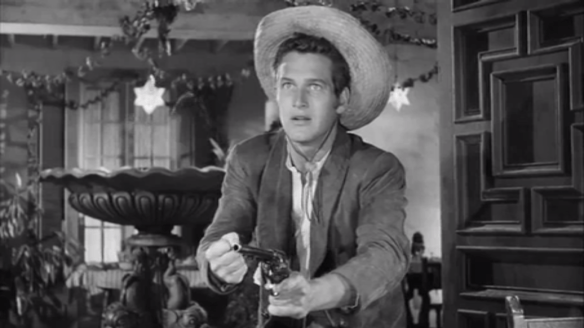
The Chase is situated at the beginning of his career and although he’s not quite the star, Redford has an integral part to play. Bubba is a local boy who breaks out of prison. Due to his dashing good looks, they don’t immediately place him as a runaway criminal type but if Paul Newman could do it, I gather Redford could do it too.

If we had to pick one central conceit this would be it, except, on the whole, The Chase proves a meandering epic, purely hit or miss, especially given such a promising cast. It’s as bloated with talent as it is convoluted by so many character arcs, each coming at us from all over the place with varying degrees of interest and importance.

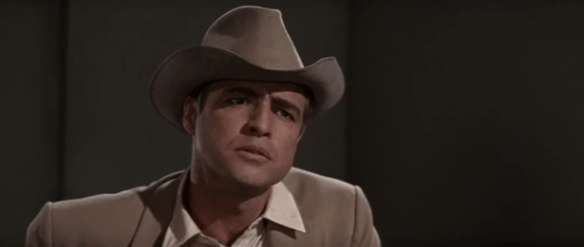
The local sheriff, named Calder (Marlon Brando), lives an honest life with his loving wife (Angie Dickinson). There is talk around town that the lawman is in the coat pocket of prominent banker Val Rogers (E.G. Marshall). Though the accusations seem dubious based on Calder’s simple integrity. However, if it is true,  he wouldn’t be the only one intent on getting on the big man’s good side.

Soon it’s Saturday night and the whole town seems to be having a party. The most coveted one is thrown by Rogers and sure enough, among his guests are the Calders. Though they hardly fit into the upper echelon, they have an open invitation because Val is intent on staying on the incumbent lawman’s good side for what he might be able to do for him.

Meanwhile, an agitated bank employee (Robert Duvall) and his coquettish wife (Janice Rule) put on a shindig for the “normal folks” who never seem to get an invitation from Rogers. The means might be humbler but they similarly get a little tipsy while play fighting, dancing, and openly flirting with anything with a pulse and a pickup line.

Two of the most accomplished adulterers and partakers in sordid gossip-worthy fodder are Emily and Damon, who are quite openly lovey-dovey, given they are both married to other people. It’s telling that the status quo is getting drunk and carousing with other’s spouses.  We hardly bat an eye because the whole town is rampant with this kind of conduct.

Despite being the lead and raking in a hefty fee, Brando spends most of the film moseying around town making house calls or patrolling the streets. In fact, initially, it feels like the most mundane and understated performance from Mr. Brando I can recall. That is until the final act where for once his hand is forced and he has to struggle for his own survival and any semblance of small-town law and order.

The only other moment where he enters such terrain again is in the final moments on the steps of the sheriff’s office; this time to deliver retribution. Because this is a film where everything seems to go awry. If the hothouse dramas of the 50s were a dying breed, The Chase might be the closest thing to a reanimation of the genre, albeit with younger, newer blood.

However, amidst this southern operatic melodrama, helmed by Arthur Penn, The Chase still comes off somewhat dated, maybe due to its evocation of earlier works. It’s as if the picture is trying to push an agenda of social importance for a new decade but simultaneously lacks a compelling framework to work within. The point is made quite clear that African-Americans and Mexican migrant workers are second-class citizens and subsequently mostly forgotten in this story. But there are few interesting conclusions on this front.

Otherwise, for the first half, there’s nothing organic or terribly alive in terms of authenticity. Because while Brando gives a fine turn, admittedly easy to overlook, most everyone else is carried away by the drama. They have nothing to give us that feels truly genuine and the story freely escalates by upping the temperature in the ongoing search for Bubba.

Finally, Redford and Jane Fonda get together, an escaped convict reunited with his long lost wife. Maybe they didn’t know it at the time but it would be the beginning of a meaningful screen partnership which has been forged over 50 years. But before long, even this brief, potentially intimate moment is interrupted by first one party, then two, and before long the whole town has turned their moment into the latest county-wide social event.

The junkyard is the finest attraction as it promises to give them the most wanted fugitive for miles around and they’ve come to be a part of the show. Soon folks are yelling exuberantly, lobbing firecrackers into the heaps of old automobiles as car horns honk in this symphony of tumult. But if this is where the climax begins it actually ends on the steps of the jailhouse in a scene that evokes if not JFK’s assassination then certainly Jack Ruby’s actions the following day. The clouds of misery linger over the frames but that’s not our biggest regret.

I think, no fault of its own, The Chase boasts almost more talent than it knows what to do with. So many actors come together at so many different crossroads of their careers. Of course, Brando is front and center. He and Robert Duvall still had The Godfather and many other classics ahead of them. Redford and Fonda were both young talents. E.G. Marshall had an illustrious career on stage and screen while Miriam Hopkins was in her twilight years in a small role. Angie Dickinson was pretty much in her prime. Even Arthur Penn had pictures with more socially incisive commentary and interesting themes including the cinema-shattering Bonnie and Clyde released the following year.

The bottom line is that in each individual case it’s easy to think of at least a handful of films each of these actors was involved in which were more enthralling than this one. It’s hard to hold a candle to that type of competition and against it, The Chase looks fairly mediocre. True, it’s a rather unfair fulcrum to measure a movie by but in this case, it’s very hard not to. Taking these unfair biases into account, it has something to offer the viewer even if it’s not quite as satiating as one would like.

3/5 Stars

Norma Rae (1979)

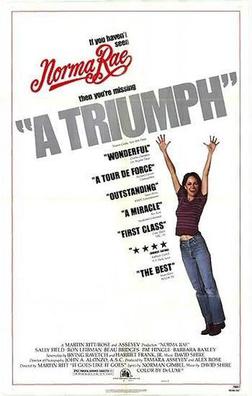
Norma_rae_ver2.jpgIf you had any trouble possibly liking Sally Field before — consequently, one of the sweetest actresses ever to cross the screen — then there’s little gripe to be had with her any longer. Norma Rae really does feel like a gift for her. Both as a story to be a part of and a character to portray since both speak to us intuitively as an audience. 
Marty Ritt offers a story that is as close a representation of his work as you might find — a narrative that’s not flashy but more importantly and yet still meaningful and chock full of human characters and conflicts. However, it’s not just sharing those elements for the sake of it. There is a rational impetus behind it all, setting out to shine a light on social grievances in order to enact some form of change. 

Again, he gets a script from husband and wife powerhouse Harriet Frank Jr. and Irving Ravetch who fortuitously helped define his career with stories such as The Long Hot Summer (1958),  Hud (1963), Hombre (1967), and this feature.

Its authentic inspiration stems from real life textile champion Crystal Lee Sutton, a worker in Roanoke Rapids, North Carolina. She spearheaded the unionization of her textile mill in an industry that has long held out against any regulation partially due to bullheaded leadership and ignorant lay workers who didn’t know any other life. There’s the arc in a nutshell. 

 Because Norma Rae (Field) is one of those people and she’s lived within a community of the very same folks all her life. Her father struggles to keep up with the strict regimen, her mother is losing her hearing systematically, and Webster has a couple young kids though she’s never officially married. As they might say, when she was a young woman, she knew a couple of men in the Biblical sense. 

Part of what makes her so likable is the trait of a genuine straight-shooter with the alacrity to do what she sees fit. When Reuben Warshowsky (Ron Leibman) sets up shop in town long-term, to try and get support for a union, most of the locals are wary of the outsider. Norma Rae asks him almost innocently, “Are you a Jew?” He responds in the affirmative and she responds that she’s never met one before. 

Though Reuben is a congenial fellow, he’s the definition of a fish-out-of-water, bred on New York society with a quality education, Dylan Thomas, and an attorney girlfriend waiting for him who his mother loves.

Ron Leibman does a fine job in the role because he doesn’t just play it charismatic and likable through every beat. He manages to skirt this fine line where there are genuine flashes of malice where we question Reuben as a person. Is he simply taking advantage of people or forcing others into a vision of what he thinks will be good for them? He even acts like a grade-A jerk and a bit of an instigator when he’s feeling up to it. 

Thus, Norma Rae grounds him as someone who does have a full stake in this fight, in this community, and this story. This is her job, her family, her reputation all put out in the open — all on the line and she’s willing to go for it. That takes true gumption and a fighting spirit few individuals can muster. Boy has she got it. She’s also capable of the southern cajoling that made men like LBJ such effective movers and shakers. 

However, the film constantly plays with this tension within her. Because she’s not a rich person by any means. When she’s given a promotion to a spot checker, her hourly rate goes up incrementally and she subsequently loses the respect of all her colleagues as someone who has gone to the enemy. The relationships mean more to her than the pay just as a better future has greater precedence over sacrificing her time and pouring heart and soul into Reuben’s cause.

Norma Rae also has a pulse of the ultimate good which is admirable. She goes to the local church — an all-white establishment — posing two questions to the reverend she has known all her life. First, asking if he would call her a Christian? He smiles and nods, with a lapse or two, yes.

But then, more pointedly, she asks if he would call himself a Christian? He’s still so caught up in the idiotic dogma that blacks and whites cannot mix. And yet for Norma Rae, the bottom line is there ought to be justice — and the church, if it’s really going to practice what it preaches, must be involved in this same dialogue.

It’s not always the words spoken but the images seen that leave a lasting impact. A funeral sequence in the rain. No words just a hearse being lowered into the ground inch by inch. The point is made better than any eulogy by man There’s Norma Rae transcribing an anti-union message on toilet paper to pass on to Reuben or the heart-to-heart she has with her kids to head-off any of the scurrilous slander they might pick up. There’s her furious struggle as two policemen try and drag her to a police car. 

Likewise, Field standing up with a cardboard cutout simply scribbled with the block letters “UNION.” She slowly circles around, resolutely, again and again. People notice her, stop for a moment of consideration and then all turn off their machines in a simultaneous act of solidarity and defiance. 

This particular sequence goes on for several minutes and the sequence is allowed to unwind wordlessly as we slowly hear the din grow progressively dimmer. It could have easily been cut down to its bare essentials and yet in this way the full brunt of the impact has been made apparent as we are forced to contemplate the full gravity. It’s an everyday action that takes on monumental dramatic importance. 

The same could be said when the ballots are read in consideration of the new union. It’s back and forth. The tension again is palpable but it’s the jubilation on the faces that captures me. In every one of these instances, Ritt gives the immaculate illusion he lets it happen. No tricks. No extra flourishes. Just all right there for us to be a part of. He’s at his best with human stories of fully realized people working through things of seemingly genuine importance. That is Norma Rae to a tee. 

4/5 Stars

Sounder (1972): A Family and Their Dog

sounder 1.png

In adolescence, you are inundated with stories about dogs. The Red Fern Grows, Shiloh, Homeward Bound, Ginger Pie, Marmaduke, Lassie, Rin Tin Tin, Air Bud, Snoopy, and Old Yeller. And that’s just the tip of the iceberg, off the top of my head. Sounder belongs to the same storied tradition based on humanity’s infatuation with canines which is certainly well-founded.

Except some will be surprised to find that this Depression-era tale brought to us by Martin Ritt is hardly about a dog at all. True, we are met with the eponymous hound dog right off the bat. What greets our ears is the bouncy staccato harmonica-twanging behind the visuals of a frantic tear through the underbrush that goes with the territory of a coon hunt. It’s an instantly recognizable image to introduce our characters.

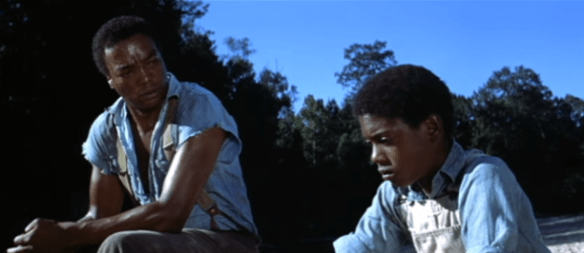
Not just Sounder but a boy named Henry Lee and his father, the jovial but hardpressed Nathan. The year is 1933 and we’re in Lousiana in the midst of the Depression. With society sectioned off as it is, as a black family, the Lee’s have been forced to scuttle through by sharecropping for a white farmer. It’s the fate faced many African-American families of the day.

They’re perpetually in debt, have trouble keeping food on the table, and live with the most meager means possible. All in all, with two parents, Nathan and his wife Rebecca (Cicely Tyson in a fiercely unvarnished performance), there are also three kids, and of course, Sounder.  Writer Lonne Elder III takes this atmosphere, the environment, and the family living within it and builds the framework of a story with great care and concern for their everyday reality. The plights and the joy that they still manage to have.

Taj Mahal, while also providing the film’s music, does a fair number in front of the camera as well as the energetic neighbor named Ike who drifts in and out of the story as he pleases. There are baseball games where Nathan Lee comes out the hero striking out his last opponent with runners in scoring position. From the local church, you can hear Gospel spirituals like “Old Time Religion” ringing out with fervor.

But in the same community, there’s a segregated schoolhouse and Nathan gets jailed and sent away for a year of hard labor for what seems like a trivial infraction. White men, including the local sheriff and the shopkeeper, will hardly budge an inch for a black man. That’s what seems so pernicious. Sometimes it’s not even outright violence but it’s this inability to change or have any amount of grace or understanding. There is no clemency to be had based on this rigid narrowmindedness.

When you begin watching more movies sometimes you fail to acknowledge those that are unpretentious and good-natured — the kind of stories that are meant for the whole family and wholly uplifting to the soul. Sounder is one of those movies. Surely there was a social hierarchy in place of oppression and de facto segregation. And yet around the nucleus of the family, there is a decency that pervades the picture and ultimately lifts it up. While it doesn’t completely eradicate ill-will, it does push it to the fringes of the frame.

Family reunions have never been so poignant — considering the moment where Nathan finally comes home after innumerable trials and his family has toiled and sweated day after day to hold onto their land. What they have in that instant is a small slice of heaven. It’s written over every face as the space between them rapidly fades away and they meet in an embrace that brings their world back together as it was meant to be.

But Sounder also manages to be a tale of empowerment for one lad in particular, young Henry Lee. The movie places people in his life who are willing to give him a leg up. There’s old Mrs. Boatright who is one of the few whites who will take any kind of stand — even a slight one — and she blesses him with things like The Three Musketeers.

It’s these people and books and knowledge that give a glimpse to a world of greater freedom and opportunity. An avenue to a life where people cannot keep you down no matter how hard they try because with ideas comes a power to think and to be your own person, set on improving yourself and the world as you go forward.

Yet another woman, a schoolteacher, takes an interest in Henry Lees improvement since she perceives the quiet wisdom that can be cultivated into something fully-realized. Her gift to him comes through education and elucidating him about figures like Harriet Tubman, Crispus Attucks, and W.E.B. Dubois — people who were shapers of history big and small — just as he has the opportunity to be.

Granted, it does feel as if the family’s pet is pushed to the periphery for much of the film, but in a way, it feels like a realistic depiction. He doesn’t need to be front and center. By their nature, if dogs are really man’s best friend, what makes them so meaningful has to do with their loyalty — they are always there — consistently reliable.

Because the life of an impoverished family like the Lees is the epitome of hardship. They need all the stability they can get. You will come to realize it is not really about a dog at all and certainly not one of those family-friendly films marketed as such because they feature some extraordinary, nearly superhuman animal.

No, Sounder is for the family because it takes care in documenting the realities of this particular family in a way that is thoroughly candid. It might still stand as faulty advertising but for the plethora of folks who are moved by the movie, they probably won’t be complaining when the credits roll. What we get is far better than a run-of-the-mill boy and his dog narrative. What I am reminded of is one subtle parallel. Sounder is winged by a shotgun when Nathan is taken away. He doesn’t come back for a long time. But when his wounds are healed, he returns good as new. There’s a startling resilience present in both the canine and the family.

4/5 Stars

No Down Payment (1957)

No_Down_Payment_-_poster.jpg

When a film seems to materialize in front of you coming out of nowhere and subsequently moves you, it seems worthy to try and champion it to others who might also be pleasantly surprised. But first, I believe an acknowledgment of director Martin Ritt is in order because I’m not sure how much adulation he usually gets amid the myriad of prominent Hollywood workhorses out there.

Though he first started out in the theater and then television during The Red Scare years, Ritt ultimately transitioned to movies with a body of work full of variety that has all but stood the test of time on numerous accounts. Highlights include a six-film collaboration with Paul Newman including the likes of The Long, Hot Summer (1958), Paris Blues (1961), Hud (1963, and Hombre (1967). Other noteworthy successes many will know are The Spy Who Came in From The Cold (1965), Sounder (1972), and Norma Rae (1979).

He is most definitely an adherent to progressive, socially conscious filmmaking that, while never flashy in formalistic aspects, is nevertheless, chock full of depth for its commitment to humanist storytelling. It’s meant to ring true and touch on subjects that pertain to real people and the world-at-large captured through a lens of stark realism. To his credit, Ritt would never claim the title “Auteur” because he himself spent time as an actor and understood how collaborative such an art form is.

That brings us to the picture at hand, No Down Payment, which while being one of his earlier directorial efforts for film, already has his sensibilities in place. There’s nothing flashy about the picture per se but it readily digs into issues that feel uncommon and cutting edge for the very fact that we rarely see them portrayed in the 1950s. This film provides a very special opportunity and I was more than happy to oblige.

To put it succinctly, our story takes place in the residential neighborhood of Sunrise Hills. What we get is a disillusioning portrait of 1950s suburbia specifically in Los Angeles, that beacon of post-war middle-class living, observing the overlapping existence of four couples.

I enjoy how everything seems to be underlined by party chatter, Cowboys and Indians on the television, and groovy rockability — all integral parts of the ubiquitous soundtrack of the suburbs. But there’s also a veneer with two layers. The outward-facing street view with white picket fences and barbeques with the neighbors and then what’s actually going on, either when the doors are closed or when you can’t contain it anymore and rancor slowly asserts itself. Underneath we also soon realize that everybody is afraid of something.

A young couple just moving in is brought into the fold of the community. The husband (Jefferey Hunter) works as an up-and-coming electrical engineer while his pretty wife (Patricia Owens) urges him to get in a more lucrative field like sales so they can grow their social status.

If your image of Tony Randall is a nice guy or a hypochondriac, try on a philandering day drunk car salesman for size. Jerry Flagg constantly has his wife Isabelle (Sheree North) exasperated because he’s always strapped for cash and never dependable, with aspirations that keep him constantly flocking to the next big idea. Of course, he’s never able to see any of them to fruition.

Arguably, the least done up of any of the husbands is Troy (Cameron Mitchell), a war hero and Tennessee native who currently works as a car mechanic but soon hopes to be brought on as the local police chief. In fact, he’s banking on it. His wife, Leola Boone (Joanne Woodward) is intent on it as well since he’s promised they can have a child once he has greater job stability. She’s tried to bury painful memories of the baby she was once forced to give away. They too are plagued by marital bickering and late night alcohol consumption.

Last of all is Herman Kreitzer (prolific TV actor Pat Hingle) and his wife Betty (Barbara Rush). While she takes the children to church on Sunday, he stays at home and washes his car out on the street. Otherwise, there’s little discord in the house as he’s a loving husband and father who runs an appliance store and is a member of the local homeowner’s board.

Ritt’s picture, with yet another script fronted by Philip Yordan and actually written by Ben Maddow, has innumerable topics of interest. However, two that were the most intriguing to me had to do with the Kreitzers. Because it just so happens that Herman’s best employee, a man named Iko (Japanese-American though played by Aki Aleong), requested help in getting his family a home in a predominantly white neighborhood. As is, he currently has a taxing commute to work every day.

And though Herman is a good man, he’s hesitant to get involved knowing full well that housing developments have long been run by de facto laws of segregation. L.A. was like any other area where African-Americans were in places like Watts and Japanese-Americans were concentrated in Little Tokyo and even Boyle Heights for a time. That’s just the way it was. You stayed with your kind.

People wouldn’t like it one bit. Off the top of his head, he knows Troy, who fought in the Pacific, wouldn’t be too keen on a “Japanese” living in the neighborhood. So Herman ultimately brings the conversation to his church-going wife who voices similar apprehension (“Do you think you’re ready to have a Japanese as a neighbor?”). It’s this conversation over the kitchen table that causes him to reconsider. Because you see we already know he’s not a churchgoer and part of the reason we can guess has to do with the hypocrisy that is often so easy to find fault with.

That brings us back to Iko and his family. As Herman sees it, what good is a church if it doesn’t lend a helping hand to someone who needs it. How can you say you’re a “Good Christian” and not do anything to help these people? The issue is hardly resolved then and there but it’s a start. At least, in this case, we get the hint of closure in the end. Other threads aren’t nearly as sanguine.

It’s fitting that we return to an establishing shot of that perfect piece of the suburbs and all our main players are at church the following Sunday. Except for one, it means a long drive in a taxi cab to who knows where. While the others will make a go of trying to preserve their dreams, this lonely individual’s exodus is a reminder of how quickly our aspirations can crumble.

4/5 Stars

Blood and Sand (1941)

blood and sand 1.png

There’s little doubt Blood and Sand was a follow up to The Mark of Zorro (1940) meant to capitalize on the lucrative romantic pairing of devilishly handsome heartthrob Tyrone Power and winsome ingenue Linda Darnell. But what it sets out to do, it achieves through an ability to capture us in a joyously Hollywood confection. It pulls out all the stops to establish Spain for the moviegoing audience. Flamenca, guitar, castanets, swirling skirts, and sashaying ladies are all present bursting forth from the screen with multicolored gaiety and merriment.

The picture in straightforward fashion charters the rise of a young boy into a renowned matador with aims at commanding the grandest stage in all of Seville. Juan Gallardo (Power), buoyed by a tight-knit band of friends and propelled by lifelong ambition, is ultimately able to realize his dreams and to garner all the laurels lavished on the man of the hour.

Most important of all, he’s finally able to marry the girl whom he’s loved since childhood, the virginal beauty Carmen Espinosa (Darnell). She has dutifully waited for his triumphant return when he serenades her with a full band and presents her a wedding dress to pronounce his everlasting love. They’re young and deliriously happy.

While initially maligned as a fifth-rate talent, now the famed purveyor of public opinion, Natalio Curro, christens Gallardo the finest matador in all the land. Laird Cregar is more than capable as the pompous bullfighting critic who relishes the spotlight as well as his reputation as a tastemaker.

Likewise, everyone wants Juan to be the godfather of their child. He is in high demand and he catches everyone’s eye. Namely, the recently returned socialite Doña Sol des Muire (Rita Hayworth) coming from irrefutably high-class stock. She has her pick of the litter and she immediately becomes diverted by this dashing matador tossing him down a red rose in return for a couple tokens of his goodwill.

Meanwhile, Carmen remains faithful by his side praying every day he enters into the ring to do his work. She dotes on him with breakfast, reading the headlines about his finest hour, and remains his constant companion.  However, the allure of the “other woman” ensnares him and his fate is all but sealed. Just as he baits the bull, she soon has him reeling much the same. But the only real person to blame is himself.

His wife is betrayed in one heart-breaking confrontation, his finances are in disarray, his temper has alienated many of his closest allies, and his success in the ring has begun to falter. None of these plot developments are unforeseen. On the contrary, we expect them. As his mother reminds him, taking cues from the Biblical parables, “One can’t build on sand.” Because everything you worked so hard to erect will just as easily come tumbling down when the downpour hits.

It’s as much his own fault is it is the fickle masses who are so unforgiving. Pretty girls like Doña just as easily move on to a new toy, this time Juan’s lifelong rival Manolo (Anthony Quinn). And of course, Curro has been quick to pronounce the new man as the latest shining comet of the new season. He fails to add that comets burn brightly only to fizzle out in a nose dive. The tragic metaphor is a little too obvious.

But again, the picture is all spectacle and it’s ultimately bolstered by lavish costumes and the early shades of Technicolor offering a seminal example of 3-strip Hollywood opulence. Rouben Mamoulian’s artistry in mise en scene from his days with the stage are on display, played out to the nth degree. The screen and the stars are easy on the eyes. The director purportedly kept cans of spray paint on hand to touch up any necessary blasé patches with enhanced color. However he achieved it, Blood and Sand generally works.

True, bullfighting always seems like a barbarous pastime even as Hollywood can’t show that much. It does feel like a modernized incarnation of gladiatorial battles.  Just as the public is petty, it’s even a little difficult to feel sorry for our protagonist, though Linda Darnell, continually surrounded by Roman Catholic imagery, remains as the last vestige of saintly virtue.  She’s never been so pure.

The same cannot be said for Rita Hayworth in her secondary role, which in itself is a rather strange circumstance since she had yet to reach the heights of her later career and pictures like Gilda (1946). Tyrone Power could coast on his looks and charisma alone and he pretty much does.

3.5/5 Stars

Review: My Darling Clementine (1946)

my darling clementine 1.png

The first time I ever saw My Darling Clementine I couldn’t get over how unimpressive it seemed. If nothing else it certainly didn’t give off any self-aware sense of its own importance. There was nothing that struck me as outright epic and monumental. And yet this western has been a heralded favorite since its initial release in 1946. People love this movie. I think this time around I understand it better.

Maybe it’s all those reruns of the M*A*S*H classic “Movie Tonight.” Colonel Potter (Harry Morgan) eases the camp’s aggravations with a showing of his favorite horse opera which, of course, is My Darling Clementine.

But while the reels are spliced and diced for poor Klinger (Jamie Farr), the audience still gets something impactful out of the experience spilling out into their shenanigans together which makes for a quality evening. Because for once My Darling Clementine is a western with many moments that feel unextraordinary in the most human of terms.

Surely there was no greater and more prominent mythmaker of the Old West than John Ford. The key is in the realization Ford need not push anything, allowing everything to unwind in a way that’s the cinematic equivalent of organic action. The director goes with his proclivities of narrative scope, pairing down dialogue, focusing the story instead around activity — and those moments don’t necessarily have to be the perfectly suited sequences for instigating incendiary drama.

Ford’s actual meeting with the real Wyatt Earp on a film set back in the 1920s was a seminal moment for him. One could say he was imparted the blueprint and the inspiration for this picture and that is enough. Because the western never thrived on facts but the embodiment of romanticized figures and ideals. Wyatt Earp was such a figure.

Here Earp (Henry Fonda) is herding some cattle with his brothers when they pass by the town of Tombstone and leave the baby of the family to hold down the fort. In the most simplistic terms, their cattle get rustled and there’s little need to guess who the perpetrators are. The grizzled Old Man Clanton (Walter Brennan) is right there with his boys, a most obvious culprit. He needn’t even bother denying it. He never does nor does Earp ever accuse him outright.

Instead, Earp decides to stick around for a while and takes up the tin star for marshaling in Tombstone, that illustrious hell hole, emblematic of western lawlessness. Straightaway he shows a bullish tenacity in running drunks and troublemakers out of town but there’s still something more to him.

Ward Bond and Tim Holt act as his brothers and his constant companions. They don’t have a whole lot to do but stand behind their brother at the bar or eat their vittles at dinner tables. But then again, you could make the case most everyone has a fairly unostentatious part.

There is no standout performance and that seems very purposeful. Surely Fonda is the glue holding it all together but it’s not due to flare so much as an ever-steady portrayal that never feels like it’s vying for attention. He leads by example and yet this does not mean the film doesn’t have moments that leave an impression.

my darling clementine 2.png

Linda Darnell gives him a slap and he proceeds to dunk her handily in the watering trough for her part in a crooked poker game. She’s the devious, saucy, and unfortunately named Latina Chihuahua. There’s the introduction of her man Doc Holliday (Victor Mature) that clears the bar and would have ended in a gunfight in most any other picture. Wyatt Earp smooths things over allowing life to sink back into the status quo.

A local theater production evokes a particularly rowdy atmosphere where Fonda gets a hat thrown his way which he promptly tosses right back while Darnell looks to whop someone over the head. The locals are aiming to make their displeasure known to the actor who has run out on them on multiple occasions. Earp and Doc go to fetch the man who is being harried by the Clanton boys. In one of the most articulate and entrancing sequences in a western to date, we are treated to Hamlet on the range. You know the words but never have they come out of a man such as Doc Holliday — suggesting that there is a side of him even an amount of breeding that we fail to comprehend.

Finally, Clementine comes to town (Kathy Downs) and we begin to understand. She was Doc’s girl back east when he was still practicing and known in circles as Dr. John Holliday. He’s different now, plagued by illness and alcohol-fueled demons while emphatically wanting her to go back from whence she came. It’s Wyatt who stands by with all sincerity. Getting up, tipping hats, and opening doors for her. The peaceful countenance she wears coaxes him in the direction of the church bells and a dance social.

my darling clementine 3.png

We know what must come in the end. It’s all but inevitable: The Gunfight at the O.K. Corral. In all truth, My Darling Clementine’s shootout is not the most climactic and I could readily name numerous others I prefer. But in capturing it the way he has, Ford has remained true to the essence of the narrative thus far. What strikes me is it is by no means a sensationalized picture. It never even feels like drama or caters to the theatrical. But John Ford has made it cinematic and though it might sound like some form of paradox, I do not think it is.

We are acutely attuned to the moments with no music intuitively because there is little auditory manipulation or further distraction. Everything of import is derived from figures placed up against Monument Valley or staged in crisp interiors. Likewise, few words need to be put to any of it. Because we are fully aware, almost subconsciously. We have just seen a microcosm of the West being tamed and made livable for common folk. The old world is being undone and churches and schools now find a place in the new social order provided by men like Wyatt Earp — embodied by the likes of Clementine as the new schoolmarm. All of this is evoked not by dramatic shifts but a near meandering rhythm of scenes stacked one on top of another.

Again, we go back to the indelible image that everyone instantly conjures up of Henry Fonda with his feet propped up against the post leaning back and just resting his feet a spell. And of course, he’s our hero and the same man who will enact this change. But Ford makes him a laconic figure and one he seems content as anything just to relax.

He’d rather get a shave at the Bon Ton Tonsorial Parlor or carry the bags of a pretty gal than get into a gunfight any day. True, he can be ornery when he wants. Still, only as a last resort. Fonda’s the perfect man for the part because there’s nothing burnished about him but he comes off honestly with a straightforward sense of integrity. This allows My Darling Clementine to induce a generally optimistic portrait of the West from a picture that could have otherwise dwelled in the depths of near noirish cynicism.

However, even with its strains of the mundane — far from feeling prosaic — the film is blessed by Ford’s mastery of the image. Because what is Film if not a visual medium? The West was by far the most American canvass and Ford one of the finest masters of the art form. There need not be a better reason to relish My Darling Clementine. Aside from my expatiating, I would be amiss not to acknowledge this film as good old-fashioned communal entertainment. M*A*S*H 4077 is the case and point.

4.5/5 Stars

Note: I watched the Pre-Release cut which was restored by UCLA with slight differences from the theatrical release (arguably closer to what Ford originally intended).

Hangover Square (1945)

Hangover_Square.jpgWithout question, Hangover Square is in many respects analogous to The Lodger with the reteaming of director John Brahm with Laird Cregar and George Sanders. However, the biggest difference is that we have Cregar putting on on a new persona and losing over 100 pounds!

Among other things, it forced director John Brahm to shoot the production in sequence as to not completely decimate the continuity, based on the movies main protagonist. In fact, the actor initially turned down the part because of his aspirations to remake his image. Though he reconsidered when he saw the part could be played to his advantage and he turned Hangover Square into a superior vehicle.

If we want to break the movie down to its most incremental themes, it’s essentially about a man in Edwardian London torn apart by conflicting musical projects representing the two women in his life, who are effectively pulling him in opposite directions. He’s a mad genius whose personality disorder is completely torn asunder by the chafing in his life. It will only prove to be his undoing.

Like any good noir, there’s the femme fatale: Linda Darnell, hair puffed up in a bouffant, legs kicking gayly as she puts on her best English accent. She handily makes a coy nuisance of herself, cajoling him with her flittering eyelashes and then evolving into an icy heartbreaker on the turn of a dime when he no longer does her bidding.

Cregar gets walked all over as Veda sucks his talent dry for her own aspirations and the pursuit of a more dashing suitor who she vows to marry — even after making fragile promises to be his. She knows how to play him, if nothing else.

Barbara (Faye Marlowe) is the “Guardian Angel” who has everything including his best interest in mind. Her father (Alan Napier) has long been advising on Georges latest masterpiece — a Concierto that he has been laboring over for some time. She has been his astute pupil on the piano while also seeing right through not only Veda’s mediocrity as a performer but also her manipulative guise. There’s nothing sincere about her.

What we continuously see are reverberations of a Dr. Jekyll and Mr. Hyde tale. Here is a man of such musical receptivity able to craft pieces with such depth of feeling and yet there is another side of him — a side that strangles cats in his spare time and other things… Quite frankly his unaccounted behavior scares him and he goes to a Dr. Middleton (George Sanders) at Scotland Yard seeking some kind of aid.

It’s true that Hangover Square is a movie plagued by claustrophobic hysteria supplied not only by Cregar’s performance but the mise en scene as well. What we have is the artifice of gothic exterior-interiors with layers of ready-made atmospherics and foreboding scoring interjected with an instantaneous cacophony of chaos composed by the virtuoso artist Bernard Hermann.

One enduring moment is that of the burning effigy lit to high heaven on Guy Fawkes Day. It’s the quintessential image to capture the essence of our main character and the conflicted conflagration burning inside of him. Nero purportedly played his violin while Rome burned. George pounds away at the piano slavishly. But his story is a tragic tale of destructive genius that overtakes him. The final lingering images can’t help but leave an impression.

If Bogart sculpted psychopathic gangsters into hardbitten anti-heroes, later on, there’s a similar sense that Laird Cregar might have fashioned his menacing villains into conflicted but still heroic alternatives too. It’s mere conjecture and alas we will never know what could have been.

Two months before the picture was even released the actor would die from a heart attack, the ultimate tragedy brought on by his rapid weight loss. A fairly heavy man in most of his earlier roles, Cregar was committed to changing his physique in an effort to be leading man material. But, again, it was not in the stars.

While not a bona fide classic per se, Hangover Square remains as a chilly noir that’s not only a testament to Linda Darnell’s aptitude as a spellbinding black widow but to Cregar’s ability to make madness all but palpable. It’s a shame we lost him so suddenly because there’s no telling what heights his career might have reached. How true it is we very rarely appreciate someone’s talents until they are no longer available.

4/5 Stars


God’s Little Acre (1958)

God's little acre 1.png

If there was an atypical even offbeat Anthony Mann picture, then God’s Little Acre would probably fit the bill. Based on the wildly popular and vehemently decried Depression-era work of the same name by Erskine Caldwell, it essentially serves as a second outing for much of the cast and crew involved with a picture from the year prior, Men in War (1957).

We have Mann reteamed with his favorite, Robert Ryan, and young Aldo Ray. Then, most prominently, we have cinematographer Ernest Haller and composer Elmer Bernstein returning. Even Phillip Yordan once more fronts for blacklisted Ben Maddow. And yet the actual results are oil and water.

The opening notes of a folksy title ballad sound off, seemingly more at home in a live-action Disney classic than a mainstream drama such as this. In truth, it’s an outmoded brand of melodrama. We just cannot hope to look at the pedigree the same way with its southern gothic and a hint of hillbilly.

That’s right. It’s part Jed Clampett, the other section Tennessee Williams, edgy and sweaty as any 50s film at its height. But what leaves an impression is not only the raciness for the day but the unadulterated playfulness. This is real Georgia down-home entertainment and it benefits from these qualities.

Ty Ty Walden (Ryan) is a slightly scatterbrained matriarch, who resolutely believes that his daddy left behind gold on their property. He’s hellbent on getting him a piece of the wealth and he’s pursued his aspirations by leaving his family acreage dotted with holes.

God's little acre 3.png

He’s dragged his two sons into it too (Jack Lord and Vic Morrow), who are both a bit neurotic in their own right. The jealous Buck is constantly at the throat of his ravishing bride Griselda (Tina Louise in a sweltering debut) believing she still has the hots for their brother-in-law Will Thompson (Aldo Ray), a man married to the eldest Walden gal (Helen Westcott). He’s not altogether wrong but he’s not helping the situation any either. Then there’s Shaw. He just repeats everything his older brother says. They’re not the sharpest tools in the shed. They take after their father.

Meanwhile, their youngest sister, the bodacious southern belle Darlin’ Jill, is quite the looker herself. Buddy Hackett is just about the same as we remember him in all his pictures. That voice. That blubbering. That rotund lovable girth. His character, the aptly named Pluto, comes looking to court Darlin’ Jill who strings him alone as is expected.

Otherwise, the cast also features a criminally underused Rex Ingram as a farmhand and Michael Landon in a thoroughly unique role as an albino. Though only a minor player, he proves a crucial component of the plot since Ty Ty is convinced that albinos have an impeccable radar for gold and he pressgangs the boy to use his remarkable abilities. The beauty is that no one seems to outrightly question such a notion. They just move along like normal. In the meantime, Darlin’ Jill has fun tantalizing her rotund suitor and making eyes at the intriguingly pale Dave Dawson.

The latter half of the story follows lusty looks and passionate clenches as forbidden love is rekindled between Will and Griselda. It seems like just about everyone is being pawed over by everybody else. Tremors are going through the household with Ty Ty putting it upon himself to bring his family together and keep them on amicable terms. It’s not such an easy task with so much dysfunction at hand.

Will’s wife is beside herself as her man gets drunk and has some vague notion of turning the power at the old plant on so work can commence again for all the impoverished locals. But Ty Ty’s also in a scrape for cash and relationships have only deteriorated into fiery hell between Buck and Will — a woman still caught between them.

What are the main takeaways from the picture? It’s a rather incredulous piece that’s provocative and dull and maladjusted all at the same time. Ryan once more shows his capability at ably anchoring an entire film. However, all I could think of was the fact that if God’s Little Acre had been a bit more conventional and garnered a few more accolades for hard-hitting drama, we might be remembering Tina Louise as a cinematic sex symbol instead of a “Movie Star” from Gilligan’s Island. Maybe some movies get buried serendipitously.

3/5 Stars


Men in War (1957)

men in war 1.png

“Tell me the story of the foot soldier and I’ll tell you the story of all wars.”

The date might seem arbitrary but we are told that this story takes place over the course of one day: Sept 6, 1950. Robert Ryan might as well be the stand-in for a Bill Mauldin G.I. as he leads a battalion cut off and deep in enemy territory. He’s got the 5 o’clock shadow and most other prerequisites. There’s a sense that he’s just trying to live through the day and keep his men alive for as long as possible — hopefully to see their way back home or at least to their brethren on the other side of the next hill.

But in order to get there, they must survive a line of snipers, a hailstorm of enemy artillery, and terrain laced with mines. If I had never seen The Steel Helmet (1951), Men in War would easily become one of the most crucial war movies for me. Because it dares to tell a narrative of war that rings fiercely resonant not simply because of cynicism or even pure authenticity. It has to do with a story stripped down to its bare essentials. Men in War is just that. It comes down to the semantics of what you think that actually means. But for the average soldier, it’s a moment by moment struggle to survive. It’s not about heroics at all. Instead, it entails methodical and level-headed action in the face of constant stressors verging on the absurd.

Though Hollywood might have suggested otherwise on various occasions, war was never about the glut of combat. It’s always lean and mean — proving to be disillusioning even to the victors and far more so to those who must stand defeated or draw a truce.

The best way I can find to describe this particular experience is through the influence of negative space. Because Mann’s film, in showing us less manages to evoke the exact inverse, suggesting what is not shown to be as vitally important as what is left in the frame. Far from lowering the tension, it only succeeds in making it all the more unnerving. There’s an ongoing sense of isolation and the enemy is left all but unseen.

Then, in a single moment, we realize they’re as afraid of us as we are of them. Actually, the adversary is only shown on a couple of brief occasions, most visibly with a surrendering Korean Soldier (played by Bonanza support Victor Sen Yung).

Aldo Ray is a soldier at his most cynical and insubordinate. The only thing more exasperating about him for Ryan is the fact that in most cases he’s right and more important still, he’s too ornery to be knocked off. But it’s almost odd how fiercely loyal he is the catatonic colonel (Robert Keith) who made it away from the lines with him.

James Edwards offers another obvious link to Fuller’s Korean War picture while serving up his usual foray in minor though intelligent portrayals of African-American soldiers. Men in War is devastating in how unsentimental and unsensational it is. The scenes with machine guns, flamethrowers, bazooka, and grenades feel palpably real. These are not infallible killing machines. Just men who are doing their best to stay alive and fight another day. Again, it’s about mere survival.

Here we have Mann’s earlier explorations in noir more fully externalized with a sense of psychological torment made visible in an environment of continuous unease. The action is taken outdoors while maintaining what we might call even an intimate interaction with its characters if it weren’t so harrowing. It’s likewise an extension of the director’s Western landscapes, though the palette is muted, it consequently plays a crucial role in shaping the drama as Mann usually takes particular care with his atmosphere.

Phillip Yordan’s involvement, whether the true author or only a frontman, might be slightly up for debate but what’s not is the fact that the script keeps the action clean and unfettered by strains of patriotism or similar endeavors. Elmer Bernstein, best remembered for his western scores of resplendent glory, nevertheless, delivers a piece with the right amount of understatement to compliment such a picture as this.

Again, Men in War is unassuming, even unspectacular, but that’s what makes it all the more deserving of discovery. By going against the grain with a few similarly formidable titles, it gave us a far more mystifying portrait of The Korean War. Because reconciling with that conflict is far from a straightforward task — as it is with most any war.

3.5/5 Stars

Madeline’s Madeline (2018)

madeline's madeline.png

Madeline’ Madeline takes the very individualistic nature of its title and boldly realizes it through POV and metaphor to begin digging around in the perplexing head-space of a teenager. The first words we hear are as follows, “The emotions you are having are not your own, they are someone else’s. You are not the cat. You are inside the cat.” We are in a hospital and then within a feline pawing and purring, followed by a turtle sliding its way out to the ocean into the depths of the sea.

In the midst of the movie, I had an epiphany that I would have difficulty being an actor if the part strayed away from human qualities. Because when I look at animals there is wonderment there but I never feel like I could bring anything to them. I cannot understand or comprehend them.

Likewise, it would be difficult for me to invest in the perspective of a turtle and a cat, not that they are not important but they do not seem to operate, think, and act in the same way that we do as human beings. Because Madeline (Helena Howard) is a character who is playing a part and the metaphor is extended across this entire film. One could say she is playing a version of herself — the version that she perceives and wants to exist as — while others have another version of her that they want.

In playing her part, she willingly sheds her skin and puts on the guise of other creatures and gives herself over to them completely. One of the inherent fascinations in the showing Howard gives is the meta nature of playing the role of someone else playing a role.

So, in theory, we have the layers and the complexities of this whole patchwork of theater people and normal everyday humans playing their parts both real and fabricated based on the world around them. A certain ubiquitous Shakespeare quote is overwrought I know but it is also quite pertinent. “All the world is a stage and the people merely players.” We can break this film down to these more basic components as well.

Madeline’s involvement in her theater troupe not only facilitates this layering of a part on top of a part but it creates a visual dichotomy between the two women in her life who carry weight over her adolescent years. Her nervously concerned mother Regina (Miranda July) is always worried about her behavior, if she’s eating, taking her medicine, being safe about sex — all sorts of things. Her high-strung nature is a result of a daughter she deems to be unpredictable.

madeline's madeline 2.png

Then, there’s Evangeline (Molly Parker) the drama director and empowering free spirit who continually encourages Madeline in her physical expression and touts her in the devotion she gives to the stage. In this carefree communal environment, the girl feels truly herself and at ease with the beings existing around her.

They do some of the familiar improv, turning the story of an incarcerated man into literal expression. They do photo shoots and costume runs with giant pig heads and garish ensembles. When they sit in a circle together sharing their emotions and insights I could not help but feel the portrait epitomized the stereotypical acting experiences seen in a show such as Community. Needless to say, someone like me repressed and stunted as I am, looks on such a showing with a skeptical eye.

In one solitary scene, Evangeline even sits down with Madeline and starts expounding upon the philosophy of Jung. All is chaos in the cosmos. In the disorder, there is an order and the pendulum perpetually swings between sense and nonsense. While not necessarily reassuring, perhaps these words allow us to piece together a certain perspective to see the world. Maybe…

It becomes increasingly apparent — certainly beginning with the opening shot — this is meant to be a very intimate film. The camera hugs Madeline’s face and really provides close-ups for just about everyone while simultaneously blurring the screen artistically with exposure techniques to allow light to constantly seep into the frame. That’s when we’re not literally inside the camera’s viewpoint. Audio is often being funneled to us with dulled or hazed effects as if we are seeing the world through interference and distractions like others do.

At one point the stage performance is about prison and then it is a metaphor and then it morphs against into a piece on mental illness until Evangeline literally turns into a performance of Madeline’s most intimate details thinking they are all part of a character named Zia. Of course, the mask is only Madeline. She becomes a daughter regurgitating the words of her mother — imprinted on her brain — in a very public forum and it becomes a bit too real.

Then, Madeline winds up seeing a different side of Evangeline, not unlike her own mother, and once more we have drolling adults communicating on an altogether different wavelength than the teenagers.

The inevitable happens and Madeline and her troupe create a near funhouse of performance art all overtaken by an idea and rebelling against the forms their fearless leader imparted to them.

There is a unique voice and a vision that is unlike most anything else. But I’m not sure it even knows what it is striving for. There’s not necessarily an issue with this and yet it does lack what we would ascertain to be a central conceit for the rest of the film to orbit around.

If I had not just If I had not just recently seen A Bread Factory I would say this movie existed in a stratosphere totally its own. Regardless, it boasts a wholly original perspective from director Josephine Decker coupled with a mesmerizing performance by Helena Howard.

Whether we know what to make of it or not is up for contention. I still haven’t decided if this point is really worth dwelling on. The onus should not always be on a film to provide answers and if that is the case Madeline’s Madeline is a success because it arguably offers something more valuable — food for thought. For now, I am content ruminating over my multitude of questions.

3.5/5 Stars