Forbidden Planet (1956)

Forbiddenplanetposter.jpgWe’re all part monsters in our subconscious. ~ Leslie Nielsen as Commander Adams

I couldn’t help but recall Han Solo’s line about the Millenium Falcon in the original Star Wars in response to Luke’s derision. After giving his pride and joy an affectionate pat he defends her reputation like so, “She may not look like much but she’s got it where it counts.”

It seems fitting that the line is used to commend Forbidden Planet because this is the film that in many ways made science fiction what it is today. It’s almost too easy to trace the line from this film to the likes of Star Wars and Star Trek and a plethora of others. But today we’re so used to the canonical worlds of established sci-fi that Forbidden Planet might come off as quaint and a bit outmoded. Still, the film has it where it counts even today.

Forbidden Planet was also unprecedented in its day because this was no B-picture. This was A-grade entertainment and that was almost unheard of at the time for science fiction, a historically low budget genre. Leslie Nielsen is given his first starring role while Walter Pidgeon plays the scientist who greets the explorers on the surface of the planet that they were sent to investigate.

But the band of expeditioners who came before them was all but decimated by some unknown force leaving only Dr. Morbius alive (Pidgeon) along with his pretty daughter Altaira (Anne Francis) who has no grasp of what life on earth is like. Commander Adams (Nielsen) is intent on staying on the planet until receiving further instructions from earth.

Still, something doesn’t sit right. There’s something off about Altair IV. A silent, invisible adversary is oftentimes more engaging than a visual one especially when it dwells very close to home and that’s precisely what presents itself moment by moment as the narrative progresses.

From their very first touchdown, this is an incredibly eery picture which manages to carry the audience’s attention for a great deal of the movie. In fact, if this was Star Wars they would have said, “I have a bad feeling about this” at least a couple times. But equally crucial is the subsequent development of the landscape around us that’s at times utterly entrancing.

The key to the film is that everyone plays it straight and serious and in this particular case it doesn’t come off as camp. There’s a gravity to it all that’s mesmerizing even in its bits of antiquity because the world is full of grand endeavors in creativity.

The electronic instrumentation provides what is purported to be the cinematic world’s first fully atonal electric score and even today each note is unnerving to the core. Whereas the theremin has somehow entered into the realm of parody these notes still seem resonant and they perform far better than any traditional score might have in the same circumstances.

At times Forbidden Planet showcases a very simple, even austere mise en scene and other times expands to almost labyrinthian proportions. The sweeping palette photographed in Eastmancolor with CinemaScope certainly adds to its allure straight out of the 1950s while still managing to take cues from stories from centuries prior, Shakespeare’s The Tempest, being the most obvious inspiration.

While not necessarily prophetic or correct in all its assertions about space travel (as far as we can possibly know) there’s a commitment to the world and a specificity to its inner workings that makes the Forbidden Planet into a fairly immersive place — a world alternative to our own that we are able to explore and I think that’s part of its unique status as a pioneering film. Because now we are so used to worldmaking and fantasies outside the realm of Earth whether it be Star Wars or Lord of the Rings or Harry Potter.

Here we see it too but it comes out of a time where most stories were human stories planted on earth or at the very least had the semblance of the reality that we know to be true here. And yet here was a narrative that dared transplant our human shortcomings to the other end of the universe in an entirely different paradigm while showing how man is his fallen nature can still make a mess of life even there. It’s a fairly powerful statement full of human psychology as much as it is about conquering new frontiers.

Robby the Robot (designed by Robert Kinoshita and the team at MGM) stands as a landmark among cinematic robots since he is his own entity as a standalone character. Far from turning on man, he’s about as useful as we might possibly think — even creating gallons of whiskey for the thirsty cook (Earl Holliman). The film was also a trendsetter in describing space travel in increments of light while miniskirts far from being a thing of the future still made a splash with 50s audiences as worn so provocatively by Anne Francis.

Through its final credits, Forbidden Planet is a special picture and that uniqueness goes far beyond its rightful place as one of the seminal explorations in science-fiction. The only thing left to say seems to be despite the iconic nature of its film poster, it has absolutely no bearing on the plot whatsoever. Still, it makes for a good piece of advertising. It must be if someone as oblivious as me is talking about Forbidden Planet over 60 years later.

4/5 Stars

I Am A Fugitive From a Chang Gang (1933)

IAmaFugitivefromaChainGangSullivan’s Travels (1941) and Cool Hand Luke (1967) were two films that took a fairly extensive look at what a chain gang actually was in cinematic terms. Meanwhile, Sam Cooke’s eponymous song made almost in jest has added another layer to the tradition.
Nowadays Chain Gangs seem a bit archaic and a part of the uncomfortable history of the South only to fall a few rungs below the injustice of Jim Crow Laws and the like. But the pre-code drama with its sensationalized title, I Am a Fugitive From a Chain Gang, was nevertheless dealing with issues very pertinent to the age and its story was semi-autobiographical in nature.

Just as this film, directed by Mervyn LeRoy, has undoubtedly been lost among other titles of the 1930s, it seems that Paul Muni as an actor has generally fallen out of the public spotlight when classic actors are concerned. Because in his day, on stage and screen, he was considered one of the finest performers that the world had to offer setting precedents that actors have followed for decades onward in terms of preparation, research, and commitment to roles still further exemplified by his extensive costume and makeup work.

Brando is supposed to have said himself that Muni was the greatest actor he ever saw and though the man upon reevaluation has been accused of overacting, there’s no denying the repute he held in his day and watching Chain Gang there’s little doubt that he carries the picture.

In its essence, this is a film of unfortunate circumstances embodied through incisive drama. James Allen (Muni) could best be described as a wide-eyed dreamer. Coming back from WWI he wants nothing to do with his old factory job, intent instead to try his luck as an engineer. But his family cannot understand how he can be so ungrateful. Still, he heads off on his own to “seek his fortune” but what beckons him is the life of a drifter and it goes alright until the fateful day where he finds himself implicated in a small time bank robbery that he never saw coming.

Still, the police only see the reality and he was the one with his hand caught in the cookie jar so their justice is swift — 10 years of hard labor. It’s in these initial interludes where life on a chain gang is painted grimly and dour. There’s nothing to be hoped for in such an existence where the food stinks, you stink, and there’s little respite from the work.

Understandably Allen is discontent and he becomes one of the few that makes a break for it and lives to tell about it. In fact, what’s more, his future becomes a bright spot as he rises up the ranks of an engineering firm and makes a bit of a name for himself. But opportunistic women and a murky past do not bode well.

Yes, he has become a credit to society, turning his life around completely, but the sticklers for law and order want him to pay off his debt and finish out his sentence before a pardon is to be enacted. He does the honorable thing and expects the gentleman’s agreement in return but instead, he watches the gates clink behind him for good.

Our protagonist is led through an existence of seeming futility that finally hits the lowest depths. By the film’s end, you almost forget that he was one of the doughboys who made it home from the war to end all wars with its plethora of disillusionments only to become a fatality at home.

It ends in the same forlorn crossroads as a picture like The Blue Angel (1930) or Nightmare Alley (1947) except maybe it’s even more akin to Fritz Lang’s seething crime drama You Only Live Once (1937) because in both cases a system of justice that is held in the highest regard, namely America’s system, is shown to be riddled with flaws that go to the core of what true justice is. It all but fails him.

This film does not even begin to unpack the reality that most of the men on the chain gang are African-American, readily choosing the perspective of the white man in almost all accounts because this is the 1930s. So even a picture like this that dredges up important issues for its day is still flawed if you look at it now from a bird’s eye view.

One other qualm with Chain Gang, oddly enough, comes with its short running time. With all of its supporting characters, it never seems to build any kind of rapport with any of them and each new female lead hardly feels substantial enough. Still, yet again, it is Muni’s film and he’s generally up to the challenge as our cinematic surrogate traversing each ruinous twist in his life. He’s put through hell twice and no man should have to deal with that. It’s not human.

4/5 Stars

The Man with The Golden Arm (1955)

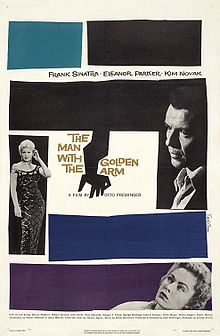
220px-The_Man_with_the_Golden_Arm_poster

Everybody’s habitual something ~ Kim Novak as Molly

Otto Preminger was the creator of a number of important “issue pictures” because he dared deal with themes that others had shied away from, mostly in part because of the production codes that ruled Hollywood well into the 1960s. Thus, any type of drug addiction was seemingly out of the question.

Such an issue might seem almost unthinkable in this day and age but that very fact is one of the reasons that The Man with the Golden Arm still maintains some resonance. Perhaps it has aged some and looks tame by today’s standards, a film that hardly dares to mention the drug in question, and yet there is much to be enjoyed all the same.

Saul Bass’s opening titles for one made the credit sequences of a film into an important attraction and he did much the same for Alfred Hitchcock and other Preminger films as well. The film is also laced with what might be best termed as sleazy jazz music to underscore the world that Frankie Machine (Frank Sinatra) returns to.

Before a word of dialogue is even spoken in the local dive we already have a pulse on what kind of place this is. It’s the type of world that sucks the life out of you. People lead you astray and if you’re not able to make something of yourself you’re bound to sink into the pits.

He is just off a stint in the State Penitentiary but unlike many, his story has a touch of hope. He’s gotten the monkey off his back as they say. He’s no longer addicted thanks to the help of a doctor who also tried to line up a job for him as a drummer. It looks like he has some talent that can take him places. He’s got a lifeline out of town.

His return is a heralded one. Everyone’s intent on welcoming him back including first-rate scrounger Sparrow (Arnold Stang) as well as the pudgy local card shark Schwiefka and the “dealer” Nifty Louie. He’s very much the devil on Frankie’s shoulder coaxing him to give him a call if he ever needs a fix of candy because he used to be a great customer.

Meanwhile, Charlie’s wheelchair-bound wife Zosh (Eleanor Parker) is constantly paranoid about his purported unfaithfulness and simultaneously quells any of his aspirations to make anything more of his life. She’s just a scared little person and her fear stifles Machine even as he tries to make her understand that things are different now.

The one person who does seem to understand him is his old flame Molly (Kim Novak) who is currently a hostess at the local club. He remains faithful to Zosh and yet it is the friendship with another woman that gives him the encouragement to pursue this new path.

Yet the film soon delves into the depths of addiction. As often rings true, after you think you’ve got addiction beat (any kind), it comes back with raging abandon and it goes for the choke hold. A bad break and the plethora of undesirable influences are leading Machine down the well-trod paths of old. He initially gives in and yet still battles and fights and shakes his way back to sobriety. But it’s not easy. The only place he has to turn is Molly and she gladly gives him her support.

All in all, this is a fairly unflinching portrait for the time and this picture points to the fact that Frank Sinatra was a serious actor, not simply a singer, a personality, or a star. Here he offers up an honest to goodness performance though his career was ripe with many others. Still, this one encapsulates the tortured cycles of those trapped in the throes of addiction.

Meanwhile, Kim Novak’s performance flows with a sincerity — a woman who is willing to do what is good and right even when it is difficult and seemingly offers very little recompense. It’s a stirring turn indeed.

The histrionics of Eleanor Parker are maybe a bit much and yet in this performance, you begin to see why she is hardly remembered along with other classical beauties. It’s because she actually wanted to be an actress first and a star second and thus, instead of projecting a certain image in all her pictures, it does seem like she’s constantly changing and stretching our expectations of her. Today her choices look quite audacious and yet it no doubt left her contemporary audiences a little befuddled. That in no way detracts from her efforts here if only to magnify our appreciation for Sinatra and Novak’s characters.

Rather than simply seeing this as an antiquated issue picture, a film made for a different era and for a different person than me, I would like to say that there is something of note in The Man with the Golden Arm. As Molly so lucidly acknowledges, many of us go through some type of cycle or we succumb to some habitual pattern whether it be an addiction or something less extreme. Still, either way, these very things can detract from our lives and trap us in rhythms of life that hinder our relationships and all that is truly paramount. That’s just a small caveat to take heed of.

3.5/5 Stars

Caged (1950)

caged 1.png

Caged proves to be a stark, even uncompromising picture for the 1950s. Director John Cromwell had a long career in Hollywood, helmed some quality film noir, and became a subsequent casualty of the Blacklist, but this just might be his finest effort.

Furthermore, despite being an actress of some acclaim, I must admit that even I forget about Eleanor Parker aside from her well-remembered appearance in The Sound of Music (1965). But if Caged is any indication, she is most certainly worthy of more credit. She freely channels a bit of the flustered timidity of Joan Fontaine early on only to transform into a completely different person entirely.

It’s a film that dances on the complete opposite spectrum of George Cukor’s The Women (1939) another film that is dominated by the lives of female characters. In that case, the narrative is preoccupied with the intricacies of their frivolous catty ways and malicious gossip. Caged has not even a pretense for laughter.

Likewise, the scenes of incarceration bring to mind images of  The Snake Pit (1946) and Shock Corridor (1964) but even those films were about mental illness and the lack of quality care, not so much the abominable corruption that begins to coalesce within prison walls.

Marie Allen (Eleanor Parker) is one of the first-time offenders who comes in with the new batch of prisoners. At only 19 years of age, she seems like no more than a girl and yet she’s already been married, had her husband fatally killed during a bank robbery, is pregnant with a child, and has an accessory rap pinned on her. That’s how Marie got where she is even if she doesn’t seem meant for such a hardened life.

Agnes Moorehead delivers one of her most sympathetic performances as a champion of rehabilitation who unfortunately is fighting a losing battle against the system as we soon see.

Some might remember the imposing Hope Emerson from Cry of the City (1947) but she leaves an even more indelible mark on this picture as the ever-necessary sadistic prison guard — an individual who sees little worth in her inmates — believing them to be animals to be treated as such. She is indicative of the institution as the cog that lays down the law and narrowly believes that there is no worth left in these women. They’re trash.

When everyone thinks that it becomes a bit of a self-fulfilling prophecy. And in time as she comes up for parole and then has it spit back in her face, the changes begin to show in Marie’s face. It’s hardened. Her voice is tougher. She’s more defiant.

Andy Dufresne in Shawshank Redemption (1994) was another character with unfortunate circumstances but he maintained his humanity in a dank place. You either get busy living or get busy dying. Yet being an impressionable girl Marie takes to heart the words of her veteran prison mates, “You get tough or you get killed.”

Maybe Caged outcome is easy to read and it ultimately succumbs to melodrama but there’s still something unnerving about the film on the whole with its overarching unsentimentality.

When I saw the name of famed composer Max Steiner as part of the production that was a tip-off but Caged rather audaciously functions in many sequences without any scoring and that lends to the overall sense of realism that pulses through this prison noir.

The utter irony is that the notes of “Rock of Ages” can be heard wafting through the corridors as Marie prepares for her final parole hearing and she makes it this time. But by now there seems little chance for redemption. She is intent on calling her own shots and not about to rely on anyone else. She’s gone beyond clinging and seeking shelter from the world around her. She doesn’t seem to need anyone. She’s become part of that world. The before and after are startling. They make for a harsh indictment of a flawed prison system.

4/5 Stars


Hacksaw Ridge (2016)

Hacksaw_Ridge_poster.pngHacksaw Ridge is not for the squeamish, its greatest irony being that for a film about a man who took on the mantle of a conscientious objector and would not brandish firearms, it is a very violent film, even aggressively so. But Mel Gibson, after all, is the man who brought us Braveheart (1995) and The Passion of the Christ (2004) while starring in The Mad Max and Lethal Weapon franchises.

Like its predecessors, this picture does not shy away from any depiction of violence but you can make the case that it is not violence for violence sake. There is a broader and some would say even a spiritual message behind it. Still, the chaos, the images of war, the killing, and the suffering are all there on the screen. No doubt about it.

Thus, Mel Gibson’s war biopic on Desmond Doss will not be a film for everyone. Perhaps it was not even a film that I truly needed to see (as I briefly skipped over some of the gorier sequences). Because the truth is I have some idea of what war can do to a man’s body. It was not something I needed to be reminded of.

However, this story is nevertheless an uplifting one and if nothing else it was a story I needed to unearth. Because as is usually customary, something as volatile and pernicious as war always seems to bring out not only the very worst in people but in others, the very best and those individuals take on the banner of heroes.

In the case of the unassuming Desmond Doss, it meant giving life instead of taking it away. And without a doubt, it’s a noble ideal and as a Seventh Day Adventist, he held ardently to that belief. Still, a major component of war is taking the life of your enemy. Some would say even that there is a time of killing especially going up against certain foes.

But Doss would not budge on the tenets of his beliefs and I think any person can laud him for that. There’s no hint of hypocrisy or contempt in him only an unswerving adherence to what he deemed to be right.

For these very reasons, it’s quite easy to draw parallels between Doss and Eric Liddell in Chariots of Fire (1981) who was another man of faith who would not compromise his belief in keeping the Sabbath either. What further connects these stories is how these men took those circumstances and made a name for themselves beyond them. For Liddell, it was winning gold during the Olympics and for Doss it meant saving countless men on the battlefield.

However, Hacksaw Ridge’s closest and most obvious predecessor might be Sergeant York (1941) which while being about a similar figure who held to his convictions, was nevertheless a great deal tamer and felt more focused on its hero in light of American’s imminent involvement in WWII. It was a patriotic propaganda picture starring one of the era’s icons in Gary Cooper and one of its up and coming girls-next-door Joan Leslie.

In fact, Hacksaw Ridge is carried by a romance of its own and while not a substantial portion of the narrative, the romance between Doss and a local nurse is one that does tug at the heartstrings for the very fact that we know a version of this meet-cute probably existed in real life.

There’s also something deeply moving when the camera dies and we first see Mr. Doss himself looking back on his earlier exploits. His humility stands front and center. Dare I say, he seems an ordinary fellow but sometimes it’s those very fellows who prove just what extraordinary things men can be capable of in the midst of tremendous duress. The numbers speak for themselves. He saved 75 soldiers in one day’s work. There are few words applicable except Awesome.

Andrew Garfield once again proves his seriousness as an “actor” and his joint performances in Hacksaw Ridge as well as Martin Scorsese’s Silence (2016) make for an extraordinary one-two showing on the year. Meanwhile, both Vince Vaughan and Hugo Weaving inhabit roles that you would not initially peg them for. But all and all, if you can tolerate Hacksaw Ridge’s gore, there is a great deal that can be gleaned from this story of unassuming heroism.

3.5/5 Stars

Isle of Dogs (2018)

IsleOfDogsFirstLook.jpgIt only became apparent to me after the fact that Isle of Dogs sounds quite close to “I love dogs.” You might even say there was a certain amount of forethought in this play on words. However, the pun only works in English as the Japanese pronunciation of the comparable kanji is “Inu ga shima.” Here we have the inherent beauty and simultaneously what some would deem the problematic nature of Wes Anderson’s latest film in a nutshell.

It’s necessary to lay out how I come at Isle of Dogs because it does contribute to how I perceive it. I’m Japanese-American. I’ve lived in Japan. I know some of the language though it’s an admittedly meager amount. However, I’ve invested in the culture and care about its people and fostering cross-cultural bonds. That’s part of the reason I was drawn to live there for an extended period of time, more than any pop culture infatuation with anime and manga. In those regards, I’m very much American. I also revere Kurosawa, Ozu, Mizoguchi and all the rest as most cinephiles do. There you are.

Wes Anderson is someone that I genuinely admire for his aesthetic though I would never necessarily sing his praises needlessly. He doesn’t need me to defend him nor do I look to. Still, when I consider Isle of Dogs I do not see a superficial homage. As with everything he does Anderson’s film feels fairly meticulous and the stop-motion creation is phenomenally precise. Beyond that, it’s infused with Japanese tradition. Certainly, there are markers that some might deem superficial like Taiko or sumo or cherry blossoms (さくら). They are all present. 

Thus, I do worry about people who have not interfaced with Japanese culture or the people. Specifically, the character of Tracy (voiced by Greta Gerwig), the foreign exchange student, feels problematic. I’ve met some folks like her where they let their own personalities take control of every situation and there seems to be no sensitivity or give and take. 

Because they don’t seem to have any sense of the culture they are in or at the very least they expect others to play by their rules. Hence why many Americans including myself are only fluent in one language. An example springs to mind of Tracy wandering into a bar and hollering at the man behind the counter in English that she wants chocolate milk. Then she berates a Japanese scientist (voiced by Yoko Ono) for not doing anything in opposition to the rampant government corruption. Again, in English. 

It was fascinating that I watched the film with an audience where the majority were Japanese so they were not ignorant of their country like Tracy or I might be. But how about viewers in another pocket of the world or even back home where I come from? The audiences saw a different movie altogether with different nuances and connotations.

Some people have noted rightly that a lot of the Japanese dialogue is lost because as the opening disclaimer notes: “The humans in this film speak only in their native tongue (occasionally translated by bilingual interpreter, foreign exchange student, and electronic device). The dogs’ barks are translated into English.” Except for the dogs, that’s a large margin for error.

Even the words of the little pilot, the intrepid boy Atari (voiced by Koyu Rankin) are all but lost on the dogs who don’t speak human and for me as well because, again, my Japanese leaves much to be desired. But the bottom line is that he almost always intuitively knows what the pack of alpha dogs is doing. 

They have a connection. He is looking for his faithful guard dog Spots (voiced by Liev Schrieber) who has been cruelly deported by his distant uncle Mayor Kobayashi in his effort to rid the dystopian Japanese city of Megasaki of infectious dogs. Spots was the first of many canines to be deported to the putrid rubbish pile of Trash Island. There you have the film’s plot but it relies on the fact that the boy and the dogs work together.

It goes back to that core tenet of society that dog is man’s best friend. And strip away any amount of visual artistry or cultural layering and that fact remains universal. Kobayashi is a cat person and we surmise his decision was merely a vendetta against canines (going back generations) more than any scientific evidence would suggest. 

To be honest, it never feels like Anderson is putting out a giant placard with film references at least not like Tracy with her megaphone. If anything the film conjures up one of Japan’s great national heroes the faithful dog Hachiko. Any traveler to Tokyo will recognize his statue in Shibuya but he is a cultural icon — emblematic of the same bond expressed in this story.

It’s still an Anderson film and as such, I never get emotionally connected with the material (actually maybe I take that back; stop-motion dogs suffering is heartbreaking to watch) nor do I gel with his very personal idiosyncrasies all the time.

But somehow, though the film’s cultural representations and relationship with Japan are flawed, nevertheless it left me more impressed than anything. It seemed like a degree of care was taken. And in the end, this story of canines has moments that unquestionably do resonate with me.

I thought I would have more problems with all the quality voice talent distracting from the story itself and it happened at times where I was stuck on Jeff Goldblum or Bill Murray but more often than not it didn’t seem like one voice stole the show. It was a story that involved many voices.

Some that we are able to understand, others that we can only gather bits and pieces of. But for me personally, rather than that being a deterrent I find it fascinating that the same film can play differently for different audiences and that native Japanese speakers can be in on the movie in a way that I never could.

It’s not that we don’t deserve to know that part of the story necessarily or need to be singled out because we don’t know the language but isn’t that one of the confounding things about culture and language? Oftentimes we don’t understand one another and need to find points of mutual understanding. Things get lost in translation and I think one could make the argument that this happens in Isle of Dogs purposely.

Certainly, Wes Anderson doesn’t know Japanese culture like the back of his hand. In an interview, he said he’s been to Japan some but his references were namely Kurosawa, Miyazaki and the woodblock prints of Hokusai and Hiroshige. And yet if that is true, it still feels as if he’s surrounded himself with some voices different than his own even if his typical ensemble is in place.

We have Kunichi Nomura with input on the script and voice duty for Mayor Kobayashi. More include Akira Takayama, Mari Natsuki, Akira Ito and then better-known names like Nojiro Noda, Yoko Ono, and Ken Watanabe. That’s not to mention the countless other Japanese contributors whose names scrolled by with the end credits.

Admittedly this is only my perception of the film but when I watch it, I never feel like it is assuming the primacy of the English speaking audience or if it is then that assumption gets slyly subverted. I mentioned already that the character of Tracy often speaks in English, in her opposition to Mayor Kobayashi or to the man serving up drinks at the bar counter.

The implicit understanding is that the Japanese characters understand the English being spoken but they choose instead to respond in their native language. So they have met us half way but have we met them? Learning Japanese is difficult, maybe even impractical, but growing our cultural literacy comes in many forms that would only assist in deepening our ties with one another. Only later did I realize that Tracy, the “white savior” as it were, essentially fails in her attempts. If anything she needs the help of an audacious Atari, his guard dog, and the nameless hacker from her school. Without them she is powerless.

As is often the case, certain people use their voices and assertive personalities to push themselves into the limelight unwittingly but those people would be nothing without the taciturn heroes who willingly stay in the periphery until they need to stand up. While Tracy turns me off slightly in fiction and in real life, it’s the others like Atari that resonate with me. Just as the tale of dogs in both camaraderie and loyalty rings a universal note.

However, I realize only now that I didn’t talk much about the actual mechanics and formalistic aspects of the movie but I’ve spoken my peace. Do with it what you will.

3.5/5 Stars

Note: Two articles that I found interesting on this topic were the following: What “Isle of Dogs” Gets Right About Japan and Justin Chang’s Isle of Dogs Review


Hidden Figures (2016)

Hidden_Figures,_2016In some respects, this feels very much like a paint by numbers biopic that takes us through the many paces of such a narrative. The rise, fall, conflict, and self-actualization of our heroes that navigates us to the film’s conclusion.

But this is also unequivocally a story that necessitated a telling for the very fact that stories like these have been hidden for decades — swept under the rug if you will. Because first and foremost Caucasians were usually the ones at the center of the master narrative of history and namely white males at that.

In one of my courses in university, the term of intersectionality would have undoubtedly cropped up in conversation right about now to denote a doubly marginalized group (African-American women). Feel free to consider the term if you are so inclined because there are others who can probably bring a lot more to the table on issues of gender and race and oftentimes those are very necessary conversations to entertain.

However, I am more interested in the actual story in question and so I will jump right to that topic. At its core, there are three women who you have probably never heard but that’s only a part of it. It’s that and the fact that they were integral cogs in something truly extraordinary.

Our first person of note Katherine Johnson (Taraji P. Henson) who is promoted to the Space Task Group, given the pressure following the Soviet’s launching of Sputnik and Johnson’s unreputed skill in analytical geometry. She moves from her own segregated division to an environment full of passive-aggressive bigotry and whites-only bathrooms. In her home life, she raises three daughters while falling in love with a handsome National Guardsman (Mahershala Ali).

The firecracker among her friends is Mary Jackson (Janelle Monae) who has aspirations to finish her schooling so that she can become a full-fledged engineer. Lastly, is the sagely one, Dorothy Vaughan (Octavia Spencer), who has seen a great deal of the world and continually shows tremendous qualities of leadership over her segregated branch which she leads with a self-possessed wisdom. One would gather these skills would apply well to any arena and so they do eventually.

For our parents’ generations events such as Neil Armstrong walking on the moon and the Challenger Explosion left an indelible mark on society and it was all for the sake of exploring the great unknown of outer space. Those later triumphs and, yes, even the tragedies would not have come into being if it wasn’t for some of the unsung individuals who got John Glenn off the ground in 1962 as we desperately tried to counter Russia’s Sputnik successes.

There’s also a slightly refreshing reversal of the age-old supporting character archetypes where this film dares to put its white characters in secondary roles while still giving them a decent amount of importance in the overall trajectory of this narrative.

Kevin Costner is the most rewarding supporting character as the head of NASA who is looking for results more than anything and that causes him to push past the accepted walls of racial hierarchy not necessarily because he’s trying to make a social statement but because he wants to get the job done. Skin color has no bearing on whether or not someone is savvy and can get John Glenn into the wild blue yonder.

Jim Parsons part does not stretch the boundaries of his Sheldon Cooper image but it is underlined by a bit of prejudicial malice as is Kirsten Dunst’s turn which no doubt adds a touch of realism representative of the defacto bigotry of the era. Meanwhile, Pharrell Williams score of sorts while somehow anachronistic undoubtedly imbues these three women with a spark of energy following every step of progress they make with NASA.

The film’s decidedly punny title aside, Hidden Figures is still full of joy even if it’s only a minor pleasure as a film. Because in some instances it doesn’t seem to take its material all that seriously and sometimes that is more refreshing than a dour and self-important exploration. Still, it takes itself out of the running from among the greatest biopics for that very reason. It’s a bit too formulaic and probably too tongue-in-cheek with historical events. Certainly this cannot take away the full impact of this history or the enjoyment value of the film. We should do well do appreciate them both.

3.5/5 Stars

Review: A Place in the Sun (1951)

a place in the sun 1.png

George Stevens is only one among a plethora of filmmakers who came back from WWII changed. He had seen a great deal of the world’s ugliness — Dachau Concentration Camp for instance — and as a result, the films he made thereafter were more mature ruminations on humanity at-large. Adapted from Theodore Dreiser’s An American Tragedy and a subsequent play, A Place in the Sun is one of those pictures crafted in the wake of such historical change.

There’s no doubt that this is Hollywood melodrama backed by a raging score from Franz Waxman but this is no less, high powered high-class stuff. It’s augmented by gorgeous black and white imagery that reaches pitch-black tones and still manages to make Lake Tahoe into a scintillating getaway. Meanwhile, the camera captures the action with elegant movements, sashaying through space, at times nearly imperceptible to the eye. Though admittedly the film’s stature as a social commentary is less interesting now than it probably would have been in its day. Still, we can’t have everything now, can we?

Montgomery Clift is often forgotten in the fray of powerhouse actors but the line can easily be traced from his intense performances to the work of Brando and Dean which would also sprout up in the 50s. Though that same intensity is there, it never feels like he’s trying to sell us a gimmick or a method. He’s simply trying to provide a lens to see a bit more clearly the intricacies of an individual, in this case, one George Eastman. It manages to be a profound and at times an agonizing performance.

Of course, Elizabeth Taylor is exquisite in every frame as always but her bright-eyed sincerity is equally arresting. She feels perfectly made for the role of Angela Vickers and seamlessly transitions into more adult fare with A Place in the Sun, standing tall alongside Clift, destined to make them one of the great romantic pairings of the 1950s. She supposedly said that she finally felt less like a puppet and more like an actress after this film. It shows.

Still, though given a thankless role at times, Shelley Winters is equally important because, in her simpler, humbler way, she reflects how quickly a man can change. She’s not a bad person at all, just a frail, even helpless one who feels like she has very few people in the world to hold onto. George proves to be a comparable companion until he unwittingly finds himself running in different circles and that’s where the tension begins.

I look at George Eastman and see the same drive for recognition, power, and wealth in many of us, those desires that oftentimes can be our undoing because they turn out to be meaningless. The irony is that his intentions never seem malicious but he is undermined by something. He quickly sinks into this double life. At first, he was simply happy to have a job and some companionship. His desires were simple. But slowly, as he found himself rising in the ranks of the Eastman company and getting more recognition, he couldn’t help but want more. Are these impulses bad? Not in the least, but they led him to some pretty rocky soil.

The scene that stands out in my mind could seem fairly mundane. But Stevens maintains a fairly long shot that’s peering through Eastman’s living room and we can see into the next room over as he is on the phone. It feels like minutes go by and Stevens fearlessly never cuts the sequence. The first call is from Alice which he takes.

But the second comes from Angela and at that point, we know that things have changed. It’s set up the dilemma. He genuinely loves Angela and wishes to be with her and to be a part of her life. Yet for that to come to fruition he must do something about the other girl. Alice won’t disappear. It’s funny how someone who you used to appreciate so dearly now feels like a burden. To her credit, we feel sorry for  Winters’ character without question.

In fact, the film succeeds along those lines. We pity her for the sorrowful position she is placed in — essentially abandoned by George. And even in her frivolity and opulence, there’s a candidness to Angela that makes us want to root for her and that allows us to simultaneously pity her because she has no idea of George’s other life. If there is anyone to lash out against it is George Eastman himself and still even in that regard, Montgomery Clift reveals the full gamut of this tortured man so even if we are hesitant to feel sorry for him, he does open us up even with a tinge of compassion.

But the muddled morality is complicated by the fact that Clift’s character has a sense of remorse. Surely he cannot be all bad based on what Vickers saw in him? His capacity to love and be tender is evident. Still, that is not enough to keep him from going on trial and the film’s final third takes place, for the majority, in a courtroom. The district attorney is played by Raymond Burr, who might well be in a dry run for Perry Mason and he comes at Eastman with all the fervor he can muster to convict him in his lies. Even in these moments, we must fall back on George’s inner conflict, his capability to love others, and his intentions for love.

If A Place in the Sun gets too preachy or succumbs too much to Hollywood’s stirringly romantic tendencies, it still might be one of the finest examples of such a film. Front and center are two phenomenal stars and Stevens films their euphoric romance with a meticulous eye, catching them in particular moments, with close-ups, and such angles that we are constantly aware of their intimacy.

As much as Eastman is looking for his place in the sun, and he could spend hours just sitting with Angela soaking in the sun’s rays (not many would blame him), it’s just as true that there is nothing new under the sun. That’s what we’re left with. Mankind is still distracted by many things. Oftentimes they are good things, but we make them ultimate things, and they wreak havoc on our lives. Meaningless, meaningless, everything is meaningless under the sun. But that doesn’t keep us from wanting to bathe in its tantalizing warmth any less. That’s part of the American Tragedy.

4.5/5 Stars

After The Storm (2016)

after the storm 1.png

There is a phenomenon in Japan called hikikomori (pulling inward). It mostly applies to 20-somethings. But in 2017 an article came out in The New York Times to document a different and yet somehow similar occurrence.

Many older people risk the chance of dying alone if they have no family because many live without a network of community and neighbors while in such proximity might still leave them invariably isolated. I have lived there for an extended period of time, granted as a foreigner, and yet I could feel the weight of such an environment

Thus, the dutiful grown children worry about their parents, about being the good son or the good daughter. Ryota’s mother is a wonderful lady. She gives him a playful slug in the stomach, tells him to his face he’s a horrible liar but always in love. Quibbles ensue between siblings over taking advantage of their mother’s good graces since she lives only off her pension following the death of her husband years back.

And yet there is a certain relish in these core relationships because even if it’s not a perfect picture you get the sense that mother and son care deeply for each other. It’s the films most gratifying interaction watching Hiroshi Abe and Kiki Kirin play off each other. Menial events take on the utmost meaning because they manage to color the characters in honest ways and the film has many of these seemingly inconsequential moments. That’s a product of its pacing.

For people who haven’t lived in Tokyo, preconceived notions of it might come from the likes of Lost in Translation (2003). Personified by ultra-hip areas like Shinjuku, Shibuya, and Harajuku touted for their nightlife and shopping. But there are a lot of other places too as director Hirokazu Kore-eda suggests. The Tokyo made up of suburbs, apartment complexes, and more ordinary landscapes. The Nerimas and Kiyoses of the world.

Coppola’s film worked because it was going for the perspective of an outsider. I enjoyed After The Storm immensely because it has the attention to detail and the touches of a local — someone who has known this terrain intimately.  I distinctly remember the first time I ever came back to the states knowing I would soon be returning to Japan. And in that moment I no longer felt like a tourist but someone with a new sort of understanding. It’s crucial because it changes your entire outlook and what you deem important. The big moments aren’t as relevant as the day-to-day.

Abe’s performance is so exquisitely rendered because while the picture is by no means a comedy his various ticks, expressions, even his lumbering figure are humorous without ever truly meaning to be. And they are organic moments that never feel forced. In other words, they are human and so despite his shortcomings, there’s something that resonates about him. When we look at his life we see a bit of his restlessness. He’s still not the man he wants to be. He realizes that.

His ex-wife is seeing another man. The rich new boyfriend feels like a universal trope that doesn’t need much explanation. Meanwhile, Ryota rarely gets to see his son, only on prearranged days were he pays child support. He’s notoriously bad on making their meetings on time. That and other reasons are hints to why his wife left him. That doesn’t mean he doesn’t hold onto some wistfulness, especially where his son is involved.

Though once an award-winning author most recently he’s taken on a job as a private investigator. He says it’s only temporary — research for his latest project — but it’s been going on far too long. He’s started getting used to it and so have his coworkers.

The film’s point of departure and ultimate revelation, if there is one, comes in the wake of a typhoon. Again, living in Japan you understand that this is a fairly common occurrence. But it’s the regular person’s side of Tokyo away from the bright lights.

Trying to field lost lottery tickets in the swirling downpour or shielding oneself inside a slide at a park watching the debris fly by is enough of a diversion because the intent is to consider not so much environmental changes but how our characters change.

Of course, implicit in the translated title is that there is something new (あたらしい) about life. And yet when we get on the other side of the storm it’s difficult to know. That would be the form of a typical film. To make the before and the after drastically different. Here the characters have changed — no doubt — but externally their behavior seems all but the same. The development is incremental and internalized.

I appreciate that. In life, there is rarely a megaphone to announce change for us. Sometimes it’s imperceptible to the eye. It’s even notoriously difficult to acknowledge some changes in ourselves. And yet we know they are there. Because to our last breath, we are indubitably a work in progress. We will never be perfect. That’s part of what makes life and this film thoroughly intriguing. What’s more is that it still glimmers with a certain hopefulness.

4/5 Stars


Review: Lost in Translation (2003)

lost in translation 1.png

30 minutes into Lost in Translation our two traveling misanthropes finally meet in the hotel lobby at the bar sharing a friendly exchange. They are two people who share one striking similarity — they are Americans in a foreign land — and they’re looking for a friend.

It’s a very pertinent film for places I’ve gone as an American who has traveled to Japan of my own volition but still as a bit of an outsider. Not because I am rejected or an outcast but for the very fact that there are obvious cultural and linguistic barriers in my way. I resonate with this film not so much because it takes on the point of view of the Japanese and empathizes with them but on the contrary, it focuses on those on the outside looking in. Like Bob & Charlotte and you and me in our manifold cultural illiteracies.

Bob is a big shot movie star. Probably not unlike Bill Murray. Big in the 70s and 80s but now his popularity is slowly waning as the years begin to catch up with him and he’s demoted to cameos. In fact, maybe Murray has fared better. Bob’s in Tokyo promoting Suntory Whiskey in their latest ad campaign. It’s good money but certainly not what he wants to be doing with his career.

He’s Suntory Time’s latest spokesperson. It’s the epitome of culture becoming completely muddled along language lines. My Japanese admittedly leaves much to be desired, but the Japanese director’s stage directions are full of passionate vision of what this scene will be, a shot out of Casablanca, full of emotion and heartache. The translation Bob gets is simply “He wants you to turn and look to the camera.” He feels like he’s missing something. Just as each reference that’s tossed haphazardly his way is never fully understood.

The Rat Pack, Bogart, Sinatra, Roger Moore, even Johnny Carson. Each of these names comes with so much more. But the context has been ripped away from them and appropriated and transplanted to different settings. It’s nothing to be up in arms about it’s simply the reality of our internationalized culture and it’s utterly befuddling to Bob. He can’t navigate it at all.

Charlotte (Scarlett Johannson) is a recently married philosophy graduate who looks hardly a day over 20. Friends back home seem too preoccupied to listen as she calls them up over the phone. Meanwhile, her dweeby husband with a particularly whiny voice (sorry Giovani Ribisi) is consumed with his own career as a photographer and distracted by old acquaintances ( namely Anna Faris). He says he loves his wife but he certainly doesn’t spend much time with Charlotte. Her loneliness shows. She’s even hit the bottom of the barrel listening to CDs to discover the purpose of her soul.

Bill Murray’s characteristic deadpan cheekiness feels entirely at odds with the culture that he is thrown into where you’re forced to cook your own food (Shabu Shabu) and he dwarfs the national average in terms of height. Bob is the prototypical American movie star making his press junket of Tokyo but at the same time, he’s also oblivious that he forgot his son’s birthday again until he receives a reminder.

In fact, Murray never feels like he could be anyone’s best friend because he’d either be a flake or he’d never open up to you because he’s too busy making jokes in lieu of actual conversation. Still, maybe there’s a grain of hope.

Bob and Charlotte are totally adrift in the city. Lost in the sea of Tokyo and it’s really no fault of the city despite its astronomical population and unfamiliar customs. It only serves to magnify the real problem — a small-scale parallel to what is going on in their lives. Their problem doesn’t start with Tokyo. It starts with the person who looks back at them in the mirror. Though they come from two very different stations of life, their current state of affairs is all but analogous. Bob and Charlotte are in the midst of personal crises — the biggest ones imaginable — what’s life really about?

That’s why when they break out in conversation it means something. Of course, he leads with an extended joke, “I‘m trying to organize a prison break. I’m looking for, like, an accomplice. We have to first get out of this bar, then the hotel, then the city, and then the country. Are you in or you out?”

Their meeting in the hotel lobby is a lifeline that they both willingly grab hold of and it leads them out into the world around them. They frequent the video game parlors, traverse Shibuya crosswalks, perform in late night Karaoke joints, and sit up talking with Japanese surfers as Tokyo’s bright lights illuminate the night air. Coppola even drops a nod to her significant other with Phoenix’s “Too Young” exemplifying the vibe around town.

The film hints at infidelity at times and Bob’s marriage is a flimsy one at best but the beauty of his relationship with Charlotte is that first and foremost it is a friendship and by the time they must part ways it’s heartbreaking. They’ve grown so close. But a hug can be as meaningful as any sexual relationship might have been. They genuinely care about each other. It turns out Bill Murray can be a good friend and one with wisdom and grace no less.

In its fleeting moments, Lost in Translation, captures just how horrible goodbyes can be. There’s so much you want to be able to say and nothing you can begin to say. In fact, Bob cannot leave it there and so he goes after her, tracks her down, and shares one final embrace and one last word. Both of them go their separate ways but there’s no doubt that Bob and Charlotte have grown and helped each other to a better place. It’s still a work in progress but that’s part of what life is about right? Living and growing alongside other people.

We can scour YouTube to come up with the latest and greatest, definitive enhanced audio video to tell us exactly what Bob leaves her with, although each one undoubtedly claims something different, or we can bask in that ambiguity which while so maddening in some way feels satisfying for the very same reason. Floating through Tokyo has never been so wistfully affecting.

4.5/5 Stars

lost in translation 1.png