
 John Donne is noted for writing that no man is an island, but if this film is any indication, there might be a need to qualify that statement to suggest that some women are islands — at least when portrayed by the elegiac Monica Vitti. Red Desert begins with blurred images and a high-pitched piercing melody playing over the credits. From its opening moments, two things are evident. It gives off the general sense of industry and it features one of the most extraordinary uses of color ever with the blues and grays contrasting sharply with the brighter pigments.
In fact, it’s oftentimes easy to think of Michelangelo Antonioni as a filmmaker well-versed in the poetic imagery of black and white but you have only to see Monica Vitti in her green coat standing with her son like two solitary beacons, to know that he is equally fit for color. He is a master equally skilled with a new palette.
You could make the assumption that the world has become a sort of wasteland. More comic depictions of these themes are obvious in the works of Chaplin and Tati. In my own mind, a bit of Modern Times and Playtime began to float to the fore. There were bits and pieces of those films that felt like they could be analogous to what Antonioni is trying to accomplish here with his images of the industrial Ravenna. There are smokestacks, bells, whistles, factories, machines and so on.
It’s easy to quickly surmise that this is all a condemnation of the world slowly going to hell because there’s no doubt that many of the opening visuals are bland and austere. But underlying Red Desert is a stark beauty that permeates the entire landscape. Thus, Antonioni’s perspective is perhaps a lot more nuance that the viewer will even acknowledge at first.
In an interview, he once said the following, “It’s too simplistic to say—as many people have done—that I am condemning the inhuman industrial world which oppresses the individuals and leads them to neurosis. The line and curves of factories and their chimneys can be more beautiful than the outline of trees, which we are already too accustomed to seeing. It is a rich world, alive and serviceable.”
 However, even if this word does reflect its share of beauty, it is Monica Vitti’s character who still embodies paranoia and disorientation with the modern civilization. In other words, she is the one out of step with the contemporary world that she finds herself in, due in part to an auto accident and a subsequent stint in a hospital. She is struggling to readjust to reality.
And it’s no wonder that Antonioni made a string of four films with her because she has a remarkable gift for personifying all that is distant and aloof in a human being, while still bearing immense powers of attraction. In this case, it’s the visiting recruiter (Richard Harris) who is taken with her. But not even a fling with him can remedy what she is struggling through. There’s no one who can fully understand her, not even the audience.
 As per usual with Antonioni, his film invariably feels to be altogether more preoccupied with form over content and that’s what is most interesting. It’s fascinating some of the environments he develops. Atmospheres full of billowing fog, wispy trees, stark alleyways, gridiron structures, and all the while the color red pops in every sequence. There’s no score in the typical sense, instead, the dialogue is backed by foghorns, machinery, and an occasional electronic sound effect.
We get a little better understanding of her psyche when she recounts a mesmerizing story to her young son about a young girl who spends her afternoons swimming in the glassy water off the coast of an immaculate island. The pantheistic fantasy she so vividly paints for him is strikingly juxtaposed with the world around her — a world she has yet to feel fully comfortable in. However, both worlds somehow seem empty.
4.5/5 Stars
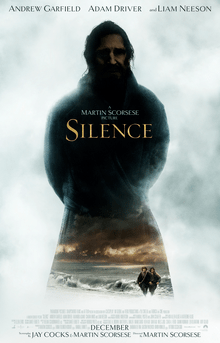 If we can take Martin Scorsese’s varied film career as a reflection of the human experience, then his completion of his long-awaited passion project Silence is not all that surprising. He’s crafted numerous classics, countless cultural touchstones, some spiritual, some historical, and some incredibly honest. But at this point in his career it seems like he has nothing left to prove to us as his audience and maybe at this point in life, if nothing else, we could do well to try and learn from someone like him. Because given the climate with funding and the like, Scorsese could not have made such a film just for other people or money or acclaim. He must have made it, at least partially, for himself.
 There’s something inherently striking about the title Mustang. It signifies something about the title girls, their free-spirits, billowing brown locks, continually running in a type of a herd, constantly full of life, movement, and motion. But with a mustang and any other creature full of life and vitality, there’s always an opposite force looking to impede, tame, and prod the spirit into some sort of submission. Because being free, being wild is constantly challenged in the world that we live in and this story is a prime example.
 Lou Gossett Jr. What a performance. He imprints himself on our brains just like the new recruits he berates, pushes, and toughens on a daily basis. He’s inscrutable. We want to hate him. We want him to get his comeuppance. Yet in the end, we cannot help but appreciate him. We are just like one of his recruits and that’s, in part, why this story works at all.
 Watching An Officer and a Gentleman, it is rather amazing that it succeeds as part romance, part war drama since all its action takes place at an air force cadet school. They haven’t even reached the front yet. There are no explosions or bombs bursting in air. It even shares similarities with Fred Zinneman’s star-studded From Here to Eternity (1953) years before. But that story had far more star power and a climatic event like Pearl Harbor to build the story around. Here there’s nothing quite like that. But it’s not really needed. We are reminded that mankind is inherently interesting and when you throw a bunch of them together under duress it’s a formula for heightened emotions.
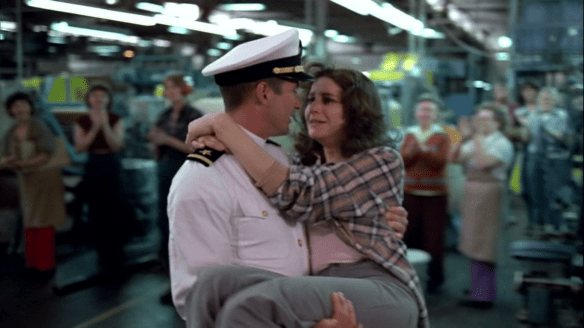 Certainly, the film functions because it has all the necessary components, a rebellious hero played by Gere, troubled pasts, innumerable odds and the like. However, breaking the film down to its simple plot points hardly gives the film the credit it is due. There are so many intangibles when you watch something on the screen that really gets to your gut. It’s not necessarily manipulation on the part of any one person, director, screenwriter or otherwise. It’s simply the emotional clout that the medium of film is capable of.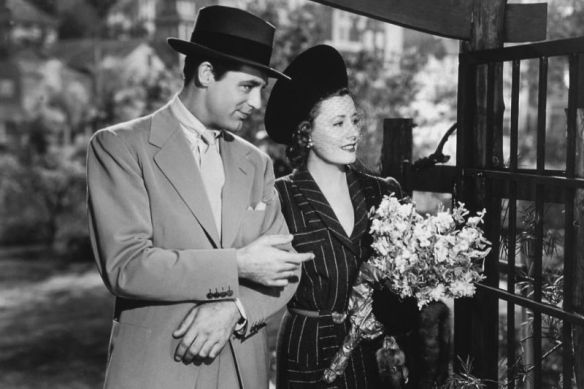
 There is a lineage of psychological dramas most notably including the likes of Shock Corridor and One Flew Over the Cuckoos Nest. But one of their primary predecessors was The Snake Pit which is a haunting, inscrutable and thought-provoking film in its own right.
 It’s a B-picture title to be sure but with Robert Siodmak and such an ensemble, this is an enticing noir all the same. The well-to-do Quincy family of small-town America are an odd bunch, still holding onto their surname with pride as they slowly drift further and further into obscurity within the walls of their old mansion.
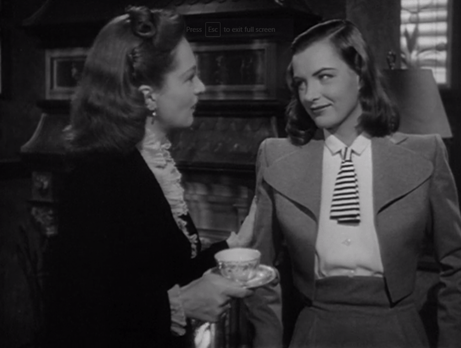 The dominating sister Letty, played by Geraldine Fitzgerald, is more aloof in her ways, veiling everything with a conviction that what she does, she does for the good of her brother. But it’s all really due to the fact that she cannot bear to let him go. In this way, she’s constantly controlling his life and undermining his happiness. She’s hardly your typical femme fatale, more cultured and refined than most, but there’s still something exacting about her.
 For so many, there is a deep connection to Star Wars that started at an early age. As I have alluded to on numerous occasions, I am no different. And if I feel that way about even the prequels, it’s exponentially greater for the original trilogy, as I can imagine it is for legions of others. Thus, when I watch Rogue One I do not linger on its shortcomings, though they most certainly exist, instead, I’m fixated on that very same suspension of disbelief that overtakes me every time I enter that world, a long time ago in a galaxy far, far away.
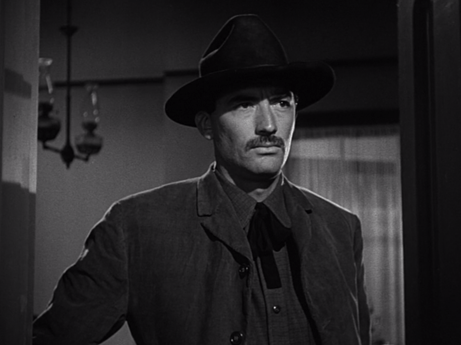 “Ringo don’t look so tough to me.”
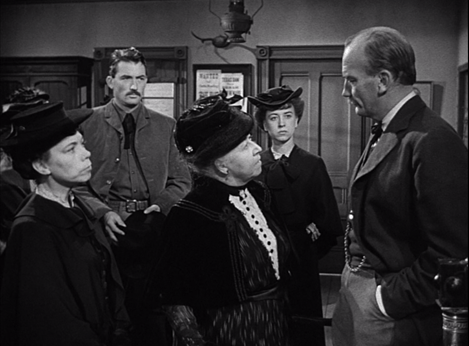 Of all men to understand Ringo, you would think that the local Marshall (Millard Mitchell) would be the last, but he happens to be an old friend of the gunman. They used to run in the same circles before Mark softened up. His life mellowed out, while Ringo’s reputation continued to build.
 The main reason Ringo stays in a town that doesn’t want him is all because of a girl (Helen Westcott). He waits and waits, biding his time, for any word from her, and finally, it comes. He gets his wish to see her and his son in private. These scenes behind closed doors are surprisingly intimate, casting the old gunman in an utterly different light.
 4 Star Films