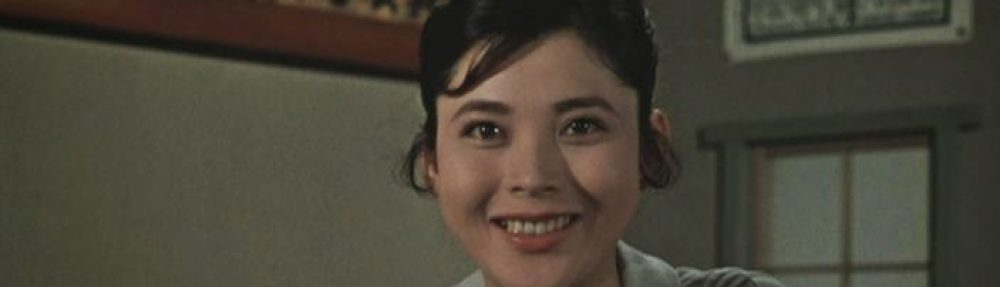
 Citizen Kane is so often lauded for the simple fact that never before had a director had so much creative control on a project and exercised it in such an unprecedented fashion, especially given the state of affairs in the Hollywood studio system. It’s an enigma, a stunning debut and really an astounding miracle where all things aligned for an instant of so-called perfection.
But some people might assume Welles dropped off the face of the map, only to resurface as a rotund larger than life personality, hardly a cinematic auteur. And it is true, after that initial opportunity, he chased after freedom of artistic expression rather unsuccessfully. That does mean he never found it. Not by a long shot.
The Trial is indisputable evidence of that. It’s greatly under-viewed and that really is a shame, because within its frame you see the glimpses of that same master, perhaps even more mature than he ever was in Kane.
The story grounds itself in the absurdist prose of Franz Kafka with Orson Welles delivering the opening narration in the form of Kafka’s parable “Before the Law,” setting the groundwork for the rest of the narrative. Anthony Perkins works seamlessly as Josef K. a tentative man set adrift in a world where he has been arrested and put on trial for a crime that is never revealed to him. He fluctuates easily between indignation and resigned timidity.
 At first glance The Trial is a bare-boned parable, feeling gaunt and cavernous with empty sets and even emptier words. Everyone Josef meets talks him in circles, tirelessly — never leading to any significant conclusion, only the next diversion in his journey.
There are some interludes in the film that could be characterized as dull, especially as we are getting acclimated to this storyline, or more precisely coming to grips with the fact that The Trial is not so much about Story. Kafka revels in the absurd rather than convention and Welles uses that surrealist absurdity as a vehicle for his own endeavors as a director.
Welles had his hands tied with lack of financial capital leading to only an abandoned railway station to work with, and he in turns transforms the space into a gloriously visual labyrinth. In his case limitations only meant further inspiration. In fact, his camera feels ever more inventive and engaging wherever it takes us within this surrealistic space. Large landscapes of dizzying scope mixed with confined, claustrophobic crevices. Further blanketed in light, utilizing a much simpler (as well as cheaper) black and white to develop an ever intricate gradation of field mingled with fascinating angles. These alone take a relatively bare scene and dress them up into something that is entrancing.
More than once, including the film’s final moments as Josef looks to be headed towards death, it’s easy to be mesmerized because there are no clear narrative distinctions. Characters function as Kafka characters should, and Welles does the rest if you only give him your attention.
 If The Trial is a hodgepodge of talent, with the presence of Americans Orson Welles and Anthony Perkins, international sirens Jeanne Moreau, Elsa Martinelli and Romy Schneider, with European backing and source material from Kafka, then it is a thoroughly intriguing marriage all the same. This film is perhaps the greatest adaptation of the work of Kafka and not due necessarily to its faithfulness to its source material, but because it displays an unmistakably Wellesian vision. The cyclical nature of the legal system pales in comparison with the fascination that comes with watching the continual creativity that is projected up on the screen — this is a hollow dream of a film.
So Orson Welles did get his artistic freedom, complete with a few surprising moments of cursing, international talent and meager funding that nevertheless gave him what he so desired. Welles ends the film with more narration and instead of running end credits he opts to list off all the names of his players. While the final intonations of his voice leave little doubt that this is his creation first and last, it also suggests that this is a personal film. Something outside of the realm of conventional Hollywood, but still very much worthwhile, even if it’s due mostly to form over content.
4/5 Stars
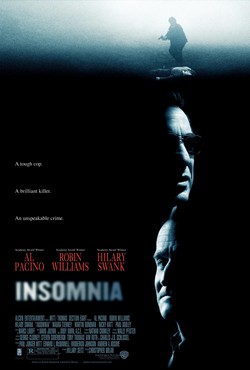 “You and I share a secret. We know how easy it is to kill somebody.” – Robin Williams as Walter Finch
 One of Jean-Luc Godard’s strengths is his capability of feigning pretentiousness, while still simultaneously articulating humor. His film opens with its first of many inter-titles, “A film adrift in the cosmos,” followed by the equally poignant “A film found in a dump.”
 Conflagrations engulf cars and human bodies while above the din comes the piercing screams of a woman bemoaning the loss of her Hermes handbag. We cannot take this anyway but humorous because it once again is yet another moment of utter insanity.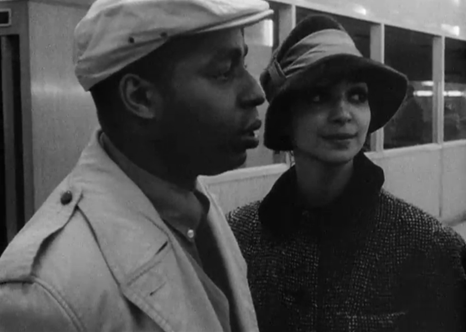


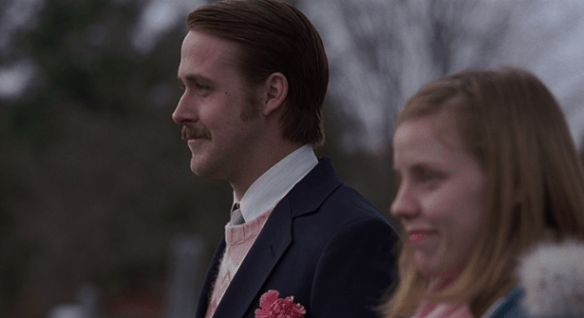
 Where to start with Liberal Arts? It’s one of those deep blue funk movies. Zach Braff tackled this issue in Garden State, and Josh Radnor does a similar thing here. Because the reality is that we live in a generation of early onset midlife crises. In the opening moments, 35-year-old Jesse Fisher (Radnor) has nearly every article of clothing he has aside from the shirt off his back stolen from a local laundromat when his back is turned. We can easily surmise that this single event epitomizes his life right now, and this is hammered home rather obviously when his unnamed girlfriend clears her belongings out of his flat. There’s no better symbol of isolation and alienation than a break-up.
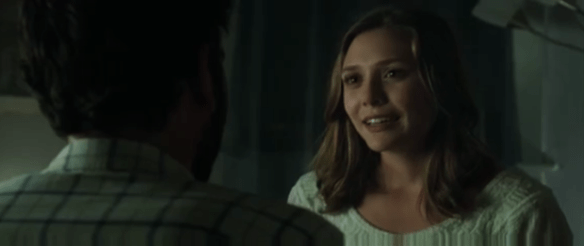 It’s crucial to note that at this juncture nothing substantive builds between these two acquaintances romantically, but they do foster an immense connection. While Jesse is taken by Zibby’s personality, she, in turn, is discontent with a contemporary culture where no one dates–everybody’s casual about relationships. She feels unequivocally millennial and yet she readily admits these areas of old-fashionedness.
 “He spat on Balzac!”
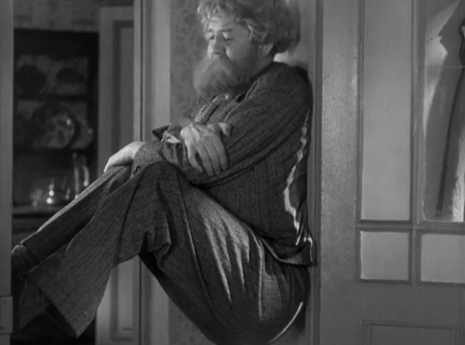 Soon Boudu is wrapped up in middle-class luxury that he didn’t ask for, at the behest of Edouard who takes an initial liking to this bushy-haired man he happened upon. After all, he is intent on playing savior and Boudu obliges. It’s in these forthcoming scenes that Renoir examines class in a satirical way, feeling rather like a precursor to some of Bunuel’s later work, without the religious undertones. And yet for some reason, we cannot help but like Boudu a lot more. True, he is loud, messy, rude and unruly, but there’s something undeniably charming about his life philosophy. There are no pretenses or false fronts. He lets it all hang out there. In this regard, Michel Simon is the most extraordinary of actors, existing as a caricature with seemingly so little effort at all. He steals every scene whether he’s propped up between two door frames or cutting out a big swath of his beard for little reason.
 Charity in a sense is met with scorn, but it feels more nuanced than, say, Bunuel’s Viridianna (1961). In many ways, Boudu seems like a proud individual or at least an independent one. He hardly asks for the charity of the wealthy, and he’s content with his lot in life, even to the extent of death. It’s also not simply chaos for the sake of it, and he hardly lowers himself to the debauchery of Bunuel’s unruly bunch. Still, he obviously rubs the more civilized classes the wrong way, by scandalizing their way of life and trampling on their social mores without much thought. It’s perfectly summed up by the last straw when a fuming Edouard incredulously exclaims, “He spat on Balzac.” The nerve!
 Two hallmarks of the political film genre are Mr. Smith Goes to Washington and All the President’s Men. The latter starred The Candidate’s lead, Robert Redford. However, in this case, the candidate, Billy McKay, is perhaps a more tempered version of Jefferson Smith. He’s a young lawyer, good looking and passionate about justice and doing right by the people.
 As I’ve grown older and, dare I say, more mature, I like to think that I’ve gained a greater appreciation for those moments when I don’t understand, can’t comprehend, and am generally ignorant. Now I am less apt to want to beat myself up and more likely to marvel and try and learn something anew. Thus, Marienbad is not so much maddening as it is fascinating. True, it is a gaudy enigma in form and meaning, but it’s elaborate ornamentation and facades easily elicit awe like a grandiose cathedral or Renaissance painting from one of the masters. It’s a piece of modern art from French director Alain Resnais and it functions rather like a mind palace of memories–a labyrinth of hollowness.
 In fact, although this film was shot on estates in and around Munich, I have been on palace grounds similar to the film. There’s something magnificent about the sprawling wide open spaces and immaculate landscaping. But still, that can so easily give way to this sense of isolation, since it becomes so obvious that you are next to nothing in this vast expanse. Marienbad conveys that beauty so exquisitely, while also paradoxically denoting a certain detachment therein.
 Do we understand this bit of interaction at this stately chateau? Probably not. In fact, I’m not sure if we are meant to know the particulars about last year in Marienbad. That doesn’t mean we still can’t enjoy it for what it is. Because Alain Resnais is perennially a fascinating director and he continued to be for many years. Whether you think this is a masterpiece or a piece of rubbish at least give it the courtesy and respect it is due. Then you can pass judgment on it, whatever it may be.
 It’s the bane of my literary existence, but I must admit that I have never read Joseph Heller’s seminal novel Catch-22. Please refrain from berating me right now, perhaps deservedly so, because at least I have acknowledged my ignorance. True, I can only take Mike Nichol’s adaptation at face value, but given this film, that still seems worthwhile. I’m not condoning my own failures, but this satirical anti-war film does have two feet to stand on.
 The Chaplain (Anthony Perkins) doesn’t feel like a man of the cloth at all, but a nervously subservient trying to carry out his duties. An agitated laundry officer (Bob Newhart) gets arbitrarily promoted to Squadron Commander, and he ducks out whenever duty calls. Finally, the Chief Surgeon (Jack Gilford) has no power to get Yossarian sent home because as he explains, Yossarian “would be crazy to fly more missions and sane if he didn’t, but if he was sane he’d have to fly them. If he flew them he was crazy and didn’t have to; but if he didn’t, he was sane and had to.” This is the mind-bending logic at the core of Catch-22, and it continues to manifest itself over and over again until it is simply too much. It’s a vicious cycle you can never beat.
 But the tonal shift of Catch-22 is important to note because while it can remain absurdly funny for some time, there is a point of no return. Yossarian constantly relives the moments he watched his young comrade die, and Nately (Art Garfunkel) ends up being killed by his own side. It’s a haunting turn and by the second half, the film is almost hollow. But we are left with one giant aerial shot that quickly pulls away from a flailing Yossarian as he tries to feebly escape this insanity in a flimsy lifeboat headed for Sweden. It’s the final exclamation point in this farcical tale.
 4 Star Films