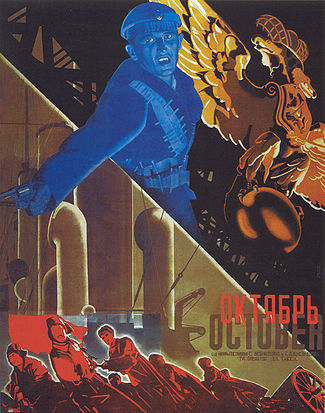
 It’s curious that the first image October conjures up is a biblical nightmare from the book of Daniel. In that instance, the Babylonian king is frightened in his dream by a giant statue that comes tumbling to the ground. Of course, in that context, it had a lot of the same connotations, that his kingdom would come crashing to the ground with a resounding thud.
Obviously, there is an overarching narrative which holds importance, but Eisenstein always was a filmmaker of emotion elicited through moving images. So if I’m to be completely honest, the exact particulars of October don’t altogether interest me that much. Certainly, the Russian Revolution is an interesting and cataclysmic moment in 2oth century world history. However, all its crevices and nuances could just as easily be found in a textbook or piece of historical literature.
October is engaging visually, as not only a piece of historical documentation, but of propaganda, and artistic expression through a highly visual medium. Sergei Eisenstein is one of the forefathers of editing and even to this day how he decided to cut his films is fascinating. Part of this is his complete and utter break with the classical Hollywood style of editing that most of us have been born and bred on. Eisenstein is in complete juxtaposition with these normal sensibilities, and that gives his work a perplexing quality that carries a great deal of weight in its own right.
There are scurrying people, smiling faces strung together with montage and quick cutting. It’s grand chaos that is stirring even as it’s, at the same time, rather frightening to behold. The images are bursting forth with fervent energy and vigor for a cause still very much on the rise across the contemporary landscape.
The sheer mass of the mayhem is mind-boggling rather like Metropolis. Its frames are inhabited by seas of people, forests of guns, earthquake of feet hitting the pavement, constantly reverberating and repeating at different intervals. The grizzled yet ecstatic faces of the common man lend credence to Einsenstein’s unifying message waving the banner of the Communist nation.The palace being overrun by hoards is difficult to discount as is the spliced together images of varying religions. These are only a few of the eclectic pieces of the train that make up October. It is a document of a time and place that just happened to be St. Peterburg Moscow on October 27th, 1917. The clocks at the denouement suggest that it had a universal impact on the entire world. If the Cold War is any indication, then Eisenstein might be right.
4/5 Stars
 “Nobody throws me my own guns and says ride on. Nobody” ~ James Coburn as Britt
 Into the valley road the seven rather like the light brigade, at first simply preparing to train up and prepare their little village of farmers to fight back against the brutal outlaw Calvera (Eli Wallach). But there’s something that happens over time. When you spend time in close proximity with people, eating their food and sharing their shelter, it’s hard not to build a bond — a connection that holds you there. At first, it seems of little consequence when the enemy gets beaten back, but everyone knows they will return with a vengeance.
 And we get the final skirmish with guns blazing, bullets flying, and lives being put on the line. Here is a film where the final body count deeply matters. Not so much of the enemy, but of our heroes, because each one chisels out a little niche for themselves. Everyone has worth and importance even as they jockey for screen time and it pays off in the end. They fight with honor just as they die with honor. Perhaps it might seem futile, but not without significance. The little village is left in peace to live out their days in tranquility. Calvera’s final words echo in their ears: “You came back – for a place like this. Why? A man like you. Why?”
 I still remember driving through the hills and dales of the English countryside listening to Hard Day’s Night in the family rental car. Back then I had a haircut that could best be described as a mop top. And then during my one visit to Liverpool, I was beyond ecstatic. I’m a fairly reserved person and yet standing in Paul McCartney’s kitchen at 20 Forthlin Road (his childhood residence) what else could I do but bend down and kiss the floor?
 What it manages to bring together within the frame of a meager B-film plot is quite astounding, balancing the brutality and atmospheric visuals with the direction of Robert Wise to develop something quite memorable. Boxing movies have been bigger and better, but film-noir has a way of dredging up the grittiest pulp and the Set-Up is that kind of film.



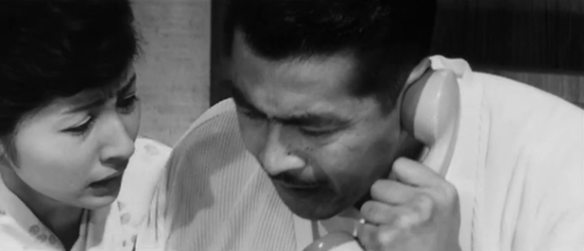 High and Low (or Heaven and Hell in the original Japanese) is a yin and yang film about the polarity of man in many ways. Gondo (Toshiro Mifune) is an affluent executive in the National Shoe Company. He worked his way up the corporate ladder from the age 16, because of his determination and commitment to a quality product. Now his colleagues want his help in forcing the company’s czar out. They come to his modernistic hilltop abode to get his support. Instead, they receive his ire, splitting in a huff. What follows is a risky plan of action from Gondo that is both fearless and shrewd. He takes all his capital to buy stock in the company so he can take over, but his whole financial stability hangs in the balance. He knows exactly what it means, but he wasn’t suspecting certain unforeseen developments.
 At this point, the police are called and they arrive incognito, ready to stake out the joint and do the best they can to get the boy back safe and sound. This section of the film almost in its entirety takes place within the confines of Gondo’s house and namely the front room overlooking the city. It’s the perfect set up for Akira Kurosawa to situate his actors. He uses full use of the widescreen and his fluid camera movements keep them perfectly arranged within the frame.
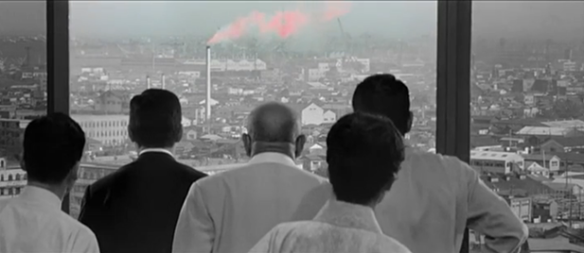 Finally, with the help of Shinichi, they make a startling discovery that ties back to the kidnapper. And the boy’s drawings along with a colorful stream of smoke help them move in ever closer. What follows is an elaborate web of trails through the streets as they work to catch the culprit in his crime, to put him away for good. And it works.
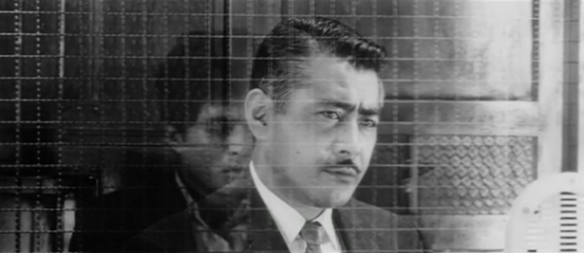 But High and Low cannot end there without a consideration of the consequences. Gondo has been brought low. He’s losing his mansion and must start a new job on the bottom of the food chain once more. His enemy requests a final meeting as he prepares for his imminent fate, and this is perhaps the most grippingly painful scene. Gondo’s face-to-face with the man who made him suffer so much. Toshiro Mifune’s violent acting style serves him well as he wrestles so intensely with his own conscience. And yet at this junction, he is past that. What is he to do but listen? In this way, it’s difficult to know who to feel sorrier for — the man who is resigned to a certain fate passively or the one who goes out proud and arrogantly against death. Both have entered some dark territory and it’s no longer about high or low or even heaven and hell. They’re stuck in some middle ground. An equally frightening purgatory.

 4 Star Films