 In a sense, I’m scared to be confronted with Bunuel’s films more often than not, because even to this day they are surprisingly subversive. But with The Exterminating Angel, there is a different sort of apprehension to be faced altogether. It is a fascinating film because it shows the descent of humanistic man into the depths of his primordial nature. However, it builds off the cruelest and most interesting practical joke ever conceived. It’s played on a group of people within the confines of the frame and the audience watching in equal measures.
Of all places, it starts at a dinner party where good etiquette, manners, the upper class, and culture all collide. Luis Bunuel seems to have a preoccupation in placing his subjects around a table because really there is nothing more human than sharing a meal together. Although, he finds ways to make it interesting and in this case wickedly absurd. The table becomes an arena for gossip, loaded barbs, harbored feelings, and ruffled feathers.
It’s quick to enter an almost surreal state as all the guests are unable to leave the confines of the room. We take things for granted so easily, but in their world leaving the room is not a given, even if it seems so straightforward to us. Some force is keeping them where they are, although we never see it or hear any mention of it. Our only inference is that there is some outside force holding them there. They are literally haunted by specters with a shroud hanging over them — an Angel of Death if you will.
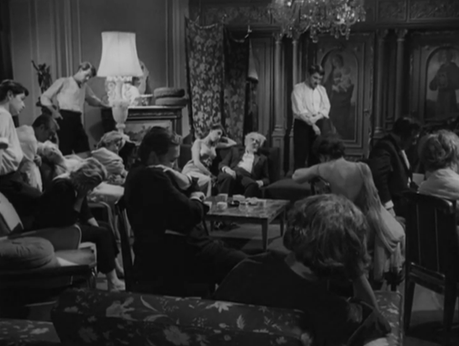 This prolonged period of isolation lends itself to the degradation of all pretenses. The animalistic tendencies replace all shreds of decency. All the dirty little secrets that lurk under the surface then begin to rear their ugly heads. Honestly, it’s hard to keep them at bay in such close proximity, for prolonged periods of time, because people see the real you. It becomes hard to hold your tongue, to keep those biting words from slipping out, especially when fatigue and hunger sets in. As many of the men and women begin to falter, the good doctor represents all things rational and seemingly honorable. But when he is cast aside it reflects an end of human dignity. These individuals who were once so high, have fallen such great heights. Lambs get taken to slaughter and pipes are busted just for even the smallest taste of water.
It strikes me that this film is literally a picture of hell. No, it’s not the fire and brimstone picture we are accustomed to, but instead, it is a hell created by the individuals themselves, feeding off their own evil and pride, and accentuated by their prolonged purposelessness. Just think, it takes a woman named Leticia (Silvia Pinal), to break all her companions out of this cycle they have become stuck in. She realizes the utterly pointless loop they are caught in and breaks them out of it with a few powerful pieces of induction. Also, could there be some symbolism in her nickname “Valkyrie” (The chooser of the living and the slain)? I think so.
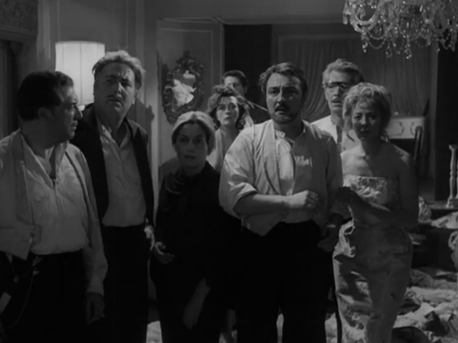 They leave the room just as easily as they entered it. It happens so unremarkably in fact that some might feel duped, and I would not blame them. Why did we watch this group of socialites remain in a room for an hour and a half if they could have gotten out this easily? But if you ask this question you miss out on the whole mind-bending aspect of Bunuel’s main conceit. We cannot fully understand; we can only marvel at the fact that something that we take for granted like leaving a room, doesn’t work so simply. Do I understand it, certainly not, but it makes for an amazingly powerful and frightening study of human nature. This is also a film that does not let off. In fact, although we finish one cycle, it looks like another one is about to begin with a few clergy trapped for another inexplicable reason in their cathedral with many parishioners. Outside a riot forms as another herd of lambs makes its way to the chapel. It’s as depressing as it is funny in some unnerving sort of way. Not only has Bunuel played a joke on his characters, but his audience as well. This time I didn’t mind all that much.
4.5/5 Stars








 4 Star Films