Gone Girl (2014)

b15ec-gone_girl_posterMy only advice for Gone Girl is to leave all your preconceived notions at the theater entrance because you are about to be blown out of the water. This is not the movie you were expecting–probably very few people were.
The story is based on the source novel of Gillian Flynn who also happened to be the film’s screenwriter. Behind the camera is mystery-thriller phenom David Fincher (Se7en, Zodiac) directing his two stars Ben Affleck (Argo) and Rosamund Pike (Pride and Prejudice).
From the beginning, we get a personal view into the married life of Nick and Amy Dunne. Back in 2005, the romance was just beginning to bud. Now on their 5th wedding anniversary, Amy is gone. Nick is the obvious culprit and we suspect him from the outset of the film, but why would he call in the police to search for his wife? He seems genuinely worried and befuddled by it all.
Soon the police are being taken on a treasure hunt while the whole town becomes frenzied behind the giant media carnival which is having open season on the find Amy campaign. The underlying tension of every present day sequence makes for a nerve-wracking procedural juxtaposed with the romantic journal entries of the gone girl. The race to find Amy is on with the days counting down and Nick collaborating with Detective Boney (Kim Dickens).
By this point, it is insanely difficult to catch up with the narrative because just when a conclusion seems certain a new wrinkle is inserted. There are no givens. Is Nick good? Who is Amy really? Who Knows?
Fincher’s film has one last grand ploy. It shows its hand earlier rather than later, feeding its audience one juicy twist. Far from being done, it continues to follow the fate of poor Nick and Amazing Amy. Gone Girl grows more and more uncomfortable as the days pass and not for the reason you would suspect. On the surface, life seems perfectly normal once more to the still clamoring media, but it’s not the first time that the cameras and reporters fail to see what is really going on.

This is one of the most intense dramas that has come out in years and it in many ways functions as a thriller, a black comedy, and even a satire of the media. The often grisly depictions of violence make the proceeding moments of laughter all that more uncomfortable. Fincher made thrillers before, but nothing quite like this. It’s fidget-inducing, spine-tingling, and utterly perplexing.
 
4/5 Stars

Paths of Glory (1957)

87e30-pathsofgloryposterStarring Kirk Douglas and directed by Stanley Kubrick, this war film with a twist follows a French Colonel Dax (Kirk Douglas) and his men during World War I. He is ordered to take part in a suicide mission by a general and everything soon goes awry. After they unsuccessfully go through with the mission , three of Dax’s men find themselves being court martialed as examples for supposed cowardliness. Despite a defense by Dax in court, the three men are found guilty and later executed by firing squad. This and other events cause Dax to openly question the decisions of his superiors. In a very touching final scene there seems to be a questioning of the inhumanity of war. In one of his earlier films Kubrick delivers a poignant piece.
 
4/5 Stars

Wages of Fear (1953)

2c3da-salairedelapeurr350Directed by Henri-Georges Clouzot, this international thriller stars a cast headed by Yves Montand. The film opens in a hell-hole of a town in South America where many jobless drifters spend their days. The joke is that it is really easy to get there, you just can never get out again. 

A Frenchman named Mario (Montand) is one of these vagabonds who has little to do except make eyes at a pretty girl (Vera Clouzot), and sit around the local hangout. Then a massive fire breaks out at a nearby oil field of the corrupt, American Southern Oil Company (SOC). In order to stop the devastation, the solution is to use explosions triggered by nitroglycerin. But the journey to the fields is extremely dangerous so there is the brilliant idea of finding four eager vagrants to transport two trucks of nitro on this 300-mile suicide mission. In need of a break, most of the town jumps at the opportunity. However, only four men actually get this “privilege.” 
One is Mario, another his jovial roommate Luigi, and then the closed off and menacing Bimba. The fourth man who eventually joins this trio is Jo who is an older French fellow who befriended Mario. Then, Mario and Jo leave in one vehicle followed by Bimba and Luigi with the fun just beginning. They must navigate the treacherous roads full of not only bumps but barricades and giant boulders. All the while they are worn thin physically and psychologically. 

Soon the confident Jo turns into a sickly coward, but the other three must keep on going if they want their payoff. In the end, this mission turns out to be too much for some. Eventually, Mario gets ready to return to his girl with $4,000 in toe, a deliriously happy man.
First off, when it is said that this film is a “thriller,” we are not talking about a Hollywood thriller here, with overwhelming action followed by twist after turn. What makes the Wages of Fear so powerful is the sustained intensity because every moment that the nitroglycerin is in the picture you half expect something to go wrong. As such a thriller, I almost came to expect the ending because I really do not think it could have ended any other way. In many ways, it is not simply a critique of the American oil industry, but also the American film industry, and it confidently defies both.

4.5/5 Stars

Gaslight (1944)

eb609-gaslight-1944Directed by George Cukor and starring Ingrid Bergman, Charles Boyer, and Josesph Cotten, with Angela Lansbury, this film begins rather abruptly with a young girl in England who witnessed the aftermath of her aunt’s murder. Then in a whirl wind she has become married to a nice young pianist and they move back to her old home in England to settle down to together. From that point on everything begins to change gradually. Gregory has a violent outburst over a letter, Paula loses her brooch mysteriously, a picture is misplaced, there are seemingly footsteps from above, and the gaslights change for no apparent reason. Gregory continues to manipulate and isolate his wife telling her it is for her own girl. A traumatic night at the opera and the new maid only worsen Paula’s mental state. She soon believes she is sinking deeper and deeper into hysteria thanks to Gregory. However, a former admirer of her aunt becomes curious of Paula and tries in earnest to meet her as he reopens her aunt’s case. Finally, they meet and together they piece together what is really going on. In the final climatic moments the inspector comes to Paula’s aid and she turns the tables on her husband. All the main players do a wonderful job, especially Bergman, and this film was built up nicely. My only qualms would have to be Joseph Cotten playing an Englishman and I found it hard to follow in the very beginning.

4/5 Stars

The Day the Earth Stood Still (1951)

911a0-day_the_earth_stood_still_1951Starring Patricia Neal and Michael Rennie with direction by Robert Wise, this sci-fi film begins with the landing of a mysterious alien space craft in Washington D. C. At first nothing seems to happen and the whole country is tense. Then an extra-terrestrial named Klaatu gets off followed by his giant cohort Gort. He comes in peace but he is wounded by a frightened gun. From that point he is taken to a hospital but his only mission is to warn the world that they must change their ways. 

Klaatu gets away from the hospital and he takes up the identity of one Carpenter in order to integrate himself so he can give the people his message. He ends up befriending a widowed lady and her small boy with his quiet kindness.  

His goal is still to deliver a message to the leaders of the world and the man he wants to speak to is Professor Jacob Barnhardt (Sam Jaffe). When he finally is able to talk, he warns against the use of atomic power, because other planets have become apprehensive and will surely neutralize the earth if they do not stop.

He is followed by Bobby and Klaatu finally reveals his true identity to Helen. Soon he shuts down all the non-essential power across the country, and when the chaos dies down, the manhunt for the culprit intensifies.

In his final entreaty before leaving earth Klaatu pleads with the people:

“It is no concern of ours how you run your own planet, but if you threaten to extend your violence, this Earth of yours will be reduced to a burned-out cinder. Your choice is simple: join us and live in peace, or pursue your present course and face obliteration. We shall be waiting for your answer. The decision rest on you.”

So ends a film that was not just another sci-fi flying saucer movie of the 1950s. It was a representation of the atomic age and an indictment of the Cold War sentiment at the time. Klaatu in many ways becomes a Christ-like figure who calls for peace, takes the name “Carpenter,” and even rises from the dead. In many ways he saved humanity too, on the day the earth stood still.

4/5 Stars

Marty (1955)

ae98e-marty_film_posterStarring Ernest Borgnine and Betsy Blair, this heart warming story is about an Italian butcher in New York. He is nice enough but he is the oldest in his family and the only one not married. Soon with the concerned questioning of his mom and the droll of his social life, Marty gets discouraged. However, after reluctantly going to a ballroom he meets a girl. She is shy and not beautiful but she and Marty immediately hit it off. Marty’s mom does not really like her and Marty’s friend Ange thinks she’s ugly. He is initially deeply affected by this but then he realizes his happiness is what really matters. Soon enough he is on the phone with his girl. This is one of those film good films and it seems to go against the usual Hollywood mold.

4.5/5 Stars

Three Colors: Red (1994)

 3a286-threecolorsred3Kieslowski’s films are mostly character driven and yet he often uses high drama to create a far more complex lens to observe his subjects. In Blue, the inciting incident was a deadly car accident. It seems only fitting that he would end this story with the catastrophic sinking of a ferry. He takes the same bleak, no-nonsense approach with little fanfare that he used before. It’s his way.

In fact Three Colors: Red as a whole is another simplistic film in plot, and yet the irony is that the film is chock full of complexity because its major point of interest is interpersonal relationships (as suggested by the intertwining phone lines shown early on). There is nothing more tangled and intricate about humanity than our relationships.

As such, this final installment is in many ways a story about love, romance, and friendship, and yet Kieslowski does not find it necessary to preach to us. He is better and more thoughtful than that, laying out the story for us to ponder and mull over. This is the story or better yet the parable he created.

Valentine (Irene Jacob) is a young student and model who is constantly an innocent and sympathetic figure with a pair of doe eyes. She is often shown in profile which continually reveals her youthful and even sullen beauty. She is even the somber poster girl of a gum campaign plastered around town. There’s a boyfriend in her life who she desires the affection of, and then there’s a brother who is hooked on drugs. In other words, life is far from rosy and secure.

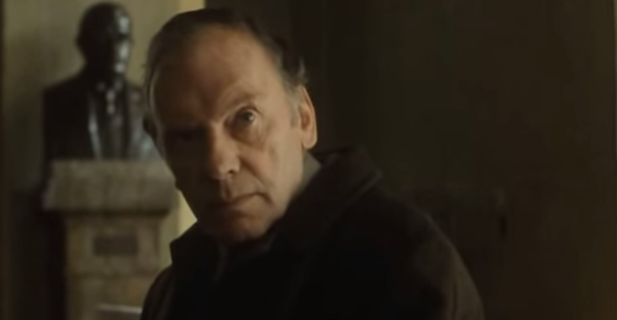
One day she accidentally runs over a dog that she takes to the owner (Jean-Louis Trintignant,) who seems surprisingly unconcerned by the event. She does the only thing she can do with a clear conscious which is taking the dog to the vet and then taking care of it herself. Soon after, Valentine finds herself walking the dog by the old man’s house once more and she discovers what he does all day. It turns out he is a retired judge, and he spends his solitary existence eavesdropping on the conversations of others (including Valentine’s neighbor Auguste).

Later, through the grapevine, she finds out that a retired judge had a suit filed against him, and she rushes to his house to assure him she had no part. He already knows because he was the one who turned himself in.

Over the next days, Valentine begins to empathize more and more with Mr. Kern’s existence. As a former judge, he was forced to make decisions far more difficult than most. In fact, why do people follow laws? Is it out of goodness or purely self-serving? Is morality all relative? What really is good and bad, because how would we act in the other man’s shoes? By this point, we see Kern’s struggle a little better.

Finally, Valentine invites her new found friend to her last fashion show before she heads to England for a few weeks. It’s a touching moment when he pays her a visit after the show, but it also reveals the pain in the old man’s past. It may be a lucky guess but all we know is that Valentine figures him out. It just shows that you cannot judge others by first impressions.

So as it goes, Auguste’s life practically mirrors that of a younger Kern, and thus, so many parallels become evident. Aside from the obvious, I only figured it out after the film was done, but they are both judges, struggle in love and the like. At the end of the film when Kern sees the news about the ferry with Valentine and Auguste aboard, the only thing we know for sure is that there were seven survivors (guess who!). In a somewhat subtle way, the trilogy is connected and Kieslowski ends his tale on a fitting note. It freezes and just like that the career of one man was done for good. A couple years later he would already be gone. But he went out on top and Three Colors cemented his legacy. I always loved the color red the best. Here’s yet another reason why.

4.5/5 Stars

Bad Day at Black Rock (1955)

8435a-bad_day_at_black_rockStarring Spencer Tracy and Robert Ryan with Lee Marvin, Ernest Borgnine, Dean Jagger, and Anne Francis, the whole story takes place in an isolated desert town. Tracy as the one-armed man Macready comes to the town and soon is face to face with many cold, detached, and suspicious folks. He has his own reasons for being there so that he can find the father of a Japanese-American war buddy of his. He asks around and no one is willing to talk. Macready soon realizes their secret and understands how much danger he is in. However, with the help of a couple of townspeople he is able to resolve everything. Then, he leaves town aboard the train just as calmly as before. This film intrigued me for a number of reasons but especially since a central topic was racism towards Japanese-Americans.

4/5 Stars

Pickpocket (1959)

6593f-pickpocketposterThis French film directed by Robert Bresson, begins with voice-over narration of a man recalling his past. Michel is a nondescript person who was down on his luck. Then, one day he ineptly tried his hand at pick pocketing and was caught. He got off and over time he sharpened his skills and teamed up with two other men. They successfully bring in a great deal and it becomes Michel’s livelihood. At the same time Michel’s mother is becoming ill and he meets a young neighbor named Jeanne. Michel’s best friend is falling for this girl while Michel himself is continually tempted to steal. This leads to a little trouble from a police inspector and yet he stays out of jail.

However, after further discussion with the chief and Jeanne, Michel leaves Paris. He returns later still impoverished, to find Jeanne with a child but unmarried. He resolves to support her and yet after trying to work, he reverts back to his past vice. This time his guard is down and he winds up in jail. Jeanne comes to visit him a great deal and through this devotion he realizes they both are in love with each other.

This film has simple but intriguing topic. Sometimes the pick pocketing scenes are shown almost as a choreographed dance which is done so fluidly. Overall Pickpocket has a striking resemblance to Doestoevsky’s Crime and Punishment but it reflects the wonderful simplicity of Robert Bresson’s realistic style. Is it just me or does Marika Green look like Natalie Portman in black and white. I certainly think so.

4.5/5 Stars

Good Night, And Good Luck (2005)

63e88-goodnight_posterThe film takes place amidst the Red Scare and it chronicles the team behind the CBS show See It Now, with the reporting of Edward R. Murrow. He along with his co-producer Fred Friendly are willing to question the actions of Senator Joseph McCarthy. However, they walk a fin line that could easily lead to controversy and the destruction of their careers. Eventually they do witness McCarthy as he begins to loser popularity, but they have no time to celebrate because they have their own set of problems with the network. Murrow closes a speech by saying television has potential if used correctly. As always he ends with “Good Night, and Good Luck.” This film had a pretty good cast, sleek black and white cinematography, and archival footage was used well throughout. It was nothing overly spectacular but it was good.

4/5 Stars