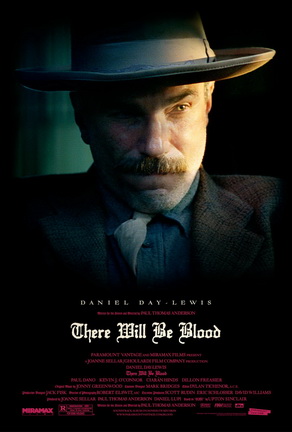
There Will Be Blood (2007)

fe325-there_will_be_blood_posterStarring Daniel Day-Lewis in a brilliant performance, the film opens at the turn of the century where a Daniel Plainview finds oil and starts a small drilling company. After a worker dies, Plainview takes the abandoned baby as his son H.W. He uses the boy to endear himself to others and his successes grow. Time passes and Daniel is approached by a boy who knows the location of oil. Daniel goes there and buys up all the land he can, becoming a wealthy man in the process. However, not everything is wonderful. He begins a long conflict with a local preacher (Paul Dana) and his son becomes ill after an explosion. Later a man comes to Plainview claiming to be his brother and Daniel also abandons his son. The years pass and he is more greedy and tyrannical and on top of that he is also a drunkard. He cruelly mocks his son before cutting all ties with him. Finally, he commits one last violent act. What stands out is that Plainview has no redeeming qualities and this man proclaiming to be a minister is also an undesirable. This film had moments reminiscent of Giant, The Treasure of Sierra Madre, and even Citizen Kane. However, despite the commanding performance of Lewis, it is not quite the same caliber in my mind.

4.5/5 Stars

The Pianist (2002)

e19e4-the_pianist_movieDirected by Roman Polanski and starring Adrien Brody, the film chronicles the life a brilliant pianist named Wladyslaw Szpilman, who has his life interrupted by the Nazis. It is 1939 and Wladyslaw is living with is family in Warsaw. However, because they are Jewish they become branded by the star of David, then they are sent to a ghetto, and finally concentration camps. They stay together as long as possible but then by pure luck Wladyslaw is saved from the camp. He gains help from non-Jewish friends and desperately struggles to survive. Eventually he is found is his hiding place by a German officer who actually spares him in part because of his musical skill. The Russians march in and Szpilman goes back to being a pianist. This film was near to Polish director Polanski’s heart. He might not be thought of as a hero and his survival may have been partly luck, but this does not make his story any less inspiring or powerful.
 
4.5/5 Stars


Breakfast at Tiffany’s (1961)

Starring Audrey Hepburn and George Peppard, the movie follows the lavish lifestyle of the ditsy Holly Golightly. Moving into her apartment building, the down-on-his-luck writer Paul immediately grows fond of Holly’s quirky personality. Considering each other simply friends, Paul comes to one of Holly’s wild parties and they journey through New York together. However, although Paul is falling for Holly, his circumstances seem to prevent it and besides she is oblivious to his affection. Slowly they fall farther apart with Holly’s upcoming marriage to a wealthy man. In the end they do reconcile, embracing in the rain (of course). Holly has finally found a man who truly loves her and does not use her. The love story is an interesting one and Hepburn gives a lively performance. Henry Mancini’s “Moon River” is a wonderful addition to this film. I would say however that this is not my favorite film with Hepburn because it is certainly hard to top Roman Holiday.

Needless to say, this is a film that I have a difficult time  making my mind up about. I will wholeheartedly admit that I enjoy Audrey Hepburn movies ranging from Roman Holiday and Sabrina to Charade and Wait Until Dark. Of all of her performances, Holly Golightly is arguably her most iconic. Perhaps this is because she played against her usual gracefully timid image or maybe it was  the memorable wardrobe put together by Givenchy. Breakfast at Tiffany’s also has some wonderful supporting actors such as Patricia Neal, Martin Balsalm, Buddy Epsen, and an unfortunately badly cast Mickey Rooney. I think I would conclude that if Tiffany’s was just composed of its beautiful opening sequence accompanied by Moon River and the final romantic moments, I would thoroughly enjoy it. However, some of the moments in the middle I suppose are not as memorable or downright strange, making this a far from perfect film. It is, however, still an enjoyable romantic comedy that showcases Audrey Hepburn and includes the best of Henry Mancini and Johnny Mercer.

4/5 Stars

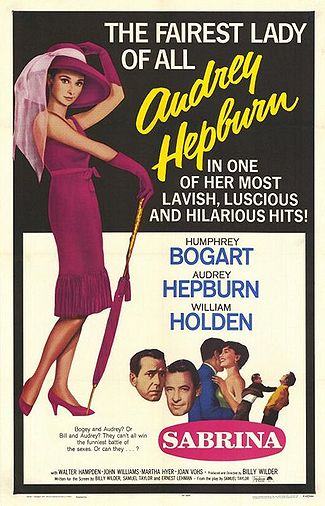
Sabrina (1954)

Starring Audrey Hepburn, Humphrey Bogart, and William Holden, with director Billy Wilder, the film begins with Sabrina (Hepburn) as a young girl. She lives with her father who is a chauffeur for a rich family. Sabrina loves the younger playboy son (Holden) however he gives her no serious attention. Depressed, Sabrina wants to kill herself and her father decides to send her off to culinary school in France. Some time passes and the grown up Sabrina is a perfect lady. Soon she catches the eye of Holden back home and all her dreams come true when they spend time together at a party. However, his older practical brother (Bogart) does not like it one bit since Holden has a fiancee. Wanting to get Sabrina away from his brother, Linus wines and dines her so the strategic wedding will stay on schedule. He then gives her a one way ticket and sends her off. Only afterward does he realize his own feelings for Sabrina and thus he decides to follow her. This film overall is a charming romance that is worth seeing.

4/5 Stars

The Spectacular Now (2013)

1ae0b-the_spectacular_now_filmFeaturing two rising stars in Miles Teller (Rabbit Hole) and Shailene Woodley (The Descendants), this film nicely melds a rough exterior with a heartfelt core to great effect.
Sutter (Teller) is a guy who parties hard, drinks incessantly, and has a long-term relationship with a beautiful girl named Cassidy (Brie Larson). He is the self-proclaimed life of the party and people like him, but no one takes him too seriously. At home, he lives with his mom, has no idea where his dad is, and hardly ever talks with his older sister. School, much less Geometry, is of little importance to him.
Matters take a turn for the worse when he and his girlfriend have a fight. He drives home plastered one night, only to wake up the next morning on a front lawn with a girl standing over him. And that is how he meets the quiet, studious, Aimee Finicky (Woodley). They strike up a friendship instantly as he helps her with a paper route, and she soon begins helping him with math. Although he convinces himself that he is doing it just because she is nice, he genuinely begins to like her. He invites her to a party and there their relationship deepens. It comes out that she is planning to stand up to her mom so she can go to university in Philadelphia. She wants Sutter to ask his mom about his estranged father. Together the two of them go to visit his dad, and Sutter is devastated to find out the truth about his father, which he never wanted to believe. On the drive home, half intoxicated by alcohol, half by his anguish, Sutter rejects Aimee’s love and tells her to leave, with dire consequences.

High school winds down and so does Sutter’s job. The night Aimee leaves for Philadelphia, however, he gets inebriated in a bar not wanting to hurt her anymore. He returns home in a stupor and confronts his mom, but he breaks down believing that he is exactly like his father. Despite all the annoyance that had been there before, she comforts him and proves Sutter otherwise.
Finally, Sutter is able to realize that his limitation is himself because even though he might veil his fears with jokes and alcohol, he has always been afraid. He takes another trip in his car, this time to Philadelphia to see Aimee again. The film ends on the steps of the university as their gazes meet and Aimee is just about to react. Who knows how it ends, but much like “Say Anything…” we can believe what we want. Needless to say, though he wasted so many of the previous “Nows,” Sutter seems destined to make the best of his tomorrow. 
This film is engrossing because although we have seen the story before no doubt, it is made fresh by the leads. A lot of people know someone like Sutter Keely. He is a person who is rough around the edges because of family, divorce, and alcohol. He often makes the stupidest of decisions. But there is still something about him that is likable and it creates empathy. Aimee on her part could be a real individual as well. She can be shy, but she is sweet and beautiful in her own unique way. However, because they are messy and have faults, it makes these two all the more believable. Neither of them can be labeled as a one-dimensional cliché because they have a genuine human quality. As Aimee would say they are not just defined by one thing, there’s more to them than that.

Some of the best moments in the film have to be when the two leads are talking with each other. It seems so real, even commonplace, the way they go through conversations. It is wonderful to watch. First, it begins awkwardly, builds into a friendship, and finally, evolves into a full-fledged relationship. These chats that they share not only cause them to grow closer, but it causes the audience to grow closer to them. I will admit I was in shock during the climax of the film, and I also dreaded the times Sutter drove home obviously drunk. That shows an actual attachment to the characters, something that is not always present in this type of film or any film for that matter. 
For a split instant I was disappointed that the film ended where it did, but then I quickly realized that’s how it had to be and it is better for it. Already I cannot wait for more from Miles Teller and Shailene Woodley especially. She is one of the most promising actresses of today along with Jennifer Lawrence. 
 
4.5/5 Stars

Saving Mr. Banks (2013)

13b45-saving_mr-_banks_theatrical_posterThe name Disney is universal, and if you ask people if they ever saw Mary Poppins as a kid they will probably give you a nod and break out in song. Mr. Banks is the film about the film, and it stars Emma Thompson as P.L. Travers, the difficult and complex author of the source novel. She is balanced out by Tom Hanks, who takes on the role of the larger than life Walt Disney. 

The year is 1961 and for 20 years now he has been prodding Mrs. Travers for the rights to her work. Each and every time she refused him, but now the royalties are only trickling in and so she reluctantly agrees to head to Los Angeles, very sure the endeavor will fail. She is a difficult lady and very hard to please whether it is the airplane, her talkative personal driver, the gifts in her hotel suite, and most of all her literary creation. She won’t have her Mary Poppins frolicking about and there will be no songs, no animation, and certainly no Dick Van Dyke. Disney is willing to make concession after concession in order to bring the story to life since it is very dear to not only him but his daughters as well. Mrs. Travers begins work with the Sherman Brothers and the screenwriter, but she is constantly displeased and calling for changes. It seems that nothing will satisfy her. Though some breakthroughs are made and Disney continues to be patient, Travers is distraught to learn there are to be animated Penguins. Just like that, she heads back to England.

However, that is only one-half of the storyline. The other occurs in flashbacks scattered throughout the film. Travers was a little girl in Australia with a playful father who was a banker. He encouraged her to never stop dreaming, but he also struggled with alcoholism. His problems cause all sorts of problems for his wife, for his bank, and most definitely his girls. Only later would Helen Goff, aka P.L. Travers, realize the impact of what had happened. She watched her mother nearly commit suicide, and she saw her father die because there was no thing and no one to save him. 

Back in the present, Walt Disney finally figures out a little more about Mrs. Travers, and he personally travels to England to talk it out with her. They have a heart to heart, and he assures her that Mary Poppins is not only hers but his and many others, who have enjoyed the magic and hope that came off the page. The fact that Mary came to save Mr. Banks gives comfort to her own tragic story, and with this realized the Mary Poppins film became a reality that numerous fans have enjoyed for nearly 50 years now. 

This film is made enjoyable by the back and forth of Emma Thompson and Tom Hanks. Thompson is especially good in her initially prickly but then softhearted portrayal of P.L Travers. Ralph the kindly driver and Colin Farrel as Travers Goff were also integral pieces of the film. The nostalgia and period look that is created of the 1960s is also pleasant to view. Initially, I did not care much for the flashbacks that fill the entire film, but I will concede that they are important to understanding the inner workings of P.L. Travers. All in all, this is a great sentimental picture that should leave us with a smile on our faces and a desire to sing some ditties like “Chim Chim Cheree.”

3.5/5 Stars

Miracle on 34th Street (1947)

Starring Edmund Gwen, Maureen O’Hara, John Payne, and Natalie Wood, the film tells the heartwarming story of an old man who acts as Santa Claus for the Macy department store in New York. However, Kris who is a very warm person (Gwen), truly does believe he is Santa and he is constantly being kind to others. Despite his popularity, a sour psychologist claims Kris is crazy and the case goes to court to decide once and for all if he is Santa. Although the case seems bleak, Kris is enlightened by the fact that his test case family (O’Hara and Wood) finally believe in him. Through a series of extraordinary events his lawyer friend (Payne) is able to win the case right before Christmas. Pretty soon Kris seems to prove that he really is who he said he was. This is one of the great cheering Christmas classics of cinema.

5/5 Stars

Merry Christmas everyone!


It’s a Wonderful Life (1946)

This is not only a Christmas classic but a classic in any sense of the word. It is the best of Stewart and Capra adding up to one of the most heartwarming stories of all time.  This may exhibit Stewart is his everyman role once again, but it breaks away from Mr. Smith in many ways making it another uniquely great film. A film like this that makes you know and feel for characters so profoundly is certainly worth watching.

Starring Jimmy Stewart and Donna Reed with a fantastic supporting cast,  the film tells the life story of George Bailey. We watch with the angel Clarence as he sees George’s life unfold. George saves his brother Harry as a boy and as a result, loses hearing in his ear. He works in the Bedford Falls drugstore and keeps the proprietor Mr. Gower from making a deadly mistake. Later on, he plans to travel the world and go to college so he can escape his hometown and do bigger and better things. But once more he sacrifices. One fateful day, he doesn’t know it yet, but he meets the love of his life Mary, and the same day his kindly father has a stroke. Soon after,  Harry goes off to college and George is left holding down the fort at their father’s old building and loan. He builds up all those around him with selfless kindness, while simultaneously standing up to the grumpy millionaire Mr. Potter. Eventually, he marries Mary and has children. First, during the Depression George gives up his honeymoon to keep the building and loan open. Then, during WWII while his brother and others become heroes, George stays in Bedford Falls because of his poor hearing. In this post-war period, the story picks up in the present.

Although, by unfortunate circumstances George Bailey finds himself contemplating suicide after the absent-minded Uncle Billy misplaces $8,000. That’s when Clarence comes into his life to show George just how important he really is. George sees a world where Harry is dead, Mr. Gower is a disgrace, Martini does not own the bar, his mother has no sons, Uncle Billy is insane, Violet is disgraced, Bert and Ernie do not know him, Mary is an old maid, and Mr. Potter has monopolized Bedford Falls.

Once he gets his life back George finds immediate joy and gains so much because of his friends and family. He runs through the streets of Bedford Falls yelling out “Merry Christmas,” because he is simply grateful to live again. Miraculously, the whole town rallies around him, and George reaps the reward for all he has sowed over the years. Clarence is finally awarded his wings and George Bailey is the richest man in town. There is nothing much to do after this film but simply be happy and sing “Auld Lang Syne.” It is a Wonderful film in many ways, with a wonderful cast, and a wonderful message. It has some of the greatest character development of any film ever because you do not simply become attached to one man but an entire community. That’s what makes the scene where Uncle Billy loses the money one of the most difficult for me to watch. Each and every time I’m so attached to these people. Even if I already know the resolution, I cannot bear for anything bad to happen to them. In fact, it is interesting to focus on just one of the supporting characters and see how they are affected by the life of George Bailey. It makes me ask myself if I were to die tomorrow would anyone care? We know in the case of George they certainly would.

I am further reminded of the phrase that is written on the wall of the building and loan, “You can only take with you, that which you give away.” This is what George Bailey did, and I believe it is something that each and every one of us should be mindful of. He is a great character not only because James Stewart played him genuinely and with such magnetism and heart, but because he was such a sacrificial figure. True, this is a sentimental film given the title and the director, but it is paramount to realize the progression this film follows. George must sink into the depths of his despair and disillusionment before he can truly realize that It’s a Wonderful Life. I would challenge you the next time you watch this film, to not simply acknowledge it as perennial Christmas fare, but look a bit deeper because there is so much more here. As always, Attaboy Clarence! You did it again.

5/5 Stars

The Caine Mutiny (1954)

With a stellar cast starring Humphrey Bogart, Van Johnson, Fred MacMurray, and Jose Ferrer among others, the film begins with a young ensign assigned to the mine sweeper named the Caine. After the first lax captain is reassigned, their new commander Queeg (Bogart) is a stickler for detail and order. After a series of incidents the crew becomes increasingly annoyed with him. The situation worsesn when Queeg begins to obsess about a few missing servings of strawberries. All these events boil over during a typhoon when the second-in-command (Johnson) prodded on, feels Queeg is unfit for command and he takes over control of the Caine. In the ensuing court martial, he is put on trial for mutiny and his attorney (Ferrer) must try to show Queeg to be truly unstable. Although he wins the case, everyone soon comes to realize Queeg was just a war-wearied man who gave a lot of himself. Despite some stark revelations the young ensign finally marries his girl and gets a pleasant surprise when he is reassigned to another boat.

4/5 Stars

The African Queen (1951)

1c3a0-the-african-queen-1With the ultimate pairing of Humphrey Bogart and Katharine Hepburn, this film throws together two starkly different people in extraordinary circumstances. Hepburn is a prim and proper missionary in Africa whose brother dies after a confrontation with German soldiers. Bogart is the rough-edged pilot of an old steamboat christened The African Queen. Together they take on the dangerous task of going down the river in order to sink a German ship. At first they are both at odds with each other and struggle to cope with their situation. However, with no one else to turn to, over time, they become close. Their bond is so great that they are willing to die rather than to be separated. This is truly a heartwarming story of love and loyalty with two legends who literally light up the screen.

5/5 Stars