Don’t Bother Knocking (1952)

Don't_bother_to_knockYou’re silk on one side and sandpaper on the other.” – Richard Widmark as Jed Powers

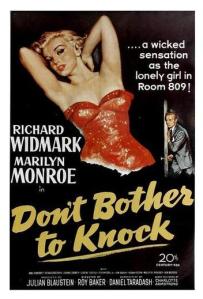
For a film so short, Don’t Bother Knocking is overflowing with wonderful talent from Richard Widmark to Anne Bancroft to a haunting performance from Marilyn Monroe. Then Elisha Cook Jr. shows up as the obliging doorman, Jim Bachus as a young girl’s father, and even the prolific Willis Bouchey takes a turn as the bartender. It’s one of those story’s that revels in the classical age of the Hollywood studio actor. The familiar faces carry with them a certain amount of depth that allows the characters to mean so much in only a few fractions of the time normally required.

Anne Bancroft’s nightclub singing (in her screen debut) sets the background mood for everything going on within the  McKinley Hotel — a seemingly upstanding establishment. It’s precisely this aloof demeanor established by the music that lends itself nicely to the strangely haunting aspects of the film.

All characters seem to lack passion, emotion, and most any type of energy except the bubbly camera gal who goes around trying to sell snapshots to patrons. Widmark is at his morose dirtbag best yet again as Jed Towers, a guy who can’t figure why his girl has dumped him.

It’s a chamber piece, and while not a man on a ledge story like Fourteen Hours, it still uses the corridors and diegetic street sounds to create a mildly intriguing environment for some minor noir thrills. You can see the lust in Widmark’s eyes when he looks out the window at Monroe prancing and swaying about seductively. Little does he know what her deal is. His frustration with life and love is right at the center of this film and he must rectify his situation one way or another.

For her part, she has some telltale signs of psychological distress aside from a constantly glazed expression. Namely, scars on her wrists. Strings of little white lies, compulsive fibs that trickle out and a flustered edge that slowly becomes more and more demented by the minute.Whether it’s Monroe’s best performance is up for interpretation but it’s certainly her most terrifyingly dramatic.

She becomes the lightning rod for all the drama, lashing out against the little girl put in her stead and distressing her uncle (Elisha Cook Jr.) who got her this gig, despite her utter lack of experience. Nell Forbes flutters so quickly between fear and hysteria, at first wary of Towers and fawning all over him the next moment — afraid that he will leave her.

It’s her histrionics that force a reaction out of Jed. He must choose what type of guy he wants to be, whether he chooses the tame or wild side of life. And as it turns out, there’s absolutely no contest in the end. He knows full well which girl is for him.

Unfortunately, the ending is a bit of a cop-out, because it is the relational and psychological dysfunction of the characters that becomes most rewarding and, in the end, most indicative of the noir malaise. A happy resolution, therefore, does not stay true to the heart and soul of this film. Stone cold and depraved. Still, this one’s a winner at 76 minutes.

3.5/5 Stars

The Strange Affair of Uncle Harry (1945)

the strange affair of uncle harry 1It’s a B-picture title to be sure but with Robert Siodmak and such an ensemble, this is an enticing noir all the same. The well-to-do Quincy family of small-town America are an odd bunch, still holding onto their surname with pride as they slowly drift further and further into obscurity within the walls of their old mansion.
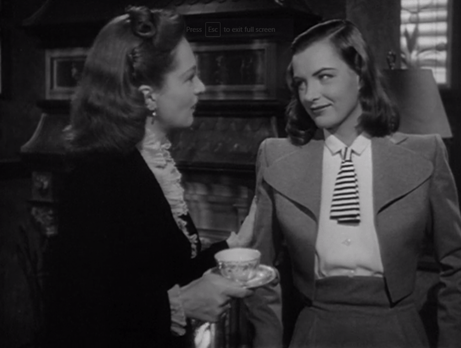
George Sanders is always a perennial favorite due to his dry wit and often snooty manner but here as Harry, we see him as all those things yet also trapped by his circumstances. Ella Raines, unfortunately, one of the often forgotten starlets of the 1940s, plays his savior in a sense and when she comes into his life there’s a chance to shake up all that is monotonous and stuffy about his existence.

Because he is constrained by his family name and a pair of sisters who rely on him continually for moral and emotional support. The eccentric Hester is always carrying an accusatory tone towards the housekeeper and getting bent out of shape about small trifles.

the strange affair of uncle harry 2The dominating sister Letty, played by Geraldine Fitzgerald, is more aloof in her ways, veiling everything with a conviction that what she does, she does for the good of her brother. But it’s all really due to the fact that she cannot bear to let him go. In this way, she’s constantly controlling his life and undermining his happiness. She’s hardly your typical femme fatale, more cultured and refined than most, but there’s still something exacting about her.

It’s when the tempered exterior and well-mannered formalities begin to crumble that her ulterior motives become more evident. Feigning illness just to keep him on a string and buying poison for some nefarious purpose. This unnerving dynamic between siblings becomes more tenuous for Harry,  accentuated by the fact that Letty, as played by Geraldine Fitzgerald, is quite attractive.

As far as the ending, there could have been five different outcomes and the one chosen fits the expectations of the contemporary audiences and the censorship board. Frankly, the affability of Ella Raines makes me want to enjoy this denouement, but my appreciation for film-noir makes me realize that this story deserved a dark turn to hammer home a genuinely twisted little picture. Still, Robert Siodmak is time after time one of the most interesting craftsmen of film-noir big and small. So it is with this morsel. Above all, I gained a newfound appreciation for the noteworthy work of Fitzgerald in particular.

3.5/5 Stars

Kansas City Confidential (1952)

KCConfidential.jpgSaying that Phil Karlson has a penchant for gritty crime dramas is a gross understatement. And yet here again is one of those real tough-guy numbers he was known for, where all you have to do is follow the trail of cigarette smoke and every punch is palpable–coming right off the screen and practically walloping you across the face.

Like all heist films, there must be a point of inception, however, Kansas City Confidential finds its story after the crime has been committed and the perpetrators have split up without a hitch. The man who takes the heat, their fall guy and the unsuspecting stooge is Joe Rolfe (John Payne who is adept at playing such roles) a nobody truck driver and a convict once upon a time.

It seems like the perfect crime as the three hired hands all wore masks and had no connection to each other, except for the stocky and demonstrative Mr. Big, the mastermind behind the whole operation and the one calling the shots. He sends each man off with enough money to tide themselves over until he contacts them to reconvene for their big payoff. Whether or not he will actually cough up the 300,000 clams he owes each of them is quite another story.

Still, each man heads his own way and Joe is getting grilled by the cops day after day in the hopes that he will crack. Finally, he is released, but with no prospects and no job, he sits in a bar stewing in his anger. The story takes it’s next big turn when he follows a lead down to Mexico to tail one of the hoods in on the job Peter Harris (Jack Elam). And although Joe is going in blind, he soon catches wind of the impending rendezvous in Barados and decides he’ll just show up as well, to get to the bottom of the entire mess.

It’s there where he first crosses paths with two other leering hoods, the beady-eyed Tony Romano (Lee Van Cleef) and the silently brooding Boyd Kane (Neville Brand). However, while keeping tabs on these cronies, he keeps company with a budding lawyer Helen Foster (Coleen Gray), who has come to call upon her protective father, the former policeman Tim Foster. If this set up isn’t plain enough already, it certainly becomes increasingly interesting as the gears continue to turn towards the story’s inevitable climax.

Most certainly Kansas City Confidential boasts jarring close-ups, low budget facades and perpetually sweaty faces that accentuate its unsentimental noirish qualities. However, Coleen Gray acts as a more enlightened noir heroine, who does not grovel for her man or weep incessantly at the thought of danger. Instead, she’s training to be a lawyer, and rational but still unequivocally kind. Despite not having a proper meet cute, the chemistry between Gray and Payne still works surprisingly well.

What makes the film inherently more interesting is how the crime is embroiled with family issues. Because, as an audience, we know Mr. Big’s identity: a corrupted cop who got a bum steer and now is going to reap the benefits of setting up some real losers. Still, that doesn’t excuse what he did and Joe got dealt a similarly sorry hand. The fact that Foster’s daughter is involved sheds him in a more humane light and in the same instance makes Joe a more likable figure. In many ways, she brings out the best qualities of both these characters. It’s the darker recesses that lurk behind their characters. Those are made more evident by the likes of Lee Van Cleef, Jack Elam and Neville Brand, a real rogues gallery of baddies if there ever was one.

4/5 Stars

Niagara (1953)

800px-Marilyn_Monroe_NiagaraRainbows, the soft misting of waterfalls, and honeymooning couples going through the tunnel of love. It hardly feels threatening at all, but that’s what makes film-noir so delicious. As the film style most reflective of the human condition, it proves that the dark proclivities and jealousies of the human heart can crop of anywhere–even a gorgeous tourist trap like Niagara Falls.
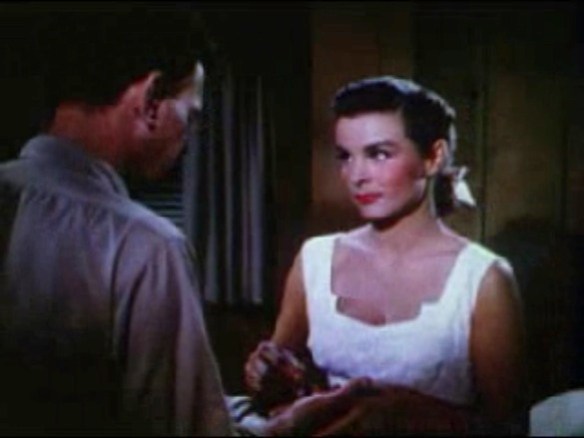
Niagara’s frames are composed of grandiose and lush imagery, and the film is greatly aided by on location shooting which develops an even more engaging world for this technicolor noir to take place.

Joseph Cotten takes on a menacing role as the tortured husband, his most notable ominous turn since Shadow of a Doubt, however, a tad more sympathetic. Meanwhile, Marilyn Monroe takes a turn as a seductive siren, the other half of this troubled couple spending a weekend at a Niagara Falls Cabin B.

She’s given plenty of screen time to strut her stuff and though early in her career, she would soon enough be catapulted to stardom forevermore with the likes of Gentlemen Prefer Blondes and How to Marry a Millionaire. As they often say, the rest was history and more so than that, she indeed made history.

If you look at her performance as Rose, while not her most enduring, it still catches the eye, due to the way she carries herself–even how she walks down a cobblestone road. You cannot help but be at least moderately mesmerized by her whole image.There was no one before or after, quite like her. She was a singular figure with no true equal.

Jean_Peters_mends_Joseph_Cotten's_hand_in_Niagara_trailer_1Without a question, Jean Peters becomes our favorite character as Polly, and it was an eye-opening for me personally to see her in a role so vastly different than Pickup on South Street. I had pigeon-holed her, rather erroneously as such a character, but Niagara shows a more tempered side to her persona that felt more representative of her as an actress. Max Showalter plays her husband, the genial and oblivious Ray Cutler, who takes his lovely wife on a long overdue honeymoon, only to have it totally ravaged thanks to the Loomises.

Henry Hathaway as per usual is a capable filmmaker, who utilizes his stars and location quite well. Charles Brackett builds this conflict between a vacationing husband and wife with his script, but it really is the visuals that elevate it to the heights of a surprisingly compelling noir. The scenes within the catacombs of the falls and at the very edge of the drop off are of particular note–both beautiful and raging in the same instance. The climactic moments between a lurking husband and his fleeing wife in the clock tower are also remarkably stylish, reflecting how a color film can still style drip with noir sentiment.

It’s a film checkered in shadows and bathed in darkness as much as it is rainbows. In some ways, that makes it all the more harrowing. Colors don’t necessarily make everything bright and cheery, they distract from what is really going on, and in this case, the falls prove to be more than an opportune locale for a honeymoon…and murder. 

3.5/5 Stars

The Set-Up (1949)

SetupPosterWhat it manages to bring together within the frame of a meager B-film plot is quite astounding, balancing the brutality and atmospheric visuals with the direction of Robert Wise to develop something quite memorable. Boxing movies have been bigger and better, but film-noir has a way of dredging up the grittiest pulp and the Set-Up is that kind of film.
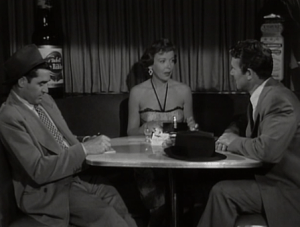
Its fight sequences are violently staged with human forms evoking the early realist images of George Bellows. However, it’s as much of a backroom drama as it is a fighting film. We see the payoff taking place behind Stoker Thompson’s (Robert Ryan) back as his manager (George Tobias) cuts a deal with the opposition without telling his main man what’s going on. He figures Stoker is all washed up at 35. There’s no way in heck he can beat the young buck he’s up against.

The dressing room is full of has-beens, young guns, and hopefuls who in just a few minutes paint a picture of what the boxing world really is. It’s a cruel game that is sweet in victory and sometimes even deadly in defeat. Still men of all backgrounds and values are drawn to it for one reason or another.

In fact, they are not the only ones. One of Robert Wise’s most formidable allies in this film are his close-ups that ratchet up his drama by utilizing the emotive reactions of his crowd. He builds a cadence introducing each nameless face early on and riding their reactions all the way through the fight. There is the woman who feigns repugnance only to reveal her ugly penchant for brutality. There’s the tub of lard who fills up on every concession imaginable while greedily watching the violence unfold. Then, the nervous husband who is constantly hitting and jabbing a phantom opponent. The list goes on.

We also witness the initial reluctance of Stoker’s girl (Audrey Totter) to go see him get beaten to a pulp. This is more than just fighting–it affects their future life together. And while he gets ready to fight, she listlessly wanders the streets too frightened to watch him get his block knocked off and still not yet empowered enough to change things. All she can manage is a jaunt through an arcade parlor, a few furtive glances overlooking the passing trains, and finally a lonely visit to a midnight diner. But this is hardly casting blame mind you.

The bottom line is that Stoker doesn’t see his girl ringside, and it feels like everyone down the line has abandoned him. There’s a need for vindication–to prove his worth when no one will give him a second thought. And that’s a dangerous place to be when people are betting on you to take a fall compliantly, namely one big whig named “Little Boy.” But Thompson’s not about to do that, fighting until he has nothing left to give. And he wins someway, somehow.

It’s when he gets ready to leave the building after the crowds have filed out and the trainers have left for home, that he meets an ominous welcoming committee. It’s not an unsurprising conclusion, but still, Thompson’s story finds a silver lining amidst all the violence. This film is a miracle of the studio age and Wise makes it an incessantly interesting piece of noir.

3.5/5 Stars

Private Hell 36 (1954)

privatehell1There’s not a whole lot to it. Aside from a wonderfully pulpy title, Private Hell 36 feels like a pretty straightforward endeavor from director Don Siegel. The low budget procedural nevertheless boasts a surprisingly good cast. The tale is framed by a nice bit of narration from the sitting police chief played by the always enjoyable Dean Jagger, in a particularly compassionate role.

Our story opens on a perfectly normal night where one copper seems to quell a drugstore burgle while he’s off duty, and another cop gets it in the crossfire between rival gangs. It causes the police to go on high alert.

When some street vermin rolls into the station to get booked, he’s found with some nifty paper. Detective Cal Bruner (Steve Cochran) and Jack Farham (Howard Duff) are assigned to follow the trail of a counterfeit $50 bill that’s pinned on a killer. So it’s more than hot money now. There just might be a murder rap at the end of it. Their canvassing leads them right to the lap of self-assured night club singer Lilli Marlowe (Ida Lupino).

Farham is a relatively honest chap with a doting wife (Dorothy Malone) and a kid already. Bruner has a propensity for recklessness, and he also takes a liking to Ms. Marlowe, especially after they spend so much time together.

privatehell2The temperature begins to rise when the two colleagues get caught up in a car chase with their counterfeiting adversary. All the days casing the local race track with Ms. Marlowe finally leads to some action. In the aftermath, one car goes careening off the road, and the boys have a decision to make. They frantically begin snatching up dollar bills and they decide to go dirty and make a run with the money.

Such a plot takes the usual turns that we would expect as girlfriends, greed, familial responsibility, and guilty consciences cloud the path to the straight and narrow. The film, which was jointly written by Ida Lupino and her former husband Collier Young, is no great work of art. But there is enough character conflict and crisis to make Private Hell 36 a gratifying piece of lower tier noir.

3/5 Stars

“You know I’ve seen this all on Dragnet” ~ Lilli Marlowe

 “Save the jokes for the customers” ~ Detective Bruner


The Strange Love of Martha Ivers (1946)

strangelove1“I don’t like anybody pushing me around. I don’t like anybody pushing you around. I don’t like anybody getting pushed around.”  Van Heflin as Sam Masterson

Lewis Milestone never quite eclipsed the heights of All Quiet on the Western Front. Still, The Strange Love of Martha Ivers is brimming with some engaging performances. Although it is, at times, more of a  melodrama than noir, there is still merit in Robert Rossen’s script. When it does not falter with didacticism, the film has a certain twisted, deep-seated emotion that runs through it. Barbara Stanwyck is the one at the center of it all, as the title suggests.

The film begins in 1928 with three children. The assumption is that these three individuals will become of greater importance later on. After that fateful evening, one would be left without any family, one would leave for good, and one would be left in the perfect position to rise up the ranks. These opening moments boasts spiraling staircases, thunder, the pounding orchestration of Miklos Rozsa, and a complete gothic set-up.

strangelove317 or 18  years later a full-grown Sam Masterson (Van Heflin) decides to return to his old stomping grounds, Iverstown, on a whim. He’s surprised to learn that the “little scared boy on Sycamore street” is now District Attorney (Kirk Douglas). And he’s now married to Martha Ivers (Stanwyck). She and Sam had something going long ago, but he’s all but forgotten it by now. He’s made a living as a gambler who has a pretty handy dandy coin trick, but really Heflin’s character could be anything.
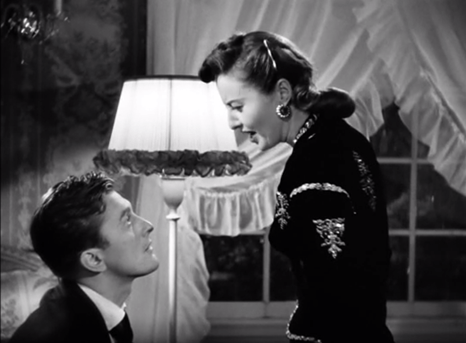
He meets a sultry, smoky-voiced Lizabeth Scott with the pouting face. For those unfamiliar, I would liken her to a Lauren Bacall-type, although she was less well-known and ultimately got typecast in noir roles. Here Scott’s “Toni” Marachek is an often despondent woman who just got out on probation.

strangelove2We don’t actually see Barbara Stanwyck’s face until 30 minutes into the film, but it doesn’t matter. She as well as Kirk Douglas (in his screen debut), leave an impression right off the bat. They are a married couple alright, but she seems to hold the keys to the kingdom, so to speak. All her power is propping him up as he makes his political rise. Perhaps there’s more going on here, however.

From its outset, Martha Ivers looks to be a tale with two threads that slowly begin to intertwine, bringing together some old pals and acquainting some new ones. When Sam wanders into the lives of Martha and Walter O’Neil, it’s putting it lightly that they’re taken aback. The district attorney is good at putting on a face for an old boyhood chum. His wife, on the other hand, is not about to hide her excitement in seeing her old flame.

However, they both think he has an agenda, misreading the twinkle in his eye as intent to blackmail, for a payoff after what he saw all those years ago. But that’s just it. Only we know that he didn’t see anything. Martha Ivers slips up, caught between love, hate, and a suffocating life. She has so much power and yet so little. So much affection and yet so much bitterness.

strangelove5Honestly, although Stanwyck is our leading lady, it’s quite difficult to decide whose film this really is. Van Heflin and Barbara Stanwyck are at its core, but then again, Scott and Douglas do a fine job trying to upstage them. There’s a polarity in the main players, meaning Stanwyck and Heflin have the power, and the other two are the subservient man and woman respectively. However, the film really becomes a constant tug-of-war. Douglas is not just a spineless alcoholic. There’s an edge to him. Scott seems like a softy and yet there’s an incongruity between her persona and that prison rap that hangs over her. Heflin seems like the one relatively straight arrow because as we find out, Stanwyck is fairly disturbed. She’s no Phyllis Dietrichson and that becomes evident in yet another climatic conflict involving a gun. But she’s still demented, just in a different way.
3.5/5 Stars

Detour (1945)

detour1Hollywood is really missing out, because with the direction that the industry has gone there really is no space for a film like Detour to be made by conventional methods anymore. It was shot in less than two weeks. It cost a minuscule amount compared to the contemporary A-Pictures, and yet it used its low production values as an advantage, not a curse.  Director Edgar G. Ulmer was the king of so-called B-films of Poverty Row and Detour was his shining gem. It feels a lot like the later film-noir D.O.A. because both have a main conceit that might be hard to swallow at first, but if you do that initially, you quickly find the film thoroughly rewarding on its own merit.

The sets are simple. A diner, a car, a hotel room, and that’s honestly about it. The actors are pretty obscure by today’s standards. Tom Neal was made for this role of the fateful victim Al Roberts, with his constantly pouting face and a pair of despondent eyes. As he sits glowering in a roadside diner it’s hard to imagine he’s ever smiled in his life. He’s a real sourpuss.

There was a time, back in the day, when he made a modest living as a piano player in a New York club. He had a girl named Sue, and he was relatively content playing the bouncy tune “I Can’t Believe You Fell in Love With Me” while making a few bucks. Now the song haunts him wherever he goes. Sue left to try her luck in Hollywood and soon after Al began his long hitchhike to California to rendezvous with her. On one unassuming evening, all his luck changed. Just like that.

An obliging fellow offered him a ride and they get on well enough. He’s a bookie, but not a bad fellow, so Charles Haskell and Al get on fine. Then they switch up driving duties and a little light rain starts coming down into the convertible. Al goes to put up the top because he assumes Haskell’s only asleep. But when he opens the side door, Haskell falls to the ground. DEAD! Al does what any normal human being would do and he freaks out. Should he dump the body? What should he do with the car? Did anyone see him? Will the people back at the rest stop be able to I.D. him? What will the cops say if they hear his story?

And so he ends up getting rid of Haskell (in a sense playing the role of guilt) and takes on the man’s identity. But wouldn’t you know it, the first person he picks up is the fiery Vera (Ann Savage), who looks apt to claw your eyes out. Of course, she too got a ride from the real Haskell and isn’t buying Al’s story. She’s got him on the rack and she’s not about to let him get off easy. She wants a cut, she wants to sell the car, and Vera’s the only one who is going to call the shots. Al is a stuck, trapped, and paranoid, as Vera waves blackmail in front of his face and won’t let him breathe. She’s got him around her finger and there’s absolutely nothing he can do. After all, who would believe his story?

But whether it’s fate or whatever you want to call it, he gets out of it much in the same way he got into it. The resolution makes me grin because it’s so wonderfully contrived. There’s a tacked on ending to mollify the Production Codes (because Al couldn’t get away with his crime), but although it is an easy fix, it hardly takes away the potency of Detour. I long for the days they made films like this. Ann Savage somehow is nastier and crueler in a few minutes than most any character is in an entire film. It’s a brilliant role and honestly, she’s not my favorite femme fatale, but she has to be one of the most notorious. She seriously sends shivers up the spine.

“Isn’t that a laugh? Haskell got me into this mess, and Haskell was getting me out of it. The police were searching for a dead man. I keep trying to forget what happened, and wonder what my life might’ve been if that car of Haskell’s hadn’t stopped. But one thing I don’t have to wonder about; I know. Someday a car will stop to pick me up that I never thumbed. Yes, fate or some mysterious force can put the finger on you or me for no good reason at all.” – Al Roberts

4/5 Stars

I Wake up Screaming (1941)

iwakeup1So the title doesn’t have a bearing on much of anything, but who cares? It sets the tone brilliantly for this wickedly twisted noir. The film opens like other films, after the death of a beautiful young woman. Two people are getting grilled in adjoining rooms. Frankie Christopher (Victor Mature) is a promoter and the former love interest of the girl, so he also happens to be high on the suspect list. He lays out how he first met the pretty young waitress Vicky Lynn (Carole Landis). With the help of two conniving friends, he made her into the next big thing. The has-been actor Robin Ray (Alan Mowbray) helps her reach the higher echelon of society. Mustachioed gossip columnist Larry Evans (Allyn Joslyn) plasters her name and picture all over his paper until the world is bound to notice. They make quite the trifecta, all too happy to give this unassuming girl a break.

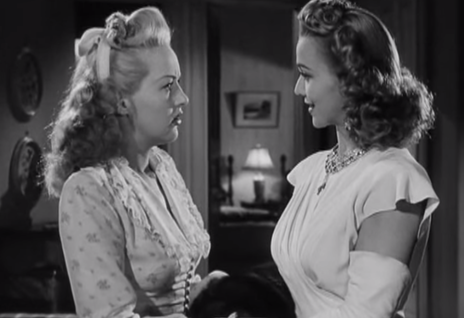
In the next room, Vicky’s sister Jill (Betty Grable) tells her side of the story: She saw how Vicky was beginning to change. She stopped working as a waitress, became entitled, and began to look down at all those around her. Now a real prima donna, she ditches her benefactors ready to head off to Hollywood for a screen test, and Christophers is understandably ticked. It doesn’t help that both Ray and Evans fell in love with Vicky. There’s also something going on between Jill and Frankie, because in the wake of the murder they turn to each other.

iwakeup2For a time the murder gets pinned on the switchboard operator — the always wide-eyed and nervous Elisha Cook Jr. But the menacing police officer Cornell (Laird Cregar), has an almost obsessive drive to find Frankie guilty of the murder. There’s something else going on here. Like so many films of this period, this story is full of men desiring women. Some of it is understandable, some of it is casual, and some of it is downright twisted.

Although she is out of the film early on, Carole Landis has the key role as the rising starlet and she is the closest thing to a femme fatale in this film. But there are a lot of characters of interest aside from our main couple of Betty Grable and Victor Mature. His two opportunistic friends are no-goods but thoroughly entertaining, and Laird Cregar is downright spooky. The film takes on another level of significance due to the tragic suicide of Carole Landis which occurred in 1948. There is most definitely an allure to her just like the women in prominent film-noir like The Woman in the Window or Laura (1944). Throughout some haunting refrains of “Somewhere Over the Rainbow” can be heard, helping to make I Wake up Screaming disconcerting from beginning to end.

3.5/5 Stars

No Way Out (1950)

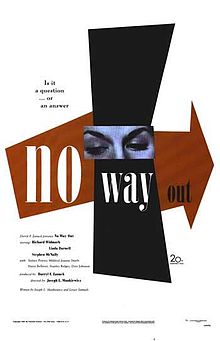
220px-No_Way_Out_(1950_film)_posterI had a preconceived notion that No Way Out might be the kind of social drama that was groundbreaking for its day and by today’s standards looks mundane and quaint. 65 years have passed and this film from Joseph L. Mankiewicz still packs a wallop, believe it or not. We are blessed with the first major role for screen icon Sidney Poitier as young doctor Luther Brooks. His main antagonist is Richard Widmark playing a racist scumbag like he does best, and Linda Darnell also gives a key performance, although her career would soon be on the decline.

The film opens with the young interning doctor — Poitier was only 22 at the time –getting ready for a night shift. His first customers just happen to be Johnny and Ray Biddle, who both got it in the leg after a botched robbery attempt. At first glance, their wounds look superficial, but Luther notices Johnny is disoriented. His diagnosis is a brain tumor so he tries to administer a spinal tap which ends up unsuccessful, partially due to Ray’s constant berating. But Ray has no sympathy; all he knows is that this black doctor has killed his brother. A white doctor could have saved him and all his prejudiced beliefs of blacks are confirmed. At least that’s what he tells himself in his narrow little mind.  Luther even goes to his superior Dr. Wharton (Stephen McNally), and although he cannot be absolutely certain, he maintains confidence in Luther’s competence.

nowayout1Again that bears little importance to Ray and he will not grant them the opportunity to do an autopsy. After all, his mind is already made up. So the next best thing is to track down Johnny’s former wife Edie (Darnell), who has pulled herself out of the gutter which is Beaver Canal and made a modest living for herself. They want her help, and unbeknownst to them, she does go see Ray. You can see it in how they interact with each other. She was Johnny’s wife once, but there was something between them and Ray won’t let her forget it. That’s undoubtedly why she wanted to get away, but Ray brings out the worst in her. Even as they speak, her racist sentiments come bubbling to the surface. It’s in her veins after all. It doesn’t help that unrest is building in the city. A riot is at hand and the slow build-up leading to the imminent rumble is boiling with tension. Mankiewicz does something important here. He shows both perspectives. I cannot help but think some things have not changed a whole lot over the years. Black vs. white. The same racism. The same belligerence. The same lack of understanding.

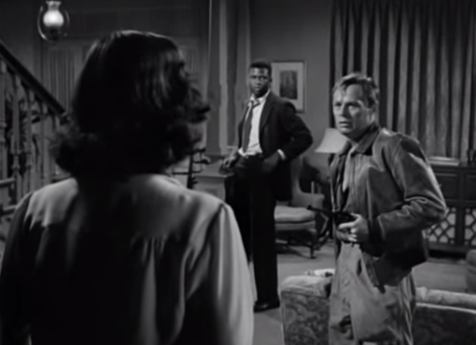
nowayout2Of course, after that is all done, that still does not wrap things up with Ray. He still has to settle a score with Luther and he uses Edie against her will. They set a trap at the home of Dr. Wharton for the unsuspecting Luther, and this scene has vital importance to the film, not simply because Biddle and Brooks come face to face once more. This is the scene where Edie must make a choice. Really it’s the universal choice. Stand passively by as injustice is being done or take a stand against it.

So you can make your own diagnosis, but this was not a superficial message movie. It hits fairly hard. I was even surprised by how often Ray Biddle lets the N-word fly. It completely fit Widmark’s characterization, but the production codes allowed it. Supposedly the actor apologized profusely after many of his scenes with Poitier, but his performance is nevertheless potent. It’s certainly convicting and we cannot be too quick to find fault with any of these characters because, truth be told, we all have some apathy and narrow-mindedness stuck inside our skulls. No Way Out is a striking reminder of that.

4/5 Stars