The Dark Corner (1946)

Dark_Corner_1946“I’m backed up into a dark corner and I don’t know who’s hitting me.”

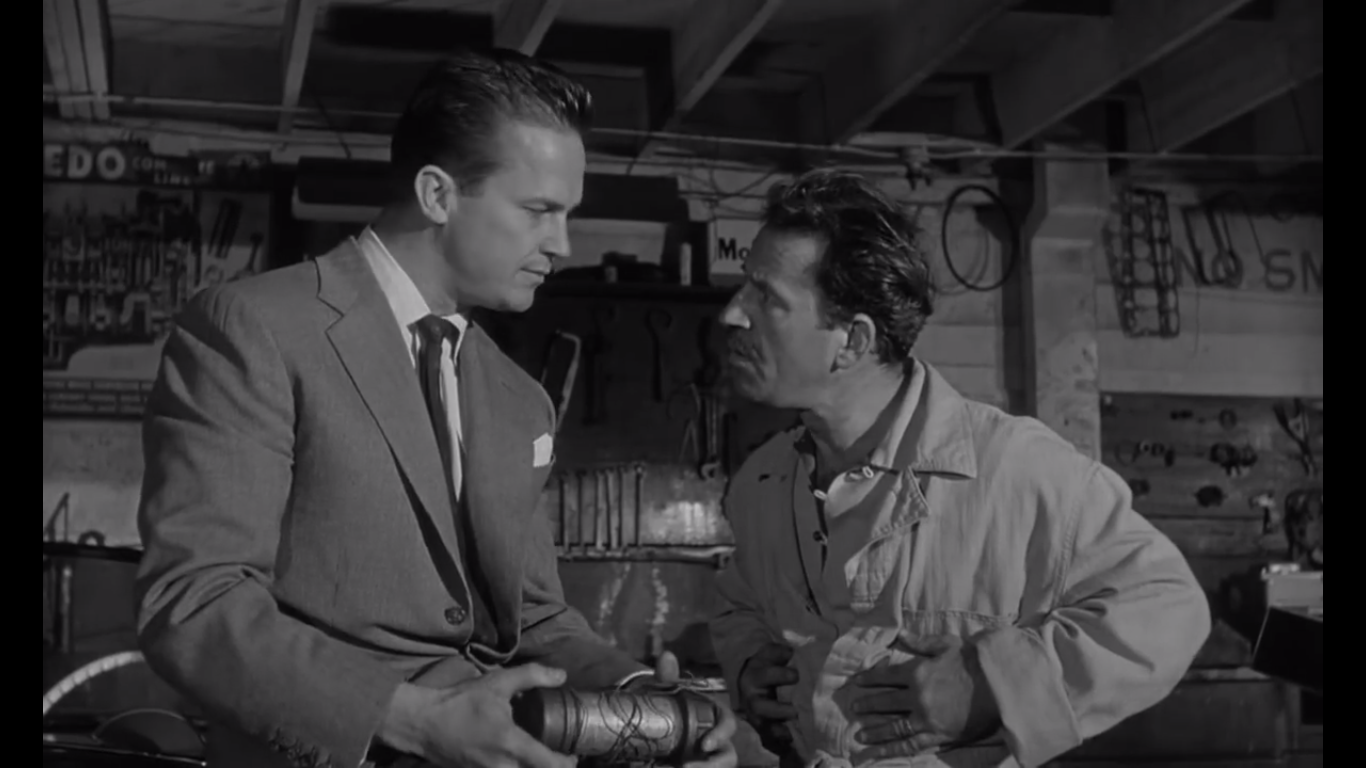
It’s always satisfying to find another little gem of a film-noir, and I think this thriller from Henry Hathaway fits that bill. Our stars include a serious and quite beautiful Lucille Ball along with Mark Stevens as gumshoe Bradford Galt. He’s more of a Cornel Wilde type. A rather nondescript lead compared to Bogey or even Dick Powell, but he works well enough as the focal point of this story.

He served a stretch in prison after he was framed for a murder wrap and now he’s a P.I. trying to keep himself on the right side of the law. But nevertheless, it’s a dirty business that’s bound to catch up with him. He’s being shadowed by a man in a white suit and almost gets mowed down by a car that had his name on it. His secretary Ms. Kathleen Stewart genuinely worries for his safety and tries to help him, so he reluctantly lets her into his life.

Everything seems to point back to one man. Anthony Jardine was the attorney who set Galt up and sent him off to the clink. It only makes sense that he would want to silence the P.I. for good. After all, if not him who else could it be? Except things get especially dicey when Galt gets framed once more and this time he knows for sure his old nemesis cannot be involved.darkcorner1The race is on for the real murderer because Galt must also attempt to clear his name before he gets charged with another killing leading to a date with the electric chair. This is when a juicy piece of dramatic irony comes in since as the audience we know who has it out for the P.I. We just don’t know why… Some sleuthing leads Galt to another crime scene and finally to an art gallery where he follows a hunch. His suspicions were on point, and he finally fights his way out of the corner.

It should go without saying that The Dark Corner is beautifully shot with a lot of wonderful low lit sequences that are deliciously moody. Interestingly enough, the storyline is infused with a lot of Culture whether it is jazz music or pieces of fine art. It’s a weird juxtaposition of this noir world bleeding into these higher echelons of society. The people and places criss-cross and intertwine in a web of the urban and the urbane. It proves that treachery can rise up from any level of society.

3.5/5 Stars
Champion (1949)

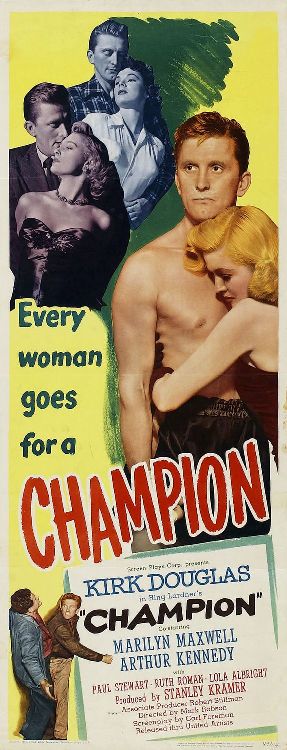
Champion1949filmA premier boxing film and Kirk Douglas‘s big break, Champion is in the company of other Noir such as The Killers, Body and Soul, and The Set-Up. This story is about one man’s rise to the top of the business and in his business, the blood and corruption actually show.

Douglas is Midge Kelly, a fiery nobody who is trying to make ends meet with his crippled brother Connie (Arthur Kennedy). When work at a hot dog joint falls through, Midge willingly takes some quick money sparring in the boxing ring. He’s got guts, but no skill, so he thinks that’s the end of his chances. Back to working at a Diner it is, and Midge has his eyes on the proprietor’s daughter (Ruth Roman), but then he’s forced into a shotgun wedding that he’s not too fond about.

Fed up with this kind of life, he searches out a manager so he can begin the long hard odyssey to make a name for himself as a boxer. His faithful brother Connie sticks by his side as does his manager Tom Kelly. City after city, Midge keeps knocking them out rising up the ranks until he is called on to throw a match. It’s all set, but in a brief instant, the reluctant slugger splits with the program. It’s a turning point that gets him in trouble with the big boys and yet makes him a media darling with the press. The opportunistic platinum blonde Grace Diamond (Marilyn Maxwell) realizes the tides are shifting and begins pursuing Midge.

It’s at this crossroads that Midge’s relationships begin to splinter since Diamond convinces him to take on the bigger fight manager Mr. Harris who can help catapult him to the top. The one thing Midge always had going for him was his loyalty to brother and manager, but in the pursuit of “happiness,” he lost both.

Connie returns to the home of his mother and pleads with Emma to come back with him. Their romance quietly builds as Midge’s star continues to rise. His infidelity also ascends with it. His next object after Diamond is the beautiful and more cultured Palmer Harris (Lola Albright), who also happens to be the young wife of Jerome Harris. However, he soon ditches the genuinely lovestruck girl when Harris gives him a wad a money to lay off of her. That’s the kind of man he’s become, but at least he’s Champion.

In one final effort, he tries to patch things up with Connie and Emma following the death of his mother. A rematch with Johnny Dunne is coming up and Midge hints at retirement, while also bringing Tommy back for one last hurrah. In rather predictable fashion, the fight plays out as we expect and yet as with any good noir their needs to be a little wrinkle and there is.

This film is by no means Citizen Kane, but in a sense, it is Kirk Douglas’s version of it.  Because he got the opportunity to play a character following the mold of the American Dream. He rose from the depths of poverty to become the champion of the world! And yet along the way, he became a cold-blooded, money-grubbing, scumbag who lost connection with all the people who actually cared about him. It’s the inverted American Dream — a cautionary tale on the most archetypal level. He plays Midge with the same tenacity of some of his earlier roles where he balances cold-hearted corruption with a nevertheless infectious charm.

Something else it has is a Cain and Abel type complex  — much like Force of Evil. There are the two brothers at odds, except instead of murder, there’s more of a self-destruct going on. In this respect, Connie is far from the most important character, but he is an interesting character thanks to the earnestness of Arthur Kennedy.

Also, I find it particularly interesting in terms of the women in Midge’s life. Thanks to posters I assumed Marilyn Maxwell was the main love interest, but in the film, he’s actually married to Ruth Roman’s character almost the entire film, and it seems to be Lola Albright’s character who is the only one who actually loves him. It makes for an interesting dynamic because these women are drifting in and out of his life. And he doesn’t end up with any of them. That’s the life of a Champion sometimes.

4/5 Stars

Angel Face (1953)

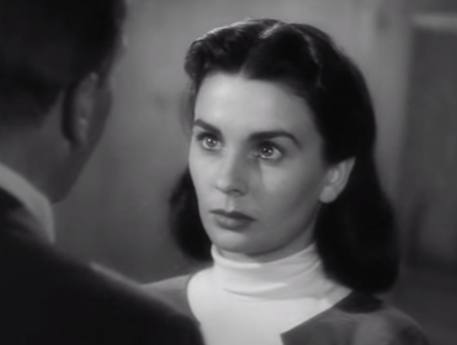
angelface1Rumor has it that Howard Hughes was angry at Jean Simmons who had cut her hair short prior to filming, as her contract was due to expire soon. But not to be outdone he told Otto Preminger that the director would get a bonus if he could shoot the picture before Simmons was released. That he did, and in the 20-day interim he gave us yet another stylish film-noir classic to follow in the footsteps of Laura and Where the Sidewalk Ends.

Robert Mitchum plays ambulance driver Frank Jessup who falls victim to the webs of young beauty Diane Treymayne who adores her superficial father, but nurses a lifelong grudge against her step-mother. She has it in for her arch nemesis and meanwhile strings Frank along, coaxing him to become her family’s chauffeur. He loses sight of her other side, and their budding romance means trouble for Frank’s longtime relationship with the sensible Mary. She sees a better fit in one of Frank’s ambulance coworkers, but he still wants her back.

Instead, Diane and Frank get caught up in a trial for their lives, after they are accused of a murder that Diane did indeed commit. But due to some wheeling and dealing, their shrewd attorney gets them off. It’s at this point that Angel Face takes an unsuspecting twist that ends up being intriguing. Could it be that the seductive Tremayne girl is actually remorseful for her actions? Is she a more nuanced femme fatale then would first be assumed? Frank was an unsuspecting lout, but then again maybe Diane is a sort of victim too.

angelface2

Her tryst with Frank is doomed and he is stuck because Mary no longer wants him, so of course, he can only end up going one place. The slow buildup to the finale makes these last moments all the more shocking. Angel Face seems to be less of a deadly poisoning than a slowly ticking time bomb just waiting to blow.

Jean Simmons is most often associated with civilized and demure beauties. A couple counterpoints or variations would be The Grass is Greener and this film. Playing against type proves to be as fruitful for her as it did for the likes of Barbara Stanwyck, Gene Tierney, Cary Grant, and Henry Fonda, just to name a few. However, in a way, Angel Face had a far more complex femme fatale than I was expecting and that’s to its credit. Still, I would never want to be trapped in her nightmarish world like Frank.

4/5 Stars

99 River Street (1953)

99river4This is a Sam Fuller type crime film that’s not pretty, it’s full of gritty realism, and it ends up being an unassuming little gem that is a great joy. However, instead, this film comes from director Phil Karlson pairing him with John Payne. In film-noir, boxers always seem to take a center stage and it is never (or hardly ever) the champs. It’s the near misses or the bums. Ernie Driscoll (Payne) falls into this category as well.

After his big fight and an unfortunate conclusion to the bout, Driscoll is all washed up and he and his wife know it. He relives the moment in agony and dejectedly takes a job as a taxi driver, while he tries to figure out a future without boxing. You can tell his wife is fed up with this way of life, and she’s getting awfully snappy. Driscoll is unhappy, with his marriage going down the tubes, so his only encouragement comes down at the coffee counter with his buddy Stan and the bubbly actress Linda.

Things get worse when Ernie sees his wife with another man who also happens to be a real thug. Ernie is humiliated and looking for revenge, but on Linda’s bidding, he follows her to the theater because she is in desperate trouble. He obliges and yet again he feels like he’s been made a fool of. He cannot even seem to trust her.

Ernie wants desperately to get back into the ring, against the better judgment of his former manager. But he still is caught up in the whole mess with the cunning tough guy Victor Rawlins who stole Driscoll’s wife. The man shows how little the girl meant to him in comparison to the money and after getting a payoff for a fat load of diamonds, he waits for a freighter to take him away.

Linda wants to help Ernie after what happened on the stage, but she cannot stop Rawlins. It’s up to Ernie to duke it out on the docks, and it turns into a real brawl where he struggles not to get his bell completely rung after a gunshot to the chest. It’s the biggest fight of his career and somehow he wins. Really 99 River Street sounds like a run-of-the-mill noir, but Payne’s performance is rather good. It feels rather like Edward G. Robinson in Scarlet Street where no one seems to be on his side. However, he does ultimately have two solid allies in the faithful dispatcher Stan and the always vibrant Linda. Ernie finally follows Stan’s earlier advice and whispers sweet nothings into the ear of his love. It’s a happy ending for a noir.

The cast is rounded out nicely by a wonderful group of character actors including Brad Dexter, Jack Lambert, and Jay Adler who all work as the scum of the earth-dwelling in New York. The contrast of the bubbly Evelyn Keyes with the more aloof Peggie Castle was also very effective in the film. Now I need to see Kansas City Confidential as well.

4/5 Stars

Kiss of Death (1947)

kissof1Film-Noir gets interesting when the stylized, more formalistic world of this dark genre begins to seep into the familiar human drama that we as an audience are more used to. Many of us have families. We have jobs so we can provide for our families.  Or maybe some of us don’t and that makes for some tough decisions.

In Henry Hathaway’s Kiss of Death, Nick Bianco (Victor Mature) has been out of work for a long time now, so on Christmas Eve, in order to get presents for his two little girls, he robs a jewelry store with a few other accomplices. What sets him apart is he’s not your stereotypical ruthless criminal. He’s a family man, but he’s also bought into the idea that you don’t squeal. So inevitably after he gets caught and booked, Nick will not talk and he gets sent to the clink. The assistant D.A. (Brian Dunleavy) tried to help him, but Bianco took the three years in Sing Sing instead.  After all, his wife is doing fine and so are his daughters.

While he’s in the clink, however, he gets tragic news that his wife committed suicide and his two girls were sent to an orphanage and that changes his entire outlook. He needs to get out of there, and he’s ready to sing if that means getting to see his girls. He begins communication with D.A. Louis D’Angelo again, and he also begins to receive visits from a pretty young woman named Nettie (Colleen Gray), who used to babysit his girls back when his wife was still alive. As his relationship and gratefulness in Nettie grow, Nick also comes in contact with Tommy Udo who is also serving time. He’s a thug with a maniacal laugh and psychopathic personality if there ever was one. He’s not a good guy to cross.

The dkissof2ay finally comes when Nick gets out and he has Nettie waiting for him with his two girls. They are a beautiful happy family and Bianco has remade his life possibly better than it ever was before. However, he’s still beholden to the D.A. and they want him to get dirt on Tommy Udo. They don’t know what they’re asking, but still, Nick goes through it reassured that depending on what he can get, Udo will be put away for good. But of course, the slimeball beats the rap and Nick’s now a sitting duck. He sends his family away and waits for a confrontation with Udo.
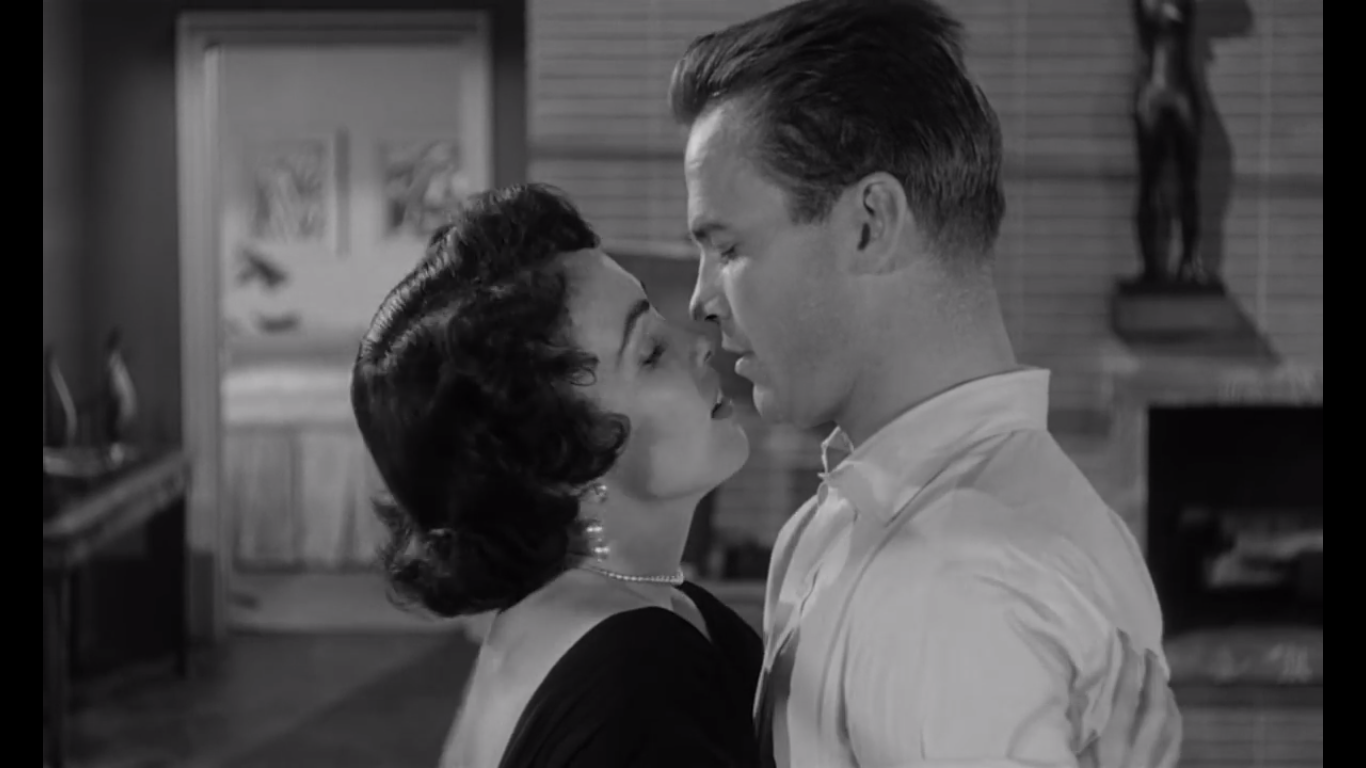
His home life has all of a sudden been shattered, and he’s a wreck. Udo’s sadistic laugh undoubtedly ringing in his ears. In a different era, this film could have spiraled deeper and deeper into the darkness after the final confrontation. Supposedly there was one cut of the film where Widmark’s character actually got away and Mature was left for dead. The ending that was decided upon is still harrowing but holds a Hollywood silver lining as Coleen Gray’s narration ties up the story in a nice bow.

There potentially was also a scene in Kiss of Death with Mrs. Bianco where Udo took advantage of her and drove her to commit suicide, but it was deemed too graphic at the time. Although I would admit that such a scene would have made Udo even more despicable, he really did not need much help. Widmark plays him to a tee with a chilling laugh that would make the Joker proud. Mature is certainly not the standout, but he’s a necessary every man who we can empathize with. The demure Colleen Gray (who unfortunately just left us) is also fun to watch as the girl who stands by him. She also serves to narrate our story informally. Maybe it’s just me, but I really do not grasp the importance of this title. It gave me major misconceptions going in, but that’s not necessarily a bad thing.

4/5 Stars

Kiss me Deadly (1955)

kissmedeadly1Set in L.A., the film stars Ralph Meeker as the callous and often corrupt P.I. Mike Hammer, adapted from the Mickey Spillane novels. One night while driving, Hammer picks up a frightened woman who begs him to remember her. They are forced off the road by thugs and the girl is eventually killed. Hammer wakes up in the hospital to his secretary girlfriend Velda (Maxime Cooper). He makes it his priority to find out what the mysterious woman was talking about. He meets up with opposition and a femme fatale, but Hammer keeps on going using strong-armed tactics. He finally tracks down a mysterious whats-it but then discovers that Velda was kidnapped. In the final confrontation, he finally learns who he was looking for and he finds out the consequences of the Pandora’s box in the hands of a deadly female.

Out of most of the prominent works in the canon, Kiss Me Deadly is probably the pulpiest of L.A. Noir. The images are rather like a historical time capsule of 1950’s Los Angeles with locations on Wilshire Blvd., Sunset Blvd, and even near Angels Flight. It has crisp black and white cinematography with many noticeably low angles underlying the sleekness, but also the paranoia wrapped up in this story. It arguably has the queerest cold open and ending of any noir, which I cannot help but remember.kissmedeadly2Ralph Meeker plays’s Mickey Spillane’s P.I. Mike Hammer to a tee. His husky voice perfectly fits the bravado of Hammer, a misogynistic brute prone to coercive action. Out of all the private gumshoes we’ve met, Hammer is probably the lowest — he’s a real scuzzball.

 Hammer throws women around like playthings and even his girl Velda has a double purpose. Yes, she is a lover, but she also makes a keen asset for business. As a P.I. specializing in divorce cases and marital problems, he’s not below giving business a little help. Velda willingly works on the husbands for him and he’s not above playing around with their wives. It’s a cozy little set-up.

kissmedeadly8That’s Hammer’s level and so when he gets caught up in the story of the mysterious girl Christina (Cloris Leachman), he has no idea what he gotten himself into. It’s a lot bigger than him and when the authorities throw around words like the Manhattan Project, Los Alamos, and Trinity he finally understands what its all about, but not really. In essence, Kiss Me Deadly is the quintessential film of paranoia in the Cold War nuclear age. We have a MacGuffin in the form of the mysterious Whats-it, but aside from that, we get few answers. Only a few deaths and some mighty destruction.

kissmedeadly4

Kiss Me Deadly has some great characters aside from Hammer and Velma. The thugs are played by the perpetually cross-eyed Jack Elam and the glowering Jack Lambert which turns out to be great casting. Also, the lively Greek-American Nick (Nick Dennis) is a great deal of fun with his enthusiasm and a lot of “Vavavoom!”

It’s an interesting dilemma because I have never loved Kiss Me Deadly, but director Robert Aldrich developed a film that is so persistently interesting. It was a film that was supposed to ruin young viewers for its moral depravity, sensuality and who knows what else. This film literally screams “Remember Me” and honestly I will not be forgetting about it anytime soon.

3.5/5 Stars

Christina: You have only one real lasting love.

Hammer: Now who could that be?

Christina: You. You’re one of those self-indulgent males who thinks about nothing but his clothes, his car, himself. Bet you do push-ups every morning just to keep your belly hard. 

While the City Sleeps (1956)

whilethecity1While the City Sleeps has a brilliant cold open followed by a pounding title sequence, courtesy of Fritz Lang, that brings to mind a bit of Diabolique and Psycho. The rest of the film turns into a case to find the wanted lipstick murderer (based on a real killer), but that only holds part of our attention.

When newspaper magnate Mr. Kyne dies suddenly, his begrudging son Walter (Vincent Price) takes over intent on shaking up the status quo and putting his mark on the company. He soon turns three men against each other as they desperately fight for the new position of executive director. The first is veteran newspaper editor John Day Griffith (played by the always memorable character actor Thomas Mitchell). The second candidate is chief of the wire service Mark Loving (George Sanders) who is Griffith’s main competitor. Finally, in the third spot is Harry Kritzer who happens to have a secret ace in the hole. Each of them is tasked with finding out the real scoop about the serial killer, and it turns into a real tooth and claw ordeal. Within the glass cubicles, everything can be seen, but not everything is heard and that’s where the secrets get disclosed.

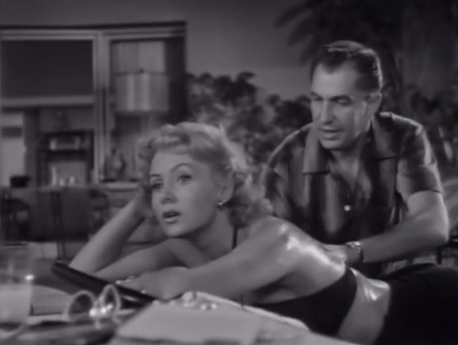
On the outside looking in, so to speak, is star TV reporter Edward Mobley (Dana Andrew), who agrees to help his friend Griffith by doing a little digging around about the murderer. He gets some tips from a cop friend Lt. Kaufmann (Howard Duff), and Mobley tries to smoke the killer out on air. However, it leads to the potential endangerment of his fiancée Nancy, who also happens to be Loving’s secretary. Loving has his love directed towards a female reporter named Mildred Donner (Ida Lupino), who attempts to needle Mobley for info. At the same time, the killer is on the move once more, with Nancy being an obvious target. Mr. Kritzer’s own romantic entanglements get him in trouble because he is seeing Kyne’s beautiful but detached wife Dorothy (Rhonda Fleming). Mildred finds out about them and they have some talking to do. Mobley also has some making up to do with Nancy after she finds out Mildred came to see him. It’s a big mess.

whilethecity3Mobley juggles everything from his love life to the big scoop and they apprehend the killer, but things at Kyne’s don’t wind up exactly the way they expected. Mobley looks to move on from the paper with Nancy, but even he cannot get away that easily.

While the City Sleeps is an underrated tale from Lang that is positively stacked with big names. Its pacing can be deliberate at times, but it is just as much an indictment of journalism as it is a thriller. The office is a web of deception with so many interconnections between these work factions. Those you would normally expect to be scrupulous seem to give up their honor in the face of this new promotion. In a sense, Mobley seems to be outside of this fray and yet he cannot help but get involved in it. It doesn’t help that nothing turns out the way it’s supposed to. Everybody seems to gain something, but nobody really wins the game.

I must say it was great to see Dana Andrews in one of these leading roles again and although their roles were smaller, Ida Lupino and George Sanders still were a deliciously stuffy and corrupt pair. I was never really a fan of Vincent Price due to the roles he normally plays, but I was inclined to like Howard Duff (Lupino’s real-life husband) in his turn as the policemen. It goes without saying that Rhonda Fleming is positively beautiful, but she also cannot be trusted. I guess that applies to about every character in this film. It’s certainly a cynical world out there that Lang paints, where the killer might be caught, but corruption is never fully quelled.

4/5 Stars

Review: The Big Heat (1953)

bigheat2The Big Heat is not a noir where the darkness comes from the shadowy visuals, but from within its characters themselves. In fact, some of these individuals are so subtle in their corruption that it easily gets overshadowed. Homicide cop Dave Bannion is, rather ironically, the straight-arrow trying to do what is right, and he becomes the most vengeful character in Fritz Lang’s film. It’s a subversion of the typical noir arc because his greatest help ultimately comes from the former femme fatale. That’s not how it’s supposed to happen, but then again a lot of things happen a little differently in The Big Heat.

The film opens and within a second a man has shot himself and left a confession on his desk. The cues tell us that he’s a cop and he’s just committed suicide. His wife comes downstairs strangely composed and shuffles through the pages he has written. She goes to the phone, not to call the police, but she talks to a third party. We quickly forget what’s she’s done, but the fact is Mrs. Duncan represents the corruption that reigns supreme in this film. She’s used a juicy piece of blackmail to receive large payoffs from someone and she’s not the only sellout.

Bannion (Glenn Ford) is a cop by day and a family man at night with a loving wife and a beautiful little girl. By convention, he is supposed to be the moral compass of this film — the emblem of good conquering evil. He takes on the straightforward case of Officer Duncan’s death, but it gets convoluted when a B-girl named Lucy Chapman calls him up to say she knew the deceased, and he would never kill himself. Initially, Bannion takes little heed of this girl, because she is hardly as respectable as Mrs. Duncan, or so society says.

He gets pressure from his superior Wilks to lay off, but Bannion is discontent with loose ends, especially when he receives news that the Chapman girl has been brutally murdered. This can’t all be all coincidence, and he begins sniffing out the truth like a bloodhound. Bannion leads us into the home of this empire of crime literally. He confronts local businessman/crime boss Mike Laganna, who he accuses of involvement in the corruption. Things are beginning to heat up, and they start to infiltrate the sanctity of his home life. The dark recesses of the noir world can never be subdued, and Bannion dives deeper into the labyrinth that is created by his own obsessive vendetta. He has no tolerance for his colleagues who don’t take a stand, in favor of their pensions. He can’t stand tight-lipped locals who give him no help and most of all he hates Laganna’s guts.

bigheat3At the local shady nightclub “The Retreat,” Bannion has his first run-in with the hired thug Vince Stone (Lee Marvin). Afterward Vince’s girl Debby is genuinely impressed by Bannion’s methods, but he will not give her the time of day. He expects her to be the same superficially ditsy dame that we have all seen before. Hardly a femme fatale, but still there is the potential to be deadly. The one character who seems to conform to the stereotype is Stone, and yet he is even more brutal than most, burning girls with cigarette butts and splashing scalding coffee on Debby’s face.

Bannion gets to one of the other hired guns named Larry and both Stone and Laganna decide that something must be done to stop Bannion in his tracks. The obvious target is his little girl, but this time the family life prevails over the noir world. His family and colleagues rally around him and yet Bannion is not done with his obsession.

In fact, it is Debby who actually finishes off Bannion’s work by paying a visit to Mrs. Chapman and then Vince. Bannion arrives soon after to reprimand Vince, but Debby has already done the dirty work. The nightmare is over and everything that is good and right comes to the forefront. Debby proves her allegiance, the criminals are put away, and Bannion gets a new position with the homicide department. But underlying this seemingly happy ending is still a sense of tension. The film ends as Bannion heads out on a new homicide case with the cycle continuing and it seems like he will never be free of it.

The world will continue ripping away the ones he loves. Before he knows it, he will be left with only his personal vengeance to drive his future. Bannion very easily could cross the line between righteousness and corruption. He already almost strangled two characters and was not opposed to slugging it out with others. It’s only a matter of time before he totally blows his cool and collected exterior. It’s a dark assumption, but then again that is a lot of what film-noir is. Fritz Lang seems to get this and that’s what makes his characters here so powerful because he knows that the root of all evil can be in everyone.

4.5/5 Stars

Review: Gun Crazy (1950)

guncrazy2

Bart has an intense obsession with guns. It’s what his life revolves around. It’s the only thing he wants to do as a boy and the only things he seems to think about. It becomes a problem when he breaks a store window, but during the following hearing, his sister and friends vouch for his character. He would never take a human life or kill. That’s not in his nature.

No matter, it is decided Bart should be sent off to a special preparatory school, and he only returns years later as a grown man recently off a stint in the army.  He’s back in his hometown not quite sure what his future plans will be, but his buddies are glad to see him. They shoot some, drink a few beers, and decide to take a jaunt to the carnival for a night of fun.

Their Bart meets the girls of his dreams. There’s a quality to John Dall that makes Bart into a pure victim of his circumstances. He’s quickly infatuated with the gun slinging and sensuous Peggy, who seems to share his one love. A goofy smile is plastered on his face as he faces off against her in an act of skill. He makes her uneasy and ultimately beats her. 

He gets a job with the carnival and spends as much time as he can with her when he’s not shooting guns. They are fed up with their boss and leave the migrant life behind. Marriage is on their radar, and they live it up with the money they have. But Peggy wants more and she wants to keep living the high life. 

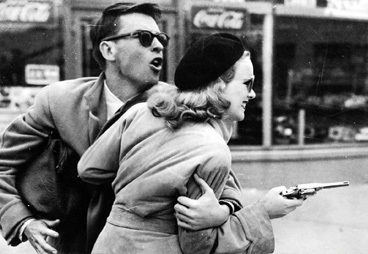
She wants to rob a gas station. It’s one little idea that soon blows way out of proportion. They are holding up banks, gas stations, and any place with money that they can lay their hands on. The pair is fugitives with exploits plastered all over the front pages and roadblocks waiting to stop them up. All the while Bart makes Peggy promise not to shoot anything because he still is totally opposed to killing people. 

It seems like things might end peaceably, except once again the gun-toting lovers are nearly flat broke so Peggy coaxes Bart into one last job to end all jobs. For the first time, despite their planning, just enough goes wrong to nearly botch their mission. Bart drives off and Peggy shoots a guard. He’s not the only one. 

 guncrazy1When Bart finds out, after the fact, he realizes they have just stepped up a level with murder stuck on them. The game is winding down and the only place Bart can turn is his hometown where his sister is. For good reason, she cannot stand Bart or Peggy who she sees as poisoning her brother. And it’s true. Bart seems different now, so paralyzed by fear that he even pulls a gun on his old friends.

The last ditch effort of Bart and Peggy is to literally head for the hills. The dragnet is sent out and the hounds are let loose. They hardly have a chance before dropping from exhaustion in a swamp. They’re trapped and a crazed Peggy looks to shoot it out to the death. But for once Bart breaks with her remembering his friends. It doesn’t help him much.

Gun Crazy is a B-film and yet it is easy to forget because the way Joseph H. Lewis constructed this film is so impressive in its economy. One scene that reflects this so beautifully is the long take from the back seat of the car. The camera does not change positioning and so we see a bank job from the outside, and it only helps to build up greater tension.

 We also have enough time to care about certain characters. We have enough time to see Peggy is really no good. Yet with her keen marksmanship, she is a different shade of femme-fatale who is still as deadly as any of her contemporaries. Along with They Live by Night (1948), this is one of the archetypal Bonnie and Clyde-esque films. Thank goodness this film’s title was changed from Deadly is the Female to the more apt Gun Crazy. That it is. 

4/5 Stars

The Spiral Staircase (1945)

spiral5The Spiral Staircase plays out like an Agatha Christie murder mystery with a moody, old mansion acting as the backdrop and numerous individuals filling out the cast. It seems to be some type of gothic-noir hybrid, with its ghostly interiors, torrential thunderstorms, and creaky shutters. However, with director Robert Siodmak at the helm, I am inclined to call it noir, not just because of his pedigree, but it certainly has the atmosphere and dim interiors that are expected of the genre.

The action opens at a movie hall after a woman is murdered by an unseen killer. But most of the actual drama takes place in the before mentioned mansion of the sickly Mrs. Warren (Ethel Barrymore). She resides with her son Steven and step-son Professor Albert Warren (George Brent) who never see eye to eye. Nearly on her deathbed, Mrs. Warren distrusts her nurse and only allows the mute girl Helen (Dorothy McGuire) to even help her. The rest of the cast is rounded out by servants, a secretary named Blanche (Rhonda Fleming) who Steven loves, and the constable and a young doctor who cares about Helen. It’s a wide array of figures and we quickly begin to analyze them for any hint of killer tendencies.

spiral3In fact, Helen is our main character and we experience much of the film from her perspective. The truth of the matter is that all the girls who were killed had some sort of defect, so the line of reasoning is that Helen might be next in line. It seems all too possible with a pair of mysterious eyes constantly watching from the shadows, but Helen does not heed Mrs. Warren’s advice to flee.

The film ultimately spirals into darkness as the killer takes one victim and looks for another. Helen must protect herself, while also confronting her past where the source of her muteness lies. Although simple in conception, The Spiral Staircase is no less an engaging mystery. It is not the best from Siodmak either, but Dorothy McGuire gives an expressive performance that deliverers so much heart and feeling without the use of words.

However, the film does ultimately allow her to find her inner voice in the midst of all the silence. She finally conquers the fear in the moment when it is most harrowing. Although her role is rather minor, Rhonda Fleming is as strikingly beautiful as ever. It’s a rather expected resolution, but there are enough quirks and twists to makes things enjoyable to the end. It goes without saying that gothic noir most definitely should be a thing if it isn’t already.

4/5 Stars