Three Colors: Blue (1993)

b0ad4-threecolorsblue“Now I only have one thing left to do: Nothing. I don’t want any belongings, any memories. No friends, no love. Those are all traps.”

I once thought that Before Sunrise was the type of movie that I would want to make. Three Colors: Blue is another concept that I have often envisioned without even knowing it. In fact, I had seen The Descendants, a film with a somewhat similar story arc told from a different perspective. Except whereas Clooney’s film is full of blatant drama and intense familial moments in Hawaii, Blue is far more nuanced.

The Descendants might be a more gripping drama, but Blue has the sort of complex depiction that seems to more closely mirror reality. The grieving process involves isolation, solemness, and at times few words. The easiest way to grieve is not to feel, not to fully embrace the pain. Sometimes that is the simplest if not the healthiest way to deal with it for Julie. It’s a real world approach to the scenario, and it’s no less painful to watch — perhaps even more so.

Julie’s husband Patrice de Courcy was a famous composer who was commissioned to arrange a grand piece to be performed at concerts for the Unification of Europe. It is a great honor and we quickly learn that Patrice is quite a big deal. However, after a car accident, Patrice and his 5-year-old daughter perish in the crash and only Julie gets away alive. It is a stark, unsentimental picture, and it succeeds in changing Julie’s life forever.

After being released from the hospital she soon sells all her possessions and moves out of her family apartment to take up residence somewhere far removed from any acquaintances, including a man named Olivier who is in love with her. She has a new home and begins to sever ties to her old life. The unfinished work of her husband (and her) is trashed and that’s the end of that. In her new Parisian home, she has a rodent problem and becomes the hesitant confidant of a local exotic dancer. Furthermore, she rejects the necklace that a young man pulled out of the wreckage. Her times of solitude are spent swimming laps alone in the local pool, submerged and half-covered in shadow. Grandiose symphonies reverberate through her mind haunting her. In such moments, Kieslowski will often black out the screen in the middle of the scene, effectively interrupting the action for a few seconds before bringing us back.

Words are few and far between for Julie and when she does speak it is often brief and reserved. We are, therefore, forced to observe her without the aid of dialogue. She is certainly detached but there is a provocative side to her. Something is mystifying about her soft features, dark eyes, and short hair. She is a wonderful woman of mystery and beauty because the reality of it is, we do not know a whole lot about her. We must discover more bit by bit and she does not readily disclose information.

It is when pictures of her life literally flash before her eyes on a TV screen that the story takes its next turn. Julie learns soon enough that her husband had a mistress that he was with for a few years. In the hands of Hollywood, this would be high drama. In the hands of Kieslowski, it is far from it. Julie is still the same aloof individual she always was and even a confrontation with the mistress does not change that. She is civil and generous through it all.

Finally, she returns to her husband’s composition which she learns Olivier has started to rewrite. They agree that he will make his own work and Julie must accept it for what it is. Faces from the film float across the screen and a still solemn Julie lets out a few silent tears. The anti-tragedy is complete, a subdued, intriguing piece of cinema. Not for those with short attention spans but, I am interested to see Red and White. Kieslowski intrigues me with his thought provoking films somehow reminiscent of the likes of Bergman or Bunuel.

4.5/5 Stars

The Kid with a Bike (2011)

fe148-kidwithabikeTo say this is an affecting film would be an understatement, because if you want, to be honest, it is truly heart wrenching and painful to watch. From the beginning moments, this film brought to mind a modern-day hybrid of The 400 Blows with a bit of The Bicycle Thief mixed in. However, comparisons are always unfair, because this film will never be either of those and that is fine.

Cyril (Thomas Doret) is a young red-headed boy whose most prize possession is his bicycle. Now his mother is non-existent (either dead or gone) and his father might as well be. The boy lives at a foster home, but he is an unruly occupant who is prone to flee. The reason being is that Cyril clings to the hope that his father will come and get him or that his father will call him soon. It never happens.
On one such escape attempt, Cyril clings to a lady hairdresser (Cecile de France)  as his caretakers pry him away. Soon she comes to see him and brings his prized bike which had been stolen. Next, she graciously agrees to take him for the weekends after he asks her. However, he is far from a perfect child, often detached, prone to disobey, and can even be violent at times. Things get worse when Cyril goes with Samantha to talk to his father. It’s a happy moment for Cyril until his father reluctantly tells him to his face that he will not take him back. He had initially asked Samantha to do it showing his lack of a spine and self-respect. You cannot much blame Cyril, but he gets worse before he gets better. He spends time with a local thug who ingratiates himself to Cyril with bike repairs, Assassins Creed, and soda. The motive being he needs a new accomplice to take part in a small-time robbery. The worst part is Cyril does it after Samantha specifically tells him not to hang out with the guy.
Without getting into all the gory details Cyril runs into more problems, Samantha gives up her boyfriend, and there are more repercussions for his actions. However, unlike The 400 Blows, this film ends on perhaps a more positive, although altogether odd, note. We can only hope that Cyril and Samantha gel even more because they deserve to be happy, but that is a story for another film. Or maybe it is better not knowing.
I had yet to see anything from the Dardenne Brothers, but I can see why their type of film-making is so popular. It’s “European film” at its best with simple storylines, realistic and humble camerawork that is brought to life by complex characters. There is a lot of raw emotion and character traits that must be parsed through. Motives and actions must always be questioned since we cannot understand everything. We just know they happen. That is a beautiful thing I suppose because these characters are not often two dimensional and that is a service to the audience. These are the type of films people deserve to watch whether they know it or not. If all we see are summer blockbusters and Oscar contenders we would be missing out on a whole different niche of film entirely. Give it a chance and just maybe you’ll like it.
4.5/5 Stars

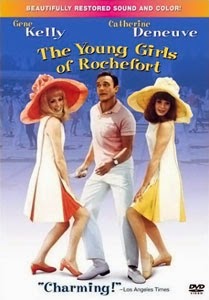
The Young Girls of Rochefort (1967)

Directed by Jacques Demy and starring an ensemble cast including Catherine Deneuve, Francois Doreleac, Gene Kelly, Michel Piccoli, George Chakiris, Grover Paul, and Danielle Darrieux, this is a whimsical French musical.

The film opens with a group of performers coming into the town of Rochefort to get ready for a big outdoor show. They become acquainted with the local hangout that includes a kindly matron and many locals including an idealistic artist and sailor, who is searching for his ideal lover.

Nearby her two adult twin daughters hold piano and ballet lessons as they two get their little prodigies ready for the big show.  Delphine is fed up with her suitor and desires a new love while Solange on her part hopes to advance her career as a pianist. She goes to the proprietor of a local music store to see if he can introduce her to a prestigious American friend.

The dramatic irony sets in, and the plot is constantly moved forward through song. Yvonne at the café is still depressed over a split with a lover 10 years prior because he had an unfortunate name. Solange has a chance encounter while stopping to pick up her kid brother Booboo, and Delphine becomes curious about an artist, who painted a portrait that looks strikingly like her. All of these events reach their apex on the Sunday of the big performance and in need of some performers, the Carnies enlist the help of the twins. They are a huge success and things wind down.

The next morning the performers get ready to leave for Paris, and the girls decide to follow suit. However, Solange has another encounter that changes her plans, and then Yvonne is reunited with her love. That leaves only Delphine to go with the boys to Paris, but not to worry. She would be united with her love soon enough.

The singing is an integral part of this film, and sometimes there seems to be so much that it gets tiresome. However, the light and very French-sounding tunes are hard not to like. Demy pays homage to the Hollywood musicals of old going so far as casting Gene Kelly in his film. The film takes place in a real location, but it truly is a fantasy world that the characters inhabit, full of perpetual dancing and most of the talking comes out in song. The real-life sisters do a wonderful job in this film, and most of the characters are pleasant in this comedic musical of renewed and new found love.

4.5/5 Stars

Cleo from 5 to 7 (1962)

This Left-Bank French film starring Corinne Marchand, follows a young singer in a real time as she waits to get back the results which will prove if she has cancer or not. The film has a unique color opening where the superstitious Cleo has her future foretold. The rest of the film follows her as she anxiously waits on her results. To pass the time she buys a new hat, rides in a taxi through Paris with her housekeeper, and also goes to a café. Returning to her flat, we see how privileged and spoiled Cleo is, first being visited by her busy boyfriend and then her joking composters. However, all the while she is constantly being reminded of what she is waiting for and what her fate might be. Cleo then meets with a friend who models and they drive through Paris together. Finally, she ends up at a park and in a quiet spot she becomes involved with a talkative soldier on leave from Algeria. They eventually take the bus to the hospital and she frantically tires to hear her results. Then, abruptly everything is okay and Cleo or Florence as we now know her, can continue living her life in relative peace. This film has many aspects of the New Wave with its often Chic Parisian atmosphere and a camera that constantly seems to be on the move. A memorable moment includes the silent picture starring Jean Luc Godard with Anna Karina.

4.5/5 Stars

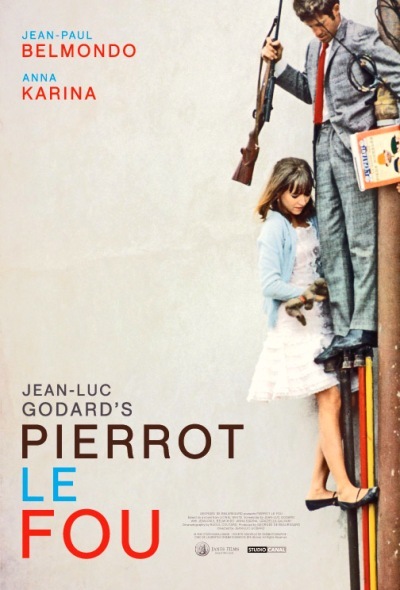
Pierrot Le Fou (1965)

Directed by Jean-Luc Godard and starring Jean Paul Belmondo and Anna Karina, this film is chock full of poetic musings, literary allusions, pop culture images, and so on. Belmondo is a Frenchman who is unhappy with his life and marriage. When a young woman he is already acquainted with comes to watch his child, they eventually elope together. Ferdinand goes with Marianne to her apartment only to find a corpse and they must flee the scene from two gangsters. Now on the run, the two lovebirds are intent on living life and making their own Hollywood inspired movie that they can both star in. Their aspirations lead them to live a wild life on the move, but finally they settle down for a awhile in the French Riviera. Ferdinand is content with a quiet life of philosophizing but Marianne is discontent with this life right out of a Robert Louis Stevenson novel. They finally move on and stop at a night club where they face one of their pursuers. After some mishaps Ferdinand and his girl get separated. Finally they are reunited only to have Marianne turn on “Pierrot” for her real boyfriend. The final moments are filled with gunfire, a suitcase full of money, blue paint, and dynamite. You could say that everything blew up in Ferdinand’s face, and you would be quite correct.

4/5 Stars

Band of Outsiders (1964)

Directed by Jean-Luc Godard, this film follows a young woman who meets two  crooks in an English language class. Through narration we learn that she told them about a cache of money she knows of and so they get her to help them swipe it. They both fight for her affection and ultimately the thug Arthur wins out. Despite Odile’s apprehension at taking the money from her aunt’s home, they continue to get the plan ready. Arthur’s uncle now wants in and then the plan changes again because the owner of the money is gone a day earlier. From this point everything begins to go wrong and after a horrible botched attempt the three culprits flee the scene with little to show for their caper. Arthur makes up an excuse to return and Odile and Franz drive off but they return when trouble seems imminent. Back at the house Arthur is confronted by his uncle and there is more bloodshed. Afterwards Odile and Franz again flee heading to South America while the narrator promises a sequel in the near future. This film unabashedly proclaims to be Nouvelle wave even going so far as having it printed on a store banner. Again, Godard combines his love of American pulp fiction and artistic experimentation to create yet another tragic tale. The film gives a nod to Hollywood crime films and also features several famous sequences. Some high points include the moment of silence, the spontaneous dance in the café, and of course the run through the Louvre. In my mind, Pulp Fiction owes at least something to Godard right here.


4/5 Stars

Contempt (1963)

Directed by Jean Luc Godard and starring an international cast including Brigitte Bardot, Michel Piccoli, Jack Palance, and Fritz Lang, this film within a film is Godard’s personal examination of the cinematic world. It opens with the shooting of a scene only to have the camera turn to face on the audience. Then begins a story where a screenwriter married to a beautiful woman is called upon to write a new screenplay for an adaption of the Odyssey. The producer is a vain and loud mouthed American who quickly has his eyes on the producer’s wife. Other members in this production are the real life legendary director Fritz Lang as well as the producer’s personal female assistant. Things begin to turn for the writer after he leaves his wife with the American playboy. She begins to become distant and she finally acknowledges that she no longer loves him. One of the famous extended sequences focuses on the argument they have inside their residence. In the course of the scene their relationship begins to crumble and finally goes beyond repair. This turn of events is very obviously paralleled in the Odyssey by Odysseus and Penelope. In the end the wife leaves with the producer and screenwriter is left in Italy to help finish up the film alone. Little does he know what has happened. Fellini’s 8 ½ may be a greater film about a filmmaker and his art, but I think “Contempt” is important because Godard focuses a great deal on the conflict between the commercial films of Hollywood and the art films of Europe. His film is more about each individual person who together make a film production possible, and he brings it to the screen with one of his best casts.

4.5/5 Stars

Vivre Sa Vie (1962)

ef6de-vivresavieposterDirected by Jean-Luc Godard and starring Anna Karina, this French film shot like a documentary begins up close and personal in the life of a 22 year old woman named Nana. In 12 separate scenes we slowly are given a view into her life. She goes from leaving her husband, trying to get into the movies, and then finally begins prostituting herself for easy money. All the while this beautiful young lady struggles with men. Here interactions sometimes leave her somber and other times light-hearted. Through it all she tries to live her life the way she sees fit. She might be playing pinball, working in a record shop, viewing a movie, or attempting to pick someone up. She is so alluring in a quiet sort of way and as observers we begin to feel pity for her more than anything. In the end tragedy strikes and all of a sudden it is no longer her life to live. This film had moments where it became talkie however the narrative divided into 12 sequences and the constantly swiveling camera were major attributes. Furthermore, this film appears as if it will be an in depth character study and yet by the time it abruptly ends we hardly know much of anything about Nana besides what is on the outside. In real life Anna Karina would be Godard’s wife for a time and he used her in many of his works.

4.5/5 Stars

Breathless (1960)

5cad1-c380_bout_de_souffle_movie_posterThe debut of Jean-Luc Godard and starring Jean-Paul Belmondo with Jean Seberg, this film was influential in helping to jump start the French New Wave. The story begins with a small-time thief named Michel stealing a car and then killing a policeman  Quickly, he becomes a fugitive in need of money. This brings him in contact with an American journalism student he had met before. They spend time together with Michel professing his love and Patricia still feeling unsure whether or not she truly loves him back. In a final act of reassurance Patricia betrays Michel and he is chased down by the authorities. He is a far cry from the American movie stars and crime films he idolizes. With its jazzy score, bilingual dialogue, jump cuts, and Parisian scenery, this film is chic and cool. It paid homage to Hollywood but it also paved the way for a new era of films starting in the 60s. The film is perhaps not as impressive to today’s audiences but it certainly has a look that you have to appreciate. Godard was ahead of his time because he went against all conventions that had been set up for cinema and he thereby revolutionized the film world.

4.5/5 Stars

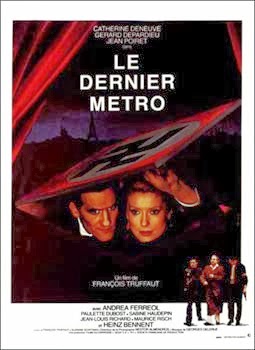
The Last Metro (1980)

Directed by Francois Truffaut and starring Catherine Denueve and Gerard Depardieu, the film opens with the very French-sounding love song “Mon amant de Sant Jean” playing over the credits. We find ourselves in occupied France during WWII where a little theater is struggling to stay open. The  famed Jewish director Lucas Steiner has been forced to flee from the Nazis although in reality he is actually hiding in the cellar of the theater. In his absence his wife Marion has taken up his role of running the theater while also continuing to act. Early on we are introduced to the young actor Bernard who is chosen to play one of the new roles in the upcoming production. At the same time Marion must try and acquire the permit to stay open from a man whom she despises, the art critic Daxiat, who has anti-Semitic beliefs. They do stay open however, and with the director’s notes of Lucas they prepare their show and open to great success. Many of the French come to their shows as an escape before they take the Last Metro home. However, at their performance Daxiat gives them a harsh review and it angers Bernard. His actions ultimately jeopardize the theater and as a result his relations with Marion become strained. As if that were not enough some Gestapo come to the theater searching for Lucas and they must rush to hide him. Needless to say the film ends on a positive note but the film is not so much about resistance against the Nazis compared to the struggles of a theater to survive. Denueve gives a moving performance and although this is not Truffaut’s best, it is admirable. As the audience, not only do we watch a movie, but we watch the play within the movie and then the drama behind the play, so Truffaut  takes us a little deeper.

4/5 Stars