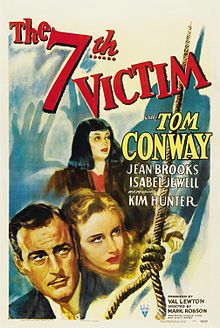
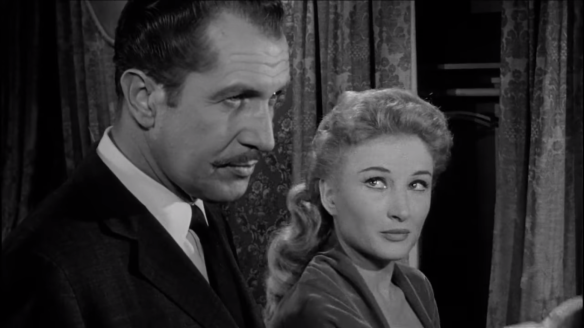
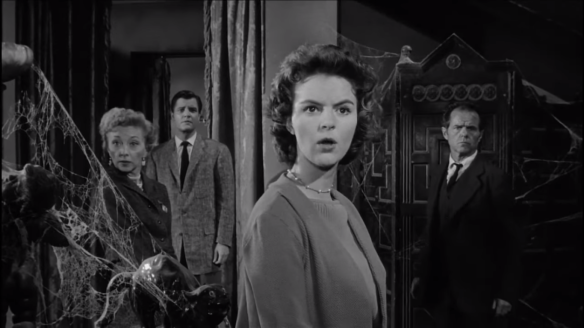
 What a picture for Kim Hunter to have come into her own (and Mark Robson for that matter). The 7th Victim is a chilling gem, and the motor to move the story forward is an audacious girl, Mary Gibson (Hunter), who makes a decision to leave her boarding school of stain glass and angelic choirs, to search after her missing big sister.
Upon arriving in New York, Mary finds out Jacqueline, in an uncharacteristic fashion, sold her profitable cosmetic company eight months prior. Something must be up. Our kiddy noir hits its paces as Mary’s intrepid investigations lead her to Dante’s Italian Restaurant. She checks in on her sister’s rented room only to find a chair and an ominous hangman’s noose.
Next, she files a claim with the missing person’s bureau and looks to hire a private eye to give her help in a city that feels generally unfriendly. However, this is not entirely the case as she makes the acquaintance of Jason, a local poet who looks to lighten up the atmosphere. Likewise, Hugh Beaumont acts as a calming force in this labyrinth of turbulence and underlying dread. Nevertheless, he warns Mary that her sister, “Lived in a world of her own fancy. Didn’t always know the truth.” Another portent of some ill fate awaiting her.
Admittedly, on a micro-level, all the pieces simply do not fit together. To understand why we only need look at what moments were potentially left on the cutting room floor. In the age of narrative incoherence in crime storytelling, The 7th Victim is among the best (or worst). The fact that in such a short time it can be so befuddling must speak to something. Dissenters might clamor this is a disjointed mess but if this is faulty storytelling there is also a sense of apprehension present, inherent to such narratives.
It cannot simply be about four scenes that were famously cut out of the picture. Though we would have gained clarity in one sense, in another these missing pieces somehow aid in this byzantine journey weaving a yarn out of relatively meager resources. The dialogue is just okay but on a macro level, it’s all very intriguing.
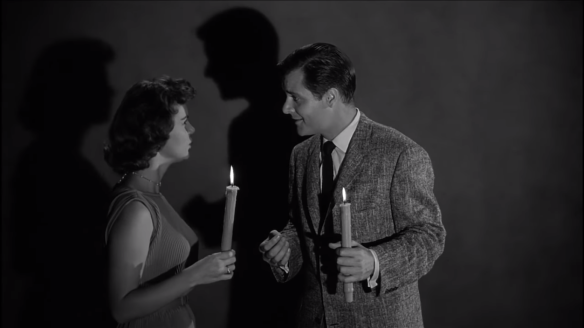
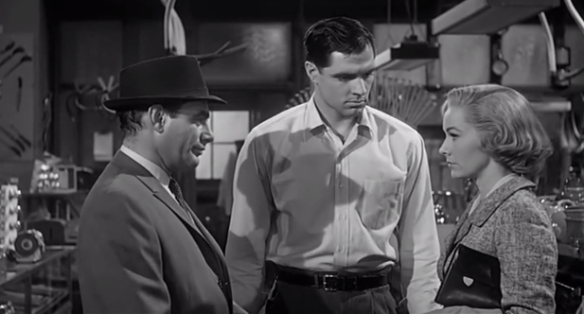
The creme de la creme of chiaroscuro photography occurs when Mary goes down to a mysterious shop with Mr. August on a clandestine mission that goes awry. Anyone walking into such a world would know to begin with no good will come of it, inching down a hallway of darkness.
Then, we have the curious appearance of Dr. Judd (Tom Power) from Cat People who conveniently provides another male character with information on Jacqueline’s current situation. He subsequently has deep abscesses of knowledge about a cult of Palladian Devil Worshippers operating out of Greenwich Village. Again, we have a mythology evoked with traditions and sacred texts lending credence to this widespread conspiratorial atmosphere.
Because of course, as you might have guessed already, Jacqueline (Jean Brooks), now cloaked in a bob of dark hair, found herself immersed in a very foreboding crowd. They don’t look too kindly on those who let their secrets out. Another stylistically rewarding moment comes right after the woman is released from certain death and winds up wandering the darkened streets in a near dazed state. She scurries away into the shadows to evade an unknown pursuer — frantically seeking the aid of an oblivious theater troupe.
We’re on again with the perplexing waling nightmares because the film chooses to dwell in such places. But if the picture chooses to acknowledge Satanic cults the equal and opposite must be called upon to whether the evil. Though not an obviously religious man, the good psychiatrist asserts there is proof that good is superior to evil.
It comes in the words of the Lord’s Prayer. He speaks the words, “Forgive us our trespasses as we forgive those who trespass against us…Deliver us from evil.” Again, the real world liturgy pads the narrative with a kind of believable ethos even as Jacqueline is still hounded by some unknowable, supernatural specter.
The final scene is a blink and you missed it circumstance. Provided a few more seconds to sink in it could have been a horrible thing. As is we hardly have time for the facts to dawn on us until the movie is over, literally seconds later. While not optimal there’s no discounting how the scene was handled visually. Even in this single moment, it says so much with what is not seen and a sound compared to so many other pictures bloated with extravagant sets and resources.
7th Victim is a reminder that sometimes our movies lack imagination, thinking money and special effects can be thrown at a story to make it novel. While this might be true on a most superficial level, sometimes it is constraints that bring out creativity and reveal to us how starkness in the right context can be a beautiful gift. Val Lewton’s horror unit is one of the small wonders of classic cinema, and they cast an indomitable shadow, widely in part to cinematographers like Nicholas Murucasa. This one is another low-lit gem. Once again economy rules.
4/5 Stars
 The film commences brilliantly as Frances Dee can be heard in voiceover with almost fond recollection, matter-of-factly stating, “I Walked with a Zombie.” The way she expresses it immediately debunks anything we might think from an admittedly exploitative title. Producer Val Lewton does not settle for a straightforward slapped together horror flick.

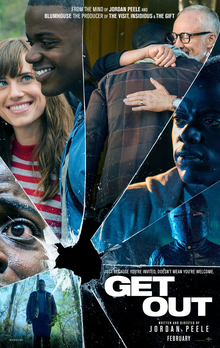 Get Out seems like a simple enough premise. Ridiculously simple even. We’ve seen it millions of times in rom-coms or other fare. It’s the fateful day when the significant other is being taken to meet the parents. Whether they pass this test will have irreversible repercussions on the entire probability of the relationship’s success. Maybe that’s a tad over the top but anyways you get the idea as Rose (Allison Williams) drives her boyfriend Chris (Daniel Kaluuya) to meet her parents.
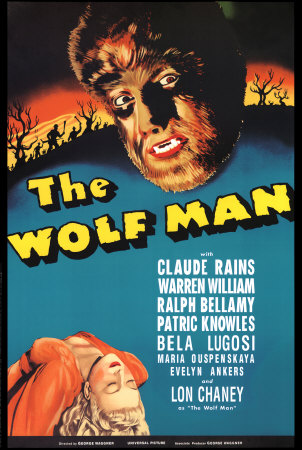 Even a man who is pure in heart, and says his prayers by night; May become a wolf when the wolfbane blooms and the autumn moon is bright.
 Cat People has one of those sensationalized B-picture premises and there are moments when its meager aspects let slip that this is a low-budget effort, but within those restrictions, it moves with a certain purpose and chilliness. It’s true that producer Val Lewton had a B-movie renaissance going on at RKO Studios and Cat People is one of his treasures.
 At Oliver’s work, talk around the water cooler is made compelling in that his best pal and colleague is the sensible Alice (Jane Alexander) always ready to lend a listening ear. She’s genuine in accepting Irena for who she is because she can tell that Oliver earnestly loves her. But at the same time, she serves as a contrasting figure — someone who is completely different than this enigmatic creature.
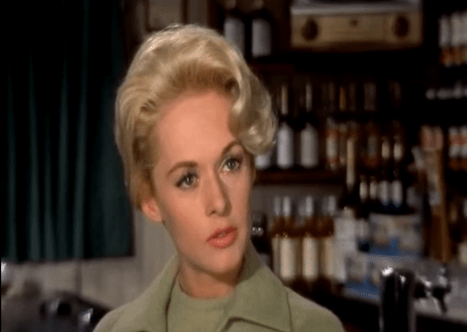 The Birds is about all sort of birds. The ones we are acquainted with initially are actually a pair of humans. Lovebirds you might call them. Except they don’t know it quite yet, but the moment Melanie Daniels (Tippi Hedren) and Mitch Brenner (Rod Taylor) meet in a pet shop, the sparks are already flying — the birds too.
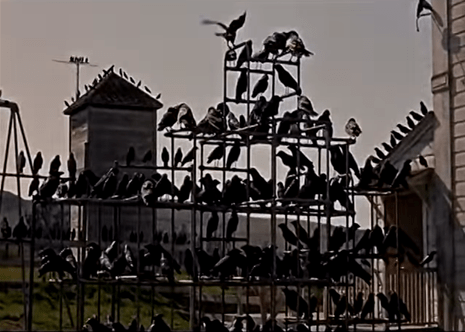 Most assuredly, the film benefits from long stretches of wordless action. The most striking example involves a murder of crows gathering on a jungle gym near the schoolhouse. Never before was the name of their posse more applicable. And while the narrative lacks a true score, the unnerving screeches from the birds is sound enough to send chills down the spine of any audience.
 4 Star Films