Rosemary’s Baby (1968)

Rosemarys_baby_posterFrom the haunting opening notes of a lullaby to the otherworldly aerial shot floating over New York, Rosemary’s Baby is undeniably a stunning Hollywood debut for Roman Polanski.

What follows is a tale weighed down by impending doom and paranoia. But although the tone is very much suited for Polanski, it’s perhaps even more surprising how faithful his adaptation is to the original source material. Most of the dialogue if not all of it is pulled from the pages of Ira Levin’s work and the Polish auteur even went so far as getting the wallpaper and interiors as close to the novel’s imagery as he could. But that hardly illuminates us to why the film is so beguiling–at least not completely.

In an effort to try and describe the look of the film, the best thing that I can come up with is inscrutably surreal. Some of it is undoubtedly due to the lighting. Partially it’s how the camera moves fluidly through the cinematic space which is mostly comprised of interiors. But nevertheless, it’s absolutely mesmerizing to look at and it pulls you in like the wreckage of a car crash. As much as you don’t want to, your eyes remain transfixed.

Mia Farrow, with her figure gaunt and her hair short, becomes the perfect embodiment of this young wife. The progression she goes through is important. Because she starts out young, bright-eyed and cute. Still, as time progresses she evolves into her iconic image, shadows under her eyes, ruddy and covered in beads of sweat. Her state is no better signified than the moments when she walks through oncoming traffic in a complete psychological daze.

John Cassavetes brings his brand of comical wryness to the role of the husband and struggling actor. But face value gives way to more sinister underpinnings. Old pros like Ruth Gordon, Sidney Blackmer, and Ralph Bellamy are given critical parts to play as an overly hospitable old crone and her husband and the aged doctor who are all privy to this deep-seated conspiracy.

You’ll find out soon enough what that means if you watch the film. However, for me what kept coming back to me is that this is, in essence, a subversion of the Christ child narrative with a new “Mother Mary” figure.  And hidden behind this psychological horror show is something, oddly enough, darkly comic. It’s summed up by the scene in the doctor’s office waiting room where Rosemary begins to leaf through Time Magazine. The headline reads bluntly, “Is God Dead?” As a relapsed Catholic surrounded by people who scoff at religion, the world is seemingly devoid of such things. Even the film itself features more profane moments, greater sensuality, and darker themes than any film of the early 60s. Thus, that magazine headline is not too far from the truth

It’s a question that many would have undoubtedly answered in the affirmative in 1968 too, a year fraught with rebellion, unrest, assassinations, and conflict. Polanski himself would even lose his beloved wife Sharon Tate at the hands of the Mansion family. Mia Farrow was served divorce papers by Frank Sinatra on set. It surely was a dark time and yet while Rosemary’s Baby is disillusioning, there’s also an absurdity running through it.

However, the bottom line is that it maintains its frightening aspects because so much is left ambiguous. We don’t see the baby. We never fully understand what’s afoot. And we don’t even know what will happen to Rosemary in the end. What choice will she make? What path will she choose? Is this all a cruel nightmare or will she wake up? Can anyone rescue her from her torment? There are no clear-cut conclusions only further and further digressions to be made.  There’s something fascinatingly disturbing about that. It ceases to grow old.

4.5/5 Stars

The Cabinet of Dr. Caligari (1920)

Das-Cabinet-des-Dr-Caligari-posterI’ve never seen anything like it, and I mean that in all truthfulness. The Cabinet of Dr. Caligari has the esteem of being called the original horror film, and that’s not something to be taken lightly. Perhaps I’m more partial to Murnau’s Nosferatu that came out two years later, but this film directed by Robert Wiene is really the epoch of German Expressionism. The German Expressionism Movement, after all, was not simply about painting, or architecture, or theater. It bled into the Weimar film industry as well, drifting as far away from realism as was possible at the time. Some say D.W. Griffith wrote the rules of moving pictures as we know them today, and if that’s so, then it was this film that tried to push the boundaries to the limit.

In an effort to be transparent, I will acknowledge that The Cabinet of Dr. Caligari does not engage me, narratively speaking, like some other silent films. It follows a Dr. Caligari as he presents his spectacular somnambulist Cesare (Conrad Veidt) at a local carnival. But all is not as it seems as a string of murders terrorize the town by night. Also, I was not a big on the score that accompanied this version. It was rather a discordant cacophony and it did not seem to go well with the action, but that is often a problem with silent films if they do not already have a score to go with them.

CABINET_DES_DR_CALIGARI_01Nevertheless, the images alone are striking, and it is still fascinating for the very reasons I mentioned above. It boasts the craziest sets, highly stylized, and made up of every type of angle and shape imaginable. We know resolutely that this is not reality, these are simply facades being put up to engage our eyes. It features a mise-en-scene for the ages, with no attempt to try and be the least bit objective. There’s no effort to aim for realism; none whatsoever, and that level of audacity is impressive. Furthermore, it’s mind-boggling to think that so many people and so many films were influenced by this movement. Especially in Hollywood.

Without it, we would not have 1930s horror films like Frankenstein and Dracula. There would be no Film-Noir or at least not the same moody, atmospheric creature that we know today. In truth, it was many European directors like Fritz Lang, Billy Wilder, Otto Preminger, and even Alfred Hitchcock, who channeled this movement in their own work. It proved to be so important to the medium of film and thus, it’s important to remember these roots. So maybe The Cabinet of Dr. Caligari is not as engaging today, but there is much to be admired and extracted from it still.

4.5/5 Stars

Shaun of the Dead (2004)

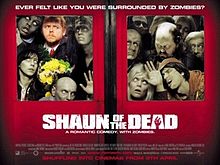
220px-Shaun-of-the-deadImagine that, it took me until after I finished the film to realize that its title was an obvious homage to Dawn of the Dead. And why not, because this comedy-zombie film celebrates the genre and George Romero’s lineage, while also carving out its own little niche. Really, this first installment from Simon Pegg and director Edgar Wright is brilliantly clever in its own right.

What I’ve come to recognize from their partnership is that they are all for the gags, the gore, and excitement, but they also have a handle on emotional impact. The worlds they build through script and character are certainly fun and engaging. I’m not even a big fan of zombie films, but this is probably one of my favorites and that’s because it’s more than just a superficial apocalyptic romp. Heaven forbid I actually care for these characters, but I do. Even Nick Frost, who is oftentimes a real idiot, but even he still finds ways to endear himself.

Simon Pegg goes through your typical hero’s journey, it’s just that it involves a lot of zombies. He begins as a washed-up assistant manager in a dead end job, with a romantic relationship that he’s really messing up. His girlfriend isn’t too happy with him as of late, and after 17 years he’s still at odds with his step-father (Bill Nighy). Meanwhile, his best friend Ed (Nick Frost) is making a nuisance of himself, playing video games and doing little else. It’s a real humdrum life that Shaun’s partaking of. You can see it in his demeanor, even his posture. If you didn’t know any better you’d think he’s a zombie or something. It’s true that Pegg and Wright have fun with a few gags like this, and even when the zombies take over the streets, Shaun hardly seems to notice. He’s so far gone in his own personal funk.

But in his case, a zombie apocalypse is just what he needs to kick-start his life again. He gains new meaning, asserts himself, and acknowledges how much he cares about those around him. He also gets to bash rows of zombies with a cricket bat and blow them up with a Winchester rifle for good measure, while saving his girlfriend Liz (Kate Ashfield), so that’s a major bonus.

Edgar Wright’s style is very dynamic and in your face, but within all the hubbub there are real moments of sincerity that elevate Shaun of the Dead not just above a lot of other zombie movies, but a lot of movies in general. Forget simply a zombie flick. This is a romance, a buddy film, and a redemption story all wrapped up into one. Simon Pegg proves himself as a leading man, who we would willingly follow during an apocalypse, especially given the other choices at hand.

4/5 Stars

Nosferatu (1922)

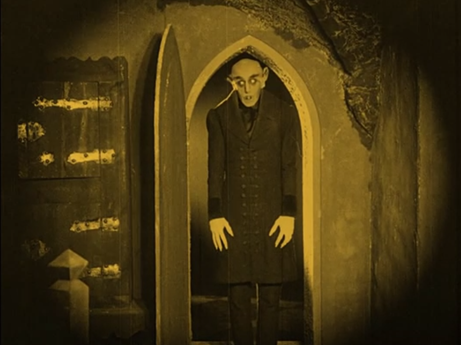
nosferatu1The hand of F.W. Murnau is less noticeable in this early classic of his, but Nosferatu still works seamlessly as a piece of drama and horror. In fact, it by now has become somewhat of a horror classic and the archetype when it comes to vampire movies, taking a lot of inspiration from Bram Stoker’s Dracula. I think one of the things that makes Nosferatu so gripping is the fact that it mixes the plausible with the supernatural making for this weirdly rewarding ride. Is it scary? No, not in the modern sense of the word.

But it’s a story steeped in Myth. There is mention of the Black Death, supernatural creatures, and a being that “suckles himself on the hellish elixir of their blood.” What wonderful imagery that develops a genuine awe in this devilish being. And yet in the same instance, we’re getting scientific explanations of venus fly traps and tentacled polyps acting as symbols certainly but also tying us back to the real world. These forces of nature are real, backed by science, and make a vampire just a little more conceivable.

Running through Nosferatu is a love story, and much like Sunrise, although Nosferatu is a “symphony of horror,” there is also a bit of a love song underlying the vampire tale. It lends this story some heart, because these characters, like our protagonist Hutter, actually have something to live for.

Nosferatu most certainly is a symphony, and along with the expressionistic images, it uses title cards as well as excerpts from ship logs, books, and letters to tell the story. One such inter-title card from Count Orlock reads: Your wife has a lovely neck. Hutter has little idea what he means (or pretends not to), but we know, making it a rather funny but unnerving comment. There’s something about knowing what is undoubtedly going to happen and being powerless to stop it. For instance, when someone acknowledges they have two mosquitoes bites quite close together that spells trouble to the audience, but we can only watch and wait.

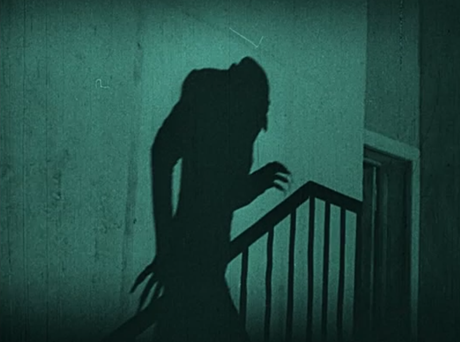
nosferatu2Because when Hutter first goes to offer Count Orlock a house we know it is bad news, to begin with, but it takes a long time for anything to actually happen. Orlock moves into the abandoned mansion across from Hutter and his wife, and that’s when the danger strikes close to home. There’s a madman in the hospital diverting attention, and Hutter winds up incapacitated so he is incapable of coming to the aid of his love. She is left vulnerable and the vampire has already proven what havoc he can wreak with the crew on a ship. Aside from Max Schreck’s frightening facade complete with pointy ears, bulging eyes, and menacing fingers, the vampire literally appears and disappears into thin air. There is a haunting aura built around him because he is something supernatural, something that we cannot understand except through myth. I found myself getting tense waiting for something that I was not sure about. That was the exciting part. It’s not a blood and guts, monsters jumping out of closets, kind of horror. It’s not ridden with cliches either because it was the one creating its own mystique.

It’s hard to believe how much popular culture has been derivative from Stoker’s Dracula, much like Doyle’s Sherlock Holmes, or Shelley’s Frankenstein. However, amidst all the vast works of Dracula and vampires, Nosferatu stands out. It represents the visual aesthetic of German Expression wonderfully, and it casts a long shadow. It’s hard not to, at the very least, admire its artistry and be taken aback by its legacy. In the realm of silent films, Nosferatu is a must, pure and simple. It doesn’t rely on bloodcurdling shrieks and screams, but the images begin to invade our consciousness. One seems fleeting and the other sticks with us.

4.5/5 Stars

The Shining (1980)

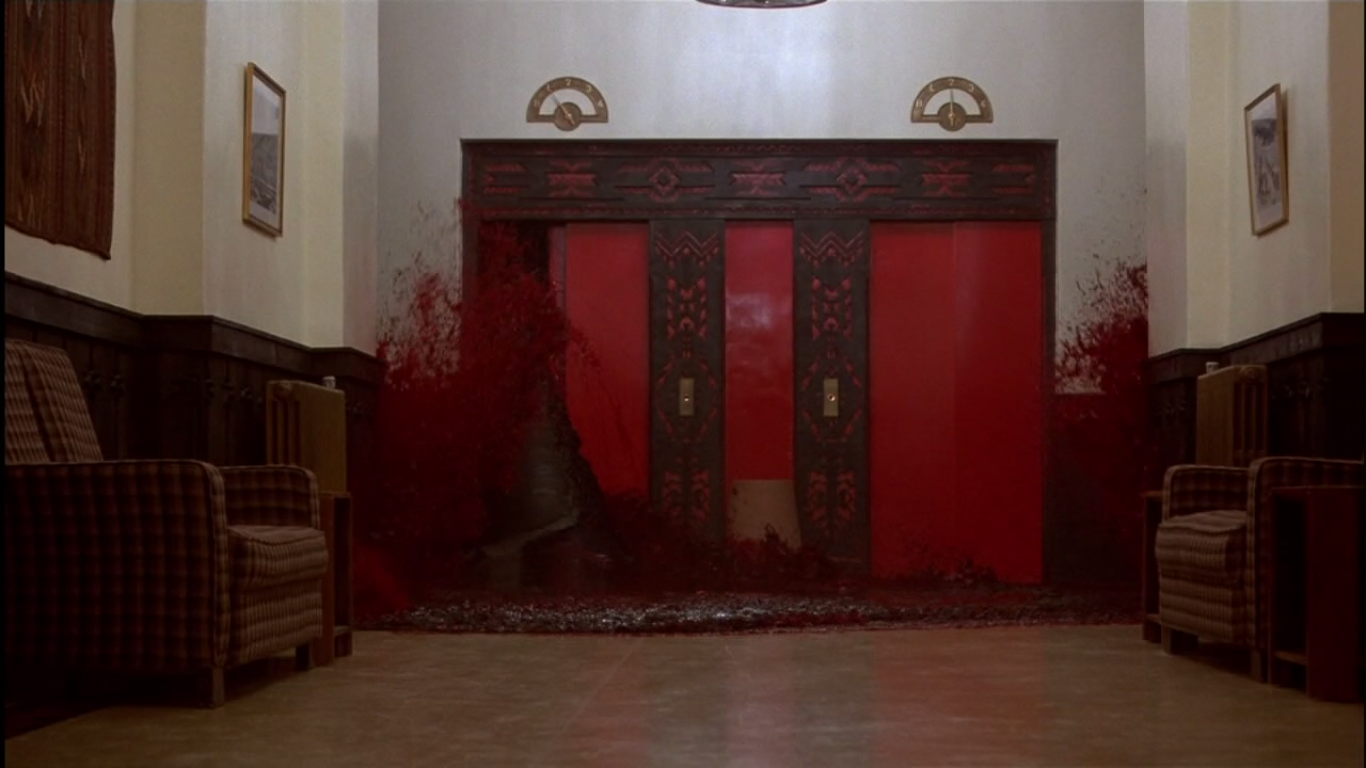
theshining3Stanley Kubrick is not generally known as a horror film director. His impact was far broader than solely one genre. How is it then that he made one of the enduring canonical films in the horror genre? It’s been over 30 years and people are still talking about The Shining — still using it in every kind of parody and homage imaginable. Like a Hitchcock or a Spielberg, he’s one of those directors with an eye for what’s thrilling as far cinema is concerned, but perhaps more so Kubrick deals in complexities. Ambiguity is his friend as much as the beautifully shot interiors of The Shining. He builds and constructs the perfect scaffold to work off of, and it’s full of tension and shock value, but it leaves the audience with questions. I watched Nosferatu recently and what I came out of it with was a conviction that it was not your typical horror film — it seems to follow you and haunt your thoughts in a sense. The Shining is a little more like a modern horror with frightening images, and yet it shares that same quality. You cannot help but ruminate over it or think about what you just saw and what it really means. Truth be told, I don’t know what to think about the cryptic ending and, in all honesty, I don’t care too much, although it makes for interesting discussion.

theshining1This film found its source in Stephen King’s novel (which I have not read). For the life of me, I had never thought of the significance of the title, but Scatman Crother’s character explains it in the same way that his mama had before him. “Shining” is being able to talk without your mouths. The little boy Danny Torrance has such an ability, and it proves to be the entry point into this film’s conceit. Not only is he able to say things without talking, but he sees things, horrible things, that other’s cannot — rather like The Sixth Sense (1999).

His father Jack (Jack Nicholson) and mother Wendy (Shelley Duvall) take him to a Colorado mountain getaway for 5 months of isolation, because it seems like a good deal. After all, Jack wants to get some work done on his book and he could use the unbroken solitude,  but of course, there’s an underlying tension that slowly builds as their time alone draws nearer. It’s done through the foreshadowing of cryptic images, violent tales of local folklore, and of course, a score that is constantly ringing in our ears. That’s the best way I can describe it. We know something is up.

So what does Room 237 mean? What about Grady and the bartender who serves Jack his drinks at the bar? They’re just as perplexing as Danny’s ability or the sudden change that seems to come over Jack. There are these perplexing moments that are difficult to account for whether it’s the initial introduction of the Chief (Scatman Crothers) and Danny, who he telepathically communicates with. Then, Jack Nicholson carries such a genial quality, and yet underlining all those Cheshire cat smiles is something deeply troubling.

theshining4Amidst the dreams and haunting images that blur the line between fantasy and reality, past and present, there is a strange fascination that develops for The Shining. Almost a morbid fascination, because we know something is wrong, but we keep watching anyway. We want to know what happens and furthermore, Kubrick’s visuals are often mesmerizing, although they remain indoors for the most part. His camera often trailing characters as if they are prey.

He pays his audience the final respect of not giving us everything and not tying up all the loose ends. We are left with images and photos ingrained in our mind’s eyes. Admittedly, Shelley Duvall is not an actress I usually pay great attention to, and certainly, this is Nicholson’s film along with Kubrick. He was made for such a twisted, layered role, that overflows with a certain level of affability and then becomes completely psychotic. It makes him far creepier than any villain clothed in black because Jack Torrance will openly kill you with a sing-song voice. That’s pure evil.

4/5/5 Stars

Review: The Silence of the Lambs (1991)

silenceof1The Silence Lamb is a horror film at times, a thriller at others, and most definitely a character study in its entirety. It features two wonderfully different figures in budding young FBI agent-to-be Clarice Starling and incarcerated serial killer Hannibal Lecter played so impeccably by Jodie Foster and Anthony Hopkins respectively.

It begins as a hunt for a serial killer named Buffalo Bill (Ted Levine), who for some reason kidnaps his victims, kills them, and skins them like some kind of perverse trophy. This in itself makes for an interesting albeit grisly storyline. The race is on to find this man before he murders his latest victim who happens to be the daughter of a prominent senator. Thus, there is an immediate need to get inside his head and figure out what the next logical steps should be. That’s when Agent Jack Crawford (Scott Glenn) of the Behavioral Science Unit calls on Starling to help him out.

The narrative of Silence of the Lambs is twofold because this larger manhunt becomes the backdrop for an arguably far more interesting development. The initial meeting and budding relationship, if we can call it that, between agent Starling and cannibalistic psychopath Dr. Lecter is deliciously intriguing. He just might be the key to unlock this case, but it’s not without peril.

silenceof2As the saying goes, “Quid pro quo.” Lecter is rather intrigued by Starling, so different and far franker than any of the other people who get thrown his direction. So he agrees to help her only asking in return that she open up about herself. It seems like a dangerous proposition with Lecter constantly playing mind games. He’s skilled at probing, dissecting, teasing, and prodding. But Starling willingly goes through his questioning to get help with the case. After all, who better to catch a serial killer than another serial killer?

They touch on the death of Starling’s father, a town Marshall, and her horror in seeing the slaughter of newborn lambs. In return, he tells her that all the information she needs is in the case files. But antagonistic Dr. Chilton is more a hindrance than a help to Starling’s case, and she must figure out the rest on her own.

Going through the files she finally makes some headway in her search for Buffalo Bill, but an FBI tactical unit already has sights on his location. Then there’s a surprising about-face in the case, not to mention that Lecter escapes his cell, kills his guards and is on the lam. Starling is not in danger from him, but he is looking to have an old friend for dinner instead.

Ultimately the plucky young agent comes through big in her case and in the academy. The film ends on a high note for her, but with it comes a titillating call from Dr. Lecter. He pays his respects for her recent graduation then goes off after his newest victim. Such a conscientious killer to offer up his congratulations like that.

How does one go about playing a man so evil and yet intricately interesting on so many levels? Hopkins said himself that he copied a friend who never blinked because it always makes people on edge. He likened his voice to an amalgamation of Katharine Hepburn and Truman Capote if that even makes sense. Finally, he saw parallels to another famed movie villain, the computer HAL in 2001: A Space Odyssey.  Both so intelligent, so unfeeling and ultimately so deadly. What might put Lecter a trifle above HAL are his chilling unflinching facial expressions that are sure to send shivers down the spine of any normal person. A face like that just doesn’t leave you.

4.5/5 Stars

The Sixth Sense (1999)

The_sixth_senseAll I knew going into The Sixth Sense was that it featured Bruce Willis and there was a twist at the end. That was about it. Thus, it was an interesting opening to have our main character already be shot within the first few minutes. But it’s not much of a spoiler per se because we quickly flash-forward to a year later.

That first case came back to haunt him in the form of a very distraught patient, with a major grudge, however, Dr. Malcolm Crowe has seemingly gotten past it and continued with his life. It doesn’t mean that his marriage is not still difficult and his work still taxing, but he gets by. Finally, he gets a case that might help him resolve his previous failures, at least that’s how he sees it. Of course, the intelligent, but aloof boy Cole Seer (Haley Joel Osment) sees the world in a whole different way. He literally sees dead people, but let’s take a step back for a moment. He has trouble connecting with his loving but nevertheless troubled mother (Toni Colette) and Dr. Crowe seems like his only friend. None of the kids at school like him, because they think he’s a creep.

What Crowe does is help him work through everything that it is unique about Cole and also help him see that there may be some purpose behind these ghosts that he can see. They want him to do things for him so maybe this is Cole’s chance to help them. And so he begins the process and despite it being terrifying and disconcerting at times, he is able to lay to rest these specters. Finally giving them peace and in the wake of a traffic accident that results in a death, Cole finally opens up to his mother. She has trouble believing him at first, but she never discounts her son, which leads to a tearful scene between mother and son.

M. Night Shyamalan is obviously well-known for his great interest in supernatural stories with twist and turns, but to his credit, he firmly plants his films in a reality, like Philadelphia, that we can grasp onto. That’s our base and he can go from there with psychological thrills and even a touch of horror. However, his film actually has characters that are far from throwaway, even if we just look at Malcolm, Cole, and his mother. They are individuals that we can grow to care for over the course of the movie even with the supernatural plot devices and of course, the final surprise ending.

Honestly, I had an unfair advantage knowing that something was coming, so I caught onto some of the peculiarities leading to the final disclosure, but I was still relatively surprised when it came. Despite the rather contrived plot and purposefully cryptic opening, followed by a long wait, the final payoff of The Sixth Sense is certainly worth it.

4/5 Stars

Zombieland (2009)

0e860-zombieland-posterI am not big on Zombie films and so I went into this one not expecting much a great deal. I still do not really like the Zombie genre but there were some decently funny moments here having to do with the rules Columbus (Jesse Eisenberg) has for surviving the apocalypse. The long lasting search for Twinkies, and of course a random cameo by a prominent funny man were a few more highlights. Woody Harrelson is good at playing the gruff type and Little Rock and Arkansas have a lot of personality which does the film a service. Remember rule #1: Cardio. Very important to survive during a zombie apocalypse if it ever comes to that.

3.5/5 Stars


The Ghost Breakers (1940)

9c09c-the_ghost_breakersYou have two great leads in Bob Hope and Paulette Goddard for this horror comedy film. It is not the best film of either of them by a long shot and it is not much to write home about but if you like the stars you will probably get some laughs out of this one.

It is a dark and stormy night in Manhattan when Mary (Goddard) learns that she is the new owner of a supposedly haunted island. Larry (Hope) on his part is a radio man who is soon on the run from mobsters after a comment he made on air. After a shooting Larry finds himself face to face with Mary and she helps him out of a pickle. Soon she boards her ship heading for her island and he has no choice but to tag along. There everything comes to fruition and the Ghost Breaksers take on the haunts and the dangers of Castillo Maldito. This is a good example of the horror comedies of the 1930s and 40s. Hope was better with Crosby and Goddard was better with Chaplin, but this film certainly has some hilarity.

3.5/5 Stars

Alien (1979)

70cca-alien_movie_posterIn the wake of other Sci-Fi smashes like Star Wars (1977) and Close Encounter of the Third Kind (1977), Alien was a radically different film, since it lacked the same sentiment of its precursors. One would wager a guess that this core variance stems from director Ridley Scott who certainly is no George Lucas or Spielberg. His films are generally darker, more world-wearied, and disillusioned. Blade Runner is a perfect illustration of this, but three years earlier came Alien, a Sci-Fi Horror film of immense critical acclaim and impact even to this day.

The film opens as a spacecraft called the Nostromo gets ready for a return trip to earth after a commercial excursion by its 7 member crew. However, a distress signal halts their plans and the captain named Dallas (Tom Skerritt) resolves to go investigate. On the surface of the abandoned planet are the remnants of what seems to be an ancient alien empire. One member of the crew Kane (John Hurt) comes upon a chamber full of what appear to be eggs and as is expected he is attacked. We knew it was building up to this point.

Back on the craft, Kane is still alive but now he has an octopus-like alien clinging to his head. It’s an acidic situation because it appears to be feeding him oxygen and it has no plans of coming off anytime soon. Next, comes the calm before the much-anticipated storm as the tension slowly increases exponentially.

What ensues is a cat and mouse game between the crew and this belligerent alien which has grown increasingly larger. Its evolutionary adaptations make it seemingly immune to extermination, but the crew tries desperately to destroy it with electric prods and flamethrowers. Soon it’s difficult to know who the cat and who the mice are, but it certainly favors the alien.

It doesn’t help that Jones the cat is on the loose and there is even a bit of mutiny aboard the craft. It feels a bit like a tense Agatha Christie novel with person after person slowly getting knocked off. But that sensation does not last long when we actually see what we are dealing with. This creature has no conscience. No humanity. It only cares about survival by killing its prey. To win you must do the same and beat it at the game.

Thus, although I initially thought it a weakness to only have one alien, it turns out that it makes this film all the more tense. Also, very little of the action actually takes place outside of the ship. They are stuck on board in the middle of outer space fighting for their lives. Not much can be more horrific than that, and it is a very unnerving ride with surprisingly good pacing and many graphically shocking moments

The cast is a nice diverse group of actors including Skerritt, Hurt, and Ian Holm, but Sigourney Weaver is undoubtedly the standout as 3rd in command Ellen Ripley. She is the last one to keep her head and her story would set the framework for the entire Alien franchise. Not to mention the role propelling Weaver to stardom and introducing the archetypal model for future female protagonists.

Alien definitely has a lot to offer and I am excited to see the next installment Aliens. That added “s” has me intrigued.

4.5/5 Stars