The Battle of Algiers (1966)

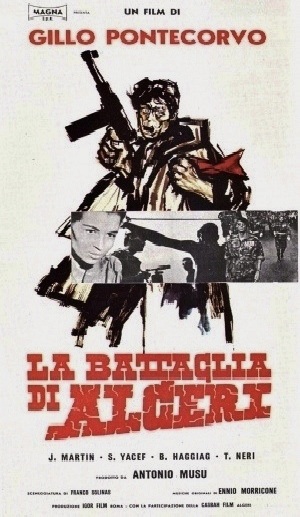
The_Battle_of_Algiers_posterBeing rather oblivious to the relations between France and Algeria as well as the battle of Algiers, this documentary-style film proved to be an enlightening and thoroughly engaging historical exercise. I certainly cannot corroborate all the facts, but the reality is, The Battle of Algiers is one of the most well-paced films that I have ever seen coming out of Europe. There is a great deal of drama, harrowing intensity, and it all brings up numerous political questions that parallel the world we live in even to this day.

It’s the story of 1950s Algeria and specifically the Casbah Muslim district of the city. It is there between 1954 to 1957 that the National Liberation Front waged war against their perceived oppressors from France. And they certainly had a point that imperialism has left an indelible mark on them. However, their own strategies include bombings and assassination that utilize civilians and people loyal to the front. You don’t know when the next attack will come, and they sweep across the land like wildfire. The leaders of the FLN include the fiery Ali la Pointe and El-hadi Jafar, who recruited la Pointe early on. A Lieutenant Colonel named Mathieu is brought in to bring down the enemy, but it proves to be a difficult task since the FLN, much like a tapeworm, will never die until the head is destroyed. Otherwise, it’s extremities will keep rebuilding in the form of loyal underlings.

The film is rather shocking in its straightforward depiction of violence, whether it be bombed buildings, gunfights in the streets, or French authorities being gunned down by insurgents. Somehow these images feel still very relevant to the contemporary age. You have the imperialists clashing horns with the locals. There’s racial profiling. Women and children are involved in the violence just as much as anyone else, and destruction pervades the public squares. There is no refuge from bomb or evil. Anyone coming around a corner could be carrying a bomb or looking to shoot you when you least expect it. Really it is amazing that a film like this was even made, and it was undoubtedly a lightning rod for controversy.

In the film’s epilogue, the unrest continues and it is finally noted that Algeria did eventually receive their independence. The French may have won the battle, but they ultimately lost the war. The audience is left to develop their own opinions about this conclusion. As for me, I find Gillo Pontecorvo’s film fascinating, because he takes a point of view that does not seem especially biased. This is not noticeably propaganda in its depiction, but instead, it is a thought-provoking document of civil unrest developing questions on war and race relations. Maybe we can even learn something from it as well in this modern age that still includes so much human conflict.

5/5 Stars

Marriage Italian Style (1964)

Marriage_Italian_StyleI had never seen any of De Sica’s later work and with the quintessential pairing of Sophia Loren and Marcello Mastroianni this seemed like a perfect place to start the journey. The character Domenico is easy to dislike from the beginning because he constantly floats in and out of the life of the former prostitute Filumena who is ironically devoted to him.

The film relates the struggles of matrimony and family in Italy as Filumena tries to support her family while struggling with Demenico who is never truly ready to commit to her. In fact he becomes absolute fed up with her after a trick marriage, but that is just the beginning.

I can only imagine what Divorce Italian Style will be like (which also features Mastroianni). Without question Sophia Loren is certainly the driving force in this film.

4/5 Stars

Yesterday, Today and Tomorrow (1963)

Yesterday,_Today_and_TomorrowThis is the lightest of any De Sica film I had seen up until this point and interestingly enough it was split up into three narratives. The first one follows a woman who continually gets pregnant in order to avoid going to jail, but after seven kids, the toll is too much on her jaded husband. Needless to say there is a happy ending.

The second tale follows a superficial socialite with a Rolls Royce. She ditches her cars as quickly as she ditches her lovers. Although the story does not go very far it is easy to see she is a snob used to getting her own way. Ironically a humble man would in many ways be too good for her.

The final vignette follows an amiable prostitute as she befriends a young man destined to join the clergy. However, he becomes smitten and so she must do her best to encourage him to continue his calling.

That really is only the basics, but it was certainly enjoyable to see Sophia Loren and Marcello Mastroianni in three separate roles playing off of each other in different ways. They reflected three very different walks of life and three varying relationships mixing a great deal of humor with a few more somber moments. All in all it was fairly enjoyable.

4/5 Stars

8 1/2 (1963)

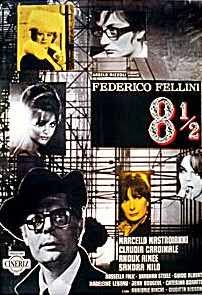
4b2c1-8mezzoDirected by Federico Fellinni and starring Marcello Mastroianni, the film follows the famous director Guido. After an opening sequence that reveals how he feels, we see Guido as he spends time at a spa trying to get healthy. However, he also must prepare for his next epic film production and he is constantly being bombarded by his writer, producer, actors, and all others involved. First his mistress arrives which he is unhappy about and then his wife comes and he is glad to see her. All these various things leave Guido confused since he does not have any answers. He wanted to make a genuine film full of truth and yet he cannot even be truthful in his own life. Even the ideal woman, the actress Claudia, has no real answers for him. Despite this, the film ends on a positive note with everyone holding hands in dance. What makes this film so fascinating is the interlocking dreams, reality, fantasy, and Guido’s childhood memories. Sometimes the viewer may get confused and yet often it is possible to decipher what is going on still. This is  a very personal film about film making itself and for Fellini it is also considered by many to be his greatest achievement.

5/5 Stars

La Notte (1961)

36075-lanotteposterHere is a film full of glitz reminiscent of La Dolce Vita, a cast starring the likes of Mastroianni, Moreau, and Vitti, with a meandering plot courtesy of Michelangelo Antonioni and gorgeous black and white visuals.

This film is certainly not for the action fanatic because we are given very little. In fact the story revolves around a couple who have trouble communicating so even the dialogue seems sparse at times. The marriage is slowly going down the tubes and neither partner is ready to acknowledge it until the end when the wife finally does.

Moreau definitely had stronger performances like Jules and Jim because here she hardly talks and is highly misanthropic. Monica Vitti is more interesting in her role simply because she has more energy infused into her.

One of my favorite moment in the film had to be at the party where Mastroianni first sees  Vitti playing a rudimentary shuffle board. We are watching just like he is except there is a strange sensation that something is doctored with the image. It turns out that we are only looking at the reflection and then the camera swivels to the right to actually show reality. It was one of the noticeable artistic shots that really stood out to me.

La Notte is a subdued film, more often than not, and so if you go expecting that type of pacing you start to enjoy the little pieces here in there that are given to you. By the end it is rather sad because the marriage not working. There is no huge fight, no bickering, just apathy and that is in many ways more painful to see.

4/5 Stars

L’avventura (1960)

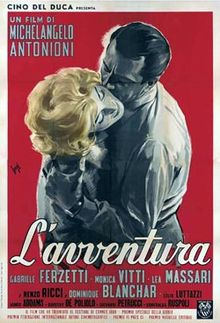
L'avventuraSmallL’avventura is one of those films that it is difficult to make a cohesive review for. If you are watching it purely to be entertained, you have it all wrong, because that is not its main purpose. Its greatest attribute is the special place it has in the pantheon of film art.

It is a film about a group of high society adventurers who go on a boat trip through some islands, only to have a woman passenger literally disappear, practically into thin air. Her boyfriend and her best friend search for her in the ensuing days, only to fall for each other, and that is about it. This is, of course, the most superficial level possible.

L’avventura is quite interesting visually and I wish I could have seen it on the big screen. The reality is, oftentimes, not a whole lot is happening, but it causes you to actually focus on the images in the frame. Michelangelo Antonioni gives us numerous settings all over Italy, and most have something to do with the wanderings of natural beauty Claudia (Monica Vitti) or her companion Sandro.

Anna (Lea Massari), despite her early importance, is hardly in the film. She is only a wisp in the wind and the mystery surrounding her is of lesser importance. The outcome is what matters as her friend and boyfriend become lovers. Theirs is the relationship that is explored as it develops, evolves, and becomes fully tested.

In the final moments, Antonioni toys with us, suggesting just possibly that Anna might be in the picture again. In fact, he must have a very cruel sense of humor indeed. Here in L’avventura as well as Blow-up (1966) he waves a mystery in front of our nose and leaves it unresolved. It is absolutely maddening, in some respects, and yet he makes us look at something else altogether. He also had the gall to name a film with a meandering plot like this L’Avventura! The nerve of it all, and yet I respect him for it because it messes with our conventions and forces us to be uncomfortable.

It is understandable that this was a polarizing film at Cannes in 1960, and I can only imagine that it has the same effect over 50 years later. One thing is for sure. This is no Gilligan’s Island with a three-hour cruise set in Italy. There is a lot more to it than the plot. Not my favorite adventure, but I respect its pure audaciousness of form.

4.5/5 Stars

Cinema Paradiso (1988)

58390-cinemaparadisoTo the casual viewer, Cinema Paradiso can seem like a plodding film, but this pacing is almost necessary since it reflects the passing of the years for one individual. It has been 30 years since Toto left his hometown as a young man never to return. Now he gets a call from the mother he never talks to, with the message that Alfredo has passed away.

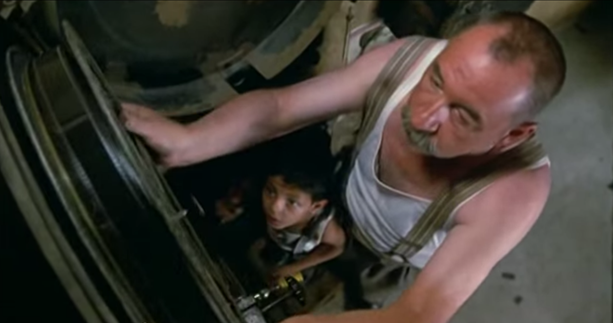
The memories become coming back from when he was a young boy in the post-war years. He had a knack for getting into trouble, falling asleep as an altar boy, and getting scolded by his mother. She was especially displeased with his obsession with the movies played at the local theater called Cinema Paradiso. It is there where Toto has his first encounters with the great legends of film, but also perhaps more importantly, the projectionist Alfredo. Initially, the middle-aged man finds the boy a nuisance but slowly a close bond forms between the two. Alfredo teaches little Toto the tricks of the trade and the movie hall flourishes with packed houses all the time. You see, it was the age when movies were a family affair, and the whole town showed up to be entertained. They were the perfect escape from disillusioned post-war years. However, there still is a local priest who censors all kissing in film because after all, that’s highly objectionable. Very racy indeed.

One such night a near fatal accident occurs when the projector overheats then burns the film setting the whole projection room ablaze. Toto barely pulls out Alfredo alive and he is permanently left without sight. From that day on his young prodigy takes over the job but never forgets his mentor and friend. The boy is soon turning into a man and it means young love and a stint in the army, and still Alfredo is around for him. He is always ready to give a bit of homespun wisdom from a movie or do a simple favor. However, finally on the advice of his old friend Toto left town and never returned in order to make something of his life. 

Now he finally returns to pay his respects and the old has passed away. Some familiar faces still inhabit the town but the Cinema Paradiso is about to be demolished and the end of an era has arrived. The days of cinema halls are waning as videos and the like grow bigger. As a gift to his friend Alfredo left Toto (now Salvatore Di Vita) one last reel of film containing a montage of big screen kisses. It is less a lesson in Italian and American classics and more of a lesson in life. Our relationships matter. More on that later. 

 Cinema Paradiso made me crave watching films with a big audience because that is something modern moviegoers often do not experience. Movies were initially meant for the masses (ie. Sullivan’s Travels) and they were meant to be enjoyed in community with one another. That’s part of their magic I suppose. 

This is also a highly sentimental, highly nostalgic look at film, but as I alluded to before, it is less about film and more about the people. I tried to recognize actors and films while I saw bits and pieces of old black and white footage, but then I realized it was arbitrary because the audience members are what really mattered. As Alfredo points out in one of his last chats with Toto, “Life isn’t like in the movies. Life…is much harder.” However, the reward of living life is great despite the risk involved, and so it is necessary to leave the movie theater, television, or your laptop behind at times. Life and the relationships that fill it are the most paramount of all and although nostalgia is wonderful there is something to be said for living in the present. That is some of what Cinema Paradiso teaches us and it is a message to take to heart.

4.5/5 Stars

La Dolce Vita (1960)

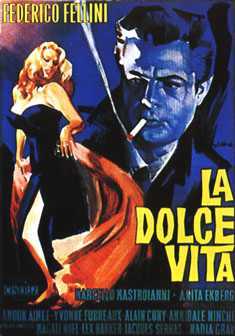
bc0c3-la_dolce_vita_1960_film_coverartStarring Marcello Mastroianni and directed by Federico Fellini, this Italian film set in Rome follows a tabloid reporter named Marcello. If he is not finding a scoop with other ravenous reporters, he spends time with his wary girlfriend, falls for an American bombshell, talks with a cultured family man, or spends time with his good natured father who he does not really know. All the while he witnesses the lives of the rich and has many romantic relations. The underlining theme of it all is boredom,  unhappiness, and superficial lifestyles. This film is not really about a main plot but rather Marcello’s many different episodes and experiences. Some are funny and others maddening, but he muddles his way through. This film, much like Breathless, is international and chic. The cinematography and score are both effective in helping to create this feel.

5/5 Stars

Rome, Open City (1945)

Directed by Roberto Rossellini this Italian neorealist film depicts the harsh realities of life in Rome during WWII during Nazi occupation. We are given an inside look at the bravery and everyday lives of these people. We become familiar with a fugitive engineer and resistance leader. He gains assistance from a kindly and collected priest who also runs a church. Their stories intertwine with a widowed woman who is just about to be remarried, a beautiful girlfriend, and a Gestapo office who is intent on stopping the resistance. After one tragic event everything continues on a downward spiral. The fugitive Manfredi and the priest, are both betrayed. Don Pietro must look on as the other man is brutally tortured to the point of death. Next, the Gestapo try to use the priest’s own beliefs against him and yet he will not yield either. He too then faces a fate just as horrible. This film at times was brutally realistic and it is perhaps one of the most moving films I have seen. We do not normally think of the struggles of Italians during WWII since Mussolini was allied with Hitler, however much like the French or even Germans, they faced tremendous danger and hardship. Furthermore, it humanized the Italians in my mind a great deal. This is the first film of the war trilogy that I have seen and now I want to see the other two. As you can see I’m still a little fuzzy on my Italian history and I would love to learn more.

5/5 Stars

The Leopard (1963)

Directed by Luchino Visconti and starring a stellar cast including Burt Lancaster, Alain Delon, and Claudia Cardinale, this Italian film revolves around a Prince and Patriarch during a period of social change in Italy in the 1860s. 

His Excellency the Prince of Salina (Lancaster) is a highly respected noble, who lives with his family on a large estate in Sicily. In his own life, the Prince is annoyed with his marriage and perturbed about the company his nephew Tancredi (Delon) is keeping. However, a revolution led by a man named Garibaldi means great change for the nation and finally following the lead of his nephew, who joins the rebel redshirts, the Prince sides with the new way and supports the plebiscites that are set up. His nephew falls for the beautiful daughter (Cardinale) of an aristocrat, and despite the fact that his own daughter has an eye on Tancredi, Don Fabrizo fully supports the marriage knowing it is good for the family. Because of his title and the respect he has garnered, the Prince is offered a position as a senator in the new government. But he courteously turns it down feeling he is too old and too attached to the old ways. Tancredi and Angelica are to be engaged and they are presented together at an extravagant ball. Over the course of the evening, Don Fabrizo has time to talk, dance with the young beauty Angelica, and reflect on his own life. As the lavish evening begins to dwindle the Leopard walks off to clear his head. 

In some respects, I saw this as an Italian equivalent to Gone with the Wind, and I could see some precursors to The Godfather here because the Italians portrayed are very religious and chivalrous people who can also be ruthless. However, I think it is fair to say that The Leopard is its own film entirely, and it should be taken as such. Tancredi and Angelica are no Rhett and Scarlett and the Prince is not the Godfather. They are their own unique characters. In my personal opinion, I would recommend the Italian version because that is the way the director meant it to be seen and Lancaster’s normal voice seems out of place in the film. Some may say that this detracts from his performance, but I think his presence and acting ability show through even if he is dubbed.

4.5/5 Stars