Suspicion (1941) – Alfred Hitchcock

Starring Cary Grant and Joan Fontaine with director Alfred Hitchcock, the film follows a young English woman who marries a charming man. However, he has gained notoriety for gambling and he also has a mysterious side. After telling his wife he is done gambling, he goes to find a job. Through a series of conversations however Fontaine’s character discovers her husband has been keeping things from her. Because of the tragic death of her husband’s good friend and other suspicious events, Fontaine begins to grow paranoid. She fears for her life as she is alone with her husband. In the final dramatic scene her situation takes a great twist. Although not Hitchcock’s best, in this film he does play with our minds as we too are constantly suspicious. Grant and Fontaine both give very commendable performances.

4/5 Stars

Dial M for Murder (1954) – Alfred Hitchcock

Directed by Alfred Hitchcock and starring Ray Milland, Grace Kelly, and Robert Cummings, this film tells the story of a married woman who has fallen for another man. However, her suspicious husband finds out and decides to have her murdered. Through a series of events he finds his murderer and sets everything up for the following evening. His plan goes awry and his wife lives so he must rush to cover up all his involvement. In the ensuing days Kelly’s character is accused of murder even though she was simply defending herself. She finds herself facing death and yet the clever police detective figures everything out. He realizes her innocence and traps Milland in his own plan. With the typical Hitchcock style and solid acting, this movie is full of many suspenseful moments and it became an early example of film making for 3D.

4/5 Stars

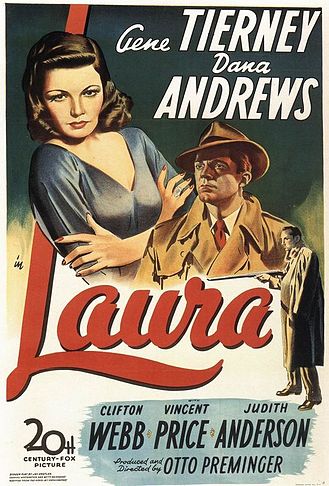
Laura (1944) – Film-Noir

fb137-laura23234If you have never seen Laura, I would first advise you to watch it and then look at my review afterwards. I do not usually do this but with Laura I think you should watch it beforehand. Enjoy!

*Contains Spoilers

Directed by Otto Preminger and starring Dana Andrews, Gene Tierney, Clifton Webb, Vincent Price, along with Judith Anderson, this is a great film-noir. With its voiceover narration, flashback, close-ups, shadowy atmosphere, plot twists, and hard-boiled detective, Laura is intriguing. From the beginning, this recently murdered woman who has a portrait on the wall, fascinates us. We follow the detective (Andrews) as he questions the columnist who helped make Laura succesful (Clift), and the playboy she was going to marry (Price). Soon Andrews finds himself also falling for this woman. However, everything changes when Laura reappears with seemingly no knowledge of any murder. After this development Andrews tries even harder to get at the truth with much difficulty. On a hunch he seems to crack the case however Laura is still in danger. In the final climax all is right again with the conflict over Laura.

5/5 Stars

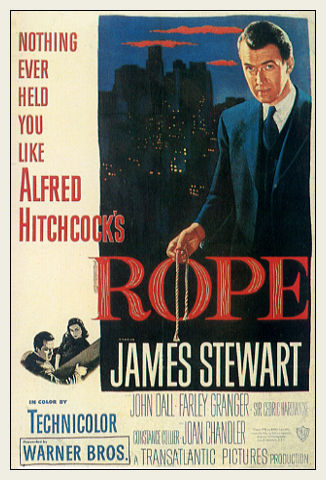
Rope (1948) – Alfred Hitchcock

eeca4-rope2What is the perfect murder? Hitchcock seemingly toys with this question in Rope . Starring Jimmy Stewart, Farley Granger, and John Dall, the latter two are students who murder their peer from university. Their only reason for doing it however is to see if they can get away with the crime. To complete their little experiment, they invite the boy’s family, his girlfriend, and other guests over to dinner, right in the room where they committed the murder. As an after though they invite their former professor (Stewart) who is the only one who would be able to catch them. At first Stewart does not suspect anything but eventually he becomes suspicious without letting on. Finally, the students lose their cool and Stewart catches them red-handed. This quickly puts an end to the perfect crime. This film is interesting because it was made to look like it was shot on one reel. Hitchcock’s movies are often known for the editing and yet this film was shot almost like a play in very long takes.

4/5 Stars

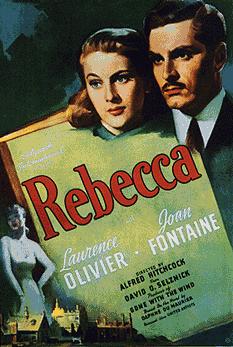
Rebecca (1940) – Alfred Hitchcock

This film directed by Alfred Hitchcock and starring Laurence Olivier with Joan Fontaine, was adapted from the Daphne du Maurier novel of the same name. The story begins in Monte Carlo where Max De Winter (Olivier) and a young woman (Fontaine) have a chance meeting as she is working for an older lady. Soon she learns that his previous wife died the year before. Fairly soon the two of them are attracted to each other and Max has plans of marriage and returning to his Manderley. However, back home the fairy tale is over and the new Mrs. De Winter is constantly tormented by the housekeeper Mrs. Danvers. Pretty soon Max himself seems to have changed. Confused Mrs. De Winter must learn what happened to Rebecca, the lady who was so enchanting. When she actually finds out the truth it is almost too much to bear. Like many Hitchcock films this one is certainly worth watching and it was actually his first American film. Olivier, Fontaine, George Sanders, and Judith Anderson all have very good performances.

4.5/5 Stars

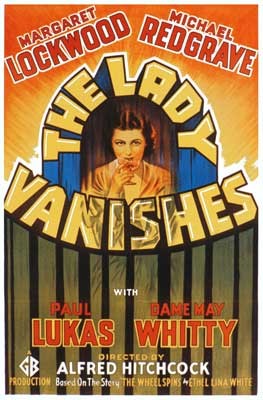
The Lady Vanishes (1938) – Alfred Hitchcock

Margaret Lockwood plays an American socialite in Europe in this Hitchcock mystery-thriller. The night before she is to leave, Lockwood meets a kindly middle-aged lady who is fascinated with European music. The next day the two ladies sit together on the train to talk. Being a bit disoriented, Lockwood takes a short nap however when she wakes up Ms. Froy is mysteriously gone. Seemingly no one remembers seeing the woman and no one will believe Lockwood. Finally, she teams up with a man who she had a run in with the night before (Michael Redgrave). Together they try to figure out what has happened to the lady. Finally discovering the truth, they come under great danger and must fight for their lives and those of the other passengers. Hitchcock does it again, bewildering the mind and making us intrigued at the same time.

4.5/5 Stars

39 Steps (1935) – Alfred Hitchcock

In one of Hitchcock’s great English films, he plays with the idea of a man on the run. Robert Donat is just an ordinary Englishman until a strangle woman tells him a deadly secret. Upon finding her murdered by a dangerous foe he flees. However, that puts him under suspicion and the hunt is on. He makes his way up to Scotland and gets some assistance however soon trouble brews. Somehow he finds himself cuffed to a woman he detests and he drags her away with him in order to escape. Due to their predicament, the unlikely pair soften to each other and try to discover the truth. After running for so long the answer finally comes to Donat  in the theater. He finally discovers what the 39 Steps are.

4.5/5 Stars

Vertigo (1958) – Alfred Hitchcock

acaeb-vertigomovie*May Contain Spoilers!

Vertigo is an intriguing Hitchcock thriller, set in San Francisco, that has you cheering for Jimmy Stewart as he falls in love and struggles with his fear of heights. Right away you are met with the haunting opening credits and the dramatic opening sequence where Scottie (Stewart) acquires his vertigo. From then on Scottie must cope with his dizzying condition however, he has no time to remedy it since he suddenly finds himself tailing a beautiful woman for a friend. Much of the rest of the film seems surreal with minimal dialogue and interesting cinematography, leading up to the death of Madaleine (Kim Novak). Then the film switches gears and is mostly about the impact on Scottie who had become infatuated with Madaleine. Often he appears to be in a trance and he becomes obsessive after meeting Judy who looks strikingly like Elster’s dead wife. Scottie becomes controlling, trying to make Judy into the image of the woman he loved. She just wants him to love her for who she is but that cannot be. Fittingly, the film ends the way it began with drama and tragedy. This certainly is a fascinating view of human psychology and complex emotions. In order to appreciate this film it is almost necessary to watch it at least twice, once to understand the plot and then another time to spot the little details. Of all of Hitchcock’s work, I would say I still enjoy Rear Window or North by Northwest better but this film at least deserves a viewing or two.

5/5 Stars

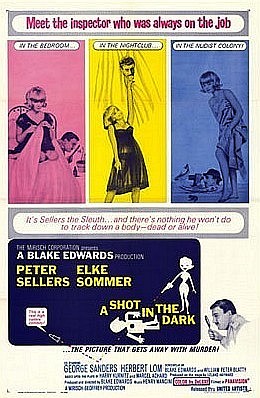
A Shot in the Dark (1964)

4a292-shot_in_the_dark

Starring a cast including Peter Sellers, Elke Sommers, Herbert Lom, and George Sanders, this comedy-mystery opens with several bustling individuals in a mansion, followed by a gunshot. A pretty maid who was found with the gun is assumed to be guilty, but the bumbling Inspector Clouseau thinks otherwise. He has run ins with his crazy boss, his man servant Kato, and the police, while he clumsily tires to solve the case. Everything seems to point to Maria after more murders. However, Clouseau spends time with her and it becomes evident to us that a black-gloved man is after him. In the melodramatic, chaotic final scene, Clouseau attempts to name the murderer, and the case is solved, no thanks to him. This second installment of the Pink Panther had some funny moments and the slapstick was very good.

4/5 Stars

Rear Window (1954) – Alfred Hitchcock

02805-rearwindowposterStarring James Stewart, Grace Kelly, and Raymond Burr with director Alfred Hitchcock, this is a superb film that takes place in a very limited space. L.B. Jefferies (Stewart) is a professional photographer who is incapacitated in his flat with a broken leg. All he has to pass the time is watching the people across the courtyard. Although he very rarely interacts with them, he slowly begins to know them just by spectating. Pretty soon he realizes something is amiss when the annoying wife across the way is no where to be seen and her husband (Burr) is acting strangely. With help of his ravishingly beautiful girlfriend (Kelly), Jeffries tries to uncover the truth. Everything escalates when Lisa breaks into the man’s apartment and it finally peaks in a climatic confrontation. In the end all is well and Jeffries realizes his true love. This is one of my favorite films because of its unique setting and it is possibly Hitchcock’s best. He takes an environment that is so confined and then makes a very entertaining and suspenseful film with it.

5/5 Stars