Silk Stockings (1957)

silk stockings 1.png

In full disclosure, though I admire Ernst Lubitsch’s directorial eye and Billy Wilder’s trenchant wit, the Ninotchka (1939) premise alone never intrigued me. But as with all the great pictures, it’s not necessarily the main conceit but the execution of the story with its own unique digressions which matters most.

That’s why having screen goddess Greta Garbo paired with the two men mentioned above is of note. They ultimately created something delightful together. And as we draw the line all the way to Silk Stockings almost two decades later, the names attached are equally important.

We can probably start with Fred Astaire who was in a period in his career that constantly seemed to fluctuate between retirement and flurries of inspired activity. In this particular case, he would follow Silk Stockings out into the theaters with a second success in Funny Face (1957) pairing him with Audrey Hepburn for the first and only time.

Though he had his initial misgivings about the material and his director, Rouben Marmoulian proved to have quite the success with Silk Stockings, which would subsequently be his last effort in a generally underrated career. He took the successful stage play and transferred it to the screen, this collaboration even featured several more tunes from Cole Porter’s repertoire while writers such as Leonard Gershe (who had already penned Funny Face) and industry veteran Harry Kurnitz worked on the script.

Then, Cyd Charisse had the seemingly insurmountable task of inheriting the role owned by a larger-than-life star if there ever was one — Garbo herself. And yet maybe it’s a reflection of my own predilections in performers but I rather like Charisse in the part not because of the acting per se but for the moments where she’s able to shed the role and become the sentient ever dynamic being she is as a dancer.

The ball starts rolling when an American film producer, Steve Canfield (Astaire) tries to coax a brilliant Russian composer named Boroff (Wim Sonneveld) to compose the score for his next film. Simultaneously three of his countrymen have been enlisted as emissaries on Parisian soil to bring him back home before he gets polluted by capitalist dogma any further. The oafish louts are eclectic talents as diverse as Peter Lorre, Jules Munshin, and Joseph Buloff.

Of course, if you know anything of Ninochtka (1939) or retrospectively, Wilder’s similar One, Two, Three (1961) you’ll know that they too get seduced by the decadence of capitalism to humorous ends. It seems there is only one person who will not fail in her mission, that is Ninotchka (Cyd Charisse), an austere devotee of the party whose only interest is observing French trivialities on a purely academic basis while making sure her comrades remain diligent in their duties. She’s a tough case to crack. It’s bound to take time and yet at some point, Canfield gets to her with a little help from “The City of Lights.”

Janis Paige enters and wows the reporters and everyone else with a tornado of flirtatious vivacity captured in the number “Glorious Technicolor Stereophonic Sound.” Like It’s Always Fair Weather (1954) before it, the musical number manages a few jabs at the direction the industry was heading with the advent and subsequent cultural boom of television. And yet in his shrewdness, Astaire lobbied for the picture to be shot a very specific way and sure enough, it got made in Cinemascope and Eastmancolor with Stereophonic Sound.

silk stockings 2.png

After shedding her dour exterior, Cyd Charisse gets arguably her finest starring spot in any film, playing opposite Astaire again following The Band Wagon (1953) and despite the constraints of her character, she fairly rapidly transforms into the free-flowing, immaculately graceful spirit we know her to be.

Fittingly, Charisse earns the film’s most emblematic scene where she exquisitely dons her first pair of silk stockings along with an entire wardrobe as she goes through her ideological transformation which subsequently transforms her very movements with carefree ease. She brings it to life moment by moment so effortlessly. In “Fated to Be Mates,”  Astaire and Charisse are featured together at their most lively as the leading man leads his partner in twirling carries and their dance devolves into a show verging on parkour and gymnastics.

Along with the amorous “All of You” to instigate his relationship with his repeatedly aloof leading lady, Astaire gets another contemporary showcase that simultaneously alludes to his rich legacy in the industry. “Ritz Roll and Rock” perfectly encapsulates this performer-extraordinaire who came out of a certain era and yet never seems outmoded even in the latest music craze.

He went out on top and continued to perform at that same level to the very end. Not every leading man can say that. Of course, the exclamation point at the end is the smashing of his top hat for all posterity. As we’ve all probably noted over the years, it’s a bit of a moniker for him and fittingly when he’s gone, it’s retired too. No one else deserves to wear the crown of the king.

3.5/5 Stars

NOTE: My entry in The FRED & GINGER BLOGATHON !


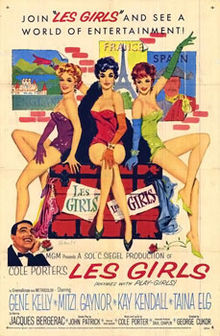
Les Girls (1957)

220px-Les_Girls.jpgClassic Hollywood musicals usually have a very common framework that they rarely seem to deviate from. There’s almost an accepted unwritten rule that they will function like so. Typically, there is an overarching story being told and yet the narrative is conveniently broken up by song and dance routines that not only provide immeasurable entertainment value and give an excuse for talented performers to strut their stuff but also serve to move our movie forward comedically, romantically, dramatically, whatever it may be.
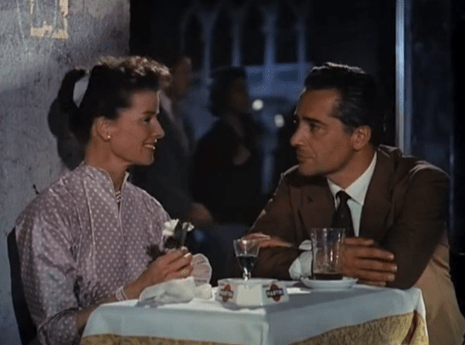
Thus, Les Girls is a generally absorbing musical simply in terms of its mechanics. They stray slightly from the set formula. It’s a bit of a Rashomon (1950) plotting device. If you will recall, Akira Kurosawa’s film famously told the same turn of events three times over from three differing perspectives. That’s what happens here, in a sense, with the action being set partially in a courtroom (a first for a musical) and then the rest on the road with theater performers.

It all comes into being because of a libel suit that has broken out between two former colleagues who used to be a part of Barry Nichols’ Les Girls act that was a smashing success in its day. But following the publishing of a tell-all memoir and suggestion of a supposed suicide attempt, blood is boiling between Frenchwoman Angele Ducros (Taina Elg) and British-born Sybil Wren (Kay Kendall) who had the gall to publish such a story.

Of course, there are actually three ladies in question, the third being the peppy American Joy Henderson (Mitzi Gaynor) who rounds out the act and, of course, Barry finds himself romantically linked to each one though he specifically makes a habit of never falling in love with his fellow dancers. It proves a hard rule for him to keep but for the audience, it gives us a good excuse to see Gene Kelly share at least one moment on the dance floor with each of his talented costars individually.

This proved to be the final film score of America’s beloved songsmith Cole Porter and he provides a few moderately memorable numbers including the title track. Kay Kendall is thoroughly convivial to watch as a comedienne and performer throughout with her number “You’re Just Too, Too” being one of the most playful in the picture.

Meanwhile, the final number with Kelly and Gaynor is a blast full of romance around table and chairs. But the real kicker is feisty Mitzi Gaynor letting Kelly have it over the head with a picture frame, deservedly so, I might add. But in the end it all comes to naught, the court case is dropped and we are left with an open ending that’s winking at us. At least everyone’s happy.

Though he is not often remembered as a musical director, in some sense, George Cukor seems well within his element with the material at hand always adept at bringing together stories of behind the scenes antics and goings on between women and their men. That’s precisely what we have here.

This would prove to be Gene Kelly’s final film with MGM after an illustrious run. You also get the sense that perhaps this character is closer to the real Gene Kelly — the man who was constantly called a perfectionist and recounted later by Esther Williams to be a terror to work with. And here he still has a dose of his winning charm but there are also signs of that dancing slave driver working his girls to the bone and unwittingly romancing them at the same time. Still, there’s no doubting his inspired screen presence that underlines nearly every picture he was ever in.

It’s true that a previous iteration of the film was to have included Cyd Charisse, Leslie Caron, and Jean Simmons. That would have been an interesting combination to be sure but what we got here instead is still a stunning and at times thoroughly unconventional musical.

3.5/5 Stars


Sunday in New York (1963)

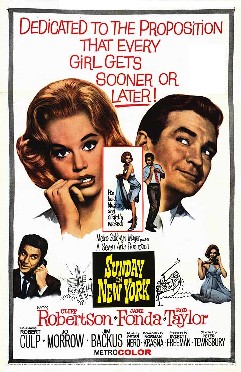
Sunday_ny_moviep.jpgIt would appear that a film like Sunday in New York would never exist today. First, it’s obviously rooted in a stage play and it functions with the kind of moments you might expect out of some of Neil Simon’s works around New York though this particular story was crafted from a play by longtime screenwriter Norman Krasna who wrote many a screwball comedy back in the day.
But this is a film of the 1960s and it looks as such by today’s standards because it’s a chaste sex comedy that is charmingly madcap in its romance and numerous mishaps all while dodging around the social mores of the day. It’s never biting, always palatable, and fairly tame fun given its central themes.

New York becomes a lovely place for a pit stop over the weekend. Numerous people are headed there. First on the list is an airline pilot (Cliff Robertson) who is titillated by the prospect of a whole day alone with his best girl. Of course, being on active call near a busy terminal can be very aggravating for your love life and he and Mona constantly find themselves spending more time on the opposite ends of a telephone than actually together eating bagels and doing whatever else they normally do.

Then there’s Eileen (Jane Fonda), Adam’s little sister who is trying to get over a breakup with her beau. As a young, naive 22-year-old, she’s still trying to figure out the conventions of society and she goes to her big brother for advice on life’s most important questions. He’s someone she can trust about this particular issue.

The fact is she’s still a virgin (Gasp!). He does the brotherly thing and commends her as a respectable man will come along sometime for her. Meanwhile, he conveniently equivocates about what his romantic life looks like.

She does meet a man (Rod Taylor) and there is something between them rather odd at first and then strained by sexual tension and finally complicated by the fact that first her beau (Robert Culp) and then her brother Adam both come back and she must explain the presence of her guest. The film has plenty of comings and goings and while the plot is nothing new and noteworthy the cast makes it work rather well.

Jane Fonda gives a delightfully radiant performance opposite the always personable Rod Taylor with a meet-cute that’s so obviously absurd that it’s easy to laugh it off and simply enjoy it. They get thrown together on public transportation, aboard a bus, but the lady’s jacket gets caught on his coat and they must proceed to exit together. One of those awkward rom-com trifles. The film is full of these cute moments. Little do they know they will be spending a great deal more time with one another on a Sunday in New York.

3.5/5 Stars

Pushover (1954)

pushover 2.png

A film such as Pushover is easy to admire for the simple fact that it does not waste a moment in telling its story. As the credits roll a bank job is already in full progress laying the basic groundwork for what will unravel in the subsequent minutes.

The introduction of our stars follows soon thereafter in a meet-cute happening outside of a local theater, the pretense being engine trouble. It’s enough of an excuse for them to make a connection — two people who started the evening on their own but felt enough of a spark to wind up together.

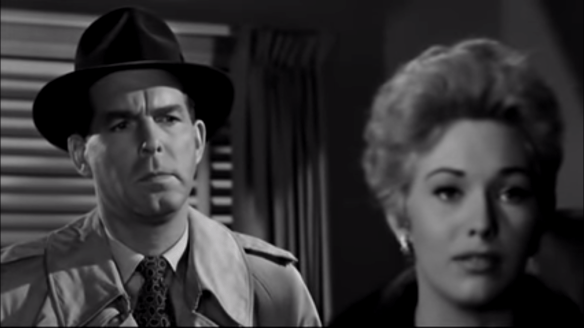
Of course, when we pull back it’s easy to realize a pretense is all that it was. Paul Sheridan (Fred MacMurray) is a cop tasked by his police chief (E.G. Marshall) to help recover the $200,000 that was nabbed in the bank job. The alluring young Lona McLane (Kim Novak) ties into it all because she was the one-time moll of wanted thug Harry Wheeler.

Thus, the police soon have her apartment under surveillance and her phone tapped for any hint of contact with the gangster. But what they weren’t counting on is for Sheridan to fall for her and put his own stake in getting back the missing money. Meanwhile, his partner Rick trusts him completely and the old vet Paddy is just trying to limp by to retain his pension.

What develops is this strange dichotomy between what is the ethical long arm of the law and what is pure voyeurism encroaching on a person’s right to privacy. Though it doesn’t explore the topic as Rear Window (1954) did that same year, there are still some interesting issues to be culled through.

Further still, despite being a policeman, Sheridan’s personal philosophy seems to be that money makes the world go around. Although he’s quite a bit older, there’s still much to enjoy about Fred MacMurray. Even if his occupation has changed, there is a sense that he’s playing another thinly veiled version of Walter Neff, that pragmatic everyman not fully prepared for playing with fire. Since that role was one of the ones that lit up his career, if this is a mere copy, it’s still a fairly enjoyable one placing him opposite Novak’s femme fatale.

There are passionate kisses that strike like lighting, some gorgeous shadows that easily help to put this into the dark recesses of the noir canon, also reflected by the number of cigarettes smoked and the loose morals that run through the narrative.

Even in her scintillating debut, Kim Novak’s voice is as husky and sultry as ever. Whether wearing her mink coats or driving her sleek wheels. Smoking her cigarettes and coolly spilling her drinks on anyone who gets fresh with her.

But she is not one of the independent strong-willed dames out of the war years. She is not Phyllis Dietrichson. She comes from a different generation and so, far from being a manipulator, it feels far more like she is willingly complicit in Sheridan’s plan as he takes the reins. In fact, it’s difficult to call her a femme fatale at all in the typical sense. It’s really the men around her who are crooked and more than anything she garners sympathy.

Phil Carey plays the stalwart cop who stands by his colleagues but he’s also no schmuck when it comes to laying down the law. The ever-active nurse next door (Dorothy Malone) who shares an adjoining wall with Lona becomes the object of his desire and it conveniently sets up parallel love stories. We now have two cops and two gals. Two romances and a line of entanglements as Sheridan tries to sidestep his colleagues and get the payoff for his own and for his beautiful new accomplice. Pushover develops into a delightfully messy piece of drama full of police corruption and avarice. But it’s a small-time story too. That’s part of its charm.

3.5/5 Stars


Kiss Me, Stupid (1964)

KissMeStupidPosterWhile a less heralded picture, this Billy Wilder film is a minor classic built around a contrived comedic situation. Dean Martin opens playing a parodied version of himself as Dino the boozing, womanizing, but altogether good-natured playboy who makes a short pit stop in the gas station of the small town of Climax, Nevada following his latest Las Vegas circuit.
The beauty of his performance, though it may be exaggerated, there is no sense that this is a thinly veiled caricature. It’s blatantly obvious that “Dino” as he is called in the film is really only playing his “Rat Pack” persona that was known the world over.

That sets the groundwork for the film’s self-reflexive nature that is keenly aware of its cultural moment and the preoccupations of the general public as with many of Wilder and I.A.L. Diamond’s best scripts.

Truthfully I’ve always been fond of Ray Walston ever since my first viewing of My Favorite Martian and before this picture, he cropped up in Billy Wilder’s The Apartment (1960). Although I do adore Peter Sellers (who had to bow out due to a heart attack) and he’s often an ad-libbing genius, somehow Walston seems to more aptly fit the bill here.

That doesn’t mean I don’t regret that Jack Lemmon couldn’t take the role because he really was Billy Wilder’s greatest comedic counterpart, portraying every bit of neuroses that manifests itself in the middle-class everyman. He just gets it and putting him opposite his real-life wife in Felicia Farr would have been another delightful ironic layer to this comedy with its roots in infidelity.

No matter. It was not to be and what we are left with is still some fairly hefty star power. Walston audaciously takes center stage as Orville Spooner, a small town piano teacher with a paranoid fit of jealousy in relation to his gorgeous wife (Felicia Farr). He believes everyone from his teenage pupil to the local milkman is out to pluck his bright-eyed, loving bride away from him.

That’s of the utmost importance when his buddy (Cliff Osmond) dreams up a plan to get themselves a contract deal with Dino. It involves hosting the conveniently laid up pop singer, getting rid of Orville’s wife, and employing the services of one of the main attractions at the local watering hole The Belly Button — the one and only Polly the Pistol (Kim Novak). It seems simple enough to get her to masquerade as Orville’s wife just for the evening so she can make Dino feel at home.

You can see already that the narrative is entangled with bits and pieces of The Apartment (1960) and The Seven Year Itch (1957). Miscommunication and four parties involved means all sorts of foreseeable consequences. Kiss Me, Stupid is also fully aware of the contemporary Hollywood framework much in the same way of Sunset Blvd. Thus, it’s not above satirizing the ways of the entertainment industry — especially the movie stars — with the Rat Pack placed front and center thanks to Martin.

The small-time piano man and gas station attendant also have dreams of being the next Henry Mancini & Johnny Mercer dynamic duo with aspirations for The Ed Sullivan Show no doubt.

Even in its throwaway lines about churchgoers, there’s something starkly sobering being acknowledged as there are in many of the things that Wilder finds time to take a jab at. The owner of the Belly Button, Big Bertha, has all her girls attend the local church because she thinks it’s good for public relations.

It passes like a blip but the suggestion seems to be that these lines of dialogue and what we see on screen might point out some kind of hypocrisy and although it’s played for comedy, instead what I see is the inherent brokenness.

The film spins in such a way that the infidelity somehow ends in a kind of loving understanding that feels like utter absurdity but maybe Wilder has done that on purpose. Still, in spite of myself, I found some humor in this film in ways that I never could in The Seven Year Itch or The Apartment.

The first was too empty with little to offer of substance and the second is often too stark and morose to be funny. This film is raucous and utterly insane in a sense but that’s the way Wilder likes it from Some Like it Hot (1959) to One, Two, Three (1961). Kiss Me Stupid isn’t such a spectacular comedy with some misfires but there’s no doubt that Wilder still has his stuff.

He always seemed to take a very basic concept that was wacky and far from allowing it to fizzle out, he sees it to completion, finding an ending that derives laughs while simultaneously providing wry commentary.

In another screenwriter’s hands or another director for that matter, the romantic comedy aspects would be endangered of becoming trite and uninspired but no such issue here. Wilder would never allow it.

The punchline of Kiss Me, Stupid is that both spouses were deceptive and unfaithful but they do it out of love — that final touch of trenchant Wilder wit. Ultimately, the film’s title is reminiscent of the famed quip in The Apartment (1960), “Shut up and deal.” You get the same sense of the relationship.

The men are essentially cads — spineless at times — and lacking much of a moral makeup (even if Orville plays the organ at church) but their women seem to give them some substance whether they be barmaids or plucky housewives. It’s still slightly mindboggling that Wilder pulled this movie off and got away with it no less.

3.5/5 Stars

Hollywood Canteen (1944)

hollywood canteen 1.png

This propaganda extravaganza showcases Hollywood in all its glory from the Brown Derby to the Hollywoodland sign and of course the pride and joy of wartime morale-boosting, the Hollywood Canteen.  It’s a bit of a faux reality, Hollywood’s rendition of what real life might actually be like since the Hollywood Canteen did in fact exist.

Historically, it began as an effort by John Garfield and Bette Davis of all people to support the troops and give them quality entertainment from the entertainment capital of the world. Though newsreel footage might serve as a better historical marker (albeit still biased), there’s no questioning the patriotic waves flooding through this picture.

True, even in this film there are anecdotes that point to a slightly different reality. Namely the fact that this was meant to be a Hollywood wide endeavor but all other studios balked and so the lineup is filled out by Warner Bros. catalog of stars and them alone.

Furthermore, it’s easy to surmise that far from being overcome by patriotic fervor, Joan Crawford probably took her role because the alphabetical billing conveniently put her above a couple perennial rivals in Bette Davis and Barbara Stanwyck.

Even with its authenticity in question, there’s no doubt that the film boasts talent. There’s an inexhaustible array of song & dance from the likes of the Andrew Sisters, Roy Rogers (with Trigger) and Jimmy Dorsey.  The stars also come out in full force with cameos from everyone conceivably under contract to Warner Bros from Kitty Carlisle, Jack Carson, Joe E. Brown, Ida Lupino, Jack Benny, and of course Peter Lorre and Sidney Greenstreet staying in character. Each one provides enough star power to fill in the idle moments around our main love story.

Still, there’s no doubt that Joan Leslie was one of America’s sweethearts and it’s no coincidence that our protagonist falls head over heels for her all the way in the South Pacific. The pair of lovebirds represents all that is seemingly good and upright about American ideals even if she is a movie star and he is only a common soldier.

That makes the prospect of actually meeting her beyond his wildest dreams, but Hollywood purportedly is in the dream making business and so Slim gets his wishes granted. A date with his dream girl is soon arranged by those tactful matchmakers Davis and Garfield.

Robert Hutton is almost uncannily reminiscent of Jimmy Stewart who was at the time leading bombing raids over Germany. It seems little coincidence that he would then land the crucial role as the universal soldier Slim — a man who saw his share of action and is home for a short spell — before heading out on his next tour of duty.

He represents all the boys fighting for not just the Red, White, and Blue but every color and creed. In his very starry-eyed and candid way, he mentions each one as the camera picks each out of the crowd. Curious the only group not mentioned were members of the Japanese-American infantry. Yet another incongruity with the world at large. But the red carpet that is rolled out for him at the Hollywood Canteen is meant to be only a small recompense for all his service to his country.

Delmer Daves’s picture much like Stage Door Canteen (1943) fits the realm of saccharine propaganda, even blatantly so, but if you allow yourself to be carried away by the historical moment it has its certain charms.

True, the Home Front or the Allied cause isn’t quite as unified and squeaky clean as it claims to be just as humanity on the whole and the stars behind Hollywood rarely could hold up to scrutiny. However, there’s still something here that can make you smile. Publicity stunt or not. Maybe it’s the romantic in me that likes to believe there’s at least a kernel of truth in here and if nothing else there’s honest to goodness sincerity.

3.5/5 Stars

Review: A Place in the Sun (1951)

a place in the sun 1.png

George Stevens is only one among a plethora of filmmakers who came back from WWII changed. He had seen a great deal of the world’s ugliness — Dachau Concentration Camp for instance — and as a result, the films he made thereafter were more mature ruminations on humanity at-large. Adapted from Theodore Dreiser’s An American Tragedy and a subsequent play, A Place in the Sun is one of those pictures crafted in the wake of such historical change.

There’s no doubt that this is Hollywood melodrama backed by a raging score from Franz Waxman but this is no less, high powered high-class stuff. It’s augmented by gorgeous black and white imagery that reaches pitch-black tones and still manages to make Lake Tahoe into a scintillating getaway. Meanwhile, the camera captures the action with elegant movements, sashaying through space, at times nearly imperceptible to the eye. Though admittedly the film’s stature as a social commentary is less interesting now than it probably would have been in its day. Still, we can’t have everything now, can we?

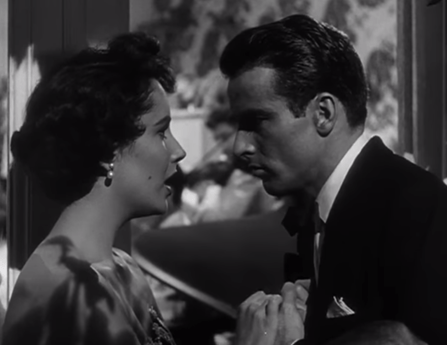
Montgomery Clift is often forgotten in the fray of powerhouse actors but the line can easily be traced from his intense performances to the work of Brando and Dean which would also sprout up in the 50s. Though that same intensity is there, it never feels like he’s trying to sell us a gimmick or a method. He’s simply trying to provide a lens to see a bit more clearly the intricacies of an individual, in this case, one George Eastman. It manages to be a profound and at times an agonizing performance.

Of course, Elizabeth Taylor is exquisite in every frame as always but her bright-eyed sincerity is equally arresting. She feels perfectly made for the role of Angela Vickers and seamlessly transitions into more adult fare with A Place in the Sun, standing tall alongside Clift, destined to make them one of the great romantic pairings of the 1950s. She supposedly said that she finally felt less like a puppet and more like an actress after this film. It shows.

Still, though given a thankless role at times, Shelley Winters is equally important because, in her simpler, humbler way, she reflects how quickly a man can change. She’s not a bad person at all, just a frail, even helpless one who feels like she has very few people in the world to hold onto. George proves to be a comparable companion until he unwittingly finds himself running in different circles and that’s where the tension begins.

I look at George Eastman and see the same drive for recognition, power, and wealth in many of us, those desires that oftentimes can be our undoing because they turn out to be meaningless. The irony is that his intentions never seem malicious but he is undermined by something. He quickly sinks into this double life. At first, he was simply happy to have a job and some companionship. His desires were simple. But slowly, as he found himself rising in the ranks of the Eastman company and getting more recognition, he couldn’t help but want more. Are these impulses bad? Not in the least, but they led him to some pretty rocky soil.

The scene that stands out in my mind could seem fairly mundane. But Stevens maintains a fairly long shot that’s peering through Eastman’s living room and we can see into the next room over as he is on the phone. It feels like minutes go by and Stevens fearlessly never cuts the sequence. The first call is from Alice which he takes.

But the second comes from Angela and at that point, we know that things have changed. It’s set up the dilemma. He genuinely loves Angela and wishes to be with her and to be a part of her life. Yet for that to come to fruition he must do something about the other girl. Alice won’t disappear. It’s funny how someone who you used to appreciate so dearly now feels like a burden. To her credit, we feel sorry for  Winters’ character without question.

In fact, the film succeeds along those lines. We pity her for the sorrowful position she is placed in — essentially abandoned by George. And even in her frivolity and opulence, there’s a candidness to Angela that makes us want to root for her and that allows us to simultaneously pity her because she has no idea of George’s other life. If there is anyone to lash out against it is George Eastman himself and still even in that regard, Montgomery Clift reveals the full gamut of this tortured man so even if we are hesitant to feel sorry for him, he does open us up even with a tinge of compassion.

But the muddled morality is complicated by the fact that Clift’s character has a sense of remorse. Surely he cannot be all bad based on what Vickers saw in him? His capacity to love and be tender is evident. Still, that is not enough to keep him from going on trial and the film’s final third takes place, for the majority, in a courtroom. The district attorney is played by Raymond Burr, who might well be in a dry run for Perry Mason and he comes at Eastman with all the fervor he can muster to convict him in his lies. Even in these moments, we must fall back on George’s inner conflict, his capability to love others, and his intentions for love.

If A Place in the Sun gets too preachy or succumbs too much to Hollywood’s stirringly romantic tendencies, it still might be one of the finest examples of such a film. Front and center are two phenomenal stars and Stevens films their euphoric romance with a meticulous eye, catching them in particular moments, with close-ups, and such angles that we are constantly aware of their intimacy.

As much as Eastman is looking for his place in the sun, and he could spend hours just sitting with Angela soaking in the sun’s rays (not many would blame him), it’s just as true that there is nothing new under the sun. That’s what we’re left with. Mankind is still distracted by many things. Oftentimes they are good things, but we make them ultimate things, and they wreak havoc on our lives. Meaningless, meaningless, everything is meaningless under the sun. But that doesn’t keep us from wanting to bathe in its tantalizing warmth any less. That’s part of the American Tragedy.

4.5/5 Stars

Densha Otoko (2005)

densha otoko.png

In English, it means Train Man and it finds its origins in a media franchise that now includes Manga, a book, a television show, and of course this movie. But the events of the story are purportedly based on real life when a young otaku (Japanese tech nerd) in Akihabara came to the defense of a woman on a train who was being accosted by a drunken businessman.

This isolated, geeky 22-year old male was her knight in shining armor and probably had never talked to a girl before in his life. Every syllable comes out of his mouth jumbled, rushed, and breathless. If they were American we would say that she’s out of his league — the head cheerleader or what have you.

But the film is blessed because it is set in Japan. Densha Otoko proves to be part dorky rom-com while also giving us a view into a unique subculture. While it deals in stereotypes somewhat, we see his constant communications taking place over online chat and although it’s dated by today’s standards the Akihabara vibe is unquestionable as is the integration of technology into modern day romance.

At the time we were on the cusp of where we’re at now and you see the signs of it. Flip phones and laptops on the train. People at their computers at work and home. Such luxuries have become increasingly more invasive and some might say they have come at the detriment of human relationship.

What this film does well is to consider both rather implicitly with online friends on one side acting as his constant peanut gallery offering conflicting pieces of advice, constant pep talks, and further considerations as they all analyze his prospects as a body.

Then, of course, we have this demure woman he stood up for on the train. She might be the Japanese iteration of a manic pixie dreamgirl — granted I’m not sure what that means exactly — no matter she’s considerate and sweet. Their interactions continue with a present sent as a Thank You, then a dinner where they split the bill, and several other affable encounters.

The film’s aesthetic might be off-putting to some as it reflects a world constantly interfacing with their screens. Further suggesting the interweb of relationships that are created where people only know each other online, denoted by a continuously split screen and yet their lives spill outside of that and we get a small taste of not just Densha Otoko but all of his fan club. These characters too could have used more definition but they serve their purpose.

Train Man pushes onward and enters territory that none of them could have ever dreamed of. And he does it by being as nervous and frantic and considerate as ever. He gets a haircut (thank goodness), buys some new duds, and tries a few other techniques. Researching dinner conversations and testing the food beforehand. It’s actually quite sweet if he weren’t so uncomfortable to watch. But then again, who am I to judge?

Still, what matters is the time they spend together. It’s pleasant and kind not interrupted by awkward kisses or embarrassing hijinks with best friends. It just the two of them and he tries to discern how to move forward with this girl on that ever perilous tightrope of male-female relationships. They’ll at least have men befuddled for eternity. I can’t speak for the ladies.

That’s not to say there aren’t throw away moments or wacky and slightly peculiar ones that we probably could have done without. I won’t bother listing them because most importantly the film remains in our good graces for what it’s mainly set out to do. Allowing a socially awkward underdog a chance to shine. Through all his tripping and falling, sniveling and awkwardness, he gets some amount of satisfaction.

Consolidate it down to its best themes and scenes and you have a rewarding picture of just that. Because after all, it’s fairly easy to forgive a heartfelt movie like this for its gaffs since even in those very things it’s staying true to its core hero: Densha Otoko.

Likewise, I’m going to stick by my guns and enjoy this film perhaps more than I should have and yet in its innocence and jubilation, I found something that is so often lacking in American films trying to work within the same genre. Tighter editing would have been a major benefit but I’ll always hold that sincerity covers a multitude of faults. Call me an old softie if you will but maybe it’s the fact that I’m probably an otaku at heart. Whether he gets the girl or not, he has my sympathy.

3.5/5 Stars

Review: Hiroshima Mon Amour (1959)

hiroshima mon amour 1

Like you I know what it is to forget and yet still be endowed with memory. These are only a couple fragments from this film stitched together but in many ways, they encapsulate the essence of its core themes.

I suppose such words ring true for all of us and Alain Resnais’ film is composed of a plethora of equally perplexing paradoxes that though never quite coming into full clarity nevertheless prove Hiroshima Mon Amour to be one of the most bewitching cinematic expressions born out of the French cinema. Without question, it is an undisputed touchstone of the forthcoming Nouvelle Vague that blew up the conventions of the 1960s.

The first time I ever saw Resnais’ romantic meditation there was something so arresting about it such that I will never forget the likes of Nevers and Hiroshima — the two entities that make up this film as not simply places of past tragedy but crucial to the very identities of the characters who come within the frame.

We never need to know the true names of this French actress (Emanuelle Riva in a riveting performance of immense grace) and the equally candid Japanese architect (Eiji Okada) who fall into the throes of a passionate affair together. They are represented well enough by these monikers — symbolic torchbearers of these names — emblematic of the age they ascribed to.

Like L’Eclisse (1961) or Dr. Strangelove (1964), this film too is in the wake of the atomic bomb and any subsequent discussion thereof cinematically speaking must at least acknowledge such films. Part of the necessity in this specific case is how the film takes a particular event and then extends it and intertwines it with so much more in such a way that it not only a monument to Hiroshima but a testament to human history.

We are people so quick to forget. We lose sight of the past. We bury our hurts deep inside. We are doomed to repeat many of our past mistakes. But still, more so we are capable of passions, emotions, and love that carry us through times of tribulation, pain, and suffering. It’s something to be immensely thankful for.

Resnais film is one of the great visual marvels of the 20th century with its graceful fade-outs and flashbacks — delicate camera zooms connecting memories and realities. Stylistically there’s a continuous poetic cadence of image and dialogue, repetitions with recollections. A solemnity exists in its very purposeful pacing that ties everything together with the utmost elegance which, far from being a muddled hodgepodge, forms a perplexing experience never to be fully elucidated.

It has very few equals and remains so as an achievement that can hardly be defined as a typical love story or any such blase categorization. It’s what we might conceive when we think of Film as art worthy of any sphere of discussion.

There’s hardly a meter to begin measuring how it makes us feel or the emotions it elicits.  Somehow connected to fate — two lovers crossing paths — these two individuals seemingly meant to be together and tied together not only by their romantic passion but their own histories. The striking flashback structure subsequently creates tiny microcosms of emotional resonance that flood with abandon.

Recollections of past scars unearthed over the course of the love affair. Both historical and personal. We have the depiction of the devastation in the aftermath of the bomb with images that are all but scorched into our mind’s eye with an unfettered pointedness. We are meant to see these images and take into account how they came into being.

But there’s also the personal trauma brought to the fore and exhumed with a kind of transfixing equanimity that’s hard to fully comprehend but nevertheless leaves us with something to ruminate over. Equally telling is the passage of time as memories begin to fade and minds begin to slowly forget. Again, that is the curse of our beings that we must fight to remember what has come before.

It’s no small coincidence that the cafe that our two lovers rendezvous at is none other than the Casablanca. The yearning and the melancholy are right there in the lyric of “As Time Goes By.” If you’ve never consciously thought about their meaning before then Resnais film might make you hear them anew and be moved.  Love, memory, and heartbreak are often so closely tied together. This is a film that dwells on each and finds some amount of catharsis.

The diversity of the crew is another glimmering bright spot of this joint partnership between nations with an abundance of involvement from both French and Japanese staff taking the shoot on-location to both countries. It’s a lovely marriage and a bond is formed by the picture just as the romance signals a tight-knit cross-cultural relationship on screen.

For some, individuals somewhat attuned to diverse backgrounds, Hiroshima Mon Amour is utterly groundbreaking in this realm. Though its cast is small, it’s a mighty statement having a French woman playing opposite a Japanese man. 50 years on it remains as an image that we do not see all that often, despite the changing of the tides.

Their closeness is palpable. Hands clasping tenderly. Eyes gazing with the deepest longing. The intimacy that they share speaks volumes. Even as it’s undercut by the morose strains of infidelity and wistfulness; this is a love story like few others.

4.5/5 Stars


My Sassy Girl (2001)

my sassy girl 1.png

We meet a college-aged Korean guy (Cha Tae-hyun) as he relates his first encounter with the girl (Jun ji-hyun) who would ultimately become his girlfriend. In the throes of a drunken stupor, she flails perilously near the railway as an incoming train comes on so he steps in to pull her back to safety. They board minutes later — he’s still watching her warily — only for her to puke all over a commuter.

Assuming he is the boyfriend, Gyeon-woo is chastized to do something about his girlfriend and so reluctantly he takes her still intoxicated by piggyback to the nearest hotel. This whole complicated scenario happens to him twice and it lands him in jail.  It doesn’t sound like the pitch-perfect moment to start off a romance but then again My Sassy Girl never has perfect pitch and that’s where it succeeds.

The film opens with these exaggerated comically cringe-worthy interactions and yet it settles into something far more fulfilling than its attention-grabbing gross-out antics. While Gyeon-woo gets all but pulled into the scenario you realize that there was a single decision. He cared enough to intervene on this girl’s behalf. Maybe he regretted it but it’s doubtful.

What was his life beforehand? Fairly inane and nondescript. He hangs out with his buddies as they grunt about inconsequential things. His face is prone to glazed over expressions. He’s constantly whining to his mother over the phone after forgetting to visit his Aunt — the Aunt who always pinches his cheeks and tries to set him up with an eligible girl. When he’s not getting swatted at by his mother at home, his father gives him a going over for not getting better grades. He’s a rudderless young man with no true conviction or sense of purpose. He’s in need of some kind of shakeup.

my sassy girl 3.png

The Girl (who is never given a name) is actually the one who dictates the sheer unpredictability and consequently, the hilarity of the picture. Jun Ji-hyun pulls off a remarkable part that brims with a feistiness, playful whimsy, and utter solemnity as it cycles between scenes. She smacks him around and bosses him to do this and that based on a momentary fancy. Also, her facial expressions are on point.There’s so much sassafras as we used to say in high school. She willingly calls out people for their behavior in public places as well as their wardrobe choices. The filter is all but lacking. She’s a creature of caprice.

Anything that Geon-woo does to her disapproval prompts her threatening catchphrase, “Wanna Die?” Partially as a veiled threat and partially as a rhetorical assertion. It works in many circumstances. Most importantly she has fun because that is her antidote to try and forget something — to get past some prior hurt — and to reclaim her life as her own.

Like the Japanese film Shall We Dance (1996), My Sassy Girl also garnered an American remake due to its popularity. But the remakes in both accounts cannot measure up to the originals for a very simple reason. These stories are meant for the cultures they came out of or at least they are given greater import in their respective countries of origin. The first film was about freedom of expression in a society that values a certain amount of conformity. My Sassy Girl highlights a character who all but goes against the norms of how people are supposed to act as she carries herself with a certain amount of unpredictable vigor.

There are some clunky seemingly superfluous scenes but our leads have a disarming even unorthodox chemistry about them that weathers it all. One scene, in particular, stops up the film’s middle where they sneak into the theme park on The Girl’s birthday only to be held hostage by an AWOL soldier. It’s ultimately another expression of romantic sentiment but it disrupts the hilarity for an extended period of time. Because those are the moments when the story is at its best.

The direction can also be a bit distracting as the camera swirls around and does this and that with POV shots inserted and lines of voiceover narration but we can attribute that merely to the film’s jarring intentions. They help personify this volatile, idiosyncratic character at its core.

The original slap bet is born on the Subway. Squash games inevitably wind up with the ball nailing Geon-woo in the face. He’s also inept at swordplay and he can’t swim. Meanwhile, she holds aspirations for writing screenplays and forces him to read her work. He notes there’s always a hero coming from the future infused with action-packed terminator or samurai vibes.

All of this movie’s finest moments of romantic hilarity can be summed up in the list of 10 points Gyeon-woo recites by heart relaying how to treat his girl:

  • First, don’t ask her to be feminine.
  • Second, don’t let her drink over three glasses, she’ll beat someone.
  • At a cafe, drink coffee instead of coke or juice.
  • If she hits you, act like it hurts. If it hurts, act like it doesn’t.
  • On your 100th day together, give her a rose during her class. She’ll like it a lot.
  • Make sure you learn fencing and squash.
  • Also, be prepared to go to prison sometimes.
  • If she says she’ll kill you, don’t take it lightly. You’ll feel better.
  • If her feet hurt, exchange shoes with her.
  • Finally, she likes to write. Encourage her.

The latter half dips more deeply into the well of sincerity and though it might seem difficult to buy this sentimental side of the characters, we’ll gladly make allowances because we’ve been through so much with them. It turns out The Sassy Girl has more to her as we always suspected.

In an excursion to one of her favorite spots that is shaded by a solitary tree, they bury a time capsule with letters written to each other. On her behest, they will come back in two years to read them but for now, she must go away and figure things out. It seems a dismal and confusing point of departure for Geon-woo and the audience. But he resigns himself to it and moves forward.

However, the film very much wants to drill into our heads that fate means building a bridge of chance for your love. It gives romance this edge of grand design where all things fall into place for those who are truly meant to be together. Fittingly, circumstance brings them back full circle. Surely, some will need to take this with a grain of salt but no matter, when it’s all said and done, there’s no question that My Sassy Girl is a satisfying rom-com moment after moment. The leads are just too memorable to pass up.

3.5/5 Stars