Viva Las Vegas (1964)

Viva_Las_Vegas_1964_PosterPreviously, whenever I thought of Elvis and films, my first inclination was to think musical and then secondly because, by some form of osmosis the culture had taught me this, Elvis went with Ann-Margret. In truth, they were astoundingly only ever in this one picture together but what a picture for them to be in. It left an indelible impact on both stars as much as it did their audience.

Sure, it’s at times utterly laughable, light, and saccharine with gaudy color schemes that make Las Vegas the flashiest spectacle known to man (which it might actually conceivably be), but there’s something still so winsome about it.

The story is one of those contrived Hollywood love stories that we know the rhythms of before they have begun.  Boy meets girl. Boy becomes infatuated with girl. Girl keeps him at arm’s length. Girl begins to fall for him. Girl gets turned off because of some trivial misunderstanding. In the end, girl gets boy or vice versa. Whichever you prefer because either way it still proves a formulaic picture.

But gosh darn it, Viva Las Vegas has a vibrant energy that probably makes every man, woman, and child wish they could go back to that era, especially all those rock ‘n rollers and beboppers who grew up with Elvis for breakfast, lunch, and dinner.

There’s no doubt that he had a magnetic charisma that went beyond a voice or a look but the very way he shimmies, snaps, and shakes his way into the heart of every gal. However, the real vivacity of the picture comes from the same kinetic friskiness that seems to charge through Ann-Margret as well. Because in most any given equation Elvis Presley is bar none going to be your dominating force commanding the screen as the indisputable Elvis the Pelvis, the King of Rock and Roll. But put him up against Ann-Margret and they tease and prod each other this way and that — the perfect romantic counterpoints.

It’s as if they both have a sense of the game that they are playing — the back and forth — the one-upmanship and playful toying that gives the story a hint of sensuality while still maintaining that squeaky clean sensibility allowing a picture like this to remain more charming than most films we are introduced to today.

And when it’s all said and done, aside from the title track which will undoubtedly be most familiar and exhilarating for audience members in its numerous refrains, there are quite a few truly dynamic sequences that go beyond tedious asides in a musical love story.

They reflect how Hollywood seemed to understand the collective power that musicals could have. Director George Sidney is not necessarily a noted name of great repute but if you look down the list of his directing catalog you see many a diverting musical (ie. Annie Get Your Gun, Kiss Me Kate, Bye Bye Birdie, and a whole slew of others).

With Viva Las Vegas it’s easy to acknowledge that he has a knack for the spectacle that remains light and amusing to the end including the notable Ray Charles tune “What’d I Say” played out on a giant roulette wheel, our leads making eyes at each other, surrounded by a crowd of fellow shimmy and shakers. But also the hip swinging, finger-snapping crowd pleaser “C’mon Everybody” that puts our stars on full display. They even end up making the smaller trifles like “The Lady Loves Me” and “If You Think I Don’t Need You” more than a complete drag.

To top it all off, far from being corny, the final Grand Prix sequence is actually quite marvelous as the cars speed through the desert past Hoover Dam and we see Lucky win out against his good-natured rival. The film truly does benefit from the on location shooting only topped by the breezy chemistry of its leads. More than The Rat Pack or Bond, this film gives me at least an iota of desire to visit Las Vegas. Although that might simply be the fact that Elvis and Ann-Margret, in particular, imbue the lifestyle with so much verve. Anyways there are no qualms in proclaiming, Viva Las Vegas!

3.5/5 Stars
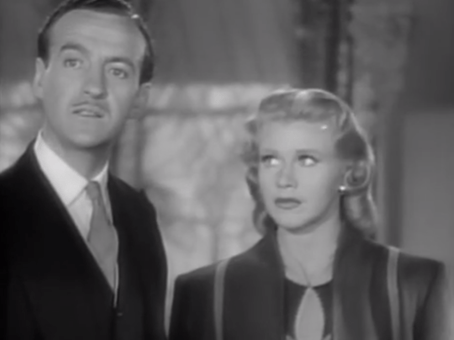
Bachelor Mother (1939)

bachelor mother 1.png

Of course, Bachelor Mother is a blatant oxymoron and it’s a perfect summation of that vestige of a genre the screwball comedy — a genre that’s about marriage and divorce and the gray areas in between conveniently skirting past issues such as adultery or people “living in sin” as it were. The norm was not a genre of divorce but of remarriage.

As such this Ginger Rogers vehicle has her playing a woman who doesn’t actually have a child out of wedlock but it’s assumed as much and that’s where the roots of the comedy get their traction. Because therein dwells so many societal taboos that are subsequently turned into marvelous fodder for misunderstanding though no actual moral statutes have been broken. It’s that line of dramatic irony that the rom-com, in general, has always needed in order to survive.

Just think how perfectly it all happens. In one moment Polly Parish (Ginger Rogers) finds herself laid off from her department store gig just in time for Christmas and between the unemployment agency and home she happens upon a lady leaving a cute little bundle of joy on the doorstep of the local orphanage. She says it’s not hers. She found it somewhere and now she’s leaving.

But Ginger Rogers being our concerned heroine can’t just let the baby sit there so she takes a course of action, delivering the child inside and enlightening the staff about the situation. Of course, they all believe she’s simply shirking her maternal responsibility and running out on her child and they pass the news along to David Merlin (David Niven), one of her former employers.

By now, Polly is already long gone. She’s agreed to take part in a dance competition at the local hall the Pink Slipper. There’s $50 in it for her and her partner Freddie (Frank Albertson of It’s a Wonderful Life prominence) if they can win. Waiting, babe in arms and valet in tow, Mr. Merlin tries to rectify the situation and get Polly to take back her child.

If the film was born on the steps of the orphanage, then it is solidified right here as a full-fledged screwball comedy of motherhood and misconstrued circumstance. Polly finds herself called into Mr. Merlin’s office and is offered her old post as long as she takes her child back. Still, they don’t listen to her renunciation so she has no course but to become a mother, after all, babies are cute. They can’t be that much work…

The fact that this is a screwball and not so much a domestic comedy is made clear by the fact the baby is more of a plot element than an actual character and Rogers and Niven find time to fall in love even with the added strain of motherhood.

What seems to do it is a lovely night together on New Year’s Eve which is highlighted by an extended gag where Niven introduces Rogers as his date from Sweden who conveniently does not speak a lick of English. It’s punctuated by the definitive punchline of the film. Simultaneously, Rogers struts her stuff all night long (though we miss Fred Astaire) in a reverie of pure joy.

But that’s not all that’s capped off amid the pandemonium of the festivities. Love Affair is far from just the movie up on the nearby theater billboard. It’s also something coming to fruition between our two stars. However, if this was the end it could hardly claim the name screwball. That’s when the baby comes in. J.B. Merlin (Coburn) finds his son with this single mother and draws conclusions of his own and…he’s very happy to be a grandfather and not so happy with the spineless conduct of his son.

What follows is a mad dash by our two leads to try and conjure up other stand-ins for a game of Who’s the Father? Three eligible contenders are brought in to play the charade. We already know Merlin, then there’s the dancing fiend and disgraced floorwalker Freddie, and the landlady’s bespectacled son.

In the end, everything is squared away nicely and the corkscrew comes full circle. Though Charles Coburn plays a very small part it proves to be a crucial one. Meanwhile, I adore Ginger Rogers and once more following Stage Door and Vivacious Lady, she proves in yet another film her genuine skills as an actress of immeasurable smarts and humor. Sometimes I’m admittedly unfair to David Niven — he’s never been the most compelling actor — but he’s fine in this picture.

This film also shares much the same world as the Devil and Miss Jones (including Charles Coburn) and the toy store environment provides the perfect arena for a terrifically comical shoplifting sequence full of excitement. It’s this movie to a tee. Positively quacking.

3.5/5 Stars

Vivacious Lady (1938)

vivacious lady 1.png

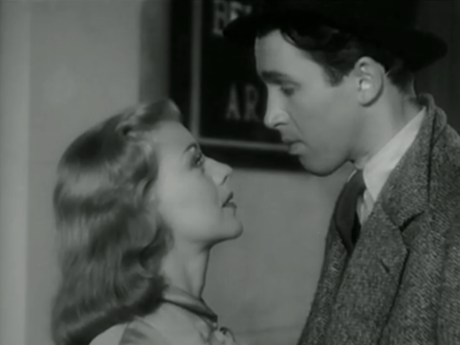
The first moment Pete Morgan (James Stewart) actually catches sight of alluring nightclub singer Francey (Ginger Rogers), the gangly botany professor proceeds to knock over a drink cooler. He’s enamored. In the movies, it’s that magical trope called “love at first sight.” For other pictures that’s where they go to die as the two loved birds get wrapped up in the throes of romance exploring New York City together. With Stewart and Rogers as our guides, there’s no place we’d rather be. Soon they are married and on their way to meet the parents in the idyllic town of Old Sharon.

Except they never get there or rather they get to the town but Pete never gets to the part about telling his parents he’s married. Charles Colburn is bullish as Peter Morgan Sr. the obdurate, overbearing intellectual who will not allow his son to get in a word edgewise. That’s aggravated by the fact that in his typical manner Stewart is always beating around the bush, never quite able to get the words out and so the happy news never finds an audience.

Besides Mr. Morgan has his sights on his son marrying the prim and proper Helen (Frances Mercer) while he turns his nose at the blonde woman that his nephew Keith (James Ellison) is traipsing around with it — that undoubtedly unsophisticated creature who also happens to be his actual daughter-in-law!

Thus, begins the film’s longest digression as wife becomes a student for the sake of being close to her husband and Pete tries his darndest to break the news to his parents while still getting time with his wife. But the guise of student and teacher isn’t helping much. They probably broke the whole code of conduct book on student-teacher relations circa 1938.

One of the favorite hot spots for late night extracurriculars just happens to have an outboard motor right next to it and it can make quite the din if accidentally pulled. Otherwise, Pete has an awful time trying to see his wife as the lobby clerk (Franklin Pangborn) is a real stickler and so the only access to her room is of a clandestine nature up the fire escape.

And still his father won’t listen to him and his former fiancee is still trying to nab him. It’s getting so hopeless that Francey thinks it might be best if she leaves Old Sharon behind for good. A memorable dance party with the parents in Francie’s room proves the kicker. Though she forms a bit of a rapport with the kindly but frail Mrs. Morgan (Beulah Bondi in 1 out of her 5 turns as Stewart’s mother), an indignant Mr. Morgan will have none of this tomfoolery.

Soon enough Francey decides to leave town of her own accord.  But even at the cost of his professorship if need be, good ol’ Jimmy Stewart won’t let her get away that easily. Whether or not this film drags a bit in the latter half is beside the point because you couldn’t have two more likable stars than Stewart and Rogers nor a Hollywood director more competent than George Stevens in balancing the breadth of slapstick comedy and romantic drama.

If the material is simply adequate enough, they are the type of talents that take us along and we will willingly be their audience through every complication. It’s our privilege.

In case there was any doubt whatsoever Ginger Rogers is awesome and it’s put on full display when she has a slap fight with her archnemesis before taking her in a headlock. If you liked her before simply for dancing prowess, she proves to be a savvy cat fighter as well.

Jimmy Stewart was still in the fairly latent stages of his illustrious career but Rogers recommended him for the role and he provides his homespun charm and length to every frame like we are accustomed to seeing from him. Not to mention his forays in home brewing. They’re quite impressive.

The only major blot on the film is an appearance of the prolific Willie Best playing his typical googly-eyed waiter — the walking stereotype that always feels like a cringe-worthy addition to any picture of old as does a cameo by Hattie McDaniels. At least there weren’t any chinamen. Not that there’s much consolation in that. Shall we just say that Rogers’ vivacity and Stewart’s universal affability make for a quality viewing experience and leave it at that?

4/5 Stars

The Circus (1928)

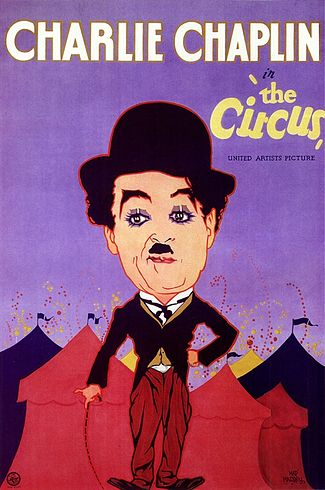
Chalincircus2b.jpgCharlie Chaplin always puts his Tramp in very simple situations that also happen to reap marvelous results both in the realms of humor and heartfelt drama. He follows up The Kid and The Gold Rush with the next iteration in the Little Man’s adventures which find him unwittingly joining the circus.

Initially, he gets caught up with a pickpocket and policemen which provides him an opportunity to go flying through funhouses with halls of mirrors and the like, the perfect fodder for a string of his best gags. Most notably giving an impeccable imitation of a mechanical man to fool the police. But his last sprint to get away from the clutches of the law takes him to the center stage where he becomes a welcomed bit of life to a rather droll piece of entertainment after he bursts onto the scene as a fugitive from justice, crashing into the stands. An unenthused audience is instantly crippled with laughter by every one of his accidental foibles. If only they had seen what he had been up to previously.

His accidental knack as a real-life clown gets him a gig in the main ring of the circus under the tyrannical showrunner (Al Ernest Garcia) who’s constantly bossing around his workers and abusing his meek daughter Merna who is also a part of the act as a tutu-wearing barebacked rider. This is where the film comes to its main storyline with Chaplin looking to do a few unassuming deeds for this girl in her horrible predicament while he himself begins to train as a show clown. But he proves to be terribly unfunny when he tries to be and it looks like he’ll back out on the street.

The major discovery is that he’s only funny unconsciously and so the opportunistic Ring Master looks to channel his innate comedy by hiring him on as a mere stagehand who nevertheless becomes the show’s main attraction. When the Tramp finally figures out what a sensation he is things are better–life is bright and cheery. But when a new man comes into the picture, a handsome tightrope walker, the vagabond’s demeanor begins to sour.  Still, he willingly gives up his own little bit of happiness for the girl whom he still truthfully adores.

Though the ending has a touch of the bittersweet, Chaplin does a masterful job of drawing up a straightforward yet rivetingly poetic tale involving his greatest incarnation. The Tramp has us fully involved in his story because he really is a marvel. Even when we’re not in stitches, it’s difficult not to smile at his very image.

In front of the camera, in many ways, it feels like business as usual. The story has euphoric moments of energy and charm underlined by dips into the dejectedness of lost love and destitution. This was always the rhythm of Chaplin’s work, But outside of his on-camera perfectionism, Chaplin’s world was thrown into turmoil to put it lightly.

He had a recent run-in with the IRS, acrimonious divorce proceedings from his co-star in The Gold Rush Lita Grey, along with the death of his mother, and a vicious fire throwing yet another wrench into the film’s production schedule. All told, it was delayed about 8 months in production purgatory, his hair grayed even more and he suffered a bit of a nervous breakdown.

Still, the final product perfectly personifies the humor that Chaplin always tried to capture rather like lightning in a jar. It’s those moments of organic, unconscious humor that can be found in a simple action. What makes The Tramp such a hilarious character is the very fact that he never for an instant seems to actually be trying to be funny.

Certainly, he’s light-hearted and mischievous but there’s a general import to his demeanor. He takes himself seriously, tips his hat, and tries to hold himself to a certain respectability. But despite his best efforts he can’t help but let out little hiccups and belches of chaos. He gives someone who deserves it a swift kick in the behind, scrambles every which way to evade a bucking donkey or gets trapped in a cage with lions and tigers, oh my! He vies for the affection of a girl the best way he knows how topping the competition on the tightrope and simultaneously tries to please each boss he has to the best of his abilities. They are very human responses even if he does it in a way uniquely attributed to him.

It’s the serious being made silly — the tragedy that is imbued with a silver lining — that is what The Circus gets to the heart and soul of. Because this hardly feels like a happy ending but the Tramp has done his good deed and walks away from center stage ready for a new adventure. As it turned out, we’d find him in the big city a few years later and he proved to never lose his sensibility for helping the burdened and downtrodden–namely a blind girl.

That is yet another reason to love that little man. His heart is large. Others give out of their abundance, but he gives out of his poverty, often offering everything he has–all he has to live on–and he does it happily so. Especially if it’s a pretty girl.

4.5/5 Stars

The African Queen (1951)

Hepburn_bogart_african_queen.png

And you call yourself a Christian! Do you hear me? Don’t ya? Don’t ya? Huh? What ya being so mean for, Miss? A man takes a drop too much once and a while, it’s only human nature. ~ Charlie
Nature, Mr. Allnut, is what we are put in this world to rise above. ~ Rose

Sometimes when great talent comes together we see the result and question where it all went wrong.  Sometimes it just works pure and simple. The African Queen is such a picture and it’s true that the greatest films function on multiple levels finding ways to exceed our expectations, enrapturing us with storylines and developments that are a far cry from what we first considered. Far from not disappointing, they join the pantheon of classics we would gladly watch over and over again. That is probably the highest praise you can give a picture and The African Queen is such a film.

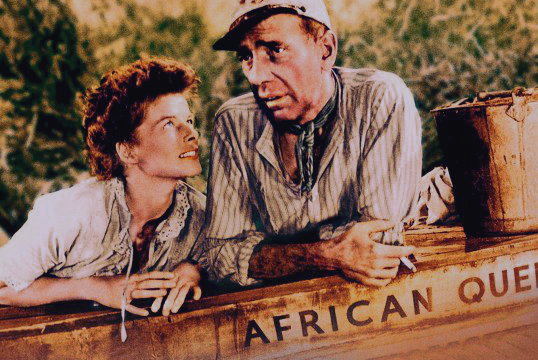
It’s christened The African Queen because she is the vessel that Charlie Allnut calls his own and she is the very vehicle for this entire adventure. Emblematic of their own grit, ingenuity, and indestructibility. Because the narrative begins with missionaries and the hint of colonialism as Rosie (Katharine Hepburn) and her Reverend brother look to bring the Gospel to the peoples of the Congo.

But due to the outbreak of World War I, Africa too is thrown into the fray as the Germans look to overrun the countryside and sweep it into their clutches. Rosie’s whole peaceful existence of Sunday services and afternoon tea are brutally disrupted. The village is burned, her brother’s physical and mental well-being suffers, and in the end, she has no recourse but to leave her little slice of home behind.

Ironically, her savior is the uncouth, uneducated Mr. Allnut (Humphrey Bogart), a jack of all trades who formerly worked at a mine before it was commandeered by the Germans. He too is an inbetweener in this war, caught on the fringes and simply trying to survive. It’s in these very circumstances that these two diverging personalities are thrown together. And in an act of defiance and pure survival tactics, they do rise above their present circumstances.

Aside from mere plot points, the very fact that the film was shot prominently on location like John Huston’s previous classic Treasure of Siera Madre benefits the film greatly because there’s an authenticity to the entire undertaking that could never be fabricated. You see the waters and the jungles. You’re almost suffocated by the sheer humidity and apprehensiveness of every successive rapid they must ford because this feels like more than a movie. The dividing line between fact and fiction in many ways feels paper thin.

Huston had some wonderful black and white films including The Maltese Falcon, Key Largo, and Sierra Madre but it seems rather fortuitous that The African Queen was made in color given the pedigree of cinematographer Jack Cardiff on such earlier vibrant classics as Black Narcissus and The Red Shoes. He brings a certain colorful exoticism to the frames that feels foreign to the eyes and yet still strangely beautiful. It all works so exquisitely.

Likewise, this is not simply a script penned by film critic, author extraordinaire James Agee with direction by Huston and the talents of legendary screen icons like Humphrey Bogart and Katharine Hepburn. Yes, those are the separate entities that are joined together in this endeavor but they become far more than the sum of their parts.

Agee’s script which Huston also got partial credit for sings with life because of the two individuals it draws up and the world it dares to place them in. Rosie Sayer is a prim and proper missionary in Africa who nevertheless has a fearless streak brought to life so spiritedly by Hepburn as only she could play it. There’s a wonderful stubbornness that’s undeniable but remove the layers and you have the same giddy passion that crept into some of her earlier screwball performances. Mr. Charlie Allnut, as such, is perhaps the most lovable Humphrey Bogart has ever been. Allnut is content just getting by and surviving and he’s good at it — trying to find little bits of comfort in this world medicating himself when gin and a nice cigar every now and again.

But while he pushes Ms. Sayer’s to be practical and lose some of her stuffier tendencies, she, in turn, prods him to step out and do something worthwhile with his life. And it’s not simply about their romance which begins as a small feud, becomes a friendship, and evolves into a frenzied relationship full of affection. Their romance is being forged as they hang onto the faint objective of driving The African Queen into the ominous German gunboat the Louisa. It feels like a small battleground amidst the chaos of World War I but it all depends on your perspective because for Rosie and Charlie this is really is the very pinnacle of their existence. It involves their very will to survive.

They cling to this purpose and the joy of their adventure is the very fact that they are able to see it to the end, in the name of their country but also for their own vindication. And the telling aspect is that they both have been transformed by their experience. They are not so much forged by fire as the jungles that engulf them and the wildlife, foes, and raging falls that all look to be their undoing. And yet this unlikely pair, these polar opposites, prove to be the most formidable allies you could draw together.

The African Queen also has its own forays into spirituality and although they do not remain front and center for the entire film, there is a certain import to them. In a particularly formative scene, Mr. Allnut calls into question the other’s Christian faith which seems at the very least unfeeling if not hypocritical. But you could say the main conflict of this film is voiced by Charlie. It’s human nature.

Charlie has grown passive towards it while Ms. Sayers affirms that humanity is meant to “rise above” and this statement can be taken spiritually or maybe even with a tinge of imperialism (as man must tame the vast wastelands of his environment and such).

But there could also be a more universal ring in her words, suggesting that humanity must rise above every trial and tribulation whether personal, environmental, or social. Any number of these interpretations have stock. The question to ask is where does that will come from? It seems ludicrous to say it comes from within, closer still to say it comes from others, and maybe there’s still something broader going on in the background. No matter your opinion on such matters, The African Queen is still without question, one of the grandest, most rewarding romantic adventures hewn out of 1950s Hollywood.

5/5 Stars

Charade (1963)

Charade_2.jpg

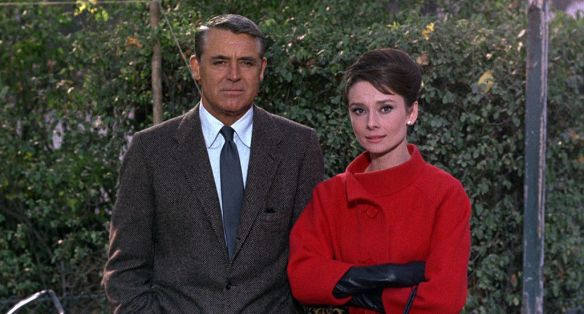
It’s easy to yearn for the days where they made stylish, amusing films like Charade which were equal parts charm, class, and wit all stirred together to perfection. Those were the days when two stars as beloved as Cary Grant and Audrey Hepburn could carry a picture no questions asked because people would turn out to see them no matter the story. And it’s true, though they were never in another picture together, there’s a wonderful chemistry that builds between them and never ceases from the outset of this lithe thriller.

From their first exchange up until their last, it’s hard not to delight in their every interaction, every word, every smirk. There’s a consistent playful patter bubbling up that’s at times suggestive but never loses its sensibilities. There’s a constant twinkle in the eyes of our stars interrupted every now and again by brief moments of sheer terror. Hepburn playing her elegant self but perpetually frantic while Grant exudes his general charisma that sees him through peril as well as innumerable comic situations (ie. an awkward game of pass the orange as well as showers with his clothes on).

Of course, it hardly hurts a bit that Charade has a surprisingly tense plot that while a little flimsy in some areas still manages to have a plethora of twists, turns, and about-faces to come off generally befuddling like many of the most enjoyable thrillers out there.

It all begins with a body getting tossed from a passing train. Regina Lampert (Audrey Hepburn) is on a vacation on a snowy mountaintop away from her husband with a wistful sense that her marriage is done for. Little does she know how right she is. She returns to her residence in Paris only to find all her belongings gone and her husband dead. The police believe it has to do with a missing $250,000 that Lampert was purported to have absconded with during the war. Their guess is that one of his old platoon mates let him have it so they could get the payload for themselves. All of this is news to Regie who was painfully ignorant of her husband’s affairs. And now with it all dropped in her lap, she doesn’t quite know what to think.

The police inspector (Jacques Marin) on one side questioning her and the Federal Agent Hamilton Bartholomew (Walter Matthau) frightening her out of her mind. The only real bright spot is her newest acquaintance Peter Joshua (Grant) and she’s bent on chasing after him before the people chasing after her catch up. Because life, even a spy life, is better with a companion.

Forget the fact that this film has often been attributed to Hitchcock. This is Stanley Donen’s creation and if nothing else it exhibits his admiration for the Master as well as his adaptability taking his own skills as a comedic and romantic director and adding a touch of the thriller to the mix.

He makes it work very well and paired with the typically jazzy score of Henry Mancini, a continually entertaining script by Peter Stone, and generally immaculate color cinematography by Charles Lang, Donen can’t miss.  If it’s not the greatest film if only for the very fact that it doesn’t take itself all that seriously, Charade uses that very quality to its advantage with plentiful splashes of fun and romance.

Audrey Hepburn robed as per usual in iconic creations by Givenchy looks to play the huntress on the prowl. While on his own admission Cary Grant takes the passive role as the pleasant older gentlemen who nevertheless wears many hats and many names. Though Hepburn and Grant undoubtedly take center stage and rightfully so,  that’s not to discount quality character actors like Walter Matthau, George Kennedy, and James Coburn filling in as the deceased Charles Lampert’s old war comrades each carrying a bit of a vendetta.

The surprisingly tense conclusion sweeps through the Parisian streets, subway stations, colonnades, and finally an abandoned theater. But, above all, Charade does well to neutralize its more intense or even grisly moments (at least by 60s standards) with its persistent charm. The type of charm that make those films of old so endearing much like the actors who starred in them.

It’s as if in the twilight years of the studio system some of the greatest names coalesced to gift the world another gem for the road. There certainly were signs of change with wistful mentions of Gene Kelly’s early classic An American in Paris or a passing remark about stamps commemorating Princess Grace’s coronation (which took her away from a brilliant film career). At 59 Cary Grant was aging gracefully but still near the end of his career with only two more pictures to follow. And Audrey Hepburn herself would finish out the 1960s with several notable classics and then she would all but conclude her illustrious career for good.With Stanley Donen still with us, he truly acts as one of the last strands connecting this generation with those Golden Years of Hollywood.

However, the most significant reality is that this film came out in December of 1963, a mere month after John F. Kennedy was assassinated near the Book Depository in Dallas Texas. That singular event more than any other was emblematic of the change that would surge through society and the world at large. That is the world that Charade was born into.

So if you were to use the unforgivable cliche at this point that they “just don’t make movies like they used to,” you probably would be correct because that’s close to the truth. Films like Charade are all but gone and when you actually consider the joy of watching Hepburn and Grant together, it really is a terrible shame, though it simply seems a testament to the rolling tides of change.

Still, there’s something truly magical that occurs when they’re together. They were an altogether different breed of star. Maybe it’s the way they carry themselves, dress, or speak. Maybe it’s the way they look at each other. Maybe it’s their quips. Maybe it’s something else entirely. But they’re two of the greatest we’ll ever know for the simple fact that they were so beloved. They made us love them and as a result, we buy into this entire film. We bought into their charade and enjoyed every last minute of it.

4/5 Stars

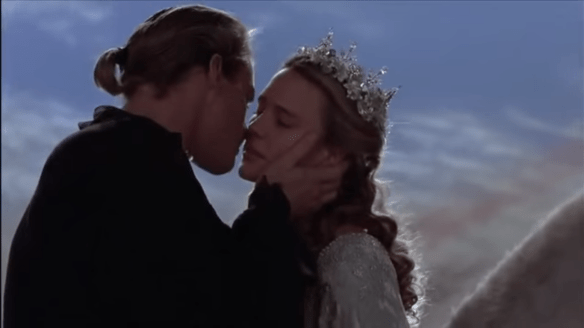
The Princess Bride (1987)

the princess bride 1.png

Few films can please the restless masses that inevitably gather at some unfortunate souls home for a movie night. Because as varied and diverse individuals of a myriad of backgrounds we very rarely agree on anything especially given the proliferation of content that is available to us at any given time. But most can agree on one thing. The Princess Bride is one of the great crowd pleasers of its generation and for good reason.

If quotability was the sole parameter for a great movie then The Princess Bride has few equals and it also happens to be the most fun you’ll have in a single sitting because all that it does, it does with an unquenchable zeal. There’s a spirit to the film full of romance and humor and adventure, even playing to those who will forever be skeptical.

Adapted from his own novel, the venerable William Goldman carries over his framing device of a grandfather reading to his sick grandson and it works marvels to bring us into this tale. Especially when the two actors in question are a precocious Fred Savage (Pre-Wonder Years) and the inimitable Peter Falk (Post-Columbo) slipping seamlessly into the role of a grandpa with a twinkle in his eye.

The story unravels like many great fables with a love story torn asunder by circumstance. A young man who goes off to seek his fortune only to die (or more likely take on the identity of the Dread Pirate Roberts) and a young maiden who is made a princess and remains unhappy all the same without her true love. Of course, she does not understand the nefarious intentions of her soon to be husband Humperdinck nor that her love is going to great lengths to find her. And amidst the fantasy, swordplay, trickery, and rampant humor, love conquers all as it has a habit of doing in fairy tales with everyone of note living happily ever after.

This unabashed tale also boasts near pitch-perfect casting. Cary Elwes as Westley does embody a certain quietly confident charm that while not quite Flynn or Fairbanks still manages to guide the film with similar charisma. He can be the hero, handsome and witty, made to play perfectly off all the intriguing figures who inhabit this fairy tale.

In her debut, Robin Wright glows with a radiant beauty and stubborn defiance that’ s enduring and which in many ways has remained a defining moment in her career and it’s certainly not a bad film to be forever remembered for. Meanwhile, Mandy Patinkin plays the vengeful Spaniard Inigo Montoya with the perfect amount of bravado, honor, and charm in his lifelong search for the six-fingered man who killed his beloved father. He’s the perfect accompaniment for Andre the Giant’s lovable brand of brawn and Wallace Shawn’s hilariously irritating turn as their cackling leader.

But what makes the film even better or the odd sorts who pop up here and there including Miracle Max (Billy Crystal) a curmudgeon wisecracker like no other and The Impressive Clergyman (played by the oft-underrated Peter Cook) who single-handedly ruined the solemnity of wedding vows for all eternity.

Rob Reiner is rarely considered a masterful director but if anything it’s easy to make the case that The Princess Bride remains years later his greatest achievement because it has so much life provided indubitably by Goldman’s superlative script and the very figures who dare to fill his world. And Reiner captures it all with a clarity that comprehends the humor but very rarely goes for that at the expense of characters or story (unless they are villains or Billy Crystal). After all, this isn’t a Mel Brooks film.

By this point, it’s a disservice to call The Princess Bride a parody or mere homage– simply a cult classic that’s garnered widespread affection. The reason people love this film is connected to those aspects but also the very fact it stands on its own.

As Falk sings the praises of the story early on, so we can affirm, it has “Fencing, fighting, torture, revenge, giants, monsters, chases, escapes, true love, miracles…” If that’s not exciting nothing is and it’s quite easy to forget that the film is continuously hilarious but there’s something remarkably moving about its story.  It plays the comedy well but simultaneously builds its own road through the mythology and fantasy of fairy tales that have captivated all people for eons.

In The Princess Bride, there’s not simply roots in comedies like The Court Jester but swashbucklers like The Adventures of Robin Hood or the magical journeying of the Wizard of Oz. It covers the spectrum of entertainment which is part of the reason it’s so satisfying.

It has scenes, moments, lines, those little idiosyncrasies and quirks that have left an indelible mark on viewers and as a result our culture as a whole. Lines like “As you wish,” “INCONCEIVABLE,” or best yet, “My Name is Inigo Montoya, you killed my father. Prepare to die.” Each has its special place within the context of the film and is still imbued with that same meaning hours after.

If I write about this film more from my heart than my head you’ll have to forgive but it truly is a weakness. I can envision being little Fred Savage enchanted by the sheer magic of fairy tales. I wouldn’t begin to care about romance until years later but swashbuckling and humor always had me enthralled and they continue to capture my imagination to this day–no more powerfully than in The Princess Bride.  It’s sheer magic in all the best ways.

5/5 Stars

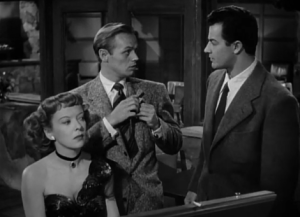
Road House (1948)

Road House 1“Doesn’t it ever enter a man’s head that a woman can do without him?” ~ Ida Lupino as Lily Stevens
Jefty’s is quite the joint. Bowling, drinks, floorshows. In a one-horse town, it’s the place to go especially when the establishment’s proprietor (Richard Widmark) brings in the alluring nightclub singer Lily Stevens (Ida Lupino) to liven up the bar. Although he hired her without much forethought following a trip to Chicago, Jefty’s convinced this girl is really something although his faithful right-hand man Pete Morgan (Cornel Wilde) has her pegged from the start.  Smoking and playing solitaire. It sums up her life. It’s true.

They don’t exactly hit it off because he thinks he already knows what type of girl she is and she’s not too happy about getting pushed out of this gig. But ultimately she stays, the general public starts coming in droves, Jefty’s happy, and Pete does his best to keep away from her. But she does exactly the opposite. She appreciates Jefty but really has eyes for Pete and she pursues him.

What the film hinges on is really a love diamond with Ida Lupino and Cornel Wilde at the points. She is the object of desire for Jefty who thinks he could finally tie the knot with a girl. He’s in love no question. But Pete warms to Lily as well and is the one looking to go away with her. There also must be some necessary credit given to Celeste Holm for her performance although she has the most thankless role as Susie, the cashier at the Road House who also has obvious feelings for Pete.

But everything is thrown for a loop when Jefty comes back from a week long hunting trip with big news to spring on Pete. He’s gotten a marriage license. He’s going to ask Lily to marry him. However, over that same week, Pete and Lily have gotten closer than ever. Obviously, when the truth comes out the old friends have it out and the two lovers look to leave town.

The whole film thus far, Jefty has been a bit of a loose cannon but a generally nice guy. Except on a dime, things turn. Soon Pete is being detained for some cash missing from the company’s safe that his old friend claims is missing. It’s Pete’s words (with Lily’s) against Jefty’s with the police in the middle. It seems like a small deal but in a whirlwind sequence of events, Pete is brought to court and convicted of grand larceny. However, in a diabolical turn of events, Jefty becomes Pete’s savior as well as his master following a talk with the judge who agrees to put the convicted man on probation at the Road House. It’s just like old times, the gang all back together again except this time Jefty has Pete in a bind. One false move, one thing that he doesn’t like and Pete goes back to fulfilling his prison sentence. Jefty’s got him on a string and everyone knows it.

It’s in these moments where the remnants of the maniacal cackle of Tommy Udo from Kiss of Death begin to rear their ugly mug. And the next hunting trip Jefty plans with everyone included fills liked forced fun. No one’s having it and Lily and her love look to take one final chance to run away because any life is better than a life under Jefty’s thumb. What follows is a race for the woods and the Canadian border with Susie fleeing after them pursued by the crazed man packing a gun a bit like A Dangerous Game. It’s bound to be a deadly finale. Someone has to lose.

Cornel Wilde always feels too much like cardboard or plastic, whichever you prefer especially when put up against Ida Lupino and Richard Widmark. The latter pair is more at home in the worlds of film noir, Lupino being both alluring and assertive, boasting a gravelly voice perfect for rasping out “One for my Baby (and One More for the Road)” that is enhanced by her smoking habits.

Meanwhile, Widmark always had a handle on the sleazy and embittered characters who were in one moment grinning and in another seething with a cunning anger. There’s a volatile polarity that he taps into that makes most every character he plays enjoyable as we slowly watch their evil tendencies overwhelm any good that is in them (or vice versa). He also likes hitting the sauce. Cigarettes and booze have always been a hallmark with noir and so it is with this film. So if you’re looking for a good time and a bit of uncompromising filmmaking, look no further than the Road House.

3.5/5 Stars

Casablanca (1942): 75th Anniversary Review

Casablanca,_Trailer_Screenshot.JPG

When someone inquires if I consider Casablanca one of my favorite movies, I don’t quite know how to respond. Yes, I do love this film passionately but I feel as if Casablanca is more deeply America’s favorite classic movie. It is not for me to call my own and I will gladly share a joint appreciation for it. Because it’s a film for all of us. As it should be. It’s the perfect articulation and expression of that former Hollywood that existed during the studio age as brought to us by Michael Curtiz.

When we are finally allowed to enter into Rick’s Cafe Americain, it almost feels like hallowed ground. It’s a mythical place that never existed in reality and yet feels so immersive to us as an audience. Curtiz moves through the space with such intent that it makes us completely involved with every person his camera settles on. This is a picture for romantics and sentimentalists to be sure but it caters to those with a cynical edge too. It suggests a deceitful world of pickpockets, unscrupulous officials, and of course, Nazis.

The political tides of the times are reflected in that cinematic bastion of a man Rick Blaine (Bogart). His foreign policy is that he sticks his neck out for no one. But that’s only on the surface. That’s the beauty of the character. There’s a sensitivity and a sacrificial nature that wells up deep inside him, hidden from view. Tortured and embittered as he is, that is not the last word.

There’s also an undeniable undercurrent to the film. Yes, this is not reality. As enveloping as it is, this is wholly a Warner Bros. aesthetic but moreover there’s a sense that the emotions that deluge over Casablanca are very real.

Aside from Bogart and the lovely, incomparable Ingrid Bergman, our cast is made up of a plethora of emigres, men and women, who fled the Nazis for this reason or that. Whether they were Jewish or had different political affiliations or just couldn’t bear to live under such an oppressive regime.

Director Michael Curtiz was originally from Hungary and in him, we find someone who totally understood the plight of those fleeing and the context of the moment where Casablanca was only a pitstop for America. Because take the picture out of its context and something would be lost. Firmly plant it in the era and you have blessed the production with something enduringly special.

Furthermore, in the scene where Lazlo (Paul Henreid) calls on the band to play “La Marseillaise” to drown out the German’s proud merrimaking it ceases to be a mere scene in a film but becomes an event that swells with real emotions. You can see it in the very body language, the tears in the eyes, and the fervor that comes over everyone. Madeleine Lebeau (the film’s last surviving cast member who passed away last year) singing defiantly, with the tears freely flowing. No longer acting but pure feelings incarnate.

When so many other minority characters make me cringe in pictures of the 30s and 40s, Sam, the piano man (Dooley Wilson), remarkably rarely does. That’s because he’s endowed with a certain autonomy attributed to him in part by Blaine. They are partners, friends, and they watch out for each other.

His singing holds the love story together. Like many of the film’s greatest faces, he’s not a mere sideshow attraction. There’s a necessity to his characterization that adds another dimension to the world that has been conjured up on the Warner Bros. lot. What would Casablanca be without Dooley Wilson, Peter Lorre, Sydney Greenstreet, S. Z. Sazall, Curt Bois, Leonid Kinskey, Marcel Dalio, John Qualen, etc.? It would lose so much color — so much definition.

Another joy of the picture after you see it too many times to count is the continued relish of the script, waiting for your favorite lines only to be taken with new quips that you never picked up on before. For me, most lines of this nature come from the wonderfully amoral and yet completely personable Captain Renault (Claude Rains). But there’s also so much going on around the edges of the frame. One of my favorites involves the young woman who fled from Bulgaria with her husband. The young lady is played by Jack Warner’s step-daughter Joy Page.

Here we see a relationship that mirrors that of Rick and Elsa in a way that only becomes apparent later on. Because she is a woman desperate to get to America with her impoverished husband. He is trying to win money gambling but it’s a desperate even futile situation.

She loves him so much, she is willing to try and use her own beauty and the influence of another man, Inspector Renault to help the man she truly loves. There’s so much subtext to the scene written with the production codes in mind and the sincerity is immediately evident even if some of the import can be lost on us. The same can be said for the foreshadowing.

Part of what makes the picture’s final act work is the fact that Lazlo is such a decent human being. He loves his wife so much, he’s willing to have Blaine take her to safety by using the Letters of Transit if need be. Thus, this dichotomy is set up and Rick must make a decision. He must do the thinking for both of them but that request from Lazlo saves Rick’s reputation no matter the decision that he makes. We know that either might be right. Even though deep in our hearts, there’s only one denouement we want.

Did I even need to write this review? Certainly not but it’s more for my sake than anyone else’s. Casablanca is a dear friend of mine and after 75 years it still comes up smelling like roses. Its themes are timeless in the sense that it allows romance to be its guiding light while still tempering it with the disillusionment and licentiousness that often is so prevalent in this world of ours. That makes its bittersweet interludes ring with a certain deep-seated truth that never comes off as fake. It’s as evocative and witty now as it was in 1942. Perhaps even more so.

5/5 Stars

The Soft Skin (1964)

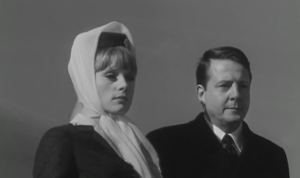
the-soft-skin-1There might be an initial predilection to call The Soft Skin Francois Truffaut’s most conventional film to date, but for me, it shows at this fairly early point in his career he seems to have grasped the main tenets of traditional filmmaking. Because his first films are full of life, energy, and idiosyncratic verve that easily charm their audience but here we see a film that in most ways looks like other classic works, well constructed and still quite engaging. Because within this very framework Truffaut is able to play around with issues that in themselves are still quite compelling. Love, intimacy, infidelity, and the like. Even with familiar names like Truffaut and Raoul Coutard, it feels very un-Nouvelle Vague. And that’s okay.

We often expect comedy from Truffaut as he shows in many of his other films but here everything is fairly reserved and understated dictated by our gentlemanly protagonist Pierre (Jean Desailly) and accentuated by most everyone else. They are not inserted into the story line to make light of issues but to actually grapple with these real life circumstances in ways that feel quite candid in their humanness.

Furthermore, Truffaut’s films are often, cinematically speaking, very self-aware but aside from a brief foray into a documentary on Andre Gide, our characters seem very much absorbed in their own world with the problems at hand and Truffaut seems to realize that. As audience members, we too become implicit accomplices to this tryst and that’s where the story comes into being.

Pierre is a managing editor of a prominent publication with a lovely wife and sweet little girl. He’s well off and travels across France in high demand at lectures and cultural galas. People want his autograph.

But in a moment he meets someone. Truffaut allows them to interact and pass each other by without anything happening. That’s the key. As I imagine it is with real life, moments go by and it’s in those passing moments that things begin to unfold. Pierre is taken by the stewardess (Francoise Dorleac) he now sees in the elevator and then invites her for a drink awkwardly. It begins there. He’s clumsy about it but his respectability and candidness probably attract the girl.

The title, of course, implies the very physical nature at the core of an affair. It’s the touch, the feel, the intimacy that is longed for. But it runs awry because that very thing that is craved becomes muddied by deception and infidelity that threatens to tear relationships apart. Not just with spouses and friends but the very people who are caught up in the throes of the affair. There’s the necessity to keep them hidden, skip out on them at a moment’s notice so as to not raise suspicion.

Everything is clouded and nothing is pleasurable anymore. There’s a moral repugnance that often goes with the territory. Of course, the one individual that we might do well to feel the sorriest for is the one we rarely see, the third party who is deceived, in this case, Pierre’s wife.

Still, Pierre is so sincere and Nicole much the same that it’s somehow easy to feel sorry for them as well as Franca. As Nicole notes to Pierre, “you made a real mess of things” partially because he’s having trouble leaving his wife after 15 years and he still wishes to see his little girl Sabine every day. He’s not much good at the whole affair business. Whether it’s leaving his wife or staying with the girl he’s found.

Perhaps the most poignant scene comes with Nicole on the balcony confiding in Pierre because we understand what she’s trying to hint at. And we don’t see Pierre but you can guess where his thoughts are at that very moment. In not so many words she is saying this thing they have won’t work anymore and that’s the end of it — at least in the way he envisioned it all, with marriage, a home, etc. It cannot exist.

And of course he has no recourse but to return to his wife and beg her forgiveness and it seems like a road worth the risk but in his unassertiveness, Pierre puts it off just long enough for it to be too late. There’s no getting it back. Because infidelity, no matter the strain, can be thoroughly insidious undermining trust and planting seeds of doubt and bitterness. That is rocky soil to maintain a relationship on and in cases like this, it can only end in tragedy. It’s true that The Soft Skin blows us out of the water in the end but what makes us stay is the great care it takes in getting there.

4/5 Stars