Love With The Proper Stranger (1963)

Love_With_The_Proper_Stranger.jpegAt first glance, this doesn’t seem like the type of picture suited for Steve McQueen and Natalie Wood. He was “The King of Cool.” She was a major player from childhood in numerous classics. Neither was what most people considered a serious actor. They were movie stars. They had charisma and general appeal to the viewing public.

What we have here is a stark slice-of-life scenario. Even put in the context of her Italian family unit Wood feels slightly out of place. It’s the kind of portrayal that worked for Ernest Borgnine in Marty (1955) and other such pictures. The same if not more can be said of Steve McQueen with his parents. He’s hardly an Italian. But the chemistry is there and that’s almost more important.

Any criticisms or preconceptions aside there must be credit paid to our stars. All power to them for wanting to be in this picture and casting aside what might have been more glamorous material for something that might stretch their acting chops. Because in the mid-50s and onward we were beginning to see a more honest strain of drama in Hollywood films. I would hesitate to call this film complete realism but there’s a candid quality that’s unquestionable.

Love With The Proper Stranger manages to put a narrative to the kind of hushed up realities that needed to be brought to the light. It’s part daring, part matter-of-fact in its actual execution. Because in merely acknowledging its subject matter, even in a minor fashion, it starts a conversation that can lead to some sort of human understanding.

You see, the film opens in a bustling union hall where a freelance musician named Rocky (Steve McQueen) gets paged by someone. He comes face-to-face with a girl. He can’t remember her name but the face is familiar. There’s a smile of recognition. The reason she came to see him catches him off guard though. She wants to ask him to find her a doctor. Because you see, they had a one night stand (the title proves a poetic euphemism) and she’s pregnant. The rest you can put together for yourself. His reaction is not what she wanted.

And so that’s how they reconnect. At first, strained and then looking to gather enough funds to pay the doctor to get it done. They’re genial enough and understanding after the initial encounter. That’s part of what’s striking. Love With The Proper Stranger chooses to traverse a generally understated road in lieu of melodramatics.

Sure, she’s a sales clerk at Macy’s and her family is devoutly Catholic with her older brothers often nagging her to get married. And he’s broke and shacked up with a nightclub dancer (Edie Adams) who runs a doggy kennel in her apartment. Still, that’s all just white noise or at least only shading to what’s really of interest.

One of the most indicative moments occurs when they’re staked out in some god-forsaken rundown warehouse and they open up about romance as they wait for their appointment. Their assertions are meant to make us understand them better but what we are provided is a level-headed dialogue that wears cynicism openly while honestly trying to figure out if love, kisses, and marriage, all those things that the movies and music seem to romanticize are even worth it after all.

During the very same conversation, Wood’s character confesses, “All I felt was scared and disgusted with myself.” Nothing more. Waiting for the bells and the banjos to sound doesn’t work. And when they go to the shady meetup and get funneled to a backroom it’s not any prettier. In fact, it’s probably worse. And it’s these moments that grieve me and pain my spirit. That anyone would have to deal with such an unfeeling environment. It’s not about condoning their behavior or not but being truthful to the way things actually are.

Meanwhile, the film’s latter half is decidedly lighter as if our main characters have settled into the new reality at hand. I suppose that’s the way real life is. It keeps on moving no matter the circumstances. Whatever decisions you have chosen and whomever you pick to live your life with.

Angie rebuffs his gallant proposal of marriage, finds her own apartment, and doesn’t complain about the road ahead. She didn’t need him to fall on his sword or take his medicine. Whatever apt metaphor you choose. That’s not her idea of a sound union. Instead, she tries to content herself with a well-meaning cook named Anthony (Tom Bosley) while Rocky piddles around discontentedly. The directness of the story allows us to dig in; it’s the comic tones of the unwinding romance that guide us to the end. Our leads see it through splendidly with a charming grace that’s collected and still sincere.

Although he will never earn much repute because his offerings are generally low-key, I will continue to do my best in cultivating an appreciation for Robert Mulligan as a director, as well as Alan Pakula. Not that they were quite as socially conscious as a Stanley Kramer or as intent on pushing boundaries like an Otto Preminger but To Kill Mockingbird (1962) and this picture are both statements of quality in themselves.

In fact, it’s rather bewildering that despite the names above the title, an immersive setting in New York’s Little Italy, and a genuine storyline, Love With The Proper Stranger is easily glossed over. Maybe it goes back to our stars. It’s not as monumental as The Great Escape (1963) or The Great Race (1965). And it’s not lauded to the degree of West Side Story (1961) or Bullitt (1966). That’s okay. It has no bearing on whether you enjoy it or not.

Not to undercut everything that I’ve already said but I’ve waited long enough. The final question I was left with is whether or not Natalie Wood was still friends with Santa Claus working at Macy’s. But then again, maybe in the world she finds herself in, Santa can’t fix all her problems. I suppose that’s okay too.

4/5 Stars
Bull Durham (1988)

bull durham 1.png

Bull Durham is actually a fairly religious film. The only catch is the fact that the religion in question is baseball with its multitude of superstitions, curses, annual rituals, and rites of passage performed daily by all those playing in the games or sitting in the bleachers cheering on their club. There’s even a shrine set up to late-great Yankee backstop Thurman Munson. The other religious sects, namely Christians and adherents to voodoo, are shown as real airheads but really everyone in this film is a bit of a laugh.

I personally found the contemporary comedy Major Leagues (1989) a fairly nasty sports film but what sets Bull Durham apart is that good sense of fun while still truly finding the joy in baseball. Because it truly is a joy. I will stand by that as a lifelong lover of the game even if I hung up my spikes in middle school.

There are still very few feelings so exhilarating as throwing a baseball and hearing the crack (or ping) of the bat as the ball goes soaring into the outfield for a base hit. Or that great moment when you make that diving catch or get that winning hit and everyone cheers you on. Whenever the ball comes down the pipe in slo-mo and it feels like you can crush it to kingdom come. I experienced each of these wonderful sensations at least once in my middling career as a kid.

But most of the time, the experience is made up of a lot of strikeouts, errors, getting hit by pitches, and that’s just as much a part of the game as all those previously mentioned aspects. In such a way, it seems like baseball has always been wrapped up in the human experience and that what allows it connect all people.

This film, in particular, is a bit of a love triangle. Baseball groupie Annie Savoy (Susan Sarandon) is annually immersed in the baseball culture of the Single-A, Minor League team The Durham Bulls. Each season she takes a young player under her wing, teaching them about the game, and holding court with them until they move on.

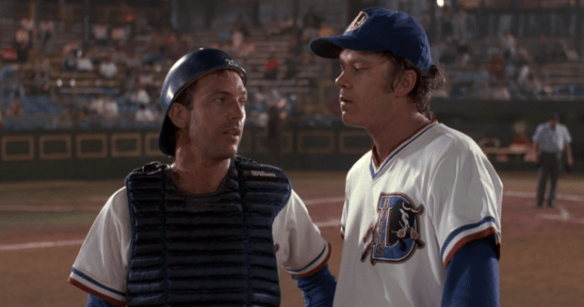
Her latest protege is the big strapping, bubbleheaded, heat-throwing pitcher “Nuke” LaLoosh (Tim Robbins). Though Nuke has a big league arm he also can’t throw a strike. It’s the veteran catcher Crash Davis (Kevin Costner) who is brought in by the management to refine their young talent. They meet in a local bar for the first time only to almost get into a fist fight until Crash cooly asserts, “You couldn’t hit water if you were falling in it!” And it’s true. But under the tutelage of Anne and the wry experience of Crash, Nuke turns into something. Someone who actually has a chance at “The Show.”

Crash was there once for 21 days but he never had the talent of this young kid. So he must watch others move on to their big chance as he stays behind and grinds out his career away from the scrutiny of the bright lights and big contracts. And it’s in Bull Durham where something becomes increasingly clear.

We so often think of sports as glamorous shows of skill by superstars with million dollar paychecks which is in one sense true. But for every one of those stories, there are probably a thousand more who will never be known. No one cares if Crash winds up with the most career home runs in Single-A, except Anne that is. He ends up scrounging around for another job. Maybe a catcher for a different club or a small time management position. In fact, it’s easy to feel sympathy for the Annies and the Crashes because their whole life is baseball and yet in sporting terms, they’re past their prime. Thankfully they can have each other to dance through life together.

Bull Durham has it’s profane moments, it’s slow patches, and some good ones too but it’s the goods ones that usually stand out and the very fact that this film genuinely seems to care about baseball — but that does not mean there’s simply reverence — there’s enough respect to show the inane stuff too. It’s treated as American’s Pastime. But even that past time had the “Clown Prince of Baseball” (Max Patkin) who is also fittingly featured in this one.

Some of the best moments happen on the diamond with our two ballplayers giving themselves mental pep talks whether it’s predicting the next pitch in the batter’s box or going through the signs. When they’re gathered around the mound not to talk strategy but to discuss what wedding present they should get for their newly hitched teammate. And of course, every time Nuke shakes off one of his catcher’s signals, Crash proceeds to tell the opposing hitter what’s coming as payback. That’s when baseball is fun. Because it is a game. When you lose sight of that it ceases to evoke the same pleasures.

3.5/5 Stars

Review: To Catch a Thief (1955)

to catch a thief 10.png

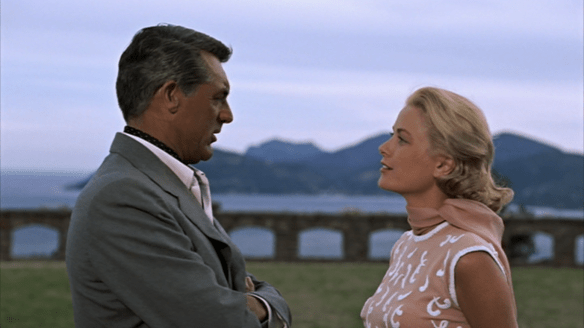
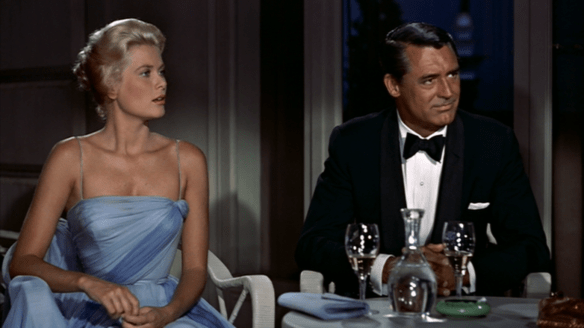
There’s little doubt that To Catch a Thief is Hitchcock at his breeziest and with the once-in-a-lifetime pairing of Cary Grant and Grace Kelly the picture could coast on looks and charm alone. Not simply based on the attributes of its stars either but the extensive on location shooting boasting Cannes shorelines colored in VistaVision and sumptuous flyovers of the winding Riviera, villas and all. It’s a scintillating getaway and a fine departure following the nerve-wracking confinement of pictures like Dial M for Murder (1954) and Rear Window (1954).

Thankfully while it is supremely light entertainment there’s something else to it as well. A rash of copycat crimes has taken place all across the Riviera leading the local police commissioner to suspect reformed cat burglar and French Resistance hero John Robie (Grant). Though the slinking and perfectly executed jewel heists bear the mark of “The Cat,” he’s the best one to acknowledge his own innocence.

Still, that doesn’t stop the police from questioning him nor his old war comrades working at a French cafe to begrudge him for what they deem as an affront to them. They want nothing to do with him. And so with things as they are, Robie must try to exonerate himself by verifying his innocence. John Williams proves the perfect accomplice as a generally agreeable chap from Lloyd’s of London who has vested interest of his own in catching the real culprit in order to recover his client’s assets.

Their introduction could not be more memorable culminating in a tussle in the flower market in Nice with bouquets flying every which way, the local authorities in hot pursuit. From there Robie floats away from the police soaking in some sunbeams as he devises his plan of action. But already we see the dangers as he must essentially play the thief, casing the joint, getting close to the jewels and their owners but all in the name of personal vindication.

What follows is a fortuitous meeting around that whirling pickpocket — the roulette wheel — where Robie makes a dashing entrance. Actually, make that a purposefully inept showing dropping a chip down a lady’s front. What follows is a fairly haphazard routine as Oregon lumber magnate Conrad Burns trading pleasantries with his newfound acquaintances.

to catch a thief 1.png

Jesse Royce Landis knocks her scenes out of the park allowing Grant and the others to laugh along amusedly due to her affinity for bourbon and straightforward speech.  Her daughter Francie (Kelly) tries to maintain her own dignity as an aloof beauty bred on finishing school.

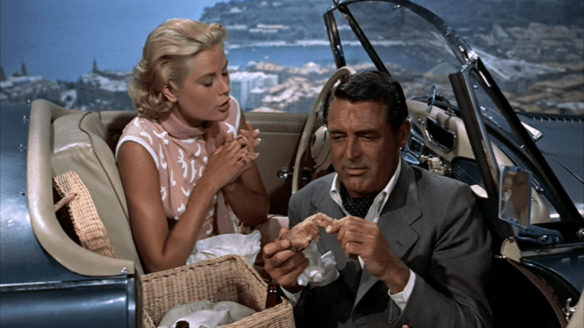
However, she’s more forward than she lets on leading with a wordless smooch in the doorway on her way to bed that begins the chase. What becomes rapidly apparent is the fact that she knows what she wants and doesn’t waste any time pursuing it. First, there’s a jaunt on the beach, then a picnic, and numerous other little romantic getaways perfectly constructed for romancing.

By now the double entendre of the title comes into full relief. On one level Robie is trying to catch someone and Francie is trying to catch him. Charade (1963) would provide a similar dynamic with the woman becoming the huntress out for love. But it’s true that the ravishing gal has a jackpot of admirable qualities which Robie nevertheless tries his best to avoid. Just as he tries relatively unsuccessfully to dodge her flurry of probing questions before finally resigning himself to beer and fried chicken.

to catch a thief 6.png

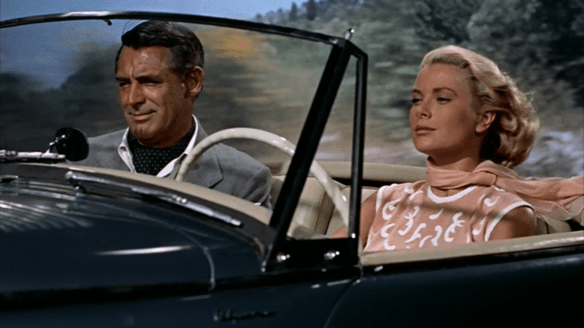
I’m the first to admit I’m the least fashion-conscious person around but there’s little denying the iconic nature of Kelly’s coral top during the picnic scenes with Grant. Again, the outfit realized by renowned costumier Edith Head is only rivaled in my admittedly meager estimation by Audrey Hepburn’s Little Black Dress (conceived by Hubert de Givenchy) in Breakfast Tiffany’s (1961) during her early morning window shopping.

The country road car sequence is a fine summation of the film’s general balancing act of John Michael Haye’s scripting with Hitchcock eye for the visual. It’s broken up by the glib interplay between our stars and yet proves silently comedic with knowing gazes and the dodging of pedestrians and roosters as the police tail close behind Francie’s sporty Sunbeam Alpine.

Though the same scene is underlined with a bit of morbidity as Princess Grace would die in a car crash years later as Princess of Monaco brought on by a sudden stroke which occurred not far from where the film was shot. It’s a tragic moment that left a dark blot the world over.

to catch a thief 7

But for now, the picture is effervescent only bounded by fireworks with the impetuous blonde intrigued by this man who she easily pinned as “The Cat” despite his constant rebuttals. She wants to be a part of his game too, all the while entrapping him with her divine loveliness.

Now’s as good a time as any to marvel at the character of John Robie who must have been made for Cary Grant precisely. At first, it’s easy to surmise that he’s supposed to be a Frenchman who can barely speak any of his native language. However, that would disregard the randomly assorted tidbits scattered throughout the film. For one, he’s said to be an American on multiple occasions. Except as Francie notes, “you’re like an American character in an English movie.” Robie even notes he once toured Europe with a troupe of acrobats, not unlike a young Archibald Leach.

The picture is also littered with what can only be termed touches of Hitchcock whether tops of umbrellas, policemen playing hacky sack on the job, or cigarettes stubbed out in eggs instead of ashtrays.

But back to the action. The final game of cat and mouse is proposed to trap the clandestine specter who has been absconding with all the jewels. It comes down to a decadent Louis 15th extravaganza frequented by the social elite and costumed policemen milling about amid the guests. Robie is waiting to pounce and takes to the rooftops to have it out once and for all!

We think we’re in for one last perfunctory car chase instead Grant and Kelly receive their final rendezvous at a villa which proves far more thrilling. The plot generally took a backseat to the stars anyways even for a Hitchcock movie. We leave them as they embrace with Francie exclaiming, “Mother will love it here!” and Grant’s quizzical look barely visible past his costar’s shoulder. That’s priceless. How could we have more fun than this?

4/5 Stars

Picnic (1955)

Original_movie_poster_for_the_film_PicnicIt’s easy to assume that Picnic is a film that time had not been very kind to. If you do a cursory glance at contemporary reviews, the majority appear far from glowing and my own reason for returning to this romance was based on a mild interest in a cultural artifact rather than an actual investment in the film itself.
As such it’s also easy to label Picnic as a contrived melodrama ripe with implausibilities and theatrical notes. One of those hot and sweaty numbers out the Tenessee Williams school of drama. This couldn’t possibly be real life. Even the romance feels a bit thin as if falling in love with someone through a simple dance could actually happen over the course of a single day. Yes, William Holden plays the energizer bunny inside the body of a has-been jock impressively but he’s a bit old for the part. Yes, Kim Novak is an aloof beauty extraordinaire but she still somehow feels out of place as a Kansas beauty queen. Rosalind Russell is and always will be a dynamo.

It’s Labor Day weekend in rural Kansas when drifter Hal Carter (Holden) stumbles off a train to call upon an old college chum named Alan Benson (Cliff Robertson) for a job. Upon his arrival, he offers to get rid of a lady’s trash in exchange for a meal.

Due to the summer heat, it seems reasonable enough that the kindly old woman (Verna Felton) tells him to strip down to the waist but a shirtless William Holden makes a stir in town from the very first ogle. Of course, it works both ways. Madge (Novak) is the local beauty and her endlessly concerned mother wants her eldest daughter to use her looks to get a nice young man like Alan.

That’s one of the prevailing notions of the times. Women must get married. They must find a nice man with means and do it while they’re young and time is still in their favor. Better yet if they’re desirable.

The alternative is winding up like Millie (Susan Strasberg), Madge’s younger sister, who keeps her nose in books, having already landed a scholarship to college while disdaining boys and avoiding them like the plague. Further still, there’s the fate of winding up like the local school teacher, the histrionic Rosemarie (Russell) who boards with the Owens and yearns for a dream man to replace the scruffy but nevertheless good-natured Howard Bevans (Arthur O’Connell), who frequently calls on her. Consequently,  Ms. Potts is one of the most agreeable characters and seems the most fulfilled (even without a husband).

However, the arrival of Hal draws out such a visible reaction from all the other women he meets and it feels severe but more than anything you can see it as wholly representative of the sexual repression of the age. It’s so jarring since in some respects the magnetism of Carter feels relatively tame and the outcry against him uncalled for but that comes out of our own sex-saturated culture.

Upon ruminating on the movie a bit longer I began to consider what it truly means when we label a film to be “dated.” We look at scenes in Picnic and are quick to write them off as an indication of the time. Maybe it’s a bit of the historian coming out in me but isn’t that part of the magic of a film like this? It can act as a time capsule. It can come to us from the era it was made in. What’s wrong with that?

As usual James Wong Howe’s color photography does an impeccable job of giving us a sense of what that life was like as does the direction of Joshua Logan since the stage version of Picnic had been his baby. They interpret the quality times that communities have together with bands, songs, games, and the best kind of food made by the most loving hands.

People called on one another, courted, were generally courteous, and there was a sense of integrity. Yes, people were often frustrated and uncomfortable but we could say the same about today too, except now the same feelings come for different reasons. Neither a culture of asceticism nor utter hedonism will find us completely content.

In the end, I stole a page out of the Astaire & Rogers musicals to try and comprehend Picnic. Unquestionably the “Moonglow” sequence is beloved and I think we can look at it utilizing a certain lens. In an age that was supposedly “repressed” a dance was a highly evocative way to express the passion of two people and like many of the most guttural cinematic sequences, this one is visually impactful with nary a line of dialogue allowing us to be captured fully in the moment.

Howe’s final stroke of ingenuity is to show our two lovers simultaneously riding off by train and bus to their life together, within the same frame. Whether they can make it work and be happy is still in question. But part of the beauty of this existence is that we each have to make our own path in the pursuit of love and everything else that’s worth living for. To use an unforgivable metaphor, life isn’t always a picnic but the dance of life will continue regardless.

3.5/5 Stars

MY ENTRY IN THE 3RD GOLDEN BOY BLOGATHON!

Young and Innocent (1937)

young and innocent.png

We meet the faces of a man and a woman bickering furiously. Another young man finds a limp body awash on the beach. He runs to get help but two young girls see his response of fleeing across the sand and believe what any normal person would believe. He’s leaving the scene of the crime. Their screams are personified by seagulls a fitting precursor to The Birds years later.

Soon film star Christine Clay covers the tabloids and the fellow finds himself on trial for murder. This is the groundwork for Young and Innocent and we have yet to even meet our heroine.

There’s a bubble-headed lawyer who’s a very nice sort but, nevertheless, a bit of a country bumpkin. Not much for such a high profile case. Thus, no one can blame the accused for fleeing the courtroom in a brief moment of tumult. Hitchcock even finds time to pose as a cameraman outside the courthouse. But more importantly, the wheels begin turning as the fugitive Tisdale calls upon the reluctant help of the local Constable’s daughter Erica Burgoyne.

Erica has become a bit of a matriarch in her family of boys and she’s learned to be a mother, a daughter, and so much more for her father and brothers. Yet soon she’s seemingly become an accessory to an assumed criminal in helping him escape. Because at the core of this story, is a variation on the Hitchcock motif. There are two innocent people on the run trying to get away including Erica who gets whisked away in the moment.

The MacGuffin set out for them to pursue is a purloined raincoat. With it comes the promise of exoneration of the wanted man. But outcomes are never that easy nor the road getting there. It leads to a row of diverting events from a brawl at a roadside rest stop with the local population of bums and even a kiddie birthday party where Erica crawls with anxiety for harboring a wanted criminal in her auntie and uncle’s home.

The story devolves into an entertaining cross-country chase, but in this particular case making its way through the countryside and to a proverbial abandoned mine shaft. These very quaint locales and the small town feel with bumbling policemen and bickering lads around the dinner table make this one feel like one of Hitchcock’s overtly “British” films or maybe one of his most stereotypically British efforts.

Some visual flourishes include a cliffhanger moment captured in typical jarring fashion and equally enjoyable is a fairly expansive crane shot that carries us through a hotel focusing on a certain person in question. Our plucky protagonist has called upon the services of an old hobo to identify the man who contacted him — the man undoubtedly implicated in the murder. Such a scene is pure Hitchcock, directing our gaze in such a way that the image he places in front of us is unavoidable. There’s no doubting his intention and he lays everything out for a fine conclusion.

Blackface aside as a horrible cultural anachronism, this picture comes off well today with Nova Pilbean coming into her own as a charming protagonist who boasts smarts and a disarming drive even as she gets whisked along.  Previously she played a crucial role in Hitchcock’s earlier thriller The Man Who Knew Too Much, but here she’s one of the undisputed stars and she and Derrick De Marney have a solid chemistry working. Of course, it’s not that customary to come to a Hitchcock picture for true romance. Still, Young and Innocent is indubitably worthwhile for aficionados of “The Master of Suspense.”

3.5/5 Stars


Sabotage (1936)

Sabotage1936.jpgSabotage: Willful destruction of buildings or machinery with the object of alarming a group of persons or inspiring public uneasiness.
It’s not exactly a titillating introduction but since this is precisely where this 1930s Hitchcock thriller commences so will I.

Again, Hitch is collaborating with Charles Bennet and of course Alma Reville (his wife) core members of his team by this point. I do find it funny that it came from a novel called The Secret Agent, the name of one of Hitchcock’s earlier entries, only to be changed to Sabotage. But it only goes to show how throwaway some of these titles were because they are hardly reflective of the genuine satisfaction in partaking in what is trying to be accomplished.

The inciting incident of the entire film involves the power grid going out all across the city. Some people assume it’s a freak event but those embroiled in national security and connected with Scotland Yard know there are far more ominous intentions. There are men looking to undermine the nation through systematic acts of sabotage and ultimately terrorism.

From our perspective, these were obvious harbingers of impending world war. In that climate, they were probably quite close to home. This film occupies itself with a single individual as he’s tailed by a government agent with his adopted family (Sylvia Sidney and Desmond Tester) acting as his convenient alibis because he’s been nothing but good to them.

One telling statement comes from the little boy when he’s talking aloud excitedly about gangsters and the like.  Because gangsters look quite ordinary, just like you and me and it’s an offhand comment but he doesn’t know how right he is. This is another textbook Hitchcock scenario because this is by no means a mystery. We know from the opening shot who the perpetrator is. But Hitchcock uses that modicum amount of knowledge to grab hold of his audience.

Similarly, he uses the tried and true example he mentioned in his dialogue with Truffaut. Having two individuals talking before a bomb blows up isn’t inherently suspenseful but if you show your cards early you’ve instantly ratcheted up the tension. He does that here immaculately aboard a double-decker bus.

Although even then it would be hard to favor Sabotage over some of his other works even those that are part of his thriller Sextet. It’s really a fairly minor addition and though Sylvia Sidney is as candid as ever she’s hardly meant for a Hitchcock film. Oskar Homolka and John Loder aren’t bad per se but they’re hardly as compelling as a Peter Lorre or Robert Donat.

Though the terrorists might look slightly different and their motives are more political than any other, there’s this uneasy sense that there is very little that is new under the sun. It’s telling that Bennet’s screenplay was loosely adapted from a Joseph Conrad story which was itself focused on sabotage in the late 19th century perpetuating this idea that certain stories are truly timeless.

Reading Walt Disney’s name in the opening credits might be a pleasant surprise for some and as might be expected, since this story does take place partially in a cinema, they show a cartoon short, seeming to be a harbinger for Sullivan’s Travels (1941) except in this story the main character gets shot with an arrow — very much a Hitchcockesque spin on animated cartoons if there ever was one. There can be humor but it’s always underlined by a sizable dose of dread.

3.5/5 Stars


Rear Window (1954): Visual Cinema and “Lisa”

rear window 1.png

There are such a vast number of levels to appreciate Rear Window on and one of those is its impeccable use of sound as well as a score courtesy of Franz Waxman. In fact, it is quite easy to consider it as a film with a wholly diegetic soundtrack but it’s really a complicated weaving of sound orchestration playing against the images onscreen. For instance, against the credits, as the blinds come up, we’re met with the playfully cool jazzy beats of “Prelude and Radio” which proves to be in perfect juxtaposition with the deathly hot heatwave hitting Greenwich Village in the film’s opening moments.

We’re also inundated with all types of songs popular and otherwise which can be picked out of the story organically if you’re paying attention. Two of the most obvious additions are “That’s Amore” and then “Mona Lisa” which can be heard being sung by a group of party guests.

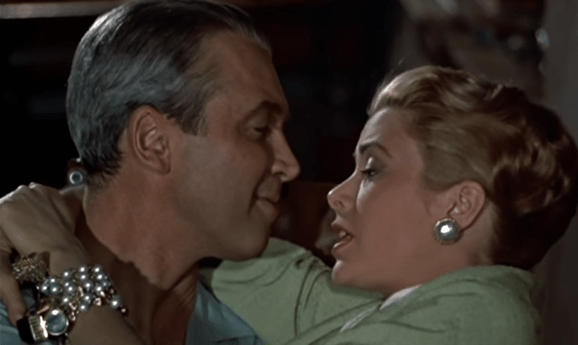
Whether or not it’s a slight nod to our heroine Lisa is up for debate but it’s also notable that she, in essence, receives her own theme song which is concurrently composed by the songwriter who lives in the courtyard that we come to know over the course of the film. It slowly involves from its nascent stages into a full-fledged tune that gains its wings once the romance between Lisa and our protagonist L.B. Jefferies has come into its own.

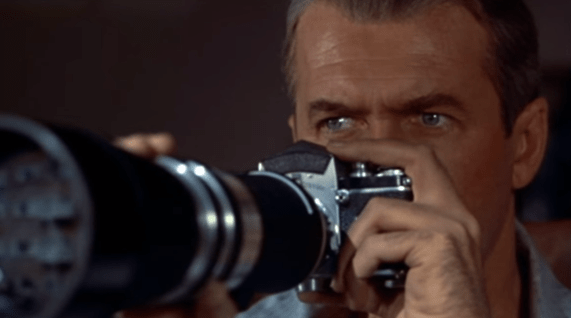
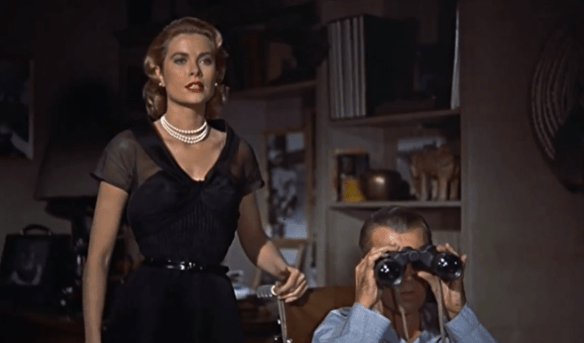
Obviously, beyond the elements of soundtrack Rear Window develops so immersive a world and Hitchcock expertly inserts us directly into the environment to the extent that we have no choice but to become involved in the whole ordeal. We are accomplices, if you will, in this viewing party of Jimmy Stewart’s.

It truly is an exhibition in the moving image because the film works so brilliantly with them. Certainly, it begins with the staging and the complex setup Hitchcock had to work with at Paramount Studios but there’s simultaneously the use of color cinematography, the lighting of the stages which sets the scene given the time of day, and common street noise that lends an almost imperceptible authenticity that we take for granted.

Furthermore, working with his long trusted photographer Robert Burks you see Hitchcock moving so fluidly and with so much purpose through the playground provided him. The camera captures objects with clear intention and a crispness that far from simply giving us the illusion of being in the space, in many ways, makes us feel like we are actually right there with Stewart looking out into the courtyard.

You also get the true essence of what visual filmmaking is because his powers of suggestion and even persuasion of the audience are impressed upon us by what he deems important. Hitchcock lays out nearly all of Stewart’s backstory not with clunky expositional dialogue but by giving us a wordless parade of his apartment while our protagonist sleeps. And the whole picture is a constant rhythmic cadence of being fed images followed by Stewart’s reaction shots. It’s Film at its primacy. Where two images put together are blessed with so much more meaning and suggestion than they could ever have alone.

But far from simply marveling at what Hitch has accomplished it’s far more miraculous that we become so enveloped in this story. It’s an admirable mystery plot chock full of tension that’s built up over time and successive shifts in perception, time of day, and personnel moving in and out of the complex. Our one commonality is Stewart stuck in that wheelchair with only his broken leg, his camera, and the neighbors to keep him entertained. They do far more than that.

rear window 4.png

Rear Window’s A-Plot is a perplexing mystery thriller that we watch unfold with a systematic unraveling that’s unnerving in part because Hitchcock has orchestrated it all in a limited space. Furthermore,  he has handicapped his protagonist and the outsiders coming in are constantly causing us to second guess or reevaluate our assumptions be they the insurance agency nurse Stella, Jefferies’  policeman pal, or his best girl Lisa. Each character is at one point in opposition to Jefferies while also providing a sounding board for his cockamamie theories which start to bear the grain of truth. We get to be a part of it all.

The utter irony is that once more not only is Hitchcock’s villain atypical — in nearly all areas a seemingly unspectacular man — he’s also quite overtly styled after David O. Selznick. If you know anything about the producer he shares some resemblance with Raymond Burr and there’s no denying that Hitchcock was never fond of the other’s meddling. As much as I love the Rebeccas (1940) and his earlier American works if Rear Window was a representation of the hands-off approach to his filmmaking than I would have to side with him.

At least by this point in his career, there’s no denying that he projected a singular vision that could hardly be quelled by any individual. This is “Alfred Hitchcock’s Rear Window,” after all, as the opening credits proclaim.

However, the beauty of this picture is that it truly does stand up to multiple viewings and every repeated viewing offers up new depths or at least minor revelations that add an even greater relish to the experience.

In particular, are the underlining themes of romance. Because this is a film about love in all its many facets with each character or couple reflecting a certain permutation of what romantic love looks like.

The love stories are playing out in each compartment of the apartment complex. Miss Torso, the queen bee with the pick of the drones. She’s very much eye candy but in the final frames, we realize there’s more to her as her love comes back home from the army. There’s Miss Lonelyhearts who is desperately seeking love and yet has enough respect not to stoop below her dignity. It’s a song that lifts her out of her despair. The Newlyweds are still in the honeymoon phase and we never see them.

rear window 2.png

Meanwhile, you have Stella providing her homespun philosophy that people shouldn’t overanalyze their situation. Jefferies is pushing back against any serious romance because in his estimation Lisa is far too perfect for him. Meanwhile, Lisa is left believing she can live in any world that Jeff is in. The list goes on and on.

But for the threads to be resolved that must become fully intertwined with the murder at its core because such an event calls for a response from our characters — at least our main ones. When Lisa sacrifices so much to show her love and devotion to him, he realizes how much he misjudged her character and perhaps more profoundly how dearly he loves her and never wants to lose her. He has made the transition from armchair philosopher and misanthrope to a man smitten with someone else. As long as he ditches the window watching he should be fine.

That leads us to another area of discussion. There’s a bit of a moral commentary present though Hitchcock doesn’t seem all that interested in those conclusions per se as much as he likes manipulating them for the sake of his drama. And yet like Vertigo four years later there is this unnerving sense that he is tapping into some of humanity’s darkest desires to watch and spy on others for pleasure without any consequence or any vulnerability on the part of the peeper.

That draws me to another aspect of the film that I’ve never really considered. Rear Window implicitly asks what it is to be a neighbor or at least what it is to live with neighbors. There’s very little in the realm of actual judgments except for the small condemnation that comes from the woman who lives just above the murderer after her yippy dog has been killed. What does she say?

You don’t know the meaning of the word ‘neighbors’! Neighbors like each other, speak to each other, care if somebody lives or dies! BUT NONE OF YOU DO.

What she provides is a heartfelt and searing indictment which is nevertheless lost in all the commotion whether it’s the big party going on across the way or the realization by our heroes that their theories about murder have been confirmed. It did make me consider even briefly if the so-called Great Commandment is to “Love Thy Neighbor,” what does that look like?

Far from peering in at other people and staying anonymous, it seems like it involves reaching out to others. In some ways, being vulnerable and candid — transparent even — so others feel comfortable entering into our lives. Like Stella says sometimes people need to go on the outside and look in for a change. If nothing else that breeds empathy.

Of course, if that was the case, there would probably have been no murder and that’s what we want right? Well, anyways, Rear Window still stands as my favorite Hitchcock picture and one of the most clinical and compelling thrillers of all time.  But you probably already knew that. If you did not I implore you to break both your legs if need be and go lock yourself in a room and force yourself to watch it right this minute.

5/5 Stars

A Matter of Life and Death (1946)


Matter_Life_Death_Hunter_Niven

Matter of Life and Death is planted in its era. It carries the vague notions of a war film, it’s certainly a romance, and it revels in the throes of fantasy. But on the whole Michael Powell and Emeric Pressburger’s film functions outside the typical confines that are put on film as a medium. The scope it dares to take on is far more expansive.

The plot is made in the first few minutes when a pilot looks to eject amid the fog engulfing his failing bomber. It’s in that single moment where he picks up the signal of a radio dispatcher down below and their lives are never the same. Believable or not they fall instantly in love — in that moment of heightened emotion — they find a connection. She, never to see his face and he, never to make it out alive.

The Conductor (Marius Goring) from the other side is already looking to pick him up. Except something goes terribly wrong, or terribly right for the pilot, depending on your perspective. In other words, he doesn’t die. He escapes death. It causes a bit of a stir and Conductor 71 must try and rectify the situation.

But of course, Peter David Carter (David Niven) quite by chance is reunited with the woman from the other side of the wire, the American named June (Kim Hunter) and they are allowed a happy life together. Except with his reservation with the afterlife still up for contention, Peter finds himself being visited by the Conductor who coaxes him to accept his death. Instead, Peter calls for an appeal and his case is set to be brought before the highest authorities to decide once and for all if he must accept his death as ordained or have it postponed so that he might continue to cement his love for June.

It evolves into a wonderfully fantastical courtroom drama, wrapped up in romance, with a bit of time travel, purgatory, special effects, and color all mixed together in a tirelessly imaginative arc.  It’s true that the ambitions of the conceptual narrative are really unlike any other cinematic creature as it cycles so lithely through time and space. Freezing images, moving characters about this way and that, and cutting back and forth between worlds most easily differentiated by their color schemes.

Still, in some way, I was gripped more with the furious emotion of The Red Shoes (1948) and yet with its phenomenal conception and immaculate staging, A Matter of Life and Death manages to be an extraordinary picture by most accounts. If its waves of romance did not seize me instantly, its sheer inventiveness was nevertheless breathtaking.  And if the concept enthralls me even more than the narrative does then so be it. It shares a world akin to Seventh Heaven (1927) or Wings of Desire (1988) and that alone is worthy of praise — carving out a place in the pantheon of transcendent films — featured on the conveyor belt that makes its way through the years.

Fantasy films were made to be like this, arguably functioning in a realm that only films could facilitate and Powell and Pressburger examined near unfathomable realms. Not only with scripting but the selection of shots, and developing fascinating spectacles out of the Other World from the stairway to heaven to the infinite courtroom where Peter’s case is debated. Jack Cardiff’s photography takes on the monumental task of balancing two worlds with equal import — the world we know and the complete other realm that has yet to be revealed to us who are still among the living. It leaves us feeling enamored with both. Not simply because of beauty but sheer size and scale.

The storyline comes down to the final moments where Peter and June are asked to make the kind of choices we have been expecting. Right about now we can hear the words ringing in our ears, there’s no greater love than to lay down one’s life for the ones you love. Their actions say as much. But as we might just come to find, give and it will be given back to you more abundantly than you could ever imagine. Sacrifice all that you have and you will find yourself gaining so much more.

It brings to mind a dialogue that emerged from the courtroom when the prosecutor (Raymond Massey) notes that “nothing is more important than the law. The whole universe was built on it.” But his learned opposition (Roger Livesey) ascertains that “this is a court of justice not of law.” The implications being that the law is good and must still be fulfilled but justice is the key here, where right is done by all men and love reigns supreme.

There are a plethora of interesting topics that arise from The Archers’ film but one of the foremost is the sentiment of not only the post-war but of an entire millennium. It’s a belief that could arise from many marginalized points of views suggesting that there is a great deal of prejudice and ill-will that could be exacted against the English (and certainly Americans too), anyone who has been a major world power.

The jurors put up against the defendant all have grievances they could hold against the English people, but then again, we are not our fathers’ fathers and we cannot necessarily turn back the clock on their past sins. But what this film does suggest more powerfully still, relevant in a post-war era or any age really, is the idea that people can reach out across the sea and really across the world to be united by something. We’ll give it a name to it and call it love in its many forms — more specifically as the Greeks might call them, storge, philia, eros, and greatest of all agape.

4.5/5 Stars

Note: My entry in the Time Travel Blogathon


Angel and the Badman (1947)

Angel_badman.jpg

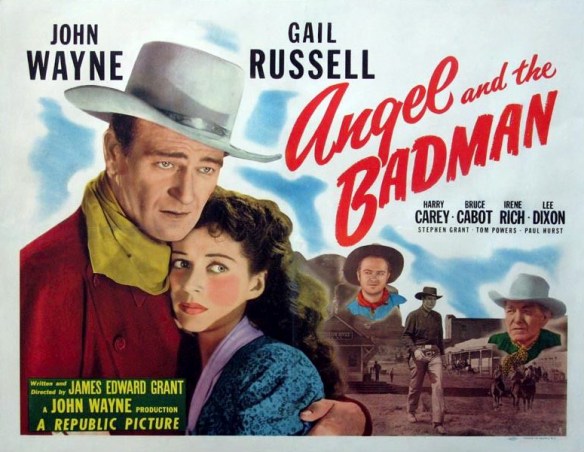
With John Wayne partnered with his longtime collaborator James Edward Grant (Hondo, McClintock!) it’s easy to see Angel and the Badman as an early vehicle for his conservative ideals but far from being heavy-handed, it goes down as a solid B-picture with a surprisingly unique perspective on the West.

In this instance, the western is used to construct a fairly simple parable that plays out over the frontier using figures that we know well from every cowboy picture we’ve ever seen.  The outlaws and the homesteaders, the sheriffs and the doctors, they’re all present.

But underlying their every interaction is a certain purpose. It’s not simply to entertain — though the film is adequate in that department and has it’s share of gunfights and showdowns. It foregoes most of the normal set pieces to carry out its main objective as a moral tale. Still, these established figures help draw up the themes by the very way they see the world.

Quirt Evans (John Wayne) has and always will be an outlaw as preordained by society until the fateful day when he finds sanctuary in the home of a Quaker family after incurring a wound. They take care of him and nurse him back to health but above all, they give him the benefit of the doubt — that he is not too far gone and he still has more than a fair chance to redeem his life if he so chooses.

The local apothecary functions as the main counterpoint to our angelic first family. He is very rational-minded, devoted to scientific thought and his cynicism leads him to begrudgingly patch up the outlaw all the while grumbling under his breath. It’s telling though that he holds this overtly religious family in high regard. But nevertheless, the parameters have been set. We must sit back and find out where John Wayne falls within the frames of this corral.

It’s true that he’s saddled with a past full of womanizing, guns, greed, and every other sin known to man. In fact, the local sheriff is bent on hanging a rope around his neck but the old veteran (Harry Carey) is a sly fellow ready to bide his time and let Quirk slip up somehow.

The main point of contention is a payload of gold that a band of glowering thugs is intent on getting a handle on. Quirt is all that stands between them and the prize but even in his injured state he still packs a gun — the bullets inside and his stellar marksmanship being the key deciding factors.

Playing against this very storyline is a parallel thread that bears equal importance if not more. Penelope Worth (Gail Russell) is the daughter of this Quaker family and she is tasked with taking care of this formidable outlaw. In any other scenario, they would be oil and water. Their lives and personalities should never mix and yet in this romance, they ultimately do. True, his lawless lifestyle chafes against the worldview of these religious Quakers who promote an existence of good will and pacifism. Still, people can change.

John Wayne notably disliked High Noon (1952) and his most famous denouncement of the picture can be seen in Rio Bravo (1959), viewed by many as a cinematic answer to its predecessor. However, in this earlier film, you see in Wayne’s character a man who also falls for a Quaker much like Will Kane (Cooper) does in High Noon. But here he comes from the wrong side of the law. Still, she redeems his very nature and far from throwing off the perceived shackles of her beliefs or simply tolerating them to stick to what he knows best (namely gunplay and showdowns) he does the fairly brazen thing and wholeheartedly embraces her way of life. Because he loves her.

It begs the question, which outcome is more believable: The sheriff who went against his wife’s pleas so he could uphold his personal convictions or the outlaw who gave up his old way of life even in the face of death because he was transformed by the love and lifestyle of his woman? Rather than drawing up which one is better exactly, it might suffice to say that Angel and the Badman, while lesser known, is still a diverting western with its own moral dilemma because westerns are and always have been horse operas.

3.5/5 Stars

Man’s Castle (1933)

220px-Mans-castle-1933.jpg“Blessed are the poor in spirit for their’s is the kingdom of heaven”

With Frank Borzage taking on both WWI and WWII in his career it only makes sense that he would take on the event that in many ways bridged them — The Great Depression.

It’s fairly early on in the story where the local resident Ira (Walter Connolly), a minister by day and a night watchman by night cites the Sermon on the Mount and later references 1 Corinthians 1:27. The moral being: Blessed are the poor in spirit and God chooses the lowly things of this world and the despised things to nullify the things that are strong.

If nothing else a character such as Ira is one of the lovable figures in this fairly dank and dreary tale but his words breathe an inherent worth into the masses of everyday individuals slogging their way through the Depression.  In many ways, this film is a eulogy to those very people, the downtrodden, the poor, the heavy-laden folks.

But sometimes those same folks seem to come in all shapes and size making it nearly impossible to get a line on them. We first meet Bill (Spencer Tracy) a veteran fast-talking Artful Dodger-type who works the streets of New York in his top hat and tails. In this very first sequence, he’s in the middle of a seemingly frivolous activity offering breadcrumbs to the pigeons.

He catches the young gal (Loretta Young) next to him giving him the eye and calls her out. Although she might not look it, she’s destitute, going without food on two days now so he begrudgingly agrees to treat her to some fine dining. Of course, when the time to pay the check comes so comes the big reveal. Bill is just about as broke as Trina and they get thrown out (at least with full bellies).

For the rest of the film they hold up together in a shantytown in the local Hooverville where the existence is sparse but Trina exists as a happy homemaker whose indefatigable spirit never seems to dampen. Bill spends his days drifting finding bits and pieces of work here and there and in the evenings he comes home to his gal. Any other circumstances and their lives would seem fairly normal.

He playing the breadwinner. She playing his devoted spouse. Except he gets the bread by serving a summons to a local stage performer and stilt walking in his free moments, among other things. But he scrapes together enough to get Trina a new stove for their hovel. The fact that they remain unmarried is invariably inconsequential and Trina’s not looking to tie down her man — she’s far too understanding and open-minded for such thoughts.

And although partially unbelievable its integral in how Tracy’s protagonist reveals his true character. Yes, he is a man with restless feet constantly playing the curmudgeon — disdaining the “ball and chain.” However, there’s an old adage that would be apt in describing him. His bark is worse than his bite.

There’s no conceivable way that two individuals such as this should remain together and even in the film there are moments when their symbiotic relationship seems to be splitting at the seams.

Tracy is brusque and surprisingly stink-eyed but as is his custom he comes around and has the audience on his side for the very fact that Loretta Young is so devoted to him. On her part, the sprightly and ever-effervescent Young at the ripe young age of 20 might be skinny but she holds her own and is crucial to making this love story something of substance.

Borzage once more dissects a romance that’s, in this case, one of the most unlikely pairings but Bill ceaselessly subverts our expectations. He’s not such a bad cad after all and Trina makes him be better than he has any right to be.

In this specific instance, the two lovers get their happy ending clutching each other closely in a pile of hay aboard a freight train. The destination nor the future seems to matter because the underlining factor is they have each other. You’ll be hard-pressed to find many affluent people in this picture and this is an important distinction to make. This is not a screwball comedy. On the contrary, center stage is given to members of society who are usually marginalized and it comes off exceedingly well thanks to Tracy and Young.

3.5/5 Stars

Note: It’s most likely that the cut you will see is the 1938 reissued version following the installation of the Hays Codes. I’m not actually sure if an original print is still available or if it’s considered lost.