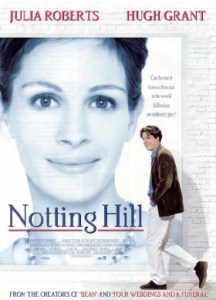
Notting Hill (1999)

NottingHillRobertsGrantThere is a scene in the film where a group of friends is sitting around the dinner table in the Notting Hill district of London, and they are having a friendly after dinner competition to decide whose life is the most hopeless. The winner gets the last delectable piece of fudge. One person sitting at the table is seemingly out of place. Actress Anna Scott (Julia Roberts). Her face is plastered on double-decker buses all down the squares. She made $ 15 million on her last film, circa 1999. You would think she’s got it made. But this woman takes her turn and shares about her own brokenness. She’s had surgeries to maintain her beauty. The tabloids rake her life over the coals, and when she gets old, she will only be remembered as the shell of someone who used to be famous.

It’s a haunting, honest look at what it means to be a celebrity superstar, and it is for this reason that Notting Hill works as a charming, at times witty, and altogether unlikely romantic comedy. It’s this simple suggestion that two people, from two entirely different spheres of life, can be together, because of the simple urge of every human for companionship, closeness, and someone to know they exist.

The two individuals, in this case, are Anna who I’ve already mentioned and Will Thacker (Hugh Grant). He’s a nobody just like you and me. He owns a corner travel bookstore, very cleverly named The Travel Book Co. He’s gotten his heart broken seriously twice and his roommate is the oddest crackpot you could ever have the misfortune of living with. That is his average, everyday life, in the neighborhood of Notting Hall.

That’s what makes a visit by an inconspicuous Anna Scott to his bookstore all the more extraordinary, while still allowing for the suspension of disbelief. Everything follows sequentially as it should. He runs into her with a cup of coffee and offers his flat as a place to freshen up. The first kiss comes quite by accident. Days later he winds up in a press conference once again face to face with this great star. But she surprises him by being his date to a small dinner for his sister’s birthday. A nighttime jaunt is accented with all the romance you could ever expect.

It’s too perfect and what follows are two obligatory strikes in their fantasy relationship. Will learns about Anna’s big shot boyfriend (Alec Baldwin) who is back in town. He’s caught off guard by it. Months go by as he tries to forget her, but she shows up on his doorstep looking for that person to talk to once more. When the tabloids show up, she is peeved, directing all her anger at Will, perhaps a little unfairly. And that looks to be the end of it all.

Months roll on again like pages in a travel log and here Anna is again in his shop, like the first time they met.  There’s an earnestness in her request to rekindle a relationship that makes us ache for Roberts. Like any frightened, often wounded, ordinary man, Will turns her down. It’s the logical decision. After all, he doesn’t want to get hurt again. Strike three. Except… his friends rally with him to catch her before it’s too late, because what’s the fun of rationality?

They go racing like a daft crew from Top Gear, “Gimme Some Lovin'” thumping in rhythm with Will’s beating heart. He gets to the Savoy Hotel just in time for her final press conference. A la Roman Holiday he professes his love incognito, and they wind up with it all. Red carpets, quiet afternoons in the park, and most importantly each other.

Notting Hall had me hooked simply with its images of England, a place that is near and dear to my own heart. It’s also a wonderful backdrop for romance, and this story from Richard Curtis finds it’s perfect duo in Julia Roberts and Hugh Grant. He is handsome certainly, but that is overshadowed by his decent, every man quality which attracts Anna to him. He’s the man who willingly defends her honor in a restaurant, not because it’s easy, but it’s simply the right thing to do. Meanwhile, Roberts perhaps is playing a version of herself, as an actress, but she gives the character the necessary insecurities, eliciting more sympathy than I would have thought possible for someone coming out of Hollywood. Yes, Notting Hall might be a few minutes too long, but getting to walk down Portobello Road just might be worth it.

3.5/5 Stars

Still Mine (2012)

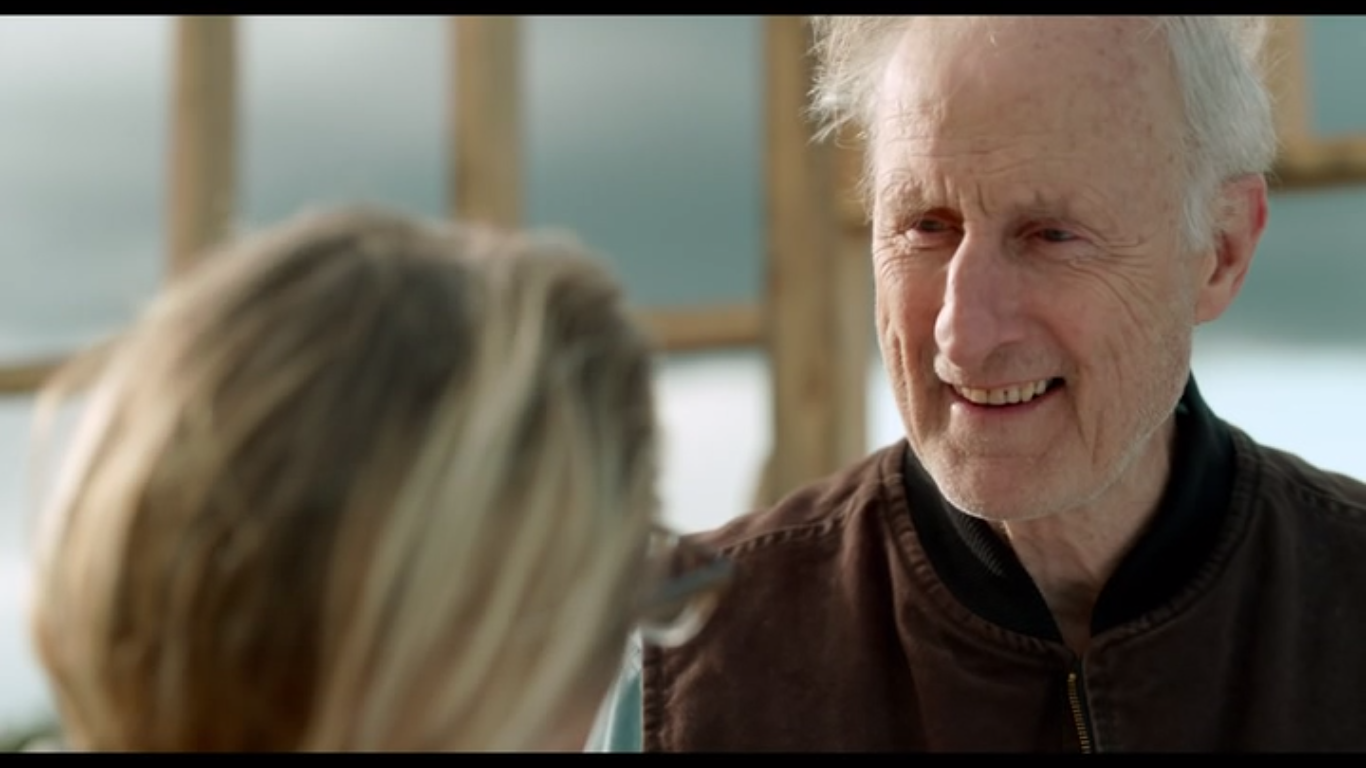
stillmine1This is not a powerhouse film, but it’s bolstered by a powerhouse performance from James Cromwell. His career has always been one worth watching. He’s been prolific for many years now in films like Babe, L.A. Confidential, The Queen, The Artist, and so on. And yet he’s never been a star, simply a wonderful character actor making each film he appears in all the more interesting. He has an imposing frame, often a quiet persona, and a relatable quality.

Still Mine is certainly a romance film, but it’s about one man almost as much as it’s about a couple. Craig Morrison (Cromwell) is well into his 80s now and he is still living in a farmhouse with his wife of 60s years. Her health and memory are quickly deteriorating and he, along with all his children, knows it. He resolves to build her a newer, smaller farmhouse that will be easier to manage.

We like him as an individual because he still has ties to the old world and the way it used to be. He doesn’t beat around the bush, and he gets fed up with the impracticality of modern-day bureaucracy. He’s proud and independent. His idol was Babe Ruth, and he has a great passion for lumber because he father was a shipbuilder long ago.

That’s why when his new project hits roadblock after roadblock in the form of building code violations, he’s peeved and annoyed. But he tries to push through, going past them, because that’s his way. His main opposition is building inspector Mr. Daigle, who although he might be a sour apple and a stickler for rules, is by no means a villain.

stillmine2So in a sense, this story is twofold. We get to see the ties that bind two people together even after so many years of marriage. They are so closely knit. They can have their tiffs, they can get frustrated, but ultimately there is an almost insurmountable amount of faith and affection that holds them together. It makes the mundane beautiful and yet at times, it becomes difficult to watch because Craig knows that his other half is slowly losing her edge, and yet he still loves her so deeply. He gets angry with her, but he has an extraordinary capacity to love her still.

But also this film is interesting because we get to watch the resolve of a man on another front. He wants to keep busy. Despite his advanced years, he wants to do this on his own. It’s the principle of the thing, and he sticks with his convictions no matter what children, neighbors, or members of the bureaucracy say. Although Cromwell still feels fairly young and spry, I didn’t mind him playing a man quite a bit older than himself. Also, the ending including Mumford’s “After the Storm,” was a rather surprising inclusion, but not a bad thing. It adds a contemplative tone to this film’s resolution.

3.5/5 Stars

Pillow Talk (1959)

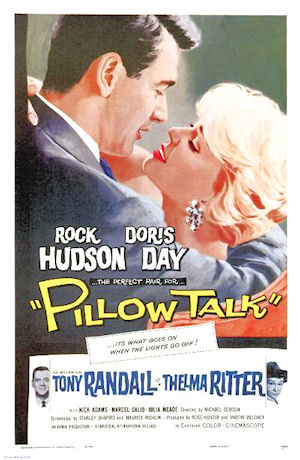
Pillowtalk_posterIt’s the original Rock Hudson Doris Day Rom-Com, with the seemingly perpetual split screen, to match the party line that constantly weaves its way through the story. It’s technicolor, it has an infectious title track, and it’s absurd wackiness somehow adds up to a boy-gets-girl happy ending.

The imposing and dashing Hudson plays songwriter and major playboy Brad Allen, before masquerading as tenderhearted Texan Rex Stetson. But how does he get there? What causes him to play such a ludicrous part? It comes in the form of Jan Morrow, our peppy platinum-haired interior decorator who has had just about enough of her party-line partner, the estimable Mr. Allen.

Her often swanked housekeeper Alma (Thelma Ritter) doesn’t mind eavesdropping and swooning along with all the other impressionable women he romances over the telephone. Jan, on the other, thinks it’s sickening behavior for a man. She would never allow herself to be taken in by such a cad.

Of course, there’s more to the story since one of Jan’s clients, the neurotic millionaire Johnathan Forbes (Tony Randall), is madly in love with her. There’s another wrinkle though, that’s far more important. He knows Allen from his college days. When Brad gets his first view of Jan, she’s an absolute knockout and he wants to win her over, but she hates his guts, at least over the phone. Enter a sweetly sincere Texan and she is swept off her feet surreptitiously.

Brad manages the charade for some time, but for the comedy to work, it must all come crumbling down. In this case, as expected, Ms. Morrow and Mr. Forbes figure things out at almost the same precise moment. It looks like Brad is sunk for good. There’s no hope for such a louse. But then again, if Pillow Talk ended there, it’s audience would be left muttering despairingly and crying inconsolably. The exclamation point comes when Hudson pulls his bride-to-be out of her bed and forcibly carries her through the streets of New York. It sets the stage for some quips perfectly at home in a quaint bedroom comedy plucked out of the 1950s.

Day and Hudson were stupendously popular with the populous and this film would begin their string of pictures together. Although they never reached the excellence, or more aptly, the above-averageness of Pillow Talk, they have remained relatively popular even to this day. Ms. Day was always a fan favorite and rightly so with her impeccably powerful voice, raucous comedic performances, and self-assured charm. And she’s still with us bless her heart! It will undoubtedly be antiquated and overly saccharine to many, but if you have a soft spot for either  Rock or Doris, then enjoy it without reservations. It’s a rather entertaining guilty pleasure.

3.5/5 Stars

Brad: Look, I don’t know what’s bothering you, but don’t take your bedroom problems out on me.

Jan: I have no bedroom problems. There’s nothing in my bedroom that bothers me.

Brad: Oh-h-h-h. That’s too bad.

Punch-Drunk Love (2002)

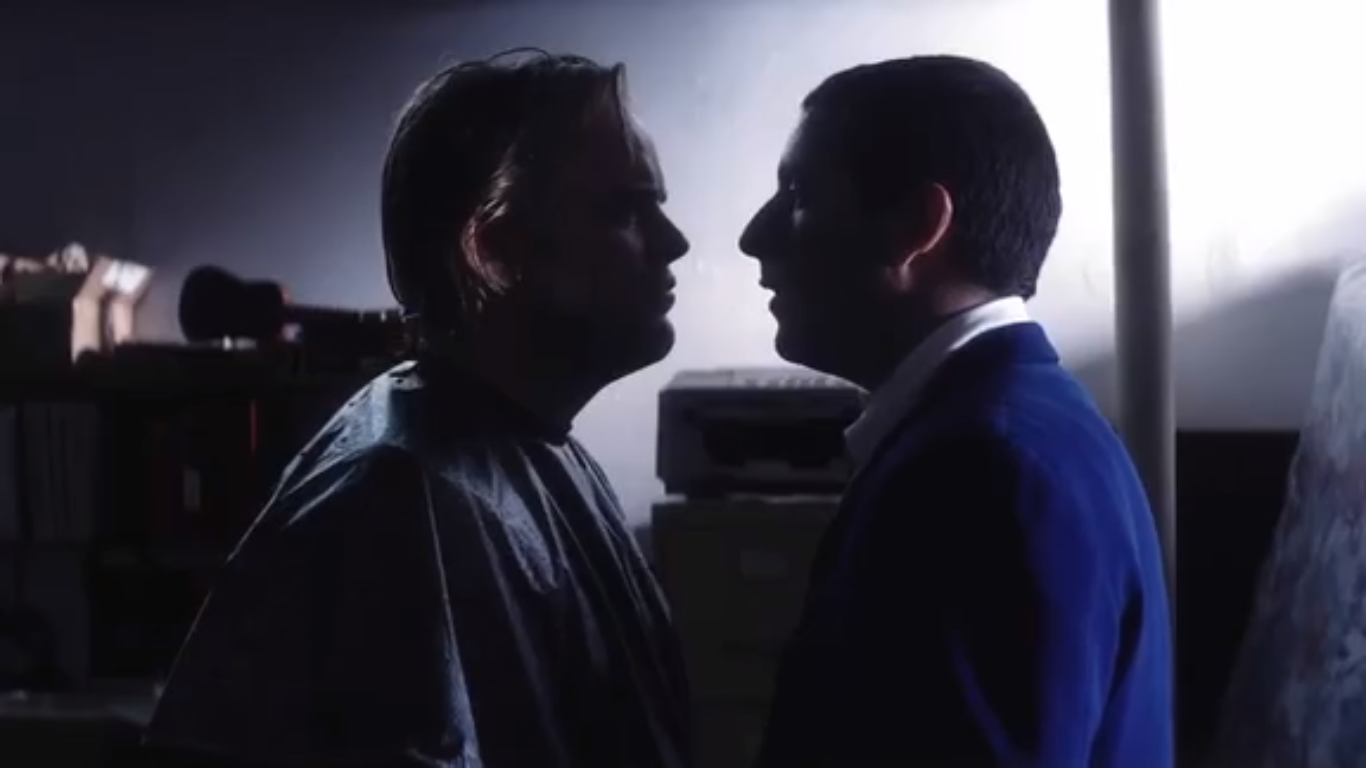
punchdrunk1When Paul Thomas Anderson said he was making a comedy with Adam Sandler, people undoubtedly scoffed at him. I know I would have if I had known about this film back then. However, he proved that you should never question him as a director. Much like a Kubrick or a few other auteurs, I’m not necessarily the biggest fan of Anderson, but you have to admit his films are interesting and very much their own entity.

Punch-Drunk Love is a comedy certainly, but not in your typical sense. It’s a romance, but it’s not quite like any romance I’ve ever seen. Thanks to the bolstering performance of Adam Sandler, it’s whimsical and odd. He plays Barry, a rather passive and antisocial type, who seems constantly quelled by the dominating personalities of his many sisters.

He’s obsessed with buying up pudding for a chance at frequent flyer miles, he picks up a harmonium tossed on the road-side, and most of all he’s lonely, but he’s not comfortable going on dates. His sister tries to set him up with a nice friend of hers who happens to be British (Emily Watson). Barry rejects an offer to go out to breakfast with them and out of loneliness calls a phone sex line. Out of stupidity, he hands over his credit card info, and the rest becomes a big scam that he can’t escape.

Thus, his work phone at the office is ringing off the hook from a girl trying to steal his money. His sister is continually trying to set him up, and Barry seems to live in his own little weird world at times, overflowing with his own personal odd ticks and quirks. He also has an anger problem, meaning he’s bad news if you give him a hammer.

punchdrunk2At times the film is thoroughly unsettling and nervously, uncomfortably funny, thanks in part to Sandler, but also the pervasively weird sound design that utilizes the harmonium. At his core, Barry is a lonely and confused man, aren’t we all, and it reveals a depth to Sandler that many probably have not seen before. It helps that the sweet Emma Watson makes us believe he is likable and in truth, he is somewhat endearing in how he can get lost in an apartment building or always wears the same blue suit. He even follows her to Hawaii for the sake of love. But don’t get any wrong ideas. This is nowhere near the realm of 50 First Dates.

3.5/5 Stars

Royal Wedding (1951)

royalwedding1The Wedding of Queen Elizabeth and Prince Phillip was a once in a lifetime experience. They’re still together to this day and yet when they got married she was not even queen yet. It’s hard to believe. It’s only fitting that a momentous occasion like that would get a film, and Stanley Donen‘s musical is a bouncy little dance fest that uses the wedding as its backdrop, hence the title.

The story follows the brother-sister dance team extraordinaire of Tom (Fred Astaire) and Ellen Bowden (Jane Powell), who after a smashing opening weekend of their show Every Night on Sunday, get a call to perform in London in the wake of the big occasion. So they get aboard the first ocean liner available and head abroad. Tom is more interested in work than love, and Ellen leaves behind a string of beaus behind, but none of them meant much to her. She finds a budding romance with Lord Brindale (Peter Lawford), and it looks like it might actually amount to something. Quite by chance, Tom finds out a woman he meets on the street happens to be part of their production, the dancer Anne Ashmond (none other than Winston Churchill’s daughter Sarah). So of course, we have these two budding romances forming as the show gets into high gear and siblings must balance their obligations with love. It’s not always easy or without heartache, but it ends up just as glorious as the Royal Wedding.

Fred Astaire is an ageless wonder looking as spry as he ever did, and his individual numbers are probably the film’s best. His coat rack dance in the gym seemingly pays homage to his friend Gene Kelly and shows his brilliance at breathing life and vitality into inanimate objects. They become his partners in the dance. His inspiration for expression.

royalwedding2Furthermore, his dance on the ceiling looks as remarkable now and feels just as magical as it probably was back then. It’s a marvel because we look for any sign of a trick, but everything looks so fluid. Thus, it’s so easy to quickly forget the technical aspect and simply be blown away by the inventiveness of Astaire.

Jane Powell is a wonderfully bright young beauty and a lovely co-star for Astaire in both song and dance. It was refreshing not to have them playing romantic leads opposite one another and the brother-sister dynamic fittingly mirrored Astaire’s own longtime real-life partnership with his sister Adele. All in all, it’s a light and elegant bit of fun that’s an exuberant delight. It does what it sets out to do and that’s about all you can ask for.

3.5/5 Stars

Atonement (2007)

atone2Without any prior knowledge and given what we know to begin with, it looks like Atonement will be a love story revolving around the characters of Keira Knightley and James McAvoy. They are, after all, the big stars in this WWII era romance based on the Ian McEwan novel. We expect to become enraptured in their passionate love affair that is to be indubitably broken up by war. However, it becomes evident very quickly that this is really a tale about a young girl  and budding author, played through the years in succession by  Saoirse Ronan, Romola Garai, and Vanessa Redgrave. It is her point of view and her part in this narrative that becomes most important, although we do not have any indication as to why to begin with.

So in front of the peering eyes of Briony Tallis, her older sister Cecilia (Knightley) and the son of the family housekeeper Robbie Turner (McAvoy) start something which Briony cannot fully comprehend and understand. What is it that is really going on around her? An intricate manipulation of time and place begins, relating the story from a number of perspectives, but always returning to Briony. How does Cecilia really feel towards Robbie, who is in a sense below her, but still proud? Briony knows she has feelings for the housekeeper’s son, but how is she to react when she finds her sister and Robbie crammed up against the bookcases together. Then, when a pair of pesky twins goes missing a search party begins. Again Briony sees something that she cannot fully understand, and yet she makes a judgment that will unwittingly tear apart two lives. There is constantly an inquisitiveness, a confusion in her expressions that is absolutely spot on.  And in these moments the score is suffocating with its pounding, clanging, and banging.

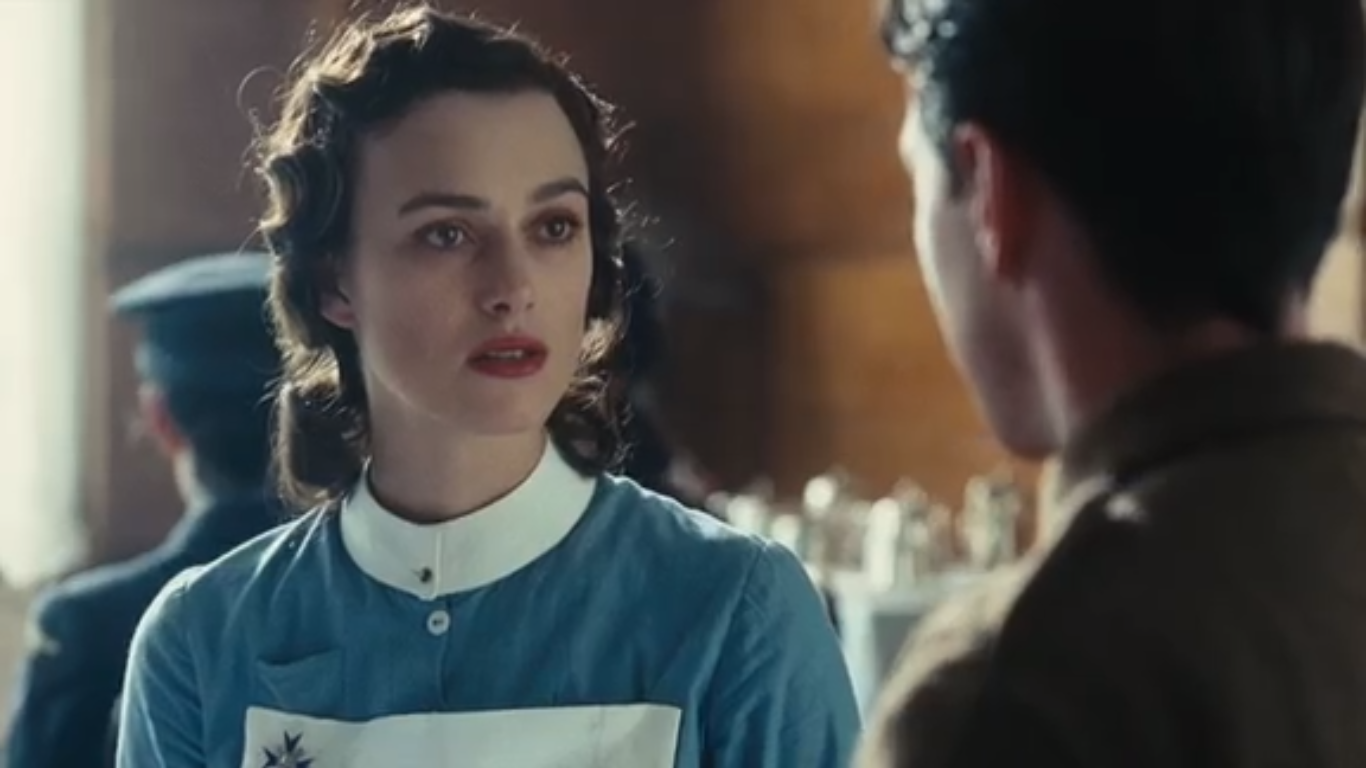
atone3Robbie gets sent away, torn from his love Cecilia, and Britain is on the brink of war. When the two lovers finally get a chance to see each other, he has joined the army in order to be released from prison, and she is working as a nurse.  But it’s a heartbreaking separation because although the passage of time is condensed for us, we can easily see the reserved, hesitant quality in both of them. How are they supposed to react? It’s difficult to hold onto the same feelings, maintain the same type of passion when you’re separated by the years. Cee reaches out to touch his hand, and he avoids her slightly. You cannot exactly blame him, but there is a tinge of sympathy for her.

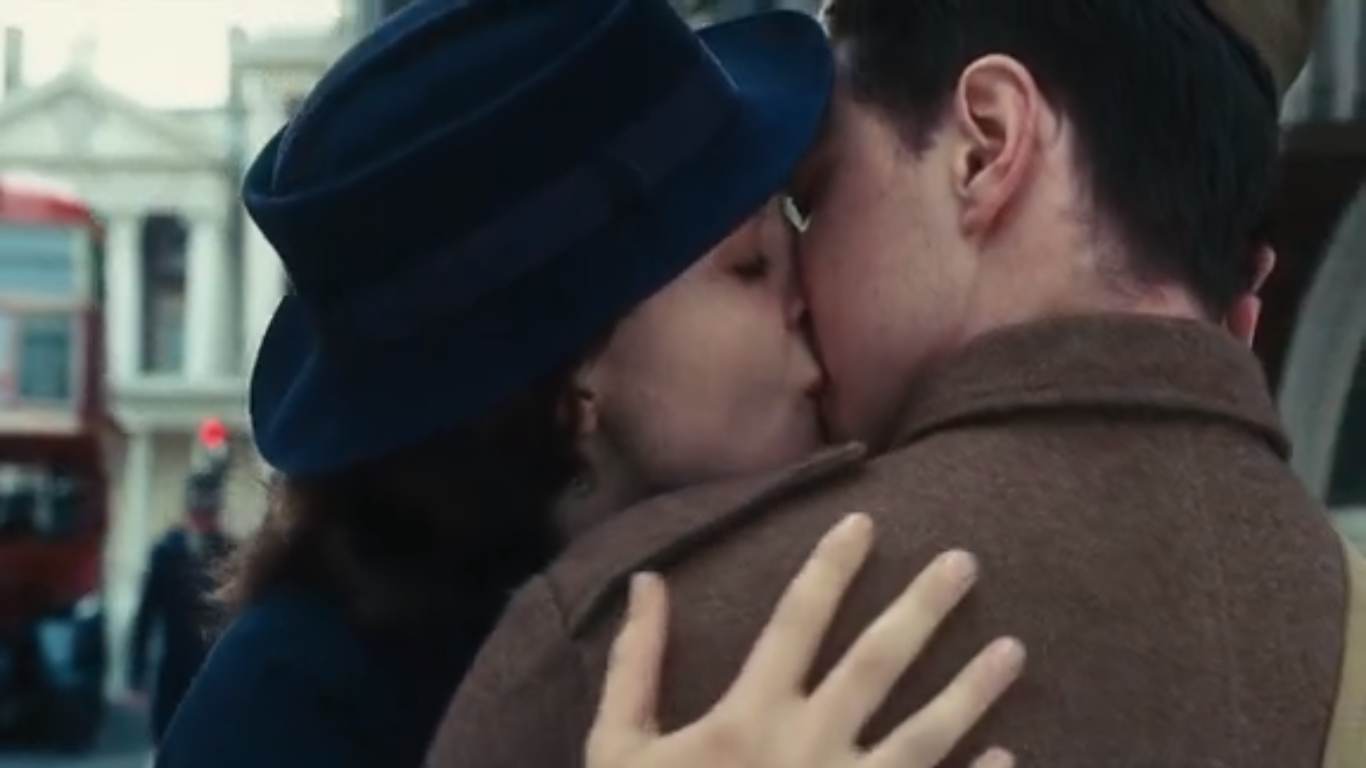
But their romance is quickly renewed and heightened once more in a matter of days, only to have the war this time pull them apart. And it’s something that’s very hard to rebound from. Robbie ends up in the middle of France and when he finally discovers the coast with a couple of comrades they come across all the forces at Dunkirk getting ready to retreat. For those engaged with WWII history, Dunkirk was in one sense a wounding blow to the English ego, but also a testament to their resilience. The men are beaten and battered, but escape the Nazi onslaught to fight another day. And yet we don’t see the fighting. With a wonderfully dynamic tracking shot director Joe Wright gives us an eye into the tired and wounded masses. And it’s somber, chilling, melancholy, and still strikingly beautiful in the same instance.

atone5Back home, Briony is now working in a hospital almost as penitence for wrongs and soon the hospital is inundated with wounded from the retreat. She is quickly thrown into action comforting a dying French soldier with a penchant for the soft refrains of Debussy. Then, comes the pivotal confrontation where Briony, now older, faces her sister who has refused to talk with her. And Robbie is there too. Together they painfully and angrily point out what the young girl had done to both of them. It’s heart-wrenching to the nth degree and yet the final revelation makes it all the more painful.

Now many years down the line, Briony, who is now much older (Redgrave) and an author of 21 books, is interviewed about her final novel Atonement. It lays out the events of the whole film, and she explains her reason for writing such a story. She wrote it to be read by the public certainly, but most importantly she wrote it for Robbie and Cee. To give them closure and the dignity that they deserved.

So you see, it’s the book within the book really or more correctly Ian McEwan writing a novel called Atonement featuring a fictitious version of the same work. In a sense, I do feel manipulated by this film, but do I mind? Not really. I don’t hold it against the film because it tells its story with so much beauty and grace.

4/5 Stars

Days of Heaven (1978)

Days_of_heaven1You can see Terrence Malick’s fingerprints all over this film and that’s certainly not a bad thing. It has his eye for the breathtakingly beautiful visuals and there is almost a spiritual quality of reverence to its pacing and tone. Slow, methodical, and ultimately deeply impactful. And there are so many Biblical parallels that can be taken hold of as well.

It’s as if Malick cannot bear to be stuck indoors. He hates having walls surrounding him especially when a camera is involved. He takes considerable interest in the sky, the landscapes, and creatures inhabiting the space around him. It’s not just his human subjects either, but everything of all shapes, sizes, and sounds. He cares about the exterior more than the interior, the earth and the heavens rather than anything made by the hands of man. It’s that type of approach that allows for such breathtaking visuals from Nestor Almendros and Haskell Wexler because the priorities are set. The sky is literally the limit.

The story opens during the presidency of Woodrow Wilson and a young man named Bill (Richard Gere) is forced to flee his mining job for Texas taking along his girlfriend Abby (Brooke Adams) and his younger sister Linda. They travel around hitching a ride on a train looking for work until they finally find seasonal jobs at a Texas ranch in the fields. Life is relatively tranquil, although the work is hard. Bill maintains that Abby is his sister to keep people from getting ideas, but they are very close.

However, the young reserved owner of the ranch is instantly taken by her. She does not share his feelings, but a marital union is formed on the advice of Bill. After all, then she would have a cut of the man’s inheritance and the farmer doesn’t suspect a thing. So in this way, the love triangle is put into place, and yet relations still remain genial between everyone. This is a life they can get used to, especially for young Linda. That is until the man notices the intimacy of Bill and Abby and it angers him deeply. It’s only exasperated because Abby is starting to have feelings for him causing the web of romance and feelings to become ever more complicated.

And of course, on the day of the locust, the final restraints holding the farmer in place are released, and he unleashes on Bill with all his wrath. He is incensed beyond reason and once again Bill finds himself in another incriminating situation which he must flee from. Abby must start over with a new life and Linda finds herself at a boarding house. It’s not where we thought we would leave them, but it nonetheless satisfies as a half-resolution. It might as well be.

Many might notice that the narrative of Days of Heaven is rather thin, being held together by the meandering narration of Linda Manz. All this took Malick over 2 years to weave together into cohesion and it may not be a perfect fit, but it was thoroughly captivating because his film-making style is so visually robust. It’s often shot at gloriously magical times of day where the outlines of people and things become beautiful contours or stylized shapes. The sky is often bursting with color or warm like a painting of pastels. Those are the images that you are left with.

On her part, Brooke Adams is a natural beauty much in the same way of a Katharine Ross. Richard Gere is necessary with his playful and still fiery ways. Sam Shepard has a plainness and a calmness to him, but he really made this film with his explosion of emotion at the end, because something needed to break through the muted characterizations. It changed how we see him and really ups the tension of a generally restrained film.

4.5/5 Stars

The Strange Love of Martha Ivers (1946)

strangelove1“I don’t like anybody pushing me around. I don’t like anybody pushing you around. I don’t like anybody getting pushed around.”  Van Heflin as Sam Masterson

Lewis Milestone never quite eclipsed the heights of All Quiet on the Western Front. Still, The Strange Love of Martha Ivers is brimming with some engaging performances. Although it is, at times, more of a  melodrama than noir, there is still merit in Robert Rossen’s script. When it does not falter with didacticism, the film has a certain twisted, deep-seated emotion that runs through it. Barbara Stanwyck is the one at the center of it all, as the title suggests.

The film begins in 1928 with three children. The assumption is that these three individuals will become of greater importance later on. After that fateful evening, one would be left without any family, one would leave for good, and one would be left in the perfect position to rise up the ranks. These opening moments boasts spiraling staircases, thunder, the pounding orchestration of Miklos Rozsa, and a complete gothic set-up.

strangelove317 or 18  years later a full-grown Sam Masterson (Van Heflin) decides to return to his old stomping grounds, Iverstown, on a whim. He’s surprised to learn that the “little scared boy on Sycamore street” is now District Attorney (Kirk Douglas). And he’s now married to Martha Ivers (Stanwyck). She and Sam had something going long ago, but he’s all but forgotten it by now. He’s made a living as a gambler who has a pretty handy dandy coin trick, but really Heflin’s character could be anything.
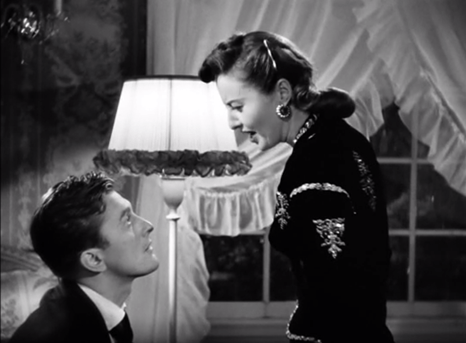
He meets a sultry, smoky-voiced Lizabeth Scott with the pouting face. For those unfamiliar, I would liken her to a Lauren Bacall-type, although she was less well-known and ultimately got typecast in noir roles. Here Scott’s “Toni” Marachek is an often despondent woman who just got out on probation.

strangelove2We don’t actually see Barbara Stanwyck’s face until 30 minutes into the film, but it doesn’t matter. She as well as Kirk Douglas (in his screen debut), leave an impression right off the bat. They are a married couple alright, but she seems to hold the keys to the kingdom, so to speak. All her power is propping him up as he makes his political rise. Perhaps there’s more going on here, however.

From its outset, Martha Ivers looks to be a tale with two threads that slowly begin to intertwine, bringing together some old pals and acquainting some new ones. When Sam wanders into the lives of Martha and Walter O’Neil, it’s putting it lightly that they’re taken aback. The district attorney is good at putting on a face for an old boyhood chum. His wife, on the other hand, is not about to hide her excitement in seeing her old flame.

However, they both think he has an agenda, misreading the twinkle in his eye as intent to blackmail, for a payoff after what he saw all those years ago. But that’s just it. Only we know that he didn’t see anything. Martha Ivers slips up, caught between love, hate, and a suffocating life. She has so much power and yet so little. So much affection and yet so much bitterness.

strangelove5Honestly, although Stanwyck is our leading lady, it’s quite difficult to decide whose film this really is. Van Heflin and Barbara Stanwyck are at its core, but then again, Scott and Douglas do a fine job trying to upstage them. There’s a polarity in the main players, meaning Stanwyck and Heflin have the power, and the other two are the subservient man and woman respectively. However, the film really becomes a constant tug-of-war. Douglas is not just a spineless alcoholic. There’s an edge to him. Scott seems like a softy and yet there’s an incongruity between her persona and that prison rap that hangs over her. Heflin seems like the one relatively straight arrow because as we find out, Stanwyck is fairly disturbed. She’s no Phyllis Dietrichson and that becomes evident in yet another climatic conflict involving a gun. But she’s still demented, just in a different way.

3.5/5 Stars

Review: Top Hat (1935)

tophat1Perhaps Astaire and Rogers most famous film together, Top Hat has them in top form once more, seemingly defying gravity at the full peak of their powers. The beauty of their partnership is that they’re able to tell the progression of a love story through dance, but they do it with such ease and grace it looks like so much fun. For a brief moment, you almost forget what the plot line of the movie is even about. It doesn’t seem to matter. All that matters is these two harmonious beings in perfect unison with each other.

But for those who take some interest in the plot, it is once more a simple screwball story of mistaken identity and romantic entanglements. Jerry Travers is supposed to perform in the show of one Horace Hardwicke, played impeccably by the stuttering Edward Everett Horton. However, Jerry gets smitten with the girl downstairs, but she gets the wrong idea. After all, he is staying in Horace’s suite. They rendezvous in Italy at a lavish gondola getaway where they meet up with Horace’s wife Madge, the always entertaining Helen Broderick. She’s playing matchmaker for Jerry because he has a girl named Dale Tremont (Rogers), who she wants him to meet. Of course, they already know each other, but again she mistakenly believes he’s Horace.

It’s all very awkward, however, all Travers knows is that he’s infatuated with this girl so he goes headlong after her. She’s aloof with him and eventually tries to marry the overly-honorable Alberto Beddini as a defense. Horace over the entire course of the film is bickering with his butler Bates (Eric Blore) and it seems like he’s constantly getting thrown under the bus. But this time Bates does something that makes everyone happy. All that matter is that Astaire and Rogers are back together because in their universe anything else would be unthinkable.

Astaire’s opening number “Fancy Free” is especially lively setting the tone of the story, while “Isn’t a Lovely Day” taking place under the gazebo in the rain is an important starting point for the love story. “Top Hat, White Tie, and Tails” honestly is not one of my favorite numbers, but it is worth it alone to see Astaire twirl around with his stick using it to develop rhythm and act as almost a third leg.

An American classic from Irving Berlin, “Cheek to Cheek” is undoubtedly the apex of this film, because by now our stars are in love and in this dance they have entered almost a suspended state of bliss personified by their floating forms. All the other players fade away and the dynamic dancing duo gracefully glides into heaven together.

The final number “The Piccolino” is rather decadently extravagant to match the flamboyant set, but again when all else fades away and we are left with only Astaire and Rogers, that’s when the scene truly feels magical. It’s as if within all the noise there is once again a moment of beautiful intimacy. But intimate in the sense of two wonderful performers being seemingly so connected in their art form. They hold the sinews of the screwball romance together if only through their exquisite dances.

Most opinion on film is essentially subjective, and in my opinion Swing Time (1936) from the following year is a stronger picture. It has a few more memorable numbers and it is perhaps a little more well balanced all around. Although you do lose Edward Everett Horton for Victor Moore, a lot of the other players remain the same. Also, Top Hat‘s script feels a little weaker, not that it’s of great importance. Because after all, most people don’t go into a film like this ready to analyze the script. We want to be dazzled by two of the great icons of Hollywood, as much now as during the Depression years, and they certainly do that to perfection.

4.5/5 Stars

Review: Swing Time (1936)

swingtime1I wondered to myself, after watching Swing Time once again, if anyone else might have easily taken Fred Astaire and Ginger Rogers’ places as films greatest dancing couple, and then I quickly discarded this heretical idea. They appeared in 10 films together with this film directed by George Stevens being there six pairing. By now they’re a well-oiled, beautifully elegant dancing machine.

As with many of their films the genre is a hybrid of a screwball comedy and a musical which of course most importantly showcases their legendary dancing prowess.

Astaire is the carefree gambler and hoofer “Lucky” Garnett who gets duped out of his marriage by his buddies and must head to New York to prove himself to his fiancees’ father. He goes off with his faithful friend “Pop” (Victor Moore), who also has a penchant for card tricks. They have nary a penny in their pockets and he meets a pretty young dance teacher (Ginger Rogers) over a stolen quarter.

From her point of view, he just won’t stop leaving her alone and he just wants to get the chance to dance with her. Astaire and Rogers’ first number together, “Pick Yourself Up,” is a peppy piece that sets the bar for the rest of the film. They swivel, glide, and sway, perfectly in sync, orbiting one another. And for the rest of the film whenever they dance together they never seem to lose that innate connection.

As far as the screwball aspect goes, Lucky is tight on money resorting to gambling for some new duds, but his chance to dance with Penny is his big break. They just need an orchestra to accompany them. The only problem is someone else owns the orchestra and the orchestra leader Ricardo is also madly in love with Penny. In a shady set-up all across the board they draw cards for the contract and “Lucky” wins. He and Penny have a growing connection, but he still feels guilt based on his attachment to his fiancee Margaret. And of course his life catches up with him and Penny finds out while simultaneously the orchestra is taken away from him.

It must happen this way so they can realize how much they mean to each other and share one final dance together. Out of all the misunderstandings comes a lot of big laughs and in the end, everybody thinks it’s funny. Since Ricardo loses his pants, Penny decides to marry Lucky after all and everything is right in the world of Astaire and Rogers.

You don’t necessarily watch a film like this for the acting, but thanks undoubtedly to the studio system we have a colorful supporting cast including the two-timing but lovable Pop, Mabel is a wisecracking riot in her own right, and although his screen time is short, Eric Blore is enjoyable as the hissy dance studio boss Mr. Gordon.

“The Way You Look Tonight” is an absolute crooner classic and aside from the initial number it can be heard throughout the film in refrains. The same goes for “A Fine Romance” which feels antiquated, but it still manages to be thoroughly enjoyable in all of its reprises. But the main attraction is, of course, the dancing, from the personified joy of “Waltz in Swing Time” to the graceful gliding of “Never Gonna Dance.” If you set aside the unfortunate blackface for a moment the Bojangles shadow dance is a stroke of creative genius that gives off an amazing result while showcasing Astaire’s individual skill.

From someone with two left feet, this film makes me want to at least attempt to dance because Fred Astaire and Ginger Rogers turn dancing into an almost mystical experience. How does he prance and twirl so effortless on the floor? How does she do it equally as beautifully and in heels no less? It looks like they’re having so much fun and yet, in reality, they practiced for hours upon hours to get it right.  Amazing stuff.

4.5/5 Stars