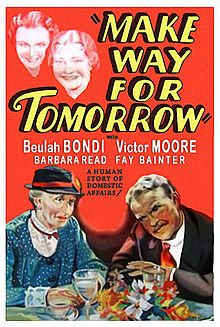
Make Way for Tomorrow (1937)

Make-way-for-tomorrow-1937It seems like Leo McCarey and this film for that matter often get lost in the shuffle. In his day he was a highly successful and well thought of director of such classics as The Awful Truth and Going My Way. However, his moving drama Make Way For Tomorrow is now often overshadowed by a similar film that used it as inspiration, Ozu’s Tokyo Story (1953).

I will not pass judgment on which film I like more. In fact, to even begin to make a decision I would have to go back to both. However, this film opens by restating the 5th commandment. Honor thy father and thy mother. After all, this film is certainly about the gap between generations, parents with children, grandparents with grandchildren, but at its core is this main concern. Honor thy father and thy mother.

The film opens in the home of Barkley (Victor Moore) and Lucy Cooper (Beulah Bondi). 4 of their 5 grown children are gathered together on the request of their parents who have something to tell them. Because their father has not been able to work, the bank is taking their house and so they will be displaced. Thus, the story is set up as the kids worry about what to do, because no one feels capable of taking both parents. Finally, it is decided that eldest son George (Thomas Mitchell) will take Mother, and one of the sisters will take father.

It is difficult for everyone. The old folks are split up for one of the first times in their 50 years of marriage. Meanwhile, grandma disrupts bridge lessons, makes life more of a nuisance on George’s daughter, and forces the maid to take on more hours. It does not make anyone angry at first, but it begins rubbing and chafing. Creating bitterness and annoyance which is arguably worse. Things reach the breaking point when George’s peeved wife finds out that her daughter is rendezvousing with men, and she is not happy at all when grandma confesses to knowing about it. She loses her temper and grandma apologizes. Seeing a letter from a retirement home she quietly decides it would be better for all if she simply moves there.

Her husband does not fare much better, and the harsh New York weather is taking a toll on his health. Furthermore, his daughter is obviously getting tired of him as her patience continues to wear thin. Mr. Cooper does make a friend in a kindly old shop owner (Maurice Moscovitch), but he soon is turned off as well. Finally, his daughter decides to send their father out of California. She says it’s for his health, but the real reason is she wants him off their hands so her other sister can deal with him.

With this new turn of events, Barkley and Lucy have one last meeting set up so they can spend time together before he is sent off to California. This is the most touching part of the entire film because underlying this oasis is the doubt that they might not see each other again. In the wake of that proposition, they have sort of a second honeymoon. They ditch the kids and have a magical evening just the two of them, reliving their youth and remembering the olden days. The miracle of this sequence is that everyone seems to finally understand them, appreciate them, and really honor them. They are offered a ride in an automobile and are met by the hotel manager who offers them drinks and listens to their wonderful stories of times past. Even the conductor plays a slow waltz just for the two of them. It’s a beautiful extended moment that is made especially moving in contrast to the earlier scenes. These are two people who, despite their advanced years, are still very much in love. It speaks to the importance that marriage holds in the life of some people. In certain circumstances, it is not a shallow event, but a lifelong friendship that carries so much weight.

When the time comes, the two lovebirds say goodbye at the train station and we don’t know what happens to them. We can guess certainly, but McCarey leaves a sweeter taste in our mouths before finishing with a realistic ending. It’s beautiful, moving, and tearful, but not in an overdramatic sort of way. In the mundane, sorrowful way that seems to reflect the rhythms of real life. Beulah Bondi was featured in some many great films, but I’m convinced that this was her greatest performance as an individual. Victor Moore was a worthy companion for her as well. However, my favorite character was probably the shopkeeper Max, because he was such a personable man in a sea of grumbling and annoyance.

5/5 Stars

My Favorite Wife (1940)

My_Favorite_Wife_posterThis is a film that I arrived at by a rather roundabout route indeed. Let me explain. I genuinely loved Cary Grant and Irene Dunne’s chemistry in The Awful Truth, but I wanted to watch My Favorite Wife before moving onto their final film together Penny Serenade. Time passed and I found two other films.

First, Something’s Got to Give which was Marilyn Monroe‘s final project that remained unfinished after her death. Only about 30 minutes were completed and it was scrapped, only to be reincarnated a year later as a Doris Day vehicle co-starring James Garner. Being a fan of Day and especially of the late-great Garner, I had to indulge in this romantic comedy Move Over, Darling.

All that is to say that the Monroe film and ultimately the Doris Day film were both based on this same basic plot. A man just recently gets married only to learn that his wife who has been missing for seven years is alive. He must figure out how to break it to his new wife, only to learn that she was shipwrecked on a tropical island with a strapping young man.

After three renditions it certainly feels over-trod, but the beauty of each adaptation is that they only have this basic framework intact. A lot of the really juicy bits are filled out by the cast. Of course, your stars change. Because James Garner is no Dean Martin is no Cary Grant. And the same goes for Monroe, Day, and Dunne. However, the same goes for the crotchety judge, the desk clerk at the hotel, the bookish shoe salesman who takes part in a deception, or even the friendly neighborhood insurance salesman.

It becomes a fun game of compare and contrast, but these different performances also free you up to watch these films on their own merit and enjoy that three times over. I have found myself to often be a proponent of characters over plot and this is another case of that.

Grant and Dunne are a lot of fun together once more even if I have seen these predicaments before because Day and Garner are great to watch, but for different reasons. And of course, all the locales and fashion trends changed a lot in two decades.

Also, I will not pass judgment on who my favorite wife was out of the three and, truth be told, I saw them out of order — I would usually pick the original. In this rendition, the judge played by Granville Bates was a real scene stealer so I was sorry to discover he passed away the same year and had very few other roles.

My only question is, would this film have been propelled to greater status if Leo McCarey had been able to direct it? Also, I am now excited I finally feel clear to watch Penny Serenade and I might just have to go back and revisit The Awful Truth because it has been a while.

3.5/5 Stars

Review: The Apartment (1960)

The_apartment_trailer_1What has always stood out to me about Billy Wilder’s films and the writing behind them is that you can almost always observe cynicism paired with wit. They are continually sharp, often funny, but they also are underlined by more serious topics altogether. This quality is what allowed him to make films as diverse as Double Indemnity and Some Like it Hot. There’s a subversion of the norm that sometimes is dark, sometimes is funny. His second pairing with Jack Lemmon in The Apartment seems to fall somewhere in between.

The legend is that this story formed in Wilder’s mind after watching a Brief Encounter, about a tryst between an English man and woman. What interested him was a very small detail indeed. What type of person would allow his place to be the location of such a rendezvous? And in such a question came the inception of C.C. Baxter a man who was unwittingly funny, but also pitiful as played by Lemmon.

He’s a man trapped in the bureaucracy, attempting to climb the corporate ladder of a  company. He’s fighting in this game of survival of the fittest and trying to get ahead the only way he knows how. Lending his flat out to higher-ranking executives who are looking for a place to take their dates and have a good time. Baxter is somewhat of a hapless stooge though. He’s far from shrewd and his high ranking pals like him for it. He follows their requests. Does what they want. He’s a perfect cog in their plan. He’s one of them. Even Baxter’s neighbor Dr. Dreyfuss and his landlady get the impression that he’s a real high flyer since there’s always music emanating from his suite and bottles piling up outside his door. But he lives the charade and spends many a frosty evening waiting for his customers to clear out. It’s certainly a sorry existence, but he doesn’t mind at first since it pays off handsomely as he moves up the ranks.

One of the more personable employees in this mass of humanity is elevator gal Fran Kubelik (Shirley MacClaine), who is always friendly with Mr. Baxter since he is a true gentleman. However, she is also caught in an affair with top exec Mr. Sheldrake (Fred MacMurray) and she is actually in love. It’s a messy situation made even more complicated when Sheldrake asks Baxter for the use of his flat. He enthusiastically agrees, but he has no idea who else will be there. That’s one of those painful moments of dramatic irony where our opportunistic nonetheless lovable protagonist gets hurt. Lemmon is good at playing the drama movingly and filling his scenes with organic humor (much like the late Robin Williams).

At this point, C.C. Baxter becomes the general scapegoat for his colleagues and even his neighbors. Everyone gives him a hard time for things he has not done or does not really deserve. Sheldrake leaves his wife and looks to solidify things with Fran, and this moment is paramount because Baxter finally mans up. He may have lost his job, but he got to finish the best game of gin rummy of his life.

I must admit the themes of The Apartment are not always my favorite. I am much more partial to Some Like it Hot or even The Odd Couple, but Lemmon makes the film for me. Whether he’s straining spaghetti through a tennis racket or trying on his new suave business bowler for size, it’s hard not to like him. Ray Walston, Fred MacMurray, and about every other character is a cad. Shirley Maclaine is pretty good, but then again she’s never been the most captivating for me actress-wise.

When it’s all said in done, this is not Wilder at his absolute best, but teaming up with IAL Diamond elicited another classic vehicle with Jack Lemmon. Now shut up and deal!

4/5 Stars

The Virgin Suicides (1999)

VirginSuicidesPosterIn her debut, Sofia Coppola fashions the 1970s with a washed out wistfulness that feels like a distant memory — lingering for a time — leaving a few far away remembrances to be eulogized and reminisced about.

Her film is really about two groups. There are the Lisbon girls who live with their militantly authoritarian parents and then the neighborhood boys who look on with awe. These girls are the unattainable prize that all of these young men are entranced by. They are not besmirched or dirtied by the ways of the world, stuck in the ivory tower of their parent’s home. It’s almost as if they come out of a dream, so pure and in the same way so provocative.

However, things get shaken up when the youngest daughter attempt to commit suicide and then in a free moment she jumps out of the window and meets death by the metal fence posts below. Red flags should be going up everywhere, but stubborn Mrs. Lisbon only becomes more stringent in her moralistic ways. She should be trusting her daughters, allowing them certain freedoms, but she only takes away more. And reluctant Mr. Lisbon does nothing to stop her. He just lets it be.

Only allowed to socialize at one dance under strict guidelines, the girls relish this opportunity and so do the boys. They finally get their chance with a different class of girl. But after the smitten Lux breaks curfew, all the sisters lose all contact with the outside world. The iron gates go down, and she never gets another moment with high school heartthrob Trip. On top of that, their mother makes her burn all her records in another strict turn.

Lux defies her passively in any way possible as she and her sisters try and maintain contact with the boys on the outside. But there is a point for any person where this type of confinement, this type of prison, gets to be too much. The girls reach the end of their rope and take the only way out they can see.

Oddly enough, most of the boys have little personality, but the focus is the Lisbons and specifically their daughters. The Virgin Suicides was partly intriguing because it never seemed to take on some dramatic tone and it never felt all that personal. I felt so far away. As Carol King mournfully sang, “Doesn’t anybody stay in one place anymore. It would be so fine to see your face at my door. Doesn’t help to know you’re so far away.” That’s exactly what this film does. It doesn’t allow us to get close and that aloofness lent itself to the intrigue we have in these girls. We’re pulled into their story along with all these young boys.

3.5/5 Stars

Angel Face (1953)

angelface1Rumor has it that Howard Hughes was angry at Jean Simmons who had cut her hair short prior to filming, as her contract was due to expire soon. But not to be outdone he told Otto Preminger that the director would get a bonus if he could shoot the picture before Simmons was released. That he did, and in the 20-day interim he gave us yet another stylish film-noir classic to follow in the footsteps of Laura and Where the Sidewalk Ends.

Robert Mitchum plays ambulance driver Frank Jessup who falls victim to the webs of young beauty Diane Treymayne who adores her superficial father, but nurses a lifelong grudge against her step-mother. She has it in for her arch nemesis and meanwhile strings Frank along, coaxing him to become her family’s chauffeur. He loses sight of her other side, and their budding romance means trouble for Frank’s longtime relationship with the sensible Mary. She sees a better fit in one of Frank’s ambulance coworkers, but he still wants her back.

Instead, Diane and Frank get caught up in a trial for their lives, after they are accused of a murder that Diane did indeed commit. But due to some wheeling and dealing, their shrewd attorney gets them off. It’s at this point that Angel Face takes an unsuspecting twist that ends up being intriguing. Could it be that the seductive Tremayne girl is actually remorseful for her actions? Is she a more nuanced femme fatale then would first be assumed? Frank was an unsuspecting lout, but then again maybe Diane is a sort of victim too.

angelface2

Her tryst with Frank is doomed and he is stuck because Mary no longer wants him, so of course, he can only end up going one place. The slow buildup to the finale makes these last moments all the more shocking. Angel Face seems to be less of a deadly poisoning than a slowly ticking time bomb just waiting to blow.

Jean Simmons is most often associated with civilized and demure beauties. A couple counterpoints or variations would be The Grass is Greener and this film. Playing against type proves to be as fruitful for her as it did for the likes of Barbara Stanwyck, Gene Tierney, Cary Grant, and Henry Fonda, just to name a few. However, in a way, Angel Face had a far more complex femme fatale than I was expecting and that’s to its credit. Still, I would never want to be trapped in her nightmarish world like Frank.

4/5 Stars

Three Days of the Condor (1975)

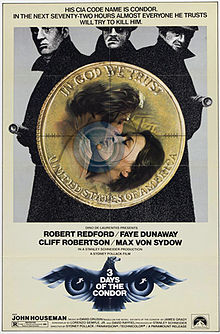
Three_Days_of_the_Condor_posterIn the wake of Watergate, the 1970s saw the advent of many political thrillers with arguably the granddaddy of them all being All The President’s Men. Three Days of the Condor is another film that finds Robert Redford trying to get to the bottom of a web involving politics and intrigue. However, this film reminds me a great deal of The Parallax View which came out a couple years earlier. Similarly, this film has probably its most startling moments during its opening sequence and slowly unwinds after that into a thriller full of paranoia and uncertainty.

Sidney Pollack’s film kicks into high gear abruptly as all “Condor’s” colleagues at a CIA-backed literature research post are gunned down by unknown professional hit men. Joe Turner (Robert Redford) was literally out to lunch picking up sandwich orders, and he returns to find his colleagues dead. From that point on begins his life of constant fear, because he cannot know who is with him and who is against him. He can trust no one.

While taking a moments respite, Turner notices a patron named Kathy Hale who is about to meet her boyfriend on the slopes, and he follows her and holds her hostage so he can have a place to stay. It’s supposed to be a matter of chance, but I mean, it is Faye Dunaway so it cannot be that random right? No matter, she’s initially deathly afraid of him, and he does not give her any relief holding her at gunpoint and tying her up. They’re both afraid.

But whether it’s some form of Stockholm syndrome or the fact that she actually believes his predicament, Kathy agrees to help him, and they have the obligatory lovemaking session inter-cut with the stark pictures on her wall.

What happens after this is sometimes difficult to track with as Redford’s character begins his search for a government agent named Higgins, avoiding hit men, while trying to understand who is even after him. Why do they want him? He’s just a lowly bookworm with one cockamamie theory about the odd languages a certain thriller has been translated in.

This one idea has got him caught up in something much bigger than he can ever know involving a hired mercenary named Joubert, CIA Deputy of Operations Leonard Atwood, and oil! That’s what it was all about. That’s why 7 people died and Turner can do barely anything about it. After all, who will print his story? Who will believe him? That’s is the country and the era he lives in after all.

Redford gives an admirable performance, and I personally prefer him to Warren Beatty any day. Dunaway walked a weird line between being demure and submissive, while also dishing out some sass every once and a while. It made her character feel uneven in a sense and she came to like Turner rather abruptly. Then again it was Robert Redford.

All in all, this film’s plotting seems utterly ludicrous to me now, and it becomes more and more ambiguous by the end. It feels hardly like a conclusion at all, much like the Parallax View. And much like the other film I can understand how this story could really strike a cord, especially after Watergate, when so much governmental corruption seemed possible. The sky was the limit and so Three Days of the Condor was perhaps not as far-fetched as it initially appeared. That’s a scary thought indeed.

3.5/5 Stars

Silver Linings Playbook (2012)

silverlinings1There was something rather therapeutically soothing about coming back to Silver Linings Playbook. I must admit this time around I was not quite as drawn to the direction of David O. Russell, because in some scenes it felt like too much attention was brought to his camera. However, I loved Jennifer Lawrence, Bradley Cooper, and Rober De Niro, since each one of them is screwed up in their own unique ways. Although their story takes place in Philadelphia and a lot of talk is made about the Eagles, what these characters really are is a cross-section of humanity.

I was just thinking recently how I dislike the term “escapism” referring to watching movies and going to theaters to get away. I do not often consider that I go to movies to escape my life. Maybe I do sometimes, but I am fascinated by movies because they can tell us more about ourselves. More about what it is to be human and coping with all that is messed up — all that is broken.

Tiffany (Lawrence) and Patrick (Cooper), are both screwed up. There’s no getting past it. She’s a widow who got fired from her job for sleeping around and now she does dance as a sort of therapy. He just spent an 8-month stretch in a Psych ward after he caught his wife in the shower with one of her coworkers. Now whenever he hears his wedding song, he goes into an enraged fit. He tries to look for the silver lining in everything, but that does not stop him from hurting the ones he loves.

Tiffany and Patrick are made for each other, even if Patrick refuses to believe it. They both know what it is to be put through therapy, drugs, and the like after personal trauma. They both lack the common filter or etiquette that humanity usually requires. We love them anyway, in spite of these reasons or more likely because of these reasons.

De Niro is Patrick’s father and a man so invested in betting on Eagles football games that it drives his life. Superstitions run rampant in his household, but he refuses to acknowledge them, just like his son refuses to accept his own problems. It makes for some familial fireworks and interesting altercations, but at the end of the day, they are still family.

The whole film culminates in a dance competition that Tiffany and Patrick have been working up to for a long time. It has the big stakes that you would expect for a climatic event, but most importantly it is this moment in time where Patrick finally realizes Tiff is the girl for him. He finally sees what most of the audience saw all along. They are made for each other, and they can accept each other with all their idiosyncrasies. He continues living his life by The Silver Linings Playbook and it makes both Tiffany and him very happy.

4.5/5 Stars

Adventureland (2009)

AdventurelandposterOddly enough, the same year the cult favorite Zombieland came out there was another film starring Jesse Eisenberg, also set in a theme park, that did not seem to get as much acclaim. That film is, of course, Greg Mottola’s Adventureland, a coming of age comedy-drama which I actually enjoyed a lot more than his previous effort Superbad.

Adventureland is the basic graduate, boy meets girl, summer job formula. Undoubtedly we’ve seen it before in many forms, but Jesse Eisenberg makes it work again as James Brennan, a high school graduate living in Pennsylvania circa 1987. With little money under his belt and his father getting a pay cut, the only choice he has is to get a summer job. He’s an extremely bright kid. Good at mathematics and the like, but he also has little real-world experience so his last resort is the local amusement park Adventureland.

Instead of an interview or a resume, they look him over, take down his name, and hand him a t-shirt. And so begins his reign as a games booth attendant for Bobby and Paulette (SNL vets Bill Hader and Kristen Wiig playing their typically lovable weirdos).

The staff is rounded out by an eclectic mix of misfits and characters steeped in folklore. There’s the constant jerk of a best friend Tommy Frigo. The bespectacled wisenheimer Joel who also has a penchant for high-end literature. The legendary and alluring Lucy P. who is the park’s eye candy. Mike Connell the parks handyman and part-time musician who is rumored to have played with Lou Reed.

But the most important character, for the purpose of this story, is Em who also works in the games department and saves James from literally being stabbed by a shifty customer over a giant stuffed panda. There’s nothing overly romantic about it at first, and that’s what makes it so intriguing. He’s not the kind of guy who has a lot of experience. School was his forte. Em is cool, collected, and went around with a lot of boys during high school. She’s been around the block as well as watching her mother die. She’s in many ways more wise to the world than Joe.

But she openly invites him into their little community, extending an invitation to a party she is having at her place. He never could imagine being so lucky, but to Em, it’s not a big deal. His mind is racing, and he cannot help but get excited about this amazing new girl he has met. Em is sleeping with Connell who is struggling in his marriage. This looks to be very messy in the foreseeable future.

It is. Em and James share their first kiss, and it’s magical like it’s supposed to be. It all moves so fast and James has heightened feelings for her. But she wants to take it slow with all the crap still in her life. It’s seemingly understandable, but it’s not what James wants to hear.  She’s so hard for him to read.

On the advice of Connell, James accepts Lisa P’s invite on a date, because, after all, it’s any boys dream to go out with her. But afterward, being the kind of guy that he is, James feels almost unfaithful and candidly shares his actions with Em. She thanks him, but her own rendezvous now weighs on her mind. She looks to end it with Connell, but of course, James finds out and it hurts him like nothing ever has.

It’s at this point in the story that the downward spiral begins. James turns to Lisa P. as his confidante, but the news of Em gets out and she quits, moving away to New York. A downtrodden James has little more to do but get drunk, and it does not bode well. All the money he tirelessly worked for ends up going down the drain. But he ends up going to New York anyway, to take a chance on a girl, because he is overwhelmed by his feelings, but he also sees Em differently than she even sees herself. She is far from a perfect human being, but she is someone who cares about her friends and loved ones. So although she is a mess-up, James sees only the good in her.

Really the only reasons to set this film in the ’80s was nostalgia sake and then you have a better excuse to have a classic soundtrack of oldies. And it did the trick because I did enjoy the film for the most part and it reminded me somewhat of the Way Way Back.  It’s another film about a summer job at a theme park in the ’80s which would feel exactly the same if it was not for the standout characters that make the story interesting.

4/5 Stars

Witness (1985)

Witness_movieI think of Harrison Ford much in the same way that I think of Paul Newman. They both play the brash, bold, smart alec characters that we adore as audiences. They make the perfect action adventure heroes but are not always respected as actors which is a shame. For Ford, his reputation hinges on a number of great characters from Han Solo, to Indiana Jones, to Rick Deckard. They all are magnificently memorable action heroes. Ironically it is the plain, seemingly everyday cop, John Book that allows Ford to truly show off his acting chops like I have never seen him do before.

The film begins when a young Amish boy named Samuel gets to take his first adventure into the big city with his mother, as they head to see some relatives in Philadelphia. Little Samuel has a pair of dark brown, wonderfully inquisitive eyes in which to take in this world that is so foreign to him. That is, in fact, one of the major themes of Witness, the colliding of two worlds that are at odds.

But anyhow, when he ventures into the restroom to use the toilet, he unwittingly sees a violent murder committed and he is able to hide in the stalls, but he also gets a look at one of the perpetrators. And so, just like that, this little boy who never spent a day in the real world is a key witness to a murder investigation.

That’s when steady, straight-arrow cop John Book comes into the picture. He’s not a bad man by any means, and he wants to wrap up the case quickly so he can let Samuel and his mother go as soon as possible. You can see he finds their customs strange, and Book feels a trifle awkward being around them, but he does his job the best way he knows how, by confiding in his superiors and having his partner watch his back.

Everything blows up in his face. He gets shot and he must make a mad dash with Samuel and his mother to their quaint Amish home. Now the roles are shifted as he must wait it out building up his strength as his pursuers try and locate him. His world of cops and guns seems to have no place in this farm community of peaceful people. But as a former carpenter and a decent individual, Book is able to adapt rather well. Rachael Lapp soon finds herself enjoying his presence around their home since she is a widower and her father-in-law Eli reluctantly allows him to stay.

Book learns how to milk a cow and helps in a barn raising, all the while building a rapport with Rachael, but others seem to be wary of the presence of such a man.

As would be expected, we have our final showdown between Book and his pursuers who are a lot closer to home than he would ever expect. When it’s all resolved he leaves the country peaceful once more, but not without some intense memories.

Peter Weir’s film has a rather interesting pacing for a thriller, starting out slowly, but we know it must be building up to some impending doom so I would reserve from calling it boring. When that moment comes, it becomes a breakneck thriller before quieting down once more in the Amish town. Then the last 20 minutes are that of a dynamic action film. However, it is in these more tranquil moments that Harrison Ford gets to show off his humanity, whether it is talking about guns with young Samuel or dancing to a car radio with Rachael. There’s no doubt that you have not seen Ford like this before, and it’s definitely worth seeing him in this gripping ’80s thriller.

4/5 Stars

L’Atalante (1934)

LatalanteHere is perhaps one of the greatest wedding processions we could ever hope to see. Buster Keaton is more outrageously funny in Seven Chances, but this one is solemn, and somehow still funny in its own way. And that’s what is most striking about L’Atalante (which also serves as the name of the boat of choice). This film seems so serious and strait-laced, you might say, and yet it brims with comedy. It’s the type of everyday comedy that makes us laugh even now. Funny looking characters, odd voices, a plethora of cats all over the place. There’s no way for that to get lost in translation, and it remains quirky and engaging 80 years later.

It also happens to be a beautiful film exemplified by a newly-wedded bride walking the prow of a boat with the fog billowing around her. Or perhaps it’s two lovers embracing passionately and a smile bursting on the face of the woman. It’s so visceral, so engaging in its displays of love, energy, and emotion. In this way, it brings to mind other love stories of the age like Sunrise, It Happened One Night, and certainly the early works of Jean Renoir. Except the thing here is that director Jean Vigo never made another film after L’Atalante. He entered bad health even during filming and died soon afterward in his early 30s, but he left behind a masterpiece.

In short, the story revolves around four main characters living life together on a boat named L’Atalante. Jean is the captain and groom who has picked a beautiful wife named Juliette who is going to share his existence on the sea. His first mate is the weathered and scruffy Pere Jules. He might have a rough exterior, but he and his cabin boy are full of bumbling and buffoonery that endears them to all.

For the two lovebirds, Paris is the enchanting destination for a fantastic makeshift honeymoon, but it also proves to test their relationship from the get-go, since Jean is extremely jealous and a street peddler openly flirts with Juliette. It’s a tragic turn in their love story which leads to Juliette looking for a way home and Jean sinking into a state of depression aboard his boat. That’s what makes their ultimate reunion all the sweeter.

Thus, L’Atalante blends a timeless topic like love with little moments of magic that bubble up from within these scenes. Whether it is Juliette walking the streets window shopping, or Pere Jules giving a lens into his past with all the souvenirs he has accrued over the years. Without a doubt, he was my favorite character. I have never quite seen anything like him.

4.5/5 Stars