Lola (1961)

Lola1961As the debut of Jacques Demy, Lola has some qualities that, for lack of a better term, are very un-Demy. First off, he was a member of the French New Wave period of filmmakers and yet he resigned himself to making mostly musicals, taking inspiration from Hollywood and setting them in his own unique world. He was not concerned with the experimenting or political undertones of many of his peers. However, this is probably the most typical looking of his work and thus a jumping off point for the rest of his career.

Not quite as elegant in camera movements as Max Ophul’s work which received a nod, Lola still has a pleasing sleek visual style representative of the French New Wave. Its silky smooth, black and white cinematography courtesy of Raoul Coutard (Breathless), however, makes the film look more like something from Godard.

Lola is what Demy himself coined “a musical without music,” I suppose because it lacks the signature singing of his later films, but keeps the music and some of the other elements. Demy’s film also has a sense of cinematic realism with characters crossing paths with one another in various coincidental moments. It may be highly unbelievable in its plotting and yet it works within the Demy world of romance and fatalism which he would often revisit later on.

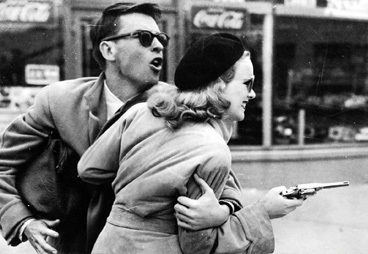
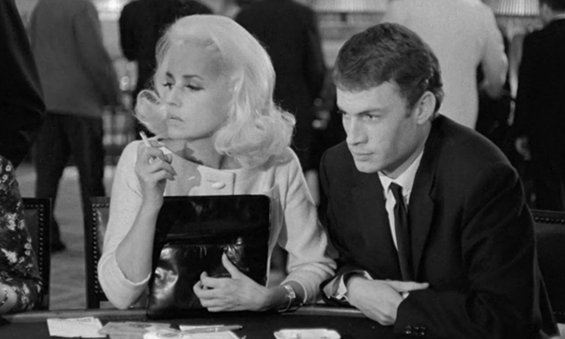
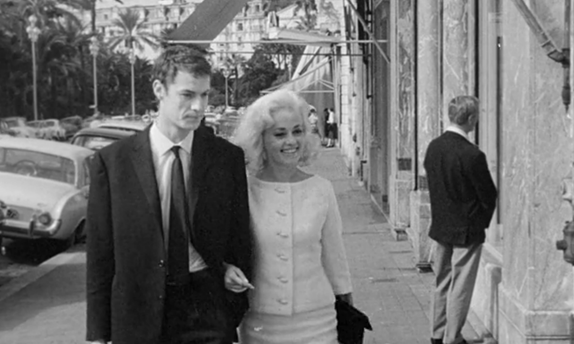
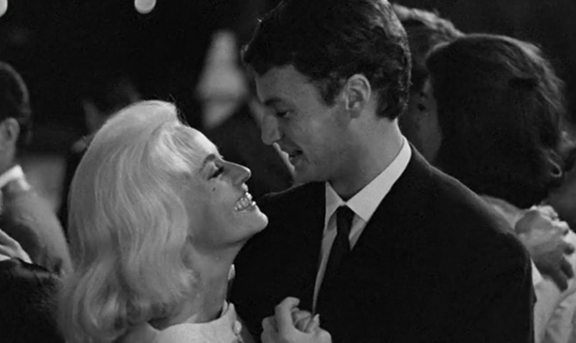
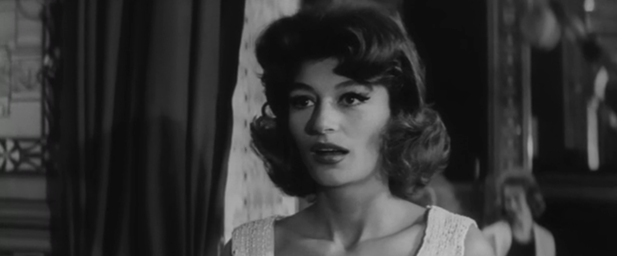
lola3This film follows a cabaret singer named Lola (Anouk Aimee) in a small seaside village called Nantes. She has a young son and a lover who she has long waited for. In the meantime, childhood friend Roland Cassard (Marc Michel) trudges on with his life without much drive. He is a befriended by a lady and her daughter Cecile at the local bookstore where they strike up a quick friendship. Then, by chance Cassard runs into to Lola, or Cecile as he used to know her when they were children. It’s been many years and although she has been getting together with an American sailor (Alan Scott) named Frankie, she is excited to go out for an evening with Roland. However, in another interesting meeting young Cecile runs into Frankie while buying a comic book and they have some fun together.

lola6In the end, Lola tells Roland that she will never truly love him and they must remain friends. It’s a bitter time for Roland as he decides to leave like he was originally planning. Finally, Michel returns and Lola is reunited with her love. It’s another bittersweet tale of love from the mind of Jacques Demy. Whimsical, poignant, and wistful too. That’s not the last we will see of Roland, though his luck doesn’t get much better (Umbrellas of Cherbourg), and  Lola returns too (Model Shop). Now only to go back and watch The Blue Angel (1930) from von Sternberg and Lola (1981) by Fassbinder which both bookend this work by Demy also chronicling a cabaret singer. There’s a lot of history here still to be seen and Jacques Demy is a worthy addition to the lineage even if this is not his best film.

4/5 Stars

Review: The Killers (1946)

Thekillers2It’s been said that Robert Siodmak’s The Killers was Ernest Hemingway’s favorite adaptation of one of his works which was, in this case, a short story. As a film-noir, it works on numerous levels from the cinematography, to the score, to the young stars, to the ingenious narrative. Some credit, of course, can go to Hemingway for the concept, but a lot of the creative success must be given to the likes of Siodmak, John Huston and a host of others.

The film opens in an instant with two lurking gunmen entering a diner in a small New Jersey town called Brentwood. Their target is a washed up boxer called “The Swede” and we do not know why, but after terrorizing a few locals, they riddle him with bullet holes and that’s the end of it. It’s an intense sequence because the thugs (William Conrad and Charles McGraw)  are antagonistic and Miklos Rozsa’s score is nearly relentlessness.

The story could have ended there if it wasn’t for an insurance investigator named Reardon (Edmond O’Brien), who takes an interest in the dead man so he can find his beneficiary. In the present, he begins to piece together little fragments of the boxer’s past slowly but surely.

It starts out with Nick Adams who witnessed the thugs and worked with The Swede when a mysterious man came by the filing station. Soon after Ole Andreson stopped coming in to work and a while later he was dead. That’s all Nick knows, and it does not give Reardon much to go on.

Next, he tracks down The Swede’s beneficiary who turns out to be a kindly hotel maid. The connection seems slim, but it turns out that she kept him from committing suicide after a tough evening where he tore his flat apart. It’s still not much to go on, but Reardon thanks her and moves on with his investigation, still intrigued.

Then he goes to Philadelphia and gets his biggest puzzle piece from a policeman named Lubinsky, who used to run with the Swede as kids and probably knew him the best of anyone. He and his wife explain to Reardon how Pete Llund, as he was known, lost his final bout and was forced to move on with his life. About that time he met Kitty Collins for the first time and was infatuated for good.

Charleston is next the old stooge who spent a good many years locked up in a cell with the Swede. Reardon comes upon him at the funeral and from the old convict, he learns about a bank job that the washed up boxer got involved in. The other partners were Blinky, Dum Dum, and Big Jim. They are Reardon’s next points of interest.

Blinky is near death and recounts the robbery. Dum Dum crosses path with Reardon and shares about the aftermath of the job which went sour. Next, comes Big Jim whose tight-lipped about the past. Last but not least is Kitty, who is fearful that Reardon knows something and can actually blackmail her. That’s when everything begins to line up and heat up. After being absent for so long, the Killers are back in the picture and Rozsa’s score picks up again threatening the status quo of the film. They put us on edge again and for good reason. But the real focal point of the ending is Kitty.

Obviously, Citizen Kane has so many layers of interest, but it shares a similar narrative arc to The Killers where the main character is killed and his story gets pieced together thanks to flashbacks that are furnished from the present. Except, in many ways, the story of The Swede intrigues me more as a character. Charles Foster Kane is a magnate with an impressive if not tragic life.

Swede’s life is probably just as tragic except it was more humble and chock full of more crime. He was small time and he even failed in love when his friend Lubinsky got the girl of his dreams. It’s an interesting life too that ended unnaturally with gunshots rather than Kane who died as an old man. The Swede was cut short in a tragic sort of way and I think that’s part of what intrigues Reardon. It’s more than a job, but a mysterious story of a man’s life that the audience also gets taken along for. As far as storytelling goes, it’s great and it really works to flesh out these characters.

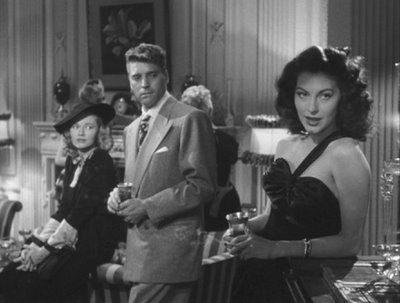
Ultimately, Reardon feels like the main character of sorts, but such an aura is built around The Swede and Kitty that it is understandable that this film made stars out of Lancaster and Gardner. They are certainly memorable partially because we hardly ever seen them in the present (except for Kitty at the end). Their whole persona is built off of what others say and there’s something interesting about that. There’s the fatalistic and sullen Swede which turned out be a perfect debut for Burt Lancaster. Ava Gardner has the soft seductive whisper of lethal poison all wrapped up in a beautiful body and it leaves a major impression.

Above all else, The Killers is a prime example of film noir blending German Expressionism from Siodmak’s native Germany with more documentary style sequences that take inspiration from post-war neo-realism. The opening sequence especially drips with noir sensibilities that, at its most dramatic, looms with shadows from the exterior of the diner to the low-key lighting of the Swede’s bedroom. For a while, it’s even difficult to know that’s Burt Lancaster reclined on the bed because his whole body is fully encased as he speaks. It’s only when he gets up into the light that we finally are introduced before he gets gunned down a few minutes later. It’s great staging and the atmosphere remains for a great deal of the film from the prison cell to Big Jim’s mansion. Each place is contrasted with the present or other locales like Reardon’s office which are more natural in lighting. It doesn’t get much better than that.

4.5/5 Stars

Review: The Big Sleep (1946)

b4c25-bigsleep1

Philip Marlowe is undoubtedly Raymond Chandler’s character, but Howard Hawks and Humphrey Bogart brought him right out of a pulp novel and stuck him on the silver screen to ever be solidified in our minds. Needless to say, this is a quintessential film-noir coming right at the tail end of WWII, known as much for its incomprehensible plot line as it is the romantic pairing of Bogey and Bacall.The title credits role and the contours of our two leads can be seen in the background, cigarette in toe with Max Steiner’s furious score pulsing in rhythm. We find ourselves on the doorstep of a man named Sternwood. A hand is ringing the doorbell and a servant answers. The hand, of course, belongs to Humphrey Bogart or closer yet Philip Marlowe. Right off the bat, he gets the come on from the flirtatious younger daughter of Sternwood and he takes it in stride.

When he meets the sickly man of the house, he’s stricken to a wheelchair parked inside a greenhouse. He and Marlowe get chummy, and he calls upon the P.I. to find a man named Geiger, while bemoaning the trouble his daughters get into. For good measure, Marlowe also gets his first taste of Sternwood’s older daughter Vivian Rutledge who is more mature, but suspicious all the same. From then on the case is a series of storefronts, L.A. street corners, and car interiors. It’s hard to believe, but it also seems so dark and dreary with buckets of rain to boot. It must be L.A. in winter (or in an alternative universe). Bogey has a little fun masquerading as an antique book aficionado and every lady he interacts with feels like another Carmen Sternwood. Always ready to flirt and he usually gives them the time of day.
He stakes out a home and he investigates a piercing scream only to find a disoriented Carmen in a big mess. Next, a dead man is pulled out of a Packard near Lido Pier. The names keep piling up too. There’s A. G. Geiger, Sean Regan, Owen Taylor, Joe Brody, Eddie Mars, Harry Jones (Elisha Cook Jr.), and a number of others. Most are seen at one time or another but a few are not.
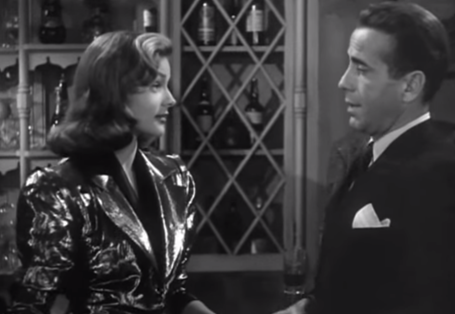
08bfb-bigsleepBy this point, The Big Sleep is less about all the facts and more about how we get there in the end. Obviously, the source material is from Raymond Chandler, but the witty script full of great patter is courtesy of William Faulkner and Leigh Brackett of all people. Bogey and Bacall have some fun on the telephone (You like to play games don’t you) which coincidentally has no bearing on the plot. Later on, they have some more spirited back and forth about horse racing. It’s at these times that you cannot help but chuckle at the rapier wit of the script. Philip Marlowe is a great character with a lot of great things to say indeed.
Soon we suspect there is something romantic going on between Eddie Mars and Rutledge. A few more stooges get it and Marlowe gets himself beat up in a dark back alley (Of course). Next thing we know is our new favorite gumshoe is tied up in a house with two ladies. Rutledge is there and the wife of Eddie Mars. What? He gets out of harm’s way thanks to Vivian, and the showdown that we have been waiting for comes to pass. Marlowe outsmarts everyone and puts the damper on the case. Everything seemingly comes to a smooth resolution, the audience just has little idea how we got there. But that’s not the greatest of concerns.
It would be great enough to watch The Big Sleep for the sass and repartee which it is positively dripping with. Thanks to the reworking of the film in 1946, the Bogey and Bacall dynamic became more prominent and fun. Although it is slightly disappointing that a lot of Martha Vickers’s performance ended up on the cutting floor, it is made slightly better by a memorable appearance by a young Dorothy Malone. All in all, there is very little to complain about if you just sit back and enjoy this very engaging film-noir for what it is. Howard Hawks brought us yet another unassuming post-war classic that is unequivocally American.

4.5/5 Stars

Caught (1949)

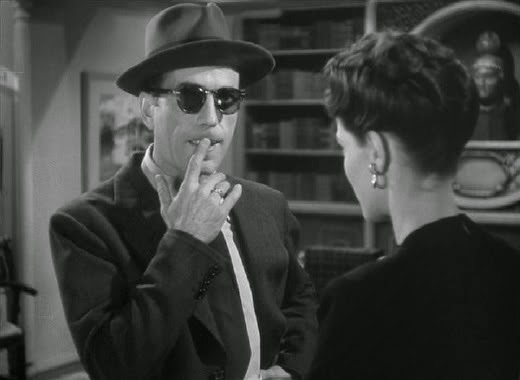
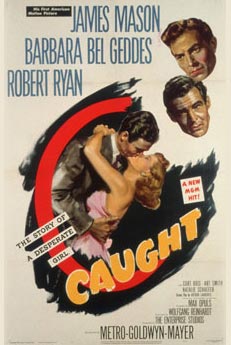
Caught_(1949_film)Max Ophul’s Caught is an interesting mix of soap opera drama and dark, brooding noir. It follows aspiring model Leonora Eames (Barbara Bel Geddes), who is obsessed with improving herself through charm school, landing a modeling job, and finding a rich husband. She’s not the only one in a world of young pretty girls who thinks money makes the world go round.

She’s a little bit different than the others, but they have slowly made her buy into the whole system. Then, one night she gets what all these gold digging girls could only dream of, she meets the filthy rich and oddly-named Smith Ohlrig (Robert Ryan), and it’s all quite by accident.

Soon more to prove a point than for love, Smith marries Leonora, and she tries her best to love him like a good wife. But he’s too busy and too difficult to get close to. She spends all her days stuck at home and unhappy with Smith’s hired aide Franzi Kartos (Curt Bois). Leonora realizes she needs something else and heads out to get a job away from Smith and his money.

The first opportunity she gets is as a receptionist for the doctor’s office of a kindly young pediatrician and his older colleague across the hall (Frank Ferguson). He pegs her as an odd applicant from the beginning but allows her to come on and work. Once she commits, Leonora proves to be a hard worker and she and Dr. Quinada (James Mason) hit it off, though he still finds her peculiar.

caught2

Once more, Leonora tries to patch things up with Ohlrig who begs her to come back home, which she does. Because she wants their marriage to still work out. However, Leonora also gets some big news from a doctor that complicates the situation. She truly is caught. She cannot leave Smith due to their marriage and other difficulties while her affections truly lie with kindly Dr. Quinada who feels the same.

Ultimately, there has to be a showdown and so there is. Leonora has to make her decision. Then Smith has one of his angina attacks and she doesn’t want to help him. It causes her increased guilt and ensuing complications. But Ohlrig doesn’t die and Leonora finally has the future she wants with Quinada.caught3Max Ophul’s was always a master with these types of melodramas and his trademark dolly shots are as prevalent as ever, developing some of the scenes wonderfully. It becomes more than a plot but a visual presentation too, and the shots often are augmented by how he moves in and about a room.  Robert Ryan steps into the villainous role easily and James Mason is a surprisingly amiable good guy. Also, though his role is small, Frank Ferguson is nonetheless pivotal and thoroughly enjoyable as a fatherly figure. Of course, Barbara Bel Geddes is a worthy protagonist, because she is ultimately the one trapped between her two male counterparts and she is the one who goes through the most mental torment with Ohlrig potentially being close behind.

Above all, Caught is a timeless indictment not simply of corrupt capitalism but a generally misguided philosophy that money is everything. Quinada has the best approach, realizing that money is necessary, but it can never buy you happiness or remedy your relationships. Smith never figures that out and it is difficult for Leonora to leave that worldview completely behind — as it is for many of us.

4/5 Stars

They Live by Night (1948)

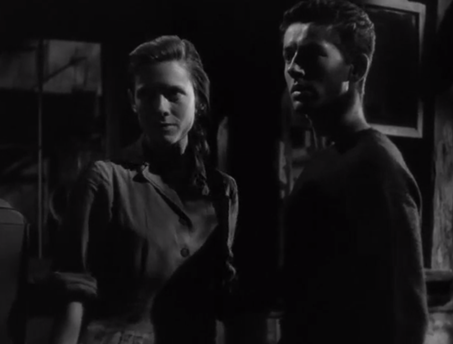
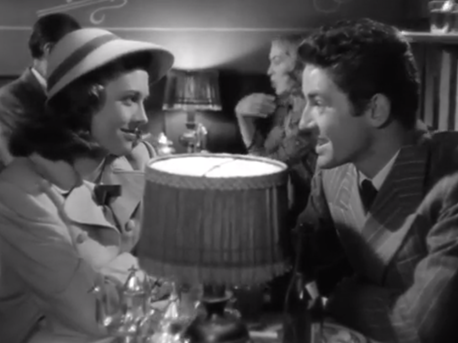
theyliveby4Regrettably, I have seen very little of Nicholas Ray, however from his debut in They Live by Night, I saw the same care spent on his youthful characters, which is also noticeable in Rebel Without a Cause. He does not treat “Keechie” and “Bowie” as cardboard cutouts or kids who are dumb and in love. They have value and feelings that are worth examining more closely.

The film opens with three thugs breaking out of the local prison. Two of the men Chicamaw (Howard Da Silva) and T-Dub (Jay C. Flippen) are weathered criminals. The third, Bowie is a baby-faced kid looking hardly a day over 20, but he went into the clink for a reason.

They find shelter at a nearby filling station where Chicamaw’s mangy older brother (Wil Wright) makes a living with his timid, no-nonsense daughter Katherine. They get a car and have enough money to get their feet off the ground before a big bank job in Kelton.

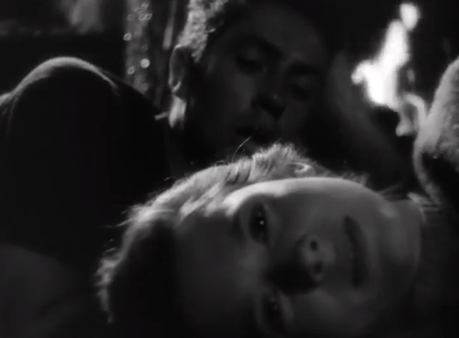
theyliveby2It goes off without a major hitch, but soon after Bowie gets in a car accident and Chicamaw takes him back to his brother’s to be cared for. Katharine is there and the two of them find companionship in each other because neither one has anyone else to turn to. They are young, naive, and in love. They’ve never had these types of feelings before.

Since Bowie needs to lay low, he takes “Keechie” with him and they make an adventure out of it. Ultimately, it results in a cheap $20 marriage and a lot of nice intimate nights spent together driving and cuddling. They’re living the lives of carefree newlyweds who need no one but each other. They find a simple cottage out in the backcountry owned by a homely proprietor (Byron Foulger), and it acts as a new home. A perfect oasis from the newspapers, the cops, and Bowie’s accomplices.

However, they do catch up with him eventually, and he and Katherine split fast after a tiff. They want a normal life, but Chicamaw and T-Dub won’t allow it because they need more money from another bank job. He won’t and in the subsequent attempt, his former partners eat it. The lookout is still hot for the boy as well.

theyliveby1He seems so undeserving of hard justice, but it is bound to come after him anyways. For such relative newcomers, Farley Granger and Cathy O’Donnell (The Best Years of Our Lives) have such genuine chemistry opposite each other. Granger is more often than not gentle and kind. O’Donnell is pretty in a simple, unadorned type of way. They elicit so much more sympathy than Bonnie and Clyde or even the fugitives in Gun Crazy. Perhaps because they aren’t even outlaws, only young kids who are victims of their circumstances.

4/5 Stars

Body Heat (1981)

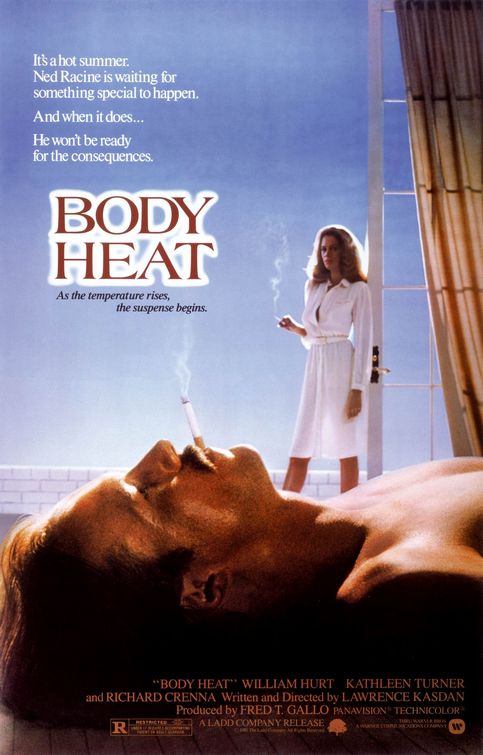
Body_heat_ver1In his directorial debut, Lawrence Kasdan (screenwriter for Empire Strikes Back and Raiders) brought us a neo-noir burning with passion and positively dripping in sweat. Quite the combination indeed.

It opens with the seductively jazzy score, courtesy of John Barry, dancing over the credits. It brings to mind cool afternoons with cool drink in hand. The first shot we are met with is a man driving in his convertible, top down and shades up. He’s a cool and collected looking young man, but we know that there must be something lurking underneath all of this. This exterior is soon dropped and we are met with a reality that is heavy with humidity and sticky days.

Our protagonist is Ned Racine (William Hurt) who is a struggling lawyer working in Florida during an especially sweltering Florida heat wave. One indelible evening he has his first encounter with a beautiful, cool blonde named Matty (Kathleen Turner) whose temperature runs a little hotter than most. He makes a pass or two even after finding she is married, and she rejects his attempts at first. However, during a point of no return, the two give into their cravings and spiral into a passionate tryst. Their affair is fairly easy to keep hidden from Mr. Walker (Richard Crenna), but an old high school friend of Matty’s and Matty’s niece unwittingly find them out one way or another.

They’ve had enough of secrecy and Racine resolves they must kill Walker so that Matty might be freed and so she might also get money due to his impending death. Not satisfied with that, Matty wants to alter the will so she gets more. Racine is completely against that idea.

The night of the murder comes and they act it out with precision and Racine gets rid of the body.  He finds out only afterward that Matty had a new will drawn up and he doesn’t like it one bit, but he is forced to play along. The prosecutor and police detective involved in the case (Ted Danson and J.A. Preston) happen to be friends with Ned through work. They spend many a sweaty afternoon chatting it up at the local diner. That’s what makes it hard when all the facts begin to pile up and slowly but surely Ned’s involvement becomes more suspect. His alibi and the degree of his relationship with Ms. Walker is being questioned.

Meanwhile, he and Matty must find a pair of glasses that might incriminate them. It becomes clear all too soon that things are not as they seem. Matty ultimately abandons Ned, and he winds up behind bars, happier without her. In one final revelation, he starts to put some of the pieces to together in prison. He’s a hot mess.

It’s difficult not to make comparisons between a film like this and classic noir such as Double Indemnity. In both films, there is a man who seems fully committed to going through with a crime, but it is really the woman who has the most to gain from the situation. Furthermore, Ned as the Walter Neff character has his Barton Keyes in the form of Lowenstein and Oscar, who are friends but also the ones who must bring him to justice. However, Body Heat can get away with more, such as sexuality and allowing certain crimes to go unpunished. It’s a rather surprising ending that is nonetheless very interesting.

Body Heat also has the cigarette prevalence of a film-noir (which Ted Danson comically will not take part in). It’s as if Lowenstein is the only character who realizes this habit is out of place in a world of 1980s sensibilities, not to mention crimes of passion.  It was odd seeing Ted Danson in a pre-Cheers role gulping down ice tea after ice tea. Kathleen Turner and William Hurt were a good fit as the gorgeous siren and her partner in crime. They are two attractive people and yet that did not put them outside of the law as they would find out. Body Heat certainly wrenched up the heat a couple of notches and never let off. It positively burns with frenetic energy and unbridled passion.

4/5 Stars

Review: The Postman Always Rings Twice (1946)

Lana_Turner_in_The_Postman_Always_Rings_TwiceThe first time I saw this gripping noir, my least favorite part of the film probably was the title, and it still is. That’s saying a lot, and the film is adapted from the James M. Cain crime novel anyways, with the title included free of charge. Otherwise, Postman is a wonderful example of the film noir canon, and yet it lacks the elements of your more typical private eye mystery.

It trades dark streets of crime for a small roadside burger joint owned by a shrewd man and his noticeably younger wife. Bring a drifter searching for a quick buck and you have everything set for the deadliest of love triangles. At the tips are John Garfield as the rambling man Frank who initially couldn’t care less for his boss’s pretty wife. Then there’s Cora, the alluring girl who seems out of place in her life. Then you have the money-grubbing Nick (Cecil Kellaway) who seems naively oblivious to the whole situation.

At first, nothing seems to be afoot, and Cora is adamant about not getting involved with the new hand. However, ultimately things evolve. That’s not necessarily the exciting part. We expect the rapid and lurid love affair that soon besets Frank and Cora.  We expect, more likely than not, that Nick will either catch them or they will knock him off first. They choose the latter and its far from preferable. Soon the district attorney is down their throats with his own suspicions about the forbidden couple. He’s pretty smart too.

Sackett plays Frank and Cora off of each other. They’re both scared. Neither one wants jail or worst the gas chamber. Nora ends up being the only one prosecuted, but her sly lawyer (Hume Cronyn) is able to call his opponents bluff and get Cora off with hardly a hitch. The only problem is that Frank and Cora hate each other guts now. They are positively poisoned to each other.

The story could end there and it would be ironic enough, but it doesn’t. It has yet another act where Frank and Cora make up following the illness of her mother, the flourishing of her establishment after the trial, and a bout with blackmail. All seems to be better than it ever was, but fate can have a cruel sense of humor.

On one out of the ordinary car ride, Frank crashes and in the aftermath, Cora is left dead with Frank on the fast track to the gas chamber. And that’s where the title comes in. The Postman Always Rings Twice. In other words, if you don’t pay for your crimes the first time around, you always end paying up one way or another. Cora was killed and Frank faced execution. Neither one got off in the end.

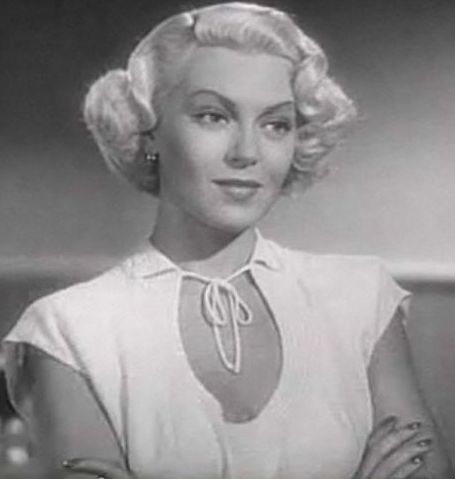
Putting aside the Hay’s Codes need for justice to be dealt, this is a wonderfully sardonic tale and ultimately sensual noir for the 1940s. Lana Turner was never better dancing with relative ease between amorous sweetness and acidic intentions. And the moment she first shows up on the screen is one of the most eye-catching entrances by a femme fatale period. Although not the greatest of leading men, John Garfield is surprisingly credible opposite, Turner. He plays the hard-working everyman incredibly well. Hume Cronyn, for his part, plays his wily prosecutor wonderfully with a sly smile all the while. I cannot quite put a finger on it, but I like him.

4.5/5 Stars

How to Steal a Million (1965)

220px-HowtostealamillionHonestly, the main attraction of this film is its leads in Audrey Hepburn and Peter O’Toole as well as its director, the great William Wyler. Otherwise, this film is a fluffy, silly caper comedy with a touch of drama. It falls somewhere in between a rom-com and an art heist film where everyone in Paris speaks English. Go figure.

Nicole Bonnet’s (Hepburn) father Charles is a master forger of all types of art which he supplements his own vast collection with. Many of his pieces have been sold for a pretty penny at auction, and he has yet to be found out.

He loans out a family heirloom, Cellini’s Venus, to a local Parisian museum for a large exhibition. Meanwhile, Nicole catches someone in the act of burglary and it ends up being a handsome young gentleman (Peter O’Toole).  She is given a fright but ultimately is taken by the man who hardly seems the thieving type. She lets him go without calling the police even giving him a ride home.

Eventually, they cross paths again and she recruits him to help her steal Cellini’s Venus from the museum. She doesn’t tell him why, but she has her reasons and he willingly obliges. It’s all good fun after all.

The caper scenes are no more harrowing than the rest of the film. In fact, it gives the perfect setting for more comedy as the two burglars get locked in a broom closet together after closing time, while also repeatedly setting off the alarm. But it’s all part of the man’s plan, because, after all, he’s a professional. And their plan works. They get away with the statue and the following day the news spreads like wildfire.

In the end, Nicole finds out that Simon Dermott is actually a private eye specializing in art and criminology. He’s no thief and so this was his first heist too. She thinks she’s in for it now, but they’re too in love for that to matter. He explains himself to Mr. Bonnet who reluctantly agrees to end his forgery career on top.

The two lovebirds drive off madcap down the streets of Paris with a beautiful life ahead of them. There’s not much else to say except Hepburn and O’Toole are fun together, while the score of a young John Williams has a recognizable bounciness. Hugh Griffin seems slightly miscast to be Hepburn’s father, and the film is far from pulse-pounding, but these small facts do not negate from its overall charm.

3.5/5 Stars

Move Over, Darling (1963)

Move_Over_Darling_-_PosterMove Over, Darling is a remake of My Favorite Wife (1940) and the unfinished Something’s Got to Give (1962). Thus, a Marilyn Monroe & Dean Martin vehicle ultimately turned into a Doris Day romantic comedy with James Garner and Polly Bergen. The dynamic feels so different and yet it ends up fitting nicely into the Doris Day canon. James Garner is always a fun actor and he plays an enjoyable role opposite Day.

The third time is still the charm with a plot involving a wife who is thought to be dead and returns after 5 years on a deserted island. Meanwhile her husband has moved on finally with a new wife who he has just recently married. One husband, two wives. That’s frowned upon in American society so he must figure out how to navigate these choppy marital waters. There are plenty of laughs in this screwball type plot line even if it is worn thin by this point.

The cast is full of great character players including Thelma Ritter, a very funny Edgar Buchannan, Don Knotts, John Astin and Chuck Connors. In this regard it is fun to compare and contrast the roles from the previous renditions such as Don Knotts versus Wally Cox as the shoe salesman, and so on.

It’s not a great film but certainly an enjoyable one full of marital mishaps and screwy situations. Not much more you can ask for so move over, darling and enjoy the show! Here’s to Doris Day who is still with us, James Garner who recently left us and a whole host of others.

3.5/5 Stars

Say Anything… (1989)

Say_Anything“How’d you get Diane Court to go out with you?”
“I called her up.”
“But how come it worked? I mean, like, what are you?”
“I’m Lloyd Dobler.”

She’s a brain, he’s not, sounds simple right? For such a basic premise Say Anything… has surprising depth. A lot of this is a credit to the performances of John Cusack and Ione Skye, along with the script by Cameron Crowe. The story is this: high school is over and the unknown future is what looms ahead. For Diane Court that means college, a fellowship in England, and the like. For Lloyd Dobler, we do not know what that means and he doesn’t either. For the moment he still has time, and he wants to use that moment to pursue Diane, the seemingly unreachable girl.

First of all, you have to understand how insane that goal is for a guy like Lloyd. He is a lover of kickboxing, The Clash, and he is an average student who lives with his sister and little nephew. Diane is the class valedictorian, doted over by her loving father, and she is a surprisingly sweet girl who dresses well and is a cut above. Not in a million years is he supposed to get her, but I said that already.

Anyways, Lloyd is a straightforward and to the point kind of guy, so he simply calls her house to ask her out. She finally gives into to his requests, and they go to a party to celebrate the end of their high school career. For him, it’s their first date, and she sees it just as a very nice evening. Diane leaves with a new found appreciation for Lloyd because he’s not like other guys. He periodically checks on her during the party to make sure she is alright and points out broken glass on the pavement for her to avoid. He is a gentleman in a trench coat, a strangely vulnerable figure.

Lloyd’s only future plans are to hang out with Diane as much as possible and as far as career plans he is not really sure. When everyone else, even his high school counselor, worry about the future, he always seems strangely, even naively, content.

Diane and Lloyd are slowly growing more and more connected and intimate. However, when Mr. Court goes under criminal investigation things begin to change. At first, everything is the same, with Lloyd teaching Diane how to drive stick shift and Diane growing more and more comfortable with him. And yet, with the familial situation at hand, she feels it necessary to break it off with him, leaving him a pen to write her with. Lloyd is especially wounded, confessing to his sister over the phone, “I gave her my heart and she gave me a pen.”

Soon enough Mr. Court’s account is cut off and in some ways, I felt strangely sorry for the man, but more so for Diane. One day Lloyd comes by with his boombox in tow, standing outside her window in one last monumental act of devotion. Nothing happens right then. Diane is still struggling with her father who it turns out has been swindling his elderly clients, but all for her future. She feels lied to and the only person she could run to is Lloyd, so she does and he takes her back.

Later on, he sees her father in prison and shares that his plan is to go to England with her, despite all the objections that come with it. The two jet-setters are together again proving all the doubters wrong. They wait for the ding of the smoking sign signaling the beginning of the rest of their lives.

This is perhaps one of the greatest high school romances ever, because it is far from the typical superficiality. Lloyd Dobler is played so wonderfully by John Cusack. You cannot help love this lanky guy who is fearlessly straightforward and willing to take a chance. Ione Skye is a bit overshadowed, but she is still convincingly sweet as the victim who finds the perfect guy. John Mahoney’s character is a despicable man and yet it is a credit to him that he actually makes us feel a bit of pity, for an instant. Obviously, the boombox scene is iconic, but I think it is the little things about Lloyd that make this film great. Every person could probably take a page out of his playbook by being honest, vulnerable, and most definitely loyal.

4.5/5 Stars