Clueless (1995)

CluelessHere is a high school teen comedy that is actually quite entertaining. Based off Jane Austen’s Emma, the story gets a 90s face lift. Cher is the quintessential ditsy Beverly Hills girl. She is popular, beautiful, and she knows how to dress. However, perhaps most importantly of all we learn over the course of the film that she has a heart.

Initially she loves to play the matchmaker and she takes on pet projects while trying to find a relationship of her own. In end she finds her true love sitting right in front of her all the time.

The film is propelled by a memorable characterization by Alicia Silverstone who is balanced out nicely by a young Paul Rudd. Cher’s voice overs throughout the entire film work swimmingly and there is a bit of a fairy tale ending. Not to mention some sagely advice and hip jargon.

Now I know never to go for a Monet. AS IF! I’m not that clueless.

3.5/5 Stars

Review: Rear Window (1954)

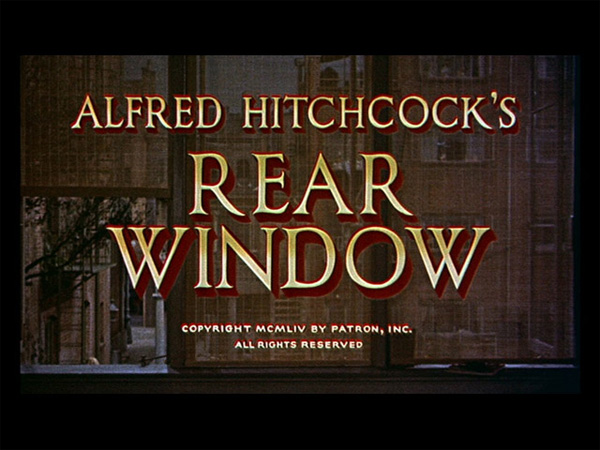
Hitchcock_stills_0006_rear-windowWho in their right mind would make a film that takes place in a courtyard? Rear Window has always been fascinating from a technical standpoint, and Alfred Hitchcock is certainly not “The Master of Suspense” for nothing. He uses the confined space of a single Greenwich Village courtyard with an incapacitated individual to truly build the tension to immeasurable heights. The events within the film are often highly bemusing as Hitchcock has a wicked sense of humor, whether Jefferies is trying desperately to scratch that itch or the conversation turns morbid as he tries to eat breakfast.

The script has so many great little moments of back in forth repartee; some supplied by the always dynamic Thelma Ritter who plays the nurse with a lot of advice and opinions about rear window ethics: “We’ve become a race of peeping toms. What people ought to do is get outside their own house and look in for a change. Yes, sir. How’s that for a bit of home-spun philosophy.

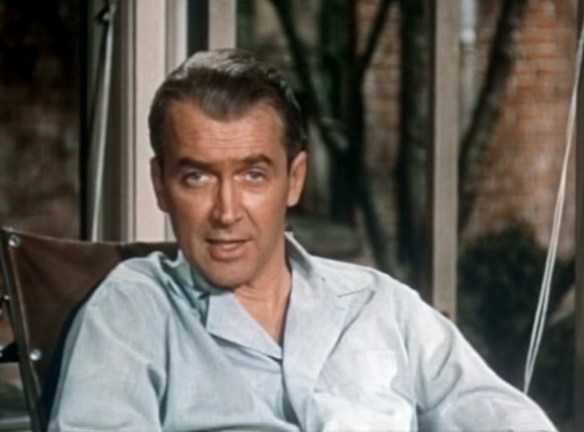
James Stewart is always a pleasure, but this time around he is perhaps at his most constrained as famed photographer L.B. Jefferies, who is laid up in his apartment for weeks on end with a leg in a cast. He got the injury thanks in part to his last big photo shoot where he ran in front of an oncoming race car. With nothing better to do, he spends his idle moments people watching and getting to know his neighbors. That’s one way to put it at least. As an actor, Stewart is stuck and relegated to conveying his whole performance through his gaze and the dialogue he speaks to those few who come in and out to see him. Most of what he’s doing is simply looking across the way and yet it works.

His neighbors are as follows:

There’s Ms. Torso who is an aspiring dancer and always the target of many men. There’s Ms. Lonelyheart who never can find the love she so desires. A washed-up composer spends the entire film trying to figure out his newest project (even getting a visit from Hitchcock himself). There are the newlyweds who hardly ever leave their bedroom because they’re doing something… Then, comes the older couple on the second floor with a cute little dog and the sculptor who lives below.

Most interesting of all is the couple directly across the way from Jefferies’ because that’s where a long-suffering husband and his wife live. All seems normal, to begin with, however, Jefferies begins to have his suspicions thanks to circumstantial evidence and no sign of Mrs. Thorwald. His first thoughts immediately shoot to murder, but it seems highly unlikely. Day and night he continues to watch seeming to get more evidence, only to have his theories crushed, and then gain new hope through more evidence.

James_Stewart_in_Rear_Window_trailerThe interesting part is that as an audience we are fully involved in this story. We see much of the picture from Jefferies’ apartment, because there is no place to go, and so we stay inside the confines of the complex. In this way, Hitchcock creates a lot of Rear Window‘s  plot out of actions occurring and then the reactions that follow. We are constantly being fed a scene and then immediately being shown the gaze of Jefferies. It effectively pulls us into this position of a peeping tom too. Danger keeps on creeping closer and closer as he discovers more and more. The narrative continues to progress methodically from day to night to the next day and the next evening.

In the climactic moments, he finally faces the man who he always looked in at from the outside and yet by the end the roles are reversed with Jefferies space being fully invaded, and yet he can do little to flee, because of his cast. Hitchcock cuts it in such a choppy and chaotic way which breaks with the smooth continuity of the rest of the film, but it works so wonderfully in stark juxtaposition.

This is one of the main appeals of Rear Window because it has this Hitchcockian story of murder, mystery, and suspense. However, I am constantly eager to revisit this story, since there are so many other intricacies that are of interest.

Although the film uses a score by Franz Waxman, the majority of the sounds heard are diegetic and they either are street noises or music wafting around the courtyard from one of the apartments.  Also, there is only one small outlet to the outside world. At times, it becomes fun to survey what is going on whether it is kids playing on the street corner or cars passing back and forth. It builds this sense of realism suggesting that this world that has been created is larger than this one set full of apartment buildings.

Another important element is themes of romance and love. Jefferies comes into the film with issues in his own love life. His girl is the elegant and refined Lisa Fremont (Grace Kelly), who seems perfect, too perfect in his estimation. In his mind, they just don’t seem compatible enough, and he cannot see marrying her. It’s something they have to work through because she truly loves him.

Really every character essentially has a different outlook on love and different struggles, because romance is never an easy thing. Like the lyricist’s song, it is so often fragmented, but in their case, Jefferies and Lisa seem to figure things out just as the song finally gets finished. The moment where you can see it in Jefferies’ face that he is both impressed and worried for Lisa’s safety seems to be the time when things change. He realizes his love for her since she is very dear. He quits his thinking and his analyzing of their relationship, as gut-wrenching emotions take over when she is caught. In a sense, he listens to Stella’s earlier advice: “Look, Mr. Jefferies, I’m not an educated woman, but I can tell you one thing. When a man and a woman see each other and like each other they ought to come together – wham! Like a couple of taxis on Broadway, not sit around analyzing each other like two specimens in a bottle.”

Wendell Corey, in his supporting role as Jefferies’ friend and the police detective, is a man who can be a skeptic and still prove his loyalty as a friend. They can be at odds and still poke fun at each other with mutual affection. It feels real. Raymond Burr as the villainous Lars Thorwald works well too because he is certainly an angry, unfriendly grouch, but he does not seem altogether evil. It shows how easy it is for the lines to be blurred.

rear-window-first-shot-of-gkAbove all, Grace Kelly shines opposite Jimmy Stewart. There’s no one quite like her, so elegant, eloquent, with a touch of playfulness and adventure. She is willing to fight for her man and even go out on a limb for him (ie. breaking into Thorwalds’ apartment). One of the film’s most extraordinary images, out of many, has to be when a shadow covers the face of Stewart as he rests. Then there is a close-up of Kelly, her face slowly descending towards him. It’s hard to forget and for the rest of the film, she attempts to not let him forget her.

It’s not often easy for me to make statements like this, but Rear Window has to be close to my favorite film of all time. Yes, I said it. It never gets old for me, and I pick out new things every time. It’s more than just a mystery thriller. Hitchcock made it a technical marvel that is also steeped in themes of love and ethical questions. The players are the best of the best from James Stewart, to Grace Kelly, to Thelma Ritter, all down the line. It’s at times deliberate, but never boring, completely immersing the viewer into this drama as a firsthand witness. It’s the type of cinema we just don’t get every day because it has everything and it cuts to the core — to the most visceral level. That is the sign of cinematic greatness.

5/5 Stars

Lost Horizon (1937)

LostHorizonPosterCertainly this is not the most well known or the best film of Capra. It is, in fact, quite different from a lot of his filmography. That is not to say that it is not an enjoyable film about a man who finds a little piece of Utopia called Shangri-La. Ronald Colman was certainly a likable fellow in the lead role and Jane Wyatt was pleasant during the time she was on screen.

What I really enjoyed in this film was the quibbling and bickering of Thomas Mitchell and Edward Everett Horton’s characters. These are two tremendous character actors who represent all that was great about the stock characters of Hollywood’s Golden Age. They are so recognizable and though not the stars they seemingly steal their scenes.

Because some of this film was lost, parts were understandably choppy since there was no visual aside from photos to go with the dialogue during certain moments. Despite this, the film is an enjoyable, albeit dated, 1930s fantasy.

4/5 Stars

Moonrise (1948)

MoonriseHere is a low budget yet artistic film from Frank Borzage. I will be honest that I had never heard of Borzage before a year or two ago and he seems to have lost some of the respect he had early on in the 20th century. The same can be said for his stars Dane Clark and Gail Russell who are unknowns to most unless you hailed from those times. I was saddened to find Russell struggled with alcoholism which contrasts with the surprisingly hopeful ending of this melodramatic noir.

Ultimately, Danny Hawkins (Clark) was able to let go of all his hatred and accept justice. Instead of throwing away his life he got the girl and came to terms with reality.

Perhaps the most striking moment of this film was the highly stylized and dark opening showing the hanging of Danny’s father and his early childhood afterwards. In only a few minutes Borzage told us so much about Danny. Thus, during the entire films those images stuck with us and we could still feel a sense of empathy for him.

Despite there small parts, I was excited to see Lloyd Bridges, a young Harry Morgan, and Harry Carey Jr. All in all this was an interesting film and it causes me to want to see more from Borzage.

3.5/5 Stars

Before Midnight (2013)

Before_MidnightWell, I was expecting great things from this film as the third installment in an intriguing romantic trilogy. I will admit that at first I thought it was decent but I was not blown away.

My favorite moment had to be near the middle when Jesse and Celine took a walk through the ancient streets of Greece. Their conversation was reminiscent of the previous two films and I appreciated that.

However, the beginning of the film was filled with family moments, discussions with friends and little time of Jesse and Celine alone like the years before.

When they finally were alone they were quick to argue and lose their tempers over familial issues and seemingly petty problems. Even to the end of the film, their relationship seemed perhaps more creaky than it had ever been.

However, over time I realized that these things that I did not like made the relationship of Jesse and Celine all the more realistic. They are not the starry-eyed kids or the young lovers meeting up for romance. They have children, strained relationships with former spouses, more wrinkles, full time jobs, and 40 years under their belts, and that is the way that real life often is. So I’ve been told.

I’m not sure if Celine and Jesse will ever be brought back to screen, but I know that I was ultimately satisfied with the place we left them at. As Ethan Hawke said it all began as a story about what might be, then it was a film about what should be, and Before Midnight was the film about what actually is. Linklater did us a favor by not giving into the conventions that we are so often used to, because he was never one to do that before, sunrise or sunset. His lovingly crafted romance would not sink to that level and should not sink to that level. It remained true to itself and even if it was not what I wanted, it was what was called for.

Who knows, 9 years down the road we might get another installment, until then I will be content with the love story Linklater, Hawke and Delphy so graciously gifted us. It’s not perfect by any means, but it’s genuine and that is far better.

4.5/5 Stars

Before Sunset (2004)

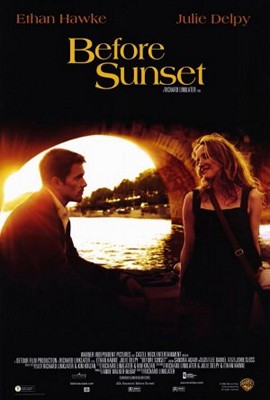
Before_SunsetIn this sequel to Before Sunrise we come back nine years later.

There is a certain degree of eagerness and nervousness as we wait to hear what happened in the months following Before Sunrise. We find out that Jesse and Celine did not actually meet 6 months after their first encounter. In all reality, what were we expecting? I myself had a secret hope that they would meet again. It’s the romantic in me, but that’s not how life ends up working out. Jesse showed up but the sudden death of Celine’s grandmother detained her. That’s one of the plights of this human existence.

Now Jesse is a writer who made a book about their evening together and one day in Paris while promoting his book there is Celine smiling through the window.

Here they are back together again nine years later with 1 hour to catch up before Jesse has to take a flight back to the States. With the passing of the years we now find ourselves watching an older, wiser, pair. They are both married now.

Jesse has lost the long hair and he is not quite so young in the face but it is still the same guy. Celine is still very pretty but more mature than the young French girl from the earlier film. Most importantly of all they still have a knack for deep, highly personal conversations.

A lot is covered as they chat through the streets of Paris. My most favorite moment however comes when Celine plays Jesse the Waltz she wrote. It is a beautiful little ballad in its own right and it shows her personal connection with Jesse that still lasts over all these years. What he encapsulated in his best selling book she documented in a song. We leave them once again as two slightly different people who still have a penchant for conversation, love and sentiment.

The film starts and like a blip on the radar it is already finished. In some regards it is rather disappointing, but not as unsatisfying as this short rendezvous must be for Jesse and Celine.

I have no bitterness, my sweet
I’ll never forget this one night thing
Even tomorrow, another arms
My heart will stay yours until I die

Let me sing you a waltz
Out of nowhere, out of my blues
Let me sing you a waltz

~A Waltz for a Night

4/5 Stars

Before Sunrise (1995)

Before_Sunrise_posterThis is a fascinating film not just about love and romance but higher, deeper concepts altogether. Without knowing the idea already existed, this is the film I always wanted to make in my head!

Two people meeting in a place under unusual circumstances (on a train in a foreign country), and then building a bond over a single day that evolves into something really special very, very quickly.

This is exactly happens with Ethan Hawke and Julie Delpy who do a wonderful job playing two genuine people who have their own set of ideas, aspirations, fears, memories and unique personalities to go with them.

They spend an evening in Vienna and create a memorable flashbulb moment out of it. One instant that sticks out in my mind is when they are sitting at a restaurant with many conversations going on around them. However, the two of them have pretend telephone conversations with other people. Through it Jesse and Celine learn how the other feels about them. It is so beautifully captured because they do not have to say it directly, but through this roundabout way they know.

Perhaps this film sounds like a bore to some and it may in fact be because a lot of it is talking. But Linklater and his collaborators frame it in such a way that I was very much engaged. Isn’t a lot of life talking anyways? In that way it had a spontaneous, realistic feel and that is thanks to a solid script along with the candid delivery of the leads. When I first saw Julie Delphy I had no idea she was French and it took me a while to catch on. She and Hawke play well off of each other and it is interesting to be able to eavesdrop on their conversations.

Before Sunrise was a pleasant surprise because it failed to fall into many of the normal conventions of romantic comedies and instead it rose above the mediocrity to tackle the ins and outs of love and life through frank and wonderfully unadulterated conversation. I cannot wait for more of Linklater’s trilogy.

4.5/5 Stars

Seven Brides for Seven Brothers (1954)

Seven_brides_seven_brothersThe title gives a clear indication of what this Stanley Donen musical will be about, but it does not tell us how we will arrive at that conclusion. It all begins when a woodsman named Adam (Howard Keel) comes to town intent on finding himself a cute and handy bride. That he does in Milly (Jane Powell) and soon enough, in a whirlwind, they are married and heading back to his home. There she is greatly surprised to meet his rambunctious and rough-edged younger brothers. Six to be exact, but you already guessed that.

Once she accepts her new life, it becomes Milly’s mission to straighten them out and find them girls to court. It isn’t easy but soon they learn table manners and proper etiquette before the big barn raising takes place. There the boys make quite the impression and the audience is given quite the show complete with bright colors and inventive-foot-tapping choreography. It’s an understatement to say that the Pontipee brothers are not popular with the locals, and not only is there a barn-raising but some hell-raising as well.

Adam is proud of their showing, but the rest of the lads are lovesick as the long cold winter begins, separating them indefinitely from their girls. With Adam’s encouragement, they decide to do as the Romans and kidnap their sweets, but they fail to think about the consequences. The town’s in an uproar, the girls are frightened, and a man-made avalanche means there is no contact with the outside world for at least 5 months!

Milly is appalled by their actions, especially Adam’s part, and the lads are made to sleep in the barn as she dotes over the scared group of girls. Not liking what he’s seeing, Adam heads off on his own for a while. Spring brings a fresh start as young love flourishes and the boys are forgiven. Milly gives birth to a baby girl, and Adam finally returns home with a new perspective. But what about the town folk you ask? They do come after the  Pontipees, and they don’t like what they see when they ride in. Needless to say, it is a happy ending with each boy getting his girl, thanks to a few shotguns.

With catchy songs, beautiful color cinematography, lively dance numbers, and an amusing premise, this is a very strong MGM musical, even if it is not the best of the lot. That is not saying much because the studio could hardly go wrong with such previous titles as On the Town, An American in Paris, Singin’ in the Rain and The Band Wagon. Seven Brides is a nice addition although I will say it vaguely reminded me of Oklahoma. However, it is different enough to be well worth it. The only question left to ask is, “Are Adam, Benjamin, Caleb, Daniel, “Frank,” and Gideon natural red-heads? I’m not sure I know the answer but I could wager a guess.

4/5 Stars

A Letter to Three Wives (1949)

A_letter_to_three_wives_movie_posterHere is a story about three wives, the three husbands that go with them, and the one woman who got in the middle of them all. The main plot device is simply this: This woman named Addie Grace, who we never see but who is always being referred to, has left town and she also left a letter addressed to the three wives. The women get it as they board a boat for an afternoon out at sea with some underprivileged children. When they read what it says their afternoon takes a major turn. The one and only Addie Ross has run off with one of their husbands and yet she does not say who it is.

The rest of their time is spent thinking back on their marriages and each recollection is framed as a long flashback. First, comes Deborah Bishop (Jeanne Crain), a farm girl who met her husband during the war. Now with his friends back home she wishes to make a good impression, but she feels like she can never measure up with such elite society. To make matters worse, she learns that before the war it was thought that Brad would marry Addie Grace because they grew up together.

Next, comes Rita Phipps (Ann Sothern), who puts on an extra special dinner for her bosses from the radio station she writes for. The night includes a forgotten birthday, sappy radio programs, and all the while Rita is constantly trying to please and appease her bosses. They enjoy the evening but her husband George is upset that she constantly caves to them. To make matters worse, as a school teacher, it is difficult for him, as the man of the house, to have her bring in a great deal of their income.

Last but not least is Lora Mae Hollingsway (Linda Darnell) who grew up in a poor household near the train tracks with her mother and younger sister. She focuses her attention on Porter Hollingsway (her future husband), an older divorced man who also happens to own a chain of department stores. After a great deal of back and forth, they get married but underlying their marriage is this assumption that she only went after him for his money. Their relationship hardly seems to involve true love.

All three women return to their lives. Rita is grateful to find George sitting in the living room. Porter, who Lora Mae half expected to be gone, has come into the house exhausted after a long day of work. Deborah is seemingly not so lucky. All of them get ready for the dance that evening with their spirits all at different levels. However, after Porter shares a revelation the evening gets a whole lot better.

This Joseph L. Mankiewicz precursor to All About Eve is a remarkable drama in its own right thanks to its primary narrative device and fine performances from the cast. Thelma Ritter was as entertaining as ever and Celeste Holme was tantalizing as the unseen voice of Addie. It is interesting how all the stories of the film interconnect characters, making us come to understand each and every one of them a little better. The ending was slightly abrupt but still clever. All in all, A Letter to Three Wives was an interesting concept that paid off beautifully.

4.5/5 Stars

Cry Danger (1951)

589aa-crydanger2Here is yet another noir gem which would never get made today, much less in a mere 22 days! This directorial debut of Robert Parrish is boosted by an often witty script from William Bowers.

Rocky Mulloy (Dick Powell) is fresh out of prison after a former marine (Richard Erdman) testifies on his behalf though Mulloy already spent five years rotting away in prison. He went in right around the end of the war because of a robbery that he was assumed to be a part of.

Regis Toomey (The Big Sleep, Raw Deal) is Lt. Cobb and he is still skeptical when he is assigned to monitor the newly released man. Richard Erdman is the peg-legged, alcoholic marine who has a penchant for booze and dames. Also, he never actually knew Mulloy before. He just wants some of the loot.

So the two new found chums set up camp in a beat down trailer park of all places, with a music playing proprietor (Jay Adler). It’s not exactly the Ritz, but Delong finds some female company, and it just so happens that Mulloy’s former flame lives there too. Nancy (Rhonda Fleming) is married to Rocky’s pal Danny who is still in the clink. His mission is to prove his innocence, but could it be more harm than good?

Rocky goes to a local mobster named Castro (William Conrad) who left him holding the bag five years ago, and he wants reimbursement for his time. He gets some of it in the form of a horse race which leads to a big payoff.

But as it turns out, the money is hot and Lt. Cobb wants to know where it came from. Rocky obliges but it becomes all too obvious he’s being set up. There was one slip up though, proving Rocky is telling the truth for once, amidst all the lies swirling around. That does not help Delong much and his girl Darlene gets blown sky high. The bullets were obviously meant for Rocky and  Nancy.

Rocky confronts Castro and they play a little game he likes to call Russian Roulette, although it’s very one-sided favoring Rocky. The fearful mobster spills the truth, revealing Danny was actually a part of the plan 5 years ago all the time. Since he took a lighter rap, someone else is holding his share of the payoff. The missing $50,000. Who is keeping it warm for him? You guessed it.

Rocky goes back to the trailer park where Nancy spills all her beautiful guts to him. What she gives is a tempting offer and Mulloy lets her believe it will happen. Off he walks with Lt. Cobb ready to swoop in. Rocky may have gone straight, but it doesn’t mean it makes it any easier. He had to turn on one of the most beautiful girls in the world, courtesy of Rhonda Fleming.

Dick Powell has another laconic performance which nearly matches his turn as Philip Marlowe in Murder, My Sweet. I always love seeing Richard Erdman as a young jokester, because he has gained a following more recently for his work in the television show Community as Leonard. William Conrad will always be the narrator in Rocky and Bullwinkle as well as Cannon. However, his big frame and mustache make for a good criminal type. What can I say about Rhonda Fleming except that she looks stunning in black and white, much less technicolor?

Lt. Gus Cobb: Now, just get it through your heads that the pressure’s on. 
(To Nancy)
Lt. Gus Cobb: I wouldn’t give a nickel for your husband’s chances before that parole board with all this going on.
(To Rocky)
Lt. Gus Cobb: And I wouldn’t give a nickel for your chances with those two apes running around looking for you.
(To Castro)
Lt. Gus Cobb: For you, I just wouldn’t give a nickel.

4/5 Stars