You Can’t Take it With You (1938)

Starring a cast boasting Lionel Barrymore, Jean Arthur, James Stewart, and Ed Arnold, this is another comical Capra film. Arnold is a wealthy banker bent on acquiring a block of land for business purposes. Stewart is his son who has fallen over heels for his secretary. Things are complicated by her peculiar family household partly because her grandfather will not give up his land to the banker. Fireworks go off literally and figuratively when the two families meet. It leads to prison, and a chaotic court appearance which causes a further rift. Because his grand daughter is sad, Grandpa decides to sell the family home. Arnold seems to have won, but his son leaves him for his love and so Arnold changes his way. Thanks to a harmonica duet and some dancing a friendship is made and everyone is happy in the end. Every Capra films comes with a message and this one preaches the importance of friends and family compared to money because after all “You Can’t Take it With You.”

4/5 Stars
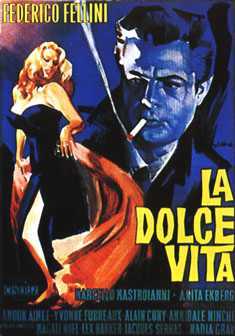
La Dolce Vita (1960)

bc0c3-la_dolce_vita_1960_film_coverartStarring Marcello Mastroianni and directed by Federico Fellini, this Italian film set in Rome follows a tabloid reporter named Marcello. If he is not finding a scoop with other ravenous reporters, he spends time with his wary girlfriend, falls for an American bombshell, talks with a cultured family man, or spends time with his good natured father who he does not really know. All the while he witnesses the lives of the rich and has many romantic relations. The underlining theme of it all is boredom,  unhappiness, and superficial lifestyles. This film is not really about a main plot but rather Marcello’s many different episodes and experiences. Some are funny and others maddening, but he muddles his way through. This film, much like Breathless, is international and chic. The cinematography and score are both effective in helping to create this feel.

5/5 Stars

Funny Face (1957)

c8b15-funny_face_1957Although not a tremendous musical, Funny Face is a fun film that is worth a watch because it pairs Fred Astaire and Audrey Hepburn.

My main purpose for watching this film was to commemorate what would have been Audrey Hepburn’s 85th birthday today. This was a great film to go to in that respect, because it features many iconic shots of true Hepburn fashion. The film facilitated it since Hepburn was the newest model for a fashion magazine and Fred Astaire was the photographer who brought her on and ultimately fell for her.

So much color, style, and a good deal of relatively entertaining song and dance courtesy of Gershwin. Although this is no American in Paris you still have some of the Parisian allure.

I must admit that Audrey Hepburn certainly does not have a “Funny Face” in my opinion, but I will say that she always was a pleasant and charming beauty to watch. She is one for the ages as an actress, a fashion queen, a humanitarian, and an all around beloved lady.

Happy Birthday Huckleberry Friend

3.5/5 Stars

Who’s Afraid of Virginia Woolf? (1966)

Starring Elizabeth Taylor and Richard Burton with director Mike Nichols, this taboo-breaking adaption of the stage play revolves around a middle-aged couple. George is a professor and he and his wife Martha have a love-hate relationship. Urged by her influential  father, Martha invites a young couple to their home. Because of the late hour and lots of alcohol, the rest of the evening becomes a wild war full of nasty insults, hurtful games, and manipulation. Martha and George use their guests and go as far as physical violence. However, in the end secrets are uncovered and they realize that they truly are afraid of Virginia Woolf. What began as a joke became all too true. At points this film seemed to elude me but I will say the acting was intense and powerful. There were moments where you disdain these people, then you feel pity for their plight, and other times you may even be able to relate to them in some ways.

4/5 Stars

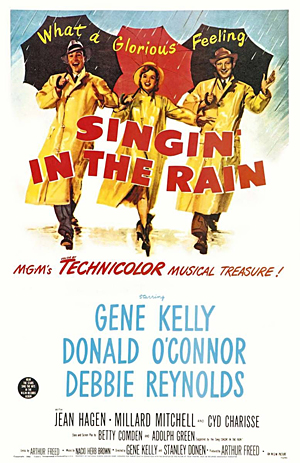
Singin’ In the Rain (1952)

This movie is a comedy, a romance, and above all a musical. However along with the immortal dance routines there is a plot and characters that are memorable as well. It helps to glorify a very different time in Hollywood and delivers a film that is funny and full of excellent song and dance.

There is something about this film that makes it extremely special. Even after seeing it many times I am still captivated by every joke and every unforgettable song. What can beat the brilliance and antics of Gene Kelly and Donald O’Connor backed by Debbie Reynolds? There is a touching love story to go along with these great actors and songs. Gene Kelly’s sloshing about in the title song is timeless and O’Connor delivers a hilarious performance in such songs as Make ’em Laugh. There are a few dance sequences that are drawn out but the rest is top notch and keeps the audience enamored the entire time. This truly is a classic movie and musical that is both funny and heartwarming.

5/5 Stars

“Dignity. Always, dignity”
~ Don Lockwood

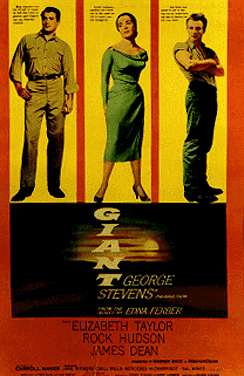
Giant (1956)

This is an epic film that stars Elizabeth Taylor, Rock Hudson, and James Dean, with direction by George Stevens. It shows the ongoing conflict between a rancher (Hudson) and his former hired hand who becomes rich off oil (Dean). As Jett Rink (Dean) exclaims, he becomes even richer than the rancher Bic Benedict (Hudson) ever dreamed. The relationship escalates when Rink makes a rude remark to Leslie Benedict (Taylor), and some punches are traded. From this point on the three main characters slowly grow older and the Benedicts have children. In his final screen appearance, Dean’s character is suppose to give a speech at a large banquet. However he is so drunk he falls flat on his face a complete wreck. Giant was ahead of his time by giving commentary about the race relations with Mexicans. It also took young actors and progressively made them look older, something that was quite unusual. Although this was Dean’s final movie I think it can be said he came full circle. He began as a youth in East of Eden and by the end of Giant he was a old man.

4.5/5 Stars

A Place in the Sun (1951)

In this film starring Montgomery Clift, Elizabeth Taylor, and Shelley Winters, with George Stevens directing, a young man (Clift) tries to rise up in his uncle’s company. He is poorly-educated yet ambitious and he slowly moves up in the Eastman business. While he works George begins to fall for a modest girl (Winters) who also works in the assembly. They slowly begin to show romantic feelings for each other because they face the same hardships. With a new found postition George begins to interact with people of higher social status. Although he feels out of place there, he meets the beautiful and rich Angela (Taylor) who he begins to fall in love with. As he begins to get more involved with Angela, he learns that his former love interest is pregnant and therefore wishes to marry him. Faced with a dilemma, George makes a decision that will ruin him forever, whether he goes through with it or not. A hard-hitting drama, and an adaptation of “An American Tragedy” by Theodore Dreiser, the latter half is the best part, including the chilling finale.

4/5 Stars

The More The Merrier (1943)

e0052-the_more_the_merrier_-_posterDirected by George Stevens and starring Jean Arthur, Joel McCrea, and Charles Coburn, this comedy makes light of the housing shortage in Washington D.C. during WWII. Retired millionaire Benjamin Dingle comes to D.C. as an adviser for the housing crisis. Unfortunately he cannot find a place to stay right away. By chance he happens upon an ad for a room the only thing is that the other tenant is a young woman. Mr. Dingle will not take no for an answer and despite her misgivings she agrees to let him stay. It soon proves to be a hilarious situation and it gets even more complicated when Dingle rents half of his half to a Sergeant Joe Carter who is about to ship out. Of course he doesn’t tell Connie. There is initial conflict however Dingle tries to play matchmaker. The only problem is that Connie is already engaged to a bureaucrat. Then Dingle oversteps his boundaries reading Ms. Milligan’s diary to Joe. Dingle accepts the responsibility and leaves but Connie allows Joe to stay since he will be gone soon. Through a series of events the newspaper gets a hold of the situation so Mr. Dingle advises them to get married to stop a scandal. As Joe gets ready to leave they realize they really do care for each other and Dingle was right Connie finally gave into her true feelings. All the main players were good and I think Charles Coburn was really the standout because he was the character who kept the whole story together. As is his motto, “Damn the torpedoes, full speed ahead.”
 
4.5/5 Stars

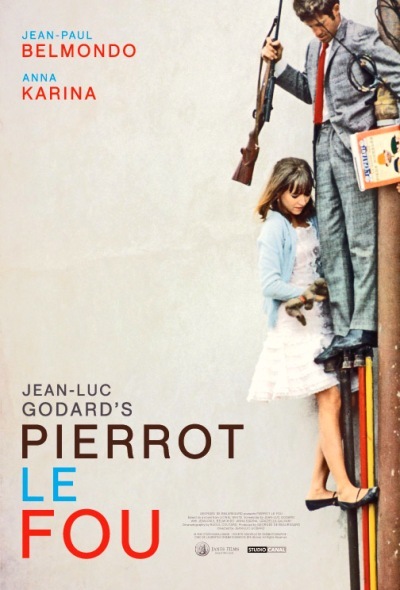
Pierrot Le Fou (1965)

Directed by Jean-Luc Godard and starring Jean Paul Belmondo and Anna Karina, this film is chock full of poetic musings, literary allusions, pop culture images, and so on. Belmondo is a Frenchman who is unhappy with his life and marriage. When a young woman he is already acquainted with comes to watch his child, they eventually elope together. Ferdinand goes with Marianne to her apartment only to find a corpse and they must flee the scene from two gangsters. Now on the run, the two lovebirds are intent on living life and making their own Hollywood inspired movie that they can both star in. Their aspirations lead them to live a wild life on the move, but finally they settle down for a awhile in the French Riviera. Ferdinand is content with a quiet life of philosophizing but Marianne is discontent with this life right out of a Robert Louis Stevenson novel. They finally move on and stop at a night club where they face one of their pursuers. After some mishaps Ferdinand and his girl get separated. Finally they are reunited only to have Marianne turn on “Pierrot” for her real boyfriend. The final moments are filled with gunfire, a suitcase full of money, blue paint, and dynamite. You could say that everything blew up in Ferdinand’s face, and you would be quite correct.

4/5 Stars

Breathless (1960)

5cad1-c380_bout_de_souffle_movie_posterThe debut of Jean-Luc Godard and starring Jean-Paul Belmondo with Jean Seberg, this film was influential in helping to jump start the French New Wave. The story begins with a small-time thief named Michel stealing a car and then killing a policeman  Quickly, he becomes a fugitive in need of money. This brings him in contact with an American journalism student he had met before. They spend time together with Michel professing his love and Patricia still feeling unsure whether or not she truly loves him back. In a final act of reassurance Patricia betrays Michel and he is chased down by the authorities. He is a far cry from the American movie stars and crime films he idolizes. With its jazzy score, bilingual dialogue, jump cuts, and Parisian scenery, this film is chic and cool. It paid homage to Hollywood but it also paved the way for a new era of films starting in the 60s. The film is perhaps not as impressive to today’s audiences but it certainly has a look that you have to appreciate. Godard was ahead of his time because he went against all conventions that had been set up for cinema and he thereby revolutionized the film world.

4.5/5 Stars