The Parallax View (1974)

1c362-parallax_view_“Fella you don’t know what this story means”

The first shot and we know where we are. We’ve been here before. It’s Seattle. The occasion is a Fourth of July parade honoring Senator Charles Carol. Any viewer paying attention knows something fishy is afoot and in perhaps the most intense moment of the whole film the man is violently assassinated. A committee deliberates and comes to the conclusion that the perpetrator was acting alone. And so begins The Parallax View.

Second rate journalist Joseph Frady is known for getting into trouble or causing it most of the time. So when he is interested in rehashing the old story his long-suffering supervisor is skeptical (Hume Cronyn). It all starts because news reporter Lee Carter comes to Frady fearful for her life. It turns out that 6 of the people who were there during the assassination have all died one by one. It’s all very circumstantial and seemingly harmless enough. Soon Carter herself is dead due to barbiturates and alcohol. Frady heads first to the town of Salmon Tale (in search of the elusive Austin Tucker), where he runs into trouble with the local authorities and stumbles upon the Parallax Corporation. He gets his rendezvous with Tucker who is also fearful for his life. Minutes later Kabooom.

He continues winding up with more questions than answers as new bits and pieces crop up. It turns out Parallax is in the very lucrative business of recruiting assassins, so he goes off the grid to join them. His training includes a montage of images to condition him, and the audience is submitted to the process as well. Frady diverts a bomb threat thanks to a stack of napkins, but still another one bites the dust. He finally finds his way to a convention hall where a big to do is in the works for a senator. In a perfect bookend, another man is shot and after deliberating the committee concludes Joseph Frady acted alone. The biggest conspiracy in the country gets away with murder again and slinks back in the shadows.

Gordon Willis’s cinematography exhibits beautiful wide and long shots framing his subjects in their environments. Beatty is fit to play the somewhat rogue reporter but very few of the other characters are memorable. Perhaps that’s precisely the point. The film has extremely deliberate pacing (ie. Two men ride up an elevator one after another in no immediate hurry). However, the paranoia elevates as the film progresses, because we have little idea what is going on, we just know that something is going on. I am partial to The Manchurian Candidate, but here is a film that represents the 1970s, a decade still fraught with political unrest and a myriad of recent assassination attempts.

3.5/5 Stars

Wait Until Dark (1967) – Updated

a752e-waituntildark1This is very much a contrived plot line but it certainly is an interesting set piece surrounding a defenseless blind woman targeted because of a heroin-filled doll which fell into her husband’s possession. It sounds like a pretty ludicrous set up but Audrey Hepburn is so believable and at times pitiful that she makes the film works thanks to her performance. Alan Arkin plays an over the top terror of a man bent on getting the doll back and he procures the help of two men to play parts in his elaborate charade. He is the near perfect opposition to torture the angelic Hepburn.

Through the entire story Susy’s blindness is being manipulated and she is constantly in a vulnerable state that is extremely uncomfortable for the audience. She is fed lies and entrusts men who she should not, but she cannot know any better. Thus, we soon forget how ridiculous this whole affair is and get caught up instead in our own fears and anxieties for Susy. From that point on we are hooked and there is no turning back until nighttime comes. Susy is cut off from the world with darkness approaching and that’s when the real nail-biting begins. But that’s for you to see for yourself. I would not deprive you of that pleasure.

The cast is rounded out by Richard Crenna, Emfram Zimbalist Jr. and Jack Weston who all are decent but their roles are relatively cookie cutter. The little girl Gloria is a spunky character but  the real attraction as I said before is Hepburn. The score by Henry Mancini gives the film a thrilling feel rather like a Columbo special. If there ever was a thriller this is certainly one of them! Just Wait Until Dark, you’ll see.

4/5 Stars

Repulsion (1965)

f483d-repulsion
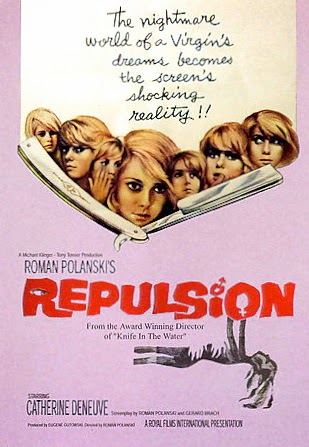
Directed by Roman Polanski and starring Catherine Deneuve, this British Psychological thriller is in the same vain as Psycho. Carol is a manicurist who is often absent-minded at work and she returns home to an apartment that she shares with her older sister. She passively resists the advances of an infatuated young man and at home she must live through her sister and a boyfriend in the next room. 

*May Contain Spoilers
Then, they leave and an attached Carol cannot bear her sister to leave her alone. The next days and weeks she sinks into a unstable state and slowly loses her sanity while losing track of reality at the same time. She is sent home from work, becomes even more preoccupied, and then begins hallucinating back in her home. When Colin comes to speak with her she is still unresponsive and she unexpectedly bludgeons him to death. Then, later on the annoyed landlord comes by for his money, and then makes advances on her, only to be killed by a frightened Carol. Helen and her boyfriend return to find the apartment in disarray and Carol out of sorts and concerned neighbors come to spectate. The camera closes in on a family photo and a young Carol’s perturbing face. 

This low budget documentary grade black and white film still packs a powerful punch and the best word to describe it is probably disconcerting. Unfortunately, I had never heard of the cinematographer Gilbert Taylor, but he had several wonderful films in his catalog including Dr. Strangelove, A Hard Day’s Night, Star Wars, and of course Repulsion.
 
4/5 Stars

Review: The Third Man (1949)

5873f-thirdmanusposterI am continually drawn to The Third Man for a number of reasons, which I would love to highlight right now. To begin with, the opening credits come up and yet behind them is the rather odd image of a row of strings. As an audience, this is our first introduction to the zither, the twangy instrument that will create the strangely haunting score over the course of the film.

Then, we are fed a casual bit of narration that quickly throws us into the story of western writer Holly Martins (Joseph Cotten), as he heads to Vienna to meet his old school chum Harry Lime (to be revealed later!). It seems safe to say that World War II was not good to the city, which is a mixture of ruins, cobblestone streets and ornate architecture that lend itself to an uneasy feeling. In other words, what happens in Vienna, stays in Vienna. Everything is zoned off nicely, and the authorities try and stay out of each other’s way.

Martins learns soon enough that Lime is dead and yet it doesn’t add up. His best friend was hit by a car driven by a colleague, carried off the road by two friends, and diagnosed by his personal doctor who all happened to be present. Martins is urged by a Major Calloway to not get involved. Heading home would be a much better solution.

But of course, Martins does not heed this advice. He meets Harry Lime’s girl, the beautiful but somber Anna (Valli), who has her own troubles with the authorities. Further investigation points to a mysterious third man who a local porter saw from his window. The old man winds up dead and soon Martins himself is threatened. Calloway encourages him to leave again before reluctantly disclosing that Lime was dealing diluted penicillin on the black market. That batch ultimately killed and harmed many a patient.

It’s a whole different ballgame now. But wait, after dropping in on Anna, Martins sees a shadowy figure out her window and in a dramatic entrance Lime shows his face. A magnificent magic trick and fully alive. The next day on a Ferris wheel Lime’s true character comes out. All I will say is that he would have been at home in the Borgia family.

Now Holly is conflicted about helping the police snag his old friend or heading home, wiping his hands of the whole ordeal. He finally reluctantly swings a deal because of his love for Anna. Plans are set and soon a trap is sprung for Lime. He is tipped off by a still faithful Anna, but the police force him to make his getaway into the sewers. That is where it all goes down for good. The next day Holly Martins waits at the side of the road for Anna. She slowly makes her way in his direction and without any acknowledgment, she keeps on walking on. She is now out of the picture and all he can do is light yet another cigarette. That is the cold and painful ending to The Third Man, a perfectly suited story for Post-War Vienna and a great Film-Noir.

We become constantly aware of this film’s almost painful camera angles, at times, which slightly distort scenes and close in on faces. It is an unnerving feeling for the viewer which is only compounded by the bleak and shadowy cinematography, along with the haunting music. It all adds up to a perfectly chilling composition. The story feels starkly real too thanks to the on-location shooting and the mixing in of the German with the English. As a non-German speaker, this extra language only furthered my confusion and, at times, my paranoia. Along with Martins, I often could not understand what was going on, causing me to be more and more befuddled.

All in all, although Orson Welles stole the show, both Joseph Cotten and Valli were superb. The two of them had the most screen time and it certainly was not wasted. Whether they were walking or talking they always made for an interesting contrast. Their accents, their demeanor, even their opinions of Lime were often in juxtaposition. I was not a fan of Trevor Howard, but he was not meant to be a likable character. Bernard Lee, on the other hand, had to be my favorite supporting role.

The Third Man is already on my watch list again and for good reason! Well done Carol Reed, Grahame Green, and Anton Karas!

5/5 Stars

The Man Who Knew Too Much (1956) – Alfred Hitchcock

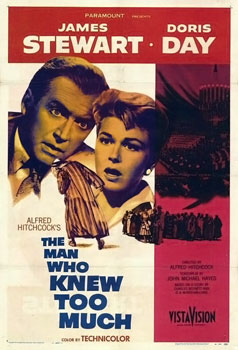
Starring James Stewart and Doris Day with director Alfred Hitchcock, the film follows the couple as they travel to Morocco with their son. Through a series of strange circumstances, Stewart finds himself learning a deadly secret from a dying man he just met the previous night. Soon his son is kidnapped and Stewart along with Day find themselves traveling to England in pursuit. Frantically, they try following leads and by the time they come up with one, the culprits are already gone before the police arrive. Their search finds them at the Royal Albert Hall foiling a plot and then they go to the embassy. Desperately, they keep up the search for their boy and it finally pays off, maybe. With the wonderful direction of Hitchcock and the song Que Sera, Sera, this film is quite good.

4/5 Stars

The Manchurian Candidate (1962)

Starring Frank Sinatra, Laurence Harvey, Angela Lansbury, and Janet Leigh, the plot revolves around a Korean war hero who is brainwashed to be a weapon for Communists. Several men in the company have recurring nightmares about brainwashing, communists, and murder. Sinatra’s character has trouble finding solace, however he does meet a beautiful woman (Leigh). Harvey’s character returns home constantly at odds with his domineering mother who is married to a dim-witted senator. He has no idea what deadly purpose he is being used for. His brainwashing causes him to commit several shocking murders. It is up to Sinatra to finally save him and stop his one final violent act. However, Harvey’s character does prevail by himself but not without tragedy. Sinatra and Harvey give wonderful performances and Lansbury is especially chilling. As you will find out, this film shows all the twists and thrills that come out of a simple game of solitaire. It was also a sign of the times during the Cold War.

5/5 Stars

Cape Fear (1962)

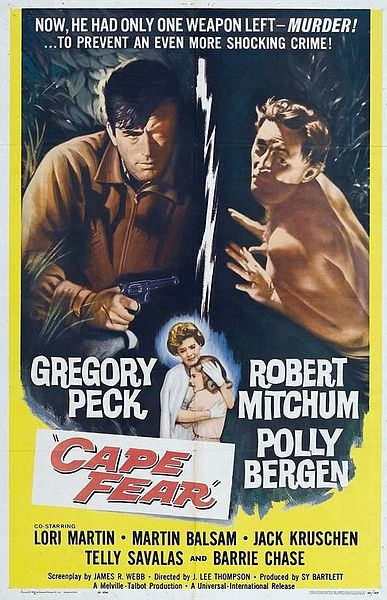
a05ec-387px-cape_fear1960sStarring Gregory Peck, Robert Mitchum, and Polly Bergen, the film is an ominous and intense thriller.Peck is an attorney in a small town and he has a beautiful wife and young daughter. However, Max Cady (Mitchum), a man he helped put away, is now out. He makes it clear he wants revenge and he will bide his time to get what he wants. He constantly torments, stalks, and plays mind games with Peck and his family. All the police and private investigator can do is keep him under surveillance. Desperate, Peck decides to set a trap, moving his wife and daughter to a house boat on Cape Fear river. Sure enough Cady comes and shows his animalistic and brutal side. In the final showdown, Peck and Mitchum face off in a tense confrontation. Cady gets what is coming but not without doing damage. Following the Night of the Hunter, Mitchum plays an even greater villain here because he fills you with anxiety without doing anything.

4.5/5 Stars

Le Samourai (1967)

2858d-lesamouraiStarring Alain Delon as the title character and with direction by Jean-Pierre Melville, this film pulls from the French New Wave as well as Hollywood Noir and Crime films making something entirely distinct in its own right. Jef Costello is Le Samourai, an expressionless and cold professional hit man who can be seen in his trench coat and hat with a cigarette. He executes a hit on a nightclub owner and he is seen leaving by the female piano player. His girlfriend gives him an alibi and the eyewitness accounts do not line up but the investigator still suspects Costello. The hit man is let off and goes to pick up his payment only to be shot instead. He gets away and fixes himself up only to return to the night club later. He returns to his room knowing something is up because the canary is agitated and he finds a bug. The police keep on his girlfriend as well but she will not retract her statement. Costello is confronted by his assailant from before only to be offered a new contract, but they struggle and Costello gets the name of the boss behind it all. Jef is on the move again and he says a goodbye to his girlfriend before going to Rey’s home to knock him off. One last time he returns to the night club piano player and in view of everyone he walks up to her a pulls out a gun. With all eyes on him he explains his new target is her, but before he can do it, Le Samourai is gunned down. The police are relieved to have got there in time, but then they realize Jef never meant to kill her. 

Delon plays such a delightfully deadly killer with a moral code. In a sense he is a tragic hero we ultimately respect because he lives a life full of solitude and honor as is the code of the samurai. I must admit that I cannot wait to see more Melville or Delon for that matter.
 
5/5 Stars

Wait Until Dark (1967)

Starring Audrey Hepburn and Alan Arkin, this is a harrowing suspense thriller. The film opens with a man being given a doll by a fearful woman. Little does he know what is inside and there is a thug trying to retrieve it. The man’s blind wife spends most of her time at home with the doll unknowingly in their care. The thug enlists two other incriminated men to help in the elaborate plan. The key is the blind woman and so they get to work by luring her husband away and then gaining her confidence. Through a course of events they hope to scare her into telling where the doll is. She begins to become suspicious but she still does not know where the doll is herself. However, soon it comes into her possession. Night is falling and she is cut off from all outside help. She waits anxiously in her darkened home and when the enraged thug returns Susy fights back the only way she knows how, in a struggle to survive.

Audrey Hepburn is usually a sympathetic figure but when you make her blind the audience worries even more for her safety. The climatic moments are thrilling and they certainly make the viewer uncomfortable. It is questionable if a real blind person would be so trusting or if an actual person would bring home a doll that was handed to them. Aside from that this is an entertaining film and Hepburn was great.

4/5 Stars

Charade (1963)

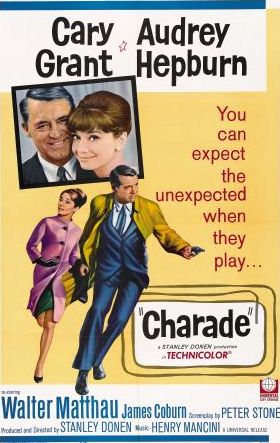
Starring the romantic pair of Cary Grant and Audrey Hepburn, with Walter Matthau, James Coburn, and George Kennedy, this film is considered the best “Hitchcock film” which the director did not make. While on vacation, Grant and Hepburn first meet briefly and then she returns to her home Paris. Hepburn goes there only to find out her husband, who she wanted to divorce, has been murdered. When meeting with a CIA man (Matthau), she learns that her husband and three buddies stole some money during a war but the three chums never got their shares. Upon meeting Grant again, he agrees to help Regina (Hepburn) and also says he is looking for the money. Through a series of events the three other men are all killed and everything seems to point to Grant. Hepburn runs for her life with Grant close behind and winds up meeting the CIA man. However, everything is not as it seems and after a shoot out Hepburn finally realizes the truth. Along with the thrills this movie has a nice score and a touch of playful comedy (including Grant’s many aliases including Peter Joshua, Alexander Dyle, Adam Canfield, etc.). Cary Grant was hesitant of playing opposite Hepburn since he was quite a bit older, but that is used nicely in the film as a source of even more comedy. Furthermore, Mancini’s score gives the film a 1960s spy vibe or I guess I should say agent… Hope you enjoy Stanley Donen‘s Charade.

4/5 Stars