North by Northwest (1959) – Alfred Hitchcock

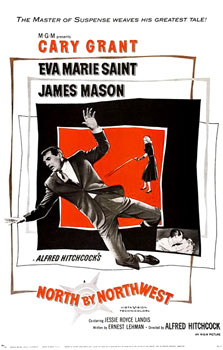
ed5e6-northbynorthwest1As the last collaboration between Cary Grant and Alfred Hitchcock, they came together to make the ultimate thriller in North by Northwest. Grant plays a common business man named Roger Thorndike who is framed as a killer in a very public place. All of the sudden he has become a fugitive on the run for a crime he never even committed. Along the way he meets a government agent (Eve Marie Sainte) while dodging the authorities. Trying to clear his name, Grant finds himself fleeing the actual killers. His adventures include a run-in with a crop dusting plane and eventually find him hanging for dear life.  However, he comes out on top in the end and he slowly falls in love too (of course). From the beginning when you see the opening credits and hear the score, you gear up for adventure and that is exactly what you get. It follows the wonderful tradition of Hitchcock films and it does not fail to entertain. Besides great locations, a memorable score, and interesting camera work, the story is wonderful.

5/5 Stars
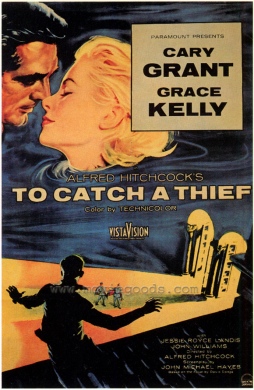
 

To Catch a Thief (1955) – Alfred Hitchcock

1b4d6-to_catch_a_thiefStarring Cary Grant and Grace Kelly and directed by Alfred Hitchcock, this film follows the life of a former cat burglar who is accused of thievery in France. An outbreak of thefts seem to point to John Robie and he seeks refuge with some old friends. He plans to clear his name by catching the real thief. He learns that a vacationing mother and daughter have the most expensive jewels and he strikes up a relationship. The daughter realizes what he is and goes on to tempt him to steal her valuables. When they actually go missing she suspects him. Trying to figure out what is going on Robie struggles with a possible burglar who falls to his death and he attends a ball with Francie who has pronounced her love for him. After a clever switch Robie waits for the real perpetrator only to be surprised. As a thriller and romance this is a fun film. The cinematography is excellent and Kelly’s wardrobe done by Edith Head is memorable. Cary Grant and Grace Kelly are certainly a memorable screen couple.

4/5 Stars

Notorious (1946) – Alfred Hitchcock

dc86a-notorious_posterPairing Cary Grant with Ingrid Bergman along with Hitchcock directing, Notorious tells a story of spies in South America after World War II. Bergman is the daughter of a former Nazi so she is enlisted by a T.R. Devlin (Grant) to spy on other Nazis in South America. Pretty soon Bergman has been accepted and is married to one of the men (Claude Rains). Bitter and cold, Devlin shows no pity for her plight. However, during a party an important discovery is made that puts her in danger. To make matters worse, she is now sick and the others are suspicious. Showing his true loyalty, Devlin comes to her aid before she is harmed and brings her to safety.

To some extent we feel for Claude Rains who will be terminated if it ever comes out he married a spy and that pity is a credit to his portrayal. This film also seems to speak well of Grant as an actor since he plays so against type here. Hitchcock memorable used the key in the film to move the plot forward effectively. Aside from that a couple of sequences stand out to me. The first occurs when Grant enters a room and then we have the POV of Bergman’s heroine. She is lying in bed and drunk so as he gets closer he appears up side down in the frame. Then, there is the famous kissing sequence that all happens simultaneously while Grant is on the phone. The final one I recall is the tracking shot at the party that closes in on the key hidden in Bergman’s hand. Hitchcock practically shoves it in our faces so we know its importance. I think these moments reflect the great direction and showmanship of Hitch.

Partially for this reason Notorious is undoubtedly one of Hitchcock’s best films with a truly stellar cast of characters. If Casablanca was the beginning of the story then this seems to be the perfect sequel. You have a WWII related plot, Bergman, Rains and Cary Grant to stand in for Bogart after all. But that is a topic for another post in the future!

5/5 Stars

Suspicion (1941) – Alfred Hitchcock

Starring Cary Grant and Joan Fontaine with director Alfred Hitchcock, the film follows a young English woman who marries a charming man. However, he has gained notoriety for gambling and he also has a mysterious side. After telling his wife he is done gambling, he goes to find a job. Through a series of conversations however Fontaine’s character discovers her husband has been keeping things from her. Because of the tragic death of her husband’s good friend and other suspicious events, Fontaine begins to grow paranoid. She fears for her life as she is alone with her husband. In the final dramatic scene her situation takes a great twist. Although not Hitchcock’s best, in this film he does play with our minds as we too are constantly suspicious. Grant and Fontaine both give very commendable performances.

4/5 Stars

The Wrong Man (1956) – Alfred Hitchcock

9c899-the-wrong-man-posterDirected by Alfred Hitchcock and starring Henry Fonda and Vera Miles, this film, based on a true story, is about an innocent man who is falsely accused of armed robbery. Manny is an unassuming musician who lives with his family in New York and barely scrapes by paying the bills. Unfortunately he closely resembles another man who held up a local insurance office. The police are called and then a few witnesses label Manny as the culprit. A coincidence on a writing sample seem to solidify his guilt and so he is jailed. Manny’s wife and family scrounge up the money for bail and a lawyer is found to represent him. Manny tries to prove he was on vacation during the incident but his three acquaintances are either dead or cannot be found. However, Manny has another alibi that his lawyer thinks may stand up in court. At the same time Rose begins to blame herself and her mental health deteriorates forcing Manny to put her in a sanitarium. His first appearance ends in a mistrial but Manny is still in despair. Finally good fortune strikes him when the real robber is finally caught. Manny is free but not without horrible consequences. I have to say Fonda is always so sympathetic in these type of roles and Miles has a good dramatic performance. Although it is lesser known, this film shows the diversity of Hitchcock. Here he essentially makes a documentary and it is just as powerful as many of his other great films in its own way.

4/5 Stars

Rope (1948) – Alfred Hitchcock

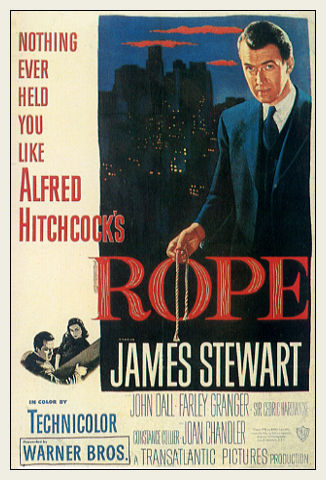
eeca4-rope2What is the perfect murder? Hitchcock seemingly toys with this question in Rope . Starring Jimmy Stewart, Farley Granger, and John Dall, the latter two are students who murder their peer from university. Their only reason for doing it however is to see if they can get away with the crime. To complete their little experiment, they invite the boy’s family, his girlfriend, and other guests over to dinner, right in the room where they committed the murder. As an after though they invite their former professor (Stewart) who is the only one who would be able to catch them. At first Stewart does not suspect anything but eventually he becomes suspicious without letting on. Finally, the students lose their cool and Stewart catches them red-handed. This quickly puts an end to the perfect crime. This film is interesting because it was made to look like it was shot on one reel. Hitchcock’s movies are often known for the editing and yet this film was shot almost like a play in very long takes.

4/5 Stars

Spellbound (1945) – Alfred Hitchcock

Directed by Alfred Hitchcock and starring Gregory Peck and Ingrid Bergman, the film follows the complicated story of an intelligent lady doctor skilled in psychoanalysis. Bergman’s character is very focused on her work and often withdrawn. That soon changes when she meets the new doctor (Peck) whom she falls for. However, soon Bergman realizes he is not the real doctor and further uncovers his state of amnesia used to forget his past. Trying to keep him out of the hands of the police, she takes Peck to her former colleague and they try to delve into his dreams. When Bergman finally seems to have all the answers unexpected complications arise. Now she must save her patient and lover before it is too late. Hitchcock’s directing, a great score, collaboration with Salvidor Dali, and good acting make this film worth seeing. Michael Chekhov is certainly good for a laugh or two as well.

4/5 Stars

Shadow of a Doubt (1943) – Alfred Hitchcock

08054-original_movie_poster_for_the_film_shadow_of_a_doubtIn one of Hitchcock’s earlier American films starring Joseph Cotten and Teresa Wright, Uncle Charlie comes to visit his niece namesake “Charlie” and the rest of the family. Initially the whole family seems to be in a funk until they find Charlie (Cotten) is coming to visit them in Santa Rosa. However, what they do not know is that he is a wanted murderer. Over time “Charlie” (Wright) becomes suspicious of her uncle and finally comes across the truth. Her uncle figures out what she knows and decides he must get rid of her. Living in constant peril, “Charlie” finally is forced to face him. In the ensuing struggle she fights madly for her life. With the constant discomfort and suspense, Hitchcock proves how powerful thrillers can be even in the home. Cotten and Wright both do a very good job in this film. Supposedly this was Hitchcock’s favorite among his own films. I think it certainly one of the best of his lesser known movies.

5/5 Stars

Foreign Correspondent (1940) – Alfred Hitchcock

Directed by Alfred Hitchcock, this film stars a cast including Joel McCrea, Laraine Day, Herbert Marshall, and George Sanders. Wanting a good scoop about events in Europe a newspaper editor sends a reporter off to dig something up. Joel McCrea’s character finds himself entangled in a complicated kidnapping scheme and assassination. On top of that he falls in love while on the job. With no one believing him at first, he must try and gather the facts that ultimately might lead to a war. Dodging two attempts on his own life, he knows he is getting close. However, little does he know how near he actually is. After more twists and turns McCrea finally gets his story and the girl but at a cost. From the scenes in the windmill until the tense moments on the plane, this movie does much to intrigue. It serves a double purpose, a decent piece of propaganda and a good thriller.

4/5 Stars

The Lady Vanishes (1938) – Alfred Hitchcock

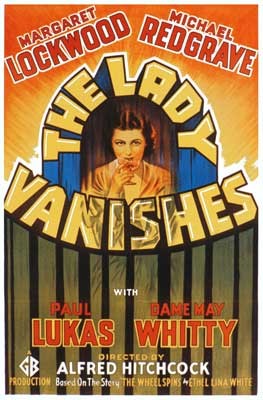
Margaret Lockwood plays an American socialite in Europe in this Hitchcock mystery-thriller. The night before she is to leave, Lockwood meets a kindly middle-aged lady who is fascinated with European music. The next day the two ladies sit together on the train to talk. Being a bit disoriented, Lockwood takes a short nap however when she wakes up Ms. Froy is mysteriously gone. Seemingly no one remembers seeing the woman and no one will believe Lockwood. Finally, she teams up with a man who she had a run in with the night before (Michael Redgrave). Together they try to figure out what has happened to the lady. Finally discovering the truth, they come under great danger and must fight for their lives and those of the other passengers. Hitchcock does it again, bewildering the mind and making us intrigued at the same time.

4.5/5 Stars