Angel and the Badman (1947)

Angel_badman.jpg

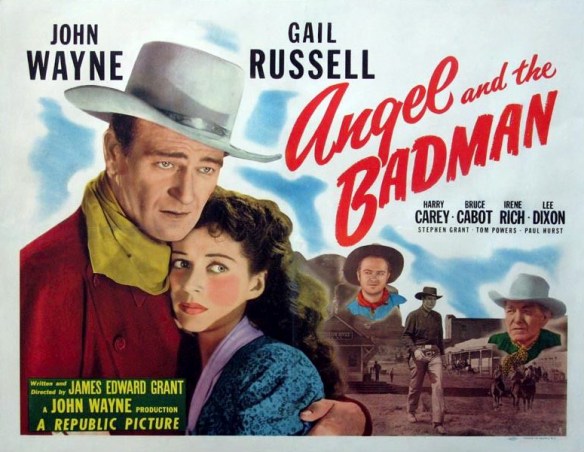
With John Wayne partnered with his longtime collaborator James Edward Grant (Hondo, McClintock!) it’s easy to see Angel and the Badman as an early vehicle for his conservative ideals but far from being heavy-handed, it goes down as a solid B-picture with a surprisingly unique perspective on the West.

In this instance, the western is used to construct a fairly simple parable that plays out over the frontier using figures that we know well from every cowboy picture we’ve ever seen.  The outlaws and the homesteaders, the sheriffs and the doctors, they’re all present.

But underlying their every interaction is a certain purpose. It’s not simply to entertain — though the film is adequate in that department and has it’s share of gunfights and showdowns. It foregoes most of the normal set pieces to carry out its main objective as a moral tale. Still, these established figures help draw up the themes by the very way they see the world.

Quirt Evans (John Wayne) has and always will be an outlaw as preordained by society until the fateful day when he finds sanctuary in the home of a Quaker family after incurring a wound. They take care of him and nurse him back to health but above all, they give him the benefit of the doubt — that he is not too far gone and he still has more than a fair chance to redeem his life if he so chooses.

The local apothecary functions as the main counterpoint to our angelic first family. He is very rational-minded, devoted to scientific thought and his cynicism leads him to begrudgingly patch up the outlaw all the while grumbling under his breath. It’s telling though that he holds this overtly religious family in high regard. But nevertheless, the parameters have been set. We must sit back and find out where John Wayne falls within the frames of this corral.

It’s true that he’s saddled with a past full of womanizing, guns, greed, and every other sin known to man. In fact, the local sheriff is bent on hanging a rope around his neck but the old veteran (Harry Carey) is a sly fellow ready to bide his time and let Quirk slip up somehow.

The main point of contention is a payload of gold that a band of glowering thugs is intent on getting a handle on. Quirt is all that stands between them and the prize but even in his injured state he still packs a gun — the bullets inside and his stellar marksmanship being the key deciding factors.

Playing against this very storyline is a parallel thread that bears equal importance if not more. Penelope Worth (Gail Russell) is the daughter of this Quaker family and she is tasked with taking care of this formidable outlaw. In any other scenario, they would be oil and water. Their lives and personalities should never mix and yet in this romance, they ultimately do. True, his lawless lifestyle chafes against the worldview of these religious Quakers who promote an existence of good will and pacifism. Still, people can change.

John Wayne notably disliked High Noon (1952) and his most famous denouncement of the picture can be seen in Rio Bravo (1959), viewed by many as a cinematic answer to its predecessor. However, in this earlier film, you see in Wayne’s character a man who also falls for a Quaker much like Will Kane (Cooper) does in High Noon. But here he comes from the wrong side of the law. Still, she redeems his very nature and far from throwing off the perceived shackles of her beliefs or simply tolerating them to stick to what he knows best (namely gunplay and showdowns) he does the fairly brazen thing and wholeheartedly embraces her way of life. Because he loves her.

It begs the question, which outcome is more believable: The sheriff who went against his wife’s pleas so he could uphold his personal convictions or the outlaw who gave up his old way of life even in the face of death because he was transformed by the love and lifestyle of his woman? Rather than drawing up which one is better exactly, it might suffice to say that Angel and the Badman, while lesser known, is still a diverting western with its own moral dilemma because westerns are and always have been horse operas.

3.5/5 Stars

Review: Giant (1956)

giant 1.png

People might come to Giant for James Dean. They might come seeking out the final film in George Stevens unofficial American Trilogy (including A Place in the Sun and Shane).  Maybe it’s even the promise of a sprawling epic of monumental length and scope that turns out to be both a blessing and a curse by most accounts.

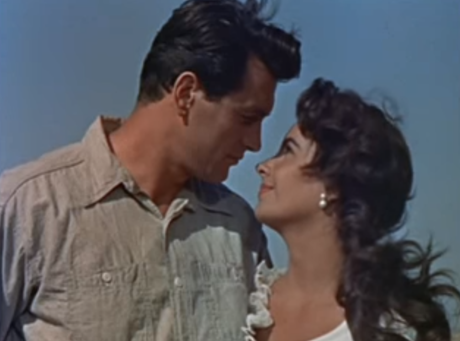
But this adaptation of Edna Ferber’s novel, despite all of this, is really a film about marriage and family in a world that’s constantly changing. Rock Hudson is a towering giant in his own right turning in a performance that works as quintessential Texan Jordan “Bic” Benedict. Elizabeth Taylor proves that far from a one-dimensional classical beauty, she has acting prowess as well delivering a spirited showing that gels with Hudson for the very fact that it often chafes against his characterization. Meaning they’re believable as husband and wife.

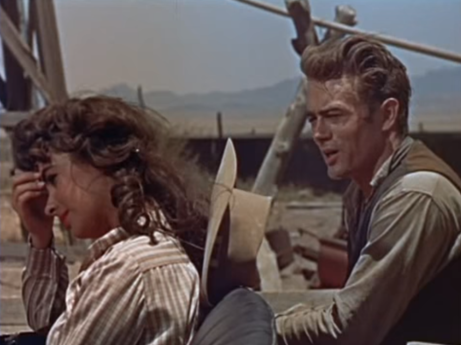
James Dean plays their marginalized ranch hand Jett Rink who is nevertheless treated well by Bic’s  hardy sister Luz (Mercedes McCambridge) as well as Leslie while harboring a life long feud with Bic over the ensuing years.

Time turns this story into a battleground of two dueling giants. One a life long rancher of great stature. The other a modern figure blessed with a meteoric rise as an oil magnate. Their resentment carries through the generations as much as their differing fields reflect the sign of the times. The tectonics shift as the old guard of the Texas plains is replaced with a new breed of powerful men.

Of course, Dean’s performance is the stuff of legend and there’s an idiosyncratic, grumbling magnetism about it as only he could do. This isn’t Brando and it’s not even Monty Clift who previously played opposite Elizabeth Taylor in Stevens’ earlier picture. It’s James Dean showcasing his personal flare.

The final moments of his “Last Supper,” after his subsequent rise to glory, are devastatingly pathetic. The mighty oil tycoon of Jetexas falls into utter disgrace crashing to the floor of the empty banquet hall with a clatter. Rolling around in a drunken stupor, making a shambles of his grand exhibition of wealth, and simultaneously concluding Dean’s last scene in front of an audience.

His life would be taken even before Giant finished filming, some of his last scenes of dialogue being reread by close friend Nick Adams, his temperamental nature and habit of mumbling lines impacting the production even after his passing. Still, George Stevens himself, despite the insurmountable hell he was put through, and the hits his shooting schedule took, even admitted that Dean was something special.

You might not like him but all of us seem to gravitate to him for some inexplicable reason. He carries our gaze with his ticks and his delivery. It’s as if he forces us to take heed even out of a necessity to understand him, his head downcast, his hands fidgeting and such, all a ploy to carry our attention. It generally works.
giant 2.png

Yes, we lost him so young but the beauty of Giant’s epic stature is that in cinematic terms Dean was blessed with a full life. We saw him as a fiery youth in East of Eden (1954) and Rebel Without a Cause (1955) and in Giant he evolved into an equally tortured man who grew old before our eyes. That’s the magic of the movies. But sometimes it’s so easy to have his legend overshadow all others.

The latter half of the film is really about the Benedict family evolving with the maturation of their children. Dean is worth a closer look certainly, but I’m inclined to enjoy the performances of Carroll Baker and Dennis Hopper nearly as much if only for the simple fact that they’re less heralded.

Baker is the daughter caught in the throes of romance and decadence who finds Jett Rink more fun partly for the very fact that her stuffy parents abhor what he has become. Meanwhile, Hopper brings a surprisingly earnest candor as the Benedict’s eldest son with aspirations to be a doctor instead of a rancher, pushing against family tradition, subsequently marrying a Mexican-American bride, and facing the unfortunate ostracization that comes with such a life.

Some of the most evocative scenes are actually held between Hudson and Taylor. To most, their careers were known for personal lives exploited by tabloids. They don’t get the same adulation as Dean as actors. Still, in this film, they do something quite spectacular in a more unassuming way. They quite authentically reflect the life of a married couple as their romance and life together waxes and wanes over the years. That includes Jett Rink’s onslaught and the trials with kids but, at the core it’s just the two of them, grappling with it together.

Because this is a film that unfolds over decades we come to appreciate the changes that come over the characters and not so much the makeup or touches of gray. More important are the strides they make in their lives or even how they remain the same.

They model what it is to be young and in love, to quarrel and bicker and to make up and to be diplomatic and to have dreams and aspirations and to want the best for your children and at the same time hold grudges and feel like the ones you love are purposely trying to undermine you.

To begin with, this is a fairy tale romance of opposites. Hudson is the formidable Texan bred as a rancher and he comes to the upper echelons of eastern society looking for a stallion and he comes back with a bride instead.

She comes to his country initially welcomed and then feeling like an outsider in a land that is so set in its ways. Men and woman are expected to exist in certain spheres. White folks don’t fraternize with Mexicans. And cattle barons tame their land and breed their stock like their fathers before them. It’s tradition and they stick to it. Bic Benedict is raised in that Texas tradition dating all the way back to the Alamo, his stock proud, fiery, and tough.

Still, his wife Leslie is just as audacious but in different ways, testing his sensibilities and testing the matrimonial bonds of their marriage. She rather comically proposes her own marriage, looks to break up the boy’s club mentality that dictates the culture, and tramples over the de facto laws of the land in favor of goodwill to all. That means if a baby is sick, she fetches a doctor. The color of its skin makes no difference. In that atmosphere, it’s radical that she extends kindness to everyone, not simply her own “kind” as it were, whether divided by class or racial barriers. Ultimately, it’s a testament to the sorry state of affairs but also of her personal convictions and they bleed into the rest of her family.

The final showcase comes not in his front and center bout with Jett Rink because although we’ve been expecting it for decades, as such it never comes. Jett’s not worth it anymore. Instead, Bic’s shining moment comes in, of all places, a roadside diner. He’s not as strapping as he used to be and he gets wailed on something awful. But in this moment as he’s duking it out with a local bigot, the platform that he stands on is not simply about his family name or his own personal honor as a Benedict but along the planes of what is morally right and wrong.

Rejecting service to people based on the color of their skin is inherently wrong. Disrespecting people of other races can and never should be accepted. Years before he would have never taken a stand on such touchy issues but he’s matured in that regard and his wife falls in love with him all over again. She sees first hand why she grew to love this man.

He lies there on the floor heaving and bloodied with food flung all around him the oddly upbeat throngs of “Yellow Rose of Texas” still whirring on the jukebox but ironically Leslie has never been more proud of her man. It’s that paradoxical maxim written about many times. Blessed are those who are persecuted for doing good.

Most modern viewers will honestly thank their lucky stars that they don’t make epics like this. But there’s something fleetingly enchanting about these old-time vehicles that managed to encompass so much space with grandiose ambitions and awesome imagery full of million dollar skies and fluffy clouds as far as the eye can see.

The West is dead as is the American genre. The stars as we knew them are no more. We are still a nation struggling with issues of race and class. Love and marriage. That mixture of nostalgia and timelessness still makes Giant a draw.  George Stevens is one of The Great American Directors and though Shane (1953) will remain his unassuming masterpiece, Giant deserves at the very least a modicum amount of respect as a dying breed of American epic.

4.5/5 Stars

Note: Entry in The Elizabeth Taylor Blogathon!

Ride in the Whirlwind (1966)

Ride_in_the_Whirlwind_(movie_poster)Anyone who takes the time to search out this movie whether the reason is a young Jack Nicholson who wrote, helped finance, and starred in this western or because it’s directed by cult favorite Monte Hellman,  they probably already know it was shot consecutively with The Shooting. Whereas the first western has an unnerving existential tilt as the plot takes us through an endless journey across the oppressive desert plains, you could make the claim that Ride in the Whirlwind is a more conventional western.

However, it’s still highly intriguing for its main premise and the dilemmas that evolve as a result. But that’s enough with the big picture. Here are a few more details to fill in between the lines. The action begins with a holdup, a true western staple. True, a pair of men get injured but it’s about what you expect from such a skirmish. In the end, the stage rides off generally unimpeded and the bandits retreat to their lair up in the nearby mountains to wait it out for a while. Maybe they know a posse is on their trail and maybe not.

Either way, they’re mighty careful when a trio of riders make their way through the main pass. Of course, they don’t know that these are only a few cowhands making their way to Texas and they’re looking for a place to bed down for the night.

Both sides have a general sense of the other but rather than make waves they do the mutually beneficial thing and everything goes about their business nice and easy. There’s no need for guns and no ones looking for any trouble.

But the next morning a posse that means business rolls in and they’re not about to wait and ask questions. They set up posts to pin down their adversary and they hardly discriminate between who was a bandit and who is innocent. That’s not the way their righteous form of justice works.

Rather like the early Hollywood Classic The Ox-Bow Incident, they are searching for the men to lynch and it hardly seems to make any difference if the men are innocent or not. They shall be avenged. However, an interesting observation is that in once sense this does not seem like mob rule. The posse is calculated and cool in executing their objective although that’s no comfort to those who are actually innocent.

In the ensuing standoff, one of the ranch hands, caught in the crossfire gets it and the two bandits who come out with their lives get about what we expect. The second half of the film follows the two men who were able to escape and they just want to find a pair of horses so they can ride away from the whole business.

Their quest on foot leads them to a nearby homestead and this latter half of the story brings to mind earlier pictures such as Shane or Hondo where families are seen trying to make a life for themselves out on the plains.

Wes (Nicholson) and Vern (Cameron Mitchell) are desperate to get away yes, and they sneak into the families home but what makes them so different is the very fact that they are not real criminals. They are only doing this out of necessity. They treat the womenfolk respectfully including the ranchers taciturn daughter Abigail (Millie Perkins) but they’re also bent on taking for themselves a pair of horses.

First off, Evan ain’t so keen on having his home invaded or his family held hostage and he’s especially not obliging that they’re going to run off with some of his stock because they’re his after all.

This is in itself another brooding film like The Shooting but for different reasons. It’s filled with genuine tension because the irony of the situation is that we know these men are innocent and yet in order to survive in some ways they must take on the mantle of criminals just to live another day. There’s no space for a rational third way. There’s no grace or any type of understanding and so they’re forced to play by the rules already set up by the posse that’s pursuing them. That’s the moral conundrum at the core of this tale.

Ride in the Whirlwind has the dismal type of ending we expect with a bit of a silver lining but it’s that very shred of hope that makes it an affecting western. It feels right at home with the sentiments of the 1960s where the world is not as innocent as it used to be and the world often does not function by the most equitable standards. Some would say that’s why the western fell out of favor because in the classical sense, it no longer reflected the perceived world at large like it once did.

3.5/5 Stars

The Shooting (1966)

ShootingHellmanCrime films, westerns, and horror. It’s easy to see why these genres make arguably the best B-pictures, all things considered. It lies in their ability to deliver thrills with minimal capital and a bit of inspiration. Film Noir is by far my favorite but a film such as The Shooting makes me love shoestring westerns too. Except that’s just an initial gut reaction. What happens over the course of this film truly plays with our preconceptions. Its ambitions being rather curious.
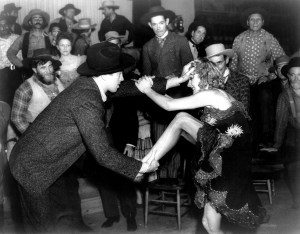
The players are set fairly early on.  The cult favorite Warren Oates is cast as the laconic Gashade who however indifferent he might seem has some shred of decency in him as signified by his friendship with Coley (Will Hutchins) a needy and rather dimwitted miner.

His genial personality makes the addition of our third player all the more important. She’s a woman (Millie Perkins) who comes upon them unannounced and generally unwanted by Gashade. But she also comes with a proposition and money to boot.

Our protagonist is lukewarm to the whole undertaking but for some inexplicable reason agrees to become her guide in tracking someone. He wins a spot for Coley in their caravan as well and it’s easy to see Coley is very much taken with the lady to make up for his buddies complete lack of interest.

The acerbically biting Millie Perkins rivals Jane Fonda and Raquel Welch in the pantheon of cinematic Western women as she verbally spars with her fellow travelers. While the ever-leering Jack Nicholson, here in a very early role as a hired gun robed in black, adds another layer of tension to this extremely peculiar western exercise.

Monte Hellman follows a script penned by Carole Eastman that leads us through the blistering deserts of Utah on a very certain quest that nevertheless becomes increasingly vague and ambiguous as the film progresses. The very fact that The Shooting takes one of the archetypes of a man with a burning vendetta (for example The Searchers or The Bravados) and subverts it so completely denotes how unique this film manages to become.

It’s all orchestrated with a certain idiosyncratic paranoia both musically and otherwise. The opening moments prove just how effectively a score can impart a level of anxiety into a film without anything of much consequence actually occurring. It complements the slow burn that follows for the next hour — slow, brooding, perplexing, all those things — as we wander along with them like the Israelites in Exodus. But there’s an underlying goal to it all, the resolution that we expect to bring everything that has happened thus far to fruition. There will be a cathartic showdown where all is revealed if not made right.

Hitchcock’s long since overused quip that I will nevertheless mechanize one more time goes something like this and seems apt for this film. There is no terror in the bang only in the anticipation of it. That’s the key here. The “bang” as it were, comes but it comes in such a way that we were never quite expecting. The sequential narrative points that we are used to traversing are never quite passed in the succession that we are used to.

There’s a penchant for throwing out names that feel vaguely relevant such as Beckett or Kafka but not being literary enough I will forego such pieces of analyses to simply state in many ways The Shooting feels perfectly at home in the 60s. It’s a real trip and not simply on horseback. More in a precursor to Easy Rider sense. I believe the coined term is an Acid Western.

Paired with another Hellman-Nicholson collaboration backed by Roger Corman and filmed consecutively, The Shooting is made for a double bill with Ride in the Whirlwind. This number, in particular, proves just how mind-bending a western can be. There are no small films only small budgets and with enough vision, not even that can inhibit a truly inventive endeavor like this.

3.5/5 Stars

Destry Rides Again (1939)

Destry-Rides-Again-1939Destry Rides Again is integral to the tradition of comedy westerns–a storied lineage that includes the likes of Way Out West, Blazing Saddles, and Support Your Local Sheriff. It takes a bit of the long maintained western lore and gives it a screwy comic twist courtesy of classic Hollywood.

The rambunctious town carries the fitting name of Bottleneck which runs rampant with guns, beer, floozies, and more beer. The town’s mayor has a permanent seat in the local saloon playing solitary games of checkers while turning a blind eye to many clandestine activities. Meanwhile, the bar’s proprietor and local hot shot (Brian Donlevy) keeps grips on numerous shady dealings including dirty poker and murder, if you want to get technical. Though he does put on a good time with a floor show courtesy of his best girl Frenchy (Marlene Dietrich) who has the whole town swooning with her knockout looks. That’s the way the world works in Bottleneck and it’s a fairly crooked operation.

After the latest sheriff is laid waste the banjo-playing drunk is christened the town’s next lawman. It certainly is a fine joke but he does something somewhat admirable. He resolves to lay off the sauce and sober up. Calling in the grown son of one of his buddies from the old days to be his deputy.

Now he’s no longer a drunk. Just a blustering old fool who no one takes seriously for one moment. Still, when Destry comes into town he believes he will have the hulking spitting image of the boy’s father, a man who will instill fear in every local troublemaker. After all, that’s how things have worked in Bottleneck as far back as anyone can remember.

But instead of a leering heavy, he finds himself face to face with gangly Tom Destry Jr. who makes a memorable first impression on the town holding a woman’s parasol and a cage of parakeets as he helps a young lady off of the stage. However, in those opening moments he does a seemingly dangerous thing, instead of exerting his dominance he seems oddly comfortable in his skin. The townsfolk think he’s a pushover and he strings them along rather well. After all, he doesn’t carry any guns. He spends a great deal of time whittling and there’s a good-natured affability to his demeanor in nearly all circumstances. Added to that he has the oddest quirk of supplying an ever-ready stream of anecdotes for any given situation.

It’s such displays that earn the glee of the local thugs and hoodlums and the ire of not only his sheriff but the folks who feel he’s aiding their enemies. And yet in certain moments, he surprises them, proving to be an incredibly humble marksman (a precursor to Atticus Finch), breaking up a vicious catfight between two women with a pail of water, and getting buddy-buddy with the town’s rebels only to turn on them.

He seeks to bring law and order to the town on his terms looking to pin a murder on Kent in order to put him away for good. Of course, he’s not about to take it lying down and the town blows up into a scatterbrained finale that equals any of the zaniness in any of its aforementioned brethren of western comedy. As the menfolk fight it out with guns, Frenchy with a new resolve gathers all the womenfolk in an assault on the opposition using all blunt instruments imaginable from rolling pins to gardening tools. It’s sheer madness.

That’s not to say that Destry does not have its share of tragedy and that might be its greatest fault. Sometimes it doesn’t quite know where to fall between the lines of comedy and drama. Still, with the two legendary icons as luminary as James Stewart and Marlene Dietrich, it’s hard for this one not to be a winner though they seem so diametrically opposed to each other.

However, Cooper and Dietrich worked surprisingly well in Morocco and so Stewart and Dietrich work in a pinch here.  There’s also an abundant stock company including future stars like Brian Donlevy and Jack Carson not to mention small time funnymen like Billy Gilbert, the long-suffering bartender, and Mischa Auer, the man who unwittingly loses his pants in a poker game. Moral of the story is, don’t gamble. In fact, I wouldn’t be surprised if Destry would come in with a story right about now.

4/5 Stars


Way Out West (1937)

Way_Out_West_PosterWhen put up against more sophisticated brands of humor and satirical wit, it would be easy to call the likes of Laurel & Hardy the lowest form of comedy. It sounds degrading but it’s also quite true. Their pictures are short. They’re for all intent and purposes plotless aside from one broad overarching objective. Their gags are simple. Pratfalls. Mannerism. Foibles. Visual gimmicks. More pratfalls and mayhem. It’s not brain science. It’s not reinventing the wheel. So, yes, it might be the simplest brand of comedy but it also might just be the funniest and most universal comedy out there.

People crashing through floorboards and chasing after each other frantically, laughing hysterically is hardly revolutionary but at the same time, most everyone can enjoy that at a visceral level. That’s why as a young man I loved Laurel & Hardy and I still love them to this day. You would be hard-pressed to find a greater, more timeless, more idiosyncratic comic duo than the two of them.

And it really is their dynamic that is at the core of all their comedy. It’s their close relationship that while antagonistic and full of bickering and manhandling has something also very sincere underneath it. Visually they’re so apparently different. Each man has his own look and routine.

Stan Laurel is the pencil-thin Brit with a bowler to match a pair of squinting eyes and a penchant for high shrieking laughter and sniveling. His tuft of hair is iconic. His nonchalant execution of supernatural feats unparalleled  (ie. lighting his thumb).

Meanwhile Oliver Hardy is the rotund fellow. The dominant personality who is always leaning on his counterpart both figuratively and literally. He’s also the one that believes he has the brains and the manners to help them pass as normal in their contemporary society. Of course, the key to all the comedy is that they’re both buffoons. Playing with their hats. Fussing with their ties. Awkwardly undressing to complete a business transaction.

They’re really made for each other. They’re inseparable. A perfect reflection of this being the very comical moment when they both go to sit down in a drawing room. Ollie rests his legs and Stan promptly props himself on his companion’s knee only to get brushed away to another chair. They really are conjoined at the hip despite how visually disparate they are.

But of course, none of this talks about Way Out West in particular and although there seems little need to talk about the film because the film is Laurel & Hardy, here’s a bit of definition all the same. Brushwood Gulch embodies all the western tropes you could possibly imagine. Bars, stagecoaches, floozies, and locals who hang around the avenues ready to break out into a western ballad at a moment’s notice.

Stan and Ollie’s arch nemesis James Finnalyson is also planted in the town as the opportunistic bar proprietor who looks to snatch away the deed to a mine that our intrepid yet idiotic heroes are meant to bestow upon the meek Mary Roberts. The ornery Irishman’s raised eyebrow shtick is in constant demand as he gets thwarted by Laurel and Hardy’s bungling at nearly every turn.  Although they still find time to make an utter shambles of the whole situation, getting chased out of town only to sneak back in to get the deed back so it can be delivered to its rightful owner.

Over the course of an hour, we get the joys of watching our two heroes do the oddest choreographed dance routine you’ve ever seen, seeing Stan eat a bowler hat, and having Ollie get synched up to a second story landing with the most disastrous results involving a pack mule. Any chance at a stealthy entrance goes out the window in a matter of seconds. That and the fact that they’re theme song tips everyone in the audience that trouble is afoot. Because there’s no pair that can make a fine mess of things as beautifully wonderfully chaotic as Laurel & Hardy. They’re imbeciles of the highest order and subsequently eternally endearing. Bless their souls.

4/5 Stars

Blazing Saddles (1974)

Blazing_saddles_movie_posterThough it’s easy to be a proponent of Support your Local Sheriff for its sheer scatterbrained zaniness, Blazing Saddles has that and something more to offer, making it arguably the greatest western satire of all time. Brooks took part in all facets of the film as was his normal prerogative and he sets up the introduction with Frankie Laine belting out the main theme with a tremendous gusto that evokes the grandeur of the West. It makes it ten times funnier when the film actually begins to hit its stride. Because it sounds like a western in the beginning, it even looks like a western, and it goes through many of the plot cycles that we’ve grown used to, but in other ways, it’s so fundamentally different.

The most obvious demarcation Blazing Saddles takes in telling its tale of the Old West involves the very fact that Bart (Cleavon Little) is made acting sheriff of the quaint frontier town of  Rock Ridge. In actuality, it’s all part of a nefarious scheme by the local man in black Hedley Lamarr and his right-hand thug Taggart (the iconic Slim Pickens). Hedley Lamarr uses the incompetent, womanizing governor as his pawn to get the new sheriff installed so the town will be sent in an uproar and he can swoop in and buy off all their land. After all, none of the white folk could possibly hope to live in a town with a black sheriff.

So that is the main conflict at the center of Blazing Saddles and it’s absolutely ludicrous and at the same time still somewhat unnerving and telling about American society. Mainstream white society did not really know how to cope with African-Americans and other racial minorities in some ways and even more so they didn’t know what to do with their own amount of messy history. Because it’s true that even in film, the mythic Old West was not very good to Native Americans or Asians and African-Americans were all but nonexistent. And in his film, Brooks takes all of that on thumbing his nose at every archetype as well as political correctness (although that term undoubtedly did not exist as prevalently as it now does throughout our culture).

Supposedly the writer’s room was utter mayhem for this film with Brooks certainly at the center of the mix with the likes of Richard Pryor and Andrew Bergman also heavily involved. No matter the amount of chaos, however, the film does come off fairly well. It’s laden with purposely absurd anachronisms like Count Basie’s orchestra, for instance, a medieval hangman’s noose complete with a medieval hangman, and of course, droves and droves of Nazis and other baddies who answer Hedley Lamarr’s call for criminal types of all descriptions.

There’s a local dance hall singer (Madeline Kahn) who does her best Marlena Dietrich knockoff from Destry Rides Again, while Mel Brooks even manages to portray a Yiddish-speaking Native American who allows the segregated black wagon train to pass as the whites get attacked.

Gene Wilder takes on a typically understated role as the town drunk and deputy who shares some traces of Dean Martin’s role in Rio Bravo. Meanwhile, the locals (all named Johnson) gather at their place of worship to have a plaintive dialogue about what they are to do to protect their good names a la High Noon. So there you have it. That’s the film in a very small nutshell as Bart must try to calm the townsfolks fears and quell his enemy all the while trying to not go crazy with all the racist white folk.

Be warned that this film does have funny segments but it also happens to be fairly crude which is not necessarily a surprise. Still, it’s obviously something to consider before watching. But it does seem that sometimes comedy such as this is able to enter territory that we’re squeamish to go in our everyday conversations and more serious moments. Because in some sense maybe comedy can poke fun at all the things we take so seriously — the things we need to lighten up about and connect over by the very fact that we’re all human beings.

However, it can also be pointed, ribbing its audience as it highlights the very things problematic not only in our past but in our present too. And that’s one of the most redeeming things that can be taken out of Blazing Saddles. Sure, you can take it simply as a raucous, inane, often vulgar western comedy from the estimable nut Mel Brooks, but it also speaks a little bit to film’s ability to enter into areas that we as a society still need to address.

The use of the “N” word throughout the film personally makes me tense as that word has so much history and a racial charge going through it. But when Brooks used it, apparently with the vehement backing of Cleavon Little and Richard Pryor, you could even argue that its very use takes some of the power away from those who wish to use it perniciously. But that’s necessary dialogue to have.

The best scene in the film has to be near the end, at the studio, as the camera pulls back and we realize we’re only on a film set. An absolute doozie of a pie fight ensues at the commissary to punctuate the utter tumult that is going down thus far and Hedley is pursued by Sheriff Bart and the Waco Kid to the film’s premiere. In the end, they get their man and ride, err, are driven off into the sunset. The fitting ending to arguably Mel Brooks greatest cinematic achievement.  If John Wayne’s any litmus test, Duke famously told Brooks being in the film didn’t fit his image, but he would be the first in line to see it. That gives you a good idea of what you’re in for.

4/5 Stars

Review: Butch Cassidy and The Sundance Kid (1969)

butch cassidy and the sudance 1.png

Despite my general reluctance to say that the Western in its classical form was on the way out, it’s hard not to make such an assertion looking at the landscape of the late 1960s. The Wild Bunch is a common marker of the seismic shift leading to the complete obliteration of the classic western mythology, but there are some related themes strewn throughout Butch Cassidy that make it equally representative of an era or so one could argue.

The times were changing historically speaking and that plays out cinematically in Butch Cassidy and the Sundance Kid. Bicycles are the future, destined to replace the old reliable horse. And the western hero as we knew him has long since gone, replaced instead by vengeful tough guys and in this case a pair of bank robbing antiheroes. Bonnie and Clyde were the new standards and out of that trend, we saw more like them.

So it’s not just the fact that the film takes place at the tail end of the Old West, slowly evolving into the modern, or New West, but simultaneously the genre would never be the same. There’s a bit of a wistfulness to it all. The legend is fun. The mythology is something to be thoroughly embellished, but it too comes to an end. It’s only a wisp of a memory made of sepia tones and silent newsreels. But Butch Cassidy and Sundance will be remembered fondly by the audience just as the West is. Maybe that is enough.

Unfortunately, Butch Cassidy as a film does have its shortcoming which became more apparent with time. It’s possible to be a dated period piece as this film is (although it’s hard not to love “Raindrops Keep Falling on My Head). Still, it can be plodding and some would argue it’s about nothing substantial, nothing meaningful at all. Still, it manages to be one of the greatest western comedies of all time only eclipsed by its own heavy dose of cynicism.

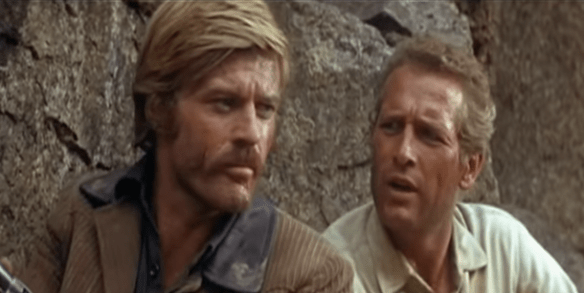
It’s funny watching Butch and Sundance go through their motions. Butch (Paul Newman) is the brains who bemoans the fact that banks are getting upgrades and shipments are being made by trains. After all, they are constantly on the move and it becomes a constant guessing game. He’s given more grief by his gang that looks to overthrow him led by the hulking thug Harvey (Ted Cassidy).

And on top of that every lawman wants him dead. In such moments, being the idea man that he is he entertains thoughts of joining the army for the Spanish-American War or even going to a far off land like Bolivia. Content with his gunplay and letting Butch do the thinking, Sundance rides by his side, certainly his own man but also part of this comic duo.

William Goldman’s script is brimming with wry wit that’s almost inexhaustible. But Paul Newman and Robert Redford loom even larger as the titular stars in this epic buddy comedy. In the age where winning charm and star power still seemed like a genuine box office draw. You came to see actors and in 1969 there were few actors as commanding as Newman and Redford. They had looks and charm. Cool and comedy. Charisma goes a long way. For those very reasons it’s an impressive film and enduringly entertaining. If we cannot watch a film and enjoy it as pure entertainment at least on some level, it really is a shame because that’s one of the many joys of the cinema.

But there’s also something admittedly depressing in how their story evolves. It can no longer be about snide repartee and living the good life robbing banks, continuously augmenting their legendary notoriety. It’s light and funny for a time before slowly spiraling into a deadly cycle.

Perhaps my faith in Butch and Sundance wavered slightly but I will go on resolutely and maintain my immense affection for them that began as a boy. This is still a wonderful film. Outlaws do not have to be one-dimensional. They can be just as funny as they are depressing. That is their right and the legend of the Hole in the Wall Gang is exactly that type of story. We don’t have to see them die. Instead, we get the satisfaction to leave them in one last shining moment of triumph. One final triumph of the West as we once knew it.

5/5 Stars

McLintock! (1963)

mclintock_4

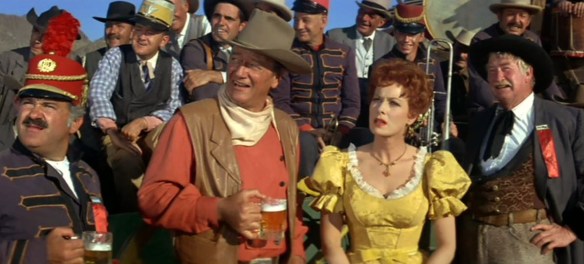
Apparently the name McLintock doesn’t come with the letter T. At least that’s the sense you get when the townsfolk send a salutation to the estimable cattle baron G.W. McLintock (John Wayne). Those who do pronounce that T are either out of towners, educated people, or probably the folks GW doesn’t like much. It’s true that the film is a western reworking of Taming of the Shrew so it’s very much a comedy. For all intent and purposes, it acts as a slapstick farce highlighted by a particularly raucous town-wide fist fight followed by a bungled hanging that just happens to commence right above a mudhole. The results speak for themselves.

But with the influence of its iconic star John Wayne, McLintock is also a fairly obvious commentary from one of Hollywood’s staunch conservatives. Still, the film never acts as a typical Western is supposed to.  In some ways, McLintock is a very modern representation of the West where you have the most amiable sheriff in the world, hardly anyone ever pulls out a gun, and numerous folks have college educations. Except in so many ways, this film can be critiqued for being outdated by today’s standards. There are “Indians,” belligerent Chinamen, and feisty women. GW has mutual respect and good relationships with many of these people but some of the usual sensibilities are still visible.

If the auteur theory can pertain to an actor than this film has Wayne’s handprints all over it. This isn’t a Ford film or a Hawks film or a Hathaway film starring John Wayne. This film is John Wayne’s, even more so than usual.

His son Michael helped produce, he enlisted the son of his old buddy Victor McLaigen to direct, his own son Patrick got a prominent position as a plucky young cattle hand, and so on. He fills the ranks with numerous veteran performers beginning with his greatest female costar Maureen O’Hara as his estranged wife who comes back to town threatening to divorce him and whisk his daughter away to the high society back east.

His trusty right hand Drago is played by Chill Wills while Strother Martin, Hank Worden, and even Edgar Buchannan take supporting turns. Perhaps the most unusual appearances are the presence of the radiant young Stefanie Powers as his daughter and yes, Jerry Van Dyke as a dorky college boy. A special guest spot was found for Yvonne De Carlo as a favor due to the fact that her husband had recently been injured on another film production.

But there’s also a pointed jab at Hubert Humphries in the form of the spineless, insensitive governor Cuthbert H. Humphrey, proving that even Wayne’s politics are channeled into the picture.

The final climax is played for laughs and it does provoke uneasy laughter, at least by today’s standards. It’s hard not to feel strange watching Maureen O’Hara running through town in her undergarments as G.W. pursues her and the town follows behind in hot pursuit. It’s full of pratfalls and slapstick moments that are indeed funny but at what cost?

For some reason, despite the light tone up to this point, it feels cringeworthy when Wayne knuckles down and gives his long-absent wife a shellacking right in front of everyone. Of course, by the end of the film they are together again and I wanted to be happy but this was not The Quiet Man (1952). It felt like Maureen O’Hara had conceded and lost. She returns to the cult of domesticity with her husband which isn’t inherently a bad thing but she hardly feels like a full partner in their complementary relationship.

By this point, although she had the upper hand the entire movie, digging in her spurs, she’s put in her place. In the end, she and GW get to live the life he wants. Because as he notes, “all the gold in the United States Treasury, all the harps in heaven, can’t equal what happens between a man and a woman with all that growing together.”

It’s true that using the word petulant to describe McLintock just doesn’t work. His daughter tries it and he laughs it off and I’m sure if any critic wrote as much Wayne would have done the same or cuffed him one maybe. There were invariably many people who didn’t much like John Wayne but it’s hard not to respect him–even in a comedy.

3.5/5 Stars

Review: Rio Bravo (1959)

howard_hawksrio_bravo_trailer_39

During the 1930s and 40s, Howard Hawks was an unstoppable force of nature churning out a string of classics year after year: Only Angels Have Wings, His Girl Friday, Sergeant York, Balls of Fire, To Have and Have Not, The Big Sleep, and Red River. All these titles stand as a collective testament to his prowess.

Over a decade later, Rio Bravo is a film that reflects something of the mastery Howard Hawks still held as a filmmaker making his way through every interlude with impeccable skill. It showcases his ability to string together scenes in a perfect rhythm, balancing humor with tension, romance with conflict, and making the western into a thoroughly entertaining experience once more. To say Rio Bravo is Hawks’ greatest films is not too far off the truth. He makes it so easy, the way he constantly tracks with his characters in space — often just talking — sometimes serious others times not, and it’s all so fluid, natural, and fun. It’s what makes the film, that’s over two hours, run seamlessly like the sweetest of liqueurs.

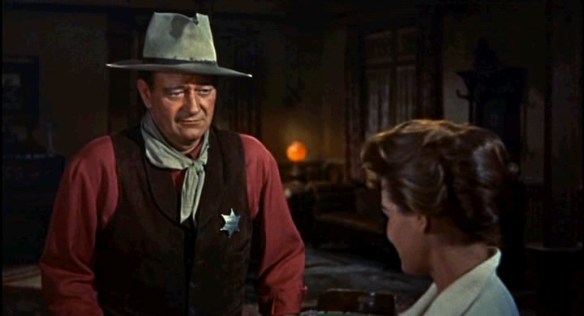
The script courtesy of Leigh Bracket and Jules Furthman is a bounty of inspiration and amusement. One such moment includes the perfect meet-cute between John T. Chance (John Wayne) and Feathers (Angie Dickinson) when she catches him in a compromising position with a pair of red bloomers. From that point on their dynamic is constantly churning with energy.

Dimitri Tiomkin’s score takes some cues from his earlier work Red River (also with Hawks) including the addition of the hauntingly sorrowful notes of “El Deguello.” With such talent as Dean Martin and Ricky Nelson, it also makes the prospect of a song a rich opportunity and Hawks finds ways to weave a musical aside into his film, showcasing the especially memorable tune, “My Rifle, My Pony, and Me.”

Howard_Hawks'Rio_Bravo_trailer_(31).jpg

Meanwhile, Hawks builds on this almost cartoonish mythology of the West where every person of interest lives life with a nickname spending as much time jawing and bickering as they do gunslinging. A great deal of that vibrancy is provided by the actors themselves with John Wayne as our anchor. Walter Brennan and Ward Bond prove to be his wizened counterparts while Dean Martin, as well as newcomers Ricky Nelson and Angie Dickinson, hold their own against the old vets.  It’s great fun to watch Dickinson spar with Wayne and Nelson lends his matinee idol looks to a laconic role as young gun “Colorado.” In an inspired bit of casting, Dean Martin plays a drunk and Brennan takes up his post in the jailhouse as a crotchety old man. It all fits nicely together.

But the question many engaged viewers might ask is whether or not Rio Bravo is a response to the earlier western High Noon. The concise answer is “yes” but that probably is not enough. It’s up to the viewer to discern which example is more truthful and honest in its portrayal of humanity. And High Noon certainly is a somber portrait full of doubt and inner turmoil. However, Rio Bravo is probably just as compelling because of its relational dynamics. John Chance is the sheriff, and as sheriff, he has a certain obligation to uphold the law. That means keeping murderer Joe Burdette (Claude Akins) behind bars. He’s the no-nonsense harbinger of justice that we expect and because he’s John Wayne he’s also tough as nails.

howard_hawksrio_bravo_trailer_26

But that’s what makes the first scene of the film so crucial. It’s notable because it begins with no dialogue, opening up on the town drunk in a saloon that also gets a visit from sheriff John T. Chance. Whether it’s an act of charity or disdain Chance saves El Borrachon’s self-respect only to get bashed over the head in return.

However, this moment is vital in how it sets up Chance’s character. Yes, he maintains a rough even grouchy exterior but looking closer, you see something else. He holds onto his friendships pretty tightly, namely old reliable Stumpy (Brennan) who he bickers with like an old married couple. Then his pal Wheeler (Bond) who comes into the bottled up Texas town with a load of supplies.

And they’re not the only ones. Chance looks to turn away a woman who’s got her face plastered on wanted posters, but slowly shows an affinity towards her. He certainly would not admit it at first but he ultimately does care for her deeply. Also, one of his most faithful allies is the spirited hotel owner Carlos (Pedro Gonzalez-Gonzalez) who is always ready to come to the sheriff’s aid while simultaneously talking his ear off.

Lastly, we go back to the Borrachon who was once Chance’s deputy but lost his sobriety in pursuit of a girl. Honestly, many people would not blame Chance for giving up on this man as a lost cause, and at several junctures, it looks like he has. But the bottom line is that he never does and in his own ornery way, he sticks by his old compadre — never deserting him or doubting him in crucial moments.

Thus, when we put High Noon up against Rio Bravo it’s not a weak sheriff versus a stalwart sheriff in the conventional sense as Hawks and Wayne might have supposed. However, what makes Chance strong are the people he surrounds himself with. In a way, when he is weak, then he is strong because he’s surrounded by people who are faithful and beholden to him. Yes, he’s still John Wayne and he’s one deadly man to cross, but he’s a lot more lethal with friends guarding his back. And that’s a testament to the people he surrounds himself with and also the ones who gravitate towards him. You get the sense that these are not fickle relationships — even in the cinematic sense. The characters can spend as much time ribbing each other as they do toting a gun through town. And perhaps the most telling part is that as an audience we grow to cherish these characters in a similar way. They’re fun to spend time with and that makes Rio Bravo a true gem.

5/5 Stars