Destry Rides Again (1939)

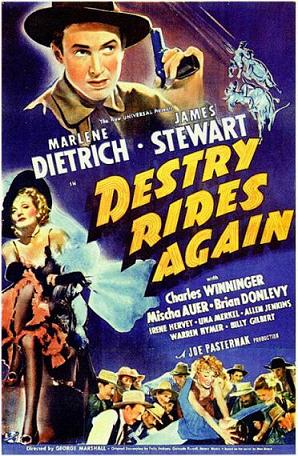
4ff56-destryridesagainposterThis comedy turned dramatic western, starring James Stewart and Marlene Dietrich, begins in a town run by a saloon owner and inhabited by a sleazy song girl. Corruption and cheating reign supreme as the sheriff is killed and the town drunk takes his place. He turns right around and calls the son of an old friend, Tom Destry Jr., to be his deputy. Despite a comical entrance, and an abhorrence for guns this man is very different. Using his smarts and playing dumb, he is able to work for justice even though he seems to be helping the villains. He picks up the trail of the dead sheriff only to have the present sheriff shot as well. In the final unorthodox showdown, good fights bad and the womenfolk join the fray. Destry finally takes up his gun and is nearly killed, but he gets the town boss in the end. It carries another great cost however. Despite this tragic end, the film finishes on a lighter note. You will finish the film understanding that Destry knew a lot of people in his time.

4/5 Stars

The Shootist (1976)

24767-shootist_movie_posterIn his last film performance, John Wayne stars alongside Lauren Bacall, Ron Howard, and James Stewart in this tale about a notorious old gunfighter, who comes to stay in a small western town. J.B. Books gets a medical diagnosis from an old friend, and the doctor confirms that he is slowly dying from cancer.

 Books pays for a room in the home of a local widow (Bacall) where his reputation and actions one night scare off tenants. He receives a visit from the uneasy local sheriff (Harry Morgan), gets an offer for a book to glorify his life, has an old flame drop in on him, and old rivals and young guns are bent on killing him.

His lifestyle impresses the young man Gillom (Howard), but his mother openly disapproves of Books. Amidst all this, Books desires to live his last days in peace and he is waited on by Bond, and the two of them become to respect each other as her boy also comes to idolize Books more. The shootist sets everything up to die on his 58th birthday, going so far as ordering a special tombstone and sending three separate notes to different gunmen in town. He leaves his horse to Gillom and bids farewell to Bond before heading off for one last showdown. 

In the saloon, he is met by three men bent on killing him. Books is wounded but proves his skill one last time. In a cruel moment, however, Books is gunned down right in front of the horrified Gillom, who in a single instant ceases to be an innocent boy and becomes a man. 

This film was the perfect swan song for Duke because in many ways the character he plays mirrors his real-life western persona. Gone were the days when he was a kid in Stagecoach, a courageous sheriff in Rio Bravo, or even the gritty old codger in True Grit. He was truly reaching the twilight of his career.

Even it was one of the most storied of acting careers it was finally coming to an end. In just three years he would die of stomach cancer, and there was no gunshot to go with it this time around. During this movie, he still has life in him though, and even when he shares scenes with the whitening and tired-looking icon James Stewart, Wayne seems as resilient as ever. The Shootist is certainly not his greatest film or best performance, but I think it can be said John Wayne went out on his own terms just like Books.

4/5 Stars

Rio Bravo (1959)

25267-riobravoposterStarring John Wayne, Dean Martin, Ricky Nelson, and Angie Dickinson with direction by Howard Hawks, Rio Bravo is a great western. A sheriff (Wayne) is faced with a difficult task. He must hold a prisoner in jail while the man’s buddies stake out all around town. His only help is the town drunk (Martin) and a crippled old man (Brennan). To make matters more complicated he takes interest in the new girl in town (Dickinson) and to top it off an old friend is shot (Ward Bond). Despite the odds and adversary, the sheriff stays tough and keeps the prisoner. Furthermore, the deputies all prove their value, including a young sharpshooter (Nelson). With a great cast and storyline, this movie is well worth watching. Howard Hawks does it again teaming up with John Wayne in the western genre.

Most any western with John Wayne is easily watchable, but this film boasts a extraordinary cast including some mainstays of the genre including Brennan and Ward Bond. However, you also have some other stars that you do not associate with westerns. Namely Dean Martin, Angie Dickinson, and Ricky Nelson. Each one delivers a fun, likable, and even moving performance.

This western has been allegedly labeled as an answer to High Noon since that tale was supposed to be an allegory for the McCarthy era in Hollywood. That aside the western elements are certainly good and it is an entertaining set piece.

All of this is great, but any film can have this. Rio Bravo has great little sequences interspersed through the action that make you chuckle or really appreciate the characters. It is hard not to like John Wayne because he is larger than life. Here the rest of the cast also is good even down to lesser supporting players. The names are great too! John T. Chance, Dude, Feathers, Colorada, and of course good ol’ Stumpy.

5/5 Stars


Red River (1948)

9ff5e-394px-redriverposter48In one of Howard Hawk’s best westerns, John Wayne plays a rough and callous cattle rancher who adopts an orphaned boy as his son. Wayne attains his dream of a ranch and yet if he wants to survive he must drive his herd somewhere to make a profit. Despite the hardships, the fanatical Wayne will not turn back or budge on his convictions. As often happens, a conflict builds between Wayne and his son (Montgomery Clift), ending in Clift taking charge of the herd. The young cow herder succeeds in leading the cattle and yet his step-father is now bent on revenge. In the final showdown the two men face off one against the other. However, by the end their true feelings are revealed and they are reconciled. Overall this is a good western with a supporting cast including Walter Brennan and Noah Beery Jr.

4.5/5 Stars

The Misfits (1961)


The Misfits is a film directed by John Huston and starring the likes of Clark Gable, Marilyn Monroe, Montgomery Clift, Thelma Ritter, and Eli Wallach. The story opens in Texas where a young woman is getting a divorce in Texas with the support of another divorced woman. After she goes through with the proceedings she feels bad but her spirits are lifted by a mechanic and then an aging cowboy who both find her extraordinary. She and the cowboy move into the half-finished home of the widowed handy man on his urging. Rosalyn and Gay slowly become closer and then he resolves to rope some wild mustang for money. Later, they go to a rodeo and meet Gay’s friend Perce who takes part in the dangerous proceedings. After a night on the town, he eventually joins the other two men in their endeavor. However, when they actually begin Rosalyn is horrified by the whole thing. In the end, Gay is back with Rosalyn but not without a great deal of strife over the horses. In many ways this film can be seen as prophetic and it certainly is historically important because it was the last film of both Marilyn Monroe and Clark Gable. Gable looks haggard and Monroe seems highly emotional, possibly hinting at their imminent deaths. Both the acting and the Arthur Miller script were commendable, and I think a good deal of credit has to be given to Eli Wallach and Thelma Ritter for their performances as well.
 
4/5 Stars

Hud (1963)

Starring Paul Newman, Melvyn Douglas, Patricia Neal, and Brandon de Wilde, the film revolves around a principled, old Texas rancher (Douglas) who has the help of his orphaned nephew Lonnie (de Wilde) and his troublesome son Hud (Newman). Most of the film reveals the conflict between the father and his impatient and often immoral son. On the other hand Lonnie looks at his uncle with admiration. Then the cattle ranch is jeopardized by the possibility of hoof and mouth disease. When not working Hud goes wild in town and after one such night in a drunken stupor he is berated by his father and then makes advances toward the house keeper (Neal). Ultimately, the news about the cattle finally comes and the aftermath leaves Mr. Bannon dead, the housekeeper gone, and Lonnie on the road, with Hud all alone on his ranch. The primary actors were all very good and the black and white cinematography was especially striking.

4.5/5 Stars

The Big Country (1958)

230bc-big_country833Directed by William Wyler and starring Gregory Peck, Jean Simmons, Charlton Heston, and Carroll Baker, this pacifist western revolves around a feud between two ranching families. A gentleman sea captain comes out west to be with his fiancée on her father’s ranch. After his arrival, he encounters a jealous farmhand (Heston), the beautiful schoolteacher friend of his fiancée, and of course the Hannasseys, who are sworn enemies of the Terills. In a sense he is a fish out of water because he never feels a need to try and prove his bravery to others. The schoolmarm is caught between the two families since she owns the vital watering hole “Big Muddy.” Mckay buys the land as a wedding present but when the wedding ties are cut now he is the one in the middle of it all. In order to stop the imminent bloodshed, he bravely rides into the Hannassey’s territory in order to get both sides to reason. Whether it be the score, the cinematography, or the dialogue, you will certainly come to realize that this is a Big Country.
 
4/5 Stars

The Gunfighter (1950)

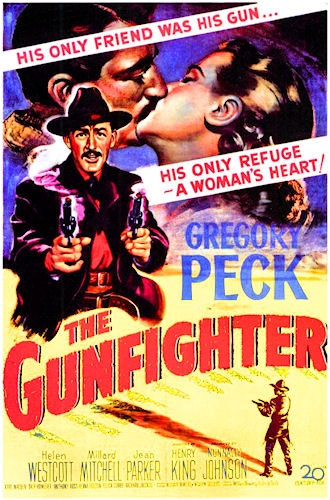
da568-the_gunfighterStarring Gregory Peck, this enjoyable western is about Jimmy Ringo, a gunfighter who has gained notoriety over the years. He rides his horse into a town and enters a saloon for a quiet drink. A cocky kids eggs him on and Ringo kills him with the boys brothers soon on his tail. He scares them off and heads to the town of Cayenne to see his estranged wife. Most of the film has Ringo resting in the saloon where the bar tender waits on him and the whole town crowds outside to peek at the legendary killer. Ringo is met by the marshall who turns out to be an old friend. He tries to help Ringo, including contacting his wife who is now a schoolteacher. Finally, Ringo is able to see his wife and their young son. Exuberant, he is about to leave town when his assailants are spotted. In the end his name was too big. This film had a striking opening score, good characters, enjoyable dialogue, and some major plot twists.
 
4.5/5 Stars

The Man Who Shot Liberty Valance (1962)

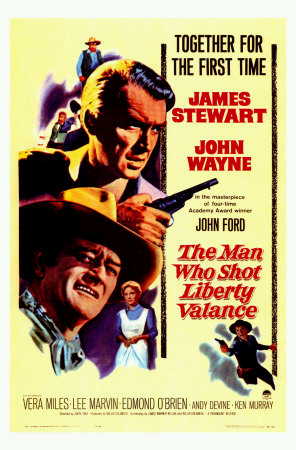
Starring both John Wayne and Jimmy Stewart, with Lee Marvin, Vera Miles, and direction by John Ford, this is certainly a moody western. Stewart, now a successful politician returns to a small town with his wife to pay his respects to an old friend. In the ensuing flashback he retells his story beginning as a young lawyer who had a run in with Liberty Valance (Marvin). After he got well he strove to bring justice and education to the land. Despite their differences, Stewart finds a friend in Wayne who has his eye on Miles. However, everything eventually goes awry when Stewart agrees to face Valance out in the street. He appears to be a goner because he is wounded, but miraculously a shot hits Valance and he falls dead. Stewart now a hero gets the girl and agrees to represent the town. Wayne fades into the background also a hero. The supporting cast includes Woody Strode, Edmond O’Brien, Andy Devine, and John Carradine. With two great icons and a great director, this western is certainly a classic. Although it did not end up making it into the film, Gene Pitney’s western ballad deserves to be acknowledged nonetheless.

4.5/5 Stars

Shane (1953)

10788-shaneposterThere is often something special about westerns, and Shane is no different. Directed by George Stevens and starring Alan Ladd, Van Heflin, Jean Arthur, and other great character actors, Shane is simple yet charming. It has many of the qualities of a great movie, because of what it shows of mankind. Furthermore, it simply makes you feel good.

In the film Shane (Ladd) is a wandering ex-gunslinger, who decides to live with a frontier family as a hired hand. His presence makes everyone happy because he is quiet, humble, and fundamentally so good. However, there is trouble from a man named Riker and his gang. Heflin’s character is adamant he must face the foe and defend his home. Shane will not allow it knowing this is a job for him. The two friends fight it out with Shane winning and riding into town. In the end, he wins the shootout but more importantly he is reconciled with the family’s boy Joey. The time has come for him to move on and Shane rides off into the distance, a humble hero.

The first thing that always strikes me about this film is the brilliant scenery around Jackson Hole, Wyoming with the Tetons looming majestically behind a solitary cabin. In some sense, this is not just a western, but the archetypal story of a family taming the land.

The very next thing of importance is the eponymous and unassuming drifter Shane. He always seems so kind and good, but early on there are glimpses of another, perhaps darker past. And yet from the point of view of Joey, he is an idolized, almost mythological figure. What is so striking about Shane is that he is obviously handy with a gun and an excellent fighter, but he never flaunts it. Perhaps it is because he wishes to rely on it as his last possible resort, or maybe it is because he is just a humble man.

As an audience, much like Joey, we want him to fight back, and we are happy when he finally does. During the course of the film, Grafton’s mercantile and saloon is often the place of conflict, and here multiple times Shane ultimately uses violence. It is his fallback, but he uses it effectively even against his own friends if he sees fit. Then Shane drifts on and the cycle undoubtedly continues again.

Yes, he certainly could be called a hero, with no last name to speak of, but he is a man, who will always be on the move. This may not be because he wants to, but because he really has no other option. Shane foresaw what we did not want to see, and now he cannot come back even if he wants to, so he rides on. This is the middle of George Steven’s so-called “American Trilogy” and probably the hallmark of his illustrious career.

5/5 Stars