Review: Rio Bravo (1959)

howard_hawksrio_bravo_trailer_39

During the 1930s and 40s, Howard Hawks was an unstoppable force of nature churning out a string of classics year after year: Only Angels Have Wings, His Girl Friday, Sergeant York, Balls of Fire, To Have and Have Not, The Big Sleep, and Red River. All these titles stand as a collective testament to his prowess.

Over a decade later, Rio Bravo is a film that reflects something of the mastery Howard Hawks still held as a filmmaker making his way through every interlude with impeccable skill. It showcases his ability to string together scenes in a perfect rhythm, balancing humor with tension, romance with conflict, and making the western into a thoroughly entertaining experience once more. To say Rio Bravo is Hawks’ greatest films is not too far off the truth. He makes it so easy, the way he constantly tracks with his characters in space — often just talking — sometimes serious others times not, and it’s all so fluid, natural, and fun. It’s what makes the film, that’s over two hours, run seamlessly like the sweetest of liqueurs.

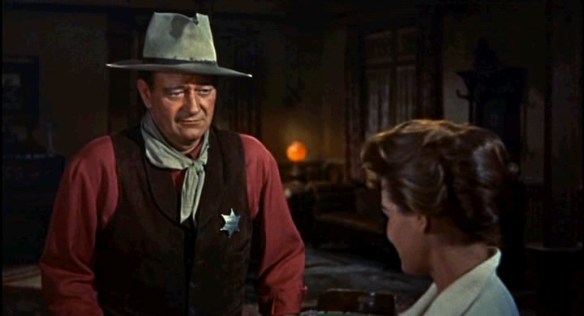
The script courtesy of Leigh Bracket and Jules Furthman is a bounty of inspiration and amusement. One such moment includes the perfect meet-cute between John T. Chance (John Wayne) and Feathers (Angie Dickinson) when she catches him in a compromising position with a pair of red bloomers. From that point on their dynamic is constantly churning with energy.

Dimitri Tiomkin’s score takes some cues from his earlier work Red River (also with Hawks) including the addition of the hauntingly sorrowful notes of “El Deguello.” With such talent as Dean Martin and Ricky Nelson, it also makes the prospect of a song a rich opportunity and Hawks finds ways to weave a musical aside into his film, showcasing the especially memorable tune, “My Rifle, My Pony, and Me.”

Howard_Hawks'Rio_Bravo_trailer_(31).jpg

Meanwhile, Hawks builds on this almost cartoonish mythology of the West where every person of interest lives life with a nickname spending as much time jawing and bickering as they do gunslinging. A great deal of that vibrancy is provided by the actors themselves with John Wayne as our anchor. Walter Brennan and Ward Bond prove to be his wizened counterparts while Dean Martin, as well as newcomers Ricky Nelson and Angie Dickinson, hold their own against the old vets.  It’s great fun to watch Dickinson spar with Wayne and Nelson lends his matinee idol looks to a laconic role as young gun “Colorado.” In an inspired bit of casting, Dean Martin plays a drunk and Brennan takes up his post in the jailhouse as a crotchety old man. It all fits nicely together.

But the question many engaged viewers might ask is whether or not Rio Bravo is a response to the earlier western High Noon. The concise answer is “yes” but that probably is not enough. It’s up to the viewer to discern which example is more truthful and honest in its portrayal of humanity. And High Noon certainly is a somber portrait full of doubt and inner turmoil. However, Rio Bravo is probably just as compelling because of its relational dynamics. John Chance is the sheriff, and as sheriff, he has a certain obligation to uphold the law. That means keeping murderer Joe Burdette (Claude Akins) behind bars. He’s the no-nonsense harbinger of justice that we expect and because he’s John Wayne he’s also tough as nails.

howard_hawksrio_bravo_trailer_26

But that’s what makes the first scene of the film so crucial. It’s notable because it begins with no dialogue, opening up on the town drunk in a saloon that also gets a visit from sheriff John T. Chance. Whether it’s an act of charity or disdain Chance saves El Borrachon’s self-respect only to get bashed over the head in return.

However, this moment is vital in how it sets up Chance’s character. Yes, he maintains a rough even grouchy exterior but looking closer, you see something else. He holds onto his friendships pretty tightly, namely old reliable Stumpy (Brennan) who he bickers with like an old married couple. Then his pal Wheeler (Bond) who comes into the bottled up Texas town with a load of supplies.

And they’re not the only ones. Chance looks to turn away a woman who’s got her face plastered on wanted posters, but slowly shows an affinity towards her. He certainly would not admit it at first but he ultimately does care for her deeply. Also, one of his most faithful allies is the spirited hotel owner Carlos (Pedro Gonzalez-Gonzalez) who is always ready to come to the sheriff’s aid while simultaneously talking his ear off.

Lastly, we go back to the Borrachon who was once Chance’s deputy but lost his sobriety in pursuit of a girl. Honestly, many people would not blame Chance for giving up on this man as a lost cause, and at several junctures, it looks like he has. But the bottom line is that he never does and in his own ornery way, he sticks by his old compadre — never deserting him or doubting him in crucial moments.

Thus, when we put High Noon up against Rio Bravo it’s not a weak sheriff versus a stalwart sheriff in the conventional sense as Hawks and Wayne might have supposed. However, what makes Chance strong are the people he surrounds himself with. In a way, when he is weak, then he is strong because he’s surrounded by people who are faithful and beholden to him. Yes, he’s still John Wayne and he’s one deadly man to cross, but he’s a lot more lethal with friends guarding his back. And that’s a testament to the people he surrounds himself with and also the ones who gravitate towards him. You get the sense that these are not fickle relationships — even in the cinematic sense. The characters can spend as much time ribbing each other as they do toting a gun through town. And perhaps the most telling part is that as an audience we grow to cherish these characters in a similar way. They’re fun to spend time with and that makes Rio Bravo a true gem.

5/5 Stars

Invasion of the Body Snatchers (1956)

film1956-invasionofthebodysnatchers-originalposterBody Snatchers works seamlessly and efficiently on multiple fronts, both as science fiction and social commentary. Don Siegel helms this film with his typical dynamic ease putting every minute of running time to good use. The screenwriter, Daniel Manwaring, put together perhaps one of the greatest political allegories ever penned and, on the whole, it’s a  taut thriller combining sci-fi and horror to a tee.

It’s a wonderful bit of ethos that our main hero Miles Bennet (Kevin McCarthy) is a well-respected doctor, a genuine guy who over time gets transformed into a blubbering paranoid mess. It begs the question. What would evoke such a change in this man? Because it’s true. When he starts out he seems immeasurably chipper. Shrugging off a euphemistic “trip to Reno” and the subsequent alimony as if it were nothing. His practice is well-respected and his old beau, the beautifully elegant Becky Driscol (Dana Wynter) has returned to their idyllic town of Santa Mira, California.

The film’s amiable leads are able to suggest chemistry in only a matter of minutes. And though Wynter hardly seems indicative of a small town girl, it’s strangely of little consequence. While their relationship is integral to the narrative it’s only suggestive of the broader issue at hand — this epidemic of mass hysteria that slowly ingratiates itself on the small town.

It’s a systematic takeover — a silent killer– that runs city deep from the farmers to the police and everyone else in between. It comes slowly at first, only evident from a few seemingly incidental cases of psychological duress and odd coincidence. Dr. Bennet has sick patients leave messages with him frantically asking for help, only to reverse their pleas for help later. Then Wilma insists her Uncle Ira isn’t the same. There’s something different about him that she can’t quite put a finger on. The same goes for a young boy who repeatedly runs away from home insisting his mother isn’t his mother.

Once more Dr. Bennet finds the behavior odd but isn’t ready to come to a conclusion on it. But the epidemic continues and pretty soon Miles and Becky are horrified to find a faceless body at the residence of their close friends. It’s at this point where the full-blown hysteria begins to deluge them as well.

They must fight to stay awake as they try and get to the bottom of this nefarious scheme. But that’s precisely it. These alien lifeforms are using human seed pods to duplicate and replace people. For all intent and purposes, they look, move, and talk exactly the same. But perhaps the most telling human characteristic is absent. Their sense of feeling. Their emotions.

And as Miles and his girl frantically flee the invasion it continues to become more and more obvious that this paranoia-filled chiller is putting a voice to the anxiety of the age. Both in Hollywood and elsewhere. Both because of the Red Scare and the backlash caused by Joseph McCarthy’s witch hunts. Because that was the fear. That the Communists were infiltrating us. We couldn’t see them. We couldn’t weed them out because they were too well concealed. But another horror brought up by this film are the implications of having those you know and love turn against you and betray you.

All of that is in this film whether you want to acknowledge or not. But on a more cursory level, it certainly delivers on the horror and it’s the best kind of horror that’s not so much popping out at us. In those cases, the scare soon dies. It’s gone. But in the case of Body Snatchers, the horror is much more insidious as it burrows further and further into our brains. It has us unsettled from the first frame and it does not subside really until the film is over. Even with a “happy” ending, that cannot fully neutralize the impact of this 50s classic.

4.5/5 Stars


Review: The 400 Blows (1959)

400 blows 1.png

Being a great believer in context,  it was a wonderful thing watching 400 Blows once more because I felt like I knew this man behind the camera so much better and I knew this character Antoine (Jean-Pierre Leaud) even better than he knew himself. After all, he was just coming into his own in this initial film.  I was also aware of some cameos including Francois Truffaut himself, Jean-Pierre Brialy and of course Jeanne Moreau, all important forces in the French New Wave movement.

However, one the most powerful things is the degree of foresight we gain about Antoine Doinel. All the things that make up his life at this juncture in time have repercussions later on that Truffaut continued to examine as he matured. We can see the gears turning as the boy develops as an adolescent. He skips out on class to go to the cinema and the carnival. He purloins a bottle of milk out of thirst, steals little trinkets from the ladies room and finally a typewriter from his father’s work. He receives the ire of his teacher and goes home to the cramped conditions and turbulence of his home life. His mother and step-father are constantly bickering. His mother is having an affair. It’s not a very happy life or a firm foundation for a boy to grow up in. And it shows.

In many of these moments, the autobiographical aspects come to the fore. Before Antoine’s story was simply a depiction of realism but as time goes on it becomes more obvious that Truffaut is being very transparent in showing bits and pieces of his own experiences. What’s striking is that this is hardly a bitter film. Somber and melancholy, yes, but it hardly ever seems to cast blame. It shows the brief moments of reverie along with the pain and that’s why I am a great admirer of Truffaut. He’s a deeply heartfelt and personal filmmaker, no more evident than in The 400 Blows.

400 blows 4.png

Antoine Doinel is a vagrant and pretty dismal kid, getting in all sorts of trouble and yet Truffaut makes us sympathize with him and to an extent we see the director’s point of view too. He’s the one trying to fall asleep while his parents bicker about what to do with him. He runs away from home and relies on the charity of a friend. He’s being locked up in a jail cell on his way to juvenile detention. He talks to a psychologist candidly about his parents never trusting him. All those moments have the power to move.

And the film is so easy to watch, so simple and wonderful and honest and unassuming, it’s almost hard to remember how influential this film was for not only jump-starting the French New Wave but for rejuvenating cinema in general. Hollywood didn’t make movies like this. That’s all I had ever seen for the longest time. But the likes of Truffaut, Godard and even Renoir, De Sica and Rossellini revealed to me that there are numerous ways to make an impassioned cinematic experience.

400 blows 3.png

As always, my mind returns to the climatic freeze frame of The 400 Blows. It remains with me and part of its iconic status is undoubtedly due to how it sums up this boy so perfectly. There’s a sadness in the eyes that without saying anything denotes all that we have already seen. It’s the perfect summation of his story thus far and with that look, it’s difficult to forget his hardships–his flaws too. Perhaps it allows us to extend grace to him because we can see firsthand that he’s in dire need of some. He has not been offered much his entire life with true love and affection being traded for punishment and biting remarks. True, his story does not end here but it’s a telling chapter of his life. Arguably the most formative years for the rest of his existence.

Within the storyline, Truffaut includes passing references for his love of the cinema and even suggests his promise with his writing composition though his teacher accuses him of plagiarism. But from these troubled roots came a man who loved movies to an extent that few others could claim. He was passionate both as a critic, champion, and creator.

Thus, it makes perfect sense that this film was dedicated to the memory of Andre Bazin, the noted founder of Cahiers du Cinema. Truffaut undoubtedly owed a tremendous debt to the magazine and its editor but he also elevated it with his own amount of passion. That same passion comes out in The 400 Blows and really all the subsequent films he made before his death. His movies are wonderful because each one shows that he genuinely cares about the material on its own individual merit. That is the kind of director that I want to watch.

5/5 Stars

Divorce Italian Style (1961)

Divorceitalian.jpgI never thought I’d get so fed up with hearing the name “Fefe.” But it’s true. There’s a first time for everything. In fact, Fefe is the name of our main character played so magnificently by Italian icon Marcello Mastroianni. In my very narrow view, he still very much epitomizes Italian cinema for me.

As for the film, a Sicilian Baron Ferdinando finds himself in rather an unfortunate conundrum — at least from his point of view. He relates through voice-over his family dynamic, with his parents, his soon to be engaged sister, his doting wife (Daniela Rocca), and of course his beautiful ingenue cousin Angela (Stefania Sandrelli). Aside from not being particularly enthralled with married life, the bigger problem is that Ferdinando is infatuated with Angela. He can’t take his eyes off her.

For those who are paying attention this comedy from director Pietro Germi, at times feels strikingly similar to the screwball comedies of Classic Hollywood where men such as Preston Sturges made light work of society by skirting censorship and building a barrage of gags almost to the point of being incomprehensible. But they might also conjure up comparisons with the darkly funny Ealing comedies out of England. And it’s true that films like Divorce Italian Style also carry a very particular name, “Commedia all’italiana” or comedy in the Italian way.

What becomes evident in a film such as Divorce Italian Style is the pointed attack on Italian social mores — the very framework that the culture is built on — and all involved are poking fun. Morality, class distinction, even the institution of marriage, are all dissected satirically as our protagonist goes through his life dreaming of knocking his wife off and living happily ever after with Angela — a girl that shares his affection — if only society didn’t say otherwise (she gets whisked to a life in a convent to maintain her purity).  Not to be deterred, the Baron attempts to hitch his wife up with a suitable suitor and as the shameful scandal finally breaks over his wife, he secretly jumps for joy. He’s getting a step closer to what he wants.

Meanwhile, the men about town all ogle at every girl that happens to walk by. Fefe’s old man is constantly harassing the maid, and more than once he walks in on his sister and her beau making out passionately.  There’s even a theatrical screening of Fellini’s La Dolce Vita (also starring Mastroianni) which literally seems to break any form of censorship in the town. The crowds flock to it joyously — men and women alike — because they want to see the lavish romance projected up onto the screen.

Mastroianni is not surprisingly a long way off from his debonair lovers taken the likes of La Dolce Vita, La Notte or 8 and 1/2. He goes through the film with a certain comedic despondency. He’s hardly a real figure. Comic and dismal with overblown ideas of how to make his existence invariably better. It’s quite a display because while it’s easy to laugh it’s also rather pitiful.

So Divorce Italian Style is perhaps even more audacious than the screwball comedies of the 30s and 40s. Because it gives the plotting Fefe the “happy” ending he was hoping for. It actually gives it to him, but the comic (or sad) thing, in the end, is that his girl is already playing footsies with another man. You see if we look at what is going on here,  he’s never going to find contentment. The ultimate irony, if there was a sequel, is that it would probably show Fefe actually trying to kill his wife because she’s cheating on him. Then it wouldn’t be so funny.

Yes, the strict societal pressures put on the members of this Sicilian community undoubtedly deserve to be questioned. There is so much obvious hypocrisy bubbling up through the layers of society and it makes for provocative comedy. But also there’s something to be said for living life under some sort of moral framework. Otherwise, life is purely about our pleasures, what makes us feel good, what our desires are and oftentimes those fail to regard what is beneficial for others. Needless to say, I’m partial to “Marriage,” not “Divorce” Italian Style — or any other way for that matter. However, I won’t even try to tackle the whole marrying your cousin thing. This is a comedy after all and Stefania Sandrelli is quite pretty. I don’t blame “Fefe” too much. He’s only human.

4/5 Stars

Solaris (1972)

solaris 1.png

Now I can finally say that I have entered the cinematic world of Andrei Tarkovsky and I am better for it. Solaris somehow traces the lines of a paradox rather remarkably. It’s a sprawling epic of nearly 3 hours and yet hardly ever feels overlong. It moves through its rhythms contemplatively but never feels too slow. And though it’s a sci-fi story, it never loses sight of its human components which remain its guiding light to the end.

To Tarkovsky’s credit, he’s able to retain the film’s continual ability to mesmerize again and again and he never lets up. I know for certain viewers this will be dull monotony–even for me at times–but for others, it’s pure magic. Repeatably fascinating for both its enigmatic mysteries and revelations. Because it delivers both up willingly to the engaged viewer.

Like any master painter, Tarkovsky begins the film by laying down his base coats. We’re introduced to enigmatic psychologist Kris Kelvin while simultaneously accustoming ourselves to the director’s naturalistic imagery — glossy and distinct. It’s in these opening moments at the home of his father back on earth where the audience gains more insight and Kris prepares himself to mount a journey to the space station orbiting the planet Solaris. Only three crew members still survive there and the psychologist is being sent to check in on them and continue to expand the reaches of human knowledge. That’s the idea at least.

However, when Kris gets to the space station it’s far from welcoming, austere and dilapidated thanks to poor upkeep. Now only two crew members remain, the curiously odd Dr. Snaut and the cold cynic Dr. Sartorious. Both men will give Kris very little information about the general state of affairs. And he only learns later that his colleague Gibarian committed suicide for some inexplicable reason.

But the film enters its most perplexing stages when Kris receives a visit from a mysterious woman — her name is Hari and for reasons unknown to us, Kris is very close to her. And his emotional state from that time forth is constantly being manipulated by the presence of this special visitor. He’s frightened of her. Then in love and completely devoted to her well-being. And despite the adamant insistence of his colleagues, he will not believe her to be an apparition. He holds onto the fact that this woman in front of him who is constantly self-destructive and in the same instance totally devoted to him, is the woman he knows and loves. But the question is not so much whether or not that is true, but what Kelvin will do with all that has been thrust upon him as a result.

On the whole, Solaris is a visual treat but not due to grandiose visions of space.  Instead, Tarkovsky blends color and sepia footage into a patchwork while juxtaposing the environmental beauty of underwater vegetation with the dour interiors of the space station. And the suspension of disbelief is maintained through the use of simple special effects and the underlying fact that this film is not really reliant on pyrotechnics of any kind. It’s about people. An equally remarkable observation is the fact that Tarkovsky seems to be self-assured enough to have his characters play their roles with relative restraint. Numerous times they face away from the camera. In other films, directors would be afraid of such a tactic, but here it only works to heighten the amount of intrigue.

It’s a philosophical and psychological study that happens to take place on a space station. And that’s really like any of the great sci-fi movies of our times. They’re not really about science-fiction or technology or robots or any of that. They’re only another mode to tell the most human of narratives even in the outer reaches of the galaxy or in futuristic worlds.

It’s also highly reductive to call this Tarkovsky’s 2001. In deference to both films really. In fact, the director did not see Kubrick’s film until well afterward and I think I too would side with his conclusion that 2001 is a little bit too “sterile.” While 2001 is a decidedly grand narrative of exploration and technological advancement, you can easily make the case that Solaris is a film most precisely about the incredibly human emotion of love. Although it’s also about the human search for some kind of truth much in the same way as its predecessor, it’s also far more personal. Solaris feels more intimate and true — perhaps even more closely tied to some of Ridley Scott’s themes in Blade Runner. Particularly his examination on what exactly separates man and machine when they share striking similarities.

As far as sound goes, there is a score to Solaris, but Tarkovsky only utilizes it at the precise moments, more often than not foregoing typical music for either electronic distortions or perhaps even more boldly complete silence. He also gives nods to the great Flemish master Pieter Bruegel using his work in the set designs inside the space station.

Truthfully, it’s easy to peg Solaris as a pessimistic movie but it’s as preoccupied with morality as it is with the pursuit of knowledge. It’s as much about the innate human desire for love as it is psychological torment. And its ending strikes a note of poignancy and bitter despair in the same instance.  But if you want profound cinema that stays with you and marinates in your mind then look no further. I will certainly be returning to Tarkovsky sooner rather than later.

5/5 Stars

E.T. The Extra-Terrestrial (1982)

e-t-the-extra-terrestrial

I remember the first time seeing  E.T. and enjoying it immensely, though it never floored me. I felt the same thing this time around for no particularly justifiable reason. Good but, in my estimation, not great, whatever that means because those terms are equally murky. Still, the fact that there had been little change in some ways made me feel uneasy. What was I not seeing?

But then thinking about it more I latched on to this idea that made me appreciate E.T. far more than I had before. Like an epiphany, it came to me what this film really is. It’s a childlike fantasy full of personal notes from a director who just happens to be Steven Spielberg. That’s not much of a discovery, but the implications are great.

The story of young Elliott (Henry Thomas) and his chance encounter and befriending of E.T. is rather like a boy and his dog story. Except both characters are going through almost parallel situations and Spielberg takes it to the literal extreme. They actually feel each other in a sense. They are perfectly empathetic towards one another.  With E.T. the motives are most obvious. His ultimate goal is to “phone home” so that he might be reunited with those that he calls family. For Elliott, it’s also about home. His home life is a bit fragmented with a father who is vaguely mentioned to be in Mexico (although that’s probably not the case) and siblings who quarrel like siblings usually do.

However, it also struck me how this family really does care about each other. Little Gerty –a beyond memorable Drew Barrymore–is the quintessential 5-year-old sister. First frightened of, then intrigued by and finally faithfully devoted to E.T. And the older brother Michael teases his siblings as has always been the case since the beginning of time but he too invests himself in this adventure. Certainly, it’s out of charity towards this visitor from outer space but it’s undoubtedly also an extension of the affection he has for his little brother.

It’s also peculiar that almost all the secondary characters are very ill-defined and the antagonistic forces attempting to impede E.T. and Elliott are even vaguer. At first, this felt wrong in some regards– a potential sign of poor storytelling. But once more I was brought back to the unmistakable idea that this film really is a boyhood dreamscape. This is Elliott’s story and if it’s Elliott’s story, it’s even more so Spielberg’s own meditation on adolescence and his own childhood. The narrative is even said to have been inspired by his own imaginary friend as a child and his own dealings with a split household. And there’s also a hint of the Wizard of Oz here. There’s no place like home.

Thus, what becomes undeniably important is this dynamic relationship between this boy and his newfound friend who just happens to be from outer space. It’s quite simple. It’s childlike really. And that is and forever will be the beauty and allure that comes from this film. Families can watch it. Kids can marvel at it. Parents can soak it up. Because just as it is about a family–dysfunctional as they may be in their suburban life–it is also for families.

There’s the sheer mayhem of the shrimpy kid grabbing a kiss from the pretty girl in class as hordes of frogs hop by. The iconic magic of Elliott and his friends soaring through the sky on their bicycles, John Williams’ score dancing majestically in the background again and again. Even the fact that this extra-terrestrial goes from death to life is strikingly analogous to the archetypal biblical narrative that permeates our culture. It’s all spectacularly remarkable but rather than be skeptical we acknowledge it with almost wide-eyed wonderment, accepting it, accepting these people that we meet. And watching E.T. ascend back into the atmosphere with true awe.

I find it fascinating that only a few years earlier Spielberg was inspired to put Francois Truffaut in Close Encounters. In E.T. I see his closest approximation of the French director’s own thematic elements. To put it in terms of homage. E.T. is Spielberg’s version of 400 Blows, granted featuring space aliens, Star Wars, cultural references and so on, but they’re not all that different. They really are about the same core issues. It takes until after 400 Blows for Antoine Doinel to find love and intimate relationship with his wife. For Elliot, it comes with family, his brother and sister, and mother, and of course, with E.T. This is what has a lasting impact on Elliott and I could guess, with Steven Spielberg as well. But the audience gets to be a part of it too, an equally important  piece in this trinity.

4.5/5 Stars

A Clockwork Orange (1971)


a-clockwork-orange-1“He will be your true Christian: ready to turn the other cheek, ready to be crucified rather than crucify” ~ Minister of The Interior

Anthony Burgess’s A Clockwork Orange began as a troubling book and it becomes perhaps an even more troubling film full of volatility placed in the hands of Stanley Kubrick.

At its core are many deep-rooted issues of violence, morality, and free will all coming to the fore because of one teenage hoodlum and his rehabilitation from a life of savage juvenile delinquency.

Whereas Burgess created this parable in all sincerity to consider these very issues of morality, it’s easy to get the sense that Kubrick simply found this moral conundrum a fascinating exercise in itself. You only have to look at Dr. Strangelove to see his proclivity towards wicked wit or only to venture with 2001 to observe his penchant for deep philosophical paradigms wrapped up in the science fiction.

A Clockwork Orange has all of that and it’s a perturbing practice in both satire and science fiction. It hums with classical music and synths, shot with distorting wide-angle lenses, while also modeling Kubrick’s perfectionist tendencies.

Malcolm McDowell’s voice-overs as the main hoodlum Alex DeLarge are a major component of the film’s structure, recalling the phraseology and world developed in Burgess’s original source material. For instance, Beethoven becomes Ludwig Van. Droogs are friends. Horrorshow is good or well. Then, Ultraviolence and the old in-out don’t need much explanation.

In fact, during the course of this film, Alex takes part in equal measures of both, causing havoc with his friends and bedding a pair of girls. There is seemingly no end to his depravity and the fascinating part is that he seems to enjoy it all.

That is, until, the government steps in to reform him. Alex is sent from prison to the Ludovico Medical Facility where he is to be issued a new variation of aversion therapy. And this is where, rather ironically, the famed sequence of Malcolm McDowell, eyes wide, screaming at the images passed in front of him entered the public consciousness. His corneas actually getting scratched in the process and the images forever ingrained in our society from that point forward.

But all of this early depravity, followed by his rehabilitation are only the beginning.  And it’s in these interludes that Kubrick tries to impress upon us the idea of Alex being our hero. It’s a difficult thought to deal with. But that’s of little consequence compared to the moral issues that hang in the balance here.

You cannot watch this film and not only feel somewhat dirtied but also saddened at what man is capable of doing. And it’s not only in the case of one man to another, or a small group to another. But, in this case, an entire bureaucracy of people systematically ridding their streets of crime. It’s a strange question maybe, but the question must still be asked, at what cost is all of this? It deserves our attention.

And to try and tease out some answers it seems crucial to look back to Burgess because although these are questions that undoubtedly intrigued Kubrick as well, but it was Burgess who first brought them to the fore. In this case, the author’s own religious background seems to have telling implications for this moral tale that he wove. He intended A Clockwork Orange to be a parable of what defines free will and forgiveness from a Christian perspective in particular.

What is goodness or forgiveness if we lose our free will — if we are only machines — functioning without beating hearts and all that is human within us. What kind of good would the greatest act of love in the universe be if it was done out of compulsion — not genuine love and charity?

In the case of Alex DeLarge, he no longers craves ultraviolence or his former lustful desires for women, but it has nothing to do with a change of heart. He’s simply learned to be repulsed by them. Kubrick’s picture is darkly perverse and the film ends not with the promise of the novel but a thoroughly downbeat ending that rings hollow.  It becomes obvious that Alex’s core desires have hardly changed. He’s simply been conditioned to know what is “good” and “bad.” That’s perhaps an even more terrifying reality than one of violence and evil.

The story goes that when Gene Kelly crossed paths with Malcolm McDowell he coldly walked away because it was in this film that his iconic tune “Singin’ in the Rain” was notoriously tarnished. But really this entire film is a dark blot and it’s truly horribly dismal to watch at times.  I cannot even manage to watch it in its entirety. Not simply for its graphic nature, but the tone that it endows. While Alex DeLarge is far from a sympathetic protagonist, it’s hard not to pity him — poor fool that he is.

3.5/5 Stars

4 Star Double Feature – Coming of Age Flicks

Starter for 10 (2006)

The cast boasts the likes of James McAvoy, Benedict Cumberbatch, Rebecca Hall, Alice Eve, and even James Corden all in one film together! The year is 1985 and Brian is off to his first year at university which turns into a formative moment in his life of new experiences, romantic entanglements, and, yes, even trivia. He’s really good at trivia. But sometimes being good at trivia still cannot prepare you for the things that life throws at you. That’s what makes life, life and not a game show as he finds out.

Sing Street (2016)

Also set in 1985 but in this case in Dublin, Sing Street is a high school coming of age story about a boy who forms a band to get a girl. It’s a simple premise but John Carney’s film explores much of the turbulence as well as the glories of that time in life. It’s about love and music and personal exploration. It also happens to be a darn good musical with a steady stream of catchy 80s tunes both real and fictional.

Tokyo Drifter (1966)

tokyo-drifter-1

Seijun Suzuki’s Tokyo Drifter is a paramount attraction of 60s camp packaged in a yakuza   B-film. It opens with highly stylized black and white imagery injected with almost psychedelic shades of color that never again leave the film’s palette. Its setting is Tokyo, Japan — but far different than any Tokyo humanity has actually seen in recent history. As such it does not exist and never has. Only in the mind of the director. It’s a swinging place of ultra-cool yakuza, jazzy vibes, and a fantastical atmosphere. Oddly indicative of the shoestring budget it was hewn from and still somehow invariably engaging.

tokyo drifter 2.png

We spend much of the film following in the footsteps of our eponymous lead Phoenix Tetsu (Tetsuya Watari), a yakuza hitman whose every effort to go straight is being challenged and impeded on all sides. He cannot escape the life that defines him and finds himself continually caught in a web of yakuza gang wars that will not give him a moment’s peace. There are gunfights, brawls, even a bit of swordplay. He has a romantic flame, a sullen nightclub singer who serenades the world with her melancholy tunes, but even she cannot redeem his existence. There are always hitmen either after his life or looking to drag him back into the fray that he threw off.

But going into plot points and character arcs already strays too far from what makes this film enjoyable. There’s often the heightened tension found in many of Sergio Leone’s greatest Spaghetti Westerns here, employing many of the same stylized characterizations. The fact that our main protagonist announces himself through song and whistling strangely feels reminiscent to “Harmonica” (Charles Bronson) in Once Upon a Time in the West. But this is a different beast. Rambunctious, chaotic and vibrant as it is.

tokyo drifter 3.png

Once more Suzuki is gifted in taking the mediocre — a narrative with very little to it — then instilling it with all sorts of energy similar to other inspired mavericks like Sam Fuller. But by the end, he’s transformed the narrative into an incomprehensible bedlam blessed with his own wickedly stylish aesthetic. There are sweet suits and shiny wheels. Nothing feels the least bit realistic. And it’s filled to the gills with surrealist situations conceived out of Suzuki’s own whimsical vision. Still, all the while it’s influenced by pop art and to some degree Technicolor musicals of the 1950s. It’s a sight to be sure, leaving its indelible mark on the b film niche. If anyone says low budget gangster flicks are the dregs of cinema, they’ve obviously never been acquainted with Seijun Suzuki

3.5/5 Stars

Tarzan The Ape Man (1932)

tarzan the ape man 1Despite being dated and marred by the imprint of imperialism, this initial entry of the well-remembered Tarzan serial of the 1930s and 4os, based on the works of Edgar Rice Boroughs, is a surprisingly gripping pre-code tale of perilous adventure.

It feels a bit like a jungle cruise, a big game hunting African safari and a bit of Gunga Din all rolled into one. And it has many of those exotic adventure elements, set in the Jungles of Africa (though filmed in Florida, near Toluca Lake in Los Angeles, and on the MGM backlot). Perhaps it’s not Heart of Darkness, but buried in there somewhere is a great deal of commentary about that time and place. In fact, it doesn’t just bring to mind the work of Conrad but other Anglos like Rudyard Kipling, a staunch proponent of the prevailing philosophy of the White Man’s Burden. However, at least this film’s adventure makes no pretense as a mission of mercy. The expedition led by one James Parker (C. Aubrey Smith) is interested in the procurement of ivory pure and simple.

Political undertones aside, Tarzan The Ape Man is stirring good fun in the same vein as King Kong and other thrilling adventure dramas of the 1930s. It boasts treacherous mountain cliffs, murky depths full of hippopotamus and crocodiles and numerous tribes of natives residing in the dark recesses of the countryside.

But if those were the only draw of Tarzan, it seems that this film too would have faded into oblivion for its rather antiquated portrayal of a bygone era. But then we hear the first notes of the unmistakable, piercing cry of the ape-man.  That iconic sound that introduces us to the famed jungle hero is the stuff of legend and rather like the famed Wilhelm Scream years later, it’s taken on a life of its own.

tarzan the ape man 2Furthermore, Johnny Weissmuller is not even the first Tarzan (purportedly the sixth incarnation) but he outshines all his predecessors who have been lost to history. It helped that he remains one of the most iconic Olympians and American swimmers of the 20th century, winning 5 Gold Medals. And he shows his prowess not only swinging from the treetops but in his true element,  gliding through the water.

Maureen O’Sullivan displays a certain amount of pluckiness while at the same time being feminine and fearful. Tarzan at first is a creature to be feared but she soon learns to trust him as he fights jaguars, lions,  and even apes to keep her safe. There’s the question of whether or not Jane Parker suffers from Stockholm Syndrome after spending so much time with this savage jungle man. But over time it does become apparent that she truly does love this chiseled man who is still much more naive and innocent than anyone she has ever known.

Back projections always make me cringe, still, the complete lack of CGI always brings a smile to my face. The elephants, lions, and tigers more often than not are the real thing and the scenes benefit from that, despite other instances that do look decidedly fake. More often than not those small details become overshadowed by the more impressive ones, namely the scenes of the elephants rampaging through the village or Tarzan duking it out with a few lions, despite his injuries. There’s something almost unsettling yet thrilling about it all for the simple assurance we have that it is essentially “real.”

But the final question remains, What’s worse, the black face and portrayal of the colonist tendencies (which were still a present reality) in this film or the modern Disney adaptation’s complete removal of any African characters. Either way, both are important talking points and, in both cases, Tarzan remains a perennially enjoyable hero, no matter the problems that still swirl around him.

3.5/5 Stars