
 Andrzej Wajda’s Man of Marble holds a meta quality that still somehow feels radically different than Godard or Truffaut’s turns in Contempt and Day for Night. It attempts to channel a younger point of view — that of an ambitious student — with an overtly political agenda. Agnieszka is an independent, fiery individual intent on making her thesis the way she sees fit. She’s prepared to go digging around in uncharted territory or at least in territory that has been off limits for a long time. That understandably unnerves her adviser and still, she forges on.
Thus, Wajda’s film is cut out of a block that is a wholly original artistic endeavor. It weaves its narrative of a film within a film from a far more humble perspective. That of an audacious but nevertheless unknown female scholar looking to complete her thesis by relating the story of a little-known bricklayer, Mateusz Birkut.
She combs through old faux newsreel footage woven together as propaganda as well as grabbing hold of outtakes that were thrown out. She conducts all the necessary interviews to get to the truth. First, comes a veteran filmmaker who now is a big name, but back then he was just trying to make a name for himself shooting a film on Birkut. She gets in touch with colleagues and friends listening to their points of view. And finally, she even tracks down Birkut’s estranged wife to try and uncover a few last crucial pieces. It hardly seems the stuff of high drama, but Andrzej Wajda’s film functions as a humbler Citizen Kane.
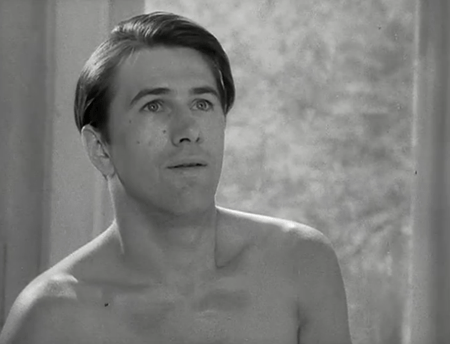 Everywhere she goes Agnieszka drags along her crew who utilize handheld cameras and wide-angle lenses, at her behest, just like American films. It becomes obvious that Birkut was hardly a political figure, instead contenting himself by using his hands to lay breaks and lay them well. He takes pleasure in his work with a big sloppy grin almost always plastered on his face. It was people like him who made Nowa Huta into the great city of industry that it was, and he became an emblem of that. The party monumentalized him and he became the man of marble to be lauded by all.
But when his livelihood, his hands, are scalded horribly, Mateusz has little else to do. He begins to fight for social issues, the rights of workers like himself, but at the same time, his best friend Witek is put on trial for sabotaging the party. Pretty soon Birkut himself has fallen for grace, is sent away to prison and re-education, and he returns to find his wife no longer wants him.
The sleuthing has gotten so far and yet it looks like it won’t even make it past review. Agnieszka looks to be at the end of her luck as her camera and film materials have been revoked, but that doesn’t stop someone with her determination. Pretty soon she is scrounging around The Lenin Shipyards in Gdansk. At first, it doesn’t make much sense, but then we see it. Birkut’s son works there and maybe he is the missing piece of the puzzle! Man of Marble ends with a rather ambiguous dead end… or is it only the end of the beginning?
Just as Agnieszka’s was initially green-lighted, it’s perhaps even more extraordinary that Wajda got away with making such a politically charged film. In truth, he got stuck in censorship purgatory for some time, but that did not stop it from ultimately being released. But aside from crafting a meta, political, and fragmented narrative, Man from Marble also speaks to the issue of trans-generational memory.
In her conversation with the director Jerzy Burski he dismisses her idea for a film as “history” and she retorts back that it’s “ancient history” for her. That’s why it interests her. She comes out of the age of disco, synths, and bell-bottoms. Thus, that era that preceded her holds fascination, even in its most mundane moments, because she can never fully comprehend it like her elders. She wasn’t there to experience it like they could. It gives at least a bit of insight into what would drive her so obstinately to tell this story.
4/5 Stars
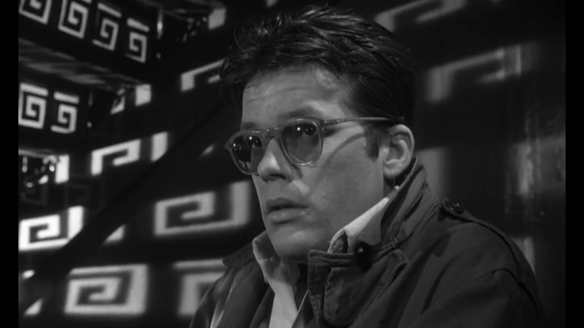 We’re used to getting our hands dirty in the thick of World War II, whether it is in the European theater or the Pacific, but very rarely do we consider the consequences that come in the wake of such an earth-shattering event. Things do not end just like that. There must be periods of rebuilding and rehabilitation. There is unrest and upheaval as the world continues to groan in response.
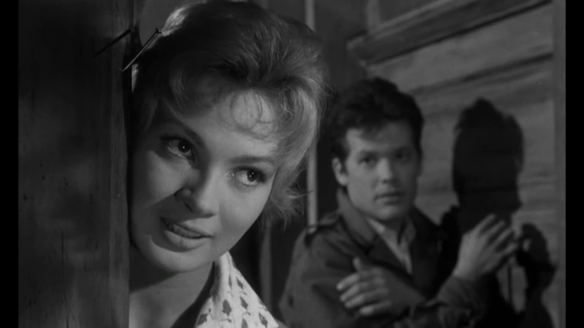 There are love scenes that are quiet, subdued, and truly intimate. In fact, it feels rather like Hiroshima Mon Amour where the camera lingers so closely on two figures in such close proximity. There does not have to be great movement or dramatic interludes because having two people next to each other should be enough. The historical context in itself seems to be enough. For that film, it meant Japan post-1945. For this one, it’s Poland after the clouds of war have lifted.
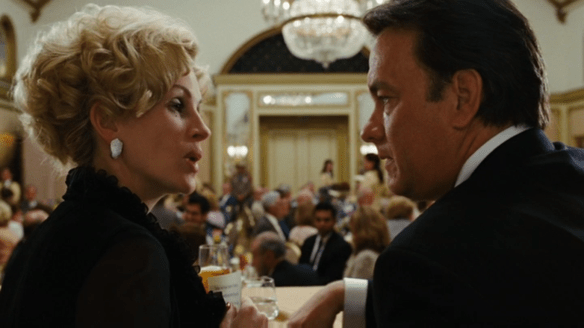 With Aaron Sorkin’s script as a road map, Charlie Wilson is a character that Mike Nichols can truly have fun with. You can easily see him getting an undue amount of delight in this man who was able to do such a momentous thing while simultaneously walking on the wild side. It had to be a good story to warrant the director’s cinematic swan song.
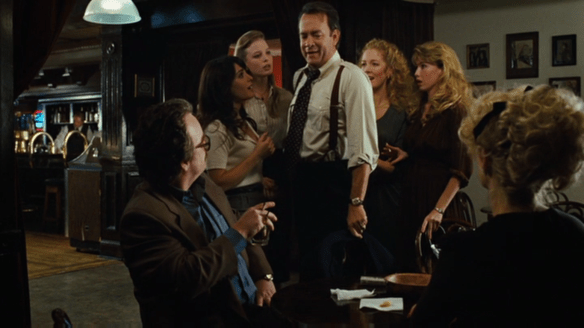 In the opening moments, it becomes obvious that Charlie Wilson is not so much an easily corruptible representative as he is a sexed-up man who enjoys charming female company. He’s “Good Time Charlie” for good reason. He surrounds himself with pretty young things, doesn’t mind playing around a bit, and even has a cocaine charge hanging over him after a potentially objectionable night in Vegas. In fact, the attorney looking into his case is, interestingly enough, one Rudy Giuliani.
 Peter Lorre has a face that will forever live in cinematic infamy, and it started with M. In truth, Fritz Lang’s drama involving a serial killer feels fresh and engaging even after all these years, maybe because humanity hasn’t changed all that much. We still murder, we still kill, we still seek justice, we still give into our base desires, and there’s not a perfect person among of us. Each one of us has our faults — our own personal downfalls.
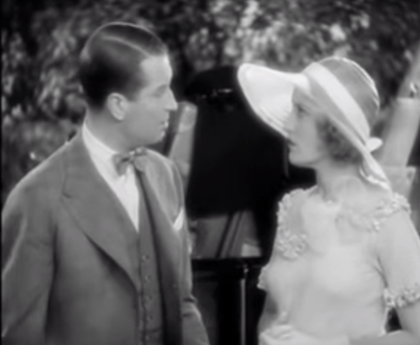 This is unequivocally the age of sound! That’s what this film proclaims from the rooftops with its symphony of syncopation as the world of Paris awakens from its slumber. Its opening rhythms are pure ingenuity and the glorious unfoldings never cease for the rest of the cheery production.
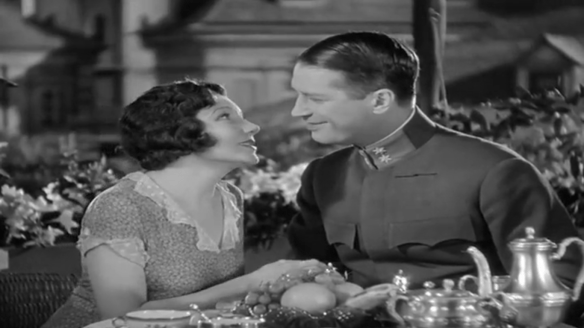 One would never think that one well-placed wink would change the course of an entire life or be the basis for an entire film, but on both accounts it is true. Ernst Lubitsch’s The Smiling Lieutenant represents all that is good and right about one of his films. It’s light and airy with a dash of charm and a tune in its heart. It’s light on its feet with humor and somehow maintains its self-respect, much like the man at the center of this one (Maurice Chevalier).
 But Lubitsch’s final twist is completely out of left field and a completely comic inversion of what’s supposed to happen — capping off his oeuvre of song, suavity, and sensuality in high fashion.
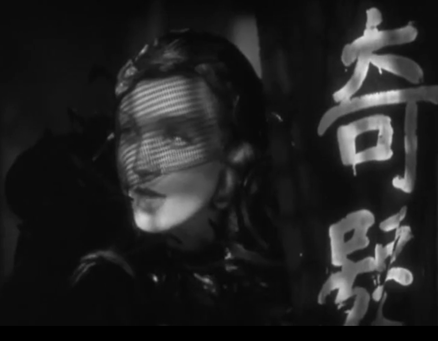 The same year as Grand Hotel there came another film, that while still boasting an ensemble cast felt far more intimate. In its day it was christened “Grand Hotel on wheels” and its narrative does unravel aboard a train. However, Josef von Sternberg’s film opens with a faceless atmosphere spilling over with the bustling commotion of a railway station. It takes a few moments to lock onto the characters we will be making the journey with, but we won’t soon forget them.
 It is in these moments that are two female heroines must act. Hui Fei (Anna May Wong) so that she might defend the honor of herself and her country. Lilly so that she might express the great, expansive depths of the love she still holds for “Doc.”
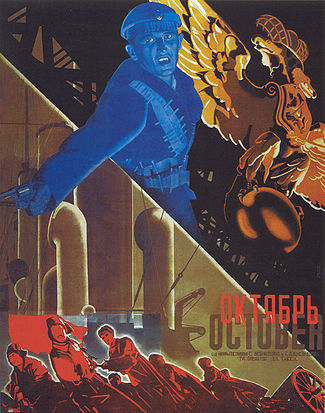 It’s curious that the first image October conjures up is a biblical nightmare from the book of Daniel. In that instance, the Babylonian king is frightened in his dream by a giant statue that comes tumbling to the ground. Of course, in that context, it had a lot of the same connotations, that his kingdom would come crashing to the ground with a resounding thud.
 “I always did like a man in a uniform. That one fits you grand. Why don’t you come up sometime and see me? I’m home every evening.” ~ Mae West
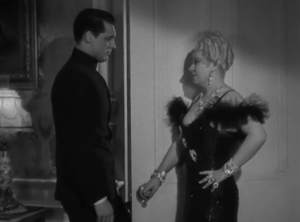 This is her film — her personal vehicle. She rules it that twinkle in her eye and a rapier wit coming from her mouth. Sometimes it’s not even what she says but how she says it (Why don’t you come up sometime and see me?). No one quite has a delivery like her. Whatever she says seems to carry implications and double meanings. In a modern culture that’s overwrought with sexual innuendo and bad taste, West led the trend when it was still in vogue. Back then, it was certainly controversial, but the box office doesn’t usually lie, and West did pretty well for herself, especially during the Depression era. There’s a reason that soldiers named their life vests after her. She was the queen of double entendres in the post-Shakespearian age, and she was ripe in the public consciousness. There was no one quite like her.
 My father has always maintained that two of his favorite films are The Magnificent Seven and True Grit. The first one makes sense with its stellar cast, resplendent score, and some top rate gunslinging. The second film, well, it makes sense too, but for completely different reasons.
