
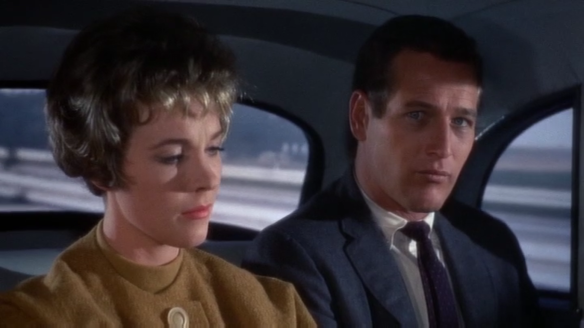
 Torn Curtain was Alfred Hitchcock’s fiftieth feature in an illustrious career. Though he was arguably on a slow decline, the film still channels the Cold War sentiment and the age of the spy thriller, while taking hold of the director’s fascination in the everyman. The storyline unwinds as Professor Michael Armstrong (Paul Newman) and his assistant and wife-to-be Sarah Sherman (Julie Andrews) are rubbing noses with the best and the brightest physicists in Denmark. However, unbeknownst to lovely sweetheart, the young professor is looking to defect and live behind the iron curtain. For Armstrong, it’s something that has to be done to gain some vital information from the communists, but for her part, Ms. Sherman does not understand what is going on and so she decides to follow her love who all too quickly began to give her the cold shoulder. But of course, things in a Hitchcock film are never cut and dry.
Armstrong tries to gain the confidence of a high-level Communist scientist who can crack the Cold War wide open with a secret formula. This is crucial, acting as the MacGuffin, a storytelling device Hitchcock used in many of his films, its only purpose being to move the plot forward. Thus, Susan finds out eventually that her fiancée is no traitor, but out of that comes the perilous prospect of getting out of the country. In the end, Newman and Andrews get away and live happily ever after. Like his previous work in North by Northwest, Hitchcock’s focus once more is on your average individual. The difference here is that instead of getting the spy life thrust upon him in middle America, the protagonist willingly dives headfirst into the world of espionage by readily going behind the lines of the Iron Curtain.
The reasons Torn Curtain slightly pales in comparison with his past works has numerous sources. In truth, he came from an earlier age of filmmakers perfectly at home in Classical Hollywood, except it appeared like the days of his rule might be coming to an end. It was his impetus to make a Cold War thriller, but it was the studio who supplied the stars and ultimately led him to cut ties with one of his greatest collaborators Bernard Hermann. To make matter worse, Hitchcock was completely disgruntled by Paul Newman’s abrasive style. The director was bred during an earlier age, while Newman was a brash young product of Method Acting. Whereas Hitch had wanted to bring back his longtime cohort Cary Grant with a role for Eva Marie Sainte, he was handed two younger stars in high demand. As such, they did not seem to fit with his usual sensibilities, and it truly did seem to suggest that he could not quite change with the times. Although his leads were certainly not his perfect match, being the creative force that he was, Hitchcock interestingly enough counterbalances his stars with a wide array of foreign supporting players. To the American eye, they were nobodies, but when given interesting roles to inhabit they help to give added texture to this Cold War world created on the Universal backlot. It truly is a lusciously constructed façade, although all the pieces do not fit quite so well this time around.
 However, when you watch any Hitchcock film you do wait to be dazzled with some twist or trick because he was always one to bring humor and fascinating aesthetic qualities into his films. Torn Curtain has a few such moments that quickly come to mind. The most prominent has to do with the editing of the sequence in the farmhouse. It is here where Gromek is murdered by Armstrong and the housewife, but it is cut in such a fascinating way. It contrasts with Psycho’s shower sequence quite easily as they try and murder him first by strangling and then anything they can get a hold of whether it’s guns, knives, shovels. There is no score to speak of. Soon it becomes a methodical rhythm of cutting between contorted faces as they slowly but surely move towards the stove. The brutality and length of the ordeal suggest how ugly and laborious it is to kill a man. Hitchcock certainly does not glorify it in any sense.
3/5 Stars
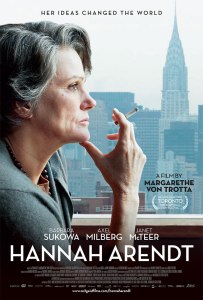 The term “banality of evil” has floated through the lexicon ever since German philosopher and columnist Hannah Arendt coined the phrase during the Eichmann trial back in 1961. In fact, the words gained so much traction that they have undoubtedly lost some impact due to overuse. However, this film takes equal interest in the backlash that she received on her remarks about the Jewish community. Her claim that the Jews were collaborators with the Nazis and privy to their own destruction, undoubtedly would be unpopular now. Back then it was a pure lightning rod for scurrilous criticism and hateful backlash.
 The Awful Truth came out of a trend that was in vogue during the 1930s. It’s called a comedy of “remarriage.” During the Hays Code era, it allowed films to nimbly skirt the whole issue of divorce and extramarital romance. We would see it again in the more remembered screwball His Girl Friday and various other forms as My Favorite Wife and The Lady Eve.
 We are definitely in the age of the well-wrought period piece and Brooklyn has all the trappings you could want. Adapted from Colm Toibin’s novel the film showcases a pure, noble heroine in Eillis Lacy who like many others makes the journey from her homeland of Ireland to the golden-paved streets of New York.
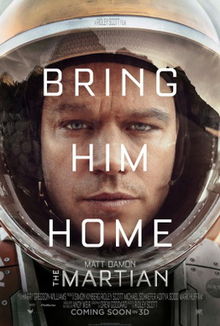 The Martian is not the film you first expect. It’s a space thriller. It has tense moments assuredly, but it also has an astute sense of humor that pulses through the film as its lifeblood. It makes Ridley Scott’s latest endeavor, based on the novel by Andy Weir, all the more palatable because it lends a fresh face to space exploration.
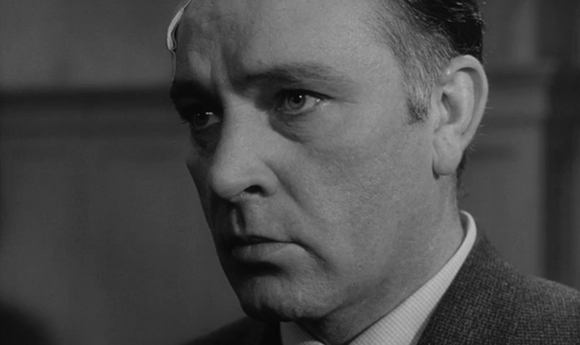 Adapted from the John le Carré novel, this is a black & white spy thriller that personifies cold war paranoia in ways that Bond never could. Richard Burton is an operative working in Berlin before being demoted to a librarian job. It looks like our narrative is heading in a direction hardly fit for a spy film. Its intentions are not so obvious at first, and it keeps its audience working for the rest of the film.
 We are brought into the world of Lew Harper with a cold open full of character. There he is.
 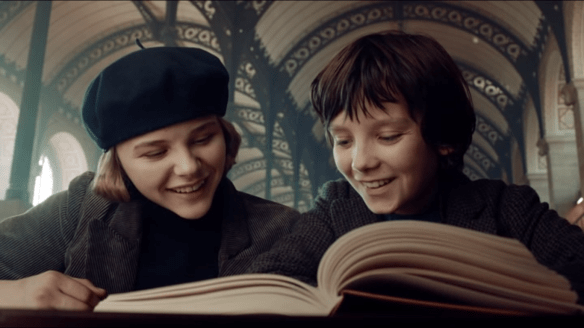 “If you’ve ever wondered where your dreams come from, look around, this is where they’re made.” – Ben Kingsley as George Melies
 Aside from the inspector, the station is full of a wide array of charming individuals who generally exhibit temperaments far more personable. However, the local toy shop owner (Ben Kingsley) is rather an odd fellow, who keeps to himself, but Hugo is wrong to cross him. He’s not a bad man, but he makes the boy work for all the things he has purloined.
 Hugo is a beautifully magical melding of the old with the new –- the mechanical and the visceral. Extravagant colors make Scorsese’s canvas pop. It works together like clockwork.
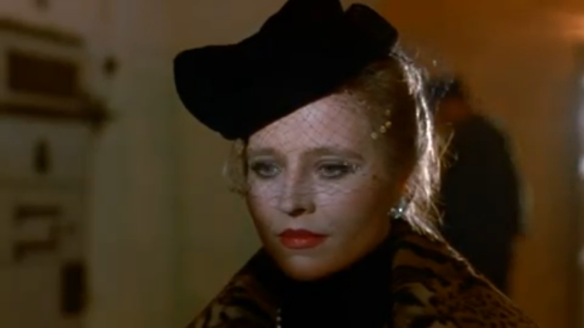 The Marriage of Maria Braun opens with a bang and a thud, literally, as bombs rain down on Germany in the waning hours of WWII. It’s perhaps the most chaotic wedding ceremony ever put to celluloid. And the story ends in an equally theatrical fashion.
 It’s hardly Charles Dickens, but still, Hard Times is a real tooth and claw street brawler. We have Charles Bronson as our token taciturn drifter, tough and down on his luck during the Depression. James Coburn is Speed, a fast-talking promoter looking for a quick buck. Walter Hill’s film may not be pretty to look at, but boy is it a lot of fun! Everyone’s favorite supporting scene stealer Strother Martin makes an appearance as a sometime doctor who dropped out of med school. These three men are at the center of an evolving partnership that comes into being on the streets of New Orleans, that hopping town of jazz, juke joints, and bare-knuckle boxing. The latter is the most important for the men aforementioned because, with Speed as his manager and Poe as his ringside doc, Chaney looks to rule the ocean front with his grit and tenacity.
