The Petrified Forest (1936)

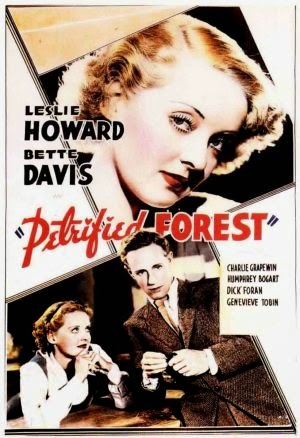
The Petrified Forest (1936)If I dare say this film begins as a rather dull budding love story between a philosophical drifting author (Leslie Howard) and a inquisitive young server (Bette Davis) at a roadside gas station in Arizona. It looks like it’s not to be as he is intent on moving on but then comes murderer Duke Mantee (Humphrey Bogart) with his thugs and things heat up a little bit. His arrival brings up some interesting points of contention and Leslie gains some new found conviction. But that’s not the half of it.

This film comes from the stage with Bogart reprising his star making role as a gangster. It is often talky and sometimes stagnant but the supporting characters and Bogart have enough personality to at least make it passable and a tad interesting. I was never a great fan of Davis, but I have to admit at least she does not look scary in this one. She’s still young and on the rise when this film came out. Leslie Howard is enjoyable with his pleasant delivery but Bogart really lights it up. His glowering face and growling voice are hard to clear from your mind. That’s for sure.

The film also has immense commentary on the survival of the fittest, women, the mythical Old West and fascist ideology that are a sign of the times.

3.5/5 Stars

Review: Double Indemnity (1944)

Double_indemnity_screenshot_8It was a hot afternoon, and I can still remember the smell of honeysuckle all along that street. How could I have known murder can sometimes smell like honeysuckle?” – Walter Neff

I can’t say this enough. Double Indemnity is so deliciously enticing each and every time I see it. Maybe it’s the A-grade script from Billy Wilder and crime novelist Raymond Chandler with its noir cynicism and memorable phraseology. Maybe it’s the shadowy, low-key interiors or L.A. exteriors. The monotonous beating score of Miklos Rozsa, mourning impending doom. Maybe it’s the plain, laconic way of Walter Neff or his bloodhound buddy Keyes. Is it the innocent Lola who gives the film morality? Or the artificial wig and the silky smooth purring of Phyllis Dietrichson?

In fact, I named many, if not all, of the many facets of this film, because I want to attempt to acknowledge all of them before I forget. But the reality is I love Double Indemnity at its most basic level as a piece of prime American cinema. Yes, it is film-noir and yes, it came from a European director, but it is very much a product of 1940s sentiment as the war years waned.

The story is pulled right from some pulp fiction sleaze by James M. Cain and cemented itself as a noir classic in its own right with all the trappings that are called for.

It opens with the beginnings of Rozsa’s score reverberating in our ears and it very rarely lets up. A car blazes wildly down the street and winds up in front of an insurance agency. Out stumbles our protagonist Walter Neff (Fred MacMurray) and for the rest of the film, he relates the recent happenings over the Dictaphone of his colleague Barton Keyes (Edward G. Robinson). It goes something like this:

During his first visit to the home of a Mr. Dietrichson, he instead has his first encounter with the man’s sensual wife, and his heart goes pitter-patter from then on. His motivation is no longer insurance. Now he just wants the chance to see her more. He gets his chance to advise her on a plan, and it all seems playful enough until she insinuates that she wants to knock off her ol’ hubby. At least that’s how Neff reads it. However, he cannot get her out of his head as he has fallen into her web. There’s no turning back.

They think of everything and Neff has everything figured out to a tee. As he suggests, it’s like having the perfect odds on the roulette wheel, you just need an accomplice to spin and Phyllis is just that person. From then it’s just straight down the line. They corroborate on all the details at local Jerry’s Market, Walter sets up his alibi, and he does the devilish deed as Phyllis stares with cool satisfaction at the road ahead.

They set it all up like an accident as the last touch, because as Neff knows all too well if it looks like Mr. Dietrichson was killed from riding a train the Double Indemnity clause of the insurance will mean double the payoff due to how unlikely the occurrence is.

 Double Indemnity (1944) - UpdatedHis only fear is the inquisitive nose of Keyes and the “little man” inside the claims investigator’s stomach, who warns him of the first sign of anything fishy. He gets close to the truth but not quite there. Neff is too close for him to see it. However, as things begin to heat up Phyllis and Neff must separate.

As Neff tries to console Lola Dietrichson over the death of her father, he quickly finds out what the naive girl has to say about her step-mother. It puts a little light on the subject, and Neff realizes what he’s been taken for. He wants to remedy things while he can, patching Lola up with her boyfriend, and going to confront Phyllis one last time.

It’s the perfect set-up. Darkened rooms with curtains drawn. Phyllis reclined in an armchair with evil intentions on her mind. In walks Walter and they have it out. Shots are fired, literally. Phyllis will never let up with her ploys until Walter gives her a little help for the final time. I’m sure the Hays Codes loved this one. I certainly did.

Back in the office Keyes finally overhears the end of Walter’s “confession” as his friend bleeds to death. In one last touching moment, Keyes returns the favor and lights the cigarette like Walter has been obliging to do the entire film.

Walter: “Know why you couldn’t figure this one, Keyes? I’ll tell ya. ‘Cause the guy you were looking for was too close. Right across the desk from ya.”
Keyes: “Closer than that, Walter.”
Walter: “I love you too”

Billy Wilder traded longtime partner Charles Brackett for Raymond Chandler, and despite a rocky partnership, they ended up with one of the greatest scripts, chock full of memorable bits of dialogue. You know you have an impressive cast when Edward G. Robinson is your third lead and each character is playing against type. It’s great casting, in a quintessential American drama solidified by great cinematography and storytelling.

It doesn’t get much better than this and it certainly does not need to. You know Double Indemnity is good when I’ve seen it multiple times and each time the bullets still keep me on the edge of my seat. Thank you, Billy Wilder, for teaching us murder sometimes smells like honeysuckle. That’s absolutely beautiful.

Phyllis: “No, I never loved you, Walter, not you or anybody else. I’m rotten to the heart. I used you just as you said. That’s all you ever meant to me. Until a minute ago, when I couldn’t fire that second shot. I never thought that could happen to me.”
Walter: “Sorry, baby, I’m not buying”
Phyllis: “I’m not asking you to buy. Just hold me close.
Walter: “Good-bye baby.”

5/5 Stars

Indiana Jones and The Temple of Doom (1984)

Indiana_Jones_and_the_Temple_of_Doom_Directed by Steven Spielberg and starring Harrison Ford, this is the second installment in the popular series. The film opens in China where Indy is trying to acquire a rare jewel but he runs into problems and must struggle for his life. He escapes with the help of his little friend Short Round and an annoyed night club singer tags along for the ride.

They finally find their way to a remote village which is fearful of a great evil. The trio is then welcomed at a grand palace. After an initial attempt on Indy’s life, they find a secret passage that leads to a temple where the Thuggee cult survives. They witness horrible tings and Indy attempts to recover the stone from the village. However, they are captured and Indy is turned into a mindless worshiper, while Short Round is forced to work and Willie is prepared for sacrifice.
Thanks to Short Round’s escape he is able to recover Indy as they fight to save Willie and get out alive. A harrowing mine car chase ends in another perilous situation for Indiana and his friends. In the final showdown he is able to prevail and as always there is a happy ending.
This is certainly the weakest of the original trilogy in my mind and coincidentally also the darkest. This film did however help bring to pass the PG-13 rating. I am partial to Short Round and Indiana Jones is all we have come to expect.
3.5/5 Stars

Lilies of the Field (1963)

Original_movie_poster_for_the_film_Lilies_of_the_FieldStarring Sidney Poitier, the film opens with a black construction worker who has an overheated car in the middle of a desert. He spots at the residence of some European nuns to get water. Homer is intent on making a quick pit stop but the mother superior has other ideas. She sees him as a gift from God so that their Chapel might be built. He reluctantly decides to stick around for a little while to help them out and teach them some English. The stubborn Mother Superior wants everything her way and Homer ends up leaving them. Although he realizes he will not get paid, Homer’s ambition to be an architect leads him to eventually start the Chapel for the nuns. He takes on a part-time job and starts the undertaking while the nuns request materials. Soon the locals want to help but Homer is adamant that he do everything. Eventually, they do join in and more materials come. Progress picks up and Homer becomes the foreman. The building is finally put up and yet the proud Mother will not thank Homer. That night she is finally tricked into thanking him and Homer leads them in a spiritual one last time before driving off into the night. This film is a battle of sorts between two strong-willed people. In the end, it brings a great deal of good.

4/5 Stars

To Catch a Thief (1955)

800px-To_Catch_a_Thief3Robert Wagner certainly knows It takes a thief, to catch a thief. The same goes for Cary Grant in this film which has him playing reformed cat burglar John Robie who is suspected for a series of thefts that have struck the French Riviera.

However, he knows he is not the culprit so he must clear his own name by catching the cat himself. The police want to nab him, his old French resistance buddies suspect him, and a beautiful young American woman (Grace Kelly) traveling with her mother is sure he is the cat. With a little help, mixed with some passionate romance, he is able bring some closure and get the girl.

That is all fine and dandy if you wanted a typical romance thriller. However, no one does it as well as Hitch. He somehow wonderfully balances the little bits of humor with his darker moments of suspense.  Jessie Royce Landis helps bring that comedy whether she is putting her cigarette out in some eggs or holding her book upside down as she commits a little white lie.

Hitchcock certainly had better films, but this one is so fun and it has the same glamorous Hollywood look as Hitchcock’s Man Who Knew Too Much (1956) with location shooting and vibrant colors.

Cary Grant and Grace Kelly make quite the pair, perfectly matched with the French Riviera in all its glory. I am convinced that Grace Kelly is and always will be one of my favorite actresses, period. Any era, any genre. Her name sums up her persona, because much like Audrey Hepburn, she has an extraordinary grace in how she carries herself. She can also be quite mischievous as well in her role as Francie. She is sure to set off fireworks.

4/5 Stars

Written on the Wind (1956)

WrittenOnTheWind2Here is a film that wholly personifies an over the top melodrama or soap opera. Douglas Sirk’s film is full of complicated romances, tense relationships, drunkenness, and murder. Yet when the two stars drive away through the gates of the Hadley Estate everything is resolved (at least to a degree).

It seems that Sirk undoubtedly knew how over the top his story is and he reinforces it with his blatantly loud colors, dramatic music, flashy cars, gaudy interiors, and so on. He embraces a style that seems stereo-typically 1950s Hollywood and he makes it work.

Ironically Rock Hudson gives a good performance and Lauren Bacall is okay but the real drama flows from Robert Stack and especially Dorothy Malone. They are the black sheep of the Hadley family and by the end of the film they definitely deserve the moniker. Except there is more to them then that. Kyle is a tragic figure to be sure and despite her sex-crazed ways there still is a bit of sympathy for Marylee.

I cannot wait to see more Sirk because he seems quintessentially 1950s.

4.5/5 Stars

The Lives of Others (2006)

This is a moral tale that could only be told in the context of the GDR. A loyal member of the Stasi is given the task of bugging the home of an influential playwright and he spends countless hours listening in on The Lives of Others. In what would have been a very uncommon occurrence this loyal comrade sees another side of the nation he lives in. It is a place full of corrupt officials, double crossing girlfriends, repression, little free speech, and above all suicides.

In an act that proves detrimental to his own career and even his way of life, Wiesler caves to his emotions to do what is ultimately good and right. After the wall crumbles he and others like him seemingly fade into oblivion. However, the one man who was unknowingly saved finally learns of his savior and resolves to write his next great work. The Sonata for a Good Man. 

I think there is certainly a universal quality to this film because although it is German language and focuses on a subject that is distinctly German, the quality of the characters translates into any language because they are human. The struggle of Wiesler is the same for many of us and we can empathize with his evolution and ultimate resolve. We can only hope that people are not put in these same positions in the future and we must also constantly question our own government so they are never reach this degree.

4.5/5 Stars

Lavender Hill Mob (1951) – Updated

33bec-lavenderhill1Here is a madcap comedy heist film that differs from the usual stories we are used to. First of all it stars Alec Guinness as an English foundry worker and the mastermind behind a gold heist. Except he is far from the criminal type (more of an English gentlemen actually) and so his attempt to snag the gold although clever has many problems. Rather than being tragic this tale is far more humorous and light with crazy chase scenes and humorous characters. If you want dark moody drama I would recommend The Asphalt Jungle or The Killing instead. You will find none of that type of violence here.

I hope to watch more from the Ealing Studios soon because like The Archers, these films seem quintessentially English which I am a fan of.  Aside from Guinness, Stanley Holloway gives a delightful performance as a partner in crime and there is also a very early appearance by Audrey Hepburn.

4.5/5 Star

Love Affair (1939)

Love Affair (1939)Imagine meeting someone through a porthole, that’s what happens in this film when a gust of wind sends Michel Marnet’s letter flying. The lady who is kind enough to return it is the friendly Terry McKay. The two acquaintances enjoy each others company and strike up a friendship in the few days before they dock in New York. Both of them have fiancees waiting for them. They begin seeing a lot of each other, but they also start to notice that the other passengers are looking on.

One day they make a stop and Michel pays a quick visit to his grandmother. Terry agrees to come along and strikes up a fast friendship with the elderly woman who really likes her. As they get close to New York Michel and Terry agree to meet in 6 months at the top of the Empire State Building. By then he will know if he can carry a job to support her. So it goes.

The 6 months finally passes and the time of the meeting arrives. An excited Terry rushes off to “get married” but tragedy strikes. Michel waits all alone and she never shows. For a long while they lose all contact as Terry recuperates and Michel continues to paint while nursing a broken heart. When he finally tracks her down, they share a slightly awkward introduction. In a marvelous sequence, Michel tells her about how “he” missed the meeting and apologizes for what “she” must have gone through. She knows what happened now, but Terry still will not tell him what happened to her, because she did not want to be a burden. In a eureka moment, Michel figures it out and goes to embrace his love. As she did the whole film, Terry accepts the hardship and meets it with a joyful heart.

Love Affair is just that, but it fails to lower itself to uninhibited passion and romance without any substance of character. Its leads are not that superficial. They are better than that and certainly more complex. In all honesty, I never have been a big fan of Charles Boyer. I see his appeal as a suave, debonair Frenchmen with an accent, but he never did anything for me. Here I saw him as more than a playboy. He filled that expectation at first, but the scenes with his kindly grandmother and then when he thinks Terry have forgotten him, show a softer, more vulnerable side.

I do not quite know why, but Irene Dunne is especially enjoyable to watch. Whether it is her skill as a comedienne with comic timing or the expressions on her face, I find her endearing every moment on the screen. She makes me smile just as she smiles. In many ways, she reminds me of another actress of the 1930s, Jean Arthur. However, Arthur I know far better because of films like Mr. Smith Goes to Washington. With Dunne, I have seen very little and yet I have been so impressed by her. Love Affair was another film that proved her genial appeal.

Furthermore, Leo McCarey does not get enough credit, because he is a great director with some great films to his name like The Awful Truth. He would later remake Love Affair as An Affair to Remember, which was a success in itself.

4/5 Stars

Cover Girl (1944)

5fff5-covergirlmpRusty Parker (Rita Hayworth) is a chorus girl at Danny McGuire’s place (Gene Kelly), however she has the chance of a lifetime to be the cover girl of a major magazine. She is going places with a rich suitor who wants to hire her and then propose marriage. Rusty neglects her old job and it leaves Danny dejected and angry. He knows that Rusty has a great future in front of her but he cannot stand to break up their team that includes their mutual friend Genius (Phil Silvers). At first Rusty does not understand her true feelings and rashly decides to get married. However, much like her grandmother before her, Rusty realizes in the nick of time how she feels.

This Technicolor film has one or two decent numbers and I was surprised how nimble Phil Silvers is on his toes. He dances well with Kelly and Hayworth. As always Eve Arden is as humorous as ever and Gene Kelly used his artistic control fairly well.

3.5/5 Stars