
- Duck Soup
- A Night at the Opera
- A Day at the Races
- Horse Feathers
- Monkey Business
- Animal Crackers
- The Cocoanuts
- At the Circus
- Go West
- A Night at Casablanca
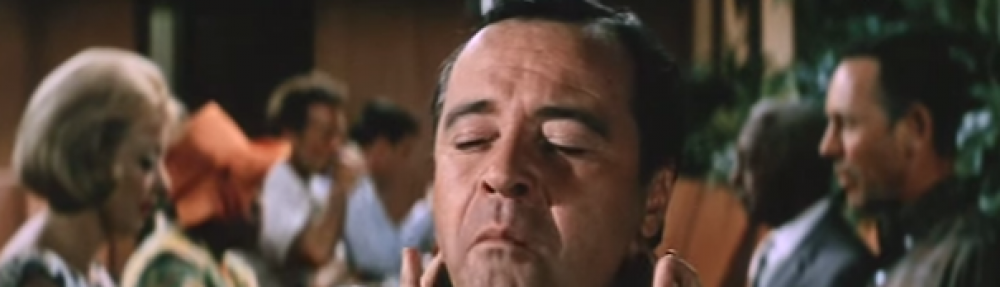
 “I’ve been doing things my whole life I’m not suppose to” ~ Alfie
Alfie is a real character, with his cockney accent and personal insight about the world he resides in and the people he crosses paths with. Before Ferris Bueller, there was originally Alfie constantly breaking the fourth wall. Although that’s where any comparison ends because Ferris may be a schemer but he is good at heart. Safe to say Alfie is no Ferris Bueller. Not by a long shot. He is a self-indulgent, hedonistic, womanizer, constantly playing the field without looking for anything real.
True he has a kid, a few affairs and casual trysts, but he never sees “Birds” as anything more than objects. Every girl is an “It” not a “Her.” They fulfill his desires and their main purpose is to be used for his pleasure and his needs. He is a man who lives for himself and no one else. He is a real cynic and a deplorable sort of person at that.
Initially I had nothing complimentary to say about the character because the reality is there really was nothing good to say about him. But in a single moment Alfie proved that he might be selfish but not heartless. He finally attempts to “settle down” only for it to backfire on him. That’s the way it works and so Alfie is about right back where he started. I would like to think his heart is a little softer though.
Michael Caine is likable enough to make me not completely hate Alfie and that is to his credit because it was difficult not to. His various conquests and companions were played by, among others, Julia Foster, Jane Asher and Shelley Winters. The film’s jazzy score may not be rock and roll but it seems to personify Swinging London as much as Double-Deckers and Tower Bridge.
3.5/5 Stars
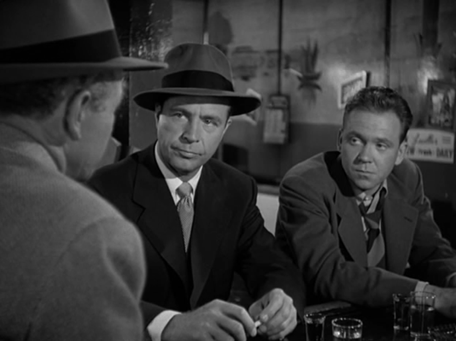 Here is yet another noir gem which would never get made today, much less in a mere 22 days! This directorial debut of Robert Parrish is boosted by an often witty script from William Bowers.
Rocky Mulloy (Dick Powell) is fresh out of prison after a former marine (Richard Erdman) testifies on his behalf though Mulloy already spent five years rotting away in prison. He went in right around the end of the war because of a robbery that he was assumed to be a part of.
Regis Toomey (The Big Sleep, Raw Deal) is Lt. Cobb and he is still skeptical when he is assigned to monitor the newly released man. Richard Erdman is the peg-legged, alcoholic marine who has a penchant for booze and dames. Also, he never actually knew Mulloy before. He just wants some of the loot.
So the two new found chums set up camp in a beat down trailer park of all places, with a music playing proprietor (Jay Adler). It’s not exactly the Ritz, but Delong finds some female company, and it just so happens that Mulloy’s former flame lives there too. Nancy (Rhonda Fleming) is married to Rocky’s pal Danny who is still in the clink. His mission is to prove his innocence, but could it be more harm than good?
Rocky goes to a local mobster named Castro (William Conrad) who left him holding the bag five years ago, and he wants reimbursement for his time. He gets some of it in the form of a horse race which leads to a big payoff.
But as it turns out, the money is hot and Lt. Cobb wants to know where it came from. Rocky obliges but it becomes all too obvious he’s being set up. There was one slip up though, proving Rocky is telling the truth for once, amidst all the lies swirling around. That does not help Delong much and his girl Darlene gets blown sky high. The bullets were obviously meant for Rocky and Nancy.
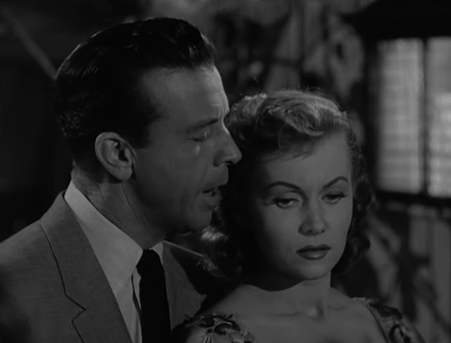 Rocky confronts Castro and they play a little game he likes to call Russian Roulette, although it’s very one-sided favoring Rocky. The fearful mobster spills the truth, revealing Danny was actually a part of the plan 5 years ago all the time. Since he took a lighter rap, someone else is holding his share of the payoff. The missing $50,000. Who is keeping it warm for him? You guessed it.
Rocky goes back to the trailer park where Nancy spills all her beautiful guts to him. What she gives is a tempting offer and Mulloy lets her believe it will happen. Off he walks with Lt. Cobb ready to swoop in. Rocky may have gone straight, but it doesn’t mean it makes it any easier. He had to turn on one of the most beautiful girls in the world, courtesy of Rhonda Fleming.
Dick Powell has another laconic performance which nearly matches his turn as Philip Marlowe in Murder, My Sweet. I always love seeing Richard Erdman as a young jokester, because he has gained a following more recently for his work in the television show Community as Leonard. William Conrad will always be the narrator in Rocky and Bullwinkle as well as Cannon. However, his big frame and mustache make for a good criminal type. What can I say about Rhonda Fleming except that she looks stunning in black and white, much less technicolor?
Lt. Gus Cobb: Now, just get it through your heads that the pressure’s on.
(To Nancy)
Lt. Gus Cobb: I wouldn’t give a nickel for your husband’s chances before that parole board with all this going on.
(To Rocky)
Lt. Gus Cobb: And I wouldn’t give a nickel for your chances with those two apes running around looking for you.
(To Castro)
Lt. Gus Cobb: For you, I just wouldn’t give a nickel.
4/5 Stars
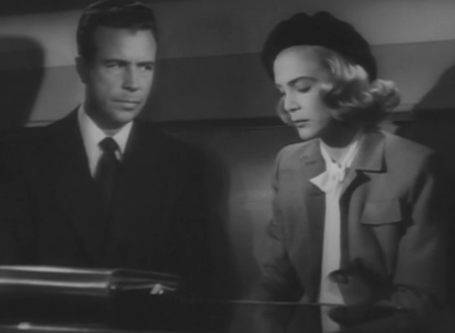 In Italy Pitfall‘s title was translated to Tragedy in Santa Monica. And that it is, but it plays out as a typical, everyday tragedy. It is far from Shakespearian. John Forbes (Dick Powell) is sorely tired of the monotony of his life: A wheel within a wheel within a wheel so to speak. And he is tired of being the so-called “backbone of the country” employed at Olympic Mutual Insurance Company.
He has a steady job and all, a beautiful, loving wife (Jane Wyatt), and a cute little son Tommy. He’s your prototypical middle-class man from your typical middle-class family. That’s what’s wrong with his life. To put it plainly he’s in a rut and desperately wants to get out.
Pitfall is a bit of a riff off of Double Indemnity. There is some of the same framework but very different variables and outcomes, so that’s enough comparison.
Things get interesting when Mona Stevens (Lizabeth Scott) comes into the picture. She is a model with a boyfriend who was just recently put into prison for embezzlement. Now Forbes’ company is charged with getting back some valuables from Stevens and she gives them up willingly. Along the way, a hired private investigator named Mac (Raymond Burr) takes a liking for her, but the feelings are not reciprocated. That’s before she meets Forbes.
When they meet, Forbes is immediately struck by her and she takes a liking to his goodwill. Everything would be great in another world. Except in the real world, Forbes is married and Mac is jealous. After he gets accosted by Mac, Mona finds out about her fling’s home life. Surprisingly she lets him off the hook, but Mac won’t let her off.
 Forbes’ overall demeanor changes and he feels reinvigorated, even back at home and in the office. But it’s never that simple, and things begin to get messy as Smiley finally gets his ticket out of the clink. Mac has been his constant visitor, filling the paranoid brute with ideas. He thinks Mona has been unfaithful, and he wants to get the guy she was with.
The ending of Pitfall is far more painful than a multitude of meaningless deaths in a monster movie. The reason being, these characters actually have some importance. There is a sense that human life is sacred and if anyone dies it is a big deal, whether they were “good” or “bad.”
Furthermore, there are hardly words enough to describe the look on Jane Wyatt’s face when she finds out the truth. This is one instance when the father did not know best, and their marriage was shaken to the core. It feels all too real. However, this film’s denouement is not quite as fatalistic as Double Indemnity. There still is a tinge of hope that these two individuals can salvage something out of a very difficult situation.
This is yet another feather in the cap of film-noir. So simple and yet so potently effective. I cannot wait for more with Dick Powell.
3.5/5 Stars
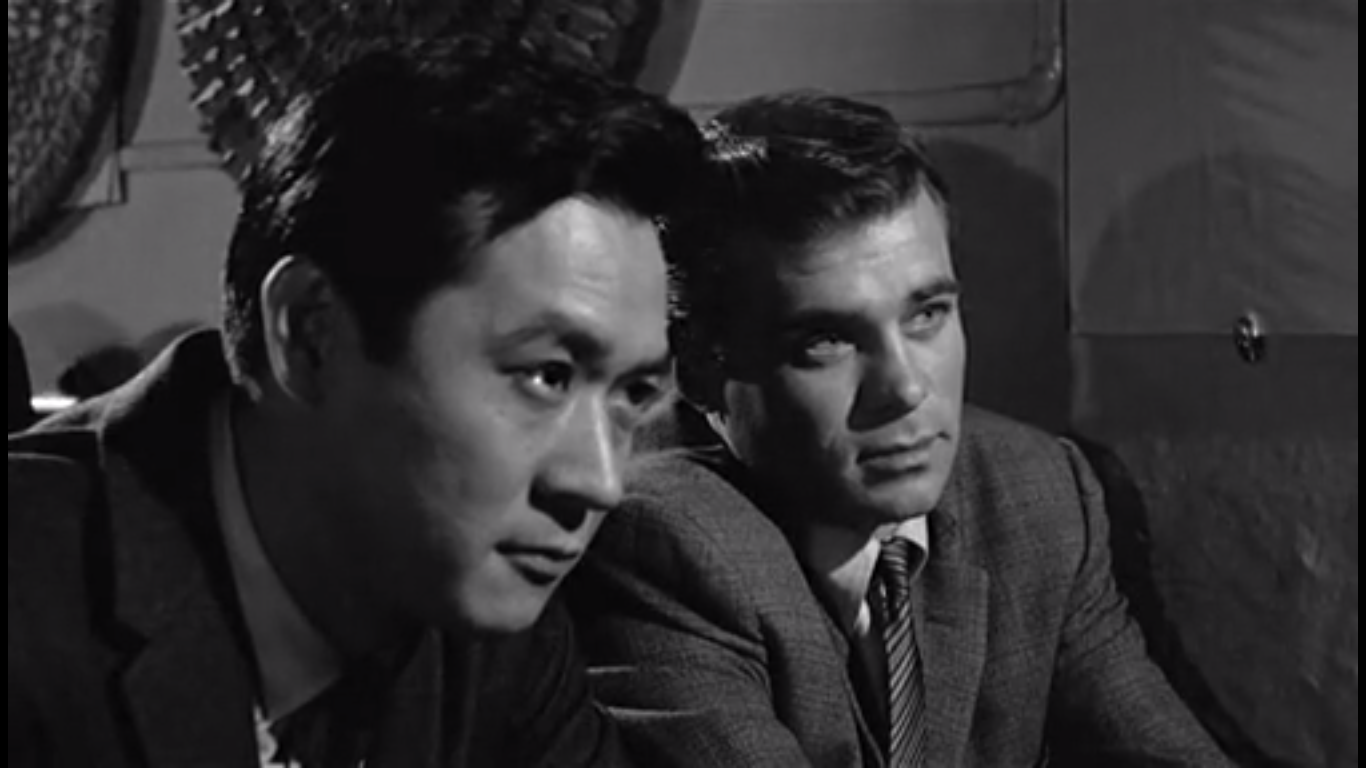 From director Samuel Fuller comes another welcomed addition to his canon. It features the same type of seedy urban landscapes and back alleys of Pick up on South Street (1953) and there are some equally interesting characters like Mac (Anna Lee). It all is underlined by some sleazy jazz music in the vein of Sweet Smell of Success except this one is set in L.A.
The plot line is basic enough following two policemen as they investigate the homicide of a local stripper with a heart of gold and wasted plans for a new show involving kimonos and karate. Their only real lead is a painting and the name that goes with it. That’s where the more interesting part of the story begins.
I failed to mention that one of the cops is Caucasian. His name is Detective Sergeant Charlie Bancroft (Glenn Corbett). His partner is Japanese-American or “Nisei,” meaning the second generation. Detective Joe Kojaku (James Shigeta) is his name. The beauty of their relationship, which is one of Fuller’s focuses, is that they are equals who are inseparable ever since landing in a fox hole together in Korea. Charlie was saved by a pint of Joe’s blood, Charlie practices kendo with Joe in their off hours, and they live together on the side. You cannot get much closer than that.
The movement of the plot leads them to Ms. Chris Downes (Victoria Shaw), a pretty young painter who is the only witness who potentially saw the man who shot Sugar Torch. In between looking at journals full of mug shots, she gets to know both Charlie and Joe. Charlie sees himself falling in love with her and like anyone he tells his best friend. Joe is happy for him until the fateful moment when he is alone with Chris. She makes her affection for him quite plain because he’s a pretty great guy, but as a good friend, he doesn’t do anything. It tears him apart and it only hurts them as they plod on with the homicide.
What follows is a painful love triangle embroiled with issues of race, friendship, and misguided notions. It’s jarring because these three are all likable and you want only the best for them, but it cannot be remedied like the murder which ultimately gets wrapped up neatly.
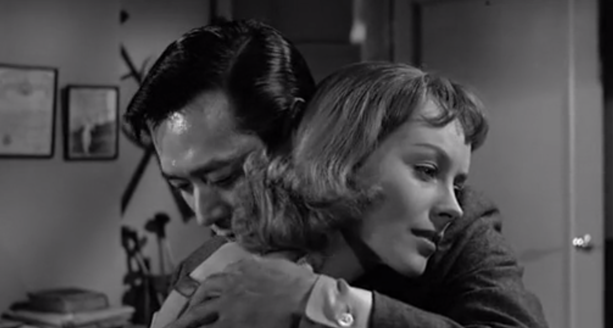 Samuel Fuller always tackles issues of race head on like no other. In fact, he was ahead of his time when no one else would show such relationships, romantic or otherwise, on the silver screen. Beyond whether or not an Asian man and a Caucasian woman romantically involved was accepted back in the 1950s or not, it probably was not what audience cared to see at the movies. To me, now, it’s really interesting, especially to see such non-stereotypical roles all across the board. It’s a breath of fresh air from the Charlie Chans and Mr. Motos.
On another level, Fuller’s camera makes solitary L.A. street corners and the bustling Nisei festival amazingly dynamic. It brings Little Tokyo alive, filling it with genuine people, sights, and sounds. Thank you, Sam Fuller.
“It’s like mixing two dabs of paint together. You could never separate them.” ~ Mac on Charlie and Joe
“It’s what you think is behind every word and every look.” ~ Chris Downes
4/5 Stars
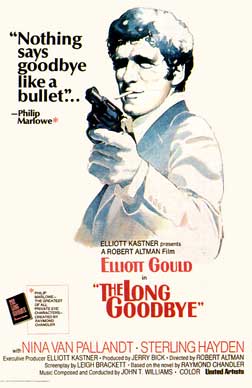 In the storied tradition of film-noir comes another film in the canon and yet another depiction of Raymond Chandler’s Phillip Marlowe. However, the world with which Robert Altman places his private eye is far different than any place the character has ever inhabited before. Whereas another neo-noir such as Chinatown followed the storied tradition of noir in many ways, The Long Goodbye is often more of a satire than a new addition to the genre.
Elliott Gould as Phillip Marlowe has the smoking down like Bogart or Dick Powell, the garb, and even the car, but his environment is the 1970s, making him quite anachronistic, and that seems to be just fine with Altman. He subverts the genre by placing Marlowe in a world he does not seem to fit in and yet he himself does not seem to question it.
The girls next door are hardly your typical girls-next-door. The police station looks like it could be out of The Rockford Files. John Williams and Johnny Mercer’s title song pops up in all places from the elevator to the car radio. His tail Harry is an incompetent joke. Passing cars give the security guard time to practice his best movie star impressions. Marlowe as well proves he is not much of an animal guy with a cat that he loses and a dog that hates him.
The drama is not much better in that regard. Two murders take place (including the death of a friend), which are later followed by a man’s suicide and his beautiful wife fleeing the country. All the while, on the case Marlowe is scrounging around and coming up mostly empty. The cops bring him in, an unhappy thug roughs him up over some money, and he can get very little out of the drunken writer Roger Wade (Sterling Hayden) or his wife (Nina van Pallandt) before she disappears.
By now we know better than to compare this Marlowe to any predecessor. He gets smashed about by the waves trying to stop a suicide and ends up in the hospital after getting bowled over by a car. He seemingly does his best detective work in a stupor, and he somehow escapes a chilling confrontation where everyone is removing their clothes. All these scenarios make little sense and even with the twisted conclusion to the mystery, there still is no explanation for the way things are. Altman gives us a surprising end but no answers as we watch Gould dance off into the distance playing a mini harmonica. Marlowe can often be heard saying, “It’s okay with me.” It’s the story of his life and if he is fine with it, I suppose his audience will just have to accept it too, even if they do not quite like it.
4/5 Stars
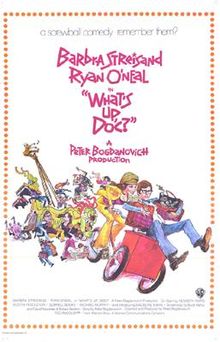 A nod to the 1930s screwball comedies, this hilarious film is directed by Peter Bogdanovich and stars Ryan O’Neil and Barbra Streisand. It opens with the prologue, “Once upon a time there was a plaid overnight case,” however very soon it becomes obvious that there are four of these cases!
One belongs to the bookish Ryan O’Neil who is going to a musicologist convention with his annoying fiancée Eunice, the other to the free spirited Judy, one has top secret information, and the last is full of jewels. This dramatic irony is set up early on for the audience and things really get chaotic when Judy tries to pick up Howard. She masquerades as his fiancée and creates a good impression with a Mr. Larabee who is in charge of giving out the grant. However, later, Judy succeeds in completely destroying Howard’s room while causing more problems for Howard with Eunice in the process.
The next day Howard is invited to a party at the home of Mr. Larabee and he is instructed to bring his charming “fiancée.” That’s where the mayhem hits its peak. All four bags end up together. There are gangsters, government agents, guests, servants, and Judy and Howard all a part of the chaotic ruckus. The unlikely couple finds themselves on the run through the hilly streets of San Fran where an epically frenzied car chase takes place. Put together a pane of glass, some bumpy steps, three cars, a parade, and a large body of water to add up to some hilarious moments. The bedlam carries over into the local courthouse where everything is eventually figured out. Everything is back to equilibrium and Howard flies off into the sunset with his new love and an in flight Bugs Bunny short.
4/5 Stars
 I had never seen any of De Sica’s later work and with the quintessential pairing of Sophia Loren and Marcello Mastroianni this seemed like a perfect place to start the journey. The character Domenico is easy to dislike from the beginning because he constantly floats in and out of the life of the former prostitute Filumena who is ironically devoted to him.
The film relates the struggles of matrimony and family in Italy as Filumena tries to support her family while struggling with Demenico who is never truly ready to commit to her. In fact he becomes absolute fed up with her after a trick marriage, but that is just the beginning.
I can only imagine what Divorce Italian Style will be like (which also features Mastroianni). Without question Sophia Loren is certainly the driving force in this film.
4/5 Stars
 Martin Luther King’s legacy will always be the “I Have a Dream” Speech. It’s a crowning moment in history with iconic images and soaring rhetoric. But Doctor King was far more than that. He was a minister, a social activist, and a champion of equality, justice, and peace. Selma is the film his story deserves, taking a magnifying glass to the events surrounding the 1965 march from Selma to Montgomery, Alabama which led President Lyndon B. Johnson to pass the Voting Rights Act of 1965.
So much had already happened. We had Rosa Parks, Sit-ins, Freedom Riders, Malcolm X, the march on Washington, the assassination of President Kennedy and of course the Civil Rights Act of 1964. In the upcoming years, there would be the further escalation of the war in Vietnam, riots in Watts, The Black Panther Party and the assassinations of both Robert Kennedy and Dr. King in 1968. The social unrest was far from over, just like it is not over now. That’s part of what makes Selma so poignant because it is certainly a necessary historical reminder and its relevance remains evident today.
Honestly, the film at times felt rough around the edges and not always the most aesthetically pleasing. For lack of a better word, it felt choppy. That was only a personal observation and not something to get too hung up on though. After all, at its core, Selma is about the characters and the moment of history they were living in. There were some spectacular performances starting with Englishman David Oyelowo as Doctor King himself. He exudes the quiet strength and displays the deliberate but powerful voice that made King the champion of all that was good and right. He is not a perfect man or perfect husband, but he was a man of God who remained true to his convictions and his friends and family.
Ever since I did some reading up on him, LBJ has always been a fascinating character to me, because he was the ultimate politician who was able to accomplish so much and yet he will always have a tarnished legacy due to Vietnam. He is played impeccably by Tom Wilkinson with the imposing figure, southern drawl, and strong will all there. LBJ is at odds with King on occasion and in him you can see a man with a job that no person would desire, trying to make political decisions that no one would want to. Somehow, through it all, the Voting Rights Act was still passed. Then, of course, you have other players like the living legend and present congressman John Lewis as well as Southern Governor and primary villain George Wallace, who seemingly turned his life around in his later years.
Even down to the smallest roles, Selma has power. We begin to see depictions of real-life individuals who lived in a world of fear and disempowerment. Where southern whites ruled with their racist ways and blacks looked for a much-needed answer to the death and suffering. Doctor King was able to lead the movement and yet he had help from friends and the common man as well — black and white. It is interesting how many of the figures who ultimately answered King’s stirring call to action were often pastors, priests, and other clergymen. It’s as if they realized that this was not just a race issue, it was a moral issue, an issue of justice, and ultimately a personal conviction. How could they live hypocritical lives of the status quo while so much was left to be healed in the South? We could ask the same questions of our society now.
The film interestingly enough led many songs to float through my head. There’s Sam Cooke’s “A Change is Gonna Come.” Bob Dylan’s “Only a Pawn in Their Game.” Dion’s “Abraham, Martin, John” and Barry Maguire’s “Eve of Destruction” to name a few fitting tunes. For that matter, even the award winning anthem “Glory” could have been played during the film and that would have made sense. And yet Selma finds its sound in more traditional tunes that lend a true authenticity to the story that is surprisingly effective.
To say that Selma really resonated is a given. The images of force and brutality, bitter prejudice, billy clubs, and tear gas are still disturbing. They should be and they should never fail to outrage us. But I think there were several times where I was really struck with the weight of all of this. The first being when King kneeled down to pray and all the masses joined him. Such a display was so visceral and moving. Also, the archive footage showing the final march was a cheering reminder that equality and change by peaceful means are possible. Dr. Martin Luther King sadly did not make it to the Promise Land, but he led the United States and his people ever closer. For that, we all owe him an incredible debt of gratitude and for that very reason, we must never forget Selma.
4.5/5 Stars
 This is the lightest of any De Sica film I had seen up until this point and interestingly enough it was split up into three narratives. The first one follows a woman who continually gets pregnant in order to avoid going to jail, but after seven kids, the toll is too much on her jaded husband. Needless to say there is a happy ending.
The second tale follows a superficial socialite with a Rolls Royce. She ditches her cars as quickly as she ditches her lovers. Although the story does not go very far it is easy to see she is a snob used to getting her own way. Ironically a humble man would in many ways be too good for her.
The final vignette follows an amiable prostitute as she befriends a young man destined to join the clergy. However, he becomes smitten and so she must do her best to encourage him to continue his calling.
That really is only the basics, but it was certainly enjoyable to see Sophia Loren and Marcello Mastroianni in three separate roles playing off of each other in different ways. They reflected three very different walks of life and three varying relationships mixing a great deal of humor with a few more somber moments. All in all it was fairly enjoyable.
4/5 Stars

