The Roaring Twenties (1939)

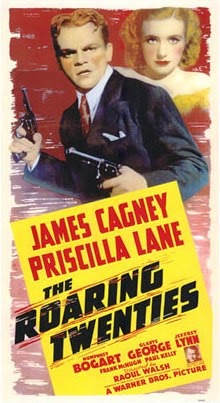
e08f7-the-roaring-twentiesHere is a retrospective gangster film reminiscing about the Jazz Age and Roaring Twenties extending from the post WWI period  of prohibition to the election of FDR.
Two mainstays of the genre including the original gangster James Cagney and hard-boiled Humphrey Bogart star as two men in a group of three soldiers who meet during World War I. In the ensuing years Eddie Bartlett (James Cagney) initially has difficulty getting back into society, but after meeting Speakeasy owner Panama Smith (Gladys George) he finds himself climbing the ranks in the bootlegging business. Soon through grit and a ruthless drive Eddie makes good racketeering by utilizing taxis with booze to make it big. 

Through it all Eddie becomes smitten with a young singer he used to know when she was a young girl (Priscilla Lane), except she does not share his affection. Pretty soon his ol’ buddy George (Bogart) comes back into the picture, with a some shifting dealings of his own. Eddie practically runs the town now but when the Crash happens he gets pushed out by George and now Jean is off and married to her lawyer beau. Eddie is a washed-up taxi driver still hanging around Panama and he has time to do one last favor for Jean.

This is one of the last great gangster films of the 1930s following in the wake of other Cagney classics like The Public Enemy and Angel with Dirty Faces. Raoul Walsh directs this film and it develops as another dynamic, action packed film with a lot of drama and heart thanks to Cagney and George. It is however different from previous gangster flicks in that it plays out as a history although it keeps the nitty-gritty look of the previous films. Like Angel with Dirty Faces especially, there are also some sentimental moments because Cagney is not a complete scoundrel, just mostly. Not wanting to continue being typecast Cagney took a break from the genre not coming back until White Heat in 1949. He did pretty well for himself during the 1940s though with performances in The Stawberry Blonde and Yankee Doodle Dandy. There was another fellow who did not do too bad in that interim period either, new found leading man Humphrey Bogart.

“What was his business?”
“He used to be a big shot.”
 
4/5 Stars

Review: Roman Holiday (1953)

Joe: Today’s gonna be a holiday.
Princess Ann: But you want to do a lot of silly things?
The answer is yes, yes we would!! That is the beauty of this film, which plays out as a lovely jaunt through Italy with two favorites in Audrey Hepburn and Gregory Peck. With Hepburn being practically unknown at this point in time, it made her a wonderful choice to play Princess Ann. She was someone without any prior identifying roles making her young princess seem plausible. William Wyler took a chance on an unknown and he certainly hit the jackpot.
Gregory Peck on his part was always a strong leading man and an All-American type, perfect to play Joe Bradley. However, he also exuded gentlemanliness,s so despite the fact that the princess spent the night in his apartment we know nothing went on.  He had no ulterior motives bringing her to his apartment and even when he arranges to get an article out of her we know that is not who he is.
The film itself consists of wonderfully connected vignettes incorporating the Roman culture and landscape. Princess Ann leaves behind the hospitality of Joe in order to explore a bit before she goes back to her real life. In order to get that major scoop, he tails her and finally invites himself to tag along, so beginning the real fun. Princess Ann gets her beautiful locks cut by a friendly barber and buys some gelato from a street vendor.
 
Soon she takes her first puff of a cigarette, takes in the glory of the Coliseum, rides a Vespa through the hectic streets of Rome, and winds up in police headquarters with some explaining to do.They finish up their afternoon on a more thoughtful note at a wall of wishes originating during World War II.
 
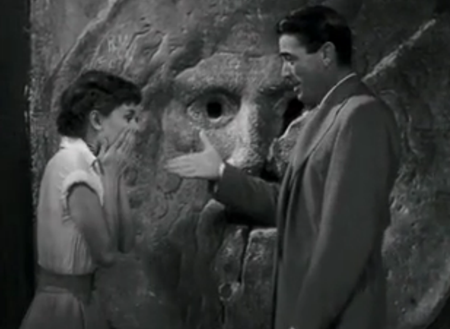
One of the best moments occurs at the mouth of truth, a great stone statue, which you are supposed to stick your hand in before it eats it up. In a moment of sheer fear Princess Ann or Audrey Hepburn, I’m not quite sure who looks on in horror as a screaming Bradley removes his arm and his hand is gone. Up comes the hand from the coat sleeves and the jokes on her. It has absolutely no bearing on the plot but it makes us love Peck and Hepburn even more.
 

To finish off the evening the two companions and Irving (Eddie Albert) cause a ruckus at a dance aboard a barge before swimming away to safety. There Ann finds love and a soaking wet kiss to go with it. But it is at that moment when the laughs stop and the romance begins that everything becomes all too clear. This wonderful day cannot last forever. There is a moment, after one final embrace, when they have to say goodbye for good.

This is not one of those “love at first sight” stories, but it is a different sort of fairy tale where two individuals share an enchanting day together and fall in love. Every Cinderella story must end and so does this one (Anna: At midnight I’ll turn into a pumpkin and drive away in my glass slipper). They must eventually come back down to reality with Princess Ann fulfilling his duties and Joe moving on with his career.
 
Joe’s major newsflash is not a thing anymore. The whole day means too much to him and being the buddy he is, good ol’ Irving understands that. Speaking of Irving, he deserves some discussion. Eddie Albert’s character is spilled on, stepped on, knocked over, tripped, and through it all remains the perfect buddy for Gregory Peck.  Even his little car is a riot, not to mention his inconspicuous tiny cigarette camera and his sly efforts at photography in every type of circumstance. Irving shares a great deal of double talk with Joe which somehow gets past the unsuspecting princess. However, by the end of the film, the princess is also a cohort in their memorable adventure with commemorative photos included! 
 
When Joe Bradley walks out of the grand palace he leaves content knowing that he shared something special. No one else needs to know (aside from Irving) about the fairy tale they shared and that is the beauty of it all. It is just their little secret, their Roman Holiday
 
5/5 Stars

The Women (1939)

6cabb-poster_-_women_the_01Starring a cast including Norma Shearer, Joan Crawford, Rosalind Russell, Paulette Goddard, and Joan Fontaine, this film is all about the lives of these women. Mary is a member of New York high society who is happy with her marriage. However, when her gossipy friends begin to talk about her husband with another women she is hurt. She eventually  files for divorce and while waiting for the conformation in Reno she meets some new friends and is finally able to find a way to get her husband back. Needless to say the ending is happy and a few women get what they deserve. This film had an enjoyable introduction, a sequence in Technicolor, and an all female cast. Most of all it characterizes the various women in this walk of life. Some are kindly, others foolish, and still others are treacherous.

4/5 Stars

Review: Butch Cassidy and the Sundance Kid (1969)


Not that it matters, but most of it is true…

The film opens with some old sepia-toned footage of a notorious gang from the turn-of-the-century and that is when we meet our two anti-heroes Butch Cassidy (Paul Newman) and the Sundance Kid (Robert Redford). Butch is the brains behind the operation (I got vision and the rest of the world wears bifocals) and Sundance is the brawn, with the most accurate gun in the West.

They make a living robbing banks and trains, but due to their lifestyle, they seldom come out ahead. Life becomes more difficult with tumult within the gang, a crackdown by the authorities and a price tag on the heads of Butch and Sundance.
Soon it becomes evident that their life of crime will never be the same with a professional tracker on their tails and a posse formed to see them hang. They are chased through hills, rock, water, and the like before finally getting away in one final desperate attempt at escape.
With one last brilliant piece of inspiration, Butch decides they should head for Bolivia to lay low, and soon enough they pack their bags and bring along The Kid’s girl (Katharine Ross) to the promised land of South America. They get more than they bargained for thanks to the language barrier and a lack of decent plunder. However, even abroad, their legend grows, winning them the new moniker “Banditos Yanquis.” The pair takes a stint on the right side of the law for once, but it somehow seems bleaker than their early days as bandits. It is evident that the hourglass is running out on them. And so it does, but not without one final glorious battle to cement the aura around two legends of the West.
I will not go so far as to call Butch Cassidy and the Sundance Kid a masterpiece because I have read too many reviews to know that there has been a great deal of division over the film. I can only speak from my own experience when I say that I quickly grew to love this story. This appreciation stems from the spot on chemistry of Paul Newman and Robert Redford. Their outlaws are not your typical thugs but lovable buffoons you cannot help but cheer for through all their screw-ups and pratfalls. Paul Newman has his ever-present mischievous smile plastered on his face, and Redford plays the cool and collected Kid to the tee. Perfect casting for the roles and to think it might have been Steve McQueen and Warren Beatty.
 
They got together again in The Sting, which was another good film, although I will always be partial to their first collaboration. William Goldman’s script can only be described as a fun romp that accentuates the comradery of Butch and Sundance. The musical score by Burt Bacharach with the inclusion of “Raindrops Keep Falling On My Head” is often at complete odds with what we have come to expect with classic westerns, but that suits the film just fine.
 
You see this is not your typical western by any means. It’s not supposed to be. Butch and Sundance are working in the twilight of the West. The horse is soon to be replaced with the future: the bicycles. Bank vaults are becoming more complex, fervor for the Spanish-American War is at its peak, and lawlessness is no longer going to be tolerated. Whether people realize it or not, this film is one in a final wave of classic westerns that finally petered out in the 70s. Now the western genre, just like the West before it, is dead. A dying breed of genre much like film-noir or even musicals.
 
That’s why Butch Cassidy works for me. People have criticized the constant change in tones, but this story never claims to be the absolute truth, and it would not be the same film if it did. This story of outlaws is not a history lesson but a legend about two infamous bank robbers. There are moments where we love these antiheroes and moments where we do not know quite what to think of them. They become disillusioned and beaten down by the changing times. Their ambush in Bolivia has only one apparent conclusion. It ended in a bloody and violent death. However, we do not have to see that for the sake of the legend of Butch Cassidy and the Sundance Kid. In one mythical moment, they regained their previous status. They went out as they came in, and they will forever be remembered as Butch and Sundance of the Hole in the Wall Gang. They have since been replaced by superheroes on the silver screen, but in their day and age, they were the original supermen — tarnished as they were.
What is amazing is that the film has not only resonated with audiences for generations, but with the leads themselves who really identified with their roles. That is perhaps the greatest compliment to its characters. 

5/5 Stars 

Mister Roberts (1955)

Starring an all star cast including Henry Fonda, James Cagney, William Powell, and Jack Lemmon, this comedy-drama chronicles the happenings on an unimportant boat during World War II. Mr. Roberts (Fonda) is one of the officers on The Reluctant and he is good to his men but constantly at odds with the difficult captain (Cagney). The ship doctor (Powell) is a kind and sagely old fellow while Ensign Pulver (Lemmon) is spineless, lazy, and still somewhat likable. due to an agreement with the captain, Roberts loses the respect of his men. However, when they realize what he has done for them, they honor him and help him get transferred so he can see some action. Pulver who is happy for Roberts, had tried to impress him earlier. After some bad news Pulver finally does something and it is fearless. I enjoyed this film because of the cast and its good combination of drama and comedy.

4/5 Stars

The Best Films of Fritz Lang

Fritz LANG1. M
2. Metropolis
3. The Big Heat
4. Scarlet Street
5. Fury
6. You Only Live Once
7. The Woman in the Window
8. The Testament of Dr. Mabuse
9. Dr. Mabuse the Gambler
10. While the City Sleeps
11. Spies
12. Hangmen Also Die!
13. Liliom
14. Rancho Notorious
15. Clash by Night
16. Man Hunt
17. Ministry of Fear
18. Blue Gardenia

The Best Films of Francois Truffaut

“I have always preferred the reflection of life to life itself.”

1. The 400 BlowsFrançois_Truffaut_(1965)
2. Day for Night
3. Jules et Jim
4. Shoot the Piano Player
5. Stolen Kisses
6. Bed and Board
7. The Wild Child
8. The Soft Skin
9. The Last Metro
10. The Story of Adele H.
11. Pocket Money
12. Mississippi Mermaid
13. Confidentially Yours
14. The Woman Next Door
15. Close Encounters of the Third Kind

Frequent Collaborator: Jean-Pierre Leaud

The Best Films of Sam Fuller

“A film is like a battleground. It’s love, hate, action, violence, death—In one word, emotions.”

1. Pickup on South Streetfuller
2. The Steel Helmet
3. The Crimson Kimono
4. The Naked Kiss
5. The Big Red One
6. Park Row
7. Forty Guns
8. Shock Corridor
9. Scandal Sheet
10. Underworld U.S.S.
11. Fixed Bayonets
12. White Dog
13. House of Bamboo
14. Pierrot le Fou

Holiday (1938)

2c3de-holiday_posterJohnny Case (Cary Grant) is a happy go lucky fellow who is crazy in love with the girl of his dreams. He returns to town telling his friends the Potters that he has plans to marry this girl he met 10 days ago at Lake Placid! He is ecstatic and not afraid to show it.

However, he must become acclimated with her family and their lifestyle. Most important is gaining the approval of her sometimes stuffy and always money-minded banking father. Julia Sefton is by all accounts a lovely girl who seems to truly return Johnny’s affection. Honestly, though he is not quite used to her type of society. He makes his entrance by arriving through the servant’s door and wanders around the stately manor marveling at all the trappings. Doing the rounds he runs into her drunken but genuine brother Ned (Lew Ayres). Then, there is sister Linda (Katharine Hepburn), the so-called black sheep of the family, although her only fault is being an energetic free-spirit.

Immediately she and Johnny hit if off, and she soon realizes that her sister has a real catch on her hands. The wedding is finally agreed upon by Mr. Seton, and a big New Year’s Eve Party is thrown much to Linda’s chagrin. The night of the big to do there are two parties that take place. Downstairs all the snobs and high society mingle with Julia parading Johnny around. Upstairs is a different matter where the quarantined Linda is eventually joined by the Potters,  Ned and even Johnny.

The little gathering gets quashed and that is not all. Father and daughter are adamant that Johnny works at the bank and make money because that’s what any respectful husband would do. They take little heed of Johnny’s dream to take a holiday once he has raised enough money to live off of. He just wants to live life free of distractions for awhile, but they just do not understand. Finally, Johnny is feeling too restricted by all the obligations to bear it any longer, because he simply cannot live that way. Again, both father and daughter do not understand. But Julia does, and she finally realizes what she must do. It’s time to take a holiday.

Here is a formidable trio in Cary Grant, Katharine Hepburn, and director George Cukor. It makes me beg the question, how this film has become so overshadowed by Bringing up Baby and The Philadelphia Story? Johnny Case is a wonderfully vibrant role for Grant, and his acrobatics alone are worthwhile viewing. Hepburn on her part plays an equally spirited individual but without the scatter-brained or feisty edge that she often carried. Instead, she is just wonderfully footloose and fancy-free. Edward Everett Horton and Jean Dixon are an absolute riot, and I would love to have friends like them. Lew Ayres role was rather an odd one, but both Doris Nolan and Henry Kolker had an adequate amount of stuffiness to pull off their parts. That juxtaposition was necessary for the film to work and it did.

4/5 Stars

Rolling Stone’s 100 Maverick Films

1.     The Godfather Trilogy (1972, 1974, 1990, Francis Ford Coppola)
2.     Vertigo (1958, Alfred Hitchcock)
3.     The Searchers (1956, John Ford)
4.     2001: A Space Odyssey (1968, Stanley Kubrick)
5.     Citizen Kane (1941, Orson Welles)
6.     Raging Bull (1980, Martin Scorsese)
7.     Chinatown (1974, Roman Polanski)
8.     The Treasure of the Sierra Madre (1948, John Huston)
9.     Blue Velvet (1986, David Lynch)
10. Pulp Fiction (1994, Quentin Tarantino)
11. King Kong (1933, Merian C. Cooper & Ernst B. Schoedsack)
12. The Manchurian Candidate (1962, John Frankenheimer)
13. Fargo (1996, Joel Coen)
14. All About Eve (1950, Joseph L. Mankiewicz)
15. Do the Right Thing (1989, Spike Lee)
16. The Night of the Hunter (1955, Charles Laughton)
17. Sherlock Jr. (1924, Buster Keaton)
18. Some Like It Hot (1959, Billy Wilder)
19. Nashville (1975, Robert Altman)
20. The Wizard of Oz (1939, Victor Fleming)
21. Sweet Smell of Success (1957, Alexander Mackendrick)
22. Brazil (1985, Terry Gilliam)
23. Invasion of the Body Snatchers (1956, Don Siegel)
24. Badlands (1973, Terrence Malick)
25. Don’t Look Now (1973, Nicolas Roeg)
26. Gone with the Wind (1939, produced by David O. Selznick)
27. Casablanca (1942, Michael Curtiz)
28. It’s a Wonderful Life (1946, Frank Capra)
29. Singin’ in the Rain (1952, Stanley Donen & Gene Kelly)
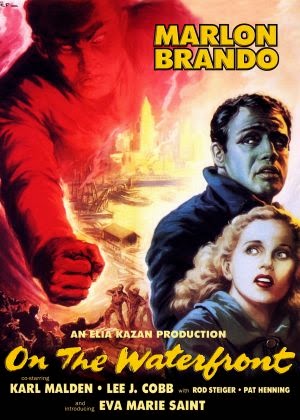
30. On the Waterfront (1954, Elia Kazan)
31. Jaws (1975, Steven Spielberg)
32. One Flew Over the Cuckoo’s Nest (1975, Milos Forman)
33. Lawrence of Arabia (1962, David Lean)
34. The Silence of the Lambs (1991, Jonathan Demme)
35. The Empire Strikes Back (1980, Irvin Kershner)
36. Ed Wood (1994, Tim Burton)
37. Faces (1968, John Cassavetes)
38. Annie Hall (1977, Woody Allen)
39. Bonnie and Clyde (1967, Arthur Penn)
40. Straw Dogs (1971, Sam Peckinpah)
41. The Third Man (1949, Carol Reed)
42. All the President’s Men (1976, Alan J. Pakula)
43. Bride of Frankenstein (1935, James Whale)
44. Rebel without a Cause (1955, Nicholas Ray)
45. Written on the Wind (1956, Douglas Sirk)
46. Swing Time (1936, George Stevens)
47. The Red Shoes (1948, Michael Powell & Emeric Pressburger)
48. Network (1976, Sidney Lumet)
49. Sullivan’s Travels (1941, Preston Sturges)
50. The Graduate (1967, Mike Nichols)
51. M (1931, Fritz Lang)
52. Zero for Conduct (1933, Jean Vigo)
53. The Rules of the Game (1939, Jean Renoir)
54. Children of Paradise (1945, Marcel Carne)
55. The Bicycle Thief (1949, Vittorio De Sica)
56. The Earrings of Madame de… (1953, Max Ophuls)
57. Tokyo Story (1953, Yasujiro Ozu)
58. The Seven Samurai (1954, Akira Kurosawa)
59. Pather Panchali (1955, Satyajit Ray)
60. Breathless (1959, Jean-Luc Godard)
61. The 400 Blows (1959, Francois Truffaut)
62. La Dolce Vita (1960, Federico Fellini)
63. Viridiana (1961, Luis Bunuel)
64. Persona (1966, Ingmar Bergman)
65. The Conformist (1970, Bernardo Bertolucci)
66. Aguirre, the Wrath of God (1972, Werner Herzog)
67. Seven Beauties (1976, Lina Wertmuller)
68. Wings of Desire (1988, Wim Wenders)
69. Women on the Verge of a Nervous Breakdown (1988, Pedro Almodovar)
70. The Killer (1989, John Woo)
71. City Lights (1931, Charles Chaplin)
72. Cabaret (1972, Bob Fosse)
73. Quiz Show (1994, Robert Redford)
74. A Night at the Opera (1935, Sam Wood)
75. The Producers (1968, Mel Brooks)
76. Lost in America (1985, Albert Brooks)
77. The Terminator (1984, James Cameron)
78. White Heat (1949, Raoul Walsh)
79. His Girl Friday (1940, Howard Hawks)
80. Out of the Past (1947, Jacques Tourneur)
81. The Piano (1993, Jane Campion)
82. Blowup (1966, Michelangelo Antonioni)
83. Blow Out (1981, Brian De Palma)
84. The Philadelphia Story (1940, George Cukor)
85. Bad Day at Black Rock (1955, John Sturges)
86. Ninotchka (1939, Ernst Lubitsch)
87. Diner (1982, Barry Levinson)
88. To Sleep With Anger (1990, Charles Burnett)
89. Unforgiven (1992, Clint Eastwood)
90. Midnight Cowboy (1969, John Schlesinger)
91. Lone Star (1996, John Sayles)
92. The Naked Kiss (1964, Samuel Fuller)
93. The Crying Game (1992, Neil Jordan)
94. Broadcast News (1987, James L. Brooks)
95. Dead Ringers (1988, David Cronenberg)
96. My Little Chickadee (1940, Edward Cline)
97. Night of the Living Dead (1968, George A. Romero)
98. Monty Python and the Holy Grail (1975, Terry Jones & Terry Gilliam)
99. Intolerance (1916, D.W. Griffith)
100. Freaks (1932, Tod Browning)