Hail Hynkel: Chaplin’s Ingenious Critique of Hitler (2013)

Charlie Chaplin was not just a movie star, he was an American icon and his fame did not simply end in the States but reached all over the globe. Furthermore, his name is synonymous with the Little Tramp who is still widely known to this day. True, Chaplin had rough patches, through numerous marriages and some unpopularity later in life, but in the early half of the 20th century, he was king. The Great Dictator not only showcased his artistry but also lambasted Hitler’s Nazi regime through the usage of outrageous humor. He used his adept skill at balancing comedy and pathos to win critical acclaim, but it also generated some controversy. Moreover, The Great Dictator is an important cultural artifact that is a reminder of a tense moment in world history.

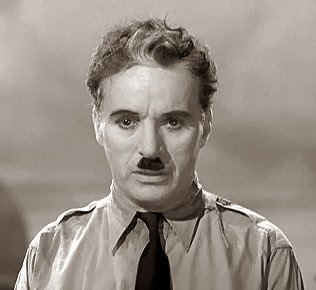
Charlie Chaplin was a perfectionist in all areas of his films and he was not any different when it came to The Great Dictator. He produced, directed, and of course, acted in the film. He played the sympathetic figure of the Jewish barber and then he delivered a grossly different performance as Adenoid Hynkel, an obvious caricature of Adolf Hitler. In fact, the first scene with Hynkel is utterly fascinating because it is so very different than anything Chaplin ever attempted before. It is a far fling from his archetypal everyman, and yet he proves his brilliant acting ability. In this introductory sequence, the Phooey is about to give a speech to his many supporters. As far as staging and cinematography go the scene is quite minimalistic. Some high-level officials sit behind their leader with a few microphones in the foreground. Cuts go almost unnoticed, the position of each shot barely changes, and the camera hardly strays from the face of the Great Dictator. The obvious focus of it all is meant to be Chaplin’s mustached masquerade. His goal is to closely emulate Hitler but then exaggerate and ridicule the Nazi leader in the same instance. During the entire sequence, the Dictator violently gesticulates and orates while an understated translator deciphers the Germanic sounding gibberish. One moment Hynkel will be thrusting his fist up in the air in a triumph of the Tomanian will. The next he condemns democracy, liberty, and freedom of speech before spouting off more propaganda about Tomania’s formidable military. His mood swings are intense and he has sudden emotional lapses especially when he recalls his former struggles with his comrades Herring and Garbage (parodies of Herman Goring and Joseph Goebbels). All the while Chaplin mixes familiar words such as Wiener schnitzel, sauerkraut, Bismarck, and blitzkrieg with, coughs, sputters, and grunts to create a sort of “Gibberman.” That along with the gestures, body language, and mustache creates an extraordinary caricature of Hitler. Chaplin is so adept when it comes to minutiae like bouncing up and down on his feet, crossing his arms, or even wiping his tears on his tie. At times these movements can easily be overlooked because they appear so natural and these small details can get overshadowed by the outrageous dialogue and gestures. Chaplin’s film ultimately succeeds thanks to the laurels of his acting ability which allows him to so aptly impersonate Hitler in an irreverent way.

1418d-the-great-dictatorOn the surface The Great Dictator certainly is a comedy, however, perhaps even more so, it is an indictment and mockery of the corrupt tyrant who was Adolf Hitler. As is the hope with all satire, Chaplin undoubtedly wanted the American public and the whole world to know how absurd and dangerous this man was. Possibly the most alarming moment in the opening speech follows the patriotic description of the Aryan which is then harshly juxtaposed with the Jews. The Aryan was the Tomanian (or German) ideal of strong men, blonde-haired, blue-eyed women, and youth who would ultimately be “soldiers for Hynkel.” However, with the mention of Jews, Hynkel positively grinds his teeth at the word. Up to this point, Chaplin’s performance is utterly farcical, but in this one instant he makes us shiver. It is important to note that this is one of the only times the camera comes in for a close-up. Since this hardly ever happens in the sequence it is surprisingly uncomfortable. Despite, the fact that the translator matter-of-factly comments that Hynkel “Just referred to the Jewish people,” Chaplin’s actions as Hynkel say otherwise. He did not just refer to them; he positively strangles them with his diction and bends them to his will, much like the nearby microphones. Thus, when Hynkel goes on another tirade and the translator says that “for the rest of the world he has nothing but peace in his heart,” you completely distrust him and Chaplin uses these discrepancies for comic effect. However, they also act as a commentary on the persona of Hitler and these inconsistencies ultimately suggest that, he too, is not to be trusted. With his directing and acting, Chaplin implies numerous other things of Hitler as well. Hynkel is power hungry, unstable, tyrannical, and dangerous to the rest of the world. The same could be said of Hitler. However, despite his oddities, Hynkel is a commanding orator who knows how to win the people over in order to control their ideology. Yet again, the same applies to Hitler. As a staunch American and believer of democracy, Chaplin attempts to bring attention to these dangers and he only hopes his audience will be attentive. His purpose was not just to make a critically acclaimed piece of art. Behind Chaplin’s art, there was an earnest purpose that transcends simple comedy.
In essence, Chaplin told two stories with The Great Dictator and this allowed his film to have a greater impact. The scene I scrutinized put a great deal of emphasis on the title character, Adenoid Hynkel. Chaplin could have simply told the satirical story of Hynkel in a way that derided such works as Mein Kampf or The Triumph of the Will. I think he did this well, but it is important to realize he did not stop there with his critique. He also represented the plight of the Jewish barber who signified not only the struggles of the Jews but of many people during the Nazi terror. Chaplin develops a great deal of sympathy for this innocent barber, and it causes the audience to be moved. As a result, there is a desire for him to succeed and though there are times when we might laugh, it is almost always with him and not at him. In one last emotional set piece Chaplin has the masquerading barber speak in the place of the dictator. He pleads with humanity to fight for peace, as ardently as Adenoid Hynkel had condemned the Jews and lauded his own army earlier. Like Chaplin and Hitler, these two cinematic figures share a few similarities, and Chaplin utilizes these features to great effect. Because Hynkel is so outrageously crazy, it amplifies the degree in which we empathize with the barber and he strikes us as all the more guiltless, while the dictator grows even more vindictive in comparison.

Chaplin began his production of The Great Dictator in a tense moment in history and his film is important when we consider that era. After 1933, Hitler was on the rise and the threat of the Nazis was becoming increasingly imminent. But in Europe, and even more so in the United States, people did not realize just how dangerous he was. Chaplin was an artistically gifted man, but also a political man who was aghast at Hitler. He knew the idealized leader portrayed in Triumph of the Will could be used as deadly propaganda to influence the masses. Furthermore, he must have also known that he had often been labeled as a Jew himself because he portrayed characters contrary to the Aryan ideal. Unlike other members of Hollywood, Chaplin did not shrink back because he was afraid of the repercussions in Germany. In fact, during this early war period, he created one of only a few films which actually tackled the issue of Hitler and the Nazis. A couple other titles would be Confessions of a Nazi Spy (1939) by Warner Bros. and then To Be or Not to Be (1942) by Ernst Lubitsch. The Great Dictator was not the first of these films to be released. However, out of these titles, The Great Dictator was probably the most celebrated and perhaps the most blatantly anti-Hitler. The American public loved the film for its comedy, which was in line with many of Chaplin’s former classics. However, Chaplin did not try and hide anything behind the film. This is not a veiled parody of Hitler; it is extremely obvious. Looking at the political climate in which he was making this movie, it is an amazing piece of cinema. In some respects it is surprising it was so well received and yet I suppose it is a testament to Chaplin and the clout that he still carried up to this point in time. You could say that Charlie Chaplin willfully took on Adolf Hitler with the film, and in many ways, Chaplin was the victor. That is quite an extraordinary achievement. Of course, with all the prestige that goes with this film, there will always be controversy. The fact is, it covers a very sensitive topic, and the use of humor can often be frowned upon as insensitive in such circumstances. Chaplin said himself that if he had “known about the actual horrors of the German concentration camps, [he] could not have made The Great Dictator.” However, it is fair to say he did not know and also this film is certainly not making light of the plight of the Jews. On the contrary, it empathizes with them so that audiences will be on their side. Thus, this film seems to be made of more good than bad and I think it is safe to say that Chaplin can be commended for the work he did.

Charlie Chaplin began humbly, then started a career in the infant film industry, and never looked back. As iconic as Charlie Chaplin is, it is difficult to refute the fact that he was a tremendously skilled performer and filmmaker who knew his craft well. The Great Dictator worked so wonderfully on multiple levels as a comedic flick and a biting satire of one of the world’s most notorious villains. Specifically, in the opening scene with Adenoid Hynkel, Chaplin creates an uproarious caricature of Hitler that is realistic enough and yet so scatterbrained to work within the context of the film. Then, Hynkel is effectively juxtaposed with the little Jewish barber who radiates naiveté. Chaplin was bold to say the least. He retired his most famous character, he made his first sound film, he played two roles, and of course, he made fun of Hitler. I suppose we would expect nothing less from one of the greatest film stars of all time. However, Charlie Chaplin not only gave us a comedic assault on Hitler, it was an indictment of anti-Semitism, a rallying call for democracy, and an urgent and universal plea for action.

My Neighbor Totoro (1988)

7eaa5-my_neighbor_totoro_-_tonari_no_totoro_movie_posterFrom the famed Japanese animator Hayao Miyazaki, this enchanting film is about two little girls and their very unusual neighbor Totoro.

The film opens with Satsuki and her little sister Mei arriving at a new home out in the country with their father. They are two energetic and rambunctious girls, who are excited by this new adventure. Their father is a kindly man, who spends a great deal of time with them when he is not working. Several other characters play a part including the elderly lady Nanny, the young boy Kanta, and of course the girls’ mother who is in the hospital. First, the girls chase dust creatures through their supposedly “haunted house.” Then, one day Mei follows a strange furry little creature under their house and then into the depths of the woods nearby.  She takes a tumble and all of a sudden she finds herself in the dwelling of a big fluffy Totoro spirit and falls asleep on its belly. When she tries to show Totoro to Satsuki and her father she cannot find him.

However, one evening as they wait for their father’s bus, Totoro comes to the stop, and this time Satsuki is introduced to the spirit who leaves them with a gift. After they spend another magical night with Totoro a few days later, the girls learn to their dismay that their mother is not coming home as planned. An annoyed Mei decides to take some corn to the hospital many miles away. Her disappearance causes a panic in the town, especially with Satsuki. She searches tirelessly for her little sister until her feet are sore. Her only other option is to plead with her neighbor Totoro to help her. Thanks to Totoro Mei and Satsuki are reunited and they see to their delight that their mother is in high spirits at the hospital.

This is certainly a film for children, but it would be unfortunate to call this a childish film. I must take a brief moment to praise the animation led by Miyazaki too. Every single image could almost be a painting they are so beautiful.  In my limited knowledge of anime, it is far above anything I have seen before. It was great to see this film in the original Japanese because it seemed more authentic, but what really struck me was the realistic nature of these young girls. Perhaps they speak a foreign language (to me) but their moods are universal. They can be extremely loud, they pout, share moments of laughter, and they love their parents.

Furthermore, this story does not need some major conflict to drive the plot. Their father is a loving open-minded man who does not even briefly doubt their adventures. I was even thinking that the obvious turn of events was that their mother would die and yet that is not the case. What this film really has is a wonderful innocence which can be appreciated by all ages. Instead of creating some major pathos we are simply able to enjoy this magical friendship between this remarkably cute fluffy spirit Totoro and these two girls. I certainly cannot wait for more from Studio Ghibli and I’m sorry that such an artist is retiring soon.

 
4.5/5 Stars

Miracle on 34th Street (1947)

Starring Edmund Gwen, Maureen O’Hara, John Payne, and Natalie Wood, the film tells the heartwarming story of an old man who acts as Santa Claus for the Macy department store in New York. However, Kris who is a very warm person (Gwen), truly does believe he is Santa and he is constantly being kind to others. Despite his popularity, a sour psychologist claims Kris is crazy and the case goes to court to decide once and for all if he is Santa. Although the case seems bleak, Kris is enlightened by the fact that his test case family (O’Hara and Wood) finally believe in him. Through a series of extraordinary events his lawyer friend (Payne) is able to win the case right before Christmas. Pretty soon Kris seems to prove that he really is who he said he was. This is one of the great cheering Christmas classics of cinema.

5/5 Stars

Merry Christmas everyone!


It’s a Wonderful Life (1946)

This is not only a Christmas classic but a classic in any sense of the word. It is the best of Stewart and Capra adding up to one of the most heartwarming stories of all time.  This may exhibit Stewart is his everyman role once again, but it breaks away from Mr. Smith in many ways making it another uniquely great film. A film like this that makes you know and feel for characters so profoundly is certainly worth watching.
Starring Jimmy Stewart and Donna Reed with a fantastic supporting cast,  the film tells the life story of George Bailey. We watch with the angel Clarence as he sees George’s life unfold. George saves his brother Harry as a boy and as a result, loses hearing in his ear. He works in the Bedford Falls drugstore and keeps the proprietor Mr. Gower from making a deadly mistake. Later on, he plans to travel the world and go to college so he can escape his hometown and do bigger and better things. But once more he sacrifices. One fateful day, he doesn’t know it yet, but he meets the love of his life Mary, and the same day his kindly father has a stroke. Soon after,  Harry goes off to college and George is left holding down the fort at their father’s old building and loan. He builds up all those around him with selfless kindness, while simultaneously standing up to the grumpy millionaire Mr. Potter. Eventually, he marries Mary and has children. First, during the Depression George gives up his honeymoon to keep the building and loan open. Then, during WWII while his brother and others become heroes, George stays in Bedford Falls because of his poor hearing. In this post-war period, the story picks up in the present.

Although, by unfortunate circumstances George Bailey finds himself contemplating suicide after the absent-minded Uncle Billy misplaces $8,000. That’s when Clarence comes into his life to show George just how important he really is. George sees a world where Harry is dead, Mr. Gower is a disgrace, Martini does not own the bar, his mother has no sons, Uncle Billy is insane, Violet is disgraced, Bert and Ernie do not know him, Mary is an old maid, and Mr. Potter has monopolized Bedford Falls.

Once he gets his life back George finds immediate joy and gains so much because of his friends and family. He runs through the streets of Bedford Falls yelling out “Merry Christmas,” because he is simply grateful to live again. Miraculously, the whole town rallies around him, and George reaps the reward for all he has sowed over the years. Clarence is finally awarded his wings and George Bailey is the richest man in town. There is nothing much to do after this film but simply be happy and sing “Auld Lang Syne.” It is a Wonderful film in many ways, with a wonderful cast, and a wonderful message. It has some of the greatest character development of any film ever because you do not simply become attached to one man but an entire community. That’s what makes the scene where Uncle Billy loses the money one of the most difficult for me to watch. Each and every time I’m so attached to these people. Even if I already know the resolution, I cannot bear for anything bad to happen to them. In fact, it is interesting to focus on just one of the supporting characters and see how they are affected by the life of George Bailey. It makes me ask myself if I were to die tomorrow would anyone care? We know in the case of George they certainly would.

I am further reminded of the phrase that is written on the wall of the building and loan, “You can only take with you, that which you give away.” This is what George Bailey did, and I believe it is something that each and every one of us should be mindful of. He is a great character not only because James Stewart played him genuinely and with such magnetism and heart, but because he was such a sacrificial figure. True, this is a sentimental film given the title and the director, but it is paramount to realize the progression this film follows. George must sink into the depths of his despair and disillusionment before he can truly realize that It’s a Wonderful Life. I would challenge you the next time you watch this film, to not simply acknowledge it as perennial Christmas fare, but look a bit deeper because there is so much more here. As always, Attaboy Clarence! You did it again.

5/5 Stars

The Bishop’s Wife (1947)

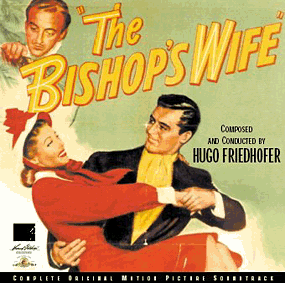
Starring Cary Grant, Loretta Young, and David Niven, I would certainly consider this film a Christmas classic. It opens and we are introduced to the kindly and handsome angel Dudley (Grant). When a Bishop prays for guidance in the difficult task of building a Cathedral, Dudley is sent to him. The once genial man has become frustrated and troubled, making life more difficult for his loving wife. When Dudley arrives, Henry finds out in disbelief that he is an angel. However, to everyone else Dudley is simply a charming man who has come to assist Henry. Everyone gravitates towards his kindness, except Henry. Dudley befriends an old professor, is kindly to the servants, helps their little daughter, and above all makes the Bishop’s wife happy by spending time with her. Over time he becomes attracted to her but she doe snot feel the same way. A jealous Henry stands up to the angel and realizes he must strengthen his marriage. Before he leaves Dudley explains he will not be remembered and he will not reutrn. Then on Christmas Eve the Bishop delivers a sermon as a new man. Dudley look on contentedly, knowing that he wrote the sermon. Most importantly he fixed the Bishop’s attitude and marriage so he could continue doing good with or without a cathedral. Grant’s charming portrayal reminds me somewhat of Clarence Oddbody and it makes sense because Henry Koster directed James Stewart in Harvey as well.

4/5 Stars

Holiday Affair (1949)

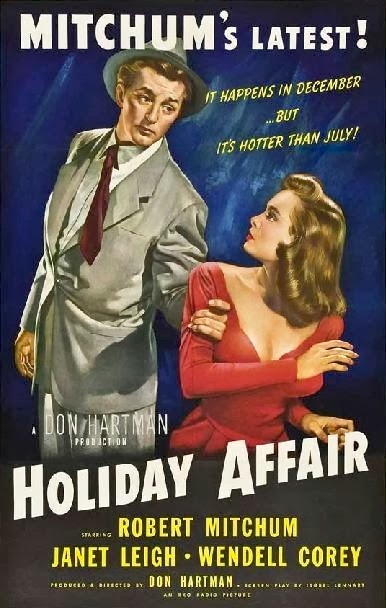
a869b-holidayaffair1949Starring Janet Leigh and Robert Mitchum, this Christmas romantic comedy revolves around a young widow, her son, and the two men in her life. The film opens with Leigh shopping at Crowley’s in New York and buying a toy train from a clerk. She takes it home and her excited boy sneaks a peak at it. However, as the sales person suspected she is a comparative shopper who returns the train. He is about to report her but does not, which costs him his job. Over time, he becomes better acquainted with Connie Ennis, her boy, and her kindly but unexciting boyfriend. Timmy then wakes up on Christmas morning to find the train under the train for him. However, as Mrs. knowns it was not from her and she goes to see Steve. She tells him of her upcoming marriage and they have a falling out. Later, Steve is taken in by the police suspected of thievery, and must be bailed out. He is then invited to Christmas dinner which is also attended by Connie’s parents. Steve announces that he loves Connie and she tells him to leave. Timmy returns his train the next day so Steve can have the money. Soon her boyfriend realizes it is over and then Connie has a confrontation with Steve. However, in the end she realizes her true love for him and she and Timmy follow him to California. This is a relatively unknown Christmas film with a lot of Christmas spirit.

3.5/5 Stars

The Caine Mutiny (1954)

With a stellar cast starring Humphrey Bogart, Van Johnson, Fred MacMurray, and Jose Ferrer among others, the film begins with a young ensign assigned to the mine sweeper named the Caine. After the first lax captain is reassigned, their new commander Queeg (Bogart) is a stickler for detail and order. After a series of incidents the crew becomes increasingly annoyed with him. The situation worsesn when Queeg begins to obsess about a few missing servings of strawberries. All these events boil over during a typhoon when the second-in-command (Johnson) prodded on, feels Queeg is unfit for command and he takes over control of the Caine. In the ensuing court martial, he is put on trial for mutiny and his attorney (Ferrer) must try to show Queeg to be truly unstable. Although he wins the case, everyone soon comes to realize Queeg was just a war-wearied man who gave a lot of himself. Despite some stark revelations the young ensign finally marries his girl and gets a pleasant surprise when he is reassigned to another boat.

4/5 Stars

National Film Registry Results for 2013!

Here were the submissions to the National Film Registry this year, including a few of the films I nominated. (3 were from my top 10 and for the life of me I cannot figure out how I missed nominating the Quiet Man). Hope you enjoy and you can send in your own nominations for 2014 if you go to the National Film Registry website.

Bless Their Little Hearts (1984)
Brandy in the Wilderness (1969)
Cicero March (1966)
Daughter of Dawn (1920)
Decasia (2002)
Ella Cinders (1926)
Forbidden Planet (1956)
Gilda (1946)
The Hole (1962)
Judgment at Nuremberg (1961)
King of Jazz (1930)
The Lunch Date (1989)
The Magnificent Seven (1960)
Martha Graham Early Dance film (1931-44)
Mary Poppins (1964)
Men & Dust (1940)
Midnight (1939)
Notes on the Port of St. Francis (1951)
Pulp Fiction (1994)
The Quiet Man (1952)
The Right Stuff (1983)
Roger & Me (1989)
A Virtuous Vamp (1919)
Who’s Afraid of Virginia Woolf (1966)
Wild Boys of the Road (1933)

The African Queen (1951)

1c3a0-the-african-queen-1With the ultimate pairing of Humphrey Bogart and Katharine Hepburn, this film throws together two starkly different people in extraordinary circumstances. Hepburn is a prim and proper missionary in Africa whose brother dies after a confrontation with German soldiers. Bogart is the rough-edged pilot of an old steamboat christened The African Queen. Together they take on the dangerous task of going down the river in order to sink a German ship. At first they are both at odds with each other and struggle to cope with their situation. However, with no one else to turn to, over time, they become close. Their bond is so great that they are willing to die rather than to be separated. This is truly a heartwarming story of love and loyalty with two legends who literally light up the screen.

5/5 Stars

In a Lonely Place (1950) – Film-Noir

Starring Humphrey Bogart and Gloria Grahame with direction by Nicholas Ray, the film is about a struggling screenwriter with a hot temper. Dixon Steele (Bogart) has not written a good script in a while but then one evening he has an enthusiastic young woman explain a novel he is supposed to adapt since he has not read it. Everything goes seemingly normal however the next morning she is dead and Steele is the main suspect. The police investigate, including Steele’s detective friend, but a neighbor gives an alibi which seems to save Steele. Soon Grahame begins to fall in love with him and vice versa. However, she soon realizes his violent side and second guesses Steele’s innocence since he has such a violent history. Although they are to be married it is broken off when he finds out she was going to leave. Only then does Grahame find out he was indeed innocent but the damage is already done and their relationship cannot be saved. This is a pretty good film noir with powerful characters.

4.5/5 Stars