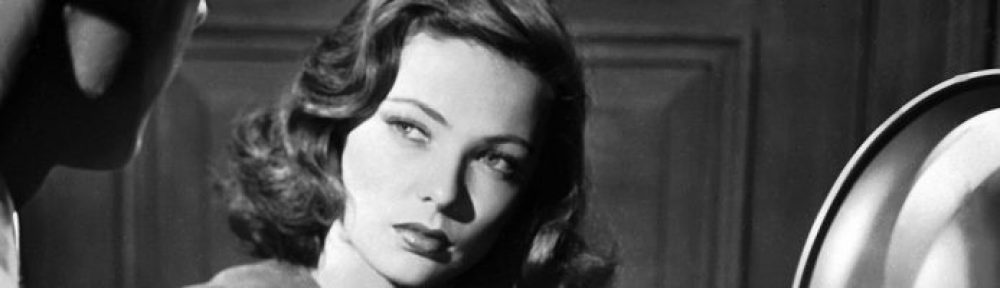
Christmas Holiday (1944): A Deanna Durbin and Gene Kelly Noir

christmas holiday 1.png

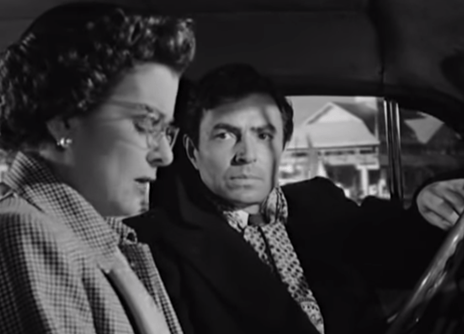
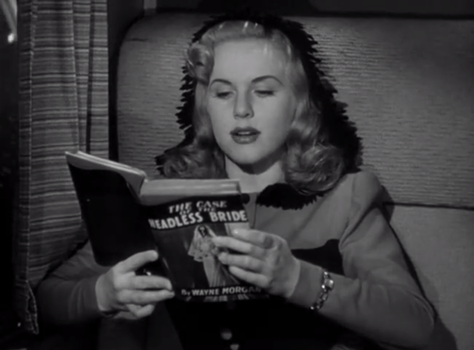
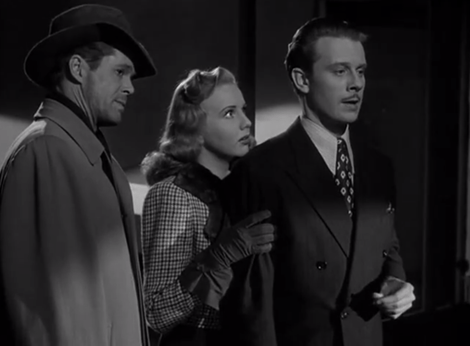
Christmas Holiday begins as a movie we’ve probably seen before countless times. A returning G.I. (Dean Harens) is getting ready for some Christmas leave except our star is as stiff as cardboard and that comes before he gets the sobering news. The girl he was intent on marrying has duped him to go get hitched to another man. Despite the pleading of his happy-go-lucky war buddy, he makes the decision to head out to San Francisco all the same.

Inclement winter weather sets up a dark and stormy detour in New Orleans and fortuitously takes the story into slightly different terrain. Unfortunately, Herman Mankiewicz’s script takes so very long to frame its story, it feels like there is a lot of catching up to do.

Although the picture is directed by quintessential film noir craftsman Robert Siodmak, Christmas Holiday is a weird clashing of discordant elements, namely musical numbers with the chiaroscuro malaise of noir. Irving Berlin’s compositions even make an appearance in the form of “Always” repeated throughout the picture as a bit of a romantic musical cue.

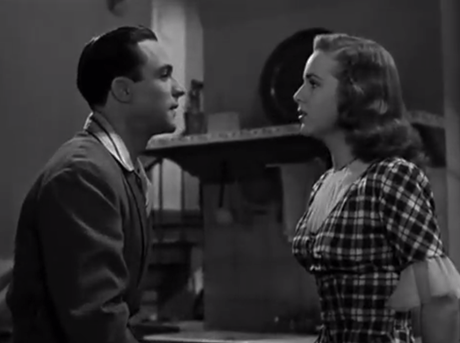
On first glance, such a dreary picture doesn’t become Deanna Durbin. She is a songstress first and apt at romantic comedy. And yet in keeping a broader mind, she isn’t too bad in this one. It seems like the material itself is to her detriment, that and an equally jarring characterization by her leading man. Because if we’re honest, a dark, brooding Gene Kelly almost feels like an oxymoron — especially as he plays a craven murderer named Robert Manette.

Again, if we run the same test and give him the benefit of the doubt, it simply does not take, regardless of the material. He feels out of his element, and it’s nominally okay because we have so many future forays to appreciate him for. Still, it does leave one scratching one’s head. While early in his career, he had already made For Me and My Gal as well as Cover Girl so it’s not like no one knew he could sing and dance.

If we summed up the glut of Christmas Holiday‘s plot, it is a less effective riff off Shadow of a Doubt in the sense that we have an everyday man who also moonlights as a murderer. I suppose most killers are like that, but the dichotomy is made so blatant with Joseph Cotten in the former film and Gene Kelly in this one. Similar to future projects like White Heat or Psycho, there is also a mother complex, albeit far less intriguing.

As much as I love Siodmak to death, it’s hard to champion a rather tepid release like this. Measured criticism once again falls on the script, which spends time setting up a character who is only of peripheral importance. It invests in a romance we already know through flashback ended tragically. Any attempts for tension between mother and daughter-in-law feel essentially dull and uninspired.

There’s no pace or ticking time bomb revealed to keep us fully engaged in these dealings until the last possible moment. This is when Manette is out of prison and returning to his missus, whom he believes has been unfaithful. Then, the expected rush from the fateful confrontation is all but nonexistent. Durbin’s wounded reaction is probably the best part.

Based on a Somerset Maugham story or not, the title Christmas Holiday also feels like a total misnomer. In fact, the entire movie feels like a sidebar conversation to what should have been a different film altogether. Man was not meant to subsist on atmospherics alone. There needs to be some form of compelling narrative or at least interesting ideas to mull over. Christmas Holiday is lacking in this department.

3/5 Stars

Jojo Rabbit (2019): Taika Waititi’s Newest Coming-of-Age Story

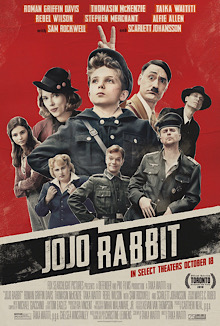
Jojo_Rabbit_(2019)_poster.jpgWe must acknowledge the elephant, or rather, the rabbit, in the room. Grappling with the intersection of Nazis and humor has always been a loaded and controversial topic. But usually, it fosters conversation nonetheless so here’s an attempt to provide some meager context.
The Great Dictator (1940) and To Be or Not to Be (1942) are two of the most prescient films to come out of their era, years before we would get the campy buffoonery of Hogan’s Heroes (1965-71) or Mel Brooks’ irreverent breakout The Producers (1968). Even something more squarely dramatic like Roberto Benigni’s Life is Beautiful (1997) is still buoyed by laughs. Understandably, with each of these examples, there have been detractors who have called into question the ways in which they tackle the historical moment given the subject matter.

I am not here to tell anyone they are wrong. There’s also the reality that the issues being wrestled with are still very real, and even after 75 years, in many cases still very raw. All of this must be taken into account.

For instance, I recall the first time I learned about Alfons Heck, trained up from the age of 6 to be a loyal cog in the Nazi propaganda machine. Only years later, did he come to terms with all the lies he and his generation of German youth were being peddled. He subsequently toured the university circuit in the states with Holocaust survivor Helen Waterford denouncing the ills of ideological brainwashing, lest we forget it ever existed.

Or I was reminded of Hans Detlef Sierck (better known as renowned film director Douglas Sirk), who after marrying a Jewish woman, was blocked by his first wife, an ardent Nazi supporter, from seeing their son Klaus. The boy would become a child star in Nazi cinema, although he eventually died in combat in 1944. Sirk never saw him again.

These are stunning reminders of how virulent ideologies can tear lives apart and this is much of what Jojo Rabbit occupies itself with. But the difference is taking the negativity and making it positive. This is a tale about empathy, understanding, anti-hate if you will. If you accept the term leniently, it is a satire, but I tend to see that word coming with a bite or an irony (not unakin to Sirk or Billy Wilder).

However, this story is mostly full of warmth, good-humor, and because this is a Taika Waititi production, wackiness. Mind you, that’s generally a compliment. The opening refrains of “Komm, gib mir deine Hand,” known in the English-speaking free world as “I Want to Hold Your Hand,” equates the nationalistic fervor to Beatlemania, recontextualizing the history but also giving it a raucous vibe. 

Consequently, some people will find Jojo Rabbit at best inane and inconsequential and at worst, offensive — as is the case when anything as sensitive as the Nazis is brought to the fore. In an age of political correctness, it’s a film trampling a danger zone where racial epithets and maledictions leave the tongues of oafish buffoons. One decidedly ironic line curses a “female, Jewish Jesse Owens.”

This is where the movie and Taika Waititi — as an emblematic supporting character — are able to succeed. It sings with a warm benevolence that proves unerringly sweet. Empathizing with those with whom we would do well to connect with and undermining the villains’ remnant of cultural clout.

It starts with our hero Johannes “Jojo” Betzler (Roman Griffin Davis) a kind-hearted young boy. His is a bildungsroman story like we’ve seen time and time again (even from Waititi). Because he is a creature of innocence, despite what the culture leads him to believe about himself. Because the difference is he, like Heck or Sierck, is coming to age in the fanatical regime of the Nazis where he is being trained up to be a good little soldier.

He’s adorably inept and faint of heart like any young lad dealing with the peer pressure around him. As a 10-year-old he still can’t tie his shoelaces nor can he muster up the needed brutality to kill a bunny during the local war games. His only real friend is the rolly polly, bespectacled Yorki. He also has an invisible friend: the imaginary dopey incarnation of Adolf himself, portrayed by Waititi.

In a sense, taking this prominent role on, with his inherent slapstick and humor, allows the director to possess the man and deconstruct him, ridiculing him from within. It’s not elemental but like many of the Nazis portrayed in Hogan’s Heroes, Waititi has some Jewish heritage, further underlying his caricature.

Rebel Wilson is good for a few of her typical bawdy punchlines and Steve Merchant as the creepily skeletal, smiling Gestapo man manages to walk the film’s tightrope of humor and lingering menace quite well. Sam Rockwell is another walking joke waiting to go off, and yet even he is allowed moments of warmth and ultimate redemption.

Scarlett Johannson asserts herself in a maternal role as one of the legitimately decent people in the movie. Whether or not it’s one of her best performances, I’ve never seen her quite like this and that is compliment enough. She reminds us, through her affectionate devotion toward her son, the powerful, if monumental, undertaking parenting can be. How goodness and decency can cover a world of sins. How laughter and yes, even dance, can be a window to some small semblance of humanity.

One is also reminded Waititi is a genuine storyteller because it’s a tenuous line to balance humor with the bleakness, injecting the story with tension and tragedy in equal measures. You half expect the film to skimp on the ruthless nature of Nazism in favor of far easier put-downs. Instead, it searches out hope within the world and less fickle themes, without entirely dismissing reality.

Thomasin Mackenzie (the brilliant actress from Leave No Trace) goes part of the way in making this possible. Because she is the girl in the walls. She’s not a rat. As Jojo comes to realize, she’s a person. A victim certainly, but she’s also got strength and defiance. After all, her people have a history of wrestling with angels. She comes out of the same hardy tradition.

What she brings into the picture is a complexity to upend everything in Jojo’s fanciful mind. What first begins as a horror trope quickly evolves almost reluctantly into mutual understanding. If his relationship with his mother holds such a stake in his life, this curious new friendship is the crutch of the film, containing its message.

In the final moments, life is back to some form of normalcy. They stand out on the streets letting their bodies free for the first time set to David Bowie’s “Helden” (or “Heroes”). Instantly this feels like Perks of Being a Wallflower and yet somehow this kind of association doesn’t feel wrong because I think Waititi worked so hard to not make this just another WWII movie cut out of the same mold.

It has this universal feeling of adolescence while not totally disregarding history and yet it’s free and comfortable enough to pull it out of its context and flair it with colors and touches of humor. The joy is how heart and hope are the final building blocks even beyond the laughter. The key is how it’s never at the true expense of the victims. Somehow it’s more tender than I was ever expecting. It wants to continue the conversation. Whether or not you agree entirely with its methods, it does seem like a noble task to undertake.

3.5/5 Stars

The Naked City (1948): One Out of Eight Million Stories

thenakedcity1.png

The Naked City begins inauspiciously enough with a flyover of New York and an introduction by producer Mark Hellinger. It seems like we’ve seen this countless times before. It’s almost like a stock image. And yet in the case of this picture, it was really one of the forerunners of a movement.

Here we have one of the first pictures to give us a sense that this is only one story in a whole patchwork of stories. There’s a loose, stream of consciousness to the proceedings as we meet people and overhear their conversations only momentarily as they go along with their daily lives.

But initially, we are introduced to an entire cross-section of people in the dead of night when most are slumbering peacefully at home. Although the street corners, places of business, and entertainment hubs are still bustling. And of course, in other spaces, we have the murder. The topic of interest in this story.

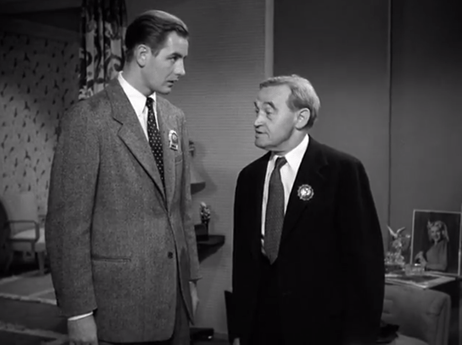
We are afforded the same opportunity to get a view into the lives of our detectives, the bright-eyed veteran Lt. Daniel Muldoon portrayed by everyone’s favorite brogue-voiced leprechaun Barry Fitzgerald. Don Taylor comes on as the fresh-faced cop and family man taken under his wing. This is the picture that made me take note of his earnest talents as a dashing everyman.

Soon they are looking into the tragic death of a beautiful young model, Jean Dexter. Until it comes out there might be more too it than meets the eye. Also, another man’s body is fished out of the drink. For the time being, they are isolated events.

The Naked City is at its best giving this beat-by-beat rundown of the case as it happened. True, it’s a compromised documentation from director Jules Dasson;  it’s not like we’re watching a docudrama. All the same, it proves a fascinating cultural artifact giving us so many authentic pieces of context. It becomes a matter of parsing through the real footage taken on the streets and then actors going through the paces of a Hollywood storyline.

Not only does Mark Hellinger supply a certain ethos to the picture, he actually remains an important piece of the story, adding his own glib commentary in a one-way conversation with the actors who play a part of the case. A more tragic note is the fact the producer and one-time journalist would die before the picture was even released. But his crucial fingerprints on the narrative cannot be disregarded as the case pushes on.

There is Howard Duff as Frank Niles, a man whose reputation begins to falter with every word that comes out of his mouth and every subsequent question he dodges. Corroborating his facts, it becomes apparent he’s lying again and again to the authorities.

Even his fiance (Dorothy Hart), a model who worked with the deceased woman, is oblivious to many of his dubious activities. But certainly, he cannot be the murderer. He has an alibi. There must be another culprit. Muldoon settles on his old friend, “J.P. McGillicuddy,” a convenient placeholder for the unnamed perpetrator they’re trying to smoke out.

The work of a detective is never done as the dead girl’s parents come to identify the body and bemoan the fact their girl went bad after having such a tough childhood. There’s a pursuit of a fugitive down a fire escape that leads through the streets and reaches a dead end when he’s able to shake them aboard the subway. But they’re getting close to something.

Detective Halloran gets the go head to follow a hunch of his own — a long shot that becomes surprisingly relevant to their case — and the legwork leads to an elusive wrestler named Willie Garzah (Ted de Corsia). However, as has a habit of happening, find one lead and a whole slew of others start falling in your lap. Things start happening.

They involve Niles, who of course, has been up to more than he was comfortable divulging. Also implicated are a doctor and Garzah as well. The others know they have been caught red-handed, but what is a police procedural without one final showdown? The chase for Willie Garzah takes off and finally finds him on a bridge climbing for his life as the police flood the area.

The final outcomes are not altogether unexpected but the fact New York plays such a concrete role in this drama greatens its appeal, and it helped develop a tradition, an affection even, for on-location shooting in The Big Apple.

Fittingly, everything is wrapped with those indelible words that would become immortalized on television forever, “There are eight million stories in New York City. This has been one of them.” It really is a producer’s dream for a serialized television show, but in its day it made a darn good crime movie too.

4/5 Stars

Classic Movie Beginner’s Guide: 1950s Film Noir

We follow up last week’s guide to classic film noir of the 1940s by continuing into the 1950s with 4 more entries. With the new decade came new progressions in realism, location shooting, and heightened character psychology.

As Paul Schrader wrote, the noir hero started to “go bananas.” What remained were graft, corruption, and the depravity of the human heart. True, gumshoes and femme fatales were never cut-and-dry. Now they were even less so. Enjoy!

Gun Crazy (1950)

Image result for gun crazy 1950

B movies form the backbone of this often down and dirty genre. There are few better than Joseph H. Lewis’s Gun Crazy an exercise in inventive economy. It tells the tale of a romance-fueled crime spree with verve and violent passion. Although mostly forgotten today, John Dall and Peggy Cummins do a fine rendition as a latter-day incarnation of Bonnie and Clyde

The Big Heat (1953)

Image result for The Big Heat

It’s a cops and robbers procedural with Glenn Ford as the straight-arrow family man going against the local mob. What Fritz Lang does is boil it over with newfound vindictiveness. We soon find out the good guys aren’t always untarnished nor the noir dames (Gloria Grahame) always the villains. True to form, Lee Marvin plays an incorrigible heavy.

The Killing (1956)

Image result for the killing 1956

It’s early Stanley Kubrick so some might find it a stark contrast to his later works. Regardless, it’s one of the finest heist films of all-time. Because the best-laid plans — even the most meticulous — always have a habit of going awry. The set-up is gritty and no-nonsense with a cast headed by a fitting protagonist: Sterling Hayden. Likewise, it’s ending just about sums up film noir fatalism.

Touch of Evil (1958)

Image result for touch of evil 1958

It’s often cited as one of the final signposts of classic film noir. With its tale of below the border corruption instigated by a portly Hank Quinlan (Orson Welles) against a Mexican policeman (Charlton Heston) and his wife (Janet Leigh), it more than fits the parameters of the genre. The extended opening shot is just one stunning testament of Welles’ vision as a director.

Worth Watching:

Sunset Blvd., In a Lonely Place, Night and The City, Where The Sidewalk Ends, Ace in The Hole, The Narrow Margin, Kansas City Confidential, Pickup on South Street, Night of The Hunter, Kiss Me Deadly, Bad Day at Black Rock, Murder by Contract, and so many more.

The Man I Love (1947): Ida Lupino Steals The Show

The_man_I_lovesmallIt feels like we might have the courtesy of a bit of Gershwin masquerading under the cloak of noir. We find ourselves at a hole-in-the-wall jazz joint after hours. Club 39 feels free and easy with an intimate jam sesh. Petey Brown (Ida Lupino) is having fun with a rendition of “The Man I Love.”

What strikes us is her breezy confidence. Everyone seems to like her, and she knows how to get by on her own laurels. So though we might begin on a New York street corner, this is all merely the set-up supplying not simply a preexisting world but the core tenets of our main character. We come to like her right from the outset.

However, quickly our action is transplanted to Long Beach, California because catching a bit of the homesickness bug, Petey goes to call on her two younger sisters and brother for the holidays. Could it be she brings darkness into sunshiny suburbia? Again, that would be a negative.

Instead, she comes back into her family’s lives to play the role of big sister and Ms. Fix-it, leaving their lives better than when she arrived. The eldest sister, Sally slings spaghetti for a living, and she’s angelic. But one Nicky Toresca (Robert Alda) has his eyes on her because his uncle runs the restaurant. He’s a real cad (On a side note: I will always have gratitude for Alda for bringing his son Alan into the world to star in M*A*S*H).

Admittedly, his sleazy charisma is pretty smooth, but it turns ugly on a dime. This isn’t just a dismissible instance of being “fresh;” it’s blatant, out-in-the-open harassment, and it grieves me to see. Because from everything we have been coming to terms with in the world, it is all but the norm. I am reminded of Janis Paige’s article bravely recounting her own real-life experience.

A movie like this can easily turn everything into an instance for melodrama, and we cannot blame it too much because it is meant to be riveting. Regardless, this is a film full to the gills with angry men. Sally’s own husband, a war hero, is under observation at the hospital for certain volatile instabilities. The girls’ younger brother Joey pushes back against the chiding of his siblings as he gets more involved running errands for Torresca.

Across the hall, a generally affable Johnny O’Connor is jealous over his glamorous wife (Dolores Moran), who finds her twin sons and a middling marriage to be a bore. Ida Lupino is the one who can capably joust with them all, because, of course, she’s from New York. She’s been around and partially to shield her sister, she takes up a job as a lounge singer at Toresca’s club. He’s got his paws and lecherous eyes all over her.

Even she falls for a man, a tragic and equally tormented pianist San Thomas (Bruce Bennet) with demons of his own to exorcise. So amid this constant collision of temperaments and personalities, there’s bound to be a firestorm of emotion, ultimately blowing up in a need for release.

Raoul Walsh is an old pro at manning stories even if this one feels slightly out of his typical wheelhouse. However, The Man I Love is blessed with a wide-ranging, truly eclectic cast. In fact, for the amount of time it has to work with, it’s genuinely surprising how many characters it chooses to erect.

Admittedly, despite the diverse spread, they could have used more shading on a whole. Martha Vickers, in particular, feels like a bit of a letdown, because her part is so tepid as the youngest sister who would rather stay home than go out with boys. Especially in juxtaposition with her scene-stealing turn in The Big Sleep, it seems like a monumental waste. Alan Hale also gets a lackluster part to fill.

So while not everyone is exactly electric (all but Lupino are fairly drab), the sheer variety of talent makes for some intriguing dynamics to go with all the genre pieces. I’m tempted to consider it a woman’s picture — more melodrama than noir — but why split threads? Infused with jazz and romance and even a bit of holiday cheer, there are some agreeable facets to the ambiance being created.

When the time comes, Petey drifts out of her family’s life and heads back out into the great big world ready to come back when she’s needed again. Wouldn’t we all like a person like that in our lives? But then real life doesn’t work quite like that. Messes are not remedied so easily. Oftentimes the pain and suffering have lifelong consequences that cannot be conveniently tied together by a Hollywood ending.

3/5 Stars

Somewhere in the Night (1946): John Hodiak and Amnesia Noir

Somewhere_in_the_Night_-1946-PosterOf the plethora of returning G.I. films and film noirs, this one reflects their fears most overtly and for this very reason, it might be generally the most forgotten today. That and the assembly of a lower-tier cast. Most of these names have been lost to time.

The one name remaining fairly enduring and bright in the annals of cinema is Joseph L. Mankiewicz who while still early in his career, was carving out a name for himself as both a writer and a director, following a stint producing. Somewhere in the Night is an early showcase for his skills.

He brings us an amnesia plot from the POV of a wounded veteran who has no idea about his own past. The soldier’s wartime injuries made sure of that and while he cannot speak, his mind is alive — an opportune moment for Mankiewicz to call on some illuminating voice-over. If anything it tells us how little this man knows and sometimes that is enough.

George Taylor (John Hodiak) finally returns to New York trying to start afresh and piece his life back together. All he has to go on are a few stray belonging from his former life. Everything, from his previous residence at the Martin Hotel, to a letter, and $5,000 deposited in his bank account, seem to lead to someone named Larry Cravat.

For the audience, we’re up for the mystery but in Taylor’s case, his identity hangs in the very balance of this question. He has to know and so he hits the pavements poking around. Henry Morgan can always be counted on in a bit part, gruffly pointing the direction to a local watering hole, The Cellar.

There a reticent Whit Bissell stands behind the bar. His face suggests he has something to say, but there’s hesitance when Taylor starts peppering him with inquiries. The bar has ears and two thugs lurk nearby. Our man doesn’t wait around to get acquainted, fleeing the scene. Instead, he wanders into the first room that happens to be open, a pretty girl’s dressing room (Nancy Guild).

The meet-cute has been sprung upon us out of necessity. Full disclosure, her singing is alright and she fits the good girl persona, but her piano playing leaves something to be desired. One must also question how easily Nancy falls in love with her deceased best friend’s former beau (This is how they connect with one another). Regardless, in watching her affable turn, you wonder why Guild never got a bigger break.

Since a good girl is never found without her foil, by pure ‘chance’ another pretty girl wanders into Taylor. It’s literally the complete inverse of the prior scene except this dame meant to be there. We don’t know why yet. The events keep on stacking one on top of the other until he’s forcibly taken for a rendezvous where he is told to stop poking around.

The story stalls when it gets talky, though it might seem a necessary evil to lend some clarity to the myriad of events. Up to this point, we have no true frame of reference. Mel Phillips (Richard Conte) becomes one anchor, as Christy’s boss who looks ready to help in any way he can. Also, Lloyd Nolan turns up as a steady police detective with an inside scoop. It turns out at the center of this entire web is hot Nazi money priced at $2,000,000. Of course.

We have mysterious messages left on windshields, house calls involving a belligerent Sheldon Leonard, Double Indemnity references, and a very familiar face; along with another ominous character. Another man named Anzelmo checks all the boxes for sleaze with his foreign accent and dubious reputation but he is only a piece in this puzzle. If this is all very oblique it’s meant to be in staying the film’s own tendencies. 

By this point, our plot is either overwhelming or monotonous as Taylor meets a homely woman sharing in a cryptic conversation that proves also deeply sentimental. Again, it is these long-winded moments that are to the story’s detriment. While Larry Cravat remains an important trigger word, one Michael Conroy is also a person of interest.

Somewhere in The Night earns its title outright around this juncture. When a character wanders into a building at the dead of night and goes down a long, low-lit corridor in search of some unnameable thing, we know we have arrived in the heart of film noir territory. There is no doubt. It feels like one of the turning points in The Big Sleep when Marlowe, snooping around, winds up finding a dead body on a carpet. An analogous outcome happens here. 

There’s a meeting of the minds in one final powwow to collectively assemble all the primary players for the long-awaited reveal.  But the final act’s twist is so obvious, it makes all the labyrinthine whirly gig leading up feel somewhat empty. However, it is often said it’s not about the outcomes but the road along the way. Taken in this light, Somewhere in The Night has its moments of genuine intrigue.

It is easy to write off the cast for their relatively forgotten status. Even Lloyd Nolan has high billing (the man most well-known for playing a detective) for a relatively minor part. But I would argue Richard Conte is an unsung hero of film noir, while the picture does give allowance for some intriguing roles in support.

Hodiak is not the ideal to hold a movie together, but he is not in this alone. It also turns out the movies were right. Detectives do always keep their hats on. Just in case they’ve got to shoot someone — it helps keep their hand’s free — makes sense enough.

3./5 Stars

Human Desire (1954): Fritz Lang vs. Jean Renoir

human desire 3.png

Edgar Buchanan always annoyed me endlessly on Green Acres reruns, and it’s affected me for a long time. Because only recently have I begun to realize just how broad and robust his body of film work is. He can be categorized with a breed of movie actor that is generally lost in today’s industry.

These were studio workhorses with filmographies so abundant it almost becomes second nature for them to don certain roles. It happens so easily and with such regularity, there’s rarely a need for explanation. It’s all right there in the character and the countless other pictures he’s popped up in before. His part is small but it doesn’t matter.

Because he is the kind of actor only Hollywood of a certain era would have utilized to his full potential. Why does any of this relate to the discussion of this film? My best explanation is the fact Human Desire is not a standalone entry. It comes from a lineage boasting Emile Zola and Jean Renoir’s Le Bete Humaine. And yet Human Desire can be viewed as nothing less than noir cranked out of the salt mines of Hollywood.

The traditions of Michel Carne and Jean Renoir, themselves in the late 30s, coalesced with the early works of Fritz Lang, like M (1931), to form a sturdy foundation to this American iteration of crime cinema. There’s no doubt Lang and Renoir were aware of each other. An obvious point of reference is the fact Lang would adapt La Chienne into a film of his own — Scarlet Street.

Human Desire is his second go at the eminent Frenchman’s filmography, albeit less to his liking. Lang’s railroad imagery isn’t quite on par with the evocative ever smoky grittiness of Renoir’s earlier effort and part of it must be chalked up to interiors which strip away much of the rail tie reality.

In even brief interludes there could be overlap with the work of the Frenchman’s father or other famed realist artists of generations before and there are quite a few lighter, brighter tones, although Le Bete Humaine is still a notable precursor to noir cinematography.

But then it gets dicey because Lang himself came out of the other tradition which all but berthed the dark genre, German Expression, with films like M or American pictures like Fury and You Only Live Once, unmistakable for their equally brooding imagery.

Renoir has an appreciation for the everyman’s daily life as it pertains to this world of grunge and brutality. There manages to be something real, this animal magnetism — a literal madness that somehow feels more authentic.

Lang picks up solely on the total bleakness of a canvas bathed in black. It’s suffocating in that sense. He also functions better within the facades and inherent artificiality of the Hollywood system. Renoir tried it too, and it proved more stifling than productive. Lang, perhaps out of necessity, used the resources more to his advantage.

After the stirring success of The Big Heat, he comes back with his two stars in Glenn Ford and Gloria Grahame to do it again. It’s unfairly overshadowed even as Grahame turns in a blistering, merciless performance as a conniving wife. But as with all black widows, the exterior begins demure and innocent enough. It only evolves and becomes more malevolently deadly as time marches on.

human desire 1

The newfound lens of a returning soldier fits into the context of the era. Because Human Desire is a story revamped for 1950s America, and it translates itself easily enough. Jeff Warren (Ford) is coming home from the army with ideals of a steady job, fishing on weekends, and nights at the movies with a pretty girl. It presents this fresh exterior just waiting to be dragged through the mire.

Because the conventions of American-grade noir, in particular, make for a compelling tale of lust and sleaze. Not that they were entirely absent in Renoir’s picture but they have a different effect.

Human Desire throws together a femme fatale and a formerly clean-cut veteran whose eyes bulge out of his sockets the first time he snatches a glance at the girl. They are not perpetrators of murder by they are implicated in the following courtroom proceedings with Warren complicit in a cover-up. There is a streamlined love triangle between Ford, Grahame, and Broderick Crawford that rarely feels interesting on its own merits.

At its best, it lives out its existence on the screen as a low-grade railway riff on Double Indemnity or The Postman Always Rings Twice. There are obvious antecedents in its French predecessor but somehow in this context, it seems applicable to canonize it as noir. Emile Zola never felt closer to James M. Cain.

I could only consider the very concrete plot points, not the literary styles themselves. Because Human Desire, of course, is not literary at all — or if it, it is only in the pulpy seediness such entertainment engendered.

Renoir could actually claim some basis in Zola’s literature, not simply by his pedigree but also by evoking the words themselves. Regardless, the two creatures have their distinct appeals for two diverse camps. There’s no question the two helmsmen were a pair of phenomenal craftsman deserving individual repute. The differences in them are as beguiling as the similarities. The same might be said of Human Desire and its forefather. Choose your poison and my guess is you won’t be disappointed either way.

3.5/5 Stars

The Blue Gardenia (1953): Anne Baxter a Victim of Noir

blue gardenia 1.png

The Blue Gardenia chooses to establish its characters and allow ample time for the audience to get acquainted with all the players. It’s genuinely a pleasure as we have a number of affable people to grow accustomed to over the course of the story.

There’s local journalist Casey Mayo (Richard Conte) and then pin-up artist Harry Prebble (Raymond Burr), giving a momentary glimpse of a Burr character who is not looking to murder someone or force himself on a woman. The fact that he’s a mere womanizer feels almost tame, showing the desensitization he is capable of instilling.

He, as well as Mayo, can be found wandering around the Los Angeles’ switchboard ward, constantly bustling with activity, call transfers and busy signals galore. The real reason for them to be hanging around are all the pretty working girls. I’m not sure it’s a great reason, but they hang around nonetheless.  The male cast is also rounded out by one of my genre favorites — Richard Erdman, as the ubiquitous cameraman, always lounging on the couch.

It’s with the female talent where Blue Gardenia samples the close-knit camaraderie of such movies as Gold Diggers of 1933 where you have a gaggle of girls living together balancing a career, a love life, and a few laughs. Crystal Carpenter (Ann Sothern) is the wise one who has lived life, maintained her looks, and currently spends evenings with her former husband the homely Homer. Sally (Ms. Jeff Donnell) is her exact antithesis as the young and unattached gal whose idea of a quality evening are dime-store crime romances.

Somewhere in the middle falls Norah (Anne Baxter), the amiable, even-tempered lady who is waiting devotedly for her man to come back from Korea (the war that is). By all accounts, they are madly in love, she has remained eternally faithful to him, and waits upon his return with exuberant expectations. Instead of spending her time out on the town, she imagines romantic meals together by candlelight with roast and champagne.

The Blue Gardenia punches up the melodrama with the disclosure of a fateful letter. It turns out her man has found true love in Tokyo, and Norah has been left adrift with her whole romantic outlook compromised. What is she to do now?

On a whim, she takes up an invitation from Mr. Prebble that was meant to be extended to one of her other roommates. She gets to the Blue Gardenia on Vine, right off of Hollywood, and soaks in the laid-back Polynesian vibe. She’s a bit unsteady, unsure of how to proceed, but she’s there. The main attraction on the floor is none other than the velvety vocals of Nat “King” Cole. His song subsequently haunts the rest of the picture as the story begins to unravel.

Because as hinted at before, Raymond Burr had a certain pedigree, before his days as whip-smart attorney Perry Mason. For lack of a better term, he was always a lascivious cad. We know what his mind is thinking because it’s always blatantly obvious from the expression on his face. Sure enough, a trip to his apartment follows, Norah gets herself more and more intoxicated — a confused and helpless victim in his lair.

He forces himself on her, and she fights him off with a fire poker. Like Philip Marlowe, she enters into a swirling pool of disorientation. It’s this bit of ambiguity laced with terror that the whole plot relies on. Equally crucial is how a victim turns herself into a culprit.

It becomes an uneasy metaphor for the way society is built around men and women are the ones blamed and villainized in certain contexts. This goes back deep into human tradition to the days when a woman’s testimony was not even considered valid in court. Implicitly, it’s as if the burden of proof is on them to prove they are innocent from the very beginning. Norah has every reason to be frightened.

blue gardenia 2.png

Because news of Prebble’s death comes out and the paper and the police are looking for the lady who left her shoes behind — this murderess who fled the scene of the crime. Here Mayo comes back into view as he promises to tell the woman’s story if only she would come forward to his paper. However, his intentions seem more driven by circulation goals than an actual charitable heart. Everyone is a wolf out for himself.

This makes it even more tragic that this woman feels so isolated and debilitated she is incapable of going to her best friends and the women around her, as they would be the ones most ready to help her. The other wrinkle is how the newshound unwittingly starts to fall for the girl he’s been looking for. It’s the height of irony even as Norah finally gets implicated in the murder.

Throughout Fritz Lang suffuses the drama with style captured not only in the most traumatic moments but also in the extensive use of tracking shots within the narrative. Still, the dramatic situation is lacking because it is hard to share the same convictions as our lead. It’s not that we don’t sympathize with her.

It’s the fact she should have nothing to be ashamed of or to be fearful about. If there was more time to isolate its themes and hone in, Blue Gardenia would be very much about the recovery process of an individual going through so much trauma. The heart and soul of the picture could be found there, but as is, there simply is not enough time to tease out these ideas.

The penultimate twist is a fine addition although it’s not as if the story can really be salvaged in one instant — happy ending notwithstanding. Despite the talent all around, the mechanisms of the storytelling alone make it apparent this was a genre quickie made with only mild regard for the material. Lang and Nicholas Musuraca are still integral to what we know as film noir — and this film is no exception — but it certainly is a less engaging effort. Probably because we know the illustrious heights they are both capable of.

3/5 Stars

Classic Movie Beginner’s Guide: 1940s Film Noir

In our ongoing series to help budding classic movie fans know where to start, I thought it would be fitting time to offer up 4 movies to try and summarize the film noir movement.

If you’re unfamiliar with the term, it’s literally the French word for “black” and it has come to describe mostly American crime films of the 1940s and 50s. Most people are probably familiar with archetypes like detectives in trenchcoats, deadly femme fatales, and brooding voiceover narration setting up flashbacks on dark and stormy nights.

It’s a foolhardy task to give just 4 examples, but we’ve done our very best here by following our gut:

The Maltese Falcon (1941)

Image result for the maltese falcon

Often considered the origin of film noir, John Huston’s debut picture is the prototype for detective fiction, based on Dashiell Hammett’s pulp gumshoe Sam Spade. It made an icon out of Humphrey Bogart while the rogue gallery filled out by the likes of Mary Astor, Peter Lorre, and Sydney Greenstreet is truly the stuff dreams are made of.

Double Indemnity (1944)

A Film Noir Icon Turns 75 - WSJ

Phyllis Dietrichson (Barbara Stanwyck) is among the preeminent femme fatales. Absolutely bad to the bone and deadly gorgeous. But she needs an accomplice, in this case, Fred MacMurray as the opportunistic insurance peddler Walter Neff. It’s film noir partially domesticated, channeling the sleaze of James M. Cain with a deliciously cynical adaptation by Billy Wilder and Raymond Chandler. Sometimes murder smells like honeysuckle.

Laura (1944)

Image result for laura 1944

Laura is film noir at it’s most dream-like and illusory with our title heroine (Gene Tierney) mesmerizing everyone including the hard-nosed detective (Dana Andrews) bent on solving her murder. David Raksin’s score helps weave the magic placed against Otto Preminger’s impeccable mise en scene and a particularly petty ensemble led by Clifton Webb.

Out of The Past (1947)

Image result for out of the past

This one checks all the boxes. Laconic hero with cigarette and trenchcoat: Robert Mitchum. A beguiling woman of destruction and deceit: Jane Greer. Gloriously stylized cinematography from the master of shadows: Nicholas Musuraca, and all the digressions and double-crosses you might expect with a labyrinthian investigation. What’s more, the past always comes back to haunt you. Film noir is nothing if not fatalistic. 

Worth Watching:

Murder My Sweet, Woman in The Window, Scarlet Street, Mildred Pierce, Detour, The Big Sleep, Leave Her to Heaven, The Killers, Gilda, The Postman Always Rings Twice, Nightmare Alley, The Third Man, White Heat, Criss Cross and so, so many more.


Brighton Rock (1947) Graham Greene’s Seedy Side of England

brighton rock 1.png

Brighton Rock, based on a Graham Green novel from 1938, opens with a disclaimer about the proceeding content. Great pains are made to differentiate the place depicted within the frames of the film — set before WWII — and Brighton circa 1947. The only reason such a note would be necessary is the fact this picture was preparing to show an unflattering side of the sea town (and also the picture used hidden cameras to film on-location). Before we have even begun, we already have a weird mixture of faux-reality with an authentic period piece. It’s certainly not a false assessment to make.

A handsome, fresh-faced lad with piercing eyes, Richard Attenborough, plays Pinkie Brown, a hoodlum to the nth degree. In fact, the actor’s performance is augmented by his obvious youth. It gives the sense of a young upstart who grew up to be tough due to his environment. He knows no other life, no other person except himself. One can only marvel at Attenborough originating the role three years prior on the stage.

The most obvious point of action begins with some blokes chasing a man named Fred (Alan Wheatley) around, running him ragged in relentless pursuit. Lady of Shanghai (1947) has the hall of mirrors. Woman on The Run (1950) has a roller coaster. Strangers on a Train (1951) has its Tunnel of Love and a haywire carousel. Brighton Rock can ably join the pantheon of morbid cinematic funhouse attractions with its own addition. The Palace Pier might be a fine place for jocularity, but it also serves as a fitting locale for murder.

The solitary person who gives a tuppence at Fred’s disappearance is the gregarious local entertainer (Hermione Baddeley), who takes a shining to him for any number of reasons. Namely, he lends her money and gives her tips on the ponies. But bless her soul, she does try her darndest to get to the bottom of his case, even as the police have already wrapped it up neatly.

The film itself conjures up a gritty world worth exploring, with the blend of British backstreet authenticity and gangster drama. We get accustomed to beer halls, grungy flats, and seaside boardwalks. Part of the joy is seeing the world of 1940s England partially untouched, as it was at the time.

Maybe it’s subliminal, because of the relationship between Graham Greene and Carol Reed by way of The Third Man, but I cannot help seeing shades of Brighton Rock in Odd Man Out and vice versa. Certainly, their characters and situations are starkly different to go with the respective terrain of Brighton and Ireland. Still, you get the same brooding sense of fatalism and the destructive nature of such lifestyles upheld by these lowbrow criminal types.

Like all the finest, most complex gangster films, what we have is the dichotomy of a criminal’s life. In “business” they can be so ruthless, and yet there is still space for family and in the case of Pinkie, love. He is prepared to murder someone for double-crossing him in one moment, and then ready to go courting with his girl the next.

The impressionable girl in question is Rose (Carol Marsh). She is a waitress who unwittingly has information to incriminate Pinkie. So he promptly goes to work on her. Being a soft touch and seeing as he has a certain amount of charm, it’s easy enough to pull off. In her naivete, she’s easily taken with him and falls head over heels in love. Ready to do anything and everything to shield him. It’s just what he wants, another person to use.

Because to the very end, we must suspect he is only keeping her close because she knows too much. As much as we want to believe he might actually love her — and be redeemed to some extent — it’s pretty clear it never happens. He remains an incorrigible reprobate, who nevertheless believes in hell and damnation.

Reckoning, for him, comes first in the form of local kingpin Colleoni who is prepared to lean on the younger hood — he’s getting too big for his britches — the police know it too. But he’s a feisty devil, continually exerting his authority over his band of cronies, even as Ida continues poking around. A racetrack becomes a perfect locale for violent tumult. Although my favorite particular image is a picketer hoisting a big sign “The Wages of Sin is Death” whilst he chows away on a sandwich, there are more imminently menacing theatrics on hand.

The rope is running out for Pinkie and his psychotic little mind sees his one last chance as a double suicide killing so he might get away. We have a sense of what he’s about to do. The rain is pouring down. He and his girl take a brisk walk out to the pier. The events are heightened by this moral imperative where death by suicide is seen as the ultimate sin on some man-made gradient.

Her we have a callow young woman who will so willingly ruin her life and blindly follow a man she thinks truly loves her. Then, there’s a criminal beholden only to himself to the very end, but Attenborough goes out and makes sure we don’t forget him even when he’s left the picture. You can’t forget someone like that nor a performance of this sleazy magnitude.

He leaves behind the gramophone recording of his voice with a malicious note, but whether Pinkie’s own tamperings or a bit of fateful happenstance the record gets caught on the phrase I love you — with everything else conveniently left out. As the camera closes in on a crucifix — the ultimate symbol of sacrificial love —  it seems a very disconcerting thing to hear Pinkie’s words echoing against it.

The music trills to suggest this is meant to be a happy ending, and yet when I see that imagery and hear those words, they don’t mesh. They remind me that the very nature of human beings is often deceptive and cruel.

If God is supposed to be good and perfect, there can hardly be any relation between our imperfect attempts at love and his, if he is indeed perfect. So if we want to retain something, it seems imperative to latch onto the word hope — what the sister entreats Rose to latch onto even as she notes “the appalling strangeness of the mercy of God.”

Graham Greene was himself an ardently religious man and even in the cynical worlds he often draws up, this hint at something else is striking. You must look upward at something greater or else take a dive into the nihilistic depths of despair. The outcomes of this picture allow for no other logical progression.

4/5 Stars