The Long, Hot Summer (1958)

The_Long,_Hot_SummerAs it turns out, Paul Newman’s a real barn burner. His family name is synonymous with conflagrations and it’s a great entry point for a character, in this case, a drifter named Ben Quick who’s run out of town by the local judge.
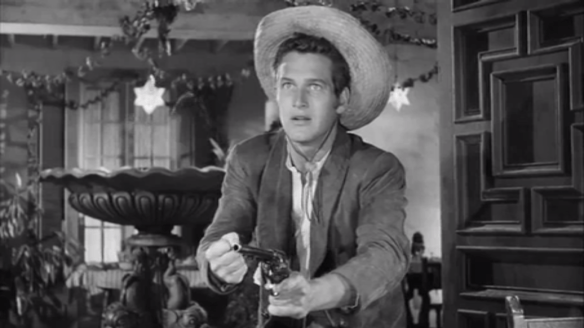
We never actually know if he was guilty of arson or not but we assume he must be. And so even with the audience, Quick carries that onus because the reputation seems to fit him. He’s a leering no-good, not to be trusted with money or women. It’s all speculation, mind you, though it cuts pretty close to the truth.

He receives some southern hospitality when a car screeches to a stop to pick him up. In the passenger’s seat is Eula (Lee Remick) with a coaxing sensuality accentuated by a sing-song twang that’s irresistible. More reserved is the driver, Clara (Joanne Woodward), who sees through Quick just like most people. She’s not about to be taken in by his animal magnetism.

This is just the beginning of a vast family drama and the names we have to thank are director Maritn Ritt, still trying to get his head above water after a blacklisting, and screenwriting stalwarts Irving Ravitch and Harriet Frank Jr.

Their tale was realized by weaving together three stories by William Faulkner that I have no prior knowledge of, matched with the atmospherics of a Tennessee Williams sweaty drama. In fact, it was released before a couple films that share more than superficial similarities, namely the well-remembered Cat on a Hot Tin Roof (1958) also starring Newman, this time opposite Elizabeth Taylor and Burl Ives. Then, there was God’s Little Acre (1958) which was probably the quirkiest and most erratic of the trio starring Robert Ryan as the head of the family.

Arguably, there’s no larger-than-life figure than Orson Welles to take the part of the portly patriarch of the Varner clan, Will, a man who puts his stamp on the local town. After a stint in the hospital with ailments, he comes back in fashion, sirens howling, so everyone knows that the king has returned. First, it’s a visit to his mistress (Angela Lansbury) who’s anxious to get married so she can have more stability. His responses remain evasive.

The Louisianna heat is no fluke and Welles is perpetually perspiring. He lends an earthiness to the proceedings that undoubtedly takes some cues from Ritt. Will Varner laughs boisterously at the catcalls of young boys directed towards his daughter-in-law, just as he conspires to get his other daughter hitched up so grandchildren can start popping out. In this regard, he’s very pragmatic (if not misogynistic). He wants heirs to maintain the family name because his gutless son certainly isn’t going to be the one to do it.

While important to the stability of the picture, by all accounts, Welles was a terror to work with for everyone on set. There are multiple indications of why this might have been. It’s all too probable he felt pressured and slightly insecure with the young upstarts coming on the scene from the Actor’s Studio, including Marlon Brando and his current co-star Paul Newman. Alternatively, with Welles being the renowned directorial power that he was, there was probably some dissatisfaction on his part because he couldn’t pull all the strings and have total control like he was normally accustomed to.

However,  put him together in a room with Paul Newman and you have two men in front of you as crooked as a barrel of fish hooks. Varner’s perceptive daughter puts it aptly, “One wolf recognizes another.” Soon they strike up a mutually beneficial deal throwing other people and lives around like they were pawns in a chess match to solely serve the two of them.

Varner wants a form of southern immortality. Males to bear his name and people to sing his praises and tame the land in a sprawling estate with spoils to match what he has accumulated over his lifetime. Quick, why, he just wants money and land and whatever else he can finagle out of the old man. What unites them is they’re both out for number one.

Paul Newman and Joanne Woodward go on their first cinematic date together and it’s a picnic in the park that ends prematurely. In real life, they would get married soon after principal photography wrapped and as they say, the rest was history. They stayed married for another 50 years until Newman’s passing in 2008. For a Hollywood marriage, this has to be some kind of record.

But regardless of what was going outside the frame, what is within the confines of the space is just as enchanting for the simple reason that they make some amount of palpable magic together. There’s a tension between them but then a certain attraction and pull that leads to oscillation back and forth in a continuous orbit of gravitation and then distaste.

In real life, it’s not what leads to stable romance but in film, it’s what dreams are made of because every sequence has an intangible undercurrent of spiritedness. It’s in the eyes twinkling. The unspoken words along with the spoken ones. Maybe it’s a lot of making something out of nothing but I would like to think it isn’t. They have something electric together.

Just as the film opened with fire, it’s another barn burning that ends the picture and gets the town in a tizzy. The irony is the very event that looks to be a dramatic firecracker actually reconciles a father and son. That’s the thing about The Long Hot Summer; it has the guts — some might say the gall — to end on an optimistic note without plunging into the throes of deep dark tragedy. Sometimes the 50s dramas take it too far. It’s almost as if they forget some of the greatest dramas historically were as much comedy as they were tragedy.

With so much talent, I’m inclined to like this one and since it all but led the pack coming out of the gates, it deserves some kudos. But best of all, the partnership between Martin Ritt, Ravitch, Frank, and Newman was just beginning, not to mention a marriage for the ages. It’s part of the reason why one can come away from The Long Hot Summer with a smile as wide as Will Varner’s.

3.5/5 Stars

The Left Handed Gun (1958)

left handed gun 1.png

Few figures in the West have the mystique in western lore as Billy the Kid, aside from a few prominent names like Wyatt Earp, Butch Cassidy, Jesse James, etc. Billy Joel even famously penned a tune chronicling the life of the outlaw.

Part of the allure, no doubt, has to do with his youth and the casting of the man as a Robin Hood type anti-hero who only robbed those with excess. Inspired by a teleplay by Gore Vidal (who for the record disliked the picture), television-turned-film-director Arthur Penn makes a conscious decision to focus his story on other facets of the character.

Although slightly older, Paul Newman came into acting about the same time as James Dean and in some respects they were cut out of the same mold. At any rate, they came from a similar school of actors training in the 1950s. Though Newman was no Dean, he does a fine facsimile here. He gives a, at times, disconcerting but overwhelmingly giddy performance as Billy the Kid and somehow his age of 33 doesn’t seem to distract from the part too much. Because he’s still holding onto a decent amount of his boyish charm and good looks.

Leslie Stevens’ script features terse often tiresome colloquial dialogue in a downright peculiarly paced western. However, this is not the main point of interest anyway. For the record, William Bonney (Paul Newman) drifts onto a ranch and is taken on by a trusting cattle rancher John Tunstall (Colin Keith-Johnston). But that same penchant for trust winds up getting him killed in an ambush.

Though he only knew the man for a short period, Billy carries a fierce loyalty and resolves to go after the four men who conspired in killing his boss pulling, his reluctant partners Charlie Bowdre and Tom Folliard into it with him. Allusions to “Through a glass darkly” from Corinthians suggests a bit of the muddled kaleidoscope that the man envisions the world through.

One morning he’s howling with his boys on a wagon heaped with flour, caked in white and the next minute he’s provoking another man to draw on him just so he can blow him away. His old friend, Pat Garrett (John Dehner), has trouble knowing what to do in the face of William’s lighting-hot personality.

The newly minted amnesty in the territory means a temporary peace, instantly obliterated by a moment of stupidity among Billy’s buddies. Though the novels back east have cast him as some fictionalized larger-than-life figure, he’s really nothing like that at all.

His buddies get it and then as the final straw, Pat vows to hunt down his estranged friend, putting on the badge of the local sheriff, after an unwanted blowup at his own wedding. Billy has alienated the one man who will make him pay. First, he brings him in to be hung and then after the kid escapes, Garrett heads out again to finish things off once.  It’s a pitiful character arc and that’s the key.

While it might be overshooting its influence to say that the Left Handed Gun singlehandedly erected a new brand of western, at the very least, it suggested a new age of the West as we knew it. Beyond this, it’s hard not to draw parallels to Penn’s later work in Bonnie and Clyde (1967) which The Left Handed Gun is an obvious precursor to in the depiction of the outsider who uses violence almost indiscriminately.

One scene that leaves an impression involves a blurred image as Billy taunts a deputy from up above, toting a shotgun and blowing him away as he squints through the sunlight. Not only is it composed as a slo-mo killing but as his body lies in the street and people run toward him, instead of screaming, a little girl looks at his solitary boot just sitting there and proceeds to point and laugh. Her mother smacks her but the damage has been done. His death is a joke. There’s no point to it. People fail to react as they have been coached to since the dawning of the cinematic western.

There’s a senselessness to the killing which explodes with an almost haphazard vengeance. In no accordance with reason or morals nor in the end by perceived good or evil. Each bullet is yet another indication of all that is idiosyncratic in the subject matter. Not a hero, not a villain, but a perplexingly near neurotic gunslinger.

Whether it’s to everyone’s taste is another question entirely. It’s more character study than drama and in this close observation, it’s the distillation of a new kind of western hero — the anti-hero, or lack thereof, that is most notable. Today it’s less interesting because we have Peckinpah, Clint Eastwood, and even Butch Cassidy and the Sundance Kid (1969).

But as a picture going against the grain, an artifact from a certain moment in time, there’s still something burning within its frames. Even if it’s not a fully cohesive effort, The Left Handed Gun is not without its flashes of artfulness and intriguing volatility. It began the work of reconstructing the mythos of the West that had been forged in the movies though there was still a great deal more to come. In fact, Arthur Penn would return to western revisioning with Little Big Man (1970) over a decade later.

3/5 Stars

Review: Cool Hand Luke (1967)

cool hand luke.png

While I might not consider it one of the finest films ever produced, Cool Hand Luke features one of the most mythic characters ever conceived for the movies. He’s one of those figures who can seemingly only exist on celluloid. Luke Jackson comes out of a certain turbulent period in American history even as his story remains indelibly timeless.

Paul Newman realized some greats throughout the 1960s from Fast Eddie Felson to Hud and then Butch Cassidy. However, this monumental role is one of his most iconic regardless of all the others that came before and proceeded it. Newman stretches himself to the edge of the frame and then some. It’s difficult to even begin to consider who else might have managed the feat if not him — furnishing both a constant resiliency and the trademark gleam in his eye.

It’s that placid demeanor and vaguely smug attitude which is above all prepossessing. A near relentless self-subjection to suffering and malevolence follows and for the most ridiculously absurd offense. Luke was bored and so he went about town slicing the tops off parking meters while inebriated. For that, he’s given a two-year sentence on a chain gang. For that, he willingly takes on the ills, disdain, and wrath of a whole community of people without hardly batting an eye.

It begins when the “fresh meat” comes to town. They’re jeered by the veterans led by the hulking southern boy Dragline (George Kennedy) and filled out like all the quality prison movies with a bevy of talented character actors. Some fairly prominent names including Dennis Hopper and Richard Davalos as well character parts for Wayne Rogers, Lou Antonio, etc.

The new faces quiver in this foreign environment, among them Ralph Waite and Harry Dean Stanton. Meanwhile, Luke Jackson sports a stellar war record though he left the military with the same rank he had going in. He was just passing time.

There’s a mild disinterest, a silent bravado, and subtle anti-establishment slant to him. He doesn’t flaunt it necessarily but it does come out. The guards and the camp’s proprietor (Strother Martin) are wary of him and the inmates don’t believe he’ll ever come to learn their pecking order.

That’s what’s so appealing about the Luke character. He could care less what other people think. He never has to prove himself. He just does what he wants and as a result, makes himself an idol of the entire chain gang without ever trying to do so.

The script, penned by the story’s original author Donn Pearce as well as Frank Pierson, is adept at creating individual moments and bits of dialogue that are in themselves so distinctive, showcasing a remarkable ability to stand on their own merit. Even now over 50 years later.

“The Night in the Box” monologue might have its imitators but it has no equal, setting up the monotonous drudgery that makes camp life, backbreaking and yet somehow strangely comforting to some men. Strother Martin famously sums up his relationship with the troublesome prisoner as a “failure to communicate” while in another sequence the girl (Joy Harmon) saucily washes her car, tantalizing all the sex-crazed men on the job.

Dragline and Luke have a boxing bout that cements the new man’s reputation as well as a budding friendship with the camp’s resident top dog. He bluffs his way through poker games to earn his iconic nickname, “Sometimes nothing is a real cool hand” Luke grins almost matter-of-factly. Everyone else howls with delight at his exploits.

Next, overtaken by a surge of giddy energy he spurs on his compatriots turning their assignment of tarring a road into a game that captures the imagination of all involved. They are taken by his spirit which never seems to sour. It’s the same temperament that will lead him to eat 50 eggs in under an hour just for the heck of it. Whether he meant to or not the whole cohort feeds off of him, even as some spurn his attempts at individuality — most gravitate toward the man. From thenceforward, outstretched on a table like a Crucifix he is cast as their Christ-like figure.

A flurry of escape attempts is spawned by the news that his mother has died. The outcome was all but inevitable. Still, that doesn’t make it sting less. The conversation shared between the two of them earlier is only one minor scene of dialogue, and yet together Newman and Joan Van Fleet make something impactful out of it. Thus, when Arletty dies, off camera, it has critical implications for the man. For once, he shows some type of emotion; he cares about something.

Luke can be found strumming away at a banjo singing “Plastic Jesus.” Not being able to get away for the funeral he resolves to sing her a dirge of his own. The rest of the film is backed by Lalo Schrifrin’s score laced with a down-home country meandering melody contributed to by an arrangement of guitars, banjos, and harmonicas with more traditional string and brass sections. It’s the soundtrack of Luke’s exploits as he gets some jackrabbit in his blood and looks to jump the coop.

His Fourth of July escape runs the hounds ragged or else he’s “shaking the bush” to take a leak only to scramble off into the underbrush. He’s away long enough to even send the boys a souvenir from the outside featuring him gussied up with two bodacious gals. His smile lights up the page and the picture gives them something to keep their blood pumping; it’s really something to live for.

But multiple times he is brought back to confinement and “the box.” The bosses, having just about enough of his impertinence, subject him to neverending ditch digging and refilling after long days of work. They’re not about to let him forget he’s a prisoner. While his inmates helplessly watch him get worked to death in the camp yard, they sing “Ain’t No Grave” in solidarity with him. Throughout Stanton can be heard belting out Gospel spirituals accompanied by his acoustic guitar.

Director Stuart Rosenberg in his first movie after a career in TV at least ably conveys the pervasively sweaty grime of the day-to-day in such a world. Nothing is clean. Dirt clings to everyone and everything. It permeates every inch of the screen.

However, some of his visual choices come off rather clunky in execution. “The Man With No Eyes” constantly has his reflective sunglasses put on display as metaphor and the choice to end the picture in a clip show gives one last upbeat note but undermines what could have been an uncompromising ending.

Contrast Milos Forman’s One Flew Over The Cuckoo’s Nest (1976) and on an external level, you have nominally similar dramas about a group rallying around one man to stick it to the institution. But there is little comparison between Randle McMurphy and Luke beyond that point just as the endings choose their own alternative resolutions.

As it is, Luke is smiling to the end of his days and Dragline canonizes him as a saint for all posterity. He becomes the vehicle for all their hopes, dreams, and aspirations. He is their Savior but he’s a fallible Christ-figure — never perfect and he never can be perfect — but they put there hope in him nonetheless. After all, he is a natural world shaker to the very last grin.

However, In his final hour, Luke can be found talking to The Man Upstairs in an abandoned church building. It is his version of Gethsemane:

“It’s beginnin’ to look like you got things fixed so I can’t never win out. Inside, outside, all them rules and regulations and bosses. You made me like I am. Just where am I supposed to fit in? Ol’ Man, I gotta tell ya. I started out pretty strong and fast. But it’s beginnin’ to get to me. When does it end?”

Surely the implications are twofold. He maintained a failure to communicate with his fellow man as a perennial outsider turned-savior but the issue extended to his relationship with God too. He is all but alone. He’s an outsider without ever trying to be. That’s simply his God-given temperament. But that can be a wearisome existence and we cannot smile at Cool Hand Luke‘s ending without harboring a residual sense of pessimism as well.

5/5 Stars

Incredibles 2 (2018)

The_Incredibles_2.jpgPleasant surprises abound in Incredibles 2. What is supremely evident is that Brad Bird still has a pulse on quality storytelling just as the overall animation is blessed by the continual technological advancements in the medium.

Here we are picking up right where the previous film left off with the Parrs donning their disguises to face off against the Underminer to save the city. It works seamlessly as an opening gambit even if it has little bearing on the subsequent plot.

Regardless, it plays like a bit of wish fulfillment and yet somehow we must begrudgingly admit the encompassing magic has somehow left the material. We can never get back the unassuming success of The Incredibles now that it returns as a blockbuster juggernaut. Still, what isn’t lost is the retro cool or the equally frosty camaraderie provided by Frozone (Samuel L. Jackson). Then, the long-awaited return of Edna Mode follows which is equally satiating though far too short.

The creme de la creme was witnessing the full extent of Jack Jack’s immeasurable powers. You can tell the Pixar team has a blast exploring his full potentials and they really hit it out of the ballpark to realize the open-endings they left themselves in the original movie.

However, the film also begins its new chapter by introducing a brother and sister power duo, Winston and Evelyn Dever (Bob Odenkirk and Catherine Keener), who are looking to rebrand the superheroes and sway public opinion to get them reinstated.

Since we still live in a world wary of supers, this is a chance to right the ship and allow the Parr family to exhibit their powers without fear of public backlash. Despite everything they’ve been through as a family, what becomes increasingly apparent is how circumstances haven’t changed much. This is where the new chapter really begins.

On the homefront, they agree Ellen will dawn her Elastigirl attire once more as Bob is faced with the harrowing task of taking care of his children. Jack Jack is literally a bouncing fireball of energy. Violet is having boy problems. Dash is struggling with The New Math without his mother’s instruction. All these issues fall on the man of the house now.

Meanwhile, on the outside, Elastigirl must track down a criminal mastermind, The Screenslaver, who is using television screens to mesmerize audiences through some ultra high-tech form of mind control. But as this is a film full of media and PR tactics, it seems convenient this is all part of a broader conspiracy to discredit supers for good. It’s meeting the Deavor’s plan in an equal and opposite direction — with nefarious implications.

Villainy is always a sense of someone with convictions they believe to be true ultimately getting twisted in ominous ways. It’s easy enough to discern who the culprit is but we can hardly hold it against the narrative.

The story culminates at a summit to promote goodwill between benevolent authority (Isabella Rossellini) and the supers. However, as the result of wide-ranging tampering,  any projected trailer-worthy moments from our three favorite superheroes are essentially killed in a dastardly attempt to sink negotiations.

But what it does do is provide a platform for the Parr kids to strut their stuff. It seems fitting the final act belongs to them following their mother’s ascension to the starring role for the bulk of Incredibles 2. It is the best reminder that the series was always a family affair and far from being just another superhero movie, it was a family movie first and last.

Still, I cannot help but feel something is eerily amiss. Yes, if we reach back into our memories from where we left The Incredibles before it does feel gratifying to add another chapter to their story.

But like Finding Dory from only a few years ago, there’s such a big gap between the chapters, a certain amount of detachment sets in, especially since we are expected to pick up right where we left off. Toy Story 3 takes into account the fact we have matured over the last decade and change.

These newer entries seem to take it for granted that we are near the same places we were years ago. Granted, I understand it’s all but necessary with where we left the Parrs. Still, in a young person’s life seismic shifts have occurred and so if Pixar’s stories have not changed, it feels odd since we have changed so much. We are more out of touch with the content. Maybe we have even moved on.

And yet even as these stories operate as if nothing has changed, there are small things that do feel different. It’s nitpicky to admit but we have a new Dash and other slight changes in the original continuity. True, the Supers were all decimated by the threat of Syndrome but there are really no tie-ins to the heroes of old — I’m talking about the supporting crew aside from Mr. Incredible, Elastagirl, and Frozone.

Because we get this new batch of superheroes who in some strange way feel out of place and we have no reason to like or even care about them. Is this overly harsh? Perhaps but it comes from a space of deep affection for what The Incredibles was able to imbibe and so anything else added to the canon is going to come under a lot of scrutiny.

Where it counts The Incredibles 2 is a worthwhile outing with flashes of nostalgia that can easily pass for rediscovered thrills. Filled in by the stellar, fresh animation and Michael Giaccomo’s score, it might be easy to claim contentment.

That doesn’t mean we cannot still hang on to some of our minor qualms. Because if anything they remain as a testament to how special the original installment was and that is not necessarily a bad thing. It just means we can cherish the first film even more.

4/5 Stars

Murphy’s Romance (1985)

murphy's romance 1.png

Despite the pure 80s-ness of the synths, I cannot help but be charmed by Carol King’s vocals in the opening track to go along with an entire score she composed for this film. It introduces an understated tale of a young divorced mother (Sally Field) and her son (Corey Haim) who are setting up camp and a new life for themselves. It’s a real fixer-upper they’ve acquired, epitomized by Sally Field chucking her boot at a rat as it scurries back into the shadows. 

However, she is defined by a do-it-yourself mentality — the of kind quality we admire in her within the first few scenes. In spite of a lack of capital, they make the shell of a ranch into a real home that’s livable even as they are still trying to come to terms with the alien community they now find themselves in.

In many ways, the rural Arizona town proves to be an analogous slice of Middle America with much of what Martin Ritt captured over the course of his career from the Huds to the Norma Raes of the world. This particular one has a local druggist named Murphy (James Garner), a widower who drives an antique car with a windshield plastered with a couple of his prime causes.

In his first interaction with Mrs. Emma Moriarty, he describes his home impeccably with four words, “Small, warm, and nosy.” It becomes instantly familiar. What we have on our hands resonates with me for the simple fact I recognize this small town. Not because I lived in it — not by a long shot — but I’ve spent time in such places just passing through or visiting family. We see at least one old friend in Charles Lane, the chipper elderly man who has found love again at the ripe young age of 89.

Otherwise, Murphy is quite the local celebrity. It seems like every middle-aged lady is having him over for bridge or dinner — something nice like that — so much so that most of his evenings are booked up. He’s a generally hot commodity and people like him. Emma soon sees his charm too. She struggles to get a loan at the bank to jumpstart her business to train and board horses because she’s a woman. The town still holds to those archaic traditions.

Though he won’t give her money outright, Murphy does bless her in more subtle ways. First, by introducing her into the folds of the tight-knit community and also directing business her way — starting with the fine horse he buys at a local auction. It’s in these scenes Garner and Field build a rapport that feels about as genuine as they come. While not necessarily romantic, they begin to enjoy each other’s company and the chemistry continues to grow. They care about one another.

The most obvious complication in the story occurs when Emma’s former husband Bobby Jack (Brian Kerwin) comes back to town. It’s as much to mooch money off his former spouse as it is to see their son whom he has all but neglected.  

The fact the casting seems poor might contribute to the fact that Field is simply such a mismatch for her husband. They have little in common as far as interest or vision or overall drive. He has zilch — prizing partying and good times over any type of breadwinning integrity. If anything she supports his leech-like ways.

A bit of Bret Maverick starts coming to the surface again, most memorably over a poker game where Garner coolly calls Bobby out to the porch to have a talk with him. He’s also not too interested in the gory human hamburger, monster movies at the local movie theater that coincidentally enthrall Bobby. This is coming from a man who hasn’t watched a movie since The Duke died. When he’s had enough he walks out and sits on a bench to chew the fat.  

As ludicrous as it seems, a bit of a tug of war begins. Even as Murphy feels a tad too old to be courting Emma, Bobby Jack has no right to her based on his lack of character. The older gentleman gets his new acquaintances into the Elk’s Club for Bingo night. There are ensuing feuds between Murphy and his jealous rival on the dance floor defusing themselves through comedy. Bobby’s renewed advances on Emma far from being passionate conclude with sneezing in the hay. Then, things take an even weirder turn when the loafing ex-husband gets his own visitor. 

Ultimately, it is a birthday part providing a stage to look over a life and give thanks for an existence full of relationships. We’re back to the small-town atmosphere again. The near lackadaisical pacing plays a part in it too. 

In an age of R-rated comedies, action films, and whatever else, Murphy’s Romance is in danger of being railroaded by its more ostentatious competition. But the fact there is no gratuitous sex or violence remains its ace in the hole. Instead, it relies wholly on the grace of its two stars who more than oblige.

Truthfully, in my mind, there would be little reason to watch this slight story without Sally Field and James Garner. The fact Brando was initially wanted for the part is nearly laughable. He couldn’t pull it off like his Sayonara (1957) costar and the chemistry with Sally Field would not have gelled in the same exquisite manner. 

Field lent such peppy candor to parts all the way back to her Gidget days, which saw her bloom into a quality talent with perennially accessible charm. It’s important for Garner to be just as approachable — a man who often asserted he never wanted anyone to catch him acting — he’s so natural, making it all look easy. We like him for it.

Their conversations amble along — the way real people interact — people who have made mistakes and deal with them in the normal way. People who manage kinship through an invitation for dinner there or a random act of kindness here. They harbor jealousy, don’t always say what they’re feeling, and their love language is connotated through quality time more than anything else.

Murphy’s Romance is charming for precisely this understatement. Tact is something so often lacking in this hypercharged world of ours. The romance mentioned in the title is warranted but some viewers might be taken aback by how it exerts itself. There is an underlying decency and a tenderness to it all.

3.5/5 Stars


The Americanization of Emily (1964)

americanization of emily 1.png

“Don’t show me how profitable it will be to fall in love with you, Charlie. Don’t Americanize me.” – Julie Andrews as Emily

Yes, Kubrick’s film is definitive. Though something inside of me wants to rale against convention and wave the flag for The Americanization of Emily instead, a movie that came out the same year as Dr. Strangelove (1964) and could probably use the acknowledgment. While not technically as renowned — Arthur Hiller is no Stanley Kubrick — this is probably the director’s best work and we do have a script by Paddy Chayefsky, the man famed for penning everything from Marty (1955) to Network (1976).

Our stars are to die for in James Garner and Julie Andrews while in its satirical bleakness, the movie predates the absurdity of Mike Nichol’s Catch-22 (1970) adaptation or Altman’s M*A*S*H (1970). At any rate, it deserves a place in the conversation among the seminal anti-war statements of the 20th century.

Though Chayefsky can get verbose with his quill, it’s all quite eloquent; between the stars and the dilemma they find themselves in, the resonance of The Americanization of Emily cannot be overstated. It starts with of all things a “Dog-Robber,” the pet name and vernacular shorthand used for personal assistants of military big wigs.

Garner always the conman, grifter, or otherwise likable trickster, is seamlessly fit to play Charlie Madison, a rapscallion who is also very good at his line of work. As right-hand man to Rear Admiral Jessup (Melvyn Douglas), Charlie is tasked with laying out the red carpet for his superior, charming and cajoling his way to get the best of the best. That means the finest food and the most charming female company that wartime Britain has to offer.

A couple of the assumed premises of the picture are troubling, starting with the prevalence of what can only be termed “tush slaps” of nearly every female attendant. Nearly everyone seems to enjoy the attention. The second is how the war takes a back seat as does the fact, despite Man being infallible and the reasons for war being muddied, Hitler was seemingly a power that necessitated some counteraction. For that matter, D-Day feels like it’s an open secret among every Tom, Dick, and Harry.

But this is all part of the groundwork which all comes into relief as we begin to visualize the story. Consequently, it doesn’t much feel like a bombed out or rationed Great Britain at any point in time. There’s little need for historical accuracy — the trail of a cynical war comedy with all its biting fury is what’s most importantly on display.

After getting off on the wrong foot, Charlie and his assigned chauffeur Emily (Andrew) joust a bit only to fall into each other’s arms. She brings him over to tea with mother and there he sees the shrine to all the deceased war heroes in their family (a lah Hail the Conquering Hero). Except Charlie sets the record straight on what he thinks of war and how other people go about it. Some might consider him callous but the way he sees it, being brutally honest, in such a case, is the most humane thing to do.

Mrs. Barnham has long been pressing on in life as if her son was still alive. However, Charlie brings the tea conversation to the cold hard facts. In his estimation, it’s the most profane thing in the world to enjoy war. Enjoyment in the same sense that he sees grieving as a sensual thing for a woman — when she can mourn her husband who gave his life so gallantly for his country. He doesn’t see anything noble about needlessly making heroes of our dead, venerating them, instead of allowing them to rest in peace.

When probed about his religious views, he retorts quite blatantly he’s “a practicing coward.” He learned it in Guadalcanal in the midst of buddies dropping all around him. “Wars are the only time a man can be gallant and redeemed. Wars are always fought for goodness, except virtue is so unnatural to us. God save us all from people doing the morally right thing.” These are little nuggets of wisdom he drops.

americanization of emily.png

The complete absurdity of it all comes into focus when his commanding officer cooks up a cockamamie plan to shoot a movie during the storming of Normandy to capture the first dead man on the beach — who will obviously be a sailor — proving to the world that the Navy is just as important as anyone else. They know he’s really flipped when Admiral Jessup dreams up the Tomb for the Unknown Sailor too.

Still, no one has the gumption to disobey so Charlie’s buddy Bus (James Coburn) looks to stall operations as long as possible and yet, in the end, they find themselves hurtling toward Normandy on an utterly pointless suicide mission. Except Bus gets bitten by the patriotic bug too and goes nutty for his duty with Charlie and his lackluster movie crew hoisted onto the LST like stray cargo. They’re going whether they like it or not.

The comedy is solidified for me in the D-Day sequences as Charlie finds himself dumped out in the ocean, flailing around in the cold, half-heartedly trying to hold onto a camera he doesn’t know how to use, probably already decommissioned by sea water. It’s utterly pointless. Here he is amid the chaos with his former friend goading him on only to wing him with a pistol in the process. Charlie’s left for dead but on the bright side, at least he’s positioned himself as the first casualty on the beaches of Normandy — a navy man, no less.

True to form, the images of him are soon plastered all over every magazine back home. He’s been christened a hero and every type of idolatry he would never care to give anyone else is lofted on him. It’s far from done, rolling over on itself one final time.

There must be continuous punchlines to underscore the sheer looniness of it all. Whereas a picture like The Spy Who Came in From the Cold (1965) is bleakly cynical, here James Garner is able to inject his grouchy strain of comedy into the part, aiding the story to its conclusion. But the final zinger goes to Julie Andrews as she is and always will be his equal in the film.

“Honestly, Charlie, your conversion to morality is really quite funny. All this time I’ve been terrified of becoming Americanized, and you, you silly ass, have turned into a bloody Englishman.”

So you see, it might have just as easily been called the Anglification of Charlie. There you have the irony at work again. Somehow it makes sense and it doesn’t at the same time. That’s war in a nutshell.

4/5 Stars

The Search (1948)

The_Search_posterAny knowledge of director Fred Zinnemann only aids in informing The Search. Formerly living in a Jewish family in Austria, he would immigrate to the bright lights of Hollywood in the 1930s only to have both his parents killed in the Holocaust. So if you think he had no stake in this picture you would be gravely mistaken.

Like Carol Reed’s Third Man of the following year, Fred Zinnemann’s film does an impeccable job in its opening moments placing us in a landscape that feels all but tangible. Improved by true post-war locales, The Search gives audiences a fairly frank depiction of the trauma and destruction left in the wake of such an all-encompassing wave of carnage like WWII.

At least in this area alone, there is no sense that this is a facade or something fake and done up to look real. There’s little of that. Not least among the casualties are children displaced from all different nations and backgrounds. Subsisting without families through much of the war.

Now, with the clouds dissipating there is work to be done. It’s the task of understaffed personnel to begin sorting through all the pieces to try and get everyone back where they need to be. It seems an insurmountable job but they get on as best as they can.

Mrs. Murray is one of the workers we get to know, a woman with both a sense of pragmatic industry but also an underlying warmth. She knows if her job is done well, there will be many children given far better lives. She does everything in her power toward those ends.

Carrying a few points of reference from Aline MacMahon’s early career, it truly is a joy to watch her fall into this role which is a stark departure from the likes of One Way Passage (1932) or Gold Diggers of 1933 (1933). Certainly, it’s less flashy but no less meaningful. She makes it count.

The pure ambiguities created by language barriers is made palpable and for American viewers, there is a narrator but little in the way of interpretation. So much of what goes on is either left unsaid or must be taken with a grain of salt. That’s compounded by the fact the reticent children are afraid men in uniforms might be SS troopers or any word they let slip will be subsequently used to send them away to a concentration camp.

While it’s near impossible to take on two viewpoints at once, at any rate, we begin to understand not only Mrs. Murray’s predicament but also the well-founded fears of these displaced youths. That’s what leads one group of children, crammed into an ambulance marked with an ominous red cross, to scatter at the first opportunity. One includes a pale-faced boy named Karel who has remained all but silent during his initial questioning and yet his will to survive is insurmountable. Still, one needs food to survive and he doesn’t have any.

This problem is what prompts the initial meeting of the two figures who we might consider our heroes. It actually happens 40 minutes in and it nearly doesn’t amount to anything at all. Sitting in his jeep, lazily kicked back, eating a sandwich, is an army engineer named Steve (Montgomery Clift) who is soon being shipped back home.

He sees a small body pop up behind some rubble obviously eyeing his lunch. The boy’s afraid to take a handout and so the soldier puts his jeep in gear to drive off but thinking better of it, he turns around and tosses the boy his sandwich. Here we have the genesis of their curious relationship, at first tenuous, because Karel has learned to fear other people and their lack of formal communication lines makes mutual understanding even more difficult.

Though not as intense as his most revered parts, Monty Clift provides a genuine charm to the role, an all but effortless job at character building. Young Ivan Jandl knew no English going into the shoot but this same undoctored quality makes the opening sequences all the more imperative. He and Clift build a rapport that’s right there in front of us.

Initially, Karel lashes out thinking he is being held prisoner again. Steve tries to get him to understand his newfound freedom and when that is established, next comes the acquisition of language which the bright boy picks up quickly. One could say that The Search is at its finest when the pair is stuck in a space together. I’m not sure about others but I resonate with these scenes. The moments where a language barrier necessitates some form of universal understanding. Words have no meaning. Like in Film itself, actions can be far more universal than any amount of exquisite dialogue. For example, chocolate tastes “good.” Alcohol smells “bad.”

Together the soldier and the boy form a bond to the point Karel follows him around like a lost puppy. He doesn’t want to be abandoned. Not again. Of course, we know Steve must ship out soon… Meanwhile, Mrs. Murray enlists the help of a concentration camp survivor (Jarmila Novotná) who is looking determinedly for her son — the dramatic irony all but apparent, if it wasn’t already.

As Steve begins to teach “Jim” English lessons, he and his buddy Jerry (Wendell Corey) try and get some news on the boy’s origins. And all they have to go on is the telling tattoo on his forearm. It’s the arrival of family from stateside that sets something off. A switch goes on inside of Jim’s brain and he realizes he needs to find his “mother” because he comes to understand what that word means and that his is missing.

The Search endangers itself with a melodramatic turn of events and to a degree, they do come. Speaking for myself, I was a most agreeable recipient if that’s what it was. With the trills of angelic voices and a final maternal embrace — the conclusion the entire film has been charted for — some emotional manipulation might be on hand. However, in a period of rebuilding, though the past must not be forgotten, nevertheless, there is a deep abiding need for hope.  I would like to think that The Search is a film acknowledging precisely that and offering some solace.

Out of all the bombed out buildings, emaciated children racked with trauma, and horrors upon horrors, there is still something that can and must be clung to. When we are lost and alone, we can be found and returned to the place where we belong. There is no need to wander aimlessly because we have a home. Whether or not you believe this picture to be a purveyor of authenticity, Zinnemann has provided a revelatory parable of genuine sensitivity. I for one admire its aspirations greatly even if they might be imperfect. Such a time calls for this kind of hope.

4.5/5 Stars

Leave No Trace (2018)

Leave_No_Trace.pngLeave No Trace instantly reminded me of two distinct reference points. The first relates to a man named Richard Proenneke who lived in the Alaskan wilderness for 30 years building his own cabin and raising his own food in a life of tranquil solitude.

Then, the other comes from a book I read when I was a kid called My Side of a Mountain, written by Jean Craighead George, following a young man who literally goes out into a forest, builds himself a home hewn out of a tree, and subsists off the land. The common themes running through these narratives are already quite obvious.

If you’re like me, especially in this technology-saturated world of ours, sometimes it seems like we’re pretty helpless and ever plugged into our devices. But some of us look at such stories and see a sense of romanticism. It seems like a nice idea — like a picnic or going camping — out communing with nature. Except it only goes so far. We love to read about it and live vicariously through others but we stop short of getting involved ourselves.

The pair existing in Leave No Trace is actually up to the challenge of living this life on the move, out in an Oregon nature reserve, surviving off the land, and in so many ways remaining self-sufficient. They are far closer than many of us can probably ever comprehend. Because everything they do has near life and death consequences. You don’t live as they do without getting close and forming a bond. There is no other way to exist aside from constant symbiosis.

The father, Will (Ben Foster), a former member of the military, has passed down so many practical skills to his daughter, training her up to survive out in the wild. It’s like an extreme version of homeschooling. Tom’s (Thomasin Mackenzie) social skills are lacking but if you stacked her up against anyone her age she’s probably more resourceful and capable than any of them. Because her brain has not been programmed by technology nor is it awash in a world of a vacuous glut of constant stimuli. Their total immersion in nature is refreshing as is their independence and very stripped down lifestyle.

But this journey is particularly worthwhile because it is still set in our world and so these two very unique individuals are forced to brush up against society and the norms in place. Technically, they are trespassing and so in a way they take on the mantle of fugitives constantly on the run as nomads dodging the authorities. You can only hide and break camp and get away so long. Even for people as attuned and regimented as them, there’s always a slip-up.

Now there are good folks in the world — social workers and then common, ordinary people who try and give them a leg up. There are ways to get Tom and her dad back into society without completing severing their ties with the naturalism that is most comfortable for them.

It is a story about a relationship, a very close-knit relationship between a father and daughter. But it becomes a story of maturation as well. Tom realizes her dad is hardwired a certain way. Whether it is restless feet, the demons of post-traumatic stress, or some unnamed specter, he’s constantly dodging, or simply discontent with modern society. He is never capable of settling down.

Meanwhile, she is willing to make allowances and sculpts each place they find together into a new home. Still, it never feels like she’s selling out completely. True, she’s enamored with a new bicycle and mentions in passing how having a phone would make it easier to communicate and yet the core aspects of her character do not waver. Tom still maintains her immense inquisitiveness and affection for all flora and fauna in the great outdoors. She loves dogs, makes friends over rabbits and honeybees. These are the places she is truly in her element.

However, she is also a willing participant, ready to enmesh herself in an ecosystem of people. She gets comfortable around the relationships she makes and yearns to set roots down somewhere. The great revelation comes when she realizes her father can never be that. Instead of always following his lead, she becomes more and more of her own person, making her own decisions. It has nothing to do with a split or not loving him anymore. This is about being mature enough to let other people go and being okay with the realization.

Read only as words on the page, Leave No Trace could be chock full of high drama but it wins its victories through the subtility of its leads and the more nuanced touches to fill in around the naturalism and bevy of sojourning survival tactics. Debra Granik directs the movie with an eye attuned to relationships and while generally unadorned, the movie is full of wonderment in the world’s natural beauty.

It exhibits the lush greenery quintessential to the rainy, fresh imagery that the Oregon coast conjures up. There is arguably no better film that I’ve seen to capture this environ in all its verdant glory. While a completely different sort of film, I could not but for a moment recall one of the greenest films to ever be on the silver screen, The Quiet Man. Because whether romantic or familial there’s no question the milieu of a film is so crucial in fashioning how we perceive a cinematic experience. Like its predecessor, Leave No Trace is a roaring success channeled through tranquil trails of its own creation. Sometimes those trails must break off and lead toward different destinations. Being content in moving on is key.

4/5 Stars

The Chase (1966)

the chase 2.png

Of all the reasons to watch this movie, I felt compelled to as a roundabout reevaluation of Robert Redford’s career as he just recently said The Old Man and The Gun would be his last film. He more recently still, admitted he never should have said he was retiring but for all intent and purposes, he’s winding down, focusing his energies on other endeavors.

The Chase is situated at the beginning of his career and although he’s not quite the star, Redford has an integral part to play. Bubba is a local boy who breaks out of prison. Due to his dashing good looks, they don’t immediately place him as a runaway criminal type but if Paul Newman could do it, I gather Redford could do it too.

If we had to pick one central conceit this would be it, except, on the whole, The Chase proves a meandering epic, purely hit or miss, especially given such a promising cast. It’s as bloated with talent as it is convoluted by so many character arcs, each coming at us from all over the place with varying degrees of interest and importance.

The local sheriff, named Calder (Marlon Brando), lives an honest life with his loving wife (Angie Dickinson). There is talk around town that the lawman is in the coat pocket of prominent banker Val Rogers (E.G. Marshall). Though the accusations seem dubious based on Calder’s simple integrity. However, if it is true,  he wouldn’t be the only one intent on getting on the big man’s good side.

Soon it’s Saturday night and the whole town seems to be having a party. The most coveted one is thrown by Rogers and sure enough, among his guests are the Calders. Though they hardly fit into the upper echelon, they have an open invitation because Val is intent on staying on the incumbent lawman’s good side for what he might be able to do for him.

Meanwhile, an agitated bank employee (Robert Duvall) and his coquettish wife (Janice Rule) put on a shindig for the “normal folks” who never seem to get an invitation from Rogers. The means might be humbler but they similarly get a little tipsy while play fighting, dancing, and openly flirting with anything with a pulse and a pickup line.

Two of the most accomplished adulterers and partakers in sordid gossip-worthy fodder are Emily and Damon, who are quite openly lovey-dovey, given they are both married to other people. It’s telling that the status quo is getting drunk and carousing with other’s spouses.  We hardly bat an eye because the whole town is rampant with this kind of conduct.

Despite being the lead and raking in a hefty fee, Brando spends most of the film moseying around town making house calls or patrolling the streets. In fact, initially, it feels like the most mundane and understated performance from Mr. Brando I can recall. That is until the final act where for once his hand is forced and he has to struggle for his own survival and any semblance of small-town law and order.

The only other moment where he enters such terrain again is in the final moments on the steps of the sheriff’s office; this time to deliver retribution. Because this is a film where everything seems to go awry. If the hothouse dramas of the 50s were a dying breed, The Chase might be the closest thing to a reanimation of the genre, albeit with younger, newer blood.

However, amidst this southern operatic melodrama, helmed by Arthur Penn, The Chase still comes off somewhat dated, maybe due to its evocation of earlier works. It’s as if the picture is trying to push an agenda of social importance for a new decade but simultaneously lacks a compelling framework to work within. The point is made quite clear that African-Americans and Mexican migrant workers are second-class citizens and subsequently mostly forgotten in this story. But there are few interesting conclusions on this front.

Otherwise, for the first half, there’s nothing organic or terribly alive in terms of authenticity. Because while Brando gives a fine turn, admittedly easy to overlook, most everyone else is carried away by the drama. They have nothing to give us that feels truly genuine and the story freely escalates by upping the temperature in the ongoing search for Bubba.

Finally, Redford and Jane Fonda get together, an escaped convict reunited with his long lost wife. Maybe they didn’t know it at the time but it would be the beginning of a meaningful screen partnership which has been forged over 50 years. But before long, even this brief, potentially intimate moment is interrupted by first one party, then two, and before long the whole town has turned their moment into the latest county-wide social event.

The junkyard is the finest attraction as it promises to give them the most wanted fugitive for miles around and they’ve come to be a part of the show. Soon folks are yelling exuberantly, lobbing firecrackers into the heaps of old automobiles as car horns honk in this symphony of tumult. But if this is where the climax begins it actually ends on the steps of the jailhouse in a scene that evokes if not JFK’s assassination then certainly Jack Ruby’s actions the following day. The clouds of misery linger over the frames but that’s not our biggest regret.

I think, no fault of its own, The Chase boasts almost more talent than it knows what to do with. So many actors come together at so many different crossroads of their careers. Of course, Brando is front and center. He and Robert Duvall still had The Godfather and many other classics ahead of them. Redford and Fonda were both young talents. E.G. Marshall had an illustrious career on stage and screen while Miriam Hopkins was in her twilight years in a small role. Angie Dickinson was pretty much in her prime. Even Arthur Penn had pictures with more socially incisive commentary and interesting themes including the cinema-shattering Bonnie and Clyde released the following year.

The bottom line is that in each individual case it’s easy to think of at least a handful of films each of these actors was involved in which were more enthralling than this one. It’s hard to hold a candle to that type of competition and against it, The Chase looks fairly mediocre. True, it’s a rather unfair fulcrum to measure a movie by but in this case, it’s very hard not to. Taking these unfair biases into account, it has something to offer the viewer even if it’s not quite as satiating as one would like.

3/5 Stars

Norma Rae (1979)

Norma_rae_ver2.jpgIf you had any trouble possibly liking Sally Field before — consequently, one of the sweetest actresses ever to cross the screen — then there’s little gripe to be had with her any longer. Norma Rae really does feel like a gift for her. Both as a story to be a part of and a character to portray since both speak to us intuitively as an audience. 

Marty Ritt offers a story that is as close a representation of his work as you might find — a narrative that’s not flashy but more importantly and yet still meaningful and chock full of human characters and conflicts. However, it’s not just sharing those elements for the sake of it. There is a rational impetus behind it all, setting out to shine a light on social grievances in order to enact some form of change. 

Again, he gets a script from husband and wife powerhouse Harriet Frank Jr. and Irving Ravetch who fortuitously helped define his career with stories such as The Long Hot Summer (1958),  Hud (1963), Hombre (1967), and this feature.

Its authentic inspiration stems from real life textile champion Crystal Lee Sutton, a worker in Roanoke Rapids, North Carolina. She spearheaded the unionization of her textile mill in an industry that has long held out against any regulation partially due to bullheaded leadership and ignorant lay workers who didn’t know any other life. There’s the arc in a nutshell. 

 Because Norma Rae (Field) is one of those people and she’s lived within a community of the very same folks all her life. Her father struggles to keep up with the strict regimen, her mother is losing her hearing systematically, and Webster has a couple young kids though she’s never officially married. As they might say, when she was a young woman, she knew a couple of men in the Biblical sense. 

Part of what makes her so likable is the trait of a genuine straight-shooter with the alacrity to do what she sees fit. When Reuben Warshowsky (Ron Leibman) sets up shop in town long-term, to try and get support for a union, most of the locals are wary of the outsider. Norma Rae asks him almost innocently, “Are you a Jew?” He responds in the affirmative and she responds that she’s never met one before. 

Though Reuben is a congenial fellow, he’s the definition of a fish-out-of-water, bred on New York society with a quality education, Dylan Thomas, and an attorney girlfriend waiting for him who his mother loves.

Ron Leibman does a fine job in the role because he doesn’t just play it charismatic and likable through every beat. He manages to skirt this fine line where there are genuine flashes of malice where we question Reuben as a person. Is he simply taking advantage of people or forcing others into a vision of what he thinks will be good for them? He even acts like a grade-A jerk and a bit of an instigator when he’s feeling up to it. 

Thus, Norma Rae grounds him as someone who does have a full stake in this fight, in this community, and this story. This is her job, her family, her reputation all put out in the open — all on the line and she’s willing to go for it. That takes true gumption and a fighting spirit few individuals can muster. Boy has she got it. She’s also capable of the southern cajoling that made men like LBJ such effective movers and shakers. 

However, the film constantly plays with this tension within her. Because she’s not a rich person by any means. When she’s given a promotion to a spot checker, her hourly rate goes up incrementally and she subsequently loses the respect of all her colleagues as someone who has gone to the enemy. The relationships mean more to her than the pay just as a better future has greater precedence over sacrificing her time and pouring heart and soul into Reuben’s cause.

Norma Rae also has a pulse of the ultimate good which is admirable. She goes to the local church — an all-white establishment — posing two questions to the reverend she has known all her life. First, asking if he would call her a Christian? He smiles and nods, with a lapse or two, yes.

But then, more pointedly, she asks if he would call himself a Christian? He’s still so caught up in the idiotic dogma that blacks and whites cannot mix. And yet for Norma Rae, the bottom line is there ought to be justice — and the church, if it’s really going to practice what it preaches, must be involved in this same dialogue.

It’s not always the words spoken but the images seen that leave a lasting impact. A funeral sequence in the rain. No words just a hearse being lowered into the ground inch by inch. The point is made better than any eulogy by man There’s Norma Rae transcribing an anti-union message on toilet paper to pass on to Reuben or the heart-to-heart she has with her kids to head-off any of the scurrilous slander they might pick up. There’s her furious struggle as two policemen try and drag her to a police car. 

Likewise, Field standing up with a cardboard cutout simply scribbled with the block letters “UNION.” She slowly circles around, resolutely, again and again. People notice her, stop for a moment of consideration and then all turn off their machines in a simultaneous act of solidarity and defiance. 

This particular sequence goes on for several minutes and the sequence is allowed to unwind wordlessly as we slowly hear the din grow progressively dimmer. It could have easily been cut down to its bare essentials and yet in this way the full brunt of the impact has been made apparent as we are forced to contemplate the full gravity. It’s an everyday action that takes on monumental dramatic importance. 

The same could be said when the ballots are read in consideration of the new union. It’s back and forth. The tension again is palpable but it’s the jubilation on the faces that captures me. In every one of these instances, Ritt gives the immaculate illusion he lets it happen. No tricks. No extra flourishes. Just all right there for us to be a part of. He’s at his best with human stories of fully realized people working through things of seemingly genuine importance. That is Norma Rae to a tee. 

4/5 Stars